Problems
Filters
42 problems found
2009 Paper 3 Q4
For any given (suitable) function \(\f\), the Laplace transform of \(\f\) is the function \(\F\) defined by \[ \F(s) = \int_0^\infty \e^{-st}\f(t)\d t \quad \quad \, (s>0) \,. \]
- Show that the Laplace transform of \(\e^{-bt}\f(t)\), where \(b>0\), is \(\F(s+b)\).
- Show that the Laplace transform of \(\f(at)\), where \(a>0\), is \(a^{-1}\F(\frac s a)\,\).
- Show that the Laplace transform of \(\f'(t)\) is \(s\F(s) -\f(0)\,\).
- In the case \(\f(t)=\sin t\), show that \(\F(s)= \dfrac 1 {s^2+1}\,\).
Solution:
- \begin{align*} \mathcal{L}\{e^{-bt}f(t)\}(s) &= \int_0^{\infty}e^{-st}\{ e^{-bt}f(t) \} \d t \\ &= \int_0^{\infty} e^{-(s+b)t}f(t) \d t \\ &= F(s+b) \end{align*}
- \begin{align*} \mathcal{L}\{f(at)\}(s) &= \int_0^{\infty} e^{-st}f(at) \d t \\ &= \int_{u=0}^{\infty}e^{-s \frac{u}{a}} f\left(a \tfrac{u}{a}\right)\frac{1}{a} \d u \\ &= \int_0^{\infty}e^{-su/a}f(u) a^{-1} \d u \\ &= a^{-1} \int_0^{\infty} e^{-(s/a)u}f(u) \d u \\ &= a^{-1} F\left (\frac{s}{a} \right) \end{align*}
- \begin{align*} \mathcal{L}\{f'(t)\}(s) &= \int_0^{\infty} e^{-st}f'(t) \d t \\ &= \left [e^{-st} f(t) \right]_0^{\infty} - \int_0^{\infty} -s e^{-st} f(t) \d t\\ &= -f(0)+sF(s) \\ &= sF(s) - f(0) \end{align*}
- Since \(f''(t) = -f(t)\) we must have: \begin{align*} && -\mathcal{L}(f)&= \mathcal{L}(f'') \\ &&&= s\mathcal{L}(f') -f'(0) \\ &&&= s(s\mathcal{L}(f)-f(0)) - f'(0) \\ &&&= s^2\mathcal{L}(f) - 1 \\ \Rightarrow && (1+s^2) \mathcal{L}(f) &= 1 \\ \Rightarrow && F(s) &= \frac{1}{1+s^2} \end{align*}
2009 Paper 3 Q8
Let \(m\) be a positive integer and let \(n\) be a non-negative integer.
- Use the result \(\displaystyle \lim_{t\to\infty}\e^{-mt} t^n=0\) to show that \[ \lim_{x\to0} x^m (\ln x)^n =0\,. \] By writing \(x^x\) as \(\e^{x\ln x}\) show that \[ \lim _{x\to0} x^x=1\,. \]
- Let \(\displaystyle I_{n} = \int_0^1 x^m (\ln x)^n \d x\,\). Show that \[ I_{n+1} = - \frac {n+1}{m+1} I_{n} \] and hence evaluate \(I_{n}\).
- Show that \[ \int_0^1 x^x \d x = 1 -\left(\tfrac12\right)^2 +\left(\tfrac13\right)^3 -\left(\tfrac14\right)^4 + \cdots \,. \]
Solution:
- \(\,\) \begin{align*} && \lim_{x \to 0} x^m(\ln x)^n &= \lim_{t \to \infty} (e^{-t})^m (\ln e^{-t})^n \\ &&&= \lim_{t \to \infty} e^{-mt} (-t)^n \\ &&&= (-1)^n \lim_{t \to \infty} e^{-mt} t^n = 0 \\ \\ && \lim_{x \to 0} x^x &= \lim_{x \to 0} e^{x \ln x} \\ &&&= \exp \left (\lim_{x \to 0} x \ln x \right) \\ &&&= \exp \left (0 \right) = 1 \end{align*}
- \(\,\) \begin{align*} && I_{n} &= \int_0^1 x^m (\ln x)^n \d x \\ && I_{n+1} &= \int_0^1 x^m (\ln x)^{n+1} \d x \\ &&&= \left [\frac{x^{m+1}}{m+1} (\ln x)^{n+1} \right]_0^1 - \frac{1}{m+1} \int_0^1 x^{m+1} (n+1) (\ln x)^n \cdot x^{-1} \d x \\ &&&= 0 - \frac{1}{m+1} \lim_{x \to 0} \left (x^{m+1} (\ln x)^{n+1} \right) - \frac{n+1}{m+1} \int_0^1 x^m (\ln x)^n \d x \\ &&&= - \frac{n+1}{m+1} I_n \\ \\ && I_0 &= \int_0^1 x^m \d x = \frac{1}{m+1} \\ && I_1 &= -\frac{1}{(m+1)^2} \\ && I_2 &= \frac{2}{(m+1)^3} \\ && I_n &= (-1)^n \frac{n!}{(m+1)^{n+1}} \end{align*}
- \(\,\) \begin{align*} && \int_0^1 x^x \d x &= \int_0^1 e^{x \ln x} \d x \\ &&&= \int_0^1 \sum_{k=0}^{\infty} \frac{x^k(\ln x)^k}{k!} \d x \\ &&&= \sum_{k=0}^{\infty} \int_0^1 \frac{x^k(\ln x)^k}{k!} \d x\\ &&&= \sum_{k=0}^{\infty} (-1)^k \frac{k!}{k!(k+1)^{k+1}}\\ &&&= \sum_{k=0}^{\infty} \frac{(-1)^k}{(k+1)^{k+1}}\\ &&&= 1 - \frac{1}{2^2} + \frac{1}{3^3} - \frac{1}{4^4} + \cdots \end{align*}
2008 Paper 1 Q4
A function \(\f(x)\) is said to be convex in the interval \(a < x < b\) if \(\f''(x)\ge0\) for all \(x\) in this interval.
- Sketch on the same axes the graphs of \(y= \frac23 \cos^2 x\) and \(y=\sin x\) in the interval \(0\le x \le 2\pi\). The function \(\f(x)\) is defined for \(0 < x < 2\pi\) by \[\f(x) = \e^{\frac23 \sin x}. \] Determine the intervals in which \(\f(x)\) is convex.
- The function \(\g(x)\) is defined for \(0 < x < \frac12\pi\) by \[\g(x) = \e^{-k \tan x}. \] If \(k=\sin 2 \alpha\) and \(0 < \alpha < \frac{1}{4}\pi\), show that \(\g(x)\) is convex in the interval \(0 < x < \alpha\), and give one other interval in which \(\g(x)\) is convex.
Solution:
- \begin{align*} && f(x) &= \exp\left (\tfrac23\sin x \right) \\ && f'(x) &= \exp\left (\tfrac23\sin x \right) \cdot \tfrac23 \cos x \\ && f''(x) &= \left ( \exp\left (\tfrac23\sin x \right) \cdot \tfrac23\right) \left ( \tfrac23 \cos^2 x - \sin x \right) \end{align*} Therefore \(f(x)\) is convex when \(\frac23 \cos^2 x \geq \sin x\). Note that we can find the equality points when \begin{align*} && \sin x &= \frac23 \cos^2 x \\ &&&= \frac23 (1- \sin^2 x) \\ \Rightarrow && 0 &= 2\sin^2 x + 3 \sin x - 2 \\ &&&= (2 \sin x -1) (\sin x+2) \end{align*} ie \(\sin x = \frac12 \Rightarrow x = \frac{\pi}{6}, \frac{5\pi}{6}\). Therefore \(f\) is convex on \([0, \frac{\pi}{6}] \cup [\frac{5\pi}{6}, 2\pi]\)
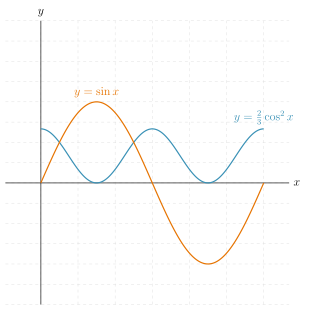
- Suppose \(g(x) = \exp \left ( -k \tan x \right)\) then \begin{align*} && g'(x) &= \exp \left ( -k \tan x \right) \cdot (-k \sec^2 x ) \\ && g''(x) &= \left ( -k \exp \left ( -k \tan x \right) \right) \left ( -k\sec^4 x + 2 \sec x \cdot \sec x \tan x\right) \\ &&&= -k \exp \left ( -k \tan x \right) \sec^4 x \left ( -k + 2\sin x \cos x \right) \\ &&&= -k \exp \left ( -k \tan x \right) \sec^4 x \left ( -k + \sin 2x \right) \\ \end{align*} If \(0 < \alpha < \frac{\pi}{4}\) then \(k > 0\) so \(g\) is convex if \(-k + \sin 2x < 0\), ie \(\sin 2x < \sin 2\alpha\), ie on \((0, \alpha)\) and \((\frac{\pi}{2} - \alpha, \frac{\pi}{2})\)
2008 Paper 1 Q6
The function \(\f\) is defined by \[ \f(x) = \frac{\e^x-1}{\e-1}, \ \ \ \ \ x\ge0, \] and the function \(\g\) is the inverse function to \(\f\), so that \(\g(\f(x))=x\). Sketch \(\f(x)\) and \(\g(x)\) on the same axes. Verify, by evaluating each integral, that \[ \int_0^\frac12 \f(x) \,\d x + \int_0^k \g(x) \,\d x = \frac1 {2(\sqrt \e +1)}\,, \] where \(\displaystyle k= \frac 1{\sqrt\e+1}\), and explain this result by means of a diagram.
2007 Paper 1 Q14
The discrete random variable \(X\) has a Poisson distribution with mean \(\lambda\).
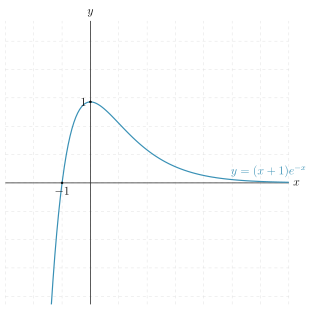
- Sketch the graph \(y=\l x+1 \r \e^{-x}\), stating the coordinates of the turning point and the points of intersection with the axes. It is known that \(\P(X \ge 2) = 1-p\), where \(p\) is a given number in the range \(0 < p <1\). Show that this information determines a unique value (which you should not attempt to find) of \(\lambda\).
- It is known (instead) that \(\P \l X = 1 \r = q\), where \(q\) is a given number in the range \(0 < q <1\). Show that this information determines a unique value of \(\lambda\) (which you should find) for exactly one value of \(q\) (which you should also find).
- It is known (instead) that \(\P \l X = 1 \, \vert \, X \le 2 \r = r\), where \(r\) is a given number in the range \(0 < r < 1\). Show that this information determines a unique value of \(\lambda\) (which you should find) for exactly one value of \(r\) (which you should also find).
Solution: Let \(X \sim Po(\lambda)\), then
- \(\,\)
Suppose \(\mathbb{P}(X \geq 2) = 1-p\) then \(\mathbb{P}(X=0) + \mathbb{P}(X=1) = p\), ie \(e^{-\lambda} +\lambda e^{-\lambda} = p\) If \(f(x) = (1+x)e^{-x}\) we have see it is strictly decreasing on \(x \geq 0\) and takes all values from \(1\) to \(0\), therefore we can find a unique value such that \(f(\lambda) = p\) which is our desired \(\lambda\).
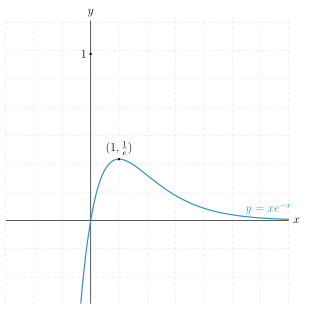
- Note that \(\mathbb{P}(X = 1) = \lambda e^{-\lambda}\)
Sketching \(y = xe^{-x}\) and finding it's turning point we can see that there is a unique value of \(\lambda = 1\) when \(q = \frac{1}{e}\), otherwise there is either no solution (\(p > \frac1{e}\)) or two solutions (\(0 < q > \frac1{e}\)).
- Suppose \(\mathbb{P}(X = 1 | X \leq 2) = r\), ie \begin{align*} && r &= \frac{\lambda e^{-\lambda}}{e^{-\lambda} + \lambda e^{-\lambda} + \frac12 \lambda^2 e^{-\lambda}} \\ &&&= \frac{2\lambda}{2+2\lambda+\lambda^2} \\ \Rightarrow && 0 &= r\lambda^2 + 2(r-1) \lambda + 2r\\ \Rightarrow && \Delta &= 4(r-1)^2 - 4\cdot r \cdot 2 r \\ &&&= 4((r-1)^2-2r^2) \\ &&&= 4(r-1-\sqrt{2}r)(r-1+\sqrt{2}r) \\ &&&= -4((\sqrt{2}-1)r + 1)((1+\sqrt{2})r-1) \end{align*} Therefore our quadratic in \(r\) has a unique solution if \(r = \frac{1}{1+\sqrt{2}}\). If it has a positive solution then note since \(2r > 0\) both solutions are positive, so \(\lambda\) is not unique by excluding other solutions.
2006 Paper 1 Q5
- Use the substitution \(u^2=2x+1\) to show that, for \(x>4\), \[ \int \frac{3} { ( x-4 ) \sqrt {2x+1}} \; \d x = \ln \l \frac{\sqrt{2x+1}-3} {\sqrt{2x+1}+3} \r + K\,, \] where \(K\) is a constant.
- Show that $ \displaystyle \int_{\ln 3}^{\ln 8} \frac{2} { \e^x \sqrt{ \e^x + 1}}\; \mathrm{d}x\, = \frac 7{12} + \ln \frac23 $ .
Solution:
- \begin{align*} && I &= \int \frac{3}{(x-4)\sqrt{2x+1}}\, \d x \\ u^2 =2x+1, 2u \frac{\d u}{\d x}=2: && &= \int \frac{3}{\left(\frac{u^2-1}{2}-4\right)u} u \d u \\ &&&= \int \frac{6}{u^2-9} \d u \\ &&&= \int \frac{6}{(u-3)(u+3)} \d u\\ &&&= \int \left ( \frac{1}{u-3} - \frac{1}{u+3} \right )\d u \\ &&&= \ln (u-3) - \ln (u+3) + C \\ &&&= \ln \frac{u-3}{u+3} + C \\ &&&= \ln \left (\frac{\sqrt{2x+1}-3}{\sqrt{2x+1}+3} \right) + C \end{align*}
- \begin{align*} && I &= \int_{\ln 3}^{\ln 8} \frac{2}{e^x\sqrt{e^x+1}} \d x \\ u = e^x, \frac{\d u}{\d x} = e^x: &&&= \int_{u=3}^{u=8} \frac{2}{u\sqrt{u+1}} \frac{1}{u} \d u \\ v^2=u+1, 2v \frac{\d v}{\d u} = 1: &&&= \int_{v=2}^{v=3} \frac{2}{v(v^2-1)^2} \d v \\ &&&= \int_2^3 \left ( \frac{2}{v} - \frac{}{v-1} - \frac{1}{2(v-1)^2} - \frac{1}{v+1} - \frac{1}{2(v+1)^2}\right) \d v \\ &&&= \left [2\ln v - \ln(v^2-1)+\frac12(v-1)^{-1}+\frac12(v+1)^{-1} \right]_2^3 \\ &&&= \left ( 2\ln3-\ln 8+\frac14+\frac18\right)-\left ( 2\ln2-\ln 3+\frac12+\frac16\right) \\ &&&= \end{align*}
2006 Paper 3 Q4
The function \(f\) satisfies the identity \begin{equation} f(x) +f(y) \equiv f(x+y) \tag{\(*\)} \end{equation} for all \(x\) and \(y\). Show that \(2\f(x)\equiv \f(2x)\) and deduce that \(f''(0)=0\). By considering the Maclaurin series for \(\f(x)\), find the most general function that satisfies \((*)\). [{\it Do not consider issues of existence or convergence of Maclaurin series in this question.}]
- By considering the function \(\G\), defined by \(\ln\big(\g(x)\big) =\G(x)\), find the most general function that, for all \(x\) and \(y\), satisfies the identity \[ \g(x) \g(y) \equiv \g(x+y)\,. \]
- By considering the function \(H\), defined by \(\h(\e^u) =H(u)\), find the most general function that satisfies, for all positive \(x\) and \(y\), the identity \[ \h(x) +\h(y) \equiv \h(xy) \,. \]
- Find the most general function \(t\) that, for all \(x\) and \(y\), satisfies the identity \begin{equation*} t(x) + t(y) \equiv t(z)\,, \end{equation*} where \(z= \dfrac{x+y}{1-xy}\,\).
Solution: \begin{align*} &&2f(x) &\equiv f(x) + f(x) \\ &&&\equiv f(x+x) \\ &&&\equiv f(2x) \\ \\ \Rightarrow && 2f(0) &= f(0) \\ \Rightarrow && f(0) &= 0 \\ && f''(0) &= \lim_{h \to 0} \frac{f(2h)-2f(0)+f(-2h)}{h^2} \\ &&&= \lim_{h \to 0} \frac{f(2h)+f(-2h)}{h^2} \\ &&&= \lim_{h \to 0} \frac{f(0)}{h^2} \\ &&&= 0 \\ \Rightarrow && f''(0) &= 0 \end{align*} If \(f(x)\) satisfies the equation, then \(f'(x)\) satisfies the equation. In particular this means that \(f^{(n)}(0) = 0\) for all \(n \geq 2\). Therefore the only non-zero term in the Maclaurin series is \(x^1\). Therefore \(f(x) = cx\)
- Suppose \(g(x)g(y) \equiv g(x+y)\), then if \(G(x) = \ln g(x)\) we must have \(G(x)+G(y) \equiv G(x+y)\), ie \(G(x) = cx \Rightarrow g(x) = e^{cx}\)
- Suppose \(h(x)+h(y) \equiv h(xy)\), then if \(h(e^u) = H(u)\) we must have that \(H(u)+H(v) \equiv h(e^u) + h(e^v) \equiv h(e^{u+v}) \equiv H(u+v)\).Therefore \(H(u) = cu\), ie \(h(e^u) = cu\) or \(h(x) = h(e^{\ln x}) = c \ln x\).
- Finally if \(t(x) + t(y) \equiv t(z)\), the considering \(T(w) = t(\tan w)\) then \(T(x) + T(y) \equiv t(\tan x) + t(\tan y) \equiv t( \frac{\tan x + \tan y}{1- \tan x \tan y}) \equiv t (\tan (x+y)) \equiv T(x+y)\). Therefore \(T(x) = cx\) Therefore \(t(\tan w) = c w \Rightarrow t(x) = c \tan^{-1} x\)
2005 Paper 2 Q1
Find the three values of \(x\) for which the derivative of \(x^2 \e^{-x^2}\) is zero. Given that \(a\) and \(b\) are distinct positive numbers, find a polynomial \(\P(x)\) such that the derivative of \(\P(x)\e^{-x^2}\) is zero for \(x=0\), \(x=\pm a\) and \(x=\pm b\,\), but for no other values of \(x\).
Solution: \begin{align*} && y &= x^2e^{-x^2} \\ \Rightarrow && y' &= 2xe^{-x^2} +x^2 \cdot (-2x)e^{-x^2} \\ &&&= e^{-x^2}(2x-2x^3) \\ &&&= 2e^{-x^2}x(1-x^2) \end{align*} Therefore the derivative is zero iff \(x = 0, \pm 1\) \begin{align*} && y &= \P(x) e^{-x^2} \\ \Rightarrow && y' &= e^{-x^2} (\P'(x)-2x\P(x)) \end{align*} Therefore we want \(\P'(x) - 2x\P(x) = Kx(x^2-a^2)(x^2-b^2)\) Since this has degree \(5\), we should look at polynomials degree \(4\) for \(\P\). We can also immediately see that \(0\) is a root of \(\P'(x)\), so \(\P(x) = a_4x^4+a_3x^3+a_2x^2+a_0\). WLOG \(a_4 = 1\) and \(K = -2\), so \begin{align*} && -2(x^5-(a^2+b^2)x^3+a^2b^2x) &= 4x^3+3a_3x^2+2a_2x- 2x(x^4+a_3x^3+a_2x^2+a_0) \\ &&&= -2x^5-2a_3 x^4+(4-2a_2)x^3+(2a_2-2a_0)x \\ \Rightarrow && a_3 &= 0 \\ && a^2+b^2 &= 2-a_2 \\ \Rightarrow && a_2 &= 2-a^2-b^2 \\ && a^2b^2 &= a_0-a_2 \\ \Rightarrow && a_0 &= a^2b^2 + 2-a^2-b^2 \\ \Rightarrow && \P(x) &= x^4+(2-a^2-b^2)x^2+(a^2-1)(b^2-1)x \end{align*}
2004 Paper 2 Q12
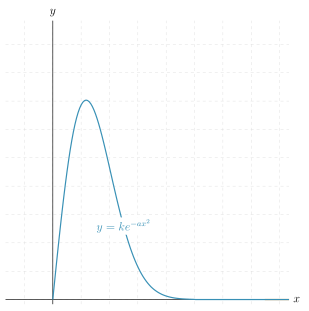
Sketch the graph, for \(x \ge 0\,\), of $$ y = kx\e^{-ax^2} \;, $$ where \(a\) and \(k\) are positive constants. The random variable \(X\) has probability density function \(\f(x)\) given by \begin{equation*} \f(x)= \begin{cases} kx\e^{-ax^2} & \text{for \(0 \le x \le 1\)}\\[3pt] 0 & \text{otherwise}. \end{cases} \end{equation*} Show that \(\displaystyle k=\frac{2a}{1-\e^{-a}}\) and find the mode \(m\) in terms of \(a\,\), distinguishing between the cases \(a < \frac12\) and \(a > \frac12\,\). Find the median \(h\) in terms of \(a\), and show that \(h > m\) if \(a > -\ln\left(2\e^{-1/2} - 1\right).\) Show that, \(-\ln\left(2\e^{-1/2}-1\right)> \frac12 \,\). Show also that, if \(a > -\ln\left(2\e^{-1/2} - 1\right) \,\), then $$ P(X > m \;\vert\; X < h) = {{2\e^{-1/2}-\e^{-a}-1} \over 1-\e^{-a}}\;. $$
Solution:
2003 Paper 2 Q8
It is given that \(y\) satisfies $$ {{\d y} \over { \d t}} + k\left({{t^2-3t+2} \over {t+1}}\right)y = 0\;, $$ where \(k\) is a constant, and \(y=A \) when \(t=0\,\), where \(A\) is a positive constant. Find \(y\) in terms of \(t\,\), \(k\) and \(A\,\). Show that \(y\) has two stationary values whose ratio is \((3/2)^{6k}\e^{-5{k}/2}.\) Describe the behaviour of \(y\) as \(t \to +\infty\) for the case where \(k> 0\) and for the case where \(k<0\,.\) In separate diagrams, sketch the graph of \(y\) for \(t>0\) for each of these cases.
Solution: \begin{align*} && \frac{\d y}{\d t} &= - k \left (\frac{t^2-3t+2}{t+1} \right) y \\ \Rightarrow && \int \frac1y \d y &= -k\int \left (t-4 + \frac{6}{t+1}\right) \d t \\ \Rightarrow && \ln y &= -k \left ( \frac12 t^2 -4t + 6\ln (t+1) \right) + C \\ (t,y) = (0,A): && \ln A &=C \\ \Rightarrow && \ln y &= -k \left ( \frac12 t^2 -4t + 6\ln (t+1) \right) + \ln A \\ && \ln \left ( \frac{y}{A}(t+1)^{6k} \right) &= -k \l \frac12 t^2 - 4t \r \\ \Rightarrow && y &= A\frac{\exp \l -k(\frac12 t^2-4t)\r}{(t+1)^{6k}} \end{align*} \(y\) wil have stationary values when \(\frac{\d y}{\d t} = 0\), ie \begin{align*} k \left (\frac{t^2-3t+2}{t+1} \right) y &= 0 \\ k \left ( \frac{(t-2)(t-1)}{t+1} \right) y &= 0 \end{align*} ie when \(y = 0, t = 1, t =2\). Clearly \(y = 0\) is not a solution, so \(y\) has the values: \begin{align*} t = 1: && y &= A\frac{\exp \l -k(\frac12 -4)\r}{(2)^{6k}} \\ &&&= A \frac{e^{7/2 k}}{2^{6k}} \\ t = 2: && y &= A\frac{\exp \l -k(2 -8)\r}{(3)^{6k}} \\ &&&= A \frac{e^{6 k}}{3^{6k}} \\ \text{ratio}: && \frac{e^{7/2k}}{2^{6k}} \cdot \frac{3^{6k}}{e^{6k}} &= (3/2)^{6k} e^{-5k/2} \end{align*} If \(k > 0\) as \(t \to \infty\) \(y \to 0\) since the \(e^{-kt^2/2}\) term dominates everything. If \(k < 0\) as \(t \to \infty\) \(y \to \infty\) as since the \(e^{-kt^2}\) term also dominates but now it growing to infinity faster than everything else.

2002 Paper 2 Q8
Find \(y\) in terms of \(x\), given that: \begin{eqnarray*} \mbox{for \(x < 0\,\)}, && \frac{\d y}{\d x} = -y \mbox{ \ \ and \ \ } y = a \mbox{ when } x = -1\;; \\ \mbox{for \(x > 0\,\)}, && \frac{\d y}{\d x} = y \mbox{ \ \ \ \ and \ \ } y = b \ \mbox{ when } x = 1\;. \end{eqnarray*} Sketch a solution curve. Determine the condition on \(a\) and \(b\) for the solution curve to be continuous (that is, for there to be no `jump' in the value of \(y\)) at \(x = 0\). Solve the differential equation \[ \frac{\d y}{\d x} = \left\vert \e^x-1\right\vert y \] given that \(y=\e^{\e}\) when \(x=1\) and that \(y\) is continuous at \(x=0\,\). Write down the following limits: \ \[ \text{(i)} \ \ \lim_ {x \to +\infty} y\exp(-\e^x)\;; \ \ \ \ \ \ \ \ \ \text{(ii)} \ \ \lim_{x \to -\infty}y \e^{-x}\,. \]
2001 Paper 2 Q5
The curve \(C_1\) passes through the origin in the \(x\)--\(y\) plane and its gradient is given by $$ \frac{\d y}{\d x} =x(1-x^2)\e^{-x^2}. $$ Show that \(C_1\) has a minimum point at the origin and a maximum point at \(\left(1,{\frac12\, \e^{-1}} \right)\). Find the coordinates of the other stationary point. Give a rough sketch of \(C_1\). The curve \(C_2\) passes through the origin and its gradient is given by $$ \frac{\d y}{\d x}= x(1-x^2)\e^{-x^3}. $$ Show that \(C_2\) has a minimum point at the origin and a maximum point at \((1,k)\), where \phantom{} \(k > \frac12 \,\e^{-1}.\) (You need not find \(k\).)
2000 Paper 2 Q8
- Let \(y\) be the solution of the differential equation \[ \frac{\d y}{\d x} + 4x\e^{-x^2} {(y+3)}^{\frac12} = 0 \qquad (x \ge 0), \] that satisfies the condition \(y=6\) when \(x=0\). Find \(y\) in terms of \(x\) and show that \(y\to1\) as \(x \to \infty\).
- Let \(y\) be any solution of the differential equation \[ \frac{\d y}{\d x} -x\e^{6 x^2} (y+3)^{1-k} = 0 \qquad (x \ge 0). \] %that satisfies the condition \(y=6\) %when \(x=0\). Find a value of \(k\) such that, as \(x \to \infty\), \(\e^{-3x^2}y\) tends to a finite non-zero limit, which you should determine.
2000 Paper 3 Q7
Given that $$\e = 1 + {1 \over 1 !} + {1 \over 2 !} + {1 \over 3 !} + \cdots + {1 \over r !} + \cdots \; ,$$ use the binomial theorem to show that $$ {\left( 1 + {1 \over n} \right)}^{\!n} < \e $$ for any positive integer \(n\). The product \({\rm P }( n )\) is defined, for any positive integer \(n\), by $$ {\rm P} ( n ) = {3 \over 2} \cdot {5 \over 4} \cdot {9 \over 8} \cdot \ldots \cdot {2^n + 1 \over 2^n} . $$ Use the arithmetic-geometric mean inequality, $$ {a_1 + a_2 + \cdots + a_n \over n} \ge \ {\left( a_1 \cdot a_2 \cdot \ldots \cdot a_n \right)}^{1 \over n}\,, $$ to show that \({\rm P }( n ) < \e\) for all \(n\) . Explain briefly why \({\rm P} ( n )\) tends to a limit as \(n\to\infty\). Show that this limit, \(L\), satisfies \(2 < L\le\e\).
1999 Paper 2 Q3
Let $$ {\rm S}_n(x)=\mathrm{e}^{x^3}{{\d^n}\over{\d x^n}}{(\mathrm{e}^{-x^3})}.$$ Show that \({\rm S}_2(x)=9x^4-6x\) and find \({\rm S}_3(x)\). Prove by induction on \(n\) that \({\rm S}_n(x)\) is a polynomial. By means of your induction argument, determine the order of this polynomial and the coefficient of the highest power of \(x\). Show also that if \(\displaystyle \frac{\d S_n}{\d x}=0\) for some value \(a\) of \(x\), then \(S_n(a)S_{n+1}(a)\le0\).
Solution: \begin{align*} && S_2(x) &= e^{x^3} \frac{d^2}{\d x^2} \left [e^{-x^3} \right] \\ &&&= e^{x^3} \frac{d}{\d x} \left [e^{-x^3}(-3x^2) \right] \\ &&&= e^{x^3} \left [e^{-x^3}(9x^4-6x) \right] \\ &&&=9x^4-6x \\ \\ && S_3(x) &= e^{x^3} \frac{\d^3}{\d x^3} \left [ e^{-x^3} \right]\\ &&&= e^{x^3} \frac{\d}{\d x} \left [ e^{-x^3}(9x^4-6x) \right ] \\ &&&= e^{x^3} e^{-x^3}\left [ (-3x^2)(9x^4-6x)+(36x^3-6) \right ] \\ &&&= -27x^6 +54x^3-6 \end{align*} Claim: \(S_n\) is a polynomial of degree \(2n\) with leading coefficient \((-3)^n\). Proof: Clearly this is true for \(n = 1, 2, 3\) by demonstration. Suppose it is true for some \(n = k\), then \begin{align*} && S_k(x) &= e^{x^2} \frac{\d^k}{\d x^k} \left [ e^{x^3}\right] \\ && (-3)^kx^{2k} +\cdots &= e^{x^3} \frac{\d^k}{\d x^k} \left [ e^{x^3}\right] \\ \Rightarrow && \frac{\d^k}{\d x^k} \left [ e^{x^3}\right] &= e^{-x^3} \left ( (-3)^kx^{2k} +\cdots\right) \\ \Rightarrow && \frac{\d^k}{\d x^k}\left [ e^{x^3}\right] &= e^{-x^3} (-3x^2)\left ( (-3)^kx^{2k} +\cdots\right) + e^{-x^3} S_k'(x) \\ &&&= e^{-x^3} \left (\underbrace{ (-3)^{k+1}x^{2k+2} + \cdots + S_k'(x)}_{\deg =2k+2}\right) \\ \Rightarrow && S_{k+1}(x) &= (-3)^{k+1}x^{2k+2} + \cdots + S_k'(x) \end{align*} And therefore \(S_{k+1}\) is a polynomial degree \(2(k+1)\) with leading coefficient \((-3)^{k+1}\) so by induction it's true for all \(n\). If \(S'_n(a) = 0\) then \(S_{n+1}(a) = (-3a^2)S_n(a) + S_n'(a) \Rightarrow S_{n+1}(a)S_n(a) = -3 (aS_n(a))^2 \leq 0\)