Problems
Filters
46 problems found
2010 Paper 1 Q3
Show that \[ \sin(x+y) -\sin(x-y) = 2 \cos x \, \sin y \] and deduce that \[ \sin A - \sin B = 2 \cos \tfrac12 (A+B) \, \sin\tfrac12 (A-B) \,. \] Show also that \[ \cos A - \cos B = -2 \sin \tfrac12(A+B) \, \sin\tfrac12(A-B)\,. \] The points \(P\), \(Q\), \(R\) and \(S\) have coordinates \(\left(a\cos p,b\sin p\right)\), \(\left(a\cos q,b\sin q\right)\), \(\left(a\cos r,b\sin r\right)\) and \(\left(a\cos s,b\sin s\right)\) respectively, where \(0\le p < q < r < s <2\pi\), and \(a\) and \(b\) are positive. Given that neither of the lines \(PQ\) and \(SR\) is vertical, show that these lines are parallel if and only if \[ r+s-p-q = 2\pi\,. \]
Solution: \begin{align*} && \sin(x+y) - \sin(x-y) &= \sin x \cos y + \cos x \sin y - (\sin x \cos y - \cos x \sin y )\\ &&&= 2 \cos x \sin y \\ \\ && A &= x+y \\ && B &= x - y \\ \Rightarrow && x = \frac12(A+B) &\quad y = \frac12(A-B) \\ \Rightarrow && \sin A - \sin B &= 2 \cos \tfrac12(A+B) \sin \tfrac12(A-B) \\ \\ && \cos (x+y) - \cos (x-y) &= \cos x \cos y - \sin x \sin y -(\cos x \cos y + \sin x \sin y ) \\ &&&= -2 \sin x \sin y \\ \Rightarrow && \cos A - \cos B &= - 2 \sin \tfrac12 (A+B) \sin \tfrac12 (A-B) \end{align*} \begin{align*} && \text{Gradient of }PQ &= \frac{b \sin q - b \sin p}{a \cos q - a \cos p } \\ && \text{Gradient of }SR &= \frac{b \sin s - b \sin r}{a \cos s - a \cos r} \\ PQ \parallel SR \Rightarrow && \frac{b \sin q - b \sin p}{a \cos q - a \cos p } &= \frac{b \sin s - b \sin r}{a \cos s - a \cos r} \\ \Rightarrow && (\sin q - \sin p)(\cos s - \cos r) &= (\sin s - \sin r)(\cos q - \cos r) \\ \Rightarrow && -4 \cos \tfrac12(p+q) \sin\tfrac12(q-p) \sin \tfrac12(s+r) \sin \tfrac12(s-r) &= -4 \cos \tfrac12(s+r) \sin \tfrac12(s-r) \sin \tfrac12 (p+q) \sin\tfrac12 (q-p) \\ \Rightarrow && 0 &= \sin \tfrac12(s-r)\sin\tfrac12(p-q) \left ( \cos \tfrac12(p+q)\sin \tfrac12(s+r) - \sin \tfrac12 (p+q)\cos \tfrac12(s+r) \right) \\ &&&= \sin \tfrac12(s-r)\sin\tfrac12(p-q) \sin \left ( \frac12 (s+r -(p+q))\right) \end{align*} Since \(s \neq r\) and \(p \neq q\) (neither line vertical) we must have \(\frac12 (s+r -(p+q)) = n \pi \Rightarrow s+r - p - q = 0, 2\pi, 4\pi, \cdots\) but given the range constraints it must be \(2 \pi\)
2010 Paper 3 Q5
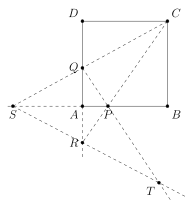
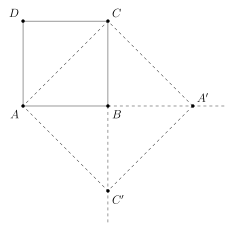
The vertices \(A\), \(B\), \(C\) and \(D\) of a square have coordinates \((0,0)\), \((a,0)\), \((a,a)\) and \((0,a)\), respectively. The points \(P\) and \(Q\) have coordinates \((an,0)\) and \((0,am)\) respectively, where \(0 < m < n < 1\). The line \(CP\) produced meets \(DA\) produced at \(R\) and the line \(CQ\) produced meets \(BA\) produced at \(S\). The line \(PQ\) produced meets the line \(RS\) produced at \(T\). Show that \(TA\) is perpendicular to \(AC\). Explain how, given a square of area \(a^2\), a square of area \(2a^2\) may be constructed using only a straight-edge. [Note: a straight-edge is a ruler with no markings on it; no measurements (and no use of compasses) are allowed in the construction.]
Solution:
2010 Paper 3 Q6
The points \(P\), \(Q\) and \(R\) lie on a sphere of unit radius centred at the origin, \(O\), which is fixed. Initially, \(P\) is at \(P_0(1, 0, 0)\), \(Q\) is at \(Q_0(0, 1, 0)\) and \(R\) is at \(R_0(0, 0, 1)\).
- The sphere is then rotated about the \(z\)-axis, so that the line \(OP\) turns directly towards the positive \(y\)-axis through an angle \(\phi\). The position of \(P\) after this rotation is denoted by \(P_1\). Write down the coordinates of \(P_1\).
- The sphere is now rotated about the line in the \(x\)-\(y\) plane perpendicular to \(OP_1\), so that the line \(OP\) turns directly towards the positive \(z\)-axis through an angle \(\lambda\). The position of \(P\) after this rotation is denoted by \(P_2\). Find the coordinates of \(P_2\). Find also the coordinates of the points \(Q_2\) and \(R_2\), which are the positions of \(Q\) and \(R\) after the two rotations.
- The sphere is now rotated for a third time, so that \(P\) returns from \(P_2\) to its original position~\(P_0\). During the rotation, \(P\) remains in the plane containing \(P_0\), \(P_2\) and \(O\). Show that the angle of this rotation, \(\theta\), satisfies \[ \cos\theta = \cos\phi \cos\lambda\,, \] and find a vector in the direction of the axis about which this rotation takes place.
2009 Paper 1 Q8
- The equation of the circle \(C\) is \[ (x-2t)^2 +(y-t)^2 =t^2, \] where \(t\) is a positive number. Show that \(C\) touches the line \(y=0\,\). Let \(\alpha\) be the acute angle between the \(x\)-axis and the line joining the origin to the centre of \(C\). Show that \(\tan2\alpha=\frac43\) and deduce that \(C\) touches the line \(3y=4x\,\).
- Find the equation of the incircle of the triangle formed by the lines \(y=0\), \(3y=4x\) and \(4y+3x=15\,\). Note: The incircle of a triangle is the circle, lying totally inside the triangle, that touches all three sides.
Solution:
- This is a circle centre \((2t,t)\) with radius \(t\). Therefore it is exactly \(t\) away from the line \(y = 0\) so just touches that line. Not that \(\tan \alpha = \frac{t}{2t} = \frac12\) so \(\tan 2\alpha = \frac{2\tan \alpha}{1-\tan^2\alpha} = \frac{1}{1-\frac14} = \frac43\). Therefore the line \(y = \frac43x\) or \(3y = 4x\) is tangent to \(C\).
- Note that \(3y=4x\) and \(4y+3x=15\) are perpendicular, so this is a right-angled triangle with incenter \((2t,t)\) for some \(t\) and hypotenuse \(15\) We can find the third coordinate when \(3y-4x = 0\) and \(4y+3x = 15\) meet, ie \((\frac{9}{5}, \frac{12}5)\) The incentre lies on the bisector of the right angle at this point, which is the line through \((\frac{9}{5}, \frac{12}5)\) and \((\frac{15}{2}, 0)\), so \begin{align*} && \frac{2t-\frac{12}{5}}{t - \frac{9}{5}} &= \frac{-\frac{12}{5}}{\frac{15}2-\frac95} \\ \Rightarrow && \frac{10t-12}{5t-9} &= \frac{-24}{57} = -\frac{8}{19} \\ \Rightarrow && 190t - 12 \cdot 19 &= -40t + 72 \\ \Rightarrow && t &= 2 \end{align*} Therefore the center is \((4, 2)\) and the equation is \((x-4)^2+(y-2)^2=2^2\)
2009 Paper 2 Q1
Two curves have equations \(\; x^4+y^4=u\;\) and \(\; xy = v\;\), where \(u\) and \(v\) are positive constants. State the equations of the lines of symmetry of each curve. The curves intersect at the distinct points \(A\), \(B\), \(C\) and \(D\) (taken anticlockwise from \(A\)). The coordinates of \(A\) are \((\alpha,\beta)\), where \(\alpha > \beta > 0\). Write down, in terms of \(\alpha\) and \(\beta\), the coordinates of \(B\), \(C\) and \(D\). Show that the quadrilateral \(ABCD\) is a rectangle and find its area in terms of \(u\) and \(v\) only. Verify that, for the case \(u=81\) and \(v=4\), the area is \(14\).
Solution: The curve \(x^4 + y^4 = u\) has lines of symmetry:
- \(y = 0\)
- \(x = 0\)
- \(y = x\)
- \(y = -x\)
- \(y = x\)
- \(y = -x\)

2009 Paper 3 Q1
The points \(S\), \(T\), \(U\) and \(V\) have coordinates \((s,ms)\), \((t,mt)\), \((u,nu)\) and \((v,nv)\), respectively. The lines \(SV\) and \(UT\) meet the line \(y=0\) at the points with coordinates \((p,0)\) and \((q,0)\), respectively. Show that \[ p = \frac{(m-n)sv}{ms-nv}\,, \] and write down a similar expression for \(q\). Given that \(S\) and \(T\) lie on the circle \(x^2 + (y-c)^2 = r^2\), find a quadratic equation satisfied by \(s\) and by \(t\), and hence determine \(st\) and \(s+t\) in terms of \(m\), \(c\) and \(r\). Given that \(S\), \(T\), \(U\) and \(V\) lie on the above circle, show that \(p+q=0\).
2008 Paper 1 Q7
The point \(P\) has coordinates \((x,y)\) with respect to the origin \(O\). By writing \(x=r\cos\theta\) and \(y=r\sin\theta\), or otherwise, show that, if the line \(OP\) is rotated by \(60^\circ\) clockwise about \(O\), the new \(y\)-coordinate of \(P\) is \(\frac12(y-\sqrt3\,x)\). What is the new \(y\)-coordinate in the case of an anti-clockwise rotation by \(60^\circ\,\)? An equilateral triangle \(OBC\) has vertices at \(O\), \((1,0)\) and \((\frac12,\frac12 \sqrt3)\), respectively. The point \(P\) has coordinates \((x,y)\). The perpendicular distance from \(P\) to the line through \(C\) and \(O\) is \(h_1\); the perpendicular distance from \(P\) to the line through \(O\) and \(B\) is \(h_2\); and the perpendicular distance from \(P\) to the line through \(B\) and \(C\) is \(h_3\). Show that \(h_1=\frac12 \big\vert y-\sqrt3\,x\big\vert\) and find expressions for \(h_2\) and \(h_3\). Show that \(h_1+h_2+h_3=\frac12 \sqrt3\) if and only if \(P\) lies on or in the triangle \(OBC\).
2006 Paper 1 Q8
{\it Note that the volume of a tetrahedron is equal to \(\frac1 3\) \(\times\) the area of the base \(\times\) the height.} The points \(O\), \(A\), \(B\) and \(C\) have coordinates \((0,0,0)\), \((a,0,0)\), \((0,b,0)\) and \((0,0,c)\), respectively, where \(a\), \(b\) and \(c\) are positive.
- Find, in terms of \(a\), \(b\) and \(c\), the volume of the tetrahedron \(OABC\).
- Let angle \(ACB = \theta\). Show that \[ \cos\theta = \frac {c^2} { { \sqrt{\vphantom{ \dot b} (a^2+c^2)(b^2+c^2)} } ^{\vphantom A} \ } \] and find, in terms of \(a\), \(b\) and \(c\), the area of triangle \(ABC\). % is %\(\displaystyle \tfrac12 \sqrt{ \vphantom{\dot A } a^2b^2 +b^2c^2 + c^2 a^2 \;} \;\).
2005 Paper 1 Q6
- The point \(A\) has coordinates \(\l 5 \, , 16 \r\) and the point \(B\) has coordinates \(\l -4 \, , 4 \r\). The variable point \(P\) has coordinates \(\l x \, , y \r\,\) and moves on a path such that \(AP=2BP\). Show that the Cartesian equation of the path of \(P\) is \[ \displaystyle \l x+7 \r^2 + y^2 =100 \;. \]
- The point \(C\) has coordinates \(\l a \, , 0 \r\) and the point \(D\) has coordinates \(\l b \, , 0 \r\), where \(a\ne b\). The variable point \(Q\) moves on a path such that \[ QC = k \times QD\;, \] where \(k>1\,\). Given that the path of \(Q\) is the same as the path of \(P\), show that \[ \frac{a+7}{b+7}=\frac{a^2+51}{b^2+51}\;. \] Show further that \((a+7)(b+7)=100\,\).
Solution:
- Since \(AP = 2BP\) we also have \(|AP|^2 = 4|BP|^2\) ie \begin{align*} && (x-5)^2 + (y-16)^2 &= 4(x+4)^2 + 4(y-4)^2 \\ \Rightarrow && x^2 - 10x+25 + y^2 -32y + 256 &= 4x^2+32x+64+4y^2-32y+64 \\ \Rightarrow && 281 &= 3x^2+42x+3y^2+128\\ && 281 &= 3(x+7)^2-147+3y^2+128 \\ \Rightarrow && 300 &= 3(x+7)^2 + 3y^2 \\ && 100 &= (x+7)^2 + y^2 \end{align*}
- Since \(|QC|^2 = k^2 |QD|^2\), \begin{align*} && (x-a)^2 + y^2 &= k^2 (x-b)^2 + k^2y^2 \\ \Rightarrow && x^2-2ax+a^2 &= k^2x^2-2k^2bx+k^2b^2 + (k^2-1)y^2 \\ && a^2-k^2b^2 &= (k^2-1)x^2-2(k^2b-a)x + (k^2-1)y^2 \\ && a^2-k^2b^2&= (k^2-1)\left(x-\frac{k^2b-a}{k^2-1}\right)^2-(k^2-1)\left(\frac{k^2b-a}{k^2-1}\right)^2+(k^2-1)y^2 \\ && \frac{a^2-k^2b^2}{k^2-1}+\left(\frac{k^2b-a}{k^2-1}\right)^2&= \left(x-\frac{k^2b-a}{k^2-1}\right)^2+y^2 \\ \Rightarrow && -7 &= \frac{k^2b-a}{k^2-1} \tag{*} \\ && 100 &= \frac{a^2-k^2b^2}{k^2-1}+\left(\frac{k^2b-a}{k^2-1}\right)^2 \\ &&&= \frac{a^2-k^2b^2}{k^2-1}+7^2 \\ \Rightarrow && 51 &= \frac{a^2-k^2b^2}{k^2-1} \tag{**} \\ (*) \Rightarrow && k^2(b+7)&= a+7 \\ (**) \Rightarrow && k^2(51+b^2)&= a^2+51 \\ \Rightarrow && \frac{a^2+51}{b^2+51} &= \frac{a+7}{b+7} \\ \\ \Rightarrow && a^2b+51b+7a^2 &= ab^2+51a+7b^2 \\ && 0 &= ab(b-a)-51(b-a)+7(b-a)(b+a) \\ &&&= (b-a)(ab+7(b+a)-51) \\ &&&= (b-a)((a+7)(b+7)-100) \\ \Rightarrow && 100 &= (a+7)(b+7) \end{align*} Since \(a \neq b\)
2005 Paper 2 Q5
The angle \(A\) of triangle \(ABC\) is a right angle and the sides \(BC\), \(CA\) and \(AB\) are of lengths \(a\), \(b\) and \(c\), respectively. Each side of the triangle is tangent to the circle \(S_1\) which is of radius \(r\). Show that \(2r = b+c-a\). Each vertex of the triangle lies on the circle~\(S_2\). The ratio of the area of the region between~\(S_1\) and the triangle to the area of \(S_2\) is denoted by \(R\,\). Show that $$ \pi R = -(\pi-1)q^2 + 2\pi q -(\pi+1) \;, $$ where \(q=\dfrac{b+c}a\,\). Deduce that $$ R\le \frac1 {\pi( \pi - 1)} \;. $$
2004 Paper 1 Q6
The three points \(A\), \(B\) and \(C\) have coordinates \(\l p_1 \, , \; q_1 \r\), \(\l p_2 \, , \; q_2 \r\) and \(\l p_3 \, , \; q_3 \r\,\), respectively. Find the point of intersection of the line joining \(A\) to the midpoint of \(BC\), and the line joining~\(B\) to the midpoint of \(AC\). Verify that this point lies on the line joining \(C\) to the midpoint of~\(AB\). The point \(H\) has coordinates \(\l p_1 + p_2 + p_3 \, , \; q_1 + q_2 + q_3 \r\,\). Show that if the line \(AH\) intersects the line \(BC\) at right angles, then \(p_2^2 + q_2^2 = p_3^2 + q_3^2\,\), and write down a similar result if the line \(BH\) intersects the line \(AC\) at right angles. Deduce that if \(AH\) is perpendicular to \(BC\) and also \(BH\) is perpendicular to \(AC\), then \(CH\) is perpendicular to \(AB\).
2003 Paper 2 Q4
The line \(y=d\,\), where \(d>0\,\), intersects the circle \(x^2+y^2=R^2\) at \(G\) and \(H\). Show that the area of the minor segment \(GH\) is equal to \begin{equation} R^2\arccos \left({d \over R}\right) -d\sqrt{R^2 - d^2}\;. \tag {\(*\)} \end{equation} In the following cases, the given line intersects the given circle. Determine how, in each case, the expression \((*)\) should be modified to give the area of the minor segment.
- Line: \(y=c\,\); \ \ \ circle: \((x-a)^2+(y-b)^2=R^2\,\).
- Line: \(y=mx+c\, \); \ \ \ circle: \(x^2+y^2=R^2\,\).
- Line: \(y=mx+c\,\); \ \ \ circle: \((x-a)^2+(y-b)^2=R^2\,\).
2003 Paper 3 Q7
In the \(x\)--\(y\) plane, the point \(A\) has coordinates \((a\,,0)\) and the point \(B\) has coordinates \((0\,,b)\,\), where \(a\) and \(b\) are positive. The point \(P\,\), which is distinct from \(A\) and \(B\), has coordinates~\((s,t)\,\). \(X\) and \(Y\) are the feet of the perpendiculars from \(P\) to the \(x\)--axis and \(y\)--axis respectively, and \(N\) is the foot of the perpendicular from \(P\) to the line \(AB\,\). Show that the coordinates \((x\,,y)\) of \(N\) are given by \[ x= \frac {ab^2 -a(bt-as)}{a^2+b^2} \;, \ \ \ y = \frac{a^2b +b(bt-as)}{a^2+b^2} \;. \] Show that, if $\ds \ \left( \frac{t-b} s\right)\left( \frac t {s-a}\right) = -1\;\(, then \)N$ lies on the line \(XY\,\). Give a geometrical interpretation of this result.
2002 Paper 1 Q1
Show that the equation of any circle passing through the points of intersection of the ellipse \((x+2)^2 +2y^2 =18\) and the ellipse \(9(x-1)^2 +16y^2 = 25\) can be written in the form \[ x^2-2ax +y^2 =5-4a\;. \]
Solution: \begin{align*} && (x+2)^2 +2y^2 &=18 \\ && 9(x-1)^2 +16y^2 &= 25 \\ \Rightarrow && 2y^2 &= 18 - (x+2)^2 \\ && 16y^2 &= 25 - 9(x-1)^2 \\ \Rightarrow && 25-9(x-1)^2 &= 8 \cdot 18 - 8(x+2)^2 \\ \Rightarrow && 25 -9+18x-9x^2 &= 144 -32- 32x +8x^2 \\ \Rightarrow && 0 &= 96 - 50x+x^2 \\ &&&= (x-48)(x-2) \\ \Rightarrow && x &= 2,48 \\ \Rightarrow && 2y^2 &= 2, 18-50^2 \\ \Rightarrow && (x,y) &= (2,\pm1) \end{align*} Therefore any circle must have it's centre on there perpendicular bisector of \((2, \pm 1)\), ie on the \(x\)-axis. Therefore it will have equation \((x-a)^2+y^2 = r^2\) and also contain the point \((2,1)\), therefore: \begin{align*} r^2 &= (2-a)^2 + 1^2 \\ &= 4 -2a+a^2 + 1 \\ &= 5-2a+a^2 \end{align*} and the equation is: \begin{align*} && (x-a)^2 + y^2 &= 5-4a+a^2 \\ \Rightarrow && x^2-2ax+a^2 +y^2 &= 5-4a+a^2 \\ \Rightarrow && x^2-2ax+y^2 &= 5-4a \end{align*} as required.
2002 Paper 1 Q6
A pyramid stands on horizontal ground. Its base is an equilateral triangle with sides of length~\(a\), the other three sides of the pyramid are of length \(b\) and its volume is \(V\). Given that the formula for the volume of any pyramid is $ \textstyle \frac13 \times \mbox{area of base} \times \mbox {height} \,, $ show that \[ V= \frac1{12} {a^2(3b^2-a^2)}^{\frac12}\;. \] The pyramid is then placed so that a non-equilateral face lies on the ground. Show that the new height, \(h\), of the pyramid is given by \[ h^2 = \frac{a^2(3b^2-a^2)}{4b^2-a^2}\;. \] Find, in terms of \(a\) and \(b\,\), the angle between the equilateral triangle and the horizontal.
Solution: First let's consider the area of the base. It is an equilateral triangle with side length \(a\), so \(\frac12 a^2 \sin 60^\circ = \frac{\sqrt{3}}4a^2\).