Problems
Filters
54 problems found
2010 Paper 1 Q10
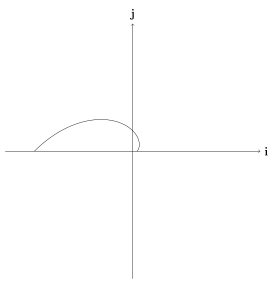
A particle \(P\) moves so that, at time \(t\), its displacement \( \bf r \) from a fixed origin is given by \[ {\bf r} =\left( \e^{t}\cos t \right) {\bf i}+ \left(\e^t \sin t\right) {\bf j}\,.\] Show that the velocity of the particle always makes an angle of \(\frac{\pi}{4}\) with the particle's displacement, and that the acceleration of the particle is always perpendicular to its displacement. Sketch the path of the particle for \(0\le t \le \pi\). A second particle \(Q\) moves on the same path, passing through each point on the path a fixed time \(T\) after \(P\) does. Show that the distance between \(P\) and \(Q\) is proportional to \(\e^{t}\).
Solution: \begin{align*} && {\bf r} &=\left( \e^{t}\cos t \right) {\bf i}+ \left(\e^t \sin t\right) {\bf j} \\ \Rightarrow && \dot{\bf r} &= \left( \e^{t}\cos t -\e^t \sin t\right) {\bf i}+ \left(\e^t \sin t+\e^t \cos t\right) {\bf j} \\ \Rightarrow && \mathbf{r}\cdot\dot{ \mathbf{r}} &= e^{2t}(\cos^2 t - \sin t \cos t) + e^{2t}(\sin^2 t+ \sin t \cos t) \\ &&&= e^{2t} (\cos^2 t + \sin ^2 t)\\ &&&= e^{2t} \\ \\ && | {\bf r}| &= e^{t} \\ && |{\bf \dot{r}}| &= e^t \sqrt{(\cos t - \sin t)^2 + (\sin t + \cos t)^2} \\ &&&= e^t \sqrt{2 \cos^2 t + 2 \sin^2 t} \\ &&&= \sqrt{2} e^t \\ \\ \Rightarrow && \frac{\mathbf{r}\cdot\dot{ \mathbf{r}}}{ |{\bf {r}}| |{\bf \dot{r}}|} &= \frac{e^{2t}}{\sqrt{2}e^te^t} \\ &&&= \frac{1}{\sqrt{2}} \end{align*} Therefore the angle between the velocity and displacement is \(\frac{\pi}{4}\). \begin{align*} && \ddot{\bf{r}} &= \left( \e^{t}(\cos t - \sin t) - \e^t (\sin t + \cos t)\right) {\bf i}+ \left(\e^t (\sin t + \cos t) + \e^t(\cos t - \sin t)\right) {\bf j} \\ &&&= \left ( -2\e^{t} \sin t \right) {\bf i}+ \left ( 2\e^{t} \cos t \right) {\bf j} \\ \Rightarrow && {\bf r} \cdot \ddot{\bf{r}} &= 2e^{2t} \left ( -\sin t \cos t + \sin t \cos t \right) \\ &&&= 0 \end{align*} Therefore the acceleration is perpendicular.
2010 Paper 3 Q9
\(\,\)
2010 Paper 3 Q10
A small bead \(B\), of mass \(m\), slides without friction on a fixed horizontal ring of radius \(a\). The centre of the ring is at \(O\). The bead is attached by a light elastic string to a fixed point \(P\) in the plane of the ring such that \(OP = b\), where \(b > a\). The natural length of the elastic string is \(c\), where \(c < b - a\), and its modulus of elasticity is \(\lambda\). Show that the equation of motion of the bead is \[ ma\ddot \phi = -\lambda\left( \frac{a\sin\phi}{c\sin\theta}-1\right)\sin(\theta+\phi) \,, \] where \(\theta=\angle BPO\) and \(\phi=\angle BOP\). Given that \(\theta\) and \(\phi\) are small, show that $a(\theta+\phi)\approx b\theta$. Hence find the period of small oscillations about the equilibrium position \(\theta=\phi =0\).
2008 Paper 1 Q9
Two identical particles \(P\) and \(Q\), each of mass \(m\), are attached to the ends of a diameter of a light thin circular hoop of radius \(a\). The hoop rolls without slipping along a straight line on a horizontal table with the plane of the hoop vertical. Initially, \(P\) is in contact with the table. At time \(t\), the hoop has rotated through an angle \(\theta\). Write down the position at time \(t\) of \(P\), relative to its starting point, in cartesian coordinates, and determine its speed in terms of \(a\), \(\theta\) and \(\dot\theta\). Show that the total kinetic energy of the two particles is \(2ma^2\dot\theta^2\). Given that the only external forces on the system are gravity and the vertical reaction of the table on the hoop, show that the hoop rolls with constant speed.
Solution:

2007 Paper 3 Q9
Two small beads, \(A\) and \(B\), each of mass \(m\), are threaded on a smooth horizontal circular hoop of radius \(a\) and centre \(O\). The angle \(\theta\) is the acute angle determined by \(2\theta = \angle AOB\). The beads are connected by a light straight spring. The energy stored in the spring is \[ mk^2 a^2(\theta - \alpha)^2, \] where \(k\) and \(\alpha\) are constants satisfying \(k>0\) and \(\frac \pi 4< \alpha<\frac\pi2\). The spring is held in compression with \(\theta =\beta\) and then released. Find the period of oscillations in the two cases that arise according to the value of \(\beta\) and state the value of \(\beta\) for which oscillations do not occur.
2007 Paper 3 Q11
- A wheel consists of a thin
light circular rim attached by light spokes of length \(a\)
to a small hub of mass
\(m\). The wheel rolls without slipping
on a rough horizontal table
directly towards a straight edge of the table.
The plane of the wheel is vertical throughout the motion.
The speed of the wheel is \(u\), where
\(u^2
- Two particles, each of mass \(m/2\), are attached to a light circular hoop of radius \(a\), at the ends of a diameter. The hoop rolls without slipping on a rough horizontal table directly towards a straight edge of the table. The plane of the hoop is vertical throughout the motion. When the centre of the hoop is vertically above the edge of the table it has speed \(u\), where \(u^2
- Two particles, each of mass \(m/2\), are attached to a light circular hoop of radius \(a\), at the ends of a diameter. The hoop rolls without slipping on a rough horizontal table directly towards a straight edge of the table. The plane of the hoop is vertical throughout the motion. When the centre of the hoop is vertically above the edge of the table it has speed \(u\), where \(u^2
2006 Paper 1 Q2
A small goat is tethered by a rope to a point at ground level on a side of a square barn which stands in a large horizontal field of grass. The sides of the barn are of length \(2a\) and the rope is of length \(4a\). Let \(A\) be the area of the grass that the goat can graze. Prove that \(A\le14\pi a^2\) and determine the minimum value of \(A\).
Solution:

2005 Paper 2 Q7
The position vectors, relative to an origin \(O\), at time \(t\) of the particles \(P\) and \(Q\) are $$\cos t \; {\bf i} + \sin t\;{\bf j} + 0 \; {\bf k} \text{ and } \cos (t+\tfrac14{\pi})\, \big[{\tfrac32}{\bf i} + { \tfrac {3\sqrt{3}}2} {\bf k}\big] + 3\sin(t+\tfrac14{\pi}) \; {\bf j}\;,$$ respectively, where \(0\le t \le 2\pi\,\).
- Give a geometrical description of the motion of \(P\) and \(Q\).
- Let \(\theta\) be the angle \(POQ\) at time \(t\) that satisfies \(0\le\theta\le\pi\,\). Show that \[ \cos\theta = \tfrac{3\surd2}{8} -\tfrac14 \cos( 2t +\tfrac14 \pi)\;. \]
- Show that the total time for which \(\theta \ge \frac14 \pi\) is \(\tfrac32 \pi\,\).
Solution:
- \(P\) is travelling in a unit circle about the origin in the \(\mathbf{i}-\mathbf{j}\) plane. \(Q\) is travelling in a circle (also about the origin, but in a different plane with radius \(3\)).
- \(\,\) \begin{align*} && \mathbf{p}\cdot \mathbf{q} &= |\mathbf{p}||\mathbf{q}| \cos \theta \\ \Rightarrow && \cos \theta &= \frac{\tfrac32\cos t \cos(t + \tfrac{\pi}4)+3\sin t \sin (t + \tfrac{\pi}{4})}{3} \\ &&&= \tfrac12\cos t \cos(t + \tfrac{\pi}4)+\sin t \sin (t + \tfrac{\pi}{4}) \\ &&&= \tfrac14 (\cos (2t + \tfrac{\pi}{4}) + \cos(\tfrac{\pi}{4} ))+\tfrac12(\cos(\tfrac{\pi}{4})-\cos(2t + \tfrac{\pi}{4})) \\ &&&= \tfrac{3\sqrt{2}}8 - \tfrac14 \cos ( 2t +\tfrac{\pi}{4}) \end{align*}
- If \(\theta \geq \frac14\pi\), then \(\cos \theta \leq \frac{\sqrt{2}}2\) \begin{align*} && \frac{\sqrt{2}}2 & \geq \frac{3\sqrt{2}}8 - \frac14 \cos ( 2t +\tfrac{\pi}{4}) \\ \Rightarrow && \frac{\sqrt{2}}2 &\geq -\cos(2t + \tfrac{\pi}{4}) \\ \Rightarrow && \cos(2t + \tfrac{\pi}{4}) &\geq -\frac{1}{\sqrt{2}} \\ \Rightarrow && 2t + \tfrac{\pi}{4} &\not\in (\tfrac{3\pi}{4},\tfrac{5\pi}{4}) \cup (\tfrac{11\pi}{4},\tfrac{13\pi}{4}) \\ \Rightarrow && t &\not\in (\tfrac{\pi}{4}, \tfrac{\pi}{2})\cup (\tfrac{5\pi}{4}, \tfrac{3\pi}{2}) \end{align*} which is is a time of \(\frac{\pi}{2}\), therefore the left over time is \(\frac32\pi\)
2005 Paper 3 Q11
A horizontal spindle rotates freely in a fixed bearing. Three light rods are each attached by one end to the spindle so that they rotate in a vertical plane. A particle of mass \(m\) is fixed to the other end of each of the three rods. The rods have lengths \(a\), \(b\) and \(c\), with \(a > b > c\,\) and the angle between any pair of rods is \(\frac23 \pi\). The angle between the rod of length \(a\) and the vertical is \(\theta\), as shown in the diagram. \vspace*{-0.1in}
2004 Paper 3 Q9
A circular hoop of radius \(a\) is free to rotate about a fixed horizontal axis passing through a point \(P\) on its circumference. The plane of the hoop is perpendicular to this axis. The hoop hangs in equilibrium with its centre, \(O\), vertically below \(P\). The point \(A\) on the hoop is vertically below \(O\), so that \(POA\) is a diameter of the hoop. A mouse \(M\) runs at constant speed \(u\) round the rough inner surface of the lower part of the hoop. Show that the mouse can choose its speed so that the hoop remains in equilibrium with diameter \(POA\) vertical. Describe what happens to the hoop when the mouse passes the point at which angle \(AOM = 2 \arctan \mu\,\), where \(\mu\) is the coefficient of friction between mouse and hoop.
2003 Paper 3 Q9
A particle \(P\) of mass \(m\) is constrained to move on a vertical circle of smooth wire with centre~\(O\) and of radius \(a\). \(L\) is the lowest point of the circle and \(H\) the highest and \(\angle LOP = \theta\,\). The particle is attached to \(H\) by an elastic string of natural length \(a\) and modulus of elasticity~\(\alpha mg\,\), where \(\alpha > 1\,\). Show that, if \(\alpha>2\,\), there is an equilibrium position with \(0<\theta<\pi\,\). Given that \(\alpha =2+\sqrt 2\,\), and that \(\displaystyle \theta = \tfrac{1}{2}\pi + \phi\,\), show that \[ \ddot{\phi} \approx -\frac{g (\sqrt2+1)}{2a }\, \phi \] when \(\phi\) is small. For this value of \(\alpha\), explain briefly what happens to the particle if it is given a small displacement when \( \theta = \frac{1}{2}\pi\).
2002 Paper 3 Q10
A light hollow cylinder of radius \(a\) can rotate freely about its axis of symmetry, which is fixed and horizontal. A particle of mass \(m\) is fixed to the cylinder, and a second particle, also of mass \(m\), moves on the rough inside surface of the cylinder. Initially, the cylinder is at rest, with the fixed particle on the same horizontal level as its axis and the second particle at rest vertically below this axis. The system is then released. Show that, if \(\theta\) is the angle through which the cylinder has rotated, then \[ \ddot{\theta} = {g \over 2a} \l \cos \theta - \sin \theta \r \,, \] provided that the second particle does not slip. Given that the coefficient of friction is \( (3 + \sqrt{3})/6\), show that the second particle starts to slip when the cylinder has rotated through \(60^\circ\).
2001 Paper 1 Q11
A smooth cylinder with circular cross-section of radius \(a\) is held with its axis horizontal. A~light elastic band of unstretched length \(2\pi a\) and modulus of elasticity \(\lambda\) is wrapped round the circumference of the cylinder, so that it forms a circle in a plane perpendicular to the axis of the cylinder. A particle of mass \(m\) is then attached to the rubber band at its lowest point and released from rest.
- Given that the particle falls to a distance \(2a\) below the below the axis of the cylinder, but no further, show that \[ \lambda = \frac{9\pi m g}{(3\sqrt3-\pi)^2} \;. \]
- Given instead that the particle reaches its maximum speed at a distance \(2a\) below the axis of the cylinder, find a similar expression for \(\lambda\)\,.
1999 Paper 1 Q11
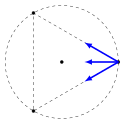
The force of attraction between two stars of masses \(m_{1}\) and \(m_{2}\) a distance \(r\) apart is \(\gamma m_{1}m_{2}/r^{2}\). The Starmakers of Kryton place three stars of equal mass \(m\) at the corners of an equilateral triangle of side \(a\). Show that it is possible for each star to revolve round the centre of mass of the system with angular velocity \((3\gamma m/a^{3})^{1/2}\). Find a corresponding result if the Starmakers place a fourth star, of mass \(\lambda m\), at the centre of mass of the system.
Solution: The net force on the planets will always be towards the centre of mass (by symmetry or similar arguments). Therefore it suffices to check whether we can find a speed where the planets follow uniform circular motion, ie \(F = mr \omega^2\). (But clearly this is possible, we just need to find the speed)

1999 Paper 2 Q11
An automated mobile dummy target for gunnery practice is moving anti-clockwise around the circumference of a large circle of radius \(R\) in a horizontal plane at a constant angular speed \(\omega\). A shell is fired from \(O\), the centre of this circle, with initial speed \(V\) and angle of elevation \(\alpha\). Show that if \(V^2 < gR\), then no matter what the value of \(\alpha\), or what vertical plane the shell is fired in, the shell cannot hit the target. Assume now that \(V^2 > gR\) and that the shell hits the target, and let \(\beta\) be the angle through which the target rotates between the time at which the shell is fired and the time of impact. Show that \(\beta\) satisfies the equation $$ g^2{{\beta}^4} - 4{{\omega}^2}{V^2}{{\beta}^2} +4{R^2}{{\omega}^4}=0. $$ Deduce that there are exactly two possible values of \(\beta\). Let \(\beta_1\) and \(\beta_2\) be the possible values of \(\beta\) and let \(P_1\) and \(P_2\) be the corresponding points of impact. By considering the quantities \((\beta_1^2 +\beta_2^2) \) and \(\beta_1^2\beta_2^2\,\), or otherwise, show that the linear distance between \(P_1\) and \(P_2\) is \[ 2R \sin\Big( \frac\omega g \sqrt{V^2-Rg}\Big) \;. \]
Solution: \begin{align*} && 0 &= V\sin \alpha t-\frac12 gt^2 \\ \Rightarrow && t &= \frac{2V \sin \alpha}{g} \\ && R &= V \cos \alpha \, t \\ &&&= \frac{2V^2 \sin \alpha \cos \alpha}{g} \\ &&&= \frac{V^2 \sin 2 \alpha}{g} \end{align*} Therefore the max distance is \(\frac{V^2}{g}\), therefore we cannot hit the target if \(R > \frac{V^2}{g} \Rightarrow gR > V^2\). We have \(\beta = \omega t \Rightarrow t = \frac{\beta}{\omega}\) \begin{align*} && \sin \alpha &= \frac{gt}{2V} \\ && \cos \alpha &= \frac{R}{Vt} \\ \Rightarrow && 1 &= \left (\frac{gt}{2V} \right)^2 + \left ( \frac{R}{Vt} \right)^2 \\ &&&= \left (\frac{g\beta}{2V \omega} \right)^2 + \left ( \frac{R\omega}{V\beta} \right)^2 \\ &&&= \frac{g^2 \beta^2}{4 V^2 \omega^2} + \frac{R^2 \omega^2}{V^2 \beta ^2} \\ \Rightarrow && 4V^2 \omega^2 \beta^2 &= g^2 \beta^4 + 4R^2 \omega^4 \\ \Rightarrow && 0 &= g^2 \beta^4 - 4\omega^2 V^2 \beta^2+4R^2\omega^4 \end{align*} This (quadratic) equation in terms of \(\beta^2\) has two solution if \(\Delta = 16\omega^4V^4-16g^2R^2\omega^4 =16\omega^4(V^4-g^2R^2) > 0\) since \(V^2 > gR\). Since \(\beta > 0\) there are exactly two solutions, once we have values for \(\beta\). First notice, \begin{align*} && \beta_1^2 + \beta_2^2 &= \frac{4\omega^2V^2}{g^2} \\ && \beta_1^2\beta_2^2 &= \frac{4R^2\omega^4}{g^2} \end{align*} Then notice the positions of \(P_1\) and \(P_2\) are \((R\cos \beta_1 , R\sin \beta_1)\) and \((R\cos \beta_2, R\sin \beta_2)\). \begin{align*} && d^2 &= R^2\left ( \cos \beta_1 - \cos \beta_2 \right)^2 + R^2 \left ( \sin \beta_1 - \sin \beta_2 \right)^2 \\ &&&= 2R^2 - 2R^2(\cos \beta_1 \cos \beta_2 + \sin \beta_1 \sin \beta_2) \\ &&&= 2R^2-2R^2\cos(\beta_1 - \beta_2) \\ &&&= 2R^2 \left (1-\cos(\sqrt{(\beta_1-\beta_2)^2} \right ) \\ &&&= 2R^2 \left (1 - \cos\left ( \sqrt{\frac{4\omega^2 V^2}{g^2} - \frac{4R\omega^2}{g}} \right) \right) \\ &&&= 2R^2 \left (1 - \cos\left (\frac{2\omega}{g} \sqrt{V^2 - Rg} \right) \right) \\ &&&= 4 R^2 \sin^2 \left (\frac{\omega}{g} \sqrt{V^2 - Rg} \right) \end{align*} which gives us the required result.