Problems
Filters
1531 problems found
2017 Paper 2 Q11
Two thin vertical parallel walls, each of height \(2a\), stand a distance \(a\) apart on horizontal ground. The projectiles in this question move in a plane perpendicular to the walls.
- A particle is projected with speed \(\sqrt{5ag}\) towards the two walls from a point \( A\) at ground level. It just clears the first wall. By considering the energy of the particle, find its speed when it passes over the first wall. Given that it just clears the second wall, show that the angle its trajectory makes with the horizontal when it passes over the first wall is \(45^\circ\,\). Find the distance of \(A\) from the foot of the first wall.
- A second particle is projected with speed \(\sqrt{5ag}\) from a point \(B\) at ground level towards the two walls. It passes a distance \(h\) above the first wall, where \(h>0\). Show that it does not clear the second wall.
Solution:
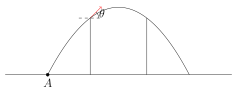
- \(\,\) \begin{align*} \bf{COE}: && \frac12 m \cdot 5ag &= mg\cdot 2a + \frac12 m v^2 \\ \Rightarrow && v^2 &= ag \\ && v &= \sqrt{ag} \end{align*} If it just clears the second wall, we must have: \begin{align*} && 0 &= \sqrt{ag} \sin \theta t - \frac12 gt^2 \\ \Rightarrow && t &= \frac{2\sqrt{ag}\sin \theta}{g} \\ && a &= \sqrt{ag} \cos \theta t \\ &&&=\sqrt{ag} \cos \theta \frac{2\sqrt{ag}\sin \theta}{g} \\ &&&= a \sin 2 \theta \\ \Rightarrow && \theta &= 45^{\circ} \end{align*} Imagine firing the particle backwards from the top of the wall at \(45^\circ\) then \begin{align*} && -2a &= \sqrt{ag}\cdot \left ( -\frac1{\sqrt{2}} \right) t - \frac12 g t^2 \\ \Rightarrow && 0 &= gt^2+\sqrt{2ag} t -4a \\ &&&= (\sqrt{g}t -\sqrt{2} \sqrt{a})(\sqrt{g}t +2\sqrt{2} \sqrt{a}) \\ \Rightarrow && t &= \sqrt{\frac{2a}{g}} \\ \Rightarrow && s &= \left ( -\frac1{\sqrt{2}} \right) \sqrt{ag} \sqrt{\frac{2a}{g}} \\ &&&= -a \end{align*} Therefore the \(A\) is \(a\) from the wall.
- When it passes over the first wall, \begin{align*} \bf{COE}: && \frac52amg &= (2a+h)mg + \frac12 m v^2 \\ \Rightarrow && v^2 &= (a-2h)g \end{align*} Now imagine firing a particle with this speed in any direction. The question is asking whether we can ever travel \(2a\) without descending more than \(h\). \begin{align*} && a &= \sqrt{(a-2h)g} \cos \beta t \\ \Rightarrow && t &= \frac{a}{\sqrt{(a-2h)g} \cos \beta}\\ && -h &= \sqrt{(a-2h)g} \sin \beta t - \frac12 g t^2 \\ &&&= a \tan \beta - \frac12 \frac{a^2}{(a-2h)} \sec^2 \beta \\ &&&= a \tan \beta - \frac{a^2}{2(a-2h)}(1+ \tan^2 \beta )\\ \Rightarrow && 0 &= \frac{a^2}{2(a-2h)} \tan^2 \beta-a \tan \beta + \frac{a^2-2ah+4h^2}{2(a-2h)} \\ && \Delta &= a^2 - \frac{a^2}{a-2h} \frac{a^2-2ah+4h^2}{a-2h} \\ &&&= \frac{a^2}{(a-2h)^2}\left ( a^2-4ah+4h^2-a^2+2ah-4h^2\right) \\ &&&= \frac{a^2}{(a-2h)^2}\left ( -2ah\right) < 0 \\ \end{align*} So there are no solutions if \(h > 0\)
2017 Paper 2 Q12
Adam and Eve are catching fish. The number of fish, \(X\), that Adam catches in any time interval is Poisson distributed with parameter \(\lambda t\), where \(\lambda\) is a constant and \(t\) is the length of the time interval. The number of fish, \(Y\), that Eve catches in any time interval is Poisson distributed with parameter \(\mu t\), where \(\mu\) is a constant and \(t\) is the length of the time interval The two Poisson variables are independent. You may assume that the expected time between Adam catching a fish and Adam catching his next fish is \(\lambda^{-1}\), and similarly for Eve.
- By considering \(\P( X + Y = r)\), show that the total number of fish caught by Adam and Eve in time \(T\) also has a Poisson distribution.
- Given that Adam and Eve catch a total of \(k\) fish in time \(T\), where \(k\) is fixed, show that the number caught by Adam has a binomial distribution.
- Given that Adam and Eve start fishing at the same time, find the probability that the first fish is caught by Adam.
- Find the expected time from the moment Adam and Eve start fishing until they have each caught at least one fish.
Solution:
- \(\,\) \begin{align*} && \mathbb{P}(X+Y=r) &= \sum_{k=0}^r \mathbb{P}(X = k, Y = r-k) \\ &&&= \sum_{k=0}^r \mathbb{P}(X = k)\mathbb{P}( Y = r-k) \\ &&&= \sum_{k=0}^r \frac{e^{-\lambda T} (\lambda T)^k}{k!}\frac{e^{-\mu T} (\mu T)^{r-k}}{(r-k)!}\\ &&&= \frac{e^{-(\mu+\lambda)T}}{r!}\sum_{k=0}^r \binom{r}{k}(\lambda T)^k (\mu T)^{r-k}\\ &&&= \frac{e^{-(\mu+\lambda)T}((\mu+\lambda)T)^r}{r!} \end{align*} Therefore \(X+Y \sim Po \left ( (\mu+\lambda)T \right)\)
- \(\,\) \begin{align*} && \mathbb{P}(X = r | X+Y = k) &= \frac{\mathbb{P}(X=r, Y = k-r)}{\mathbb{P}(X+Y=k)} \\ &&&= \frac{\frac{e^{-\lambda T} (\lambda T)^r}{r!}\frac{e^{-\mu T} (\mu T)^{k-r}}{(k-r)!}}{\frac{e^{-(\mu+\lambda)T}((\mu+\lambda)T)^k}{k!}} \\ &&&= \binom{k}{r} \left ( \frac{\lambda}{\lambda + \mu} \right)^r \left ( \frac{\mu}{\lambda + \mu} \right)^{k-r} \end{align*} Therefore \(X|X+Y=k \sim B(k, \frac{\lambda}{\lambda + \mu})\)
- \(P(X=1|X+Y = 1) = \frac{\lambda}{\lambda + \mu}\)
- Let \(X_1, Y_1\) be the time to the first fish are caught by Adam and Eve, then \begin{align*} && \mathbb{P}(X_1, Y_1 > t) &= \mathbb{P}(X_1> t) \mathbb{P}( Y_1 > t) \\ &&&= e^{-\lambda t}e^{-\mu t} \\ &&&= e^{-(\lambda+\mu)t} \\ \Rightarrow && f_{\max(X_1,Y_1)}(t) &= (\lambda+\mu)e^{-(\lambda+\mu)} \end{align*} Therefore the expected time is \(\frac1{\mu+\lambda}\)
2017 Paper 2 Q13
In a television game show, a contestant has to open a door using a key. The contestant is given a bag containing \(n\) keys, where \(n\ge2\). Only one key in the bag will open the door. There are three versions of the game. In each version, the contestant starts by choosing a key at random from the bag.
- In version 1, after each failed attempt at opening the door the key that has been tried is put back into the bag and the contestant again selects a key at random from the bag. By considering the binomial expansion of \(( 1 - q)^{-2}\), or otherwise, find the expected number of attempts required to open the door.
- In version 2, after each failed attempt at opening the door the key that has been tried is put aside and the contestant selects another key at random from the bag. Find the expected number of attempts required to open the door.
- In version 3, after each failed attempt at opening the door the key that has been tried is put back into the bag and another incorrect key is added to the bag. The contestant then selects a key at random from the bag. Show that the probability that the contestant draws the correct key at the \(k\)th attempt is \[ \frac{n-1}{(n+k-1)(n+k-2)} \,.\] Show also, using partial fractions, that the expected number of attempts required to open the door is infinite. You may use without proof the result that \(\displaystyle\sum_{m=1}^N \dfrac 1 m \to \infty \,\) as \(N\to \infty\,\).
Solution:
- The probability they pull the key out on the \(k\)th attempt will be \(\left ( \frac{n-1}{n} \right)^{k-1} \frac1n\), so we want: \begin{align*} \E[G_1] &= \sum_{k=1}^{\infty} k \cdot \left ( \frac{n-1}{n} \right)^{k-1} \frac1n \\ &= \frac{1}n \sum_{k=1}^{\infty} k \cdot \left ( \frac{n-1}{n} \right)^{k-1} \\ &= \frac1n \frac{1}{\left (1 - \frac{n-1}{n} \right)^2} \\ &= \frac{1}{n} \frac{n^2}{1^2} = n \end{align*}
- In version 2, the probability the correct key comes out at the \(k\)th attempt is \(\frac1n\) (assume we take out all the keys, then the correct key is equally likely to appear in all of the space). Therefore \(\E[G_2] = \frac1n (1 + 2 + \cdots + n) = \frac{n+1}{2}\)
- The probability the key comes out on the correct attempt is: \begin{align*} && \mathbb{P}(G_3 = k) &= \frac{n-1}{n} \cdot \frac{n}{n+1} \cdot \frac{n+1}{n+2} \cdots \frac{n+k-3}{n+k-2} \cdot \frac{1}{n+k-1} \\ &&&= \frac{n-1}{(n+k-2)(n+k-1)} \\ \\ &&k \cdot \mathbb{P}(G_3 = k) &= \frac{k(n-1)}{(n+k-2)(n+k-1)} \\ &&&= \frac{(n-1)(2-n)}{n+k-2} + \frac{(n-1)^2}{n+k-1} \\ &&&= \frac{(n-1)^2}{n+k-1} - \frac{(n-1)^2}{n+k-2} + \frac{n-1}{n-k+2} \\ \Rightarrow && \E[G_3] &= \sum_{k=1}^{\infty} k \cdot \mathbb{P}(G_3 = k) \\ &&&= \sum_{k=1}^{\infty} \left ( \frac{(n-1)^2}{n+k-1} - \frac{(n-1)^2}{n+k-2} + \frac{n-1}{n+k-2} \right) \\ &&&= \sum_{k=1}^{\infty} \left ( \frac{(n-1)^2}{n+k-1} - \frac{(n-1)^2}{n+k-2} \right) +\underbrace{\sum_{k=1}^{\infty} \frac{n-1}{n-k+2}}_{\to \infty} \\ \end{align*}
2017 Paper 3 Q1
- Prove that, for any positive integers \(n\) and \(r\), \[ \frac{1}{^{n+r}\C_{r+1}} =\frac{r+1}{r} \left(\frac{1}{^{n+r-1}\C_{r}}-\frac{1}{^{n+r}\C_{r}}\right). \] Hence determine \[ \sum_{n=1}^{\infty}{\frac{1}{^{n+r}\C_{r+1}}} \,, \] and deduce that \ \(\displaystyle \sum_{n=2}^\infty \frac 1 {^{n+2}\C_3} = \frac12\,\).
- Show that, for \(n \ge 3\,\), \[ \frac{3!}{n^3} < \frac{1}{^{n+1}\C_{3}} \ \ \ \ \ \text{and} \ \ \ \ \ \frac{20}{^{n+1}\C_3} - \frac{1}{^{n+2}\C_{5}} < \frac{5!}{n^3} \,. \] By summing these inequalities for \(n \ge 3\,\), show that \[ \frac{115}{96} < \sum_{n=1}^{\infty}{\frac{1}{n^3}} < \frac{116}{96} \, . \]
Solution: \begin{align*} \frac{r+1}{r} \left(\frac{1}{^{n+r-1}\C_{r}}-\frac{1}{^{n+r}\C_{r}}\right) &= \frac{r+1}{r} \l \frac{r!(n-1)!}{(n+r-1)!} - \frac{r!n!}{(n+r)!} \r \\ &= \frac{(r+1)!(n-1)!}{r(n+r-1)!} \l 1 - \frac{n}{n+r} \r \\ &= \frac{(r+1)!(n-1)!}{r(n+r-1)!} \frac{r}{n+r} \\ &= \frac{(r+1)!n!}{(n+r)!} \\ &= \frac{1}{^{n+r}\C_{r+1}} \end{align*} \begin{align*} \sum_{n=1}^{\infty}{\frac{1}{^{n+r}\C_{r+1}}} &= \sum_{n=1}^{\infty} \l \frac{r+1}{r} \left(\frac{1}{^{n+r-1}\C_{r}}-\frac{1}{^{n+r}\C_{r}}\right) \r \\ &= \frac{r+1}{r} \sum_{n=1}^{\infty} \l \frac{1}{^{n+r-1}\C_{r}}-\frac{1}{^{n+r}\C_{r}} \r \\ &= \frac{r+1}{r} \lim_{N \to \infty} \sum_{n=1}^{N} \l \frac{1}{^{n+r-1}\C_{r}}-\frac{1}{^{n+r}\C_{r}} \r \\ &= \frac{r+1}{r} \lim_{N \to \infty} \l \frac{1}{^{1+r-1}\C_{r}} - \frac{1}{^{N+r}\C_{r}}\r \\ &= \frac{r+1}{r} \frac{1}{^{1+r-1}\C_{r}} \tag{since \(\frac{1}{^{N+r}\C_{r}} \to 0\)} \\ &= \frac{r+1}{r} \end{align*} When \(r = 2\), we have: \begin{align*} && \frac{3}{2} &= \sum_{n=1}^{\infty}{\frac{1}{^{n+2}\C_{3}}} \\ && &=\frac{1}{^{1+2}\C_{3}} + \sum_{n=2}^{\infty}{\frac{1}{^{n+2}\C_{3}}} \\ && &= 1 + \sum_{n=2}^{\infty}{\frac{1}{^{n+2}\C_{3}}} \\ \Rightarrow && \sum_{n=2}^{\infty}{\frac{1}{^{n+2}\C_{3}}} &= \frac12 \end{align*} \begin{align*} \frac{1}{^{n+1}\C_{3}} &= \frac{3!}{(n+1)n(n-1)} \\ &= \frac{3!}{n^3-n} \\ &> \frac{3!}{n^3} \end{align*} \begin{align*} \frac{20}{^{n+1}\C_3} - \frac{1}{^{n+2}\C_{5}} &= \frac{5!}{(n+1)n(n-1)} - \frac{5!}{(n+2)(n+1)n(n-1)(n-2)} \\ &= \frac{5!}{n^3} \frac{n^2}{n^2-1}\l 1- \frac{1}{n^2-4} \r \\ &= \frac{5!}{n^3} \frac{n^2}{n^2-1}\l \frac{n^2-5}{n^2-4} \r \\ &= \frac{5!}{n^3} \frac{n^2(n^2-5)}{(n^2-1)(n^2-4)} \\ &< \frac{5!}{n^3} \end{align*} Since \(k(k-5) < (k-1)(k-4) \Leftrightarrow 0 < 4\), this only makes sense if \(n \geq 3\) \begin{align*} &&\frac{3!}{n^3} &< \frac{1}{^{n+1}\C_{3}} \tag{if \(n \geq 3\)} \\ \Rightarrow &&\sum_{n=3}^\infty \frac{3!}{n^3} &< \sum_{n=3}^\infty \frac{1}{^{n+1}\C_{3}} \\ \Rightarrow && \frac{6}{1^3} + \frac{6}{2^3} + \sum_{n=3}^\infty \frac{3!}{n^3} &< \frac{6}{1^3} + \frac{6}{2^3} + \sum_{n=3}^\infty \frac{1}{^{n+1}\C_{3}} \\ \Rightarrow && \sum_{n=1}^\infty \frac{3!}{n^3} &< 6 + \frac{3}{4} + \sum_{n=2}^\infty \frac{1}{^{n+2}\C_{2+1}} \\ \Rightarrow && \sum_{n=1}^\infty \frac{3!}{n^3} &< 6 + \frac{3}{4} + \frac{1}{2} = \frac{29}{4} \\ \Rightarrow && \sum_{n=1}^\infty \frac{1}{n^3} &< \frac{29}{24} = \frac{116}{96} \\ \end{align*} \begin{align*} && \frac{20}{^{n+1}\C_3} - \frac{1}{^{n+2}\C_{5}} &< \frac{5!}{n^3} \\ \Rightarrow && \sum_{n=3}^\infty \l \frac{20}{^{n+1}\C_3} - \frac{1}{^{n+2}\C_{5}} \r &< \sum_{n=3}^\infty \frac{5!}{n^3} \\ \Rightarrow && \frac{120}{1^3} + \frac{120}{2^3} + \sum_{n=3}^\infty \frac{20}{^{n+1}\C_3} - \sum_{n=3}^\infty \frac{1}{^{n+2}\C_{5}} &< \frac{120}{1^3} + \frac{120}{2^3} + \sum_{n=3}^\infty \frac{5!}{n^3} \\ \Rightarrow && \frac{120}{1^3} + \frac{120}{2^3} + \sum_{n=2}^\infty \frac{20}{^{n+2}\C_{2+1}} - \sum_{n=1}^\infty \frac{1}{^{n+4}\C_{4+1}} &< \frac{120}{1^3} + \frac{120}{2^3} + \sum_{n=3}^\infty \frac{5!}{n^3} \\ \Rightarrow && \frac{120}{1^3} + \frac{120}{2^3} + \frac{20}{2} - \frac{4+1}{4} &< \sum_{n=1}^\infty \frac{5!}{n^3} \\ \Rightarrow && \frac{115}{96} &< \sum_{n=1}^\infty \frac{1}{n^3} \\ \end{align*}
2017 Paper 3 Q2
The transformation \(R\) in the complex plane is a rotation (anticlockwise) by an angle \(\theta\) about the point represented by the complex number \(a\). The transformation \(S\) in the complex plane is a rotation (anticlockwise) by an angle \(\phi\) about the point represented by the complex number \(b\).
- The point \(P\) is represented by the complex number~\(z\). Show that the image of \(P\) under \(R\) is represented by \[ \e^{{\mathrm i} \theta}z + a(1-\e^{{\rm i} \theta})\,. \]
- Show that the transformation \(SR\) (equivalent to \(R\) followed by \(S\)) is a rotation about the point represented by \(c\), where \[ %\textstyle c\,\sin \tfrac12 (\theta+\phi) = a\,\e^{ {\mathrm i}\phi/2}\sin \tfrac12\theta + b\,\e^{-{\mathrm i} \theta/2}\sin \tfrac12 \phi \,, \] provided \(\theta+\phi \ne 2n\pi\) for any integer \(n\). What is the transformation \(SR\) if \(\theta +\phi = 2\pi\)?
- Under what circumstances is \(RS =SR\)?
Solution:
- We can map \(a \mapsto 0\), rotate the whole plane, then shift the plane back to \(a\), so \(z \mapsto (z-a) \mapsto e^{i \theta}(z-a) \mapsto a + e^{i \theta}(z-a) = e^{i \theta}z + a(1 - e^{i\theta})\)
- \(z \mapsto e^{i \theta}z + a(1 - e^{i\theta}) \mapsto e^{i \phi} \l e^{i \theta}z + a(1 - e^{i\theta}) \r + b(1 - e^{i \phi})\) \begin{align*} e^{i \phi} \l e^{i \theta}z + a(1 - e^{i\theta}) \r + b(1 - e^{i \phi}) &= e^{i(\phi + \theta)}z + ae^{i\phi} - ae^{i (\theta + \phi)} + b(1 - e^{i \phi}) \\ \end{align*} Therefore this is rotation by angle \(\phi + \theta\) and about \begin{align*} \frac{ae^{i\phi} - ae^{i (\theta + \phi)} + b(1 - e^{i \phi})}{1 - e^{i(\phi + \theta)}} &= \frac{e^{-i\frac{(\phi + \theta)}{2}} \l ae^{i\phi} - ae^{i (\theta + \phi)} + b(1 - e^{i \phi}) \r}{e^{-i\frac{(\phi + \theta)}{2}} - e^{i\frac{(\phi + \theta)}2}} \\ &= \frac{\l ae^{i\frac{\phi-\theta}{2}} - ae^{i \frac{(\theta + \phi)}{2}} + b(e^{-i\frac{(\phi + \theta)}{2}} -e^{i\frac{(\phi - \theta)}{2}}) \r}{e^{-i\frac{(\phi + \theta)}{2}} - e^{i\frac{(\phi + \theta)}2}} \\ &= \frac{ae^{i\frac{\phi}{2}} 2i\sin(\frac{\theta}{2}) + be^{-i\frac{\theta}{2}}2i\sin\frac{\phi}{2} }{2i \sin(\frac{\phi + \theta}2)} \\ \end{align*} as required. If \(\phi + \theta = 2\pi\), then \(z \mapsto z + (b-a)(1 - e^{i\phi})\) which is a translation.
- If \(\phi + \theta \neq 2 \pi\) then \(RS = ST\) if \begin{align*} && a\,\e^{ {\mathrm i}\phi/2}\sin \tfrac12\theta + b\,\e^{-{\mathrm i} \theta/2}\sin \tfrac12 \phi &= b\,\e^{ {\mathrm i}\theta/2}\sin \tfrac12\phi + a\,\e^{-{\mathrm i} \phi/2}\sin \tfrac12 \theta \\ && a\,(\e^{ {\mathrm i}\phi/2}-\e^{-{\mathrm i}\phi/2})\sin \tfrac12\theta + b\,(\e^{-{\mathrm i} \theta/2}-\e^{+{\mathrm i} \theta/2})\sin \tfrac12 \phi &= 0 \\ && a \sin \frac{\phi}{2} \sin \frac{\theta}{2}-b \sin \frac{\theta}{2} \sin \frac{\phi}{2} &= 0 \\ \Leftrightarrow && a = b \text{ or } \sin \frac{\theta}{2} = 0 \text{ or } \sin \frac{\phi}{2} = 0 \\ \Leftrightarrow && a = b \text{ or } \theta = 0 \text{ or } \phi = 0 \\ \end{align*} If \(\phi + \theta \neq 2 \pi\) then \(RS = ST\) if \(b = a\) or \(e^{i\phi} = e^{i \theta}\) ie rotation through the same angle.
2017 Paper 3 Q3
Let \(\alpha\), \(\beta\), \(\gamma\) and \(\delta\) be the roots of the quartic equation \[ x^4 +px^3 +qx^2 +r x +s =0 \,. \] You are given that, for any such equation, \(\,\alpha \beta + \gamma\delta\,\), \(\alpha\gamma+\beta\delta\,\) and \(\,\alpha \delta + \beta\gamma\,\) satisfy a cubic equation of the form \[ y^3+Ay^2+ (pr-4s)y+ (4qs-p^2s -r^2) =0 \,. \] Determine \(A\). Now consider the quartic equation given by \(p=0\,\), \(q= 3\,\), \(r=-6\,\) and \(s=10\,\).
- Find the value of \(\alpha\beta + \gamma \delta\), given that it is the largest root of the corresponding cubic equation.
- Hence, using the values of \(q\) and \(s\), find the value of \((\alpha +\beta)(\gamma+\delta)\,\) and the value of \(\alpha\beta\) given that \(\alpha\beta >\gamma\delta\,\).
- Using these results, and the values of \(p\) and \(r\), solve the quartic equation.
Solution: \begin{align*} A &= -(\alpha \beta + \gamma\delta + \alpha\gamma+\beta\delta+\alpha \delta + \beta\gamma) \\ &= -q \end{align*}
- The corresponding cubic equation is: \begin{align*} && 0 &= y^3 - 3y^2-40y+(120-36) \\ &&&= y^3 -3y^2 - 40y + 84 \\ &&&= (y-7)(y-2)(y+6) \end{align*} Therefore \(\alpha\beta + \gamma \delta = 7\)
- \begin{align*}(\alpha+\beta)(\gamma+\delta) &= \alpha \gamma + \alpha \delta + \beta \gamma + \beta \delta \\ &= 3 -(\alpha\beta + \gamma\delta) \\ &=3-7 = -4 \end{align*} Let \(\alpha\beta\) and \(\gamma\delta\) be the roots of a quadratic; then the quadratic will be \(t^2-7t+10 = 0 \Rightarrow t = 2,5\) so \(\alpha\beta = 5\)
- \(\alpha\beta = 5, \gamma\delta = 2\) Consider the quadratic with roots \(\alpha+\beta\) and \(\gamma+\delta\), then \(t^2-4 = 0 \Rightarrow t = \pm 2\). Suppose \(\alpha+\beta = 2, \gamma+\delta=-2\) then \(\alpha, \beta = 1 \pm 2i, \gamma,\delta = -1 \pm i\) \(\alpha \beta \gamma + \beta\gamma\delta + \gamma\delta\alpha + \delta\alpha\beta = 5\gamma + 2\beta + 2\alpha + 5\delta = -6 \neq 6\) Suppose \(\alpha+\beta = -2, \gamma+\delta=2\) then \(\alpha, \beta = -1 \pm 2i, \gamma,\delta = 1 \pm i\) \(\alpha \beta \gamma + \beta\gamma\delta + \gamma\delta\alpha + \delta\alpha\beta = 5\gamma + 2\beta + 2\alpha + 5\delta = 6\), therefore these are there roots. (In some order): \(1 \pm i, -1 \pm 2i\)
2017 Paper 3 Q4
For any function \(\f\) satisfying \(\f(x) > 0\), we define the geometric mean, F, by \[ F(y) = e^{\frac{1}{y} \int_{0}^{y} \ln f(x) \, dx} \quad (y > 0). \]
- The function f satisfies \(\f(x) > 0\) and \(a\) is a positive number with \(a\ne1\). Prove that \[ F(y) = a^{\frac{1}{y} \int_{0}^{y} \log_a f(x) \, dx}. \]
- The functions f and g satisfy \(\f(x) > 0\) and \(\g(x) > 0\), and the function \(\h\) is defined by \(\h(x) = \f(x)\g(x)\). Their geometric means are F, G and H, respectively. Show that \(H(y)= \F(y) \G(y)\,\).
- Prove that, for any positive number \(b\), the geometric mean of \(b^x\) is \(\sqrt{b^y}\,\).
- Prove that, if \(\f(x)>0\) and the geometric mean of \(\f(x)\) is \(\sqrt{\f(y)}\,\), then \(\f(x) = b^x\) for some positive number \(b\).
Solution:
- \begin{align*} && a^{\frac{1}{y} \int_{0}^{y} \log_a f(x) \, dx} &= e^{\ln a \cdot \frac{1}{y} \int_{0}^{y} \log_a f(x) \, dx} \\ &&&= e^{\ln a \cdot \frac{1}{y} \int_{0}^{y} \frac{\ln f(x)}{\ln a} \, dx} \\ &&&= e^{ \frac{1}{y} \int_{0}^{y} \ln f(x) \, dx} \\ &&&= F(y) \end{align*}
- \(\,\) \begin{align*} && H(y) &= e^{\frac1y \int_0^y \ln h(x) \d x} \\ &&&= e^{\frac1y \int_0^y \ln (f(x)g(x))\d x} \\ &&&= e^{\frac1y \int_0^y \left ( \ln f(x)+\ln g(x) \right)\d x} \\ &&&= e^{\frac1y \int_0^y \ln f(x) \d x +\frac1y \int_0^y \ln g(x) \d x} \\ &&&= e^{\frac1y \int_0^y \ln f(x) \d x }e^{\frac1y \int_0^y \ln g(x) \d x} \\ &&&= F(y)G(y) \end{align*}
- Suppose \(f(x) = b^x\), then \begin{align*} && F(y) &= b^{\frac1y \int_0^y \log_b f(x) \d x} \\ &&&= b^{\frac1y \int_0^y x \d x}\\ &&&= b^{\frac1y \frac{y^2}{2}} \\ &&&= b^{\frac{y}2} = \sqrt{b^y} \end{align*}
- Suppose the geometric mean of \(f(x)\) is \(\sqrt{f(y)}\) then the geometric mean of \(f(x)^2\) is \(f(y)\) by the the second part.
2017 Paper 3 Q5
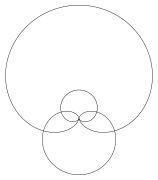
The point with cartesian coordinates \((x,y)\) lies on a curve with polar equation \(r=\f(\theta)\,\). Find an expression for \(\dfrac{\d y}{\d x}\) in terms of \(\f(\theta)\), \(\f'(\theta)\) and \(\tan\theta\,\). Two curves, with polar equations \(r=\f(\theta)\) and \(r=\g(\theta)\), meet at right angles. Show that where they meet \[ \f'(\theta) \g'(\theta) +\f(\theta)\g(\theta) = 0 \,. \] The curve \(C\) has polar equation \(r=\f(\theta)\) and passes through the point given by \(r=4\), \(\theta = - \frac12\pi\). For each positive value of \(a\), the curve with polar equation \(r= a(1+\sin\theta)\) meets~\(C\) at right angles. Find \(\f(\theta)\,\). Sketch on a single diagram the three curves with polar equations \(r= 1+\sin\theta\,\), \ \(r= 4(1+\sin\theta)\) and \(r=\f(\theta)\,\).
Solution: \((x, y) = (f(\theta)\cos(\theta), f(\theta)\sin(\theta))\) so \begin{align*} \frac{dy}{d\theta} &= -f(\theta)\sin(\theta) + f'(\theta)\cos(\theta) \\ \frac{dx}{d\theta} &= f(\theta)\cos(\theta) + f'(\theta)\sin(\theta) \\ \frac{dy}{dx} &= \frac{-f(\theta)\sin(\theta) + f'(\theta)\cos(\theta)}{f(\theta)\cos(\theta) + f'(\theta)\sin(\theta) } \\ &= \frac{-f(\theta)\tan(\theta) + f'(\theta)}{f(\theta) + f'(\theta)\tan(\theta) } \end{align*} If the curves meet at right angles then the product of their gradients is \(-1\), ie \begin{align*} \frac{-f(\theta)\tan(\theta) + f'(\theta)}{f(\theta) + f'(\theta)\tan(\theta) } \cdot \frac{-g(\theta)\tan(\theta) + g'(\theta)}{g(\theta) + g'(\theta)\tan(\theta) } &= -1 \\ f(\theta)g(\theta)\tan^2 \theta - f(\theta)g'(\theta)\tan \theta - f'(\theta)g(\theta)\tan \theta + f'(\theta)g'(\theta) &= \\ \quad - \l f(\theta)g(\theta) + f(\theta)g'(\theta)\tan(\theta) + f'(\theta)g(\theta)\tan(\theta) + f'(\theta)g'(\theta)\tan^2 \theta \r \\ \tan^2\theta \l f(\theta)g(\theta) + f'(\theta)g'(\theta) \r + f'(\theta)g'(\theta) + f(\theta)g(\theta) &= 0 \\ (\tan^2\theta + 1) \l f(\theta)g(\theta) + f'(\theta)g'(\theta) \r &= 0 \\ f(\theta)g(\theta) + f'(\theta)g'(\theta) &= 0 \end{align*} \(g(\theta) = a(1+\sin\theta), g'(\theta) = a\cos\theta\) Therefore \(f'(\theta)a\cos \theta+f(\theta)a(1+\sin(\theta)) = 0\) \begin{align*} && \frac{f'(\theta)}{f(\theta)} &= -\sec(\theta) - \tan(\theta) \\ \Rightarrow && \ln(f(\theta)) &= -\ln |\tan(\theta) + \sec(\theta)| + \ln |\cos(\theta)| + C \\ \Rightarrow && f(\theta) &= A \frac{\cos \theta}{\tan \theta + \sec \theta} \\ &&&= A \frac{\cos^2 \theta}{\sin \theta + 1} \\ &&&= A \frac{1-\sin^2 \theta}{\sin \theta + 1} \\ &&&= A (1-\sin \theta) \end{align*} When \(\theta = -\frac12 \pi, r = 4\), so \(A = 2\).
2017 Paper 3 Q6
In this question, you are not permitted to use any properties of trigonometric functions or inverse trigonometric functions. The function \(\T\) is defined for \(x>0\) by \[ \T(x) = \int_0^x \! \frac 1 {1+u^2} \, \d u\,, \] and $\displaystyle T_\infty = \int_0^\infty \!\! \frac 1 {1+u^2} \, \d u\,$ (which has a finite value).
- By making an appropriate substitution in the integral for \(\T(x)\), show that \[\T(x) = \T_\infty - \T(x^{-1})\,.\]
- Let \(v= \dfrac{u+a}{1-au}\), where \(a\) is a constant. Verify that, for \(u\ne a^{-1}\), \[ \frac{\d v}{\d u} = \frac{1+v^2}{1+u^2} \,. \] Hence show that, for \(a>0\) and \(x< \dfrac1a\,\), \[ \T(x) = \T\left(\frac{x+a}{1-ax}\right) -\T(a) \,. \] Deduce that \[ \T(x^{-1}) = 2\T_\infty -\T\left(\frac{x+a}{1-ax}\right) -\T(a^{-1}) \] and hence that, for \(b>0\) and \(y>\dfrac1b\,\), \[ \T(y) =2\T_\infty - \T\left(\frac{y+b}{by-1}\right) - \T(b) \,. \]
- Use the above results to show that \(\T(\sqrt3)= \tfrac23 \T_\infty \,\) and \(\T(\sqrt2 -1)= \frac14 \T_\infty\,\).
Solution:
- \(\,\) \begin{align*} && T(x) &= \int_0^x \! \frac 1 {1+u^2} \, \d u \\ &&&= \int_0^{\infty} \frac{1}{1+u^2} \d u - \int_x^\infty \frac{1}{1+u^2} \d u \\ &&&= T_\infty - \int_x^\infty \frac{1}{1+u^2} \d u \\ u = 1/v, \d u = -1/v^2 \d v: &&&= T_\infty - \int_{v=x^{-1}}^{v=0} \frac{1}{1+v^{-2}} \frac{-1}{v^2} \d v \\ &&&= T_\infty - \int_{0}^{x^{-1}} \frac{1}{1+v^2} \d v \\ &&&= T_\infty - T(x^{-1}) \end{align*}
- Let \(v = \frac{u+a}{1-au}\) then \begin{align*} && \frac{\d v}{\d u} &= \frac{(1-au) \cdot 1 - (u+a)\cdot(-a)}{(1-au)^2} \\ &&&= \frac{1-au+au+a^2}{(1-au)^2} \\ &&&= \frac{1+a^2}{(1-au)^2} \\ \\ && \frac{1+v^2}{1+u^2} &= \frac{1 + \left ( \frac{u+a}{1-ua} \right)^2}{1+u^2} \\ &&&= \frac{(1-ua)^2+(u+a)^2}{(1-ua)^2(1+u^2)} \\ &&&= \frac{1+u^2a^2+u^2+a^2}{(1-ua)^2(1+u^2)} \\ &&&= \frac{(1+u^2)(1+a^2)}{(1-ua)^2(1+u^2)} \\ &&&= \frac{1+a^2}{(1-ua)^2} \end{align*} if \(a > 0, x < \frac1a\) then \begin{align*} && T(x) &= \int_0^x \frac{1}{1+u^2} \d u \\ &&&= \int_{v=a}^{v=\frac{a+x}{1-ax}} \frac{1}{1+u^2} \frac{1+u^2}{1+v^2} \d v \\ &&&= T\left ( \frac{x+a}{1-ax} \right) - T(a) \\ \\ \Rightarrow && T(x^{-1}) &= T_\infty - T(x) \\ &&&= T_\infty - 2T\left ( \frac{x+a}{1-ax} \right) + T(a) \\ &&&= T_\infty - 2T\left ( \frac{x+a}{1-ax} \right) + T_\infty-T(a^{-1}) \\ &&&= 2T_\infty - 2T\left ( \frac{x+a}{1-ax} \right) -T(a^{-1}) \end{align*} \(b > 0, y > \frac1b\) then \(y> 0, b > \frac1y\) (same as letting \(x = \frac1y, a = \frac1b\) \begin{align*} && T(y) &= 2T_\infty - 2T \left ( \frac{\frac1y+\frac1b}{1-\frac1{by}} \right) + T(b) \\ \Rightarrow && T(y) &= 2T_\infty - 2T \left ( \frac{b+y}{by-1} \right) + T(b) \\ \end{align*}
- Letting \(y = b = \sqrt{3}\) in the final equation \begin{align*} && T(\sqrt{3}) &= 2T_{\infty} - T \left ( \frac{\sqrt{3}+\sqrt{3}}{\sqrt{3}\sqrt{3}-1} \right) -T (\sqrt{3}) \\ &&&= 2T_\infty - 2T(\sqrt{3}) \\ \Rightarrow && T(\sqrt{3}) &= \tfrac23 T_\infty \end{align*} Let \(x = \sqrt2 - 1, a = 1\) so, \begin{align*} && T(\sqrt2 -1) &= T \left ( \frac{\sqrt2-1+1}{1-\sqrt2+1} \right)-T(1) \\ &&&= T \left ( \frac{\sqrt{2}}{2-\sqrt{2}} \right) - T(1) \\ &&&= T(\frac{\sqrt{2}(2+\sqrt{2})}{2}) - T(1) \\ &&&= T(\sqrt{2}+1) - T(1) \\ &&&= T_\infty - T(\sqrt2-1)-T(1) \\ \Rightarrow && T(\sqrt{2}-1) &= \frac12T_\infty-\frac12T(1) \\ && T(1) &= T_\infty - T(1) \\ \Rightarrow && T(1) &= \frac12 T_\infty \\ \Rightarrow && T(\sqrt2-1) &= \frac12T_\infty - \frac14T_\infty \\ &&&= \frac14 T_\infty \end{align*}
2017 Paper 3 Q7
Show that the point \(T\) with coordinates \[ \left( \frac{a(1-t^2)}{1+t^2} \; , \; \frac{2bt}{1+t^2}\right) \tag{\(*\)} \] (where \(a\) and \(b\) are non-zero) lies on the ellipse \[ \frac{x^2}{a^2} + \frac{y^2}{b^2} =1 \,. \]
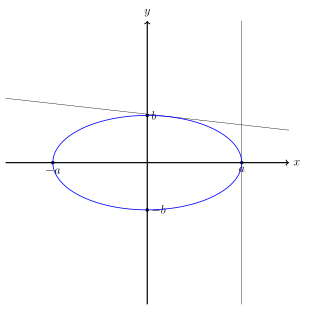
- The line \(L\) is the tangent to the ellipse at \(T\). The point \((X,Y)\) lies on \(L\), and \(X^2\ne a^2\). Show that \[ (a+X)bt^2 -2aYt +b(a-X) =0 \,.\] Deduce that if \(a^2Y^2>(a^2-X^2)b^2\), then there are two distinct lines through \((X,Y)\) that are tangents to the ellipse. Interpret this result geometrically. Show, by means of a sketch, that the result holds also if \(X^2=a^2\,\).
- The distinct points \(P\) and \(Q\) are given by \((*)\), with \(t=p\) and \(t=q\), respectively. The tangents to the ellipse at \(P\) and \(Q\) meet at the point with coordinates \((X,Y)\), where \(X^2\ne a^2\,\). Show that \[ (a+X)pq = a-X\] and find an expression for \(p+q\) in terms of \(a\), \(b\), \(X\) and \(Y\). Given that the tangents meet the \(y\)-axis at points \((0,y_1)\) and \((0,y_2)\), where \(y_1+y_2 = 2b\,\), show that \[ \frac{X^2}{a^2} +\frac{Y}{b}= 1 \,. \]
Solution:
- The tangent has equation:
\begin{align*}
&& 0 &= \frac{Xx}{a^2} + \frac{Yy}{b^2} -1 \\
\Rightarrow &&&= \frac{Xa(1-t^2)}{a^2(1+t^2)} + \frac{Y2bt}{b^2(1+t^2)} - 1 \\
\Rightarrow &&0&= Xb(1-t^2) + Y2at - ab(1+t^2)\\
&&&= -(b(a+X)t^2 -2aYt +b(a-X)) \\
\Rightarrow && 0 &= (a+X)bt^2-2aYt+b(a-X) \\
\\
&& 0 <\Delta &= 4a^2Y^2 - 4(a+X)b(a-X)b \\
&&&= 4(a^2Y^2-b^2(a^2-X^2)) \\
\Leftrightarrow && a^2Y^2 &> (a^2-X^2)b^2
\end{align*}
Therefore there are two roots to the quadratic, ie two values of the parameter \(t\) which works. The condition is equivalent to \(\frac{X^2}{a^2} + \frac{Y^2}{b^2} > 1\). ie from any point outside the ellipse there are two tangent lies.
Clearly there are two tangents when \(X = \pm a\) (except \((X,Y) = (\pm a, 0)\).
- We must have \(p\) and \(q\) are roots of \(0 = (a+X)bt^2-2aYt+b(a-X)\), ie \(pq = \frac{b(a-X)}{(a+X)b} \Rightarrow (a+X)pq = a-X\). Similarly \(p+q = \frac{2aY}{(a+X)b}\) Given that the tangents meet the \(y\)-axis at \((0, y_i)\) we must have \(abt^2-2ay_it + ab = 0\), so \begin{align*} && 0 &= abp^2-2ay_1p + ab \\ && 0 &= abq^2-2ay_2q + ab \\ \Rightarrow && y_1 &= \frac{ab(p^2+1)}{2ap} \\ && y_2 &= \frac{ab(q^2+1)}{2aq} \\ \Rightarrow && 2b &= \frac{ab(p^2+1)}{2ap} +\frac{ab(q^2+1)}{2aq} \\ &&&= \frac{ab(pq(p+q)+p+q)}{2apq} \\ \Rightarrow && 4pq &= pq(p+q)+p+q \\ \Rightarrow && 4 \frac{b(a-X)}{(a+X)b} &= \frac{2aY}{(a+X)b} \left ( \frac{b(a-X)}{(a+X)b} + 1 \right) \\ && &= \frac{2aY}{(a+X)b} \frac{2ab}{(a+X)b} \\ \Rightarrow && 4b^2(a^2-X^2) &= 4a^2bY \\ \Rightarrow && 1 &= \frac{Y}{b} + \frac{X^2}{a^2} \end{align*} as required.
2017 Paper 3 Q8
Prove that, for any numbers \(a_1, a_2, \ldots\,,\) and \(b_1, b_2, \ldots\,,\) and for \(n\ge1\), \[ \sum_{m=1}^n a_m(b_{m+1} -b_m) = a_{n+1}b_{n+1} -a_1b_1 -\sum_{m=1}^n b_{m+1}(a_{m+1} -a_m) \,. \]
- By setting \(b_m = \sin mx\), show that \[ \sum_{m=1}^n \cos (m+\tfrac12)x = \tfrac12 \big(\sin (n+1)x - \sin x \big) \cosec \tfrac12 x \,. \] Note: $\sin A - \sin B = \displaystyle 2 \cos \big( \tfrac{{\displaystyle A+B\vphantom{_1}}} {\displaystyle 2\vphantom{^1}} \big)\, \sin\big( \tfrac{{\displaystyle A-B\vphantom{_1}}}{\displaystyle 2\vphantom{^1}} \big)\, $.
- Show that \[ \sum_{m=1}^n m\sin mx = \big (p \sin(n+1)x +q \sin nx\big) \cosec^2 \tfrac12 x \,, \] where \(p\) and \(q\) are to be determined in terms of \(n\). Note: \(2\sin A \sin B = \cos (A-B) - \cos (A+B)\,\); Note: \(2\cos A \sin B = \sin (A+B) - \sin (A-B)\,\).
Solution: \begin{align*} \sum_{m=1}^n a_m(b_{m+1} -b_m) +\sum_{m=1}^n b_{m+1}(a_{m+1} -a_m) &= \sum_{m=1}^n \left (a_{m+1}b_{m+1}-a_mb_m \right) \\ &= a_{n+1}b_{n+1} - a_1b_1 \end{align*} And the result follows.
- Let \(b_m = \sin m x \), \(a_m = \cosec \frac{x}{2}\), so \begin{align*} && \sum_{m=1}^n \cosec \frac{x}{2} \left (\sin (m+1)x - \sin mx \right) &= \sum_{m=1}^n \cosec \frac{x}{2} 2 \cos \left ( \frac{2m+1}{2}x \right) \sin \left ( \frac{(m+1)-m}{2}x \right) \\ &&&=2 \sum_{m=1}^n\cos \left ( (m + \tfrac12)x \right)\\ \\ \Rightarrow && \sum_{m=1}^n\cos \left ( (m + \tfrac12)x \right) &= \tfrac12 \cosec \tfrac{x}{2}\left ( \sin(n+1)x - \sin x \right) \end{align*}
- \(\,\) \begin{align*} && b_{m+1}-b_m &= \sin m x \sin \tfrac12 x \\ &&&= \frac12 \left ( \cos (m-\tfrac12)x - \cos (m+\tfrac12)x \right)\\ \Rightarrow && b_m &= -\tfrac12 \cos (m - \tfrac12)x\\ && a_m &= m \\ \Rightarrow && \sum_{m=1}^n m \sin m x \sin \tfrac12 x &= (n+1) b_{n+1} - 1 \cdot b_1 - \sum_{m=1}^n b_{m+1} \cdot 1 \\ &&&= -(n+1) \tfrac12\cos(n+1-\tfrac12)x+\tfrac12\cos(\tfrac12x) + \tfrac12\sum_{m=1}^n \cos(m+\tfrac12)x \\ &&&= -(n+1) \tfrac12\cos(n+1-\tfrac12)x+\tfrac12\cos(\tfrac12x) + \tfrac14 \cosec \tfrac{x}{2}\left ( \sin(n+1)x - \sin x \right) \\ &&&= -(n+1) \tfrac12\cos(n+1-\tfrac12)x+ \tfrac14 \cosec \tfrac{x}{2}\sin(n+1)x \\ &&&= \tfrac12\cosec\tfrac{x}2 \left (\tfrac12 \sin (n+1)x-(n+1)\cos(n+\tfrac12)x\sin\tfrac12x \right) \\ &&&= \tfrac12\cosec\tfrac{x}2 \left (\tfrac12 \sin (n+1)x-(n+1)\tfrac12 \left ( \sin (n+1)x - \sin nx \right) \right) \\ &&&= \tfrac14 \cosec \tfrac{x}{2} \left ( -n \sin (n+1)x +(n+1) \sin n x \right) \end{align*} Therefore \(p = -\frac{n}4, q = \frac{n+1}{4}\)
2017 Paper 3 Q9
Two particles \(A\) and \(B\) of masses \(m\) and \(2 m\), respectively, are connected by a light spring of natural length \(a\) and modulus of elasticity \(\lambda\). They are placed on a smooth horizontal table with \(AB\) perpendicular to the edge of the table, and \(A\) is held on the edge of the table. Initially the spring is at its natural length. Particle \(A\) is released. At a time \(t\) later, particle \(A\) has dropped a distance \(y\) and particle \( B\) has moved a distance \(x\) from its initial position (where \(x < a\)). Show that \( y + 2x= \frac12 gt^2\). The value of \(\lambda\) is such that particle \(B\) reaches the edge of the table at a time \(T\) given by \(T= \sqrt{6a/g\,}\,\). By considering the total energy of the system (without solving any differential equations), show that the speed of particle \(B\) at this time is \(\sqrt{2ag/3\,}\,\).
Solution: \begin{align*} \text{N2}(\downarrow): && mg -T &= m\ddot{y} \\ \text{N2}(\rightarrow): && T &= 2m\ddot{x} \\ \Rightarrow && g &= \ddot{y}+2\ddot{x} \\ \Rightarrow && \tfrac12gt^2 &= y + 2x \end{align*} At time \(T = \sqrt{6a/g}\), we have \(y + 2x = 3a\), note also that \(\dot{y}+2\dot{x} = gt\) \begin{array}{ccc} & \text{KE} & \text{GPE} & \text{EPE} \\ \text{Initial} & 0 & 0 & 0 \\ \text{Final} & \frac12m\dot{y}^2 + \frac12(2m)\dot{x}^2 & -mgy & \frac{\lambda (y-x)^2}{2a} \end{array} Also note when we head over the table, \(x = a\) and \(y = a\) \begin{align*} \text{COE}: && 0 &= \frac12m(gT-2\dot{x})^2+m\dot{x}^2-mga+\frac{\lambda(0)^2}{2a} \\ \Rightarrow && 0 &= (gT-2\dot{x})^2+2\dot{x}^2-2ga \\ &&&= (\sqrt{6ag}-2\dot{x})^2+2\dot{x}^2-2ga \\ &&&= 6\dot{x}^2-4\sqrt{6ag}+4ag \\ \Rightarrow &&&= (\sqrt{6}\dot{x} - 2\sqrt{ag})^2 \\ \Rightarrow && \dot{x} &= \sqrt{2ag/3} \end{align*} as required.
2017 Paper 3 Q10
A uniform rod \(PQ\) of mass \(m\) and length \(3a\) is freely hinged at \(P\). The rod is held horizontally and a particle of mass \(m\) is placed on top of the rod at a distance~\(\ell\) from \(P\), where \(\ell <2a\). The coefficient of friction between the rod and the particle is \(\mu\). The rod is then released. Show that, while the particle does not slip along the rod, \[ (3a^2+\ell^2)\dot \theta^2 = g(3a+2\ell)\sin\theta \,, \] where \(\theta\) is the angle through which the rod has turned, and the dot denotes the time derivative. Hence, or otherwise, find an expression for \(\ddot \theta\) and show that the normal reaction of the rod on the particle is non-zero when~\(\theta\) is acute. Show further that, when the particle is on the point of slipping, \[ \tan\theta = \frac{\mu a (2a-\ell)}{2(\ell^2 + a\ell +a^2)} \,. \] What happens at the moment the rod is released if, instead, \(\ell>2a\)?
Solution:

| Inital | \@ \(\theta\) | |
| Rotational KE of rod | \(0\) | \(\frac{1}{2}I\dot{\theta}^2 = \frac{1}{2} \frac{1}{3} m (3a)^2 \dot{\theta}^2 = \frac32 m a^2 \dot{\theta}^2\) |
| KE of particle | \(0\) | \(\frac12 m \ell^2\dot{\theta}^2\) |
| GPE of rod | \(0\) | \(-\frac{3}{2}mga \sin \theta\) |
| GPE of particle | \(0\) | \(-mg \ell \sin \theta\) |
| Total | \(0\) | \(\frac12m \l \l 3a^2 + \ell^2\r \dot{\theta}^2 - \l 3a + 2\ell \r g \sin \theta \r\) |
2017 Paper 3 Q11
A railway truck, initially at rest, can move forwards without friction on a long straight horizontal track. On the truck, \(n\) guns are mounted parallel to the track and facing backwards, where \(n>1\). Each of the guns is loaded with a single projectile of mass \(m\). The mass of the truck and guns (but not including the projectiles) is \(M\). When a gun is fired, the projectile leaves its muzzle horizontally with a speed \(v-V\) relative to the ground, where \(V\) is the speed of the truck immediately before the gun is fired.
- All \(n\) guns are fired simultaneously. Find the speed, \(u\), with which the truck moves, and show that the kinetic energy, \(K\), which is gained by the system (truck, guns and projectiles) is given by \[ K= \tfrac{1}{2}nmv^2\left(1 +\frac{nm}{M} \right) . \]
- Instead, the guns are fired one at a time. Let \(u_r\) be the speed of the truck when \(r\) guns have been fired, so that \(u_0= 0\). Show that, for \(1\le r \le n\,\), \[ u_r - u_{r-1} = \frac{mv}{M+(n-r)m} \tag{\(*\)} \] and hence that \(u_n < u\,\).
- Let \(K_r\) be the total kinetic energy of the system when \(r\) guns have been fired (one at a time), so that \(K_0 = 0\). Using \((*)\), show that, for \(1\le r\le n\,\), \[ K_r -K_{r-1} = \tfrac 12 mv^2 + \tfrac12 mv (u_r-u_{r-1}) \] and hence show that \[ K_n = \tfrac{1}{2}nmv^2 +\tfrac{1}{2}mvu_n \,. \] Deduce that \(K_n < K\).
Solution:
- \(\,\) \begin{align*} \text{COM}: && 0 &= nm(v-0) - Mu \\ \Rightarrow && u &= \frac{nm}{M}v \\ \\ \Rightarrow && \text{K.E.} &= \underbrace{\tfrac12 nmv^2}_{\text{projectiles}} + \underbrace{\tfrac12Mu^2}_{\text{guns and truck}} \\ &&&= \tfrac12nmv^2 + \tfrac12M \frac{n^2m^2}{M^2}v^2 \\ &&&= \tfrac12 nmv^2 \left (1 + \frac{nm}{M} \right) \end{align*}
- \(\,\) \begin{align*} \text{COM}: && ((n-r+1)m+M)u_{r-1} &= -m(v-u_{r-1})+ ((n-r)m+M)u_r \\ \Rightarrow && mv &= -((n-r+1)m+M-m)u_{r-1}+((n-r)m+M)u_r \\ \Rightarrow && u_r-u_{r-1} &= \frac{mv}{M+(n-r)m} \\ \\ && u_n &= \frac{mv}{M+(n-1)m} + \frac{mv}{M+(n-2)m} + \cdots + \frac{mv}{M} \\ &&&< \frac{mv}M + \cdots + \frac{mv}{M} \\ &&&= \frac{mn}{M}v = u \end{align*}
- \(\,\) \begin{align*} && K_r &= \underbrace{K_{r-1}-\frac12(m(n-r+1)+M)u_{r-1}^2}_{\text{energy of already dispersed projectiles}} + \frac12m(v-u_{r-1})^2 + \frac12(m(n-r)+M)u_r^2 \\ \Rightarrow && K_r-K_{r-1} &= \tfrac12(u_r^2-u_{r-1}^2)(M+m(n-r))+\tfrac12mv^2-mvu_{r-1} \\ &&&=\tfrac12mv^2+ \tfrac12(u_r+u_{r-1})mv-mvu_{r-1} \\ &&&= \tfrac12mv^2 + \tfrac12mv(u_r-u_{r-1}) \\ \\ && K_n &= \frac12nmv^2 + \tfrac12mv(u_n - u_0) \\ &&&= \tfrac12nmv^2 + \tfrac12mvu_n \\ &&&< \tfrac12nmv^2 + \tfrac12mvu \\ &&&= \tfrac12nmv^2 + \tfrac12mv \frac{nm}{M}v \\ &&&= \tfrac12nmv^2 \left (1 +\frac{m}{M} \right) \\ &&&\leq K \end{align*}
2017 Paper 3 Q12
The discrete random variables \(X\) and \(Y\) can each take the values \(1\), \(\ldots\,\), \(n\) (where \(n\ge2\)). Their joint probability distribution is given by \[ \P(X=x, \ Y=y) = k(x+y) \,, \] where \(k\) is a constant.
- Show that \[ \P(X=x) = \dfrac{n+1+2x}{2n(n+1)}\,. \] Hence determine whether \(X\) and \(Y\) are independent.
- Show that the covariance of \(X\) and \(Y\) is negative.
Solution:
- \(\,\) \begin{align*} && \mathbb{P}(X = x) &= \sum_{y=1}^n \mathbb{P}(X=x,Y=y) \\ &&&= \sum_{y=1}^n k(x+y) \\ &&&= nkx + k\frac{n(n+1)}2 \\ \\ && 1 &= \sum_{x=1}^n \mathbb{P}(X=x) \\ &&&= nk\frac{n(n+1)}{2} + kn\frac{n(n+1)}2 \\ &&&= kn^2(n+1) \\ \Rightarrow && k &= \frac{1}{n^2(n+1)} \\ \Rightarrow && \mathbb{P}(X = x) &= \frac{nx}{n^2(n+1)} + \frac{n(n+1)}{2n^2(n+1)} \\ &&&= \frac{n+1+2x}{2n(n+1)} \\ \\ && \mathbb{P}(X=x)\mathbb{P}(Y=y) &= \frac{(n+1)^2+2(n+1)(x+y)+4xy}{4n^2(n+1)^2} \\ &&&\neq \frac{x+y}{n^2(n+1)} \end{align*} Therefore \(X\) and \(Y\) are not independent.
- \(\,\) \begin{align*} && \E[X] &= \sum_{x=1}^n x \mathbb{P}(X=x) \\ &&&= \sum_{x=1}^n x \mathbb{P}(X=x)\\ &&&= \sum_{x=1}^n x \frac{n+1+2x}{2n(n+1)} \\ &&&= \frac{1}{2n(n+1)} \left ( (n+1) \sum x + 2\sum x^2\right)\\ &&&= \frac{1}{2n(n+1)} \left ( \frac{n(n+1)^2}{2} + \frac{n(n+1)(2n+1)}{3} \right) \\ &&&= \frac{1}{2} \left ( \frac{n+1}{2} + \frac{2n+1}{3} \right)\\ &&&= \frac{1}{2} \left ( \frac{7n+5}{6} \right)\\ &&&= \frac{7n+5}{12} \\ \\ && \textrm{Cov}(X,Y) &= \mathbb{E}\left[XY\right] - \E[X] \E[Y] \\ &&&= \sum_{x=1}^n \sum_{y=1}^n xy \frac{x+y}{n^2(n+1)} - \E[X]^2 \\ &&&= \frac{1}{n^2(n+1)} \sum \sum (x^2 y+xy^2) - \E[X]^2 \\ &&&= \frac{1}{n^2(n+1)} \left (\sum y \right )\left (\sum x^2\right ) - \E[X]^2 \\ &&&=\frac{(n+1)(2n+1)}{12} - \left ( \frac{7n+5}{12}\right)^2 \\ &&&= \frac1{144} \left (12(2n^2+3n+1) - (49n^2+70n+25) \right)\\ &&&= \frac{1}{144} \left (-25n^2-34n-13 \right) \\ &&& < 0 \end{align*} since \(\Delta = 34^2 - 4 \cdot 25 \cdot 13 = 4(17^2-25 \times 13) = -4 \cdot 36 < 0\)