Problems
Filters
1531 problems found
2017 Paper 1 Q9
A particle is projected at speed \(u\) from a point \(O\) on a horizontal plane. It passes through a fixed point \(P\) which is at a horizontal distance \(d\) from \(O\) and at a height \(d \tan \beta\) above the plane, where \(d>0\) and \(\beta \) is an acute angle. The angle of projection \(\alpha\) is chosen so that \(u\) is as small as possible.
- Show that \(u^2 = gd \tan \alpha\) and \(2\alpha = \beta + 90^\circ\,\).
- At what angle to the horizontal is the particle travelling when it passes through \(P\)? Express your answer in terms of \(\alpha\) in its simplest form.
Solution:
- \(\,\) \begin{align*} && d &= u \cos \alpha t \\ && d \tan \beta &= u \sin \alpha t - \frac12 gt^2 \\ && &= d\tan \alpha - \frac1{2u^2} g d^2 \sec^2 \alpha \\ \Rightarrow && u^2 &= \frac{gd \sec^2 \alpha}{2(\tan \alpha + \tan \beta)} \\ &&&= \frac{gd t^2}{2(t+\tan \beta)} \\ && \frac{\d}{\d t} \left (u^2 \right) &= \frac{2gdt\cdot 2(t+\tan \beta) - gdt^2 \cdot 2}{4(t+\tan \beta)^2} \\ &&&= \frac{2gdt(2t-t+2\tan \beta)}{4(t+\tan \beta)^2} \\ &&&= \frac{gdt(t+2\tan \beta)}{2(t+\tan \beta)^2} \\ \end{align*} So either \(t = 0\) or \(t = -2 \tan \beta\) \begin{align*} && u^2 &= \frac{gd\cdot 4 \tan^2 \beta}{2(-2\tan \beta + \tan \beta)} \\ &&&= \frac{2gd \tan \beta}{-1} \\ &&&= gd (-2\tan \beta) \\ &&&= gd \tan \alpha \end{align*} \begin{align*} && d \tan \beta &= d \tan \alpha - \frac12 \frac{gd^2}{gd \tan \alpha \cdot \cos^2 \alpha } \\ \Rightarrow && \tan \beta&= \tan \alpha - \frac{1}{2\sin \alpha \cos \alpha} \\ &&&= \frac{2 \sin^2 \alpha - 1}{2 \sin \alpha \cos \alpha} \\ &&&= \frac{-\cos 2 \alpha}{\sin 2 \alpha} \\ &&&= -\cot 2 \alpha \\ &&&= \tan (2\alpha - 90^\circ) \\ \Rightarrow && \beta &= 2\alpha - 90^\circ \\ \Rightarrow && 2\alpha &= \beta + 90^\circ \end{align*}
- Suppose the angle to the horizontal is \(\theta\), then \(\tan \theta = \frac{v_y}{v_x}\) so \begin{align*} && \tan \theta &= \frac{u \sin \alpha - gt}{u \cos \alpha} \\ &&&= \frac{u \sin \alpha - \frac12 g \frac{d}{u \cos \alpha}}{u \cos \alpha} \\ &&&= \frac{u^2\sin \alpha \cos \alpha - gd}{u^2 \cos^2 \alpha} \\ &&&= \frac{gd \tan \alpha \sin \alpha \cos \alpha- gd}{ gd \tan \alpha \cdot \cos^2 \alpha} \\ &&&= \frac{\tan \alpha \sin \alpha \cos \alpha - 1}{ \sin \alpha \cos \alpha} \\ &&&= \frac{\sin^2 \alpha - 1}{\sin \alpha \cos \alpha} \\ &&&= -\frac{\cos \alpha}{\sin \alpha}\\ &&&= - \cot \alpha = \tan (\alpha - 90^\circ)\\ \Rightarrow && \theta &= \alpha - 90^\circ \end{align*}
2017 Paper 1 Q10
Particles \(P_1\), \(P_2\), \(\ldots\) are at rest on the \(x\)-axis, and the \(x\)-coordinate of \(P_n\) is \(n\). The mass of \(P_n\) is \(\lambda^nm\). Particle \(P\), of mass \(m\), is projected from the origin at speed \(u\) towards \(P_1\). A series of collisions takes place, and the coefficient of restitution at each collision is \(e\), where \(0 < e <1\). The speed of \(P_n\) immediately after its first collision is \(u_n\) and the speed of \(P_n\) immediately after its second collision is \(v_n\). No external forces act on the particles.
- Show that \(u_1=\dfrac{1+e}{1+\lambda}\, u\) and find expressions for \(u_n\) and \(v_n\) in terms of \(e\), \(\lambda\), \(u\) and \(n\).
- Show that, if \(e > \lambda\), then each particle (except \(P\)) is involved in exactly two collisions.
- Describe what happens if \(e=\lambda\) and show that, in this case, the fraction of the initial kinetic energy lost approaches \(e\) as the number of collisions increases.
- Describe what happens if \(\lambda e=1\). What fraction of the initial kinetic energy is \mbox{eventually} lost in this case?
Solution:
- \begin{align*} \text{COM}: && mu &= mv + \lambda m u_1 \\ \Rightarrow && u &= v + \lambda u_1 \tag{1} \\ \text{NEL}: && e &= \frac{u_1-v}{u} \\ \Rightarrow && eu &= u_1 - v \tag{2} \\ (1)+(2) && (1+e)u &= (1+\lambda) u_1 \\ \Rightarrow && u_1 &= \frac{1+e}{1+\lambda}u \\ && v &= u_1 - eu \\ &&&= \frac{1+e - (1+\lambda)e}{1+\lambda} u \\ &&&= \frac{1-\lambda e}{1+\lambda}u \end{align*} Note that subsequent (first (and second)) are the same as these, therefore: \begin{align*} u_n &= \left ( \frac{1+e}{1+\lambda} \right)^n u \\ v_n &= \frac{1-\lambda e}{1+\lambda } u_n \\ &= \frac{1-\lambda e}{1+\lambda } \left ( \frac{1+e}{1+\lambda} \right)^n u \end{align*}

- If \(e > \lambda\) then \((1-\lambda e) > 1-e^2 > 0\) and \begin{align*} \frac{v_{n+1}}{v_n} &= \frac{1+e}{1+\lambda} > 1 \end{align*} So the particles are moving away from each other - hence no more collisions.
- If \(e = \lambda\) then \(u_n = u\) and \(v_n = (1-\lambda)u\) so all the particles end up moving at the same speed. \begin{align*} \text{initial k.e.} &= \frac12 m u^2 \\ \text{final k.e.} &= \frac12 m((1-e)u)^2 + \sum_{n = 1}^{\infty} \frac12 \lambda^n m ((1-e)u)^2 \\ &= \frac12mu^2(1-e)^2 \left ( \sum_{n=0}^{\infty} e^n \right) \tag{\(e = \lambda\)} \\ &= \frac12 mu^2(1-e)^2 \frac{1}{1-e} \\ &= \frac12m u^2 (1-e) \\ \text{change in k.e.} &= \frac12 m u^2 - \frac12m u^2 (1-e) \\ &= e\frac12m u^2 \end{align*} Ie the total energy lost approaches a fraction of \(e\).
- If \(\lambda e = 1\), after the second collision the particle will be stationary. ie \begin{align*} \text{initial k.e.} &= \frac12 m u^2 \\ \text{k.e. after }n\text{ collisions} &= \frac12 \lambda^n m \left (\left ( \frac{1+e}{1+\lambda} \right)^n u \right)^2\\ &= \frac12 \lambda^n m \left ( \frac{1+\frac1{\lambda}}{1+\lambda} \right)^{2n} u&2\\ &= \frac12 \lambda^n m \left ( \frac{1+\frac1{\lambda}}{1+\lambda} \right)^{2n} u\\ &= \frac12 \lambda^n m \left ( \frac{1}{\lambda} \right)^{2n} u\\ &= \frac12 m \lambda^{-n} u\\ &\to 0 \end{align*} Eventually we lose all the kinetic energy.
2017 Paper 1 Q11
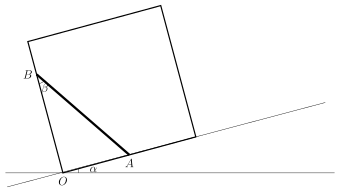
A plane makes an acute angle \(\alpha\) with the horizontal. A box in the shape of a cube is fixed onto the plane in such a way that four of its edges are horizontal and two of its sides are vertical. A uniform rod of length \(2L\) and weight \(W\) rests with its lower end at \(A\) on the bottom of the box and its upper end at \(B\) on a side of the box, as shown in the diagram below. The vertical plane containing the rod is parallel to the vertical sides of the box and cuts the lowest edge of the box at \(O\). The rod makes an acute angle~\(\beta\) with the side of the box at \(B\). The coefficients of friction between the rod and the box at the two points of contact are both \(\tan \gamma\), where \(0 < \gamma < \frac12\pi\). %The frictional force on the rod at \(A\) acts toward \(O\), %and the frictional force on the rod at~\(B\) %acts away from \(O\). The rod is in limiting equilibrium, with the end at \(A\) on the point of slipping in the direction away from \(O\) and the end at \(B\) on the point of slipping towards \(O\). Given that \(\alpha < \beta\), show that \(\beta = \alpha + 2\gamma\). [\(Hint\): You may find it helpful to take moments about the midpoint of the rod.]
Solution:

2017 Paper 1 Q12
In a lottery, each of the \(N\) participants pays \(\pounds c\) to the organiser and picks a number from \(1\) to \(N\). The organiser picks at random the winning number from \(1\) to \(N\) and all those participants who picked this number receive an equal share of the prize, \(\pounds J\).
- The participants pick their numbers independently and with equal probability. Obtain an expression for the probability that no participant picks the winning number, and hence determine the organiser's expected profit. Use the approximation \[ \left( 1 - \frac{a}{N} \right)^N \approx \e^{-a} \tag{\(*\)} \] to show that if \(2Nc = J\) then the organiser will expect to make a loss. Note: \(\e > 2\).
- Instead of the numbers being equally popular, a fraction \(\gamma\) of the numbers are popular and the rest are unpopular. For each participant, the probability of picking any given popular number is \(\dfrac{a}{N}\) and the probability of picking any given unpopular number is \(\dfrac{b}{N}\,\). Find a relationship between \(a\), \(b\) and \(\gamma\). Show that, using the approximation \((*)\), the organiser's expected profit can be expressed in the form \[ A\e^{-a} + B\e^{-b} +C \,, \] where \(A\), \(B\) and \(C\) can be written in terms of \(J\), \(c\), \(N\) and \(\gamma\). In the case \(\gamma = \frac18\) and \(a=9b\), find \(a\) and \(b\). Show that, if \(2Nc = J\), then the organiser will expect to make a profit. Note: \(\e < 3\).
Solution:
- The probability no-one picks the winning number is \(\left ( 1 - \frac{1}{N}\right)^N \approx \frac1e\). \begin{align*} && \mathbb{E}(\text{profit}) &= Nc - (1-e^{-1})J \\ &&& < Nc -(1- \tfrac12 )J \\ &&& < Nc - \frac12 J \\ &&&= \frac{2Nc-J}{2} \end{align*} Therefore if \(J = 2Nc\) the expected profit is negative.
- \(\,\) \begin{align*} && 1 &= \sum_{\text{all numbers}} \mathbb{P}(\text{pick }i) \\ &&&= \sum_{\text{popular numbers}} \mathbb{P}(\text{pick }i)+\sum_{\text{unpopular numbers}} \mathbb{P}(\text{pick }i) \\ &&&=\gamma N \frac{a}{N} + (1-\gamma)N \frac{b}{N} \\ &&&= \gamma a + (1-\gamma)b \end{align*} \begin{align*} && \mathbb{P}(\text{no-one picks winning number}) &= \mathbb{P}(\text{no-one picks winning number} | \text{winning number is popular})\mathbb{P})(\text{winning number is popular}) + \\ &&&\quad + \mathbb{P}(\text{no-one picks} | \text{unpopular})\mathbb{P}(\text{unpopular}) \\ &&&= \left (1 - \frac{a}{N} \right)^N \gamma + \left (1 - \frac{b}{N} \right)^N (1-\gamma) \\ &&&\approx \gamma e^{-a} + (1-\gamma)e^{-b} \\ \\ && \mathbb{E}(\text{profit}) &= Nc - (1-\gamma e^{-a} - (1-\gamma)e^{-b})J \\ &&&= Nc-J+J\gamma e^{-a} +J(1-\gamma)e^{-b} \end{align*} If \(\gamma = \frac18\) and \(a=9b\), then \(1=\frac18 a + \frac78b = 2b \Rightarrow b = \frac12, a = \frac92\) and \begin{align*} && \mathbb{E}(\text{profit}) &= Nc-J +J\tfrac18e^{-9/2}+J\tfrac78e^{-1/2} \\ &&&= Nc-J+\tfrac18Je^{-1/2}(e^{-4}+7) \end{align*} If we can show \(e^{-1/2}\frac{e^{-4}+7}{8} > \frac12\) we'd be done, so \begin{align*} && e^{-1/2}\frac{e^{-4}+7}{8} &> \frac12 \\ \Leftrightarrow && e^{-4}+7 &>4e^{1/2} \\ \Leftrightarrow && 49+14e^{-4}+e^{-8} &>16e \\ \end{align*} But clearly the LHS \(>49\) and the RHS \(<48\) so we're done
2017 Paper 1 Q13
I have a sliced loaf which initially contains \(n\) slices of bread. Each time I finish setting a STEP question, I make myself a snack: either toast, using one slice of bread; or a sandwich, using two slices of bread. I make toast with probability \(p\) and I make a sandwich with probability \(q\), where \(p+q=1\), unless there is only one slice left in which case I must, of course, make toast. Let \(s_r\) (\(1 \le r \le n\)) be the probability that the \(r\)th slice of bread is the second of two slices used to make a sandwich and let \(t_r\) (\(1 \le r \le n\)) be the probability that the \(r\)th slice of bread is used to make toast. What is the value of \(s_1\)? Explain why the following equations hold: \begin{align*} \phantom{\hspace{2cm} (2\le r \le n-1)} t_r &= (s_{r-1}+ t_{r-1})\,p \hspace{2cm} (2\le r \le n-1)\,; \\ \phantom{\hspace{1.53cm} (2\le r \le n) } s_r &= 1- (s_{r-1} + t_{r-1}) \hspace{1.53cm} ( 2\le r \le n )\,. \end{align*} Hence, or otherwise, show that \(s_{r} = q(1-s_{r-1})\) for \(2\le r\le n-1\). Show further that \[ \phantom{\hspace{2.7cm} (1\le r\le n)\,,} s_r = \frac{q+(-q)^r}{1+q} \hspace{2.7cm} (1\le r\le n-1)\,, \, \hspace{0.14cm} \] and find the corresponding expression for \(t_r\). Find also expressions for \(s_n\) and \(t_n\) in terms of \(q\).
Solution: The \(1\)st slice of bread can only be the first slice in a sandwich or a slice of toast. Therefore \(s_1 = 0\) \begin{align*} && t_r &= \underbrace{s_{r-1}}_{r-1\text{th is the end of a sandwich}} \cdot \underbrace{p}_{\text{and we make toast}} + \underbrace{t_{r-1}}_{r-1\text{th is toast}} \cdot \underbrace{p}_{\text{and we make toast}} \\ &&&= (s_{r-1}+t_{r-1})p \\ \\ && s_r &= 1-\mathbb{P}(\text{previous slice is not the first of a sandwich}) \\ &&&= 1-(s_{r-1} + t_{r-1}) \\ \\ \Rightarrow && s_r &= 1 - \frac{t_r}{p} \\ \Rightarrow && t_r &= p - ps_r \\ \Rightarrow && s_r &= 1 - s_{r-1} - (p-ps_{r-1}) \\ &&&= 1 -p -(1-p)s_{r-1} \\ &&&= q(1-s_{r-1}) \end{align*} Therefore since \(s_r + qs_{r-1} = q\) we should look for a solution of the form \(s_r = A(-q)^r + B\). The particular solution will have \((1+q)B = q \Rightarrow B = \frac{q}{1+q}\), the initial condition will have \(s_1 = \frac{q}{1+q} +A(-q) = 0 \Rightarrow q = \frac{1}{1+q}\), so we must have \begin{align*} && s_r &= \frac{q+(-q)^r}{1+q}\\ \Rightarrow && t_r &= p(1-s_r) \\ &&&= p \frac{1+q-q-(-q)^r}{1+q} \\ &&&= \frac{(1-q)(1-(-q)^r)}{1+q} \\ && s_n &= 1-\frac{q+(-q)^{n-1}}{1+q} - \frac{p(1-(-q)^{n-1})}{1+q} \\ &&&= 1-\frac{1+(1-p)(-q)^{n-1}}{1+q}\\ &&&= 1-\frac{1-(-q)^n}{1+q}\\ &&&= \frac{q+(-q)^n}{1+q}\\ && t_n &=1-s_n \\ &&&=\frac{1-(-q)^n}{1+q} \end{align*}
2017 Paper 2 Q1
Note: In this question you may use without proof the result \( \dfrac{\d \ }{\d x}\big(\!\arctan x \big) = \dfrac 1 {1+x^2}\,\). Let \[ I_n = \int_0^1 x^n \arctan x \, \d x \;, \] where \(n=0\), 1, 2, 3, \(\ldots\) .
- Show that, for \(n\ge0\,\), \[ (n+1) I_n = \frac \pi 4 - \int _0^1 \frac {x^{n+1}}{1+x^2} \, \d x \, \] and evaluate \(I_0\).
- Find an expression, in terms of \(n\), for \((n+3)I_{n+2}+(n+1)I_{n}\,\). Use this result to evaluate \(I_4\).
- Prove by induction that, for \(n\ge1\), \[ (4n+1) I_{4n} =A - \frac12 \sum_{r=1}^{2n} (-1)^r \frac 1 {r} \,, \] where \(A\) is a constant to be determined.
Solution:
- \(\,\) \begin{align*} && I_n &= \int_0^1 x^n \arctan x \d x \\ &&&= \left [ \frac{x^{n+1}}{n+1} \arctan x\right]_0^1 - \int_0^1 \frac{x^{n+1}}{n+1} \frac{1}{1+x^2} \d x \\ &&&= \frac{1}{n+1} \frac{\pi}{4} - \frac{1}{n+1} \int_0^1 \frac{x^{n+1}}{1+x^2}\d x \\ \Rightarrow && (n+1)I_n &= \frac{\pi}{4} - \int_0^1 \frac{x^{n+1}}{1+x^2}\d x \\ && I_0 &= \frac{\pi}{4} - \int_0^1 \frac{x}{1+x^2} \d x \\ &&&= \frac{\pi}{4} - \left [\frac12 \ln(1+x^2) \right]_0^1 \\ &&&= \frac{\pi}{4} - \frac12 \ln 2 \end{align*}
- \(\,\) \begin{align*} && (n+3)I_{n+2} + (n+1)I_n &=\left ( \frac{\pi}{4} - \int_0^1 \frac{x^{n+3}}{1+x^2} \d x \right)+ \left (\frac{\pi}{4} - \int_0^1 \frac{x^{n+1}}{1+x^2} \d x \right) \\ &&&=\frac{\pi}{2}+ \int_0^1 \frac{x^{n+1}+x^{n+3}}{1+x^2} \d x \\ &&&=\frac{\pi}{2}+ \int_0^1 x^{n+1} \d x \\ &&&= \frac{\pi}{2} + \frac{1}{n+2} \\ && 3I_2 + I_0 &= \frac{\pi}{2} + \frac{1}{2} \\ \Rightarrow && 3I_2 &=\frac{\pi}{4} + \frac12 \ln 2 + \frac12 \\ && 5I_4 + 3I_2 &= \frac{\pi}{2} + \frac14 \\ \Rightarrow && 5I_4 &= \frac{\pi}{2} + \frac14 - \left ( \frac{\pi}{4} + \frac12 \ln 2 + \frac12\right) \\ &&&= \frac{\pi}4-\frac12 \ln 2-\frac14 \\ \Rightarrow && I_4 &= \frac15 \left (\frac{\pi}4-\frac12 \ln 2-\frac14 \right) \\ &&&= \frac1{20} \left (\pi - 2\ln 2 -1 \right) \end{align*}
- Claim: \[ (4n+1) I_{4n} =\frac{\pi}4-\frac12 \ln 2 - \frac12 \sum_{r=1}^{2n} (-1)^r \frac 1 {r} \,, \] Proof: Base case we have just shown above Assume true for \(n = k\), consider \(n = k+1\), then \begin{align*} && (4(k+1)+1) I_{4(k+1)} &= \frac{\pi}{2} + \frac{1}{4(k+1)} - (4k+3)I_{4k+2} \\ &&&= \frac{\pi}{2} + \frac{1}{4(k+1)} - \left (\frac{\pi}{2} + \frac{1}{2(2k+1)} - (4k+1)I_{4k} \right)\\ &&&= (4k+1)I_{4k} - \frac12 \left ( \frac{1}{2k+2} - \frac{1}{2k+1}\right) \\ &&&= \frac{\pi}4-\frac12 \ln 2 - \frac12 \sum_{r=1}^{2k} (-1)^r \frac 1 {r} - \frac12 \left ( \frac{1}{2k+2} - \frac{1}{2k+1}\right)\\ &&&= \frac{\pi}4-\frac12 \ln 2 - \frac12 \sum_{r=1}^{2(k+1)} (-1)^r \frac 1 {r} \\ \end{align*} as required.
2017 Paper 2 Q2
The sequence of numbers \(x_0\), \(x_1\), \(x_2\), \(\ldots\) satisfies \[ x_{n+1} = \frac{ax_n-1}{x_n+b} \,. \] (You may assume that \(a\), \(b\) and \(x_0\) are such that \(x_n+b\ne0\,\).) Find an expression for \(x_{n+2}\) in terms of \(a\), \(b\) and \(x_n\).
- Show that \(a+b=0\) is a necessary condition for the sequence to be periodic with period 2. Note: The sequence is said to be periodic with period \(k\) if \(x_{n+k} = x_n\) for all \(n\), and there is no integer \(m\) with \(0 < m < k\) such that \(x_{n+m} = x_n\) for all \(n\).
- Find necessary and sufficient conditions for the sequence to have period 4.
Solution: \begin{align*} x_{n+2} &= \frac{ax_{n+1}-1}{x_{n+1}+b} \\ &= \frac{a \frac{ax_n - 1}{x_n+b}-1}{\frac{ax_n - 1}{x_n+b}+b} \\ &= \frac{a(ax_n-1)-(x_n+b)}{ax_n-1+b(x_n+b)} \\ &= \frac{(a^2-1)x_n-(a+b)}{(a+b)x_n+b^2-1} \end{align*}
- If \(x_{n+2} = x_n\) then \begin{align*} && x_n &= \frac{(a^2-1)x_n-(a+b)}{(a+b)x_n+b^2-1} \\ \Rightarrow && 0 &=(a+b)x_n^2+(b^2-a^2)x_n+(a+b) \\ &&&= (a+b)(x_n^2+(a-b)x_n + 1) \end{align*} If \(x_{n+1} = x_n\) then \(x_n^2+(a-b)x_n + 1\) and since our sequence has period \(2\) rather than \(1\) it must be the case this is non-zero. Therefore \(a+b =0\).
- \begin{align*} x_{n+4} &= \frac{(a^2-1)x_{n+2}-(a+b)}{(a+b)x_{n+2}+b^2-1} \\ &= \frac{(a^2-1)\frac{(a^2-1)x_{n}-(a+b)}{(a+b)x_{n}+b^2-1} -(a+b)}{(a+b)\frac{(a^2-1)x_{n}-(a+b)}{(a+b)x_{n}+b^2-1} +b^2-1} \\ &= \frac{((a^2-1)^2-(a+b)^2)x_n -(a^2+b^2-2)(a+b)}{(a^2+b^2-2)(a+b)x_n + (b^2-1)^2-(a+b)^2} \end{align*} If \(x_{n+4} = x_n\) then \begin{align*} x_n &=\frac{((a^2-1)^2-(a+b)^2)x_n -(a^2+b^2-2)(a+b)}{(a^2+b^2-2)(a+b)x_n + (b^2-1)^2-(a+b)^2} \\ 0 &= (a^2+b^2-2)(a+b)x_n^2 + \l (b^2-1)^2-(a^2-1)^2 \r x_n+(a^2+b^2-2)(a+b) \\ &= (a^2+b^2-2)(a+b)x_n^2+(b^2-a^2)(a^2+b^2-2)x_n + (a^2+b^2-2)(a+b) \\ &= (a^2+b^2-2)(a+b)(x_n^2+(b-a)x_n + 1) \end{align*} Since we do not want \(x_n\) to be periodic with period \(1\) we must have the quadratic in \(x_n\) \(\neq 0\). If \(a+b = 0\) then \(x_n\) is periodic with period \(2\) since \(x_{n+2} = \frac{(a^2-1)x_n}{((-a)^2-1)} = x_n\). Therefore it is necessary that \(a^2+b^2-2 = 0\). If \(a^2+b^2-2= 0\) then \begin{align*} x_{n+4} &= \frac{((a^2-1)^2-(a+b)^2)x_n}{(b^2-1)^2-(a+b)^2} \\ &=\frac{((a^2-1)^2-(a+b)^2)x_n}{((2-a^2)-1)^2-(a+b)^2} \\ &=\frac{((a^2-1)^2-(a+b)^2)x_n}{((1-a^2)^2-(a+b)^2} \\ &= x_n \end{align*} Therefore it is sufficient too. So our conditions are \(a+b \neq 0, \, \, x_n^2+(a-b)x_n + 1 \neq 0\) and \(a^2+b^2-2 = 0\)
2017 Paper 2 Q3
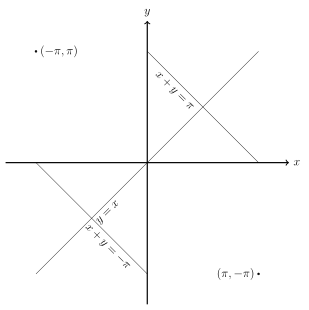
- Sketch, on \(x\)-\(y\) axes, the set of all points satisfying \(\sin y = \sin x\), for \(-\pi \le x \le \pi\) and \(-\pi \le y \le \pi\). You should give the equations of all the lines on your sketch.
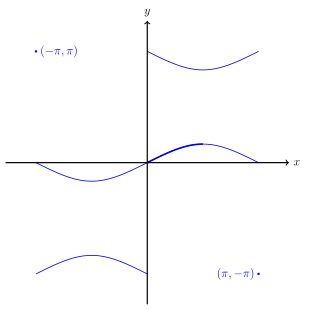
- Given that \[ \sin y = \tfrac12 \sin x \] obtain an expression, in terms of \(x\), for \(y'\) when \(0\le x \le \frac12 \pi\) and \(0\le y \le \frac12 \pi\), and show that \[ y'' = - \frac {3\sin x}{(4-\sin^2 x)^{\frac32}} \;. \] Use these results to sketch the set of all points satisfying \(\sin y = \tfrac12 \sin x\) for \(0 \le x \le \frac12 \pi\) and \(0 \le y \le \frac12 \pi\). Hence sketch the set of all points satisfying \(\sin y = \tfrac12 \sin x\) for \(-\pi\! \le \! x \! \le \! \pi\) and \mbox{\( -\pi \, \le\, y\, \le\, \pi\,\)}.
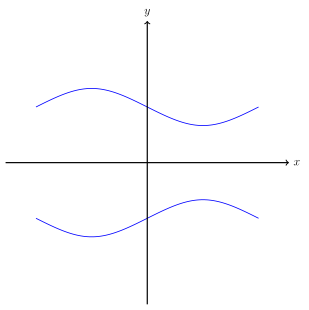
- Without further calculation, sketch the set of all points satisfying \(\cos y = \tfrac12 \sin x\) for \(- \pi \le x \le \pi\) and \( -\pi \le y \le \pi\).
Solution:
- \(\,\)
- \(\,\) \begin{align*}
&& \sin y &= \tfrac12 \sin x \\
\Rightarrow && \frac{\d y}{\d x} \cos y &= \tfrac12 \cos x \\
\Rightarrow && \frac{\d y}{\d x} &= \frac{\cos x}{2 \cos y} \\
&&&= \frac{\cos x}{2 \sqrt{1-\sin^2 y}} \\
&&&= \frac{\cos x}{2 \sqrt{1-\frac14 \sin^2 x}} \\
&&&= \frac{\cos x}{\sqrt{4-\sin^2 x}} \\
\\
&& y'' &= \frac{-\sin x \cdot (4-\sin^2 x)^{\frac12} - \cos x \cdot (4-\sin^2 x)^{-\frac12} \cdot 2 \sin x \cos x}{(4-\sin^2 x)} \\
&&&= \frac{-\sin x \cdot (4-\sin^2 x) - \cos x \cdot 2 \sin x \cos x}{(4-\sin^2x)^{\frac32}} \\
&&&= \frac{-\sin x \cdot (4-\sin^2 x) - \sin x (1-\sin^2x)}{(4-\sin^2x)^{\frac32}} \\
&&&= \frac{-3\sin x }{(4-\sin^2x)^{\frac32}} \\
\end{align*}
- \(\,\)
2017 Paper 2 Q4
The Schwarz inequality is \[ \left( \int_a^b \f(x)\, \g(x)\,\d x\right)^{\!\!2} \le \left( \int_a^b \big( \f(x)\big)^2 \d x \right) \left( \int_a^b \big( \g(x)\big)^2 \d x \right) . \tag{\(*\)} \]
- By setting \( \f(x)=1\) in \((*)\), and choosing \(\g(x)\), \(a\) and \(b\) suitably, show that for \(t> 0\,\), \[ \frac {\e^t -1}{\e^t+1} \le \frac t 2 \,. \]
- By setting \( \f(x)= x\) in \((*)\), and choosing \( \g(x)\) suitably, show that \[ \int_0^1\e^{-\frac12 x^2}\d x \ge 12 \big(1-\e^{-\frac14})^2 \,. \]
- Use \((*)\) to show that \[ \frac {64}{25\pi} \le \int_0^{\frac12\pi} \!\! {\textstyle \sqrt{\, \sin x\, } } \, \d x \le \sqrt{\frac \pi 2 } \,. \]
Solution:
- Let \(f(x) = 1, g(x) = e^x, a = 0, b = t\), so \begin{align*} && \left ( \int_0^t e^x \d x \right)^2 &\leq \left (\int_0^t 1^2 \d x \right) \cdot \left (\int_0^t (e^x)^2 \d x \right) \\ \Rightarrow && (e^t-1)^2 &\leq t \cdot (\frac12e^{2t} - \frac12) \\ \Rightarrow && \frac{e^t-1}{e^t+1} & \leq \frac{t}{2} \end{align*}
- Let \(f(x) = x, g(x) = e^{-\frac14 x^2}, a = 0, b = 1\) \begin{align*} && \left ( \int_0^1 xe^{-\frac14 x^2} \d x \right)^2 &\leq \left (\int_0^1 x^2 \d x \right) \cdot \left (\int_0^1 (e^{-\frac14x^2})^2 \d x \right) \\ \Rightarrow && \left ( \left [-2e^{-\frac14x^2} \right]_0^1 \right)^2 & \leq \frac{1}{3} \int_0^1 e^{-\frac12 x^2} \d x \\ \Rightarrow && \int_0^1 e^{-\frac12 x^2} \d x & \geq 12(1-e^{-\frac14})^2 \end{align*}
- Let \(f(x) = 1, g(x) = \sqrt{\sin x}, a = 0, b = \tfrac12 \pi\), then \begin{align*} && \left ( \int_0^{\frac12 \pi} \sqrt{\sin x} \d x \right)^2 &\leq \left (\int_0^{\frac12 \pi} 1^2 \d x \right) \cdot \left (\int_0^{\frac12 \pi}|\sin x| \d x \right) \\ &&&= \frac{\pi}{2} \cdot 1 \\ \Rightarrow && \int_0^{\frac12 \pi} \sqrt{\sin x} \d x & \leq \sqrt{\frac{\pi}{2}} \end{align*} Let \(f(x) =(\sin x)^{\frac14}, g(x) = \cos x, a = 0, b = \tfrac12 \pi\), so \begin{align*} && \left ( \int_0^{\frac12 \pi} (\sin x)^{\frac14} \cos x \d x \right)^2 &\leq \left (\int_0^{\frac12 \pi} \cos^2 x \d x \right) \cdot \left (\int_0^{\frac12 \pi}\sqrt{\sin x} \d x \right) \\ \Rightarrow &&\left ( \left [\frac45 (\sin x)^{\frac54} \right]_0^{\frac12 \pi} \right)^2 & \leq \frac{\pi}{4} \int_0^{\frac12 \pi}\sqrt{\sin x} \d x \\ \Rightarrow && \frac{64}{25\pi} &\leq \int_0^{\frac12 \pi}\sqrt{\sin x} \d x \end{align*}
2017 Paper 2 Q5
A curve \(C\) is determined by the parametric equations \[ x=at^2 \, , \; y = 2at\,, \] where \(a > 0\).
- Show that the normal to \(C\) at a point \(P\), with non-zero parameter \(p\), meets \(C\) again at a point \(N\), with parameter \(n\), where \[ n= - \left( p + \frac{2}{p} \right). \]
- Show that the distance \(\left| PN \right|\) is given by \[ \vert PN\vert^2 = 16a^2\frac{(p^2+1)^3}{p^4} \] and that this is minimised when \(p^2=2\,\).
- The point \(Q\), with parameter \(q\), is the point at which the circle with diameter \(PN\) cuts \(C\) again. By considering the gradients of \(QP\) and \(QN\), show that \[ 2 = p^2-q^2 + \frac{2q}p. \] Deduce that \(\left| PN \right|\) is at its minimum when \(Q\) is at the origin.
Solution:
- \(\,\) \begin{align*} && \frac{\d x}{\d t} &= 2at \\ && \frac{\d y}{\d t} &= 2a \\ \Rightarrow && \frac{\d y}{\d x} &= \frac1t \\ && -p &= \text{grad of normal} \\ &&&= \frac{y-2ap}{x-ap^2} \\ \Rightarrow && y &= -px + ap^3+2ap \\ && 2an &= -pan^2 + ap^3 + 2ap \\ \Rightarrow && 0 &= pan^2+2an-ap(2+p^2) \\ \Rightarrow && n &= p, -\left ( p + \frac2{p}\right) \\ \Rightarrow && n &= -\left ( p + \frac2{p}\right) \end{align*}
- \(\,\) \begin{align*} && |PN|^2 &= (ap^2-an^2)^2 +(2ap-2an)^2 \\ &&&= a^2(p-n)^2(p+n)^2+4a^2(p-n)^2 \\ &&&= a^2(p-n)^2((p+n)^2+4) \\ &&&= a^2\left(p+p+\frac2p \right)^2 \left ( \left ( -\frac2p\right)^2+4\right)\\ &&&= a^2\left(\frac{2p^2+2}p \right)^2 \left ( \frac{4}{p^2}+4\right)\\ &&&= 16a^2 \frac{(p^2+1)^3}{p^4} \\ \\ && \frac{\d |PN|^2}{\d p^2} &= 16a^2\frac{3(p^2+1)^2p^4-2(p^2+1)^3p^2}{p^8} \\ &&&= 16a^2(p^2+1)^2 \frac{3p^2-2(p^2+1)}{p^6} \\ &&&= 16a^2(p^2+1)^2 \frac{p^2-2}{p^6} \end{align*} Therefore minimized when \(p^2=2\) (clearly a minimum by considering behaviour as \(p^2 \to 0, \infty\))
- If \(PN\) is the diameter of \(PNQ\) then \(QP\) and \(QN\) are perpendicular, ie \begin{align*} && -1 &= \frac{2ap-2aq}{ap^2-aq^2} \cdot \frac{2aq-2an}{aq^2-an^2} \\ &&&= \frac{2}{p+q} \cdot \frac{2}{q+n} \\ &&&= \frac{2}{p+q} \cdot \frac{2}{q - p -\frac{2}{p}} \\ \Rightarrow && 4 &= (p+q)(p+\frac2{p}-q) \\ &&&= p^2-q^2 + \frac{2q}{p} + 2 \\ \Rightarrow && 2 &= p^2 - q^2 + \frac{2q}{p} \end{align*} Therefore \(q = 0 \Rightarrow p^2 = 2 \Rightarrow |PN|\) is at it's minimum.
2017 Paper 2 Q6
Let \[ S_n = \sum_{r=1}^n \frac 1 {\sqrt r \ } \,, \] where \(n\) is a positive integer.
- Prove by induction that \[ S_n \le 2\sqrt n -1\, . \]
- Show that \((4k+1)\sqrt{k+1} > (4k+3)\sqrt k\,\) for \(k\ge0\,\). Determine the smallest number \(C\) such that \[ S_n \ge 2\sqrt n + \frac 1 {2\sqrt n} -C \,.\]
Solution:
- Claim: \(S_n \leq 2\sqrt{n} -1\). Proof: (By induction) (Base case: \(n = 1\)). \(\frac{1}{\sqrt{1}} \leq 1 = 2 \cdot \sqrt1 - 1\). Therefore the base case is true. (Inductive step): Suppose our result is true for \(n = k\). Then consider \(n = k+1\). \begin{align*} && \sum_{r=1}^{k+1} \frac{1}{\sqrt{r}} &=\sum_{r=1}^{k} \frac{1}{\sqrt{r}} + \frac{1}{\sqrt{k+1}} \\ &&&\leq 2\sqrt{k} - 1 + \frac{1}{\sqrt{k+1}} \\ &&&= \frac{2 \sqrt{k}\sqrt{k+1}+1}{\sqrt{k+1}} - 1 \\ &&&\underbrace{\leq}_{AM-GM} \frac{(k+k+1)+1}{\sqrt{k+1}} - 1 \\ &&&=\frac{2(k+1)}{\sqrt{k+1}} - 1 \\ &&&= 2\sqrt{k+1}-1 \end{align*} Therefore, since if our statement is true for \(n = k\), it is also true for \(n = k+1\). By the principle of mathematical induction we can say that it is true for all \(n \geq 1, n \in \mathbb{Z}\)
- Claim: \((4k+1)\sqrt{k+1} > (4k+3)\sqrt k\,\) for \(k\ge0\,\) Proof: \begin{align*} && (4k+1)\sqrt{k+1} &> (4k+3)\sqrt k \\ \Leftrightarrow && (4k+1)^2(k+1) &> (4k+3)^2k \\ \Leftrightarrow && (16k^2+8k+1)(k+1) &> (16k^2 + 24k+9)k \\ \Leftrightarrow && 16 k^3 + 24 k^2 + 9 k +1&> 16k^3 + 24k^2+9k \end{align*} But this last inequality is clearly true, hence our original inequality is true. Suppose \(S_n \geq 2\sqrt{n} + \frac{1}{2 \sqrt{n}} - C\), then adding \(\frac{1}{\sqrt{n+1}}\) to both sides we have: \begin{align*} S_{n+1} &\geq 2\sqrt{n} + \frac{1}{2 \sqrt{n}} - C + \frac{1}{\sqrt{n+1}} \\ &= 2\sqrt{n+1} + \frac{1}{2\sqrt{n+1}} - C + \frac{1}{2\sqrt{n+1}} +\frac{1}{2 \sqrt{n}} +2(\sqrt{n} - \sqrt{n+1})\\ &= 2\sqrt{n+1} + \frac{1}{2\sqrt{n+1}} - C + \frac{1}{2\sqrt{n+1}} +\frac{1}{2 \sqrt{n}} -\frac{2}{\sqrt{n+1} + \sqrt{n}}\\ \end{align*} Therefore as long as the inequality is satisfied for \(n=1\), ie \(1 \geq 2\sqrt{1} + \frac{1}{2 \sqrt{1}} - C = \frac52 - C \Rightarrow C \geq \frac32\)
2017 Paper 2 Q7
The functions \(\f\) and \(\g\) are defined, for \(x>0\), by \[ \f(x) = x^x\,, \ \ \ \ \ \g(x) = x^{\f(x)}\,. \]
- By taking logarithms, or otherwise, show that \(\f(x) > x\) for \(0 < x < 1\,\). Show further that \(x < \g(x) < \f(x)\) for \(0 < x < 1\,\). Write down the corresponding results for \(x > 1 \,\).
- Find the value of \(x\) for which \(\f'(x)=0\,\).
- Use the result \(x\ln x \to 0\) as \(x\to 0\) to find \(\lim\limits_{x\to0}\f(x)\), and write down \(\lim\limits_{x\to0}\g(x)\,\).
- Show that \( x^{-1}+\, \ln x \ge 1\,\) for \(x>0\). Using this result, or otherwise, show that \(\g'(x) > 0\,\).
Solution:
- \(\,\) \begin{align*} && \ln f(x) &= x \ln x \\ &&&> \ln x \quad (\text{if } 0 < x < 1)\\ \Rightarrow && f(x) &> x\quad\quad (\text{if } 0 < x < 1)\\ \Rightarrow && x^{f(x)} &< x^x \\ && g(x) &< f(x) \\ && 1&>f(x) \\ \Rightarrow && x &< x^{f(x)} = g(x) \end{align*}
- \(\,\) \begin{align*} && f(x) &= e^{x \ln x} \\ \Rightarrow && f'(x) &= (\ln x + 1)e^{x \ln x} \\ \Rightarrow && f'(x) = 0 &\Leftrightarrow x = \frac1e \end{align*}
- \(\,\) \begin{align*} && \lim_{x \to 0} f(x) &= \lim_{x \to 0} \exp \left ( x \ln x \right ) \\ &&&= \exp \left ( \lim_{x \to 0} \left ( x \ln x \right )\right) \\ &&&= \exp \left ( 0 \right) = 1\\ \\ && \lim_{x \to 0} g(x) &= \lim_{x \to 0} \exp \left ( f(x) \ln x\right) \\ &&&= \exp \left (\lim_{x \to 0} \ln x f(x)\right) \\ &&&= \exp \left (\lim_{x \to 0} \ln x \lim_{x \to 0}f(x)\right) \\ &&&= \exp \left (\lim_{x \to 0} \ln x\right) \\ &&&= 0 \end{align*}
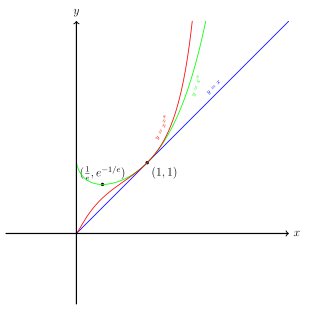
- \(y = x^{-1} + \ln x \Rightarrow y' = -x^{-2} + x^{-1}\) which has roots at \(x =1\), therefore the minimum value is \(1\). (We can see it's a minimum by considering \(x \to 0, x \to \infty\). So \begin{align*} && g'(x) &= x^{f(x)} \cdot (f'(x) \ln x + f(x) x^{-1})\\ &&&= x^{f(x)} \cdot f(x) \cdot ((1+\ln x) \ln x + x^{-1}) \\ &&&= x^{f(x)} \cdot f(x) \cdot (\ln x + x^{-1} + (\ln x)^2) \\ &&&\geq x^{f(x)} \cdot f(x) > 0 \end{align*}
2017 Paper 2 Q8
All vectors in this question lie in the same plane. The vertices of the non-right-angled triangle \(ABC\) have position vectors \(\bf a\), \(\bf b\) and \(\bf c\), respectively. The non-zero vectors \(\bf u\) and \(\bf v\) are perpendicular to \(BC\) and \(CA\), respectively. Write down the vector equation of the line through \(A\) perpendicular to \(BC\), in terms of \(\bf u\), \(\bf a\) and a parameter \(\lambda \). The line through \(A\) perpendicular to \(BC\) intersects the line through \(B\) perpendicular to \(CA\) at \(P\). Find the position vector of \(P\) in terms of \(\bf a\), \(\bf b\), \(\bf c\) and \(\bf u\). Hence show that the line \(CP\) is perpendicular to the line \(AB\).
Solution: The line through \(A\) perpendicular to \(BC\) is \(\mathbf{a} + \lambda\mathbf{u}\). The line through \(B\) perpendicular to \(CA\) is \(\mathbf{b} + \mu \mathbf{v}\). They intersect when \(\mathbf{a} + \lambda\mathbf{u} = \mathbf{b} + \mu \mathbf{v}\). Since \(\mathbf{v}\) is perpendicular to \(CA\), we must have \begin{align*} && \mathbf{a} + \lambda\mathbf{u} &= \mathbf{b} + \mu \mathbf{v} \\ \Rightarrow && \mathbf{a}\cdot(\mathbf{c}-\mathbf{a}) + \lambda\mathbf{u}\cdot(\mathbf{c}-\mathbf{a}) &= \mathbf{b}\cdot(\mathbf{c}-\mathbf{a}) + \mu \mathbf{v}\cdot(\mathbf{c}-\mathbf{a}) \\ \\ \Rightarrow && \lambda &= \frac{\mathbf{b}\cdot(\mathbf{c}-\mathbf{a}) -\mathbf{a}\cdot(\mathbf{c}-\mathbf{a})}{\mathbf{u}\cdot(\mathbf{c}-\mathbf{a})} \\ &&&= \frac{(\mathbf{b}-\mathbf{a})\cdot(\mathbf{c}-\mathbf{a})}{\mathbf{u} \cdot(\mathbf{c}-\mathbf{a})} \end{align*} Therefore the point is \(\mathbf{a} + \frac{(\mathbf{b}-\mathbf{a})\cdot(\mathbf{c}-\mathbf{a})}{\mathbf{u} \cdot(\mathbf{c}-\mathbf{a})} \mathbf{u}\). The line \(CP\) is \(\mathbf{c} + \nu \left (\mathbf{p} - \mathbf{c} \right)\), to check this is perpendicular with \(AB\) we should dot \(\mathbf{p}-\mathbf{c}\) with \(\mathbf{a}-\mathbf{b}\), ie \begin{align*} && (\mathbf{p}-\mathbf{c}) \cdot (\mathbf{a}-\mathbf{b}) &= \left ( \mathbf{a} + \frac{(\mathbf{b}-\mathbf{a})\cdot(\mathbf{c}-\mathbf{a})}{\mathbf{u} \cdot(\mathbf{c}-\mathbf{a})} \mathbf{u} - \mathbf{c}\right) \cdot ( \mathbf{a}-\mathbf{b}) \\ &&&= \left ( \mathbf{a}- \mathbf{c} + \frac{(\mathbf{b}-\mathbf{a})\cdot(\mathbf{c}-\mathbf{a})}{\mathbf{u} \cdot(\mathbf{c}-\mathbf{a})} \mathbf{u} \right) \cdot ( \mathbf{a}-\mathbf{c}+(\mathbf{c}-\mathbf{b})) \\ &&&= (\mathbf{a}-\mathbf{c})\cdot(\mathbf{a}-\mathbf{c}) + \frac{(\mathbf{b}-\mathbf{a})\cdot(\mathbf{c}-\mathbf{a})}{\mathbf{u} \cdot(\mathbf{c}-\mathbf{a})}\mathbf{u} \cdot (\mathbf{a}-\mathbf{c}) + \\ &&&\quad (\mathbf{a}-\mathbf{c})\cdot(\mathbf{c}-\mathbf{b}) + \lambda \underbrace{\mathbf{u} \cdot (\mathbf{c}-\mathbf{b})}_{=0} \\ &&&=(\mathbf{a}-\mathbf{c})\cdot(\mathbf{a}-\mathbf{c}) -(\mathbf{b}-\mathbf{a})\cdot(\mathbf{c}-\mathbf{a})+ (\mathbf{a}-\mathbf{c})\cdot(\mathbf{c}-\mathbf{b}) \\ &&&= (\mathbf{a}-\mathbf{c})\cdot(\mathbf{a}-\mathbf{c}+\mathbf{b}-\mathbf{a}+\mathbf{c}-\mathbf{b}) \\ &&&= 0 \end{align*} as required.
2017 Paper 2 Q9
Two identical rough cylinders of radius \(r\) and weight \(W\) rest, not touching each other but a negligible distance apart, on a horizontal floor. A thin flat rough plank of width \(2a\), where \(a < r\), and weight \(kW\) rests symmetrically and horizontally on the cylinders, with its length parallel to the axes of the cylinders and its faces horizontal. A vertical cross-section is shown in the diagram below.
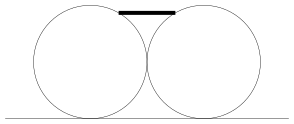
- Let \(F\) be the frictional force between one cylinder and the floor, and let \(R\) be the normal reaction between the plank and one cylinder. Show that \[ R\sin\theta = F(1+\cos\theta)\,, \] where \(\theta\) is the acute angle between the plank and the tangent to the cylinder at the point of contact. Deduce that \(2\sin\theta \le 1+\cos\theta\,\).
- Show that \[ N= \left( 1+\frac2 k\right)\left(\frac{1+\cos\theta}{\sin\theta} \right) F \,, \] where \(N\) is the normal reaction between the floor and one cylinder. Write down the condition that the cylinder does not slip on the floor and show that it is satisfied with no extra restrictions on \(\theta\).
- Show that \(\sin\theta\le\frac45\,\) and hence that \(r\le5a\,\).
Solution:
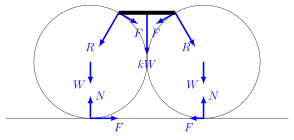
- \(\,\) \begin{align*} \text{N2}(\rightarrow, \text{ one cylinder}): && F\cos \theta + F - R \sin \theta &= 0 \\ \Rightarrow && F(1+\cos \theta) &= R \sin \theta \\ && F \leq \tfrac12 R \\ \Rightarrow && R \sin \theta &\leq \frac12 R(1+\cos \theta) \\ \Rightarrow && 2 \sin \theta &\leq 1 + \cos \theta \end{align*}
- \(\,\) \begin{align*} \text{N2}(\uparrow, \text{system}): && 2N-(k+2)W &= 0 \\ \Rightarrow && W &= \left ( \frac{2}{k+2} \right)N \\ \text{N2}(\uparrow, \text{one cylinder}): && N - W - R\cos \theta -F\sin \theta &= 0 \\ \Rightarrow && N - \left ( \frac{2}{k+2} \right)N - F \left ( \frac{1+\cos \theta}{\sin \theta} \right) \cos \theta - F \sin \theta &= 0 \\ \Rightarrow && \left ( \frac{k}{k+2} \right)N &= \left ( \frac{\cos \theta + \cos^2 \theta + \sin^2 \theta}{\sin \theta} \right) F\\ \Rightarrow && N &= \left ( 1 + \frac2{k} \right) \left ( \frac{\cos \theta + 1}{\sin \theta} \right) F \end{align*} The cylinder does not slip if \(F \leq \tfrac12 N\), ie \begin{align*} && N &\leq \left ( 1 + \frac2{k} \right) \left ( \frac{\cos \theta + 1}{\sin \theta} \right) \frac12 N \\ \Rightarrow && 2\sin \theta &\leq \left ( 1 + \frac2{k} \right) \left ( \cos \theta + 1 \right) \end{align*} but since \(2 \sin \theta \leq (1 + \cos \theta)\) and \((1+\frac2k) > 1\) this inequality is obviously satisfied.
- We can notice that \(2\sin \theta = 1 + \cos \theta\) is satisfied by a \(3-4-5\) triangle, where \(\sin \theta = 4/5, \cos \theta = 3/5\) and hence if \(\sin \theta \leq \frac45\) the condition must hold.
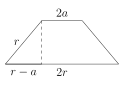
So \(\sin \theta = \frac{r-a}{r} \leq \frac45 \Rightarrow 5r-5a \leq 4r \Rightarrow r \leq 5a\)
2017 Paper 2 Q10
A car of mass \(m\) makes a journey of distance \(2d\) in a straight line. It experiences air resistance and rolling resistance so that the total resistance to motion when it is moving with speed \(v\) is \(Av^2 +R\), where \(A\) and \(R\) are constants. The car starts from rest and moves with constant acceleration \(a\) for a distance \(d\). Show that the work done by the engine for this half of the journey is \[ \int_0^d (ma+R+Av^2) \, \d x \] and that it can be written in the form \[ \int_0^w \frac {(ma+R+Av^2)v}a\; \d v \,, \] where \(w =\sqrt {2ad\,}\,\). For the second half of the journey, the acceleration of the car is \(-a\).
- In the case \(R>ma\), show that the work done by the engine for the whole journey is \[ 2Aad^2 + 2Rd \,. \]
- In the case \(ma-2Aad< R< ma\), show that at a certain speed the driving force required to maintain the constant acceleration falls to zero. Thereafter, the engine does no work (and the driver applies the brakes to maintain the constant acceleration). Show that the work done by the engine for the whole journey is \[ 2Aad^2 + 2 Rd + \frac{(ma-R)^2}{4Aa} \, .\]
Solution: The force delivered by the engine must be \(ma + R + Av^2\), (so the net force is \(ma\)). Therefore the work done is \(\displaystyle \int_0^d F \d x = \int_0^d (ma + R + Av^2) \d x\) Notice that \(a = v \frac{\d v}{\d x} \Rightarrow \frac{a}{v} = \frac{\d v}{\d x}\) and so \begin{align*} && WD &= \int_0^d (ma + R + Av^2) \d x \\ &&&= \int_{x=0}^{x=d} (ma + R + Av^2) \frac{v}{a} \frac{\d v}{\d x} \d x \\ &&&= \int_{x=0}^{x=d} \frac{ (ma + R + Av^2)v}{a} \d v \\ \end{align*} Also notice that if we move with constant acceleration from rest for a distance \(d\) the final speed is \(v^2 = 2ad \Rightarrow v = \sqrt{2ad}\)
- For the second part of the journey, the engine will be putting out a force of \(-ma+R+Av^2>0\), and the car will have a final speed of \(0\) \begin{align*} WD &= \int_0^{w} \frac{(ma+R+Av^2)v}{a} \d v + \int_w^0 \frac{(-ma+R+Av^2)v}{-a} \d v \\ &= \int_0^w \frac{2(Rv+Av^3)}{a} \d v \\ &= \frac{Rw^2+\frac12Aw^4}{a} \\ &= \frac{R2ad+\frac12A4a^2d^2}{a} \\ &= 2Rd + 2Aad^2 \end{align*}
- If \(ma - 2Aad < R < ma\) then the driving force is still \(-ma+R+Av^2\) which is positive when \(v = \sqrt{2as}\) but negative when \(v = 0\), and therefore at some point in-between the driving force must be \(0\). The engine will stop working when \(-ma+R+Av^2 =0 \Rightarrow v = \sqrt{\frac{ma-R}{A}}\) so \begin{align*} WD &= \int_0^w \frac{(ma+R+Av^2)v}{a} \d v + \int_w^{ \sqrt{\frac{ma-R}{A}}} \frac{(-ma+R+Av^2)v}{-a} \d v \\ &= \int_0^w \frac{2(R+Av^2)v}{a} \d v - \int_0^{\sqrt{\frac{ma-R}{A}}} \frac{(-ma+R+Av^2)v}{a}\d v \\ &= 2Aad^2+2Rd + \frac1a\left (\frac12(R-ma)\frac{ma-R}{A} + \frac{A}{4}\left ( \frac{ma-R}{A}\right)^2 \right) \\ &= 2Aad^2+2Rd - \frac{(ma-R)^2}{Aa}\left (-\frac12+ \frac14 \right) \\ &= 2Aad^2+2Rd - \frac{(ma-R)^2}{4Aa} \end{align*}