Problems
Filters
219 problems found
1989 Paper 1 Q7
Sketch the curve \(y^{2}=1-\left|x\right|\). A rectangle, with sides parallel to the axes, is inscribed within this curve. Show that the largest possible area of the rectangle is \(8/\sqrt{27}\). Find the maximum area of a rectangle similarly inscribed within the curve given by \(y^{2m}=\left(1-\left|x\right|\right)^{n}\), where \(m\) and \(n\) are positive integers, with \(n\) odd.
Solution:

1989 Paper 1 Q10
A spaceship of mass \(M\) is travelling at constant speed \(V\) in a straight line when it enters a force field which applies a resistive force acting directly backwards and of magnitude \(M\omega(v^{2}+V^{2})/v\), where \(v\) is the instantaneous speed of the spaceship, and \(\omega\) is a positive constant. No other forces act on the spaceship. Find the distance travelled from the edge of the force field until the speed is reduced to \(\frac{1}{2}V\). As soon as the spaceship has travelled this distance within the force field, the field is altered to a constant resistive force, acting directly backwards, whose magnitude is within 10% of that of the force acting on the spaceship immediately before the change. If \(z\) is the extra distance travelled by the spaceship before coming instantaneously to rest, determine limits between which \(z\) must lie.
Solution: Using Newton's second law, we have: \begin{align*} && -M\omega(v^2+V^2)/v &= M v \frac{\d v}{\d x} \\ \Rightarrow && \frac{v^2}{v^2+V^2} \frac{\d v}{\d x} &= -\omega \\ \Rightarrow && \omega X &= \int_{V/2}^V \frac{v^2}{v^2+V^2} \d v \\ &&&= \int_{V/2}^V \l 1 - \frac{V^2}{v^2+V^2} \r \d v \\ &&&= \left [v - V\tan^{-1} \frac{v}{V} \right]_{V/2}^V \\ &&&= V \l \frac12 - \tan^{-1} 1 + \tan^{-1} \frac12 \r \\ \Rightarrow X &= \frac{V}{\omega} \l \tan^{-1} \frac12 + \frac12 - \frac{\pi}{4} \r \end{align*}. The resistive force just before the field changes is \(M \omega (\frac{V^2}{4} + V^2)/\frac{V}{2} = \frac52MV\omega\). Therefor the constant resistive force is between \(\frac{11}4MV\omega\) and \(\frac{9}{4}MV \omega\) and acceleration is \(\frac{11}{4}V\omega, \frac{9}{4}V\omega\). Since \(v^2 = u^2 + 2as \Rightarrow s = \frac{v^2-u^2}{2a} = \frac{\frac{V^2}{4}}{2kV\omega} = \frac{V}{8k\omega}\) therefore \(z \in \left [ \frac{V}{22\omega},\frac{V}{18 \omega} \right]\)
1989 Paper 1 Q11
A shot-putter projects a shot at an angle \(\theta\) above the horizontal, releasing it at height \(h\) above the level ground, with speed \(v\). Show that the distance \(R\) travelled horizontally by the shot from its point of release until it strikes the ground is given by \[ R=\frac{v^{2}}{2g}\sin2\theta\left(1+\sqrt{1+\frac{2hg}{v^{2}\sin^{2}\theta}}\right). \] The shot-putter's style is such that currently \(\theta=45^{\circ}\). Determine (with justification) whether a small decrease in \(\theta\) will increase \(R\). [Air resistance may be neglected.]
Solution: Notice that \(u_x = v \cos \theta, u_y = v \sin \theta\). We are interested in the time taken for the shot to hit the ground. \(-h = u_y t -\frac12 g t^2\) since our distance will be \(v \cos \theta \cdot t\). Solving this quadratic for \(t\) we obtain: \begin{align*} && 0 &= h + v \sin \theta \cdot t - \frac12 g \cdot t^2 \\ \Rightarrow && t_\pm &= \frac{-v \sin \theta \pm \sqrt{v^2 \sin^2 \theta+2hg}}{-g} \\ \Rightarrow && t_- &= \frac{v \sin \theta+v\sin \theta \sqrt{1 + \frac{2hg}{v^2 \sin^2 \theta}}}{g} \\ \Rightarrow && v \cos \theta t_{-} &= \frac{v^2}{g} \cos \theta \sin \theta \left( 1 + \sqrt{1 + \frac{2hg}{v^2 \sin^2 \theta}} \right) \\ &&&= \frac{v^2}{2g} \sin 2 \theta \left( 1 + \sqrt{1 + \frac{2hg}{v^2 \sin^2 \theta}} \right) \end{align*} Differentiating \(R\) wrt to \(\theta\) at \(\frac{\pi}{4}\) we obtain: \begin{align*} \frac{\d R}{\d \theta} &= \frac{v^2}{2g} \left (2 \cos 2 \theta + 2 \cos 2 \theta \sqrt{1 + \frac{2hg}{v^2 \sin^2 \theta}} + \sin 2\theta \left ( 1 + \frac{2hg}{v^2 \sin^2 \theta}\right)^{-\frac12} \frac12 \frac{2hg} {v^2}(-2) \frac{\cos \theta}{\sin^3 \theta}\right) \\ \frac{\d R}{\d \theta} \biggr \rvert_{\theta = \frac{\pi}{4}} &=\frac{v^2}{2g}\left(0+0- 4\left ( 1 + \frac{4hg}{v^2 }\right)^{-\frac12} \frac{hg} {v^2} \right) \\ &< 0 \end{align*} Therefore, since \(R\) is locally decreasing in \(\theta\) he should reduce his angle of projection slightly.
1989 Paper 1 Q13
A uniform ladder of mass \(M\) rests with its upper end against a smooth vertical wall, and with its lower end on a rough slope which rises upwards towards the wall and makes an angle of \(\phi\) with the horizontal. The acute angle between the ladder and the wall is \(\theta\). If the ladder is in equilibrium, show that \(N\) and \(F\), the normal reaction and frictional force at the foot of the ladder are given by \[ N=Mg\left(\cos\phi-\frac{\tan\theta\sin\phi}{2}\right), \] \[ F=Mg\left(\sin\phi+\frac{\tan\theta\cos\phi}{2}\right). \] If the coefficient of friction between the ladder and the slope is \(2\), and \(\phi=45^{\circ}\), what is the largest value of \(\theta\) for which the ladder can rest in equilibrium?
Solution: \begin{align*} \overset{\curvearrowleft}{X}: && 0&= \frac{l}{2} Mg\sin \theta - l R_1 \cos \theta \\ \Rightarrow && R_1 &= \frac12 \tan \theta Mg \\ \text{N2}(\uparrow): && 0 &= R\cos \phi +F \sin \phi - Mg \\ \text{N2}(\rightarrow):&& 0&=R_1-F \cos \phi + R \sin \phi \\ \Rightarrow && \frac12 \tan \theta Mg &= F \cos \phi- R \sin \phi \\ && Mg &= F \sin \phi +R \cos \phi \\ \Rightarrow && F &= Mg \left ( \sin \phi + \frac12 \tan \theta \cos \phi \right) \\ && N &= Mg \left (\cos \phi - \frac12 \tan \theta \sin \phi \right ) \end{align*} If \(\mu = 2\) and \(\phi = 45^{\circ}\), we must have \(F \leq 2 N\), so: \begin{align*} && Mg \left ( \sin \phi + \frac12 \tan \theta \cos \phi \right) &\leq 2 Mg \left (\cos \phi - \frac12 \tan \theta \sin \phi \right ) \\ \Rightarrow && 1 + \frac12 \tan \theta \leq 2-\tan \theta \\ \Rightarrow && \frac 32 \tan \theta \leq 1 \\ \Rightarrow && \tan \theta \leq \frac23 \\ \Rightarrow && \theta \leq \tan^{-1} \frac23 \end{align*}
1989 Paper 1 Q15
I can choose one of three routes to cycle to school. Via Angle Avenue the distance is 5\(\,\)km, and I am held up at a level crossing for \(A\) minutes, where \(A\) is a continuous random variable uniformly distributed between \(0\) and 10. Via Bend Boulevard the distance is 4\(\,\)km, and I am delayed, by talking to each of \(B\) friends for 3\(\,\)minutes, for a total of \(3B\) minutes, where \(B\) is a random variable whose distribution is Poisson with mean 4. Via Detour Drive the distance should be only 2\(\,\)km, but in addition, due to never-ending road works, there are five places at each of which, with probability \(\frac{4}{5},\) I have to make a detour that increases the distance by 1\(\,\)km. Except when delayed by talking to friends or at the level crossing, I cycle at a steady 12\(\,\)km\(\,\)h\(^{-1}\). For each of the three routs, calculate the probability that a journey lasts at least 27 minutes. Each day I choose one of the three routes at random, and I am equally likely to choose any of the three alternatives. One day I arrive at school after a journey of at least 27 minutes. What is the probability that I came via Bend Boulevard? Which route should I use all the time: \begin{questionparts} \item if I wish my average journey time to be as small as possible; \item if I wish my journey time to be less than 32 minutes as often as possible? \end{questionpart} Justify your answers.
Solution: \(A \sim 5\cdot 5 + U[0,10]\) \(B \sim 4 \cdot 5 + 3 \textrm{Po}(4)\) \(C \sim 2 \cdot 5 + B(5, \frac{4}{5}) \cdot 5\) \begin{align*} && \mathbb{P}(A \leq 27) &= \mathbb{P}(U \leq 2) = 0.2 \\ && \mathbb{P}(B \leq 27) &= \mathbb{P}(3 \textrm{Po}(4) \leq 7) \\\ &&&= \mathbb{P}(Po(4) \leq 2) \\ &&&= e^{-4}(1 + 4 + \frac{4^2}{2}) \\ &&&= 0.23810\ldots \\ && \mathbb{P}(C \leq 27) &= \mathbb{P}(5 \cdot B(5,\tfrac45) \leq 17) \\ &&&= \mathbb{P}(B(5,\tfrac45) \leq 3) \\ &&&= \binom{5}{0} (\tfrac15)^5 + \binom{5}{1} (\tfrac45)(\tfrac 15)^4+ \binom{5}{2} (\tfrac45)^2(\tfrac 15)^3 + \binom{5}3 (\tfrac45)^3(\tfrac 15)^2+\\ &&&= 0.26272 \end{align*} \begin{align*} \mathbb{P}(\text{came via B} | \text{at least 27 minutes}) &= \frac{\mathbb{P}(\text{came via B and at least 27 minutes})}{\mathbb{P}(\text{at least 27 minutes})} \\ &= \frac{\frac13 \cdot 0.23810\ldots }{\frac13 \cdot 0.2 + \frac13 \cdot 0.23810\ldots + \frac13 \cdot 0.26272} \\ &= 0.3397\ldots \\ &= 0.340 \, \, (3\text{ s.f.}) \end{align*}
- \begin{align*} \mathbb{E}(A) &= 25 + 5 &= 30 \\ \mathbb{E}(B) &= 20 + 3\cdot 4 &= 32 \\ \mathbb{E}(C) &= 10 + 5 \cdot 4 &= 30 \end{align*} \(A\) and \(C\) are equally good.
- \begin{align*} \mathbb{P}(A \leq 32) &= \mathbb{P}(U \leq 7) &= 0.7 \\ \mathbb{P}(B \leq 32) &= \mathbb{P}(Po(4) \leq 4) \\ &= e^{-4}(1 + 4 + 8 + \frac{4^3}{6}) &= 0.4334\ldots \\ \mathbb{P}(C \leq 32) &= \mathbb{P}(B(5,\tfrac45) \leq 4) \\ &= 1 - \mathbb{P}(B(5,\tfrac45) = 5) \\ &= 1 - \frac{4^5}{5^5} &=0.67232 \end{align*} So you should choose route \(A\).
1989 Paper 1 Q16
A and B play a guessing game. Each simultaneously names one of the numbers \(1,2,3.\) If the numbers differ by 2, whoever guessed the smaller pays the opponent £\(2\). If the numbers differ by 1, whoever guessed the larger pays the opponent £\(1.\) Otherwise no money changes hands. Many rounds of the game are played.
- If A says he will always guess the same number \(N\), explain (for each value of \(N\)) how B can maximise his winnings.
- In an attempt to improve his play, A announces that he will guess each number at random with probability \(\frac{1}{3},\) guesses on different rounds being independent. To counter this, B secretly decides to guess \(j\) with probability \(b_{j}\) (\(j=1,2,3,\, b_{1}+b_{2}+b_{3}=1\)), guesses on different rounds being independent. Derive an expression for B's expected winnings on any round. How should the probabilities \(b_{j}\) be chosen so as to maximize this expression?
- A now announces that he will guess \(j\) with probability \(a_{j}\) (\(j=1,2,3,\, a_{1}+a_{2}+a_{3}=1\)). If B guesses \(j\) with probability \(b_{j}\) (\(j=1,2,3,\, b_{1}+b_{2}+b_{3}=1\)), obtain an expression for his expected winnings in the form \[ Xa_{1}+Ya_{2}+Za_{3}. \] Show that he can choose \(b_{1},b_{2}\) and \(b_{3}\) such that \(X,Y\) and \(Z\) are all non-negative. Deduce that, whatever values for \(a_{j}\) are chosen by A, B can ensure that in the long run he loses no money.
Solution:
- Suppose A always plays \(1\), then B should always play \(2\) and every time they will win 1. Suppose A always plays \(2\) then B should always play \(3\) and every time they will win 1. If A always plays \(3\) then B should always play \(1\) and every time they will win 2.
- \begin{array}{cccc} & b_1 & b_2 & b_3 \\ \frac13 & (0, \frac{b_1}{3}) & (1, \frac{b_2}{3}) & (-2, \frac{b_3}{3}) \\ \frac13 & (-1, \frac{b_1}{3}) & (0, \frac{b_2}{3}) & (1, \frac{b_3}{3}) \\ \frac13 & (2, \frac{b_1}{3}) & (-1, \frac{b_2}{3}) & (0, \frac{b_3}{3}) \\ \end{array} Therefore the expected value is: \(\frac{b_1}{3} - \frac{b_3}{3}\) and to maximise this he should always guess \(1\) (ie \(b_1 = 1, b_2 = 0, b_3 = 0\).)
- \begin{array}{cccc} & b_1 & b_2 & b_3 \\ a_1 & (0, a_1b_1) & (1, a_1b_2) & (-2, a_1b_3) \\ a_2 & (-1, a_2b_1) & (0, a_2b_2) & (1, a_2b_3) \\ a_3 & (2, a_3b_1) & (-1, a_3b_2) & (0, a_3b_3) \\ \end{array} Therefore the expected value is: \((b_2-2b_3)a_1 + (b_3-b_1)a_2 + (2b_1-b_2)a_3\) We need \(b_2 \geq 2b_3, b_3 \geq b_1, 2b_1 \geq b_2\) so \(b_1 \leq b_3 \leq \frac12 b_2 \leq b_1\) so we could take \(b_1 = b_3 = \frac12 b_2\) or \(b_1 = b_3 = \frac14, b_2 = \frac12\) and all values would be \(0\). Therefore by choosing these values \(B\) can guarantee his expected value is \(0\) and therefore shouldn't expect to lose money in the long run.
1989 Paper 2 Q14
One end of a light inextrnsible string of length \(l\) is fixed to a point on the upper surface of a thin, smooth, horizontal table-top, at a distance \((l-a)\) from one edge of the table-top. A particle of mass \(m\) is fixed to the other end of the string, and held a distance \(a\) away from this edge of the table-top, so that the string is horizontal and taut. The particle is then released. Find the tension in the string after the string has rotated through an angle \(\theta,\) and show that the largest magnitude of the force on the edge of the table top is \(8mg/\sqrt{3}.\)
Solution:
1988 Paper 1 Q1
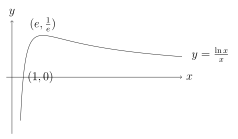
Sketch the graph of the function \(\mathrm{h}\), where \[ \mathrm{h}(x)=\frac{\ln x}{x},\qquad(x>0). \] Hence, or otherwise, find all pairs of distinct positive integers \(m\) and \(n\) which satisfy the equation \[ n^{m}=m^{n}. \]
Solution:
1988 Paper 1 Q3
Two points \(P\) and \(Q\) lie within, or on the boundary of, a square of side 1cm, one corner of which is the point \(O\). Show that the length of at least one of the lines \(OP,PQ\) and \(QO\) must be less than or equal to \((\sqrt{6}-\sqrt{2})\) cm.
Solution: First note that \((\sqrt{6} - \sqrt{2})^2 = 8 - 2\sqrt{12} = 8 - 4\sqrt{3}\) and since \(49 > 16 \times 3\) \(\sqrt{6}-\sqrt{2} > 1\). Therefore we can assume without loss of generality that \(P\) and \(Q\) both do not lie on the same side as each other, a side containing \(O\), otherwise one of those lengths would be \(1 \text{ cm} < (\sqrt{6}-\sqrt{2}) \text{ cm} \). Let \(O = (0,0)\), \(P = (1,x)\), \(Q = (y,1)\), then our lengths squared are: \(1 + x^2, 1 + y^2, (1-x)^2+(1-y)^2\). To maximise the length of the smallest side, each side should be equal in length (otherwise we could increase the length of the smallest side by moving the point between the shortest side and the longest side (without affecting the other side). Therefore \(x = y\) and \(1+x^2 = 2(1-x)^2 \Rightarrow x^2-4x+1 = 0 \Rightarrow x = 2 - \sqrt{3} \). Therefore the distances are all \(\sqrt{1+7-4\sqrt{3}} = \sqrt{8-4\sqrt{3}} = (\sqrt{6}-\sqrt{2}) \text{ cm}\)
1988 Paper 1 Q7
The function \(\mathrm{f}\) is defined by \[ \mathrm{f}(x)=ax^{2}+bx+c. \] Show that \[ \mathrm{f}'(x)=\mathrm{f}(1)\left(x+\tfrac{1}{2}\right)+\mathrm{f}(-1)\left(x-\tfrac{1}{2}\right)-2\mathrm{f}(0)x. \] If \(a,b\) and \(c\) are real and such that \(\left|\mathrm{f}(x)\right|\leqslant1\) for \(\left|x\right|\leqslant1\), show that \(\left|\mathrm{f}'(x)\right|\leqslant4\) for \(\left|x\right|\leqslant1\). Find particular values of \(a,b\) and \(c\) such that, for the corresponding function \(\mathrm{f}\) of the above form \(\left|\mathrm{f}(x)\right|\leqslant1\) for all \(x\) with \(\left|x\right|\leqslant1\) and \(\mathrm{f}'(x)=4\) for some \(x\) satisfying \(\left|x\right|\leqslant1\).
Solution: Let \(f(x) = ax^2 + bx + c\) then \begin{align*} f'(x) &= 2ax + b \\ f(0) &= c \\ f(1) &= a+b+c \\ f(-1) &= a-b+c \\ f(1)+f(-1) &= 2(a+c) \\ f(1)-f(-1) &= 2b \\ f'(x) &= x(f(1)+f(-1)) + \frac12 (f(1) - f(-1)) - 2f(0)x \end{align*} as required. Since \(f'(x)\) is a straight line, the maximum value is either at \(1, -1\) or it's constant and either end suffices. \begin{align*} |f'(1)| & \leq |f(1)|\frac{3}{2} + |f(-1)| \frac12 + 2 |f(0)| \\ &\leq \frac{3}{2} + \frac12 + 2 \\ &= 4 \\ \\ |f'(-1)| & \leq |f(1)|\frac{1}{2} + |f(-1)| \frac32 + 2 |f(0)| \\ &\leq \frac{3}{2} + \frac12 + 2 \\ &= 4 \\ \end{align*} Therefore \(|f'(x)| \leq 4\). Suppose \(|f'(x)| = 4\) for some value in \(x \in [-1,1]\), then it must be either \(-1\) or \(1\). If \(f'(1) = 4\) then \(f(1) = 1, f(-1) = 1, f(0) = -1\) so \(f(x) = 1+ k(x^2-1) \Rightarrow f(x) = 1+2(x^2-1) = 2x^2 -1\). If \(f'(-1) = 4\) then \(f(1) = -1, f(-1) = -1, f(0) = 1 \Rightarrow f(x) = -2x^2 + 1\)
1988 Paper 1 Q10
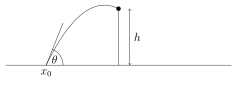
A sniper at the top of a tree of height \(h\) is hit by a bullet fired from the undergrowth covering the horizontal ground below. The position and elevation of the gun which fired the shot are unknown, but it is known that the bullet left the gun with speed \(v\). Show that it must have been fired from a point within a circle centred on the base of the tree and of radius \((v/g)\sqrt{v^{2}-2gh}\). {[}Neglect air resistance.{]}
Solution:
1988 Paper 1 Q12
A skater of mass \(M\) is skating inattentively on a smooth frozen canal. She suddenly realises that she is heading perpendicularly towards the straight canal bank at speed \(V\). She is at a distance \(d\) from the bank and can choose one of two methods of trying to avoid it; either she can apply a force of constant magnitude \(F\), acting at right-angles to her velocity, so that she travels in a circle; or she can apply a force of magnitude \(\frac{1}{2}F(V^{2}+v^{2})/V^{2}\) directly backwards, where \(v\) is her instantaneous speed. Treating the skater as a particle, find the set of values of \(d\) for which she can avoid hitting the bank. Comment briefly on the assumption that the skater is a particle.
Solution: Suppose she applies a force of magnitude \(\frac{1}{2}F(V^{2}+v^{2})/V^{2}\) backwards, then \begin{align*} && M v \frac{dv}{dx} &= -\frac{1}{2}F(V^{2}+v^{2})/V^{2} \\ \Rightarrow && M\int_{V}^0 \frac{2v}{V^2+ v^2} \d v &= - \frac{F}{V^2} x \\ \Rightarrow && M \left [ -\log(V^2+v^2) \right]_0^V &= -\frac{Fx}{V^2} \\ \Rightarrow && -M \ln 2&= -\frac{Fx}{V^2} \end{align*} Therefore she will stop quickly enough if \(d > \frac{V^2M \ln 2}{F}\) If she attempts to use the right-angled method, then she will travel a distance at most \(r\) where \(r\) is the radius of her circle: \begin{align*} && F &= M \frac{V^2}{r} \\ \Rightarrow && r &= \frac{MV^2}{F} \end{align*} Therefore she can always avoid the wall if \(d > \frac{MV^2}{F}\). There are two potential issues with being a particle. Firstly we would need to account for any variation in the distance to the wall (which could be accounted for by changing \(d\)). Secondly when she enters circular motion she will rotate and therefore we might need to consider her inertia as well as just her velocity when modelling.
1988 Paper 1 Q14
Let \(X\) be a standard normal random variable. If \(M\) is any real number, the random variable \(X_{M}\) is defined in terms of \(X\) by \[ X_{M}=\begin{cases} X & \mbox{if }X < M,\\ M & \mbox{if }X\geqslant M. \end{cases} \] Show that the expectation of \(X_{M}\) is given by \[ \mathrm{E}(X_{M})=-\phi(M)+M(1-\Phi(M)), \] where \(\phi\) is the probability density function, and \(\Phi\) is the cumulative distribution function of \(X\). Fifty times a year, 1024 tourists disembark from a cruise liner at the port of Slaka. From there they must travel to the capital either by taxi or by bus. Officials of HOGPo are equally likely to direct a tourist to the bus station or to the taxi rank. Each bus of the bus coorperative holds 31 passengers, and the coorperative currently runs 16 buses. The bus coorperative makes a profit of 1 vloska for each passenger carried. It carries all the passengers it can, with any excess being (eventually) transported by taxi. What is the largest annual bribe the bus coorperative should consider paying to HOGPo in order to be allowed to run an extra bus?
Solution: Let \(X \sim N(0,1)\), and $\displaystyle X_{M}=\begin{cases} X & \text{if }X < M,\\ M & \text{if }X\geqslant M. \end{cases} $. Then we can calculate: \begin{align*} \mathbb{E}[X_M] &= \int_{-\infty}^M xf_X(x)\,dx + M\mathbb{P}(X \geq M) \\ &= \int_{-\infty}^M x \frac1{\sqrt{2\pi}}e^{-\frac12x^2}\,dx + M\mathbb{P}(X \geq M) \\ &= \left [ -\frac{1}{\sqrt{2\pi}}e^{-\frac12x^2} \right ]_{-\infty}^M + M (1-\mathbb{P}(X < M)) \\ &= -\phi(M) + M(1-\Phi(M)) \end{align*} Let \(B \sim B\left (1024, \frac12 \right)\) be the number of potential bus passengers. Then \(B \approx N(512, 256) = N(512, 16^2)\) which is a good approximation since both \(np\) and \(nq\) are large. The question is asking us, how much additional profit would the bus company get if they ran an additional bus. Currently each week they is (on average) \(512\) passengers worth of demand, but they can only supply \(496\) seats, so we should expect that there is demand for another bus. The question is how much that demand is worth. Using the first part of the question, we can see that their profit is something like a `capped normal', \(X_M\), except we are scaled and with a different cap. So we are interested in $\displaystyle Y_{M}=\begin{cases} B & \mbox{if }B< M,\\ M & \mbox{if }B\geqslant M. \end{cases}\(, but since \)B \approx N\left (512,16^2\right)$ this is similar to \begin{align*} Y_{M}&=\begin{cases} 16X+512 & \mbox{if }16X+512< M,\\ M & \mbox{if }16X+512\geq M. \end{cases} \\ &= \begin{cases} 16X+512 & \mbox{if }X< \frac{M-512}{16},\\ M & \mbox{if }X \geq \frac{M-512}{16}. \end{cases} \\ &= 16X_{\frac{M-512}{16}} + 512\end{align*} We are interested in \(\mathbb{E}[Y_{16\times31}]\) and \(\mathbb{E}[Y_{17\times31}]\), which are \(16\mathbb{E}[X_{-1}]+512\) and \(16\mathbb{E}[Y_{\frac{15}{16}}]+512\) Since \(\frac{15}{16} \approx 1\), lets look at \(16(\mathbb{E}[X_1] - \mathbb{E}[X_{-1}])\) \begin{align*} \mathbb{E}[X_1] - \mathbb{E}[X_{-1}] &= \left ( -\phi(1) + 1-\Phi(1)\right) - \left ( - \phi(-1) -(1 - \Phi(-1)) \right ) \\ &= -\phi(1) + \phi(-1) + 1-\Phi(1) + 1 - \Phi(-1) \\ &= 1 - \Phi(1) + \Phi(1) \\ &= 1 \end{align*} Therefore the extra \(31\) will fill roughly \(16\) of them. (This is a slight overestimate, which is worth bearing in mind). A better approximation might be that \(\mathbb{E}[X_t] - \mathbb{E}[X_{-1}] = \frac{t +1}{2}\) for \(t \approx 1\), (since we want something increasing). This would give us an approximation of \(15.5\), which is very close to the `true' answer. Therefore, over \(50\) bus runs, we should earn roughly \(800\) vloska extra from an additional bus. (Again an overestimate, and with an uncertain pay-off, they should consider offering maybe \(600\)). Since this is the future, we can quite easily calculate the exact values using the binomial distribution on a computer. This gives the true value as \(15.833\), and so they should pay up to \(791\)
1988 Paper 2 Q13
A librarian wishes to pick up a row of identical books from a shelf, by pressing her hands on the outer covers of the two outermost books and lifting the whole row together. The covers of the books are all in parallel vertical planes, and the weight of each book is \(W\). With each arm, the librarian can exert a maximum force of \(P\) in the vertical direction, and, independently, a maximum force of \(Q\) in the horizontal direction. The coefficient of friction between each pair of books and also between each hand and a book is \(\mu.\) Derive an expression for the maximum number of books that can be picked up without slipping, using this method. {[}You may assume that the books are thin enough for the rotational effect of the couple on each book to be ignored.{]}
Solution:

1988 Paper 3 Q4
A kingdom consists of a vast plane with a central parabolic hill. In a vertical cross-section through the centre of the hill, with the \(x\)-axis horizontal and the \(z\)-axis vertical, the surface of the plane and hill is given by \[ z=\begin{cases} \dfrac{1}{2a}(a^{2}-x^{2}) & \mbox{ for }\left|x\right|\leqslant a,\\ 0 & \mbox{ for }\left|x\right|>a. \end{cases} \] The whole surface is formed by rotating this cross-section about the \(z\)-axis. In the \((x,z)\) plane through the centre of the hill, the king has a summer residence at \((-R,0)\) and a winter residence at \((R,0)\), where \(R>a.\) He wishes to connect them by a road, consisting of the following segments: \begin{itemize} \item a path in the \((x,z)\) plane joining \((-R,0)\) to \((-b,(a^{2}-b^{2})/2a),\) where \(0\leqslant b\leqslant a.\) \item a horizontal semicircular path joining the two points \((\pm b,(a^{2}-b^{2})/2a),\) if \(b\neq0;\) \item a path in the \((x,z)\) plane joining \((b,(a^{2}-b^{2})/2a)\) to \((R,0).\) \end{itemiz} The king wants the road to be as short as possible. Advise him on his choice of \(b.\)
Solution: The path can be broken down into \(5\) sections. 1. The section from \((-R,0)\) to \((-a,0)\) which will have distance \(R-a\) and is unchangeable. 2. The distance from \((-a,0)\) to \((-b, \frac{a^2-b^2}{2a})\) whose distance we will calculate shortly. 3. The distance from \((-b, \frac{a^2-b^2}{2a})\) to \((b, \frac{a^2-b^2}{2a})\) which will have distance \(\pi b\). 4. The distance from \((b, \frac{a^2-b^2}{2a})\) to \((a,0)\) which will have the same distance as 2. 5. The distance from \((a,0)\) to \((R,0)\) which will have distance \(R-a\) and we have no control over. \begin{align*} \text{distance 2.} &= \int_b^a \sqrt{1 + \left ( \frac{x}{a}\right)^2 } \d x \end{align*} We want to minimize the total, by varying \(b\), so it makes sense to differentiate and set to zero. \begin{align*} &&0&= -2\sqrt{1+\frac{b^2}{a^2}} + \pi \\ \Rightarrow && \frac{\pi^2}{4} &= 1 + \frac{b^2}{a^2} \\ \Rightarrow && b &= a \sqrt{\frac{\pi^2}{4}-1} \end{align*} Since \(\pi \approx 3\) this point is outside our range \(0 \leq b \leq a\), and our derivative is always positive. Therefore the distance is always increasing and the king would be better off going around the hill as soon as he arrives at it.