Problems
Filters
1531 problems found
2018 Paper 2 Q5
In this question, you should ignore issues of convergence.
- Write down the binomial expansion, for \(\vert x \vert<1\,\), of \(\;\dfrac{1}{1+x}\,\) and deduce that %. By considering %$ %\displaystyle \int \frac 1 {1+x} \, \d x %\,, %$ %show that \[ \displaystyle \ln (1+x) = -\sum_{n=1}^\infty \frac {(-x)^n}n \, \] for \(\vert x \vert <1 \,\).
- Write down the series expansion in powers of \(x\) of \(\displaystyle \e^{-ax}\,\). Use this expansion to show that \[ \int_0^\infty \frac {\left(1- \e^{-ax}\right)\e^{-x}}x \,\d x = \ln(1+a) \ \ \ \ \ \ \ (\vert a \vert <1)\,. \]
- Deduce the value of \[ \int_0^1 \frac{x^p - x^q}{\ln x} \, \d x \ \ \ \ \ \ (\vert p\vert <1, \ \vert q\vert <1) \,. \]
Solution:
- \begin{align*} && \frac1{1+x} &= 1 - x+ x^2 - x^3+ \cdots \\ \Rightarrow && \int_0^x \frac{1}{1+t} \d t &= \int_0^x \sum_{n=0}^{\infty} (-t)^n \d t \\ &&&= \left [\sum_{n=0}^{\infty} -\frac{(-t)^{n+1}}{n+1} \right]_0^x \\ \Rightarrow &&\ln(1+x)&=- \sum_{n=1}^\infty \frac{(-x)^n}{n} \end{align*}
- \begin{align*} && e^{-ax} &= \sum_{n=0}^\infty \frac{(-a)^n}{n!} x^n \\ \Rightarrow && \int_0^{\infty} \frac{1}{x} \left (1-e^{-ax} \right)e^{-x} \d x &= \int_0^{\infty} \frac{1}{x} \left (-\sum_{n=1}^\infty \frac{(-a)^n}{n!}x^n \right)e^{-x} \d x \\ &&&= -\int_0^{\infty} \sum_{n=1}^\infty \frac{(-a)^n}{n!} x^{n-1} e^{-x} \d x \\ &&&= -\sum_{n=1}^\infty \frac{(-a)^n}{n!} \int_0^{\infty} x^{n-1} e^{-x} \d x \\ &&&= -\sum_{n=1}^\infty \frac{(-a)^n}{n!} (n-1)! \\ &&&= -\sum_{n=1}^\infty \frac{(-a)^n}{n} \\ &&&= \ln (1+a) \end{align*}
- \begin{align*} && \int_0^1 \frac{x^p - x^q}{\ln x} \, \d x &= \int_0^1 \frac{x^p(1 - x^{q-p})}{\ln x} \, \d x \\ e^{-u} = x, \d x = -e^{-u} \d u: &&&=\int_{u=\infty}^{0} \frac{e^{-pu}-e^{-qu}}{-u} (-e^{-u})\d u \\ &&&= \int_0^\infty \frac{e^{-u}(e^{-qu}-e^{-pu})}{u} \d u \\ &&&= \int_0^\infty \frac{e^{-(1+q)u}(1-e^{-(p-q)u})}{u} \d u \\ v = (1+q)u, \d v = (1+q) \d u: &&&=\int_0^{\infty} \frac{e^{-v}(1-e^{-\left(\frac{p-q}{1+q}\right)v}}{v}\d v \\ &&&= \ln \left(1 + \frac{p-q}{1+q} \right) \\ &&&= \ln \left ( \frac{1+p}{1+q} \right) \end{align*}
2018 Paper 2 Q6
- Find all pairs of positive integers \((n,p)\), where \(p\) is a prime number, that satisfy \[ n!+ 5 =p \,. \]
- In this part of the question you may use the following two theorems:
- For \(n\ge 7\), \(1! \times 3! \times \cdots \times (2n-1)! > (4n)!\,\).
- For every positive integer \(n\), there is a prime number between \(2n\) and \(4n\).
Solution:
- Let \(n! + 5 = p\). If \(n \geq 5\) then \(5\) divides the LHS and so must also divide the RHS. Since \(n!+5 > 5\) this means the RHS cannot be prime. Therefore consider \(n = 1, 2, 3, 4\). \begin{align*} n = 1: && 1! + 5 = 6 &&\text{ nope} \\ n=2: && 2! + 5 = 7 && \checkmark \\ n=3: && 3! + 5 = 11 && \checkmark \\ n=4: && 4! + 5 = 29 && \checkmark \end{align*} Therefore the solutions are \((2,7), (3,11), (4,29)\).
- Suppose \(1! \times 3! \times \cdots \times (2n-1)! = m!\). If \(n \geq 7\) then \(m! > (4n)!\) (by the first theorem) in particular \(m > 4n\). Therefore (by the second theorem) the RHS is divisible by some prime which cannot divide the LHS. Therefore consider \(n = 1,2,3,4,5,6\) \begin{align*} n = 1: && 1! = 1 = 1! && \checkmark \\ n = 2: && 1! \times 3! = 6 = 3! && \checkmark \\ n = 3: && 1! \times 3! \times 5! = 6! && \checkmark \\ n = 4: && 1! \times 3! \times 5! \times 7! = 6! \times 7! = 10! && \checkmark \\ n = 5: && 1! \times 3! \times 5! \times 7! \times 9! = 10! 9! > 11! && \text{would need a factor of } 11\text{ so no} \\ n = 6: && 1! \times 3! \times 5! \times 7! \times 9! \times 11! = 10! 11! 9! > 13! && \text{would need a factor of } 13\text{ so no} \\ \end{align*} Therefore all solutions are \((1,1), (2,3), (3,6), (4,10)\)
2018 Paper 2 Q7
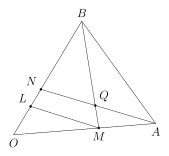
The points \(O\), \(A\) and \(B\) are the vertices of an acute-angled triangle. The points \(M\) and \(N\) lie on the sides \(OA\) and \(OB\) respectively, and the lines \(AN\) and \(BM\) intersect at \(Q\). The position vector of \(A\) with respect to \(O\) is \(\bf a\), and the position vectors of the other points are labelled similarly. Given that \(\vert MQ \vert = \mu \vert QB\vert \), and that \(\vert NQ \vert = \nu \vert QA\vert \), where \(\mu\) and \(\nu\) are positive and \(\mu \nu <1\), show that \[ {\bf m} = \frac {(1+\mu)\nu}{1+\nu} \, {\bf a} \,. \] The point \(L\) lies on the side \(OB\), and \(\vert OL \vert = \lambda \vert OB \vert \,\). Given that \(ML\) is parallel to \(AN\), express \(\lambda\) in terms of \(\mu\) and \(\nu\). What is the geometrical significance of the condition \(\mu\nu<1\,\)?
Solution:
2018 Paper 2 Q8
- Use the substitution \(v= \sqrt y\) to solve the differential equation \[ \frac{\d y}{\d t} = \alpha y^{\frac12} - \beta y \ \ \ \ \ \ \ \ \ \ (y\ge0, \ \ t\ge0) \,, \] where \(\alpha\) and \(\beta\) are positive constants. Find the non-constant solution \(y_1(x)\) that satisfies \(y_1(0)=0\,\).
- Solve the differential equation \[ \frac{\d y}{\d t} = \alpha y^{\frac23} - \beta y \ \ \ \ \ \ \ \ \ \ (y\ge0, \ \ t\ge0) \,, \] where \(\alpha\) and \(\beta\) are positive constants. Find the non-constant solution \(y_2(x)\) that satisfies \(y_2(0)=0\,\).
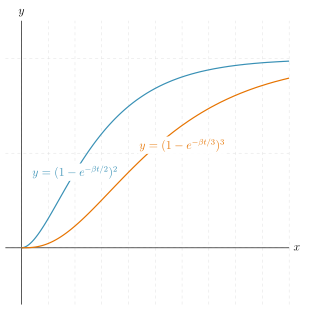
- In the case \(\alpha=\beta\), sketch \(y_1(x)\) and \(y_2(x)\) on the same axes, indicating clearly which is \(y_1(x)\) and which is \(y_2(x)\). You should explain how you determined the positions of the curves relative to each other.
Solution:
- Suppose \(v = \sqrt{y} \Rightarrow v^2 = y \Rightarrow 2v v' = y'\) so \begin{align*} && 2vv' &= \alpha v-\beta v^2 \\ \Rightarrow && 2v' &= \alpha - \beta v \\ \Rightarrow && v' + \frac{\beta}{2} v &= \frac{\alpha}{2} \\ \Rightarrow && \frac{\d}{\d t} \left (e^{\beta t/2} v \right) &= \frac{\alpha}{2} e^{\beta t/2} \\ \Rightarrow && e^{\beta t/2} v &=C+ \frac{\alpha}{\beta}e^{\beta t /2} \\ \Rightarrow && v &= Ce^{-\beta t/2} + \frac{\alpha}{\beta} \\ \Rightarrow && \sqrt{y} &= Ce^{-\beta t/2} + \frac{\alpha}{\beta} \\ y(0) = 0: && 0 &= C+\frac{\alpha}{\beta} \\ \Rightarrow && \sqrt{y} &= \frac{\alpha}{\beta} \left (1-e^{-\beta t/2} \right) \\ \Rightarrow && y &= \frac{ \alpha^2}{\beta^2} \left (1-e^{-\beta t/2} \right)^2 \end{align*}
- Try \(v = y^{1/3} \Rightarrow v^3 = y \Rightarrow 3v^2 v' = y'\) so \begin{align*} && y' &= \alpha v^2 - \beta y \\ \Rightarrow && 3v^2v' &= \alpha v^2 - \beta v^3 \\ \Rightarrow && v' +\frac{\beta}{3} v &= \frac{\alpha}{3} \\ \Rightarrow && (v e^{\beta t/3})' &= \frac{\alpha}{3}e^{\beta t/3} \\ \Rightarrow && v &= Ce^{-\beta t/3} + \frac{\alpha}{\beta} \\ v(0) = 0: && v &= \frac{\alpha}{\beta} \left (1 - e^{-\beta t/3} \right) \\ \Rightarrow && y &= \frac{\alpha^3}{\beta^3} \left (1 - e^{-\beta t/3} \right) ^3 \end{align*}
- \(y_1 = (1-e^{-\beta t/2})^2, y_2 = (1-e^{-\beta t/3})^3\)
By considering the differential equation, notice that \(0 < y_i < 1\) so \(y^{1/2} > y^{2/3}\) and therefore \(y_1' > y_2'\) and so \(y_1\) increases faster.
2018 Paper 2 Q9
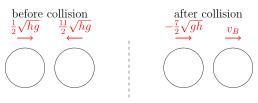
Two small beads, \(A\) and \(B\), of the same mass, are threaded onto a vertical wire on which they slide without friction, and which is fixed to the ground at \(P\). They are released simultaneously from rest, \(A\) from a height of \(8h\) above \(P\) and \(B\) from a height of \(17h\) above \(P\). When \(A\) reaches the ground for the first time, it is moving with speed \( V\). It then rebounds with coefficient of restitution \(\frac{1}{2}\) and subsequently collides with \(B\) at height \(H\) above \(P\). Show that \(H= \frac{15}8h\) and find, in terms of \(g\) and \(h\), the speeds \(u_A\) and \(u_B\) of the two beads just before the collision. When \(A\) reaches the ground for the second time, it is again moving with speed \( V\). Determine the coefficient of restitution between the two beads.
Solution: \begin{align*} && v^2 &= u^2 +2as \\ \Rightarrow && V^2 &= 2 g \cdot (8h)\\ \Rightarrow && V &=4\sqrt{hg}\\ \end{align*} When the first particle collides with the ground, the second particle is at \(9h\) traveling with speed \(V\), the first particle is at \(0\) traveling (upwards) with speed \(\tfrac12 V\). For a collision we need: \begin{align*} && \underbrace{\frac12 V t- \frac12 g t^2}_{\text{position of A}} &= \underbrace{9h - Vt - \frac12 gt^2}_{\text{position of B}} \\ \Rightarrow && \frac32Vt &= 9h \\ \Rightarrow && t &= \frac{6h}{V} \\ \\ && \underbrace{\frac12 V t- \frac12 g t^2}_{\text{position of A}} &= \frac12 V \frac{6h}{V} - \frac12 g t^2 \\ &&&= 3h - \frac12 g\frac{36h^2}{16hg} \\ &&&= 3h - \frac{9}{8}h \\ &&&= \frac{15}{8}h \end{align*} Just before the collision, \(A\) will be moving with velocity (taking upwards as positive) \begin{align*} && u_A &= \frac12 V-gt \\ &&&= 2\sqrt{hg}-g \frac{6h}{V} \\ &&&= 2\sqrt{hg} - g \frac{6h}{4\sqrt{hg}} \\ &&&= 2\sqrt{hg}-\frac32\sqrt{hg} \\ &&&= \frac12 \sqrt{hg} \end{align*} Similarly, for \(B\). \begin{align*} && u_B &= -V -gt \\ &&&= -4\sqrt{hg} - \frac32\sqrt{hg} \\ &&&= -\frac{11}{2}\sqrt{hg} \end{align*} Considering \(A\), to figure out \(v_A\). \begin{align*} && v^2 &= u^2 + 2as \\ && V^2 &= v_A^2 + 2g\frac{15}{8}h \\ && 16hg &= v_A^2 + \frac{15}{4}gh \\ \Rightarrow && v_A^2 &= \frac{49}{4}gh \\ \Rightarrow && v_A &= -\frac{7}{2}\sqrt{gh} \end{align*}
2018 Paper 2 Q10
A uniform elastic string lies on a smooth horizontal table. One end of the string is attached to a fixed peg, and the other end is pulled at constant speed \(u\). At time \(t=0\), the string is taut and its length is \(a\). Obtain an expression for the speed, at time \(t\), of the point on the string which is a distance \(x\) from the peg at time \(t\). An ant walks along the string starting at \(t=0\) at the peg. The ant walks at constant speed \(v\) along the string (so that its speed relative to the peg is the sum of \(v\) and the speed of the point on the string beneath the ant). At time \(t\), the ant is a distance \(x\) from the peg. Write down a first order differential equation for \(x\), and verify that \[ \frac{\d }{\d t} \left( \frac x {a+ut}\right) = \frac v {a+ut} \,. \] Show that the time \(T\) taken for the ant to reach the end of the string is given by \[uT = a(\e^k-1)\,,\] where \(k=u/v\). On reaching the end of the string, the ant turns round and walks back to the peg. Find in terms of \(T\) and \(k\) the time taken for the journey back.
Solution: Points always maintain a constant fraction of the distance from the start, so the point distance \(x\) from the start at time \(t\) is moving with speed \(\frac{x}{a+ut} u\) The point is moving with speed \(v+\frac{x}{a+ut} u\) or in other words \begin{align*} && \frac{\d x}{\d t} &= v + \frac{x}{a+ut}u \\ \Rightarrow && \frac{\d x }{\d t} - \frac{u}{a+ut} x &= v \\ \Rightarrow && \frac{1}{a+ut} \frac{\d x}{\d t} - \frac{u}{(a+ut)^2} x &= \frac{1}{a+ut} v\\ \Rightarrow && \frac{\d}{\d x} \left ( \frac{x}{a+ut} \right) &= \frac{v}{a+ut} \\ \Rightarrow && \frac{x}{a+ut} &=\frac{v}{u} \ln (a + ut) + C \\ t = 0, x = 0: && 0 &= \frac{v}{u} \ln a + C \\ \Rightarrow && x &= (a+ut) \frac{v}{u} \ln \left ( \frac{a+ut}{a} \right) \\ \\ \Rightarrow && 1 &= \frac{v}{u} \ln \left ( \frac{a+uT}{a} \right) \\ \Rightarrow && e^k &= 1 + \frac{uT}{a} \\ \Rightarrow && uT &= a(e^k-1) \end{align*} On the return journey, we have \begin{align*} && \frac{\d x}{\d t} &= \frac{x}{a+ut}u - v \\ \Rightarrow && \frac{\d x}{\d t} - \frac{u}{a+ut} x &= - v \\ \Rightarrow && \frac{\d }{\d x} \left ( \frac{x}{a+ut} \right) &= -\frac{v}{a+ut} \\ \Rightarrow &&f &= -\frac{v}{u} \ln(a+ut) + K \\ t = T, f = 1: && 1 &= -\frac{v}{u}\ln(a+uT) + K \\ \Rightarrow && f &= 1+\frac{v}{u}\ln \left ( \frac{a+uT}{a+ut} \right) \\ \Rightarrow && 0 &= 1+\frac{v}{u} \ln \left ( \frac{a+uT}{a+uT_2} \right) \\ \Rightarrow && e^k &= \frac{a+uT_2}{a+uT}\\ \Rightarrow && uT_2 &= (a+uT)e^k - a \\ \Rightarrow && T_2 - T &= \frac{1}{u} \left ( (a+uT)e^k - a - uT\right) \\ &&&= \frac{1}{u} \left ((a+a(e^k-1))e^k-a-a(e^k-1) \right) \\ &&&= \frac{1}{u} \left (ae^{2k} -ae^k \right) \\ &&&= \frac{ae^k}{u} \left ( e^k-1 \right) \\ &&&= Te^k \end{align*}
2018 Paper 2 Q11
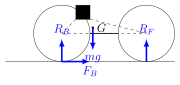
The axles of the wheels of a motorbike of mass \(m\) are a distance \(b\) apart. Its centre of mass is a horizontal distance of \(d\) from the front axle, where \(d < b\), and a vertical distance \(h\) above the road, which is horizontal and straight. The engine is connected to the rear wheel. The coefficient of friction between the ground and the rear wheel is \(\mu\), where \(\mu < b/h\), and the front wheel is smooth. You may assume that the sum of the moments of the forces acting on the motorbike about the centre of mass is zero. By taking moments about the centre of mass show that, as the acceleration of the motorbike increases from zero, the rear wheel will slip before the front wheel loses contact with the road if \[ \mu < \frac {b-d}h\,. \tag{*} \] If the inequality \((*)\) holds and the rear wheel does not slip, show that the maximum acceleration is \[ \frac{ \mu dg}{b-\mu h} \,. \] If the inequality \((*)\) does not hold, find the maximum acceleration given that the front wheel remains in contact with the road.
Solution:
2018 Paper 2 Q12
In a game, I toss a coin repeatedly. The probability, \(p\), that the coin shows Heads on any given toss is given by \[ p= \frac N{N+1} \,, \] where \(N\) is a positive integer. The outcomes of any two tosses are independent. The game has two versions. In each version, I can choose to stop playing after any number of tosses, in which case I win £\(H\), where \(H\) is the number of Heads I have tossed. However, the game may end before that, in which case I win nothing.
- In version 1, the game ends when the coin first shows Tails (if I haven't stopped playing before that). I decide from the start to toss the coin until a total of \(h\) Heads have been shown, unless the game ends before then. Find, in terms of \(h\) and \(p\), an expression for my expected winnings and show that I can maximise my expected winnings by choosing \(h=N\).
- In version 2, the game ends when the coin shows Tails on two consecutive tosses (if I haven't stopped playing before that). I decide from the start to toss the coin until a total of \(h\) Heads have been shown, unless the game ends before then. Show that my expected winnings are \[ \frac{ hN^h (N+2)^h}{(N+1)^{2h}} \,.\] In the case \(N=2\,\), use the approximation \(\log_3 2 \approx 0.63\) to show that the maximum value of my expected winnings is approximately £3.
Solution:
- Since we either win \(h\) or \(0\), to calculate the expected winnings we just need to calculate the probability that we get \(h\) consecutive heads, therefore: \begin{align*} && \mathbb{E}(\text{winnings}) &= E_h \\ &&&= h \cdot \left ( \frac{N}{N+1} \right)^h \\ && \frac{E_{h+1}}{E_h} &= \frac{h+1}{h }\left ( \frac{N}{N+1} \right) \end{align*} Therefore \(E_h\) is increasing if \(h \leq N\), so we can maximise our winnings by taking \(h = N\). (In fact, we could take \(h = N\) or \(h = N+1\), but arguably \(h = N\) is better as we have the same expected value but lower variance).
- We can have up to \(h\) tails appearing (if we imagine slots for tails of the form \(\underbrace{\_H\_H\_H\_\cdots\_H}_{h\text{ spaces and }h\, H}\) so, we have \begin{align*} && \mathbb{P}(\text{wins}) &= \sum_{t = 0}^h \mathbb{P}(\text{wins and } t\text{ tails}) \\ &&&= \sum_{t = 0}^h\binom{h}{t} \left ( \frac{N}{N+1} \right)^h\left ( \frac{1}{N+1} \right)^t \\ &&&= \left ( \frac{N}{N+1} \right)^h \sum_{t = 0}^h\binom{h}{t}\left ( \frac{1}{N+1} \right)^t \cdot 1^{h-t} \\ &&&= \left ( \frac{N}{N+1} \right)^h \left ( 1 + \left ( \frac{1}{N+1} \right) \right)^h \\ &&&= \left ( \frac{N}{N+1} \right)^h \left ( \frac{N+2}{N+1}\right)^h \\ &&&= \frac{N^h(N+2)^h}{(N+1)^{2h}} \\ \Rightarrow && \E(\text{winnings}) &= h \cdot \frac{N^h(N+2)^h}{(N+1)^{2h}} \end{align*} If \(N = 2\), we have \begin{align*} && \E(\text{winnings}) &= E_h \\ &&&= h \cdot \frac{2^h\cdot2^{2h}}{3^{2h}}\\ &&&= h \cdot \frac{2^{3h}}{3^{2h}} \\ \Rightarrow && \frac{E_{h+1}}{E_h} &= \frac{h+1}{h} \frac{8}{9} \\ \end{align*} Therefore to maximise the winnings we should take \(h = 8\), and the expected winnings will be: \begin{align*} && E_8 &= 8 \cdot \frac{2^{24}}{3^{16}} \\ \Rightarrow && \log_3 E_8 &= 27 \log_3 2 - 16 \\ &&&\approx 24 \cdot 0.63 - 16 \\ &&&\approx 17 - 16 \\ &&&\approx 1 \\ \Rightarrow && E_8 &\approx 3 \end{align*}
2018 Paper 2 Q13
Four children, \(A\), \(B\), \(C\) and \(D\), are playing a version of the game `pass the parcel'. They stand in a circle, so that \(ABCDA\) is the clockwise order. Each time a whistle is blown, the child holding the parcel is supposed to pass the parcel immediately exactly one place clockwise. In fact each child, independently of any other past event, passes the parcel clockwise with probability \(\frac{1}{4}\), passes it anticlockwise with probability \(\frac{1}{4}\) and fails to pass it at all with probability \(\frac{1}{2}\). At the start of the game, child \(A\) is holding the parcel. The probability that child \(A\) is holding the parcel just after the whistle has been blown for the \(n\)th time is \(A_n\), and \(B_n\), \(C_n\) and \(D_n\) are defined similarly.
- Find \(A_1\), \(B_1\), \(C_1\) and \(D_1\). Find also \(A_2\), \(B_2\), \(C_2\) and \(D_2\).
- By first considering \(B_{n+1}+D_{n+1}\), or otherwise, find \(B_n\) and \(D_n\). Find also expressions for \(A_n\) and \(C_n\) in terms of \(n\).
Solution:
- \(\,\) \begin{align*} && A_1 &= \frac12 \\ && B_1 &= \frac14 \\ && C_1 &= 0 \\ && D_1 &= \frac14 \end{align*} \begin{align*} && A_2 &= \frac12 \cdot \frac12 + 2 \cdot \frac14 \cdot \frac14 = \frac38 \\ && B_2 &= \frac14 \cdot \frac12 + \frac12 \cdot \frac14 = \frac14 \\ && C_2 &=2 \cdot \frac14 \cdot \frac14 =\frac18 \\ && D_2 &= B_2 = \frac14 \end{align*}
- \begin{align*} && A_{n+1} &= \frac12 A_n+ \frac14(B_n + D_n) \\ && B_{n+1} &= \frac12 B_n+ \frac14(A_n + C_n) \\ && C_{n+1} &= \frac12 C_n+ \frac14(D_n +B_n) \\ && D_{n+1} &= \frac12 D_n+ \frac14(C_n +A_n) \\ \\ \Rightarrow && B_{n+1}+D_{n+1} &= \frac12 (B_n+D_n) + \frac12(A_n+C_n) \\ &&&= \frac12 \\ \Rightarrow && B_{n+1}&=D_{n+1} = \frac14 \\ \\ && C_{n+1} &= \frac12C_n + \frac14 \cdot \frac12 \\ &&&= \frac12 C_n + \frac18\\ &&&= \frac12 C_{n-1} + \frac1{8} + \frac1{16} \\ &&&= \frac1{8} + \frac{1}{16} + \cdots + \frac{1}{8 \cdot 2^{n-1}} \\ &&&= \frac18 \left (1 + \frac12 + \cdots + \frac1{2^{n-1}} \right) \\ &&&= \frac18\left ( \frac{1-\frac1{2^n}}{1-\frac12} \right) \\ &&&= \frac18 \left (2 - \frac{1}{2^{n-1}} \right) \\ &&&= \frac14 - \frac{1}{2^{n-1}} \\ \Rightarrow && A_n &= \frac14 + \frac1{2^{n-1}} \end{align*}
2018 Paper 3 Q1
- The function \(\f\) is given by \[ \f(\beta)=\beta - \frac 1 \beta - \frac 1 {\beta^2} \ \ \ \ \ \ \ \ (\beta\ne0) \,. \] Find the stationary point of the curve \(y=\f(\beta)\,\) and sketch the curve. Sketch also the curve \(y=\g(\beta)\,\), where \[ \g(\beta) = \beta + \frac 3 \beta - \frac 1 {\beta^2} \ \ \ \ \ \ \ \ (\beta\ne0)\,. \]
- Let \(u\) and \(v\) be the roots of the equation \[ x^2 +\alpha x +\beta = 0 \,, \] where \(\beta\ne0\,\). Obtain expressions in terms of \(\alpha\) and \(\beta\) for \(\displaystyle u+v + \frac 1 {uv}\) and \( \displaystyle \frac 1 u + \frac 1 v + uv\,\).
- Given that \(\displaystyle u+v + \frac 1 {uv} = -1\,\), and that \(u\) and \(v\) are real, show that \(\displaystyle \frac 1 u+ \frac 1 v + {uv} \le -1\;\).
- Given instead that \(\displaystyle u+v + \frac 1 {uv} = 3 \;\), and that \(u\) and \(v\) are real, find the greatest value of \(\displaystyle \frac 1 u+ \frac 1v + {uv}\,\).
Solution:
- \begin{align*}
&& f(\beta) &= \beta - \frac1{\beta}-\frac1{\beta^2} \\
\Rightarrow && f'(\beta) &= 1 +\frac{1}{\beta^2}+\frac{2}{\beta^3} \\
\Rightarrow && 0 &= f'(\beta) \\
&&&= 1 + \frac1{\beta^2} + \frac{2}{\beta^3} \\
\Rightarrow && 0 &= \beta^3 + \beta + 2 \\
&&&= (\beta+1)(\beta^2-\beta+2)
\end{align*}
Therefore the only stationary point is at \(\beta = -1, f(-1) = -1\)
\begin{align*} && g(\beta) &= \beta + \frac3{\beta}-\frac1{\beta^2} \\ \Rightarrow && g'(\beta) &= 1 -\frac{3}{\beta^2}+\frac{2}{\beta^3} \\ \Rightarrow && 0 &= f'(\beta) \\ &&&= 1 - \frac3{\beta^2} + \frac{2}{\beta^3} \\ \Rightarrow && 0 &= \beta^3 - 3\beta + 2 \\ &&&= (\beta-1)^2(\beta+2) \end{align*} Therefore there are stationary points at \(\beta=1,f(1) = 3, \beta=-2, f(-2) = \frac14\)
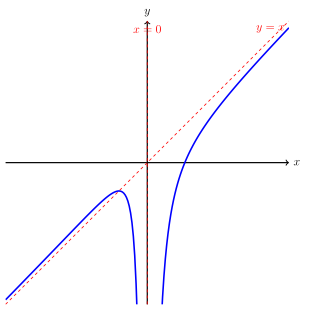
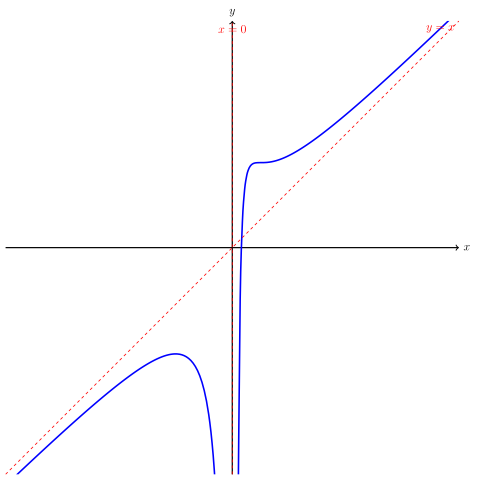
- Let \(u,v\) be the roots of \(x^2 + \alpha x + \beta = 0\), then since \((x-u)(x-v) = 0\) we must have \(\alpha = -(u+v), \beta = uv\). Therefore: \begin{align*} && u+v +\frac{1}{uv} &= -\alpha + \frac{1}{\beta} \\ && \frac1u+\frac1v + uv &= \frac{u+v}{uv} + uv \\ &&&= -\frac{\alpha}{\beta} + \beta \end{align*} Given \(u+v + \frac 1 {uv} = -1\), ie \(-\alpha + \frac{1}{\beta} = -1\). Since the roots are real, we must also have that \(\alpha^2 - 4\beta \geq 0\), so \begin{align*} && -\alpha + \frac1\beta &= -1 \\ \Rightarrow && \alpha &= 1 +\frac1\beta \\ \Rightarrow && -\frac{\alpha}{\beta}+\beta &= -\frac{1}{\beta} \l1+\frac1{\beta}\r + \beta \\ &&&=\beta - \frac{1}{\beta}-\frac{1}{\beta^2} \end{align*} So we want to maximise \(f(\beta)\) subject to \(\alpha ^2 - 4\beta \geq 0\) \begin{align*} && 0 &\leq \alpha^2 -4 \beta \\ &&&= \l 1 + \frac1{\beta} \r^2 - 4\beta \\ &&&= 1+ \frac2{\beta} + \frac1{\beta^2} - 4\beta \\ \Leftrightarrow && 0 &\leq -4\beta^3+\beta^2 + 2\beta + 1 \\ &&&=-(\beta-1)(4\beta^2+3\beta+1)\\ \Leftrightarrow && \beta &\leq 1 \end{align*} But we know \(f(\beta) \leq -1\) on \((-\infty,1]\) so we're done.
- Given that \(-\alpha + \frac{1}{\beta} = 3\) we have \begin{align*} && -\alpha + \frac1\beta &= 3 \\ \Rightarrow && \alpha &= -3 +\frac1\beta \\ \Rightarrow && -\frac{\alpha}{\beta}+\beta &= -\frac{1}{\beta} \l-3+\frac1{\beta}\r + \beta \\ &&&=\beta + \frac{3}{\beta}-\frac{1}{\beta^2} \end{align*} which we want to maximise, subject to: \begin{align*} && 0 &\leq \alpha^2 -4 \beta \\ &&&= \l -3 + \frac1{\beta} \r^2 - 4\beta \\ &&&= 9- \frac6{\beta} + \frac1{\beta^2} - 4\beta \\ \Leftrightarrow && 0 &\leq -4\beta^3+9\beta^2 - 6\beta + 1 \\ &&&=-(\beta-1)^2(4\beta-1)\\ \Leftrightarrow && \beta &\leq \frac14 \end{align*} Therefore the maximum will either be \(f(-2) = \frac14\) or \(f(\frac14) = -\frac{15}4\). Therefore the maximum is \(\frac14\)
2018 Paper 3 Q2
The sequence of functions \(y_0\), \(y_1\), \(y_2\), \(\ldots\,\) is defined by \(y_0=1\) and, for \(n\ge1\,\), \[ y_n = (-1)^n \frac {1}{z} \, \frac{\d^{n} z}{\d x^n} \,, \] where \(z= \e^{-x^2}\!\).
- Show that \(\dfrac{\d y_n}{\hspace{-4.7pt}\d x} = 2x y_n -y_{n+1}\,\) for \(n\ge1\,\).
- Prove by induction that, for \(n\ge1\,\), \[ y_{n+1} = 2x y_n -2ny_{n-1} \,. \] Deduce that, for \(n\ge1\,\), \[ y_{n+1}^2 - {y}_n {y}_{n+2} = 2n (y_n^2 - y_{n-1}y_{n+1}) + 2 y_n^2 \,. \]
- Hence show that $y_{n}^2 - y^2_{n-1} y^2_{n+1} > 0\( for \)n \ge 1$.
Solution:
- \begin{align*} \frac{\d y_n}{\d x} &= \frac{\d}{\d x} \l (-1)^n e^{x^2} \frac{\d^n}{\d x^{n}} \l e^{-x^2}\r \r \\ &= (-1)^n 2xe^{x^2} \frac{\d^n}{\d x^{n}} \l e^{-x^2}\r + (-1)^n e^{x^2} \frac{\d^{n+1}}{\d x^{n+1}} \l e^{-x^2}\r \\ &= 2xy_n - (-1)^{n+1} e^{x^2} \frac{\d^{n+1}}{\d x^{n+1}} \l e^{-x^2}\r \\ &= 2xy_n - y_{n+1} \end{align*}
- \(y_0 = 1\), \(y_1 = (-1) e^{x^2} \cdot (-2x) \cdot e^{-x^2} = 2x\), \(y_2 = e^{x^2} \frac{\d^2}{\d x^2} \l e^{-x^2}\r = e^{x^2} \frac{\d }{\d x}\l -2xe^{-x^2} \r = e^{x^2} \l -2e^{-x^2}+4x^2e^{-x^2}\r = 4x^2-2\). Therefore \(2xy_1 - 2y_0 = 2x \cdot 2x - 2\cdot1 = 4x^2-2 = y_2\) so our statement is true for \(n=1\). Assume the statement is true for \(n=k\), then \begin{align*} && y_{k+1} &= 2xy_k - 2ky_{k-1} \\ \frac{\d }{\d x}: && \frac{\d y_{k+1}}{\d x} &= 2\frac{\d}{\d x}\l xy_k \r - 2k\frac{\d y_{k-1}}{\d x} \\ \Rightarrow && 2xy_{k+1}-y_{k+2} &= 2y_k+2x \l 2xy_k-y_{k+1}\r - 2k \l 2xy_{k-1}-y_k \r \\ \Rightarrow && y_{k+2} &=2y_k+ 4x \cdot y_{k+1}-(4x^2+2k)y_k+2x \cdot 2k y_{k-1} \\ &&&= 4x \cdot y_{k+1}-(4x^2+2(k+1))y_k+2x \l2xy_k - y_{k+1} \r \\ &&&= 2x \cdot y_{k+1} -2(k+1)y_k \end{align*} Therefore since our statement is true for \(n=1\) and if it is true for \(n=k\) it is true for \(n=k=1\), therefore by the principle of mathematical induction it is true for all \(n \geq 1\). Since \(2x = \frac{y_{n+1}+2ny_{n-1}}{y_n}\) for all \(n\), we must have \begin{align*} && \frac{y_{n+1}+2ny_{n-1}}{y_n} &= \frac{y_{n+2}+2(n+1)y_{n}}{y_{n+1}} \\ \Leftrightarrow && y_{n+1}^2+2ny_{n-1}y_{n+1} &= y_ny_{n+2}+2ny_n^2+2y_n^2 \\ \Leftrightarrow && y_{n+1}^2-y_ny_{n+2} &= 2n(y_n^2-y_{n-1}y_{n+1})+2y_n^2 \end{align*}
- Consider the functions \(f_n(x) = y_{n}^2-y_{n-1}y_{n+1}\) then clearly \(f_{n+1} = 2nf_{n} + 2y_n^2 \geq f_{n}\) so to prove \(f_n(x) > 0\) for \(n \geq 1\) it suffices to prove it for \(n = 1\). But \(f_1 = y_1^2 - y_0y_{2} = (2x)^2-(4x^2-2) = 2 > 0\) so we are done.
2018 Paper 3 Q3
Show that the second-order differential equation \[ x^2y''+(1-2p) x\, y' + (p^2-q^2) \, y= \f(x) \,, \] where \(p\) and \(q\) are constants, can be written in the form \[ x^a \big(x^b (x^cy)'\big)' = \f(x) \,, \tag{\(*\)} \] where \(a\), \(b\) and \(c\) are constants.
- Use \((*)\) to derive the general solution of the equation \[ x^{2}y''+(1-2p)xy'+(p^2-q^{2})y=0 \] in the different cases that arise according to the values of \(p\) and \(q\).
- Use \((*)\) to derive the general solution of the equation \[ x^{2}y''+(1-2p)xy'+p^2y=x^{n} \] in the different cases that arise according to the values of \(p\) and \(n\).
Solution: Consider $x^a \big(x^b (x^cy)'\big)'$ then \begin{align*} x^a \big(x^b (x^cy)'\big)' &= x^a \big (bx^{b-1}(x^c y)'+x^b(x^cy)'' \big ) \\ &= x^a \big (bx^{b-1} (cx^{c-1}y + x^c y') + x^b(c(c-1)x^{c-2}y + 2cx^{c-1}y' + x^cy'') \\ &= x^{a+b+c}y'' + (2cx^{c-1+b+a}+bx^{c+b-1+a})y'+(c(b+c-1))x^{a+b+c-2} y \end{align*} So we need: \begin{align*} &&& \begin{cases} a+b+c &= 2 \\ 2c+b &= 1-2p \\ c(b+c-1) &= p^2-q^2 \end{cases} \\ \Rightarrow && c((1-2p)-2c+c-1) &=p^2-q^2 \\ \Rightarrow && c^2+2pc &= q^2-p^2 \end{align*}
2018 Paper 3 Q4
The point \(P(a\sec \theta, b\tan \theta )\) lies on the hyperbola \[ \dfrac{x^{2}}{a^{2}}-\dfrac{y^{2}}{b^{2}}=1\,, \] where \(a>b>0\,\). Show that the equation of the tangent to the hyperbola at \(P\) can be written as \[ bx- ay \sin\theta = ab \cos\theta \,. \]
- This tangent meets the lines \(\dfrac x a = \dfrac yb\) and \(\dfrac x a =- \dfrac y b\) at \(S\) and \(T\), respectively. How is the mid-point of \(ST\) related to \(P\)?
- The point \(Q(a\sec \phi, b\tan \phi)\) also lies on the hyperbola and the tangents to the hyperbola at \(P\) and \(Q\) are perpendicular. These two tangents intersect at \((x,y)\). Obtain expressions for \(x^2\) and \(y^2\) in terms of \(a\), \(\theta\) and \(\phi\). Hence, or otherwise, show that \(x^2+y^2 = a^2 -b^2\).
Solution: Note that \begin{align*} && \frac{\d a \sec \theta}{\d \theta} &= a \sec \theta \tan \theta \\ && \frac{\d b \tan \theta}{\d \theta} &= b \sec^2 \theta \\ \Rightarrow && \frac{\d y}{\d x} &= \frac{b \sec^2 \theta}{a \sec \theta \tan \theta} \\ &&&= \frac{b}{a} \frac{1}{\sin \theta} \\ \Rightarrow && \frac{y-b \tan \theta}{x - a \sec \theta} &= \frac{b}{a} \frac{1}{\sin \theta} \\ \Rightarrow && a \sin \theta y - ab \tan \theta \sin \theta &= bx -ab \sec \theta \\ \Rightarrow && bx-ay\sin \theta &= ab \sec x (1 - \sin ^2 \theta) \\ &&&= ab \cos \theta \end{align*}
- \begin{align*} S: &&& \begin{cases} bx-ay &= 0 \\ bx-ay \sin \theta &= ab \cos \theta \end{cases} \\ \Rightarrow && ay(1-\sin \theta) &= ab \cos \theta \\ \Rightarrow && y &= \frac{b \cos \theta}{1-\sin \theta} \\ &&x &=\frac{a\cos \theta}{1-\sin \theta} \\ T: &&& \begin{cases} bx+ay &= 0 \\ bx-ay \sin \theta &= ab \cos \theta \end{cases} \\ \Rightarrow && ay(1+\sin \theta) &= -ab \cos \theta \\ \Rightarrow && y &= \frac{-b \cos \theta}{1+\sin \theta} \\ &&x &=\frac{a\cos \theta}{1+\sin \theta} \\ M: && x &= \frac{a \cos \theta}{2} \frac{2}{1-\sin^2 \theta} \\ &&&= a \sec \theta \\ && y &= \frac{b \cos \theta}{2} \frac{2 \sin \theta}{1-\sin^2 \theta} \\ &&&= b \tan \theta \end{align*} The midpoint of \(ST\) is the same as \(P\).
- The tangents are perpendicular, therefore \(\frac{b}{a} \cosec \theta = - \frac{a}{b} \sin \phi\), ie \(b^2 = -a^2 \sin \phi \sin \theta\) The will intersect at: \begin{align*} &&& \begin{cases} bx - ay \sin \theta &= ab \cos \theta \\ bx - ay \sin \phi &= ab \cos \phi \end{cases} \\ \Rightarrow && ay ( \sin \theta - \sin \phi) &= ab(\cos \phi - \cos \theta) \\ \Rightarrow && y &= \frac{b(\cos \phi - \cos \theta)}{(\sin \theta - \sin \phi)} \\ && y^2 &= \frac{-a^2 \sin \phi \sin \theta (\cos\phi - \cos \theta)^2}{(\sin \theta - \sin \phi)^2} \\ \Rightarrow && bx(\sin \phi - \sin \theta) &= ab(\cos \theta \sin \phi - \cos \phi \sin \theta) \\ \Rightarrow && x &= \frac{a(\cos \theta \sin \phi - \cos \phi \sin \theta)}{\sin \phi - \sin \theta} \\ &&&= \frac{a^2(\cos \theta \sin \phi - \cos \phi \sin \theta)^2}{(\sin \phi - \sin \theta)^2} \end{align*} Therefore \begin{align*} && x^2+y^2 &= \frac{a^2}{(\sin \phi - \sin \theta)^2} \l (\cos \theta \sin \phi- \cos \phi \sin \theta)^2 - \sin \phi \sin \theta (\cos\phi - \cos \theta)^2 \r \\ &&&= \frac{a^2}{(\sin \phi - \sin \theta)^2} \l (\sin \phi - \sin \theta)(\cos^2 \theta \sin \phi - \sin \theta \cos^2 \phi) \r \\ &&&=a^2-b^2 \end{align*}
2018 Paper 3 Q5
The real numbers \(a_1\), \(a_2\), \(a_3\), \(\ldots\) are all positive. For each positive integer \(n\), \(A_n\) and \(G_n\) are defined by \[ A_n = \frac{a_1+a_2 + \cdots + a_n}n \ \ \ \ \ \text{and } \ \ \ \ \ G_n = \big( a_1a_2\cdots a_n\big) ^{1/n} \,. \]
- Show that, for any given positive integer \(k\), \[ (k+1) ( A_{k+1} - G_{k+1}) \ge k (A_k-G_k) \] if and only if \[\lambda^{k+1}_k -(k+1)\lambda_{{k}} +k \ge 0\,, \] where \( \lambda_{{k}} = \left(\dfrac{a_{k+1}}{G_{k}}\right)^{\frac1 {k+1}}\,\).
- Let \[ \f(x)=x^{k+1} -(k+1)x +k \,, \] where \(x > 0\) and \(k\) is a positive integer. Show that \(\f(x)\ge0\) and that \(\f(x)=0\) if and only if \(x = 1\,\).
- Deduce that:
- \(A_n \ge G_n\) for all \(n\); \\
- if \(A_n=G_n\) for some \(n\), then \(a_1=a_2 = \cdots = a_n\,\).
Solution:
- \begin{align*} && (k+1) (A_{k+1} - G_{k+1}) & \geq k(A_k - G_k) \\ \Leftrightarrow && \sum_{i=1}^{k+1} a_i - (k+1)G_{k+1} &\geq \sum_{i=1}^k a_i - kG_k \\ \Leftrightarrow && a_{k+1} -(k+1)G_k^{k/(k+1)}a_{k+1}^{1/(k+1)} & \geq - k G_k \\ \Leftrightarrow && a_{k+1} -(k+1)G_k^{k/(k+1)}a_{k+1}^{1/(k+1)} + k G_k& \geq 0\\ \Leftrightarrow && \frac{a_{k+1}}{G_k} -(k+1)G_k^{k/(k+1)-1}a_{k+1}^{1/(k+1)} + k & \geq 0\\ \Leftrightarrow && \lambda_k^{k+1} -(k+1)\lambda_k+ k & \geq 0\\ \end{align*} as required.
- \begin{align*} && f'(x) &= (k+1)x^k - (k+1) \\ &&&= (k+1)(x^k-1) \end{align*} Therefore \(f(x)\) is strictly decreasing on \((0,1)\) and strictly increasing on \((1,\infty)\) and so the minimum will be \(f(1) = 1 - (k+1) + k = 0\), so \(f(x) \geq 0\) with equality only at \(x = 1\).
- We can proceed by induction to show since the inequality holds for \(n=1\) and since if it holds for \(n=k\) it will hold for \(n=k+1\) as \(A_{k+1}-G_{k+1}\) must have the same sign as \(A_k - G_k\).
- The only way for equality to hold is if \(\lambda_k = 1\) for \(k = 1, \cdots n\), ie \(a_{k+1} = G_k\), but this means \(a_2 = a_1, a_3 = a_1\) etc. Therefore all values are equal.
2018 Paper 3 Q6
- The distinct points \(A\), \(Q\) and \(C\) lie on a straight line in the Argand diagram, and represent the distinct complex numbers \(a\), \(q\) and \(c\), respectively. Show that \(\dfrac {q-a}{c-a}\) is real and hence that \((c-a)(q^*-a^*) = (c^*-a^*)(q-a)\,\). Given that \(aa^* = cc^* = 1\), show further that \[ q+ ac q^* = a+c \,. \]
- The distinct points \(A\), \(B\), \(C\) and \(D\) lie, in anticlockwise order, on the circle of unit radius with centre at the origin (so that, for example, \(aa^* =1\)). The lines \(AC\) and \(BD\) meet at \(Q\). Show that \[ (ac-bd)q^* = (a+c)-(b+d) \,, \] where \(b\) and \(d\) are complex numbers represented by the points \(B\) and \(D\) respectively, and show further that \[ (ac-bd) (q+q^*) = (a-b)(1+cd) +(c-d)(1+ab) \,. \]
- The lines \(AB\) and \(CD\) meet at \(P\), which represents the complex number \(p\). Given that \(p\) is real, show that \(p(1+ab)=a+b\,\). Given further that \(ac-bd \ne 0\,\), show that \[ p(q+q^*) = 2 \,. \]
Solution:
- \(A\), \(Q\), \(C\) lie on a straight line if \(q = \lambda a + (1-\lambda)c\) for some \(\lambda \in \mathbb{R}\), \begin{align*} && q &= \lambda a + (1-\lambda)c \\ \Leftrightarrow && q - a &= (\lambda - 1)a + (1-\lambda)c \\ \Leftrightarrow && q - a &= (\lambda - 1)(a-c) \\ \Leftrightarrow && \frac{q - a}{c-a} &= 1-\lambda \\ \end{align*} therefore \(\frac{q-a}{c-a} \in \mathbb{R}\) \begin{align*} && \frac{q-a}{c-a} & \in \mathbb{R} \\ \Leftrightarrow && \left (\frac{q-a}{c-a} \right)^* &= \frac{q-a}{c-a} \\ \Leftrightarrow && (q^*-a^*)(c-a) &= (q-a)(c^*-a^*) \\ \end{align*} Given \(aa^* = cc^* = 1\), \begin{align*} && (q^*-a^*)(c-a) &= (q-a)(c^*-a^*) \\ \Leftrightarrow && q^*(c-a) - \frac{c}{a}+1 &= q \frac{a-c}{ca} - \frac{a}{c}+1 \\ \Leftrightarrow && (c-a)\l q^* +\frac{q}{ca}\r &= \frac{c}{a} - \frac{a}{c} \\ &&&= \frac{c^2-a^2}{ac} \\ \Leftrightarrow && q^* +\frac{q}{ca} &= \frac{c+a}{ac} \\ \Leftrightarrow && q^*ac +q &= a+c \end{align*}
- Since \(Q\) lies on \(AC\) and \(BD\) we must have \begin{align*} &&& \begin{cases} q^*ac +q &= a+c \\ q^*bd +q &= b+d \\ \end{cases} \\ \Rightarrow && q^*(ac-bd) &= (a+c)-(b+d) \\ \Rightarrow && q(ac-bd) &= (b+d)ac-(a+c)bd \\ \Rightarrow && (q+q^*)(ac-bd) &= (a+c)(1-bd)+(b+d)(ac-1) \\ &&&=a-abd+c-bcd+abc-b+acd-d \\ &&&= a(1+cd)-b(1+cd)+c(1+ab)-d(1+ab) \\ &&&= (a-b)(1+cd)+(c-d)(1+ab) \end{align*}
- If \(AB\) and \(CD\) meet at \(p\) we must have \(p^*ab + p = a+b\), ie \(p(1+ab) = a+b\) amd \(p(1+cd) = c+d\), so \begin{align*} && (q+q^*)(ac-bd) &= (a-b) \frac{c+d}{p} + (c-d) \frac{a+b}{p} \\ \Leftrightarrow && p(q+q^*)(ac-bd) &= (a-b)(c+d)+(c-d)(a+b) \\ &&&= ac+ad-bc-bd+ac+bc-ad-bd \\ &&&= 2(ac-bd) \\ \Leftrightarrow && p(q+q^*) &= 2 \end{align*}