2018 Paper 3 Q1
Year: 2018
Paper: 3
Question Number: 1
Course: UFM Pure
Section: Roots of polynomials
Problem
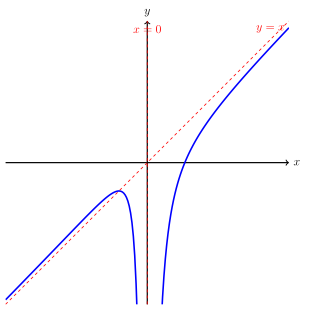
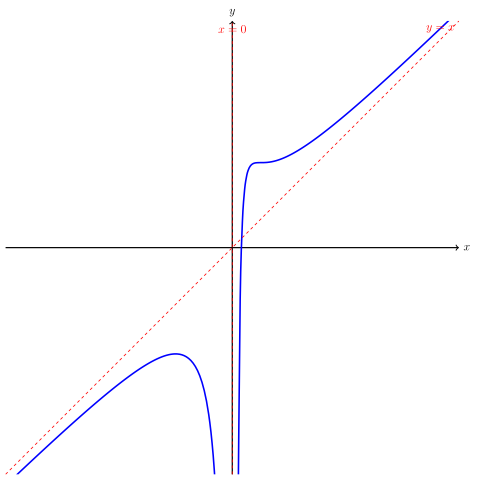
- The function \(\f\) is given by \[ \f(\beta)=\beta - \frac 1 \beta - \frac 1 {\beta^2} \ \ \ \ \ \ \ \ (\beta\ne0) \,. \] Find the stationary point of the curve \(y=\f(\beta)\,\) and sketch the curve. Sketch also the curve \(y=\g(\beta)\,\), where \[ \g(\beta) = \beta + \frac 3 \beta - \frac 1 {\beta^2} \ \ \ \ \ \ \ \ (\beta\ne0)\,. \]
- Let \(u\) and \(v\) be the roots of the equation \[ x^2 +\alpha x +\beta = 0 \,, \] where \(\beta\ne0\,\). Obtain expressions in terms of \(\alpha\) and \(\beta\) for \(\displaystyle u+v + \frac 1 {uv}\) and \( \displaystyle \frac 1 u + \frac 1 v + uv\,\).
- Given that \(\displaystyle u+v + \frac 1 {uv} = -1\,\), and that \(u\) and \(v\) are real, show that \(\displaystyle \frac 1 u+ \frac 1 v + {uv} \le -1\;\).
- Given instead that \(\displaystyle u+v + \frac 1 {uv} = 3 \;\), and that \(u\) and \(v\) are real, find the greatest value of \(\displaystyle \frac 1 u+ \frac 1v + {uv}\,\).
Solution
- \begin{align*}
&& f(\beta) &= \beta - \frac1{\beta}-\frac1{\beta^2} \\
\Rightarrow && f'(\beta) &= 1 +\frac{1}{\beta^2}+\frac{2}{\beta^3} \\
\Rightarrow && 0 &= f'(\beta) \\
&&&= 1 + \frac1{\beta^2} + \frac{2}{\beta^3} \\
\Rightarrow && 0 &= \beta^3 + \beta + 2 \\
&&&= (\beta+1)(\beta^2-\beta+2)
\end{align*}
Therefore the only stationary point is at \(\beta = -1, f(-1) = -1\)
\begin{align*} && g(\beta) &= \beta + \frac3{\beta}-\frac1{\beta^2} \\ \Rightarrow && g'(\beta) &= 1 -\frac{3}{\beta^2}+\frac{2}{\beta^3} \\ \Rightarrow && 0 &= f'(\beta) \\ &&&= 1 - \frac3{\beta^2} + \frac{2}{\beta^3} \\ \Rightarrow && 0 &= \beta^3 - 3\beta + 2 \\ &&&= (\beta-1)^2(\beta+2) \end{align*} Therefore there are stationary points at \(\beta=1,f(1) = 3, \beta=-2, f(-2) = \frac14\)
- Let \(u,v\) be the roots of \(x^2 + \alpha x + \beta = 0\), then since \((x-u)(x-v) = 0\) we must have \(\alpha = -(u+v), \beta = uv\). Therefore: \begin{align*} && u+v +\frac{1}{uv} &= -\alpha + \frac{1}{\beta} \\ && \frac1u+\frac1v + uv &= \frac{u+v}{uv} + uv \\ &&&= -\frac{\alpha}{\beta} + \beta \end{align*} Given \(u+v + \frac 1 {uv} = -1\), ie \(-\alpha + \frac{1}{\beta} = -1\). Since the roots are real, we must also have that \(\alpha^2 - 4\beta \geq 0\), so \begin{align*} && -\alpha + \frac1\beta &= -1 \\ \Rightarrow && \alpha &= 1 +\frac1\beta \\ \Rightarrow && -\frac{\alpha}{\beta}+\beta &= -\frac{1}{\beta} \l1+\frac1{\beta}\r + \beta \\ &&&=\beta - \frac{1}{\beta}-\frac{1}{\beta^2} \end{align*} So we want to maximise \(f(\beta)\) subject to \(\alpha ^2 - 4\beta \geq 0\) \begin{align*} && 0 &\leq \alpha^2 -4 \beta \\ &&&= \l 1 + \frac1{\beta} \r^2 - 4\beta \\ &&&= 1+ \frac2{\beta} + \frac1{\beta^2} - 4\beta \\ \Leftrightarrow && 0 &\leq -4\beta^3+\beta^2 + 2\beta + 1 \\ &&&=-(\beta-1)(4\beta^2+3\beta+1)\\ \Leftrightarrow && \beta &\leq 1 \end{align*} But we know \(f(\beta) \leq -1\) on \((-\infty,1]\) so we're done.
- Given that \(-\alpha + \frac{1}{\beta} = 3\) we have \begin{align*} && -\alpha + \frac1\beta &= 3 \\ \Rightarrow && \alpha &= -3 +\frac1\beta \\ \Rightarrow && -\frac{\alpha}{\beta}+\beta &= -\frac{1}{\beta} \l-3+\frac1{\beta}\r + \beta \\ &&&=\beta + \frac{3}{\beta}-\frac{1}{\beta^2} \end{align*} which we want to maximise, subject to: \begin{align*} && 0 &\leq \alpha^2 -4 \beta \\ &&&= \l -3 + \frac1{\beta} \r^2 - 4\beta \\ &&&= 9- \frac6{\beta} + \frac1{\beta^2} - 4\beta \\ \Leftrightarrow && 0 &\leq -4\beta^3+9\beta^2 - 6\beta + 1 \\ &&&=-(\beta-1)^2(4\beta-1)\\ \Leftrightarrow && \beta &\leq \frac14 \end{align*} Therefore the maximum will either be \(f(-2) = \frac14\) or \(f(\frac14) = -\frac{15}4\). Therefore the maximum is \(\frac14\)
Examiner's report
— 2018 STEP 3, Question 1The total entry was a record number, an increase of over 6% on 2017. Only question 1 was attempted by more than 90%, although question 2 was attempted by very nearly 90%. Every question was attempted by a significant number of candidates with even the two least popular questions being attempted by 9%. More than 92% restricted themselves to attempting no more than 7 questions with very few indeed attempting more than 8. As has been normal in the past, apart from a handful of very strong candidates, those attempting six questions scored better than those attempting more than six.
Rating Information
Difficulty Rating: 1700.0
Difficulty Comparisons: 0
Banger Rating: 1484.0
Banger Comparisons: 1
Show LaTeX source
Problem source
\begin{questionparts}
\item
The function $\f$  is given by
\[
\f(\beta)=\beta - \frac 1 \beta - \frac 1 {\beta^2}
\ \ \ \ \ \ \ \ (\beta\ne0) \,.
\]
Find the stationary point of
the curve $y=\f(\beta)\,$ and sketch the curve.
Sketch also the curve $y=\g(\beta)\,$, where
\[
\g(\beta) = \beta + \frac 3 \beta - \frac 1 {\beta^2}
\ \ \ \ \ \ \ \ (\beta\ne0)\,.
\]
\item
Let $u$ and $v$ be the roots of the equation
\[
x^2 +\alpha x +\beta = 0
\,,
\]
where $\beta\ne0\,$.
Obtain expressions in terms of $\alpha$ and $\beta$ for
$\displaystyle u+v + \frac 1 {uv}$ and
$ \displaystyle \frac 1 u + \frac 1 v + uv\,$.
\item  Given that
$\displaystyle u+v + \frac 1 {uv} = -1\,$,
and that
$u$ and $v$ are real,
show  that  $\displaystyle \frac 1 u+ \frac 1 v +  {uv} \le -1\;$.
\item Given  instead that
$\displaystyle u+v + \frac 1 {uv} = 3 \;$, and that $u$ and $v$ are real,
find the greatest value of
$\displaystyle  \frac 1 u+ \frac 1v +  {uv}\,$.
\end{questionparts}
Solution source
\begin{questionparts}
\item \begin{align*}
&& f(\beta) &= \beta - \frac1{\beta}-\frac1{\beta^2} \\
\Rightarrow && f'(\beta) &= 1 +\frac{1}{\beta^2}+\frac{2}{\beta^3} \\
\Rightarrow && 0 &= f'(\beta) \\
&&&= 1 + \frac1{\beta^2} + \frac{2}{\beta^3} \\
\Rightarrow && 0 &= \beta^3 + \beta + 2 \\
&&&= (\beta+1)(\beta^2-\beta+2)
\end{align*}

Therefore the only stationary point is at $\beta = -1, f(-1) = -1$

\begin{center}
    \begin{tikzpicture}
    \def\functionf(#1){(#1)-1/((#1))-1/((#1)^2)};
    % \def\functiong(#1){((#1)+5)*((#1)-4)*((#1)+1)/((#1)-5)/((#1)+4)};
    \def\xl{-5};
    \def\xu{5};
    \def\yl{-5};
    \def\yu{5};

    % Calculate scaling factors to make the plot square
    \pgfmathsetmacro{\xrange}{\xu-\xl}
    \pgfmathsetmacro{\yrange}{\yu-\yl}
    \pgfmathsetmacro{\xscale}{1}
    \pgfmathsetmacro{\yscale}{\xrange/\yrange}

    % Define the styles for the axes and grid
    \tikzset{
        axis/.style={very thick, ->},
        grid/.style={thin, gray!30},
        x=\xscale cm,
        y=\yscale cm
    }

    % Set up axes
    \draw[axis] (\xl,0) -- (\xu,0) node[right] {$x$};
    \draw[axis] (0,\yl) -- (0,\yu) node[above] {$y$};

    % Define the bounding region with clip
    \begin{scope}
        % You can modify these values to change your plotting region
        \clip (\xl,\yl) rectangle (\xu,\yu);

        % Draw a grid (optional)
        % \draw[grid] (-5,-3) grid (5,3);
        \draw[ultra thick, blue, smooth, domain=-5:-0.2, samples=100]
            plot (\x, {\functionf(\x)});
        \draw[ultra thick, blue, smooth, domain=0.2:5, samples=100]
            plot (\x, {\functionf(\x)});
        \draw[thick, red, dashed] (0, \yl) -- (0, \yu) node [below] {$x = 0$};
        \draw[thick, red, dashed] (\yl, \xl) -- (\xu, \yu) node [below left] {$y = x$};
    \end{scope}

    \end{tikzpicture}
\end{center}

\begin{align*}
&& g(\beta) &= \beta + \frac3{\beta}-\frac1{\beta^2} \\
\Rightarrow && g'(\beta) &= 1 -\frac{3}{\beta^2}+\frac{2}{\beta^3} \\
\Rightarrow && 0 &= f'(\beta) \\
&&&= 1 - \frac3{\beta^2} + \frac{2}{\beta^3} \\
\Rightarrow && 0 &= \beta^3 - 3\beta + 2 \\
&&&= (\beta-1)^2(\beta+2)
\end{align*}

Therefore there are stationary  points at $\beta=1,f(1) = 3, \beta=-2, f(-2) = \frac14$

\begin{center}
    \begin{tikzpicture}
    \def\functionf(#1){(#1)+3/((#1))-1/((#1)^2)};
    % \def\functiong(#1){((#1)+5)*((#1)-4)*((#1)+1)/((#1)-5)/((#1)+4)};
    \def\xl{-8};
    \def\xu{8};
    \def\yl{-8};
    \def\yu{8};

    % Calculate scaling factors to make the plot square
    \pgfmathsetmacro{\xrange}{\xu-\xl}
    \pgfmathsetmacro{\yrange}{\yu-\yl}
    \pgfmathsetmacro{\xscale}{1}
    \pgfmathsetmacro{\yscale}{\xrange/\yrange}

    % Define the styles for the axes and grid
    \tikzset{
        axis/.style={very thick, ->},
        grid/.style={thin, gray!30},
        x=\xscale cm,
        y=\yscale cm
    }

    % Set up axes
    \draw[axis] (\xl,0) -- (\xu,0) node[right] {$x$};
    \draw[axis] (0,\yl) -- (0,\yu) node[above] {$y$};

    % Define the bounding region with clip
    \begin{scope}
        % You can modify these values to change your plotting region
        \clip (\xl,\yl) rectangle (\xu,\yu);

        % Draw a grid (optional)
        % \draw[grid] (-5,-3) grid (5,3);
        \draw[ultra thick, blue, smooth, domain=-8:-0.2, samples=100]
            plot (\x, {\functionf(\x)});
        \draw[ultra thick, blue, smooth, domain=0.2:8, samples=100]
            plot (\x, {\functionf(\x)});
        \draw[thick, red, dashed] (0, \yl) -- (0, \yu) node [below] {$x = 0$};
        \draw[thick, red, dashed] (\yl, \xl) -- (\xu, \yu) node [below left] {$y = x$};
    \end{scope}

    \end{tikzpicture}
\end{center}

\item Let $u,v$ be the roots of $x^2 + \alpha x + \beta = 0$, then since $(x-u)(x-v) = 0$ we must have $\alpha = -(u+v), \beta = uv$.

Therefore:

\begin{align*}
&& u+v +\frac{1}{uv} &= -\alpha + \frac{1}{\beta} \\
&& \frac1u+\frac1v + uv &= \frac{u+v}{uv} + uv \\
&&&= -\frac{\alpha}{\beta} + \beta
\end{align*}

Given $u+v + \frac 1 {uv} = -1$, ie $-\alpha + \frac{1}{\beta} = -1$. Since the roots are real, we must also have that $\alpha^2 - 4\beta \geq 0$, so

\begin{align*}
&& -\alpha + \frac1\beta &= -1 \\
\Rightarrow && \alpha &= 1 +\frac1\beta \\
\Rightarrow && -\frac{\alpha}{\beta}+\beta &= -\frac{1}{\beta} \l1+\frac1{\beta}\r + \beta \\
&&&=\beta - \frac{1}{\beta}-\frac{1}{\beta^2}
\end{align*}

So we want to maximise $f(\beta)$ subject to $\alpha ^2 - 4\beta \geq 0$

\begin{align*}
&& 0 &\leq \alpha^2 -4 \beta \\
&&&= \l 1 + \frac1{\beta} \r^2 - 4\beta \\
&&&= 1+ \frac2{\beta} + \frac1{\beta^2} - 4\beta \\
\Leftrightarrow && 0 &\leq -4\beta^3+\beta^2 + 2\beta + 1 \\
&&&=-(\beta-1)(4\beta^2+3\beta+1)\\
\Leftrightarrow && \beta &\leq 1
\end{align*}

But we know $f(\beta) \leq -1$ on $(-\infty,1]$ so we're done.

\item Given that $-\alpha + \frac{1}{\beta} = 3$ we have
\begin{align*}
&& -\alpha + \frac1\beta &= 3 \\
\Rightarrow && \alpha &= -3 +\frac1\beta \\
\Rightarrow && -\frac{\alpha}{\beta}+\beta &= -\frac{1}{\beta} \l-3+\frac1{\beta}\r + \beta \\
&&&=\beta + \frac{3}{\beta}-\frac{1}{\beta^2}
\end{align*}
which we want to maximise, subject to:

\begin{align*}
&& 0 &\leq \alpha^2 -4 \beta \\
&&&= \l -3 + \frac1{\beta} \r^2 - 4\beta \\
&&&= 9- \frac6{\beta} + \frac1{\beta^2} - 4\beta \\
\Leftrightarrow && 0 &\leq -4\beta^3+9\beta^2 - 6\beta + 1 \\
&&&=-(\beta-1)^2(4\beta-1)\\
\Leftrightarrow && \beta &\leq \frac14
\end{align*}

Therefore the maximum will either be $f(-2) = \frac14$ or $f(\frac14) = -\frac{15}4$. Therefore the maximum is $\frac14$

\end{questionparts}
As usual, this was the most popular question to be attempted with more than 93% of candidates doing so. However, scoring for it was only moderately good with a mean below 9/20. Most successfully differentiated and obtained a value for from the cubic but ignored considering whether this was the only stationary point. Sketches frequently did not display the asymptote; some that did showed the negative branch of the curve touching rather than intersecting the asymptote at the maximum. Many did not appreciate that to sketch the second curve in part (i) it was not sufficient to just offer a drawing without the working; the horizontal point of inflection and asymptote were frequent casualties. Part (ii) was straightforward for most. Many recognised that part (iii) made use of the first function, provided that they used the condition to substitute for. However, their justification suffered from ignoring the reality condition and using specious arguments, as a consequence. Part (iv) followed a similar trend to part (iii), except using, and only differing in that of those that did apply the reality condition, quite a few overlooked 1 as a solution of the cubic inequality, and so their final answer was wrong.