Problems
Filters
218 problems found
1993 Paper 3 Q2
The curve \(C\) has the equation \(x^3+y^3 = 3xy\).
- Show that there is no point of inflection on \(C\). You may assume that the origin is not a point of inflection.
- The part of \(C\) which lies in the first quadrant is a closed loop touching the axes at the origin. By converting to polar coordinates, or otherwise, evaluate the area of this loop.
1993 Paper 3 Q16
The time taken for me to set an acceptable examination question it \(T\) hours. The distribution of \(T\) is a truncated normal distribution with probability density \(\f\) where \[ \mathrm{f}(t)=\begin{cases} \dfrac{1}{k\sigma\sqrt{2\pi}}\exp\left(-\dfrac{1}{2}\left(\dfrac{t-\sigma}{\sigma}\right)^{2}\right) & \mbox{ for }t\geqslant0\\ 0 & \mbox{ for }t<0. \end{cases} \] Sketch the graph of \(\f(t)\). Show that \(k\) is approximately \(0.841\) and obtain the mean of \(T\) as a multiple of \(\sigma\). Over a period of years, I find that the mean setting time is 3 hours.
- Find the approximate probability that none of the 16 questions on next year's paper will take more than 4 hours to set.
- Given that a particular question is unsatisfactory after 2 hours work, find the probability that it will still be unacceptable after a further 2 hours work.
1992 Paper 1 Q4
Sketch the following subsets of the complex plane using Argand diagrams. Give reasons for your answers.
- \(\{z:\mathrm{Re}((1+\mathrm{i})z)\geqslant0\}.\)
- \(\{z: |z^{2}| \leqslant2,\mathrm{Re}(z^{2})\geqslant0\}.\)
- \(\{z=z_{1}+z_{2}:\left|z_{1}\right|=2,\left|z_{2}\right|=1\}.\)
Solution:
- Multiplication by \(1+i\) rotates by \(45^{\circ}\) anticlockwise

- \(|z| \leq \sqrt{2}\), \(\textrm{Re}(z^2) \geq 0\) means \(\textrm{Re}{z} \geq \textrm{Im}{z}\)

- These are all points within \(1\) unit from a circle radius \(2\) units.

1992 Paper 2 Q3
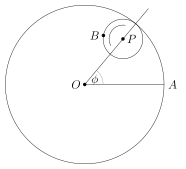
In the figure, the large circle with centre \(O\) has radius \(4\) and the small circle with centre \(P\) has radius \(1\). The small circle rolls around the inside of the larger one. When \(P\) was on the line \(OA\) (before the small circle began to roll), the point \(B\) was in contact with the point \(A\) on the large circle.
1992 Paper 2 Q6
Sketch the graphs of \(y=\sec x\) and \(y=\ln(2\sec x)\) for \(0\leqslant x\leqslant\frac{1}{2}\pi\). Show graphically that the equation \[ kx=\ln(2\sec x) \] has no solution with \(0\leqslant x<\frac{1}{2}\pi\) if \(k\) is a small positive number but two solutions if \(k\) is large. Explain why there is a number \(k_{0}\) such that \[ k_{0}x=\ln(2\sec x) \] has exactly one solution with \(0\leqslant x<\frac{1}{2}\pi\). Let \(x_{0}\) be this solution, so that \(0\leqslant x_{0}<\frac{1}{2}\pi\) and \(k_{0}x_{0}=\ln(2\sec x_0)\). Show that \[ x_{0}=\cot x_{0}\ln(2\sec x_{0}). \] Use any appropriate method to find \(x_{0}\) correct to two decimal places. Hence find an approximate value for \(k_{0}\).
Solution:

1992 Paper 3 Q3
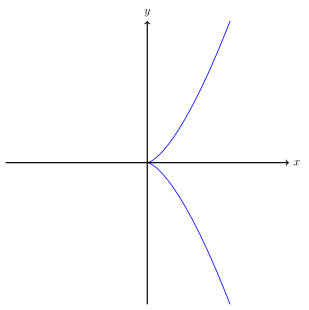
Sketch the curve \(C_{1}\) whose parametric equations are \(x=t^{2},\) \(y=t^{3}.\) The circle \(C_{2}\) passes through the origin \(O\). The points \(R\) and \(S\) with real non-zero parameters \(r\) and \(s\) respectively are other intersections of \(C_{1}\) and \(C_{2}.\) Show that \(r\) and \(s\) are roots of an equation of the form \[ t^{4}+t^{2}+at+b=0, \] where \(a\) and \(b\) are real constants. By obtaining a quadratic equation, with coefficients expressed in terms of \(r\) and \(s\), whose roots would be the parameters of any further intersections of \(C_{1}\) and \(C_{2},\) or otherwise, show that \(O\), \(R\) and \(S\) are the only real intersections of \(C_{1}\) and \(C_{2}.\)
Solution:
1992 Paper 3 Q4
A set of curves \(S_{1}\) is defined by the equation \[ y=\frac{x}{x-a}, \] where \(a\) is a constant which is different for different members of \(S_{1}.\) Sketch on the same axes the curves for which \(a=-2,-1,1\) and \(2\). A second of curves \(S_{2}\) is such that at each intersection between a member of \(S_{2}\) and a member of \(S_{1}\) the tangents of the intersecting curves are perpendicular. On the same axes as the already sketched members of \(S_{1},\) sketch the member of \(S_{2}\) that passes through the point \((1,-1)\). Obtain the first order differential equation for \(y\) satisfied at all points on all members of \(S_{1}\) (i.e. an equation connecting \(x,y\) and \(\mathrm{d}y/\mathrm{d}x\) which does not involve \(a\)). State the relationship between the values of \(\mathrm{d}y/\mathrm{d}x\) on two intersecting curves, one from \(S_{1}\) and one from \(S_{2},\) at their intersection. Hence show that the differential equation for the curves of \(S_{2}\) is \[ x=y(y-1)\dfrac{\mathrm{d}y}{\mathrm{d}x}. \] Find an equation for the member of \(S_{2}\) that you have sketched.
1992 Paper 3 Q10
Sketch the curve \(C\) whose polar equation is \[ r=4a\cos2\theta\qquad\mbox{ for }-\tfrac{1}{4}\pi<\theta<\tfrac{1}{4}\pi. \] The ellipse \(E\) has parametric equations \[ x=2a\cos\phi,\qquad y=a\sin\phi. \] Show, without evaluating the integrals, that the perimeters of \(C\) and \(E\) are equal. Show also that the areas of the regions enclosed by \(C\) and \(E\) are equal.
Solution:

1991 Paper 1 Q6
Criticise each step of the following arguments. You should correct the arguments where necessary and possible, and say (with justification) whether you think the conclusion are true even though the argument is incorrect.
- The function \(g\) defined by \[ \mathrm{g}(x)=\frac{2x^{3}+3}{x^{4}+4} \] satisfies \(\mathrm{g}'(x)=0\) only for \(x=0\) or \(x=\pm1.\) Hence the stationary values are given by \(x=0\), \(\mathrm{g}(x)=\frac{3}{4}\) and \(x=\pm1,\) \(\mathrm{g}(x)=1.\) Since \(\frac{3}{4}<1,\) there is a minimum at \(x=0\) and maxima at \(x=\pm1.\) Thus we must have \(\frac{3}{4}\leqslant\mathrm{g}(x)\leqslant1\) for all \(x\).
- \({\displaystyle \int(1-x)^{-3}\,\mathrm{d}x=-3(1-x)^{-4}}\quad\) and so \(\quad{\displaystyle \int_{-1}^{3}(1-x)^{-3}\,\mathrm{d}x=0.}\)
Solution:
- \begin{align*} && g(x) &= \frac{2x^3+3}{x^4+4} \\ \Rightarrow && g'(x) &= \frac{6x^2(x^4+4) - (2x^3+3)(4x^3)}{(x^4+4)^2} \\ &&&= \frac{-2x^6-12x^3+24x^2}{(x^4+4)} \\ &&&= \frac{-2x^2(x^4+6x-12)}{(x^4+4)} \end{align*} So \(g'(x)\) is not \(0\) for \(x = \pm 1\). We can also note that \(g(-1) = \frac1{5} \neq 1\) Even if the other turning point was \(1\), we would also need to check the behaviour as \(x \to \pm \infty\). We can also note that \(g(-1) = \frac{1}{5} < \frac34\) so the conclusion is also not true.
- There are several errors. \[ \int (1-x)^{-3} \d x = \underbrace{\frac{1}{4}}_{\text{correct constant}}(1-x)^{-4} + \underbrace{C}_{\text{constant of integration}} \] We cannot integrate through the asymptote at \(1\). There is a sense in which we could argue \(\displaystyle \int_{-1}^3 (1-x)^{-3} \d x = 0\), specifically using Cauchy principal value \begin{align*} \mathrm {p.v.} \int_{-1}^3 (1-x)^{-3} &=\lim_{\epsilon \to 0} \left [ \int_{-1}^{1-\epsilon} (1-x)^{-3} \d x+ \int_{1+\epsilon}^{3} (1-x)^{-3} \d x\right] \\ &=\lim_{\epsilon \to 0} \left [ \left[ \frac14 (1-x)^{-4}\right]_{-1}^{1-\epsilon}+ \left[ \frac14 (1-x)^{-4}\right]_{1+\epsilon}^3\right] \\ &=\lim_{\epsilon \to 0} \left [ \frac14 \epsilon^{-4}-\frac14 \frac1{2^4} + \frac14 \frac1{2^4} - \frac14 \epsilon^{-4} \right] \\ &= \lim_{\epsilon \to 0} 0 \\ &= 0 \end{align*} However, in many normal ways of treating this integral it would be undefined.
1991 Paper 2 Q2
The equation of a hyperbola (with respect to axes which are displaced and rotated with respect to the standard axes) is \[ 3y^{2}-10xy+3x^{2}+16y-16x+15=0.\tag{\(\dagger\)} \] By differentiating \((\dagger)\), or otherwise, show that the equation of the tangent through the point \((s,t)\) on the curve is \[ y=\left(\frac{5t-3s+8}{3t-5s+8}\right)x-\left(\frac{8t-8s+15}{3t-5s+8}\right). \] Show that the equations of the asymptote (the limiting tangents as \(s\rightarrow\infty\)) are \[ y=3x-4\qquad\mbox{ and }\qquad3y=x-4. \] {[}Hint: You will need to find a relationship between \(s\) and \(t\) which is valid in the limit as \(s\rightarrow\infty.\){]} Show that the angle between one asymptote and the \(x\)-axis is the same as the angle between the other asymptote and the \(y\)-axis. Deduce the slopes of the lines that bisect the angles between the asymptotes and find the equations of the axes of the hyperbola.
Solution: \begin{align*} && 0 &= 3y^{2}-10xy+3x^{2}+16y-16x+15 \\ \Rightarrow && 0 &= 6y \frac{\d y}{\d x} - 10x \frac{\d y}{\d x} - 10y + 6x+ 16 \frac{\d y}{\d x } - 16 \\ &&&= \frac{\d y}{\d x} \left (6y - 10x +16 \right) - (10y-6x+16) \\ \Rightarrow && \frac{\d y}{\d x} &= \frac{5y-3x+8}{3y-5x+8} \\ \Rightarrow && \frac{y-t}{x-s} &= \frac{5t-3s+8}{3t-5s+8} \\ && y &= \left(\frac{5t-3s+8}{3t-5s+8}\right)x -\left(\frac{5t-3s+8}{3t-5s+8}\right)s + t \\ &&&= \left(\frac{5t-3s+8}{3t-5s+8}\right)x - \frac{(5ts-3s^2+8s)-(3t^2-5st+8t)}{3t-5s+8} \\ &&&= \left(\frac{5t-3s+8}{3t-5s+8}\right)x - \frac{(5ts-3s^2+8s)-(3t^2-5st+8t)}{3t-5s+8} \\ &&&= \left(\frac{5t-3s+8}{3t-5s+8}\right)x - \frac{8s-8t-(3s^2+3t^2-10st)}{3t-5s+8} \\ &&&= \left(\frac{5t-3s+8}{3t-5s+8}\right)x - \frac{8s-8t-(16s-16t-15)}{3t-5s+8} \\ &&&= \left(\frac{5t-3s+8}{3t-5s+8}\right)x - \frac{8t-8s+15}{3t-5s+8} \\ \end{align*} While \(x \to \infty\) we still have \(3 \frac{y^2}{x^2} - 10 \frac{y}{x} + 3 + 16 \frac{y}{x^2} - 16\frac{1}{x} + 15 \frac{1}{x^2} = 0\), ie if \(\frac{y}{x} = k\), then \(3k^2 - 10k + 3 \to 0 \Rightarrow k \to 3, \frac13\). Therefore, as \(s \to \infty\) we can write \begin{align*} && y &= \left(\frac{5\frac{t}{s}-3+8\frac{1}{s}}{3\frac{t}{s}-5+8\frac1{s}}\right)x - \frac{8\frac{t}s-8+15\frac{1}{s}}{3\frac{t}{s}-5+8\frac{1}{s}} \\ k \to 3: &&& \to \left(\frac{15-3}{9-5}\right)x - \frac{24-8}{9-5} \\ &&&= 3x - 4 \\ k \to \frac13: && &\to \left(\frac{\frac53-3}{1-5}\right)x - \frac{\frac83-8}{1-5} \\ &&&= \frac13 x - \frac43 \end{align*} Therefore the equations are \(y = 3x-4\) and \(3y=x-4\) The lines are parallel to \(y = 3x\) and \(y = \frac13x\), so by considering the triangles formed with the origin and a point \(1\) along the \(x\) or \(y\) axis we can see the angles are identical. This means the line \(y = x\) is parallel to one axis and \(y = -x\) is parallel to the other. They must meet where our two lines meet which is \((1,-1)\), so our lines are \(y = x-2\) and \(y = -x\)
1991 Paper 2 Q5
Give a rough sketch of the function \(\tan^{k}\theta\) for \(0\leqslant\theta\leqslant\frac{1}{4}\pi\) in the two cases \(k=1\) and \(k\gg1\) (i.e. \(k\) is much greater than 1). Show that for any positive integer \(n\) \[ \int_{0}^{\frac{1}{4}\pi}\tan^{2n+1}\theta\,\mathrm{d}\theta=(-1)^{n}\left(\tfrac{1}{2}\ln2+\sum_{m=1}^{n}\frac{(-1)^{m}}{2m}\right), \] and deduce that \[ \sum_{m=1}^{\infty}\frac{(-1)^{m-1}}{2m}=\tfrac{1}{2}\ln2. \] Show similarly that \[ \sum_{m=1}^{\infty}\frac{(-1)^{m-1}}{2m-1}=\frac{\pi}{4}. \]
Solution:

1991 Paper 3 Q3
The function \(\mathrm{f}\) is defined for \(x<2\) by \[ \mathrm{f}(x)=2| x^{2}-x|+|x^{2}-1|-2|x^{2}+x|. \] Find the maximum and minimum points and the points of inflection of the graph of \(\mathrm{f}\) and sketch this graph. Is \(\mathrm{f}\) continuous everywhere? Is \(\mathrm{f}\) differentiable everywhere? Find the inverse of the function \(\mathrm{f}\), i.e. expressions for \(\mathrm{f}^{-1}(x),\) defined in the various appropriate intervals.
Solution: \[ f(x) = 2|x(x-1)| + |(x-1)(x+1)|-2|x(x+1)| \] Therefore the absolute value terms will change behaviour at \(x = -1, 0, 1\). Then \begin{align*} f(x) &= \begin{cases} 2(x^2-x)+(x^2-1)-2(x^2+x) & x \leq -1 \\ 2(x^2-x)-(x^2-1)+2(x^2+x) & -1 < x \leq 0 \\ -2(x^2-x)-(x^2-1)-2(x^2+x) & 0 < x \leq 1 \\ 2(x^2-x)+(x^2-1)-2(x^2+x) & 1 < x\end{cases} \\ &= \begin{cases} x^2-4x-1 & x \leq -1 \\ 3x^2+1& -1 < x \leq 0 \\ -5x^2+1& 0 < x \leq 1 \\ x^2-4x-1 & 1 < x\end{cases} \\ \\ f'(x) &= \begin{cases} 2x-4 & x <-1 \\ 6x & -1 < x < 0 \\ -10x & 0 < x < 1 \\ 2x-4 & 1 < x\end{cases} \\ \end{align*} Therefore \(f'(x) = 0 \Rightarrow x = 0, 2\) and so we should check all the turning points. Therefore the minimum is \(x = 2, y = -5\), maximum is \(x = -2, y = 11\) (assuming the range is actually \(|x| < 2\). There is a point of inflection at \(x = 0, y = 1\).

1991 Paper 3 Q12
A smooth tube whose axis is horizontal has an elliptic cross-section in the form of the curve with parametric equations \[ x=a\cos\theta\qquad y=b\sin\theta \] where the \(x\)-axis is horizontal and the \(y\)-axis is vertically upwards. A particle moves freely under gravity on the inside of the tube in the plane of this cross-section. By first finding \(\ddot{x}\) and \(\ddot{y},\) or otherwise, show that the acceleration along the inward normal at the point with parameter \(\theta\) is \[ \frac{ab\dot{\theta}^{2}}{\sqrt{a^{2}\sin^{2}\theta+b^{2}\cos^{2}\theta}}. \] The particle is projected along the surface in the vertical cross-section plane, with speed \(2\sqrt{bg},\) from the lowest point. Given that \(2a=3b,\) show that it will leave the surface at the point with parameter \(\theta\) where \[ 5\sin^{3}\theta+12\sin\theta-8=0. \]
1990 Paper 1 Q5
- Evaluate \[ \int_{1}^{3}\frac{1}{6x^{2}+19x+15}\,\mathrm{d}x\,. \]
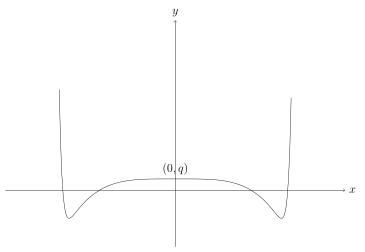
- Sketch the graph of the function \(\mathrm{f}\), where \(\mathrm{f}(x)=x^{1760}-x^{220}+q\), and \(q\) is a constant. Find the possible numbers of \textit{distinct }roots of the equation \(\mathrm{f}(x)=0\), and state the inequalities satisfied by \(q\).
Solution:
- \begin{align*} \int_{1}^{3}\frac{1}{6x^{2}+19x+15}\,\mathrm{d}x &= \int_1^3 \frac1{(2x+3)(3x+5)} \d x \\ &= \int_1^3 \l \frac{2}{2x+3} - \frac{3}{3x+5} \r \d x \\ &= \left [\ln(2x+3) - \ln(3x+5) \right ]_1^3 \\ &= \l \ln9 - \ln14 \r - \l \ln 5 - \ln 8 \r \\ &= \ln \frac{72}{70} \\ &= \ln \frac{36}{35} \end{align*}
- When \(q = 0\) the roots are \(-1, 0, 1\) There can be \(0, 2, 3, 4\) roots. There will be no roots if \(q > -\min (x^{1760} - x^{220})\) since the whole graph will be above the axis. There will be \(2\) roots if \(q = -\min (x^{1760} - x^{220})\) or \(q > 0\) There will be \(4\) roots if \(0 > q > -\min (x^{1760} - x^{220})\). There will be \(3\) roots if \(q =0\)
1990 Paper 1 Q9
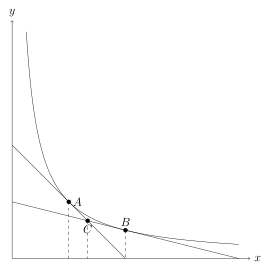
Let \(A\) and \(B\) be the points \((1,1)\) and \((b,1/b)\) respectively, where \(b>1\). The tangents at \(A\) and \(B\) to the curve \(y=1/x\) intersect at \(C\). Find the coordinates of \(C\). Let \(A',B'\) and \(C'\) denote the projections of \(A,B\) and \(C\), respectively, to the \(x\)-axis. Obtain an expression for the sum of the areas of the quadrilaterals \(ACC'A'\) and \(CBB'C'\). Hence or otherwise prove that, for \(z>0\), \[ \frac{2z}{2+z}\leqslant\ln\left(1+z\right)\leqslant z. \]
Solution: