Problems
Filters
218 problems found
1997 Paper 2 Q5
The complex numbers \(w=u+\mathrm{i}v\) and \(z=x+\mathrm{i}y\) are related by the equation $$z= (\cos v+\mathrm{i}\sin v)\mathrm{e}^u.$$ Find all \(w\) which correspond to \(z=\mathrm{i\,e}\). Find the loci in the \(x\)--\(y\) plane corresponding to the lines \(u=\) constant in the \(u\)--\(v\) plane. Find also the loci corresponding to the lines \(v=\) constant. Illustrate your answers with clearly labelled sketches. Identify two subsets \(W_1\) and \(W_2\) of the \(u\)--\(v\) plane each of which is in one-to-one correspondence with the first quadrant \(\{(x,\,y):\,x>0,\,y>0\}\) of the \(x\)--\(y\) plane. Identify also two subsets \(W_3\) and \(W_4\) each of which is in one-to-one correspondence with the set \(\{z\,:0<\,\vert z\vert\,<1\}\). \noindent[{\bf NB} `one-to-one' means here that to each value of \(w\) there is only one corresponding value of \(z\), and vice-versa.]
1997 Paper 2 Q7
Let $$y^2=x^2(a^2-x^2),$$ where \(a\) is a real constant. Find, in terms of \(a\), the maximum and minimum values of \(y\). Sketch carefully on the same axes the graphs of \(y\) in the cases \(a=1\) and \(a=2\).
Solution: \begin{align*} && y^2 &= x^2a^2-x^2 \\ &&&= \frac{a^4}{4} -\left ( x^2 -\frac{a^2}{2} \right)^2 \end{align*} Therefore the maximum and minimum values of \(y\) are \(\pm \frac{a^2}2\)

1997 Paper 3 Q2
Let \[\mathrm{f}(t)=\frac{\ln t}t\quad\text{ for }t>0.\] Sketch the graph of \(\mathrm{f}(t)\) and find its maximum value. How many positive values of \(t\) correspond to a given value of \(\mathrm f(t)\)? Find how many positive values of \(y\) satisfy \(x^y=y^x\) for a given positive value of \(x\). Sketch the set of points \((x,y)\) which satisfy \(x^y=y^x\) with \(x,y>0\).
1995 Paper 1 Q1
- Find the real values of \(x\) for which \[ x^{3}-4x^{2}-x+4\geqslant0. \]
- Find the three lines in the \((x,y)\) plane on which \[ x^{3}-4x^{2}y-xy^{2}+4y^{3}=0. \]
- On a sketch shade the regions of the \((x,y)\) plane for which \[ x^{3}-4x^{2}y-xy^{2}+4y^{3}\geqslant0. \]
Solution:
- \(\,\) \begin{align*} && 0 & \leq x^3 - 4x^2 - x + 4 \\ &&&= (x-1)(x^2-3x-4) \\ &&&= (x-1)(x-4)(x+1) \\ \Leftrightarrow && x &\in [-1, 1] \cup [4, \infty) \end{align*}
- \(\,\) \begin{align*} && 0 &= x^{3}-4x^{2}y-xy^{2}+4y^{3} \\ && 0 &= (x-y)(x-4y)(x+y) \end{align*} Therefore the lines are \(y = x, 4y = x, y=-x\).
- (quickest way to see this is to check the \(x\) or \(y\)-axis)

1995 Paper 2 Q4
Let \[ u_{n}=\int_{0}^{\frac{1}{2}\pi}\sin^{n}t\,\mathrm{d}t \] for each integer \(n\geqslant0\). By integrating \[ \int_{0}^{\frac{1}{2}\pi}\sin t\sin^{n-1}t\,\mathrm{d}t \] by parts, or otherwise, obtain a formula connecting \(u_{n}\) and \(u_{n-2}\) when \(n\geqslant2\) and deduce that \[ nu_{n}u_{n-1}=\left(n-1\right)u_{n-1}u_{n-2} \] for all \(n\geqslant2\). Deduce that \[ nu_{n}u_{n-1}=\tfrac{1}{2}\pi. \] Sketch graphs of \(\sin^{n}t\) and \(\sin^{n-1}t\), for \(0\leqslant t\leqslant\frac{1}{2}\pi,\) on the same diagram and explain why \(0 < u_{n} < u_{n-1}.\) By using the result of the previous paragraph show that \[ nu_{n}^{2} < \tfrac{1}{2}\pi < nu_{n-1}^{2} \] for all \(n\geqslant1\). Hence show that \[ \left(\frac{n}{n+1}\right)\tfrac{1}{2}\pi < nu_{n}^{2} < \tfrac{1}{2}\pi \] and deduce that \(nu_{n}^{2}\rightarrow\tfrac{1}{2}\pi\) as \(n\rightarrow\infty\).
Solution: \begin{align*} && u_n &= \int_0^{\tfrac12 \pi} \sin^{n} t \, \d t \\ && &= \int_0^{\tfrac12 \pi} \sin t \sin^{n-1} t \, \d t \\ && &= \left [ -\cos t \sin^{n-1} t \right]_0^{\tfrac12 \pi} + \int_0^{\tfrac12 \pi} \cos t (n-1) \sin^{n-2} t \cos t \d t \\ && &= 0 + (n-1)\int_0^{\tfrac12 \pi} \cos^2 t \sin^{n-2} t \d t \\ && &= (n-1) \int_0^{\tfrac12 \pi}(1-\sin^2 t) \sin^{n-2} t \d t \\ && &= (n-1)u_{n-2} - (n-1)u_n \\ \Rightarrow && n u_n &= (n-1)u_{n-2} \\ \end{align*} Mutplying both sides by \(u_{n-1}\) we obtain \(nu_{n}u_{n-1}=\left(n-1\right)u_{n-1}u_{n-2}\). Therefore \(nu_nu_{n-1}\) is constant, ie is equal to \(\displaystyle u_1u_0 = \int_0^{\tfrac12 \pi} \sin^{1} t \, \d t \int_0^{\tfrac12 \pi} \sin^{0} t \, \d t = 1 \cdot \frac{\pi}{2} = \frac{\pi}{2}\)

1995 Paper 2 Q8
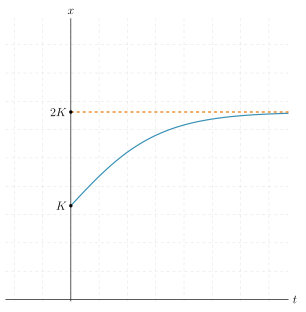
If there are \(x\) micrograms of bacteria in a nutrient medium, the population of bacteria will grow at the rate \((2K-x)x\) micrograms per hour. Show that, if \(x=K\) when \(t=0\), the population at time \(t\) is given by \[ x(t)=K+K\frac{1-\mathrm{e}^{-2Kt}}{1+\mathrm{e}^{-2Kt}}. \] Sketch, for \(t\geqslant0\), the graph of \(x\) against \(t\). What happens to \(x(t)\) as \(t\rightarrow\infty\)? Now suppose that the situation is as described in the first paragraph, except that we remove the bacteria from the nutrient medium at a rate \(L\) micrograms per hour where \(K^{2}>L\). We set \(\alpha=\sqrt{K^{2}-L}.\) Write down the new differential equation for \(x\). By considering a new variable \(y=x-K+\alpha,\) or otherwise, show that, if \(x(0)=K\) then \(x(t)\rightarrow K+\alpha\) as \(t\rightarrow\infty\).
Solution: \begin{align*} && \dot{x} &= (2K-x)x \\ \Rightarrow && \int \d t &= \int \frac{1}{(2K-x)x} \d x \\ &&&= \int \frac1{2K}\left ( \frac{1}{2K-x} + \frac{1}{x} \right) \d x \\ &&&= \frac{1}{2K} \left (\ln x - \ln (2K-x) \right) \\ \Rightarrow && 2Kt+C &= \ln \frac{x}{2K-x} \\ t = 0, x = K: && C &= \ln \frac{K}{2K-K} = 0 \\ \Rightarrow && e^{2Kt} &= \frac{x}{2K-x} \\ \Rightarrow && e^{-2Kt} &= \frac{2K}{x} -1 \\ \Rightarrow && x &= \frac{2K}{1+e^{-2Kt}} \\ &&&= K + K \frac{1-e^{-2Kt}}{1+e^{-2Kt}} \end{align*}
1995 Paper 3 Q6
The variable non-zero complex number \(z\) is such that \[ \left|z-\mathrm{i}\right|=1. \] Find the modulus of \(z\) when its argument is \(\theta.\) Find also the modulus and argument of \(1/z\) in terms of \(\theta\) and show in an Argand diagram the loci of points which represent \(z\) and \(1/z\). Find the locus \(C\) in the Argand diagram such that \(w\in C\) if, and only if, the real part of \((1/w)\) is \(-1\).
Solution:

1994 Paper 1 Q5
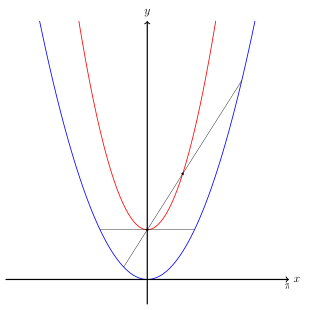
A parabola has the equation \(y=x^{2}.\) The points \(P\) and \(Q\) with coordinates \((p,p^{2})\) and \((q,q^{2})\) respectively move on the parabola in such a way that \(\angle POQ\) is always a right angle.
- Find and sketch the locus of the midpoint \(R\) of the chord \(PQ.\)
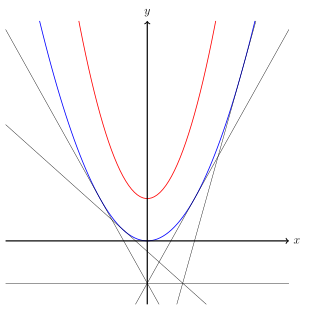
- Find and sketch the locus of the point \(T\) where the tangents to the parabola at \(P\) and \(Q\) intersect.
Solution:
- The line \(PO\) has gradient \(\frac{p^2}{p} = p\) and teh line \(QO\) has gradient \(q\), therefore we must have that \(pq = -1\). Therefore, \(R\) is the point
\begin{align*}
&& R &= \left ( \frac{p-\frac{1}{p}}{2}, \frac{p^2+\frac{1}{p^2}}{2} \right) \\
&&&= \left ( \frac12\left ( p - \frac{1}{p} \right),2\left (\frac12 \left(p-\frac{1}{p}\right) \right)^2+1 \right) \\
&&&= \left ( t, 2t^2+1\right)
\end{align*}
So we are looking at another parabola.
- The tangents are \(y = 2px+c\), ie \(p^2 = 2p^2+c\), ie \(y = 2px -p^2\) so we have
\begin{align*}
&& y - 2px &= -p^2 \\
&& y - 2qx &= -q^2 \\
\Rightarrow && (2p-2q)x &= p^2-q^2 \\
\Rightarrow && x &= \frac12 (p+q)\\
&& y &= p(p+q)-p^2 \\
&& y &= pq = -1
\end{align*}
Therefore \(x = \frac12(p - \frac1p), y= -1\), so we have the line \(y = -1\) (the directrix)
1994 Paper 2 Q5
- Show that the equation \[ (x-1)^{4}+(x+1)^{4}=c \] has exactly two real roots if \(c>2,\) one root if \(c=2\) and no roots if \(c<2\).
- How many real roots does the equation \(\left(x-3\right)^{4}+\left(x-1\right)^{4}=c\) have?
- How many real roots does the equation \(\left|x-3\right|+\left|x-1\right|=c\) have?
- How many real roots does the equation \(\left(x-3\right)^{3}+\left(x-1\right)^{3}=c\) have?
Solution:
- \(\,\) \begin{align*} && c &= (x-1)^4+(x+1)^4 \\ &&&= 2x^4+12x^2+2 \\ \Rightarrow && 0 &= (x^2+6)^2-\frac{c}{2} - 35 \\ \Rightarrow && \underbrace{x^2+6}_{\geq 6} &= \pm \sqrt{35 + \frac{c}{2}}\\ \end{align*} Therefore there are two solutions if \(c > 2\), one solution if \(c = 2\) and no solutions otherwise.
- \(\,\) This equation is the same equation if \(y = x-2\), ie there are two solutions if \(c > 2\), one solution if \(c = 2\) and no solutions otherwise.
- Rewriting as \(|x-1|+|x+1| = c\) we have For \(x < -1\): \(1-x-1-x = -2x\) For \(-1 \leq x \leq 1\): \(1-x+x+1 = 2\) For \(x > 1\): \(x-1+x+1 = 2x\) Therefore there are infinitely many solutions if \(c = 2\) (the interval \([-3,-1]\)), two solutions if \(c > 2\) and none otherwise.
- Rewriting as \((x-1)^3+(x+1)^3\) we have \(x^3+6x = c\). Notice that \(3x^2+6 > 0\) so the function is increasing, ie there is one solution for all \(c\)
1994 Paper 2 Q8
`24 Hour Spares' stocks a small, widely used and cheap component. Every \(T\) hours \(X\) units arrive by lorry from the wholesaler, for which the owner pays a total \(\pounds (a+qX)\). It costs the owner \(\pounds b\) per hour to store one unit. If she has the units in stock she expects to sell \(r\) units per hour at \(\pounds(p+q)\) per unit. The other running costs of her business remain at \(\pounds c\) pounds an hour irrespective of whether she has stock or not. (All of the quantities \(T,X,a,b,r,q,p\) and \(c\) are greater than 0.) Explain why she should take \(X\leqslant rT\). Given that the process may be assumed continuous (the items are very small and she sells many each hour), sketch \(S(t)\) the amount of stock remaining as a function of \(t\) the time from the last delivery. Compute the total profit over each period of \(T\) hours. Show that, if \(T\) is fixed with \(T\geqslant p/b\), the business can be made profitable if \[ p^{2}>2\frac{(a+cT)b}{r}. \]
1994 Paper 3 Q4
Find the two solutions of the differential equation \[ \left(\frac{\mathrm{d}y}{\mathrm{d}x}\right)^{2}=4y \] which pass through the point \((a,b^{2}),\) where \(b\neq0.\) Find two distinct points \((a_{1},1)\) and \((a_{2},1)\) such that one of the solutions through each of them also passes through the origin. Show that the graphs of these two solutions coincide and sketch their common graph, together with the other solutions through \((a_{1},1)\) and \((a_{2},1)\). Now sketch sufficient members of the family of solutions (for varying \(a\) and \(b\)) to indicate the general behaviour. Use your sketch to identify a common tangent, and comment briefly on its relevance to the differential equation.
1993 Paper 1 Q6
Let \(N=10^{100}.\) The graph of \[ \mathrm{f}(x)=\frac{x^{N}}{1+x^{N}}+2 \] for \(-3\leqslant x\leqslant3\) is sketched in the following diagram. \noindent
1993 Paper 1 Q7
Sketch the curve \[ \mathrm{f}(x)=x^{3}+Ax^{2}+B \] first in the case \(A>0\) and \(B>0\), and then in the case \(A<0\) and \(B>0.\) Show that the equation \[ x^{3}+ax^{2}+b=0, \] where \(a\) and \(b\) are real, will have three distinct real roots if \[ 27b^{2}+3a^{3}b<0, \] but will have fewer than three if \[ 27b^{2}+4a^{3}b<0. \]
1993 Paper 2 Q5
\noindent
1993 Paper 3 Q1
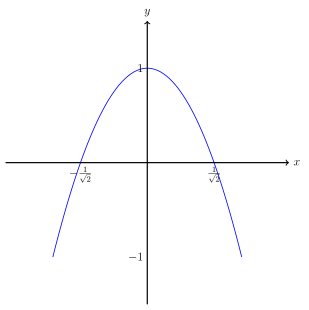
The curve \(P\) has the parametric equations $$ x= \sin\theta, \quad y=\cos2\theta \qquad\hbox{ for }-\pi/2 \le \theta \le \pi/2. $$ Show that \(P\) is part of the parabola \(y=1-2x^2\) and sketch \(P\). Show that the length of \(P\) is \(\surd (17) + {1\over 4} \sinh^{-1}4\). Obtain the volume of the solid enclosed when \(P\) is rotated through \(2\pi\) radians about the line \(y=-1\).
Solution: First notice that \(y = \cos 2 \theta = 1 - 2\sin^2 \theta = 1- 2x^2\), therefore \(P\) is lies on that parabola.