1995 Paper 2 Q8
Year: 1995
Paper: 2
Question Number: 8
Course: UFM Pure
Section: First order differential equations (integrating factor)
Difficulty: 1600.0
Banger: 1500.8
differential equation
separable ODE
partial fractions
population dynamics
curve sketching
asymptotic behaviour
logistic growth
substitution
Problem
If there are \(x\) micrograms of bacteria in a nutrient medium, the population of bacteria will grow at the rate \((2K-x)x\) micrograms per hour. Show that, if \(x=K\) when \(t=0\), the population at time \(t\) is given by
\[
x(t)=K+K\frac{1-\mathrm{e}^{-2Kt}}{1+\mathrm{e}^{-2Kt}}.
\]
Sketch, for \(t\geqslant0\), the graph of \(x\) against \(t\). What happens to \(x(t)\) as \(t\rightarrow\infty\)?
Now suppose that the situation is as described in the first paragraph, except that we remove the bacteria from the nutrient medium at a rate \(L\) micrograms per hour where \(K^{2}>L\). We set \(\alpha=\sqrt{K^{2}-L}.\)
Write down the new differential equation for \(x\). By considering a new variable \(y=x-K+\alpha,\) or otherwise, show that, if \(x(0)=K\) then \(x(t)\rightarrow K+\alpha\) as \(t\rightarrow\infty\).
Solution
\begin{align*}
&& \dot{x} &= (2K-x)x \\
\Rightarrow && \int \d t &= \int \frac{1}{(2K-x)x} \d x \\
&&&= \int \frac1{2K}\left ( \frac{1}{2K-x} + \frac{1}{x} \right) \d x \\
&&&= \frac{1}{2K} \left (\ln x - \ln (2K-x) \right) \\
\Rightarrow && 2Kt+C &= \ln \frac{x}{2K-x} \\
t = 0, x = K: && C &= \ln \frac{K}{2K-K} = 0 \\
\Rightarrow && e^{2Kt} &= \frac{x}{2K-x} \\
\Rightarrow && e^{-2Kt} &= \frac{2K}{x} -1 \\
\Rightarrow && x &= \frac{2K}{1+e^{-2Kt}} \\
&&&= K + K \frac{1-e^{-2Kt}}{1+e^{-2Kt}}
\end{align*}
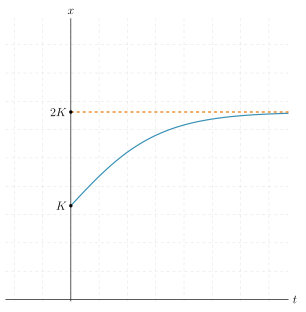 As \(t \to \infty\) \(x(t) \to 2K\)
We now have
\[ \dot{x} = (2K-x)x - L\]
Suppose \(y = x - K + \alpha\), where \(\alpha = \sqrt{K^2-L}\) then,
\begin{align*}
&& \dot{y} &= \dot{x} \\
&&&= (2K-x)x - L \\
&&&= (2K - (y+K-\alpha))(y+K-\alpha) - L \\
&&&= (K+\alpha - y)y + (K+\alpha-y)(K-\alpha) - L \\
&&&= (K+\alpha-y)y + K^2-\alpha^2 -y(K-\alpha) - L \\
&&&= (K+\alpha-y)y -y(K-\alpha) \\
&&&= (2\alpha-y)y
\end{align*}
Note that when \(t = 0, x = K, y = \alpha\) so we have the original equation but with \(x \to y\) and \(\alpha \to K\), in particular as \(t \to \infty\) \(y \to 2\alpha\) and \(x \to 2\alpha - \alpha + K = K +\alpha\)
As \(t \to \infty\) \(x(t) \to 2K\)
We now have
\[ \dot{x} = (2K-x)x - L\]
Suppose \(y = x - K + \alpha\), where \(\alpha = \sqrt{K^2-L}\) then,
\begin{align*}
&& \dot{y} &= \dot{x} \\
&&&= (2K-x)x - L \\
&&&= (2K - (y+K-\alpha))(y+K-\alpha) - L \\
&&&= (K+\alpha - y)y + (K+\alpha-y)(K-\alpha) - L \\
&&&= (K+\alpha-y)y + K^2-\alpha^2 -y(K-\alpha) - L \\
&&&= (K+\alpha-y)y -y(K-\alpha) \\
&&&= (2\alpha-y)y
\end{align*}
Note that when \(t = 0, x = K, y = \alpha\) so we have the original equation but with \(x \to y\) and \(\alpha \to K\), in particular as \(t \to \infty\) \(y \to 2\alpha\) and \(x \to 2\alpha - \alpha + K = K +\alpha\)
Rating Information
Difficulty Rating: 1600.0
Difficulty Comparisons: 0
Banger Rating: 1500.8
Banger Comparisons: 2
Show LaTeX source
Problem source
If there are $x$ micrograms of bacteria in a nutrient medium, the population of bacteria will grow at the rate $(2K-x)x$ micrograms per hour. Show that, if $x=K$ when $t=0$, the population at time $t$ is given by
\[
x(t)=K+K\frac{1-\mathrm{e}^{-2Kt}}{1+\mathrm{e}^{-2Kt}}.
\]
Sketch, for $t\geqslant0$, the graph of $x$ against $t$. What happens to $x(t)$ as $t\rightarrow\infty$?
Now suppose that the situation is as described in the first paragraph, except that we remove the bacteria from the nutrient medium at a rate $L$ micrograms per hour where $K^{2}>L$. We set $\alpha=\sqrt{K^{2}-L}.$
Write down the new differential equation for $x$. By considering a new variable $y=x-K+\alpha,$ or otherwise, show that, if $x(0)=K$ then $x(t)\rightarrow K+\alpha$ as $t\rightarrow\infty$.
Solution source
\begin{align*}
&& \dot{x} &= (2K-x)x \\
\Rightarrow && \int \d t &= \int \frac{1}{(2K-x)x} \d x \\
&&&= \int \frac1{2K}\left ( \frac{1}{2K-x} + \frac{1}{x} \right) \d x \\
&&&= \frac{1}{2K} \left (\ln x - \ln (2K-x) \right) \\
\Rightarrow && 2Kt+C &= \ln \frac{x}{2K-x} \\
t = 0, x = K: && C &= \ln \frac{K}{2K-K} = 0 \\
\Rightarrow && e^{2Kt} &= \frac{x}{2K-x} \\
\Rightarrow && e^{-2Kt} &= \frac{2K}{x} -1 \\
\Rightarrow && x &= \frac{2K}{1+e^{-2Kt}} \\
&&&= K + K \frac{1-e^{-2Kt}}{1+e^{-2Kt}}
\end{align*}

\begin{center}
    \begin{tikzpicture}
    \def\functionf(#1){0.5+0.5*(1-exp(-(#1)))/(1+exp(-(#1)))};
    \def\xl{-1.5};
    \def\xu{5};
    \def\yl{-0.01}; \def\yu{1.5};

    % Calculate scaling factors to make the plot square
    \pgfmathsetmacro{\xrange}{\xu-\xl}
    \pgfmathsetmacro{\yrange}{\yu-\yl}
    \pgfmathsetmacro{\xscale}{10/\xrange}
    \pgfmathsetmacro{\yscale}{10/\yrange}

    % Define the reusable styles to keep code clean
    \tikzset{
        x=\xscale cm, y=\yscale cm,
        axis/.style={thick, draw=black!80, -{Stealth[scale=1.2]}},
        grid/.style={thin, dashed, gray!30},
        curveA/.style={very thick, color=cyan!70!black, smooth},
        curveB/.style={very thick, color=orange!90!black, smooth},
        dot/.style={circle, fill=black, inner sep=1.2pt},
        labelbox/.style={fill=white, inner sep=2pt, rounded corners=2pt} % Protects text from lines
    }

    % Draw background grid
    \draw[grid] (\xl,\yl) grid (\xu,\yu);

    % Set up axes
    \draw[axis] (\xl,0) -- (\xu,0) node[right, black] {$t$};
    \draw[axis] (0,\yl) -- (0,\yu) node[above, black] {$x$};

    % Define the bounding region with clip
    \begin{scope}
        \clip (\xl,\yl) rectangle (\xu,\yu);


        \draw[curveA, domain=0:6, samples=150]
            plot ({\x},{\functionf(\x)});
        \draw[curveB, dashed] (0,1) -- (\xu, 1);

        \filldraw (0, 0.5) circle (1.5pt) node[left] {$K$};
        \filldraw (0, 1) circle (1.5pt) node[left] {$2K$};
    \end{scope}

    % Annotate Function Names


    \end{tikzpicture}
\end{center}

As $t \to \infty$ $x(t) \to 2K$

We now have
\[ \dot{x} = (2K-x)x - L\]
Suppose $y = x - K + \alpha$, where $\alpha = \sqrt{K^2-L}$ then,

\begin{align*}
&& \dot{y} &= \dot{x} \\
&&&= (2K-x)x - L \\
&&&= (2K - (y+K-\alpha))(y+K-\alpha) - L \\
&&&= (K+\alpha - y)y + (K+\alpha-y)(K-\alpha) - L \\
&&&= (K+\alpha-y)y + K^2-\alpha^2 -y(K-\alpha) - L \\
&&&= (K+\alpha-y)y -y(K-\alpha) \\
&&&= (2\alpha-y)y
\end{align*}

Note that when $t = 0, x = K, y = \alpha$ so we have the original equation but with $x \to y$ and $\alpha \to K$, in particular as $t \to \infty$ $y \to 2\alpha$ and $x \to 2\alpha - \alpha + K = K +\alpha$