Problems
Filters
233 problems found
2002 Paper 3 Q9
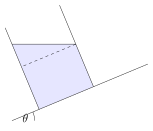
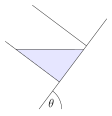
A tall container made of light material of negligible thickness has the form of a prism, with a square base of area \(a^2\). It contains a volume \(ka^3\) of fluid of uniform density. The container is held so that it stands on a rough plane, which is inclined at angle \(\theta\) to the horizontal, with two of the edges of the base of the container horizontal. In the case \(k > \frac12 \tan\theta\), show that the centre of mass of the fluid is at a distance \(x\) from the lower side of the container and at a distance \(y\) from the base of the container, where \[ \frac x a = \frac12 - \frac {\tan\theta}{12k}\;, \ \ \ \ \ \ \frac y a = \frac k 2 + \frac{\tan^2\theta}{24k}\;. \] Determine the corresponding coordinates in the case \(k < \frac12 \tan\theta\). The container is now released. Given that \(k < \frac12\), show that the container will topple if \(\theta >45^\circ\).
Solution:
2001 Paper 1 Q5
Show that (for \(t>0\))
- \[ \int_0^1 \frac1{(1+tx)^2} \d x = \frac1{(1+t)} \]
- \[ \int_0^1 \frac{-2x}{(1+tx)^3} \d x = -\frac1{(1+t)^2} \]
Solution:
- For the first one, consider \begin{align*} && \int_0^1 \frac{1}{(1+tx)^2} \d x &= \left [ -\frac{1}{t}(1+tx)^{-1} \right]_0^1 \\ &&&= \frac{1}{t} - \frac{1}{t(1+t)} \\ &&&= \frac{t+1-1}{t(t+1)} = \frac{1}{t+1} \end{align*}
- Consider \begin{align*} && \int_0^1 \frac{-2x}{(1+tx)^3} \d x &= \int_0^1 \frac{\frac{2}{t}(1+tx) -\frac{2}{t}}{(1+tx)^3} \d x \\ &&&= -\frac{2}{t} \int_0^1 \left (\frac{1}{(1+tx)^2}- \frac{1}{(1+tx)^3} \right) \d x \\ &&&= -\frac{2}{t} \frac{1}{t+1} + \frac{2}{t} \left [ \frac{1}{-2t}(1+tx)^{-2}\right]_0^1 \\ &&&= -\frac{2}{t(t+1)} + \frac2t\left (\frac{1}{2t} - \frac{1}{2t(1+t)^2} \right) \\ &&&= -\frac{2}{t} \left ( \frac{1}{t+1} + \frac{1}{2t(1+t)^2} - \frac{1}{2t}\right) \\ &&&= -\frac{2}{t} \frac{2t(1+t)+1-(1+t)^2}{2t(1+t)^2} \\ &&&= -\frac{2}{t} \frac{2t^2+2t+1-1-2t-t^2}{2t(1+t)^2} \\ &&&= -\frac{1}{(1+t)^2} \end{align*}
2001 Paper 1 Q6
A spherical loaf of bread is cut into parallel slices of equal thickness. Show that, after any number of the slices have been eaten, the area of crust remaining is proportional to the number of slices remaining. A European ruling decrees that a parallel-sliced spherical loaf can only be referred to as `crusty' if the ratio of volume \(V\) (in cubic metres) of bread remaining to area \(A\) (in square metres) of crust remaining after any number of slices have been eaten satisfies \(V/A<1\). Show that the radius of a crusty parallel-sliced spherical loaf must be less than \(2\frac23\) metres. [{\sl The area \(A\) and volume \(V\) formed by rotating a curve in the \(x\)--\(y\) plane round the \(x\)-axis from \(x=-a\) to \(x=-a+t\) are given by \[ A= 2\pi\int_{-a}^{-a+t} { y}\left( 1+ \Big(\frac{\d {y}}{\d x}\Big)^2\right)^{\frac12} \d x\;, \ \ \ \ \ \ \ \ \ \ \ V= \pi \int_{-a}^{-a+t} {y}^2 \d x \;. \ \ ] \] }
2001 Paper 1 Q7
In a cosmological model, the radius \(\rm R\) of the universe is a function of the age \(t\) of the universe. The function \(\rm R\) satisfies the three conditions: $$ \mbox{\({\rm R}(0)=0\)}, \ \ \ \ \ \ \ \ \ \mbox{\({\rm R'}(t)>0\) for \(t>0\)}, \ \ \ \ \ \ \ \ \ \ \mbox{\({\rm R''}(t)<0\) for \(t>0\)}, \tag{*} $$ where \({\rm R''}\) denotes the second derivative of \(\rm R\). The function \({\rm H}\) is defined by \[ {\rm H} (t)= \frac{{\rm R}'(t)}{{\rm R}( t)}\;. \]
- Sketch a graph of \({\rm R} (t)\). By considering a tangent to the graph, show that \(t<1/{\rm H}(t)\).
- Observations reveal that \({\rm H}(t) = a/t\), where \(a\) is constant. Derive an expression for \({\rm R}(t)\). What range of values of \(a\) is consistent with the three conditions \((*)\)?
- Suppose, instead, that observations reveal that \({\rm H}(t)= b t^{-2}\), where \(b\) is constant. Show that this is not consistent with conditions \((*)\) for any value of \(b\).
Solution:
- \(\,\)
Notice the tangent must hit the \(y\)-axis above the origin, ie \begin{align*} && 0 &< R'(t)(0-t) + R(t) \\ \Rightarrow && R'(t) t &< R(t) \\ \Rightarrow && t &< \frac{R(t)}{R'(t)} = \frac{1}{H(t)} \end{align*}

- Suppose \(H(t) = a/t\) then \begin{align*} && \frac{R'}{R} &= \frac{a}{t} \\ \Rightarrow && \int \frac{1}{R} \d R &= \int \frac{a}{t} \d t \\ \Rightarrow && \ln R &= a \ln t + C \tag{t, R > 0} \\ \Rightarrow && R &= Kt^a \end{align*} Since we need \(R(t) > 0\), \(K > 0\), since \(R'(t) > 0\) we need \(a > 0\), since \(R''(t) < 0\) we need \(a(a-1) < 0\) ie \(0 < a < 1\)
- Suppose instead \(H(t) = bt^{-2}\) then \begin{align*} && \frac{R'}{R} &= \frac{b}{t^2} \\ \Rightarrow && \int \frac{1}{R} \d R &= \int \frac{b}{t^2} \d t \\ \Rightarrow && \ln R &= -bt^{-1} + C \tag{R > 0} \\ \Rightarrow && R &= Ke^{-b/t} \end{align*} Since \(R > 0\) we must have \(K > 0\). \begin{align*} R' > 0: && R' &= K(b/t^2)e^{-b/t} > 0 \\ \Rightarrow && b &> 0 \\ R'' < 0: && R'' &= K(b^2/t^4)e^{-b/t} -K2b/t^3 e^{-b/t} \\ &&&= Kb/t^4 (b-2t)e^{-b/t} < 0 \\ \Rightarrow && b &< 2t\\ \Rightarrow && b &< 2t \end{align*} which cannot be true for all \(t\), ie there is no \(b\) which satisfies this.
2001 Paper 2 Q5
The curve \(C_1\) passes through the origin in the \(x\)--\(y\) plane and its gradient is given by $$ \frac{\d y}{\d x} =x(1-x^2)\e^{-x^2}. $$ Show that \(C_1\) has a minimum point at the origin and a maximum point at \(\left(1,{\frac12\, \e^{-1}} \right)\). Find the coordinates of the other stationary point. Give a rough sketch of \(C_1\). The curve \(C_2\) passes through the origin and its gradient is given by $$ \frac{\d y}{\d x}= x(1-x^2)\e^{-x^3}. $$ Show that \(C_2\) has a minimum point at the origin and a maximum point at \((1,k)\), where \phantom{} \(k > \frac12 \,\e^{-1}.\) (You need not find \(k\).)
2001 Paper 2 Q6
Show that \[ \int_0^1 \frac{x^4}{1+x^2} \, \d x = \frac \pi {4} - \frac 23 \;. \] Determine the values of
- \(\displaystyle \int_0^1 x^3 \; \tan ^{-1} \left(\frac {1-x} {1+x} \right) \,\d x \)
- \(\displaystyle \int_0^1 \frac {(1-y)^3} {(1+y)^5} \; {{\tan}^{-1} y}\, \d y\)
Solution: \begin{align*} && \int_0^1 \frac{x^4}{1+x^2} \d x &= \int_0^1 \frac{(x^2-1)(1+x^2)+1}{x^2+1} \d x\\ &&&= \int_0^1 \frac{1}{1+x^2} \d x -\int_0^1 (1-x^2) \d x \\ &&&= \left [\tan^{-1}x \right]_0^1 - \left [x - \tfrac13x^3 \right]_0^1 \\ &&&= \frac{\pi}{4} - \frac23 \end{align*}
- \(\,\) \begin{align*} && I &= \int_0^1 x^3 \; \tan ^{-1} \left(\frac {1-x} {1+x} \right) \,\d x \\ &&&= \left [ \frac{x^4}{4}\tan ^{-1} \left(\frac {1-x} {1+x} \right) \right]_0^1 -\int_0^1 \frac{x^4}{4} \frac{1}{1 +\left(\frac {1-x} {1+x} \right) ^2 } \cdot \frac{-2}{(1+x)^2} \d x \\ &&&= \frac{1}{2} \int_0^1 \frac{x^4}{(1+x)^2+(1-x)^2} \d x \\ &&&= \frac{1}{4} \int_0^1 \frac{x^4}{1+x^2} \d x \\ &&&= \frac{\pi}{16} - \frac{1}{6} \end{align*}
- \(\,\) \begin{align*} && J &= \int_0^1 \frac {(1-y)^3} {(1+y)^5} \; {{\tan}^{-1} y}\, \d y \\ &&&= \left [ \frac {(y(1+y^2)} {(1+y)^4} \tan^{-1}y \right]_0^1 - \int_0^1 \frac {(y(1+y^2)} {(1+y)^4} \frac{1}{1+y^2} \d y \\ &&&= \frac{\pi}{32} - \int_0^1 \frac{y}{(1+y)^4} \d y \\ &&&= \frac{\pi}{32} - \left[ - \frac{3y+1}{6(1+y)^3} \right]_0^1 \\ &&&= \frac{\pi}{32} +\frac{4}{6 \cdot 8} - \frac{1}{6} \\ &&&= \frac{\pi}{32} - \frac{1}{12} \end{align*}
2001 Paper 3 Q2
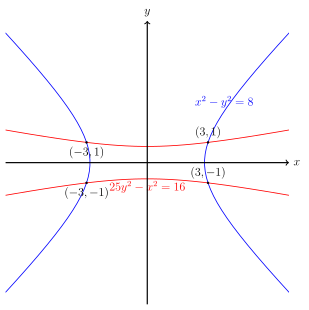
Show that \( \cosh^{-1} x = \ln ( x + \sqrt{x^2-1})\). Show that the area of the region defined by the inequalities \(\displaystyle y^2 \ge x^2-8\) and \(\displaystyle x^2\ge 25y^2 -16 \) is \((72/5) \ln 2\).
Solution: \begin{align*} && x &= \cosh y \\ \Rightarrow && x &= \tfrac12 (e^y + e^{-y} ) \\ \Rightarrow && 0 &= e^{2y} - 2xe^y + 1 \\ \Rightarrow && e^y &= \frac{2x \pm \sqrt{4x^2-4}}{2} \\ &&&= x \pm \sqrt{x^2-1} \\ \Rightarrow &&e^y &= x + \sqrt{x^2-1} \tag{by convention \(\cosh^{-1} > 0\)} \\ \Rightarrow && y &= \ln (x + \sqrt{x^2-1}) \end{align*}
2000 Paper 1 Q3
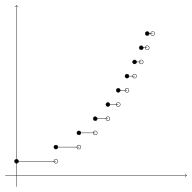
For any number \(x\), the largest integer less than or equal to \(x\) is denoted by \([x]\). For example, \([3.7]=3\) and \([4]=4\). Sketch the graph of \(y=[x]\) for \(0\le x<5\) and evaluate \[ \int_0^5 [x]\;\d x. \] Sketch the graph of \(y=[\e^{x}]\) for \(0\le x< \ln n\), where \(n\) is an integer, and show that \[ \int_{0}^{\ln n}[\e^{x}]\, \d x =n\ln n - \ln (n!). \]
Solution:

2000 Paper 1 Q4
- Show that, for \(0\le x\le 1\), the largest value of \(\displaystyle \frac{x^6}{(x^2+1)^4}\) is \(\frac1{16}\).
- Find constants \(A\), \(B\), \(C\) and \(D\) such that, for all \(x\), \[ \frac{1}{(x^2+1)^4}= \frac{\d \ }{\d x} \left( \frac{Ax^5+Bx^3+Cx}{(x^2+1)^3}\right) +\frac{Dx^6}{(x^2+1)^4}. \]
- Hence, or otherwise, prove that \[ \frac{11}{24} \le \int_{0}^{1}\frac{1}{(x^{2}+1)^{4}}\, \d x \le \frac{11}{24} + \frac 1{16} \; . \]
Solution:
- \(x^2 + 1 \geq 2x \Rightarrow \frac{1}{x^2+1} \leq \frac1{2x} \Rightarrow \frac{x^6}{(x^2+1)^4}\leq \frac{x^6}{16x^2} = \frac1{16}x^2 \leq \frac1{16}\) with equality when \(x = 1\)
- \(\,\) \begin{align*} && RHS &= \frac{\d \ }{\d x} \left( \frac{Ax^5+Bx^3+Cx}{(x^2+1)^3}\right) +\frac{Dx^6}{(x^2+1)^4} \\ &&&= \frac{(5Ax^4+3Bx^2+C)(x^2+1)^3-6x(x^2+1)^2(Ax^5+Bx^3+Cx)}{(x^2+1)^6}+\frac{Dx^6}{(x^2+1)^4} \\ &&&= \frac{(5Ax^4+3Bx^2+C)(x^2+1)-6x(Ax^5+Bx^3+Cx)+Dx^6}{(x^2+1)^4} \\ &&&= \frac{(D-A) x^6 + (5A-3B) x^4 + (3B-5C)x^2 + C}{(x^2+1)^4} \\ \Rightarrow && C &= 1 \\ && 3B &= 5 \quad\quad\quad\Rightarrow B = \frac53 \\ && 5A &= 3B = 5\Rightarrow A = 1 \\ && D &= A \quad\quad \Rightarrow D = 1 \end{align*}
- So \begin{align*} && I &= \int_{0}^{1}\frac{1}{(x^{2}+1)^{4}}\, \d x \\ &&&= \int_{0}^{1}\frac{\d \ }{\d x} \left( \frac{Ax^5+Bx^3+Cx}{(x^2+1)^3}\right) +\frac{Dx^6}{(x^2+1)^4} \, \d x \\ &&&= \left [ \frac{Ax^5+Bx^3+Cx}{(x^2+1)^3} \right]_0^1 + \int_{0}^{1}\frac{Dx^6}{(x^2+1)^4} \, \d x \\ &&& \leq \frac{A+B+C}{8} + \frac1{16} \\ &&&= \frac{2+\frac53}{8} + \frac1{16} = \frac{11}{24} + \frac{1}{16} \\ && I &\geq \left [ \frac{Ax^5+Bx^3+Cx}{(x^2+1)^3} \right]_0^1 = \frac{11}{24} \end{align*}
2000 Paper 1 Q8
Show that \[ \int_{-1}^1 \vert \, x\e^x \,\vert \d x =- \int_{-1}^0 x\e^x \d x + \int_0^1 x\e^x \d x \] and hence evaluate the integral. Evaluate the following integrals:
- \(\displaystyle \int_0^4 \vert\, x^3-2x^2-x+2 \,\vert \, \d x\,;\)
- \(\displaystyle \int_{-\pi}^\pi \vert\, \sin x +\cos x \,\vert \; \d x\,.\)
Solution: \begin{align*} && \int_{-1}^1 |x e^x |\d x &= \int_{-1}^0 |xe^x| \d x + \int_0^1 |xe^x| \d x \\ &&&= \int_{-1}^0 -xe^x \d x + \int_0^1 x \e^x \d x \\ &&&= -\int_{-1}^0 xe^x \d x + \int_0^1 x \e^x \d x \\ \\ && \int xe^x \d x &= xe^x - \int e^x \d x \\ &&&= xe^x - e^x \\ \\ \Rightarrow && \int_{-1}^1 |x e^x |\d x &= \left [ xe^x - e^x \right]_0^{-1}+ \left [ xe^x - e^x \right]_0^{1} \\ &&&= -e^{-1}-e^{-1} +e^{0} + e^1 - e^1 +e^0 \\ &&&= 2-2e^{-1} \end{align*}
- \(\,\) \begin{align*} && I &= \int_0^4 | x^3-2x^2-x+2| \d x \\ &&&= \int_0^4 |(x-2)(x-1)(x+1)| \d x\\ &&&= \int_0^1( x^3-2x^2-x+2) \d x- \int_1^2 ( x^3-2x^2-x+2) \d x + \int_2^4 ( x^3-2x^2-x+2) \d x \\ &&&= \left [\frac14 x^4-\frac23 x^3- \frac12 x^2 +2x \right]_0^1 - \left [\frac14 x^4-\frac23 x^3- \frac12 x^2 +2x \right]_1^2 + \left [\frac14 x^4-\frac23 x^3- \frac12 x^2 +2x \right]_2^4 \\ &&&= 2 \left ( \frac14 - \frac23 -\frac12 + 2\right) - 2 \left ( \frac14 2^4 - \frac23 2^3 -\frac12 2^2 + 2 \cdot 2\right)+ \left ( \frac14 4^4 - \frac23 4^3 -\frac12 4^2 + 2 \cdot 4\right) \\ &&&= \frac{133}{6} \end{align*}
- \(\,\) \begin{align*} && J &= \int_{-\pi}^\pi | \sin x + \cos x | \d x \\ &&&= \int_{-\pi}^{\pi} | \sqrt{2} \sin(x + \tfrac{\pi}{4})| \d x \\ &&&= 2\sqrt{2}\int_0^\pi \sin x \d x \\ &&&= 4\sqrt{2} \end{align*}
2000 Paper 2 Q5
It is required to approximate a given function \(\f(x)\), over the interval \(0 \le x \le 1\), by the linear function \(\lambda x\), where \(\lambda\) is chosen to minimise \[ \int_0^1 \big(\f(x)-\lambda x \big)^{\!2} \,\d x . \] Show that \[ \lambda = 3 \int_0^1 x\f(x)\,\d x. \] The residual error, \(R\), of this approximation process is such that \[ R^2 = \int_0^1 \big(\f(x)-\lambda x \big)^{\!2}\,\d x. \] Show that \[ R^2 = \int_0^1 \big(\f(x)\big)^{\!2}\,\d x -\tfrac{1}{3} \lambda ^2. \] Given now that \(\f(x)= \sin (\pi x/n)\), show that (i) for large \(n\), \(\lambda \approx \pi/n\) and (ii) \(\lim_{n \to \infty}R = 0.\) Explain why, prior to any calculation, these results are to be expected. [You may assume that, when \(\theta\) is small, $\sin \theta \approx \theta-\frac{1}{6}\theta^3$ and \(\cos \theta \approx 1 - \frac{1}{2}\theta^2.\)]
Solution: \begin{align*} && g(\lambda) &= \int_0^1 \big(\f(x)-\lambda x \big)^{\!2} \,\d x \\ &&&= \int_0^1 \left ( f(x)^2 -2\lambda xf(x) + \lambda^2 x^2\right) \d x \\ &&&= \frac13\lambda^2 - 2\lambda \int_0^1 x f(x) \d x + \int_0^1 f(x)^2 \d x \\ \end{align*} Differentiating (or completing the square) it is clear the minimum occurs when \(\displaystyle \lambda = 3 \int_0^1 xf(x) \d x\) \begin{align*} && R^2 &= \int_0^1 (f(x) - \lambda x )^2 \d x \\ &&&= \frac13\lambda^2 - 2\lambda \int_0^1 x f(x) \d x + \int_0^1 f(x)^2 \d x \\ &&&= \frac13 \left (\lambda -3\int_0^1 xf(x) \d x \right)^2 -\frac13 \left ( 3\int_0^1 xf(x) \d x \right)^2+\int_0^1 f(x)^2 \d x \\ \end{align*} When \(\lambda = 3\int_0^1 xf(x) \d x \) clearly this is the desired result. \begin{align*} && \lambda &= 3\int_0^1 xf(x) \d x \\ &&&= 3\int_0^1 x \sin(\pi x /n) \d x \\ &&&= 3 \left [-x \frac{n}{\pi} \cos (\pi x /n) \right]_0^1 + \frac{3n}{\pi} \int_0^1 \cos(\pi x /n) \d x \\ &&&= -\frac{3n}{\pi}\cos(\pi/n) + \frac{3n}{\pi} \left [ \frac{n}{\pi} \sin(\pi x /n)\right]_0^1 \\ &&&= -\frac{3n}{\pi} \cos(\pi/n) + \frac{3n^2}{\pi^2} \sin(\pi /n) \\ \text{for large }n: &&&\approx -\frac{3n}{\pi}\left ( 1 - \frac12\frac{\pi^2}{n^2} + o(1/n^4)\right) + \frac{3n^2}{\pi^2} \left (\frac{\pi}{n} - \frac16 \frac{\pi^3}{n^3} +o(1/n^5) \right) \\ &&&= \left (\frac32 -\frac12\right)\frac{\pi}{n} + o(1/n^3) \\ &&&= \frac{\pi}{n} + o(1/n^2) \end{align*} Therefore for large \(n\), \(\lambda \approx \frac{\pi}n\) \begin{align*} && \int_0^1 \sin^2(\pi x/n) \d x &= \frac12\int_0^1(1- \cos(2\pi x/n)) \d x\\ &&&= \frac12\left ( 1 - \frac{n}{2\pi}\left[\sin(2\pi x/n) \right]_0^1 \right) \\ &&&= \frac12 -\frac{n}{4\pi}\sin(2\pi /n) \\ \\ && R^2 &= \frac12 -\frac{n}{4\pi}\sin(2\pi /n) - \frac13 \left ( \frac{\pi}{n}+o(1/n^2)\right)^2 \\ &&&= \frac12 - \left ( \frac{1}{2} -\frac16\frac{\pi}{n}+o(1/n^3) \right) - o(1/n^2) \\ &&& = \frac16 \frac{\pi}{n} + o(1/n^2) \\ &&&\to 0 \text{ as } n \to \infty \end{align*} We should expect these results as for \(n\) very large \(\sin(\pi x/n) \approx \frac{\pi }{n}x\) so the best linear approximation is likely to be \(\lambda = \frac{\pi}{n}\) and we should expect it to improve to the point that we cannot tell the difference, ie \(R^2 \to 0\)
2000 Paper 2 Q6
Show that \[ \sin\theta = \frac {2t}{1+t^2}, \ \ \ \cos\theta = \frac{1-t^2}{1+t^2}, \ \ \ \frac{1+\cos\theta}{\sin\theta} = \tan (\tfrac{1}{2}\pi-\tfrac{1}{2}\theta), \] where \(t =\tan\frac{1}{2}\theta\). Use the substitution \(t =\tan\frac{1}{2}\theta\) to show that, for \(0<\alpha<\frac{1}{2}\pi\), \[ \int_0^{\frac{1}{2}\pi} {1 \over {1 + \cos\alpha \sin \theta}} \,\d\theta =\frac{\alpha}{\sin\alpha}\,, \] and deduce a similar result for \[ \int_0^{\frac{1}{2}\pi} {1 \over {1 + \sin\alpha \cos \theta}} \,\d\theta \,. \]
Solution: \begin{align*} && \frac{2t}{1+t^2} &= \frac{2 \sin \tfrac12 \theta \cos\tfrac12 \theta }{\cos^2 \tfrac12 \theta + \sin^2 \tfrac12 \theta} \\ &&&= \frac{\sin \theta}{1} = \sin \theta \\ \\ && \frac{1-t^2}{1+t^2} &= \frac{\cos^2 \tfrac12 \theta - \sin^2 \tfrac12 \theta}{\cos^2 \tfrac12 \theta + \sin^2 \tfrac12 \theta} \\ &&&= \frac{\cos \theta }{1} = \cos \theta \\ \\ && \tan(\tfrac12 \pi - \tfrac12 \theta) &= \frac{1}{t} \\ && \frac{1+\cos \theta}{\sin \theta} &= \frac{1 + \frac{1-t^2}{1+t^2}}{\frac{2t}{1+t^2}} \\ &&&= \frac{2}{2t} = \frac1t = \tan(\tfrac12\pi - \tfrac12 \theta) \end{align*} Notice also that \(\frac{\d t}{\d \theta} = \tfrac12 \sec^2 \tfrac12 \theta = \tfrac12(1 + t^2)\) so \begin{align*} && I &= \int_0^{\frac12 \pi} \frac{1}{1 + \cos \alpha \sin \theta} \d \theta \\ t = \tan \tfrac12 \theta, \d \theta = \frac{2}{1+t^2} \d t: &&&= \int_{0}^{1} \frac{1}{1 + \cos \alpha \frac{2t}{1+t^2}}\frac{2}{1+t^2} \d t \\ &&&= \int_0^1 \frac{2}{1+t^2 + 2\cos \alpha t} \d t \\ &&&= \int_0^1 \frac{2}{(t + \cos \alpha)^2+\sin^2 \alpha} \d t \\ &&&= \left [ \frac{2}{\sin \alpha} \tan^{-1} \left ( \frac{t+ \cos \alpha}{\sin \alpha} \right) \right]_0^1 \\ &&&= \frac{2}{\sin \alpha} \left ( \tan^{-1} \left ( \frac{1+ \cos \alpha}{\sin \alpha} \right) - \tan^{-1} \left ( \frac{ \cos \alpha}{\sin \alpha} \right) \right) \\ &&&= \frac{2}{\sin \alpha} \left ( \tan^{-1} \left (\tan (\tfrac12 \pi - \tfrac12 \alpha \right) - \tan^{-1} \left (\tan(\tfrac12\pi - \alpha )\right) \right) \\ &&&= \frac{2}{\sin \alpha} \left ( \tfrac12 \pi - \tfrac12 \alpha - \tfrac12 \pi + \alpha \right) \\ &&&= \frac{\alpha}{\sin \alpha} \end{align*} \begin{align*} && J &= \int_0^{\tfrac12 \pi} \frac{1}{1 + \sin \alpha \cos \theta} \d \theta \\ &&&= \int_0^{\tfrac12 \pi} \frac{1}{1 + \cos (\tfrac12 \pi - \alpha) \sin \theta} \d \theta \\ &&&= \frac{\tfrac12 \pi - \alpha}{\cos \alpha} \end{align*}
2000 Paper 2 Q8
- Let \(y\) be the solution of the differential equation \[ \frac{\d y}{\d x} + 4x\e^{-x^2} {(y+3)}^{\frac12} = 0 \qquad (x \ge 0), \] that satisfies the condition \(y=6\) when \(x=0\). Find \(y\) in terms of \(x\) and show that \(y\to1\) as \(x \to \infty\).
- Let \(y\) be any solution of the differential equation \[ \frac{\d y}{\d x} -x\e^{6 x^2} (y+3)^{1-k} = 0 \qquad (x \ge 0). \] %that satisfies the condition \(y=6\) %when \(x=0\). Find a value of \(k\) such that, as \(x \to \infty\), \(\e^{-3x^2}y\) tends to a finite non-zero limit, which you should determine.
2000 Paper 2 Q9
In an aerobatics display, Jane and Karen jump from a great height and go through a period of free fall before opening their parachutes. While in free fall at speed \(v\), Jane experiences air resistance \(kv\) per unit mass but Karen, who spread-eagles, experiences air resistance \mbox{\(kv + (2k^2/g)v^2\)} per unit mass. Show that Jane's speed can never reach \(g/k\). Obtain the corresponding result for Karen. Jane opens her parachute when her speed is \(g/(3{k})\). Show that she has then been in free fall for time \(k^{-1}\ln (3/2)\). Karen also opens her parachute when her speed is \(g/(3{k})\). Find the time she has then been in free fall.
Solution: Looking at the forces on Jane, \(kv < g \Rightarrow v < \frac{g}{k}\). For Karen we have \begin{align*} kv + (2k^2/g)v^2 &< g\\ -g^2 + gkv + (2k^2)v^2 &< 0 \\ (2kv-g)(kv+g) &< 0\\ \Rightarrow v &< \frac{g}{2k} \end{align*} \begin{align*} && \dot{v} &= g - kv \\ \Rightarrow && \frac{\dot{v}}{g - kv} &= 1 \\ \Rightarrow && T &= \int_0^{g/(3k)} \frac{1}{g - kv} dv \\ && &= \int_0^{g/(3k)} \frac{1}{g - kv} dv\\ && &= \int_0^{g/(3k)} \frac{1}{g - kv} dv \\ && &= \left [-\frac{1}{k} \ln \l g - kv \r \right ]_0^{g/(3k)} \\ && &= \frac{1}{k} \ln \l g \r - \frac{1}{k} \ln \l \frac{2}{3}g \r\\ &&&= \frac{1}{k} \ln \l \frac{3}{2} \r \end{align*} \begin{align*} && \dot{v} &= g - kv - (2k^2/g)v^2 \\ \Rightarrow && \frac{\dot{v}}{g - kv - (2k^2/g)v^2} &= 1 \\ \Rightarrow && T &= \int_0^{g/(3k)} \frac{1}{g - kv - (2k^2/g)v^2} dv \\ && &= \int_0^{g/(3k)} \frac{g}{(g-2kv)(kv+g)} dv\\ && &= \int_0^{g/(3k)} \l \frac{2}{3(g-2kv)} + \frac{1}{3(kv+g)} \r dv\\ && &= \left [ \l -\frac{1}{3k} \ln (g-2kv) + \frac{1}{3k}\ln(kv+g) \r \right ]_0^{g/(3k)} \\ && &= \left [ \l -\frac{1}{3k}\ln \l \frac{g}{3} \r + \frac{1}{3k}\ln \l \frac{4g}{3} \r \r \right ] - \left [- \frac1{3k} \ln(g) + \frac{1}{3k} \ln (g) \right ] \\ && &= \frac{1}{3k} \ln \l 4 \r \end{align*} NB: \(\sqrt[3]{4} \approx 1.58 > \frac{3}{2}\) so Karen has been in free-fall for longer, but not \emph{much} longer than Jane.
2000 Paper 3 Q2
Use the substitution \(x = 2-\cos \theta \) to evaluate the integral $$ \int_{3/2}^2 \left(x - 1 \over 3 - x\right)^{\!\frac12}\! \d x. $$ Show that, for \(a < b\), $$ \int_p^q \left( x - a \over b - x\right)^{\!\frac12} \!\d x = \frac{(b-a)(\pi +3{\surd3} -6)}{12}, $$ where \(p= {(3a+b)/4}\) and \(q={(a+b)/2}\).