2000 Paper 1 Q3
Year: 2000
Paper: 1
Question Number: 3
Course: LFM Pure and Mechanics
Section: Integration as Area
Difficulty: 1500.0
Banger: 1500.0
Problem
For any number \(x\), the largest integer less than or equal to \(x\) is denoted by \([x]\). For example, \([3.7]=3\) and \([4]=4\).
Sketch the graph of \(y=[x]\) for \(0\le x<5\) and evaluate
\[
\int_0^5 [x]\;\d x.
\]
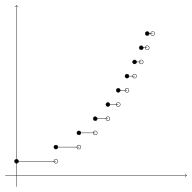
Sketch the graph of \(y=[\e^{x}]\) for \(0\le x< \ln n\), where \(n\) is an integer, and show that
\[
\int_{0}^{\ln n}[\e^{x}]\, \d x =n\ln n - \ln (n!).
\]
Solution

Rating Information
Difficulty Rating: 1500.0
Difficulty Comparisons: 0
Banger Rating: 1500.0
Banger Comparisons: 0
Show LaTeX source
Problem source
For any number $x$, the largest integer less than or equal to $x$ is denoted by $[x]$. For example, $[3.7]=3$ and $[4]=4$.
Sketch the graph of $y=[x]$ for $0\le x<5$ and evaluate
\[
\int_0^5 [x]\;\d x.
\]

Sketch the graph of  $y=[\e^{x}]$ for $0\le x< \ln n$,  where $n$ is an integer, and show that
\[
\int_{0}^{\ln n}[\e^{x}]\,  \d x =n\ln n - \ln (n!).
\]
Solution source
\begin{center}
\begin{tikzpicture}[scale=1]
    % Circle
    \draw[->] (0, -1) -- (0, 6);
    \draw[->] (-1, 0) -- (6, 0);

    \draw (0,0) -- (1,0);
    \draw (1,1) -- (2,1);
    \draw (2,2) -- (3,2);
    \draw (3,3) -- (4,3);
    \draw (4,4) -- (5,4);

    \filldraw (0,0) circle (2pt);
    \filldraw (1,1) circle (2pt);
    \filldraw (2,2) circle (2pt);
    \filldraw (3,3) circle (2pt);
    \filldraw (4,4) circle (2pt);

    \draw (1,0) circle (2pt);
    \draw (2,1) circle (2pt);
    \draw (3,2) circle (2pt);
    \draw (4,3) circle (2pt);
    \draw (5,4) circle (2pt);

\end{tikzpicture}\end{center}

\begin{align*}
\int_0^5 [x]\;\d x &= 0 \cdot 1 + 1 \cdot 1 + 2 \cdot 1 + 3 \cdot 1 + 4 \cdot 1 \\
&= 10
\end{align*}

\begin{center}
\begin{tikzpicture}[scale=2]
        % Circle
    \draw[->] (0, -.2) -- (0, 3);
    \draw[->] (-.2, 0) -- (3, 0);

\draw (0,0.25) -- (0.693147180559945,0.25);
\draw (0.693147180559945,0.5) -- (1.09861228866811,0.5);
\draw (1.09861228866811,0.75) -- (1.38629436111989,0.75);
\draw (1.38629436111989,1) -- (1.6094379124341,1);
\draw (1.6094379124341,1.25) -- (1.79175946922805,1.25);
\draw (1.79175946922805,1.5) -- (1.94591014905531,1.5);
\draw (1.94591014905531,1.75) -- (2.07944154167984,1.75);
\draw (2.07944154167984,2) -- (2.19722457733622,2);
\draw (2.19722457733622,2.25) -- (2.30258509299405,2.25);
\draw (2.30258509299405,2.5) -- (2.39789527279837,2.5);

\filldraw  (0,0.25) circle (1pt);
\filldraw  (0.693147180559945,0.5) circle (1pt);
\filldraw  (1.09861228866811,0.75) circle (1pt);
\filldraw  (1.38629436111989,1) circle (1pt);
\filldraw  (1.6094379124341,1.25) circle (1pt);
\filldraw  (1.79175946922805,1.5) circle (1pt);
\filldraw  (1.94591014905531,1.75) circle (1pt);
\filldraw  (2.07944154167984,2) circle (1pt);
\filldraw  (2.19722457733622,2.25) circle (1pt);
\filldraw  (2.30258509299405,2.5) circle (1pt);

\draw (0.693147180559945,0.25) circle (1pt);
\draw (1.09861228866811,0.5) circle (1pt);
\draw (1.38629436111989,0.75) circle (1pt);
\draw (1.6094379124341,1) circle (1pt);
\draw (1.79175946922805,1.25) circle (1pt);
\draw (1.94591014905531,1.5) circle (1pt);
\draw (2.07944154167984,1.75) circle (1pt);
\draw (2.19722457733622,2) circle (1pt);
\draw (2.30258509299405,2.25) circle (1pt);
\draw (2.39789527279837,2.5) circle (1pt);


\end{tikzpicture}\end{center}

\begin{align*}
\int_{0}^{\ln n}[\e^{x}]\,  \d x &= \sum_{k=1}^{n-1} \int_{\ln k}^{\ln (k+1)}[\e^{x}]\,  \d x \\
&= \sum_{k=1}^{n-1} k \l \ln (k+1) - \ln (k) \r\\
&= \sum_{k=1}^{n-1} \l( (k+1) \l \ln (k+1) - \ln (k) \r - \ln(k+1) \r \\
&= \sum_{k=1}^{n-1} (k+1) \ln (k+1) - \sum_{k=1}^{n-1} k \ln (k) - \sum_{k=1}^{n-1} \ln (k+1) \\
&= n \ln n - 1 \ln 1 -  \sum_{k=1}^{n-1} \ln (k+1) \\
&= n \ln n - \ln \l \prod_{k=1}^{n-1} (k+1)\r \\
&= n \ln n - \ln (n!)
\end{align*}