Problems

Filters
Clear Filters

5 problems found

2018 Paper 3 Q11
D: 1700.0 B: 1487.9

A particle is attached to one end of a light inextensible string of length \(b\). The other end of the string is attached to a fixed point \(O\). Initially the particle hangs vertically below \(O\). The particle then receives a horizontal impulse. The particle moves in a circular arc with the string taut until the acute angle between the string and the upward vertical is \(\alpha\), at which time it becomes slack. Express \(V\), the speed of the particle when the string becomes slack, in terms of \( b\), \(g\) and \(\alpha\). Show that the string becomes taut again a time \(T\) later, where \[ gT = 4V \sin\alpha \,,\] and that just before this time the trajectory of the particle makes an angle \(\beta \) with the horizontal where \(\tan\beta = 3\tan \alpha \,\). When the string becomes taut, the momentum of the particle in the direction of the string is destroyed. Show that the particle comes instantaneously to rest at this time if and only if \[ \sin^2\alpha = \dfrac {1+\sqrt3}4 \,. \]


Solution:

TikZ diagram
\begin{align*} \text{N2}(\swarrow): &&T +mg \cos \alpha &= m \frac{V^2}{b} \\ \end{align*} So the string goes slack when \(bg\cos \alpha = V^2 \Rightarrow V = \sqrt{bg \cos \alpha}\). Once the string goes slack, the particle moves as a projectile. It's initial speed is \(V\binom{-\cos \alpha}{\sin \alpha}\) and it's position is \(\binom{b\sin \alpha}{b\cos \alpha}\): \begin{align*} && \mathbf{s} &= \binom{b\sin \alpha}{b\cos \alpha}+Vt \binom{-\cos \alpha}{\sin \alpha} + \frac12 gt^2 \binom{0}{-1} \\ &&&= \binom{b\sin \alpha - Vt \cos \alpha}{b\cos \alpha + Vt \sin \alpha - \frac12 gt^2} \\ |\mathbf{s}|^2 = b^2 \Rightarrow && b^2 &= \left ( \binom{b\sin \alpha}{b\cos \alpha}+Vt \binom{-\cos \alpha}{\sin \alpha} + \frac12 gt^2 \binom{0}{-1} \right)^2 \\ &&&= b^2 + V^2t^2+\frac14 g^2 t^4 -gb\cos \alpha t^2-V\sin \alpha gt^3 \\ \Rightarrow && 0 &= V^2t^2 + \frac14 g^2 t^4 - V^2 t^2- V \sin \alpha g t^3 \\ &&&= \frac14 g^2 t^4 - V \sin \alpha gt^3 \\ \Rightarrow && gT &= 4V \sin \alpha \end{align*} The particle will have velocity \(\displaystyle \binom{-V \cos \alpha}{V \sin \alpha - 4V \sin \alpha} = \binom{-V \cos \alpha}{-3V \sin \alpha}\) so the angle \(\beta\) will satisfy \(\tan \beta = 3 \tan \alpha\). The particle will come to an instantaneous rest if all the momentum is destroyed, ie if the particle is travelling parallel to the string. \begin{align*} && 3 \tan \alpha &= \frac{b\cos \alpha + Vt \sin \alpha - \frac12 gt^2}{b\sin \alpha - Vt \cos \alpha} \\ &&&= \frac{\frac{V^2}{g}+\frac{4V^2\sin^2\alpha}{g} - \frac{8V^2\sin^2 \alpha}{g}}{\frac{V^2\sin \alpha}{g \cos \alpha} - \frac{4V^2 \sin \alpha \cos \alpha}{g}} \\ &&&= \frac{1 -4\sin^2 \alpha}{\tan \alpha(1 - 4\cos^2 \alpha)} \\ \Leftrightarrow&& 3 \frac{\sin^2 \alpha}{1-\sin^2 \alpha} &= \frac{1- 4 \sin^2 \alpha}{-3+4\sin^2 \alpha} \\ \Leftrightarrow && -9 \sin^2 \alpha + 12 \sin^4 \alpha &= 1 - 5 \sin^2 \alpha + 4 \sin^4 \alpha \\ \Leftrightarrow && 0 &= 1+4 \sin^2 \alpha - 8\sin^4 \alpha \\ \Leftrightarrow && \sin^2 \alpha &= \frac{1 + \sqrt{3}}4 \end{align*} (taking the only positive root)

2011 Paper 3 Q9
D: 1700.0 B: 1484.0

Particles \(P\) and \(Q\) have masses \(3m\) and \(4m\), respectively. They lie on the outer curved surface of a~smooth circular cylinder of radius~\(a\) which is fixed with its axis horizontal. They are connected by a light inextensible string of length \(\frac12 \pi a\), which passes over the surface of the cylinder. The particles and the string all lie in a vertical plane perpendicular to the axis of the cylinder, and the axis intersects this plane at \(O\). Initially, the particles are in equilibrium. Equilibrium is slightly disturbed and \(Q\) begins to move downwards. Show that while the two particles are still in contact with the cylinder the angle \(\theta\) between \(OQ\) and the vertical satisfies \[ 7a\dot\theta^2 +8g \cos\theta + 6 g\sin\theta = 10g\,. \]

  1. Given that \(Q\) loses contact with the cylinder first, show that it does so when~\(\theta=\beta\), where \(\beta\) satisfies \[ 15\cos\beta +6\sin\beta =10. \]
  2. Show also that while \(P\) and \(Q\) are still in contact with the cylinder the tension in the string is $\frac {12}7 mg(\sin\theta +\cos\theta)\,$.

2003 Paper 2 Q10
D: 1600.0 B: 1500.0

A bead \(B\) of mass \(m\) can slide along a rough horizontal wire. A light inextensible string of length \(2\ell\) has one end attached to a fixed point \(A\) of the wire and the other to \(B\,\). A particle \(P\) of mass \(3m\) is attached to the mid-point of the string and \(B\) is held at a distance \(\ell\) from~\(A\,\). The bead is released from rest. Let \(a_1\) and \(a_2\) be the magnitudes of the horizontal and vertical components of the initial acceleration of \(P\,\). Show by considering the motion of \(P\) relative to \(A\,\), or otherwise, that \(a_1= \sqrt 3 a_2\,\). Show also that the magnitude of the initial acceleration of \(B\) is \(2a_1\,\). Given that the frictional force opposing the motion of \(B\) is equal to \(({\sqrt{3}}/6)R\), where \(R\) is the normal reaction between \(B\) and the wire, show that the magnitude of the initial acceleration of \(P\) is~\(g/18\,\).

1992 Paper 3 Q14
D: 1700.0 B: 1500.0

\(\,\)

\psset{xunit=1.0cm,yunit=1.0cm,algebraic=true,dimen=middle,dotstyle=o,dotsize=3pt 0,linewidth=0.3pt,arrowsize=3pt 2,arrowinset=0.25} \begin{pspicture*}(-2.26,-2.36)(6,5.7) \pscircle(0,0){2} \psline(-1.52,1.3)(1.38,4.08) \psline{->}(0,0)(0,5) \psline{->}(0,0)(5,0) \psline(0,0)(-1.52,1.3) \psline(0,2)(4,2) \parametricplot{0.0}{2.4340509797353143}{0.6*cos(t)+0|0.6*sin(t)+0} \rput[tl](1.58,4.34){\(P\)} \rput[tl](4.22,2.14){\(B\)} \rput[tl](0.44,0.92){\(\theta\)} \rput[tl](-2,1.75){\(Q\)} \rput[tl](-0.26,-0.06){\(O\)} \rput[tl](5.14,0.12){\(x\)} \rput[tl](-0.08,5.4){\(y\)} \begin{scriptsize} \psdots[dotstyle=*](1.38,4.08) \psdots[dotstyle=*](4,2) \end{scriptsize} \end{pspicture*}
A horizontal circular disc of radius \(a\) and centre \(O\) lies on a horizontal table and is fixed to it so that it cannot rotate. A light inextensible string of negligible thickness is wrapped round the disc and attached at its free end to a particle \(P\) of mass \(m\). When the string is all in contact with the disc, \(P\) is at \(A\). The string is unwound so that the part not in contact with the disc is taut and parallel to \(OA\). \(P\) is then at \(B\). The particle is projected along the table from \(B\) with speed \(V\) perpendicular to and away from \(OA\). In the general position, the string is tangential to the disc at \(Q\) and \(\angle AOQ=\theta.\) Show that, in the general position, the \(x\)-coordinate of \(P\) with respect to the axes shown in the figure is \(a\cos\theta+a\theta\sin\theta,\) and find \(y\)-coordinate of \(P\). Hence, or otherwise, show that the acceleration of \(P\) has components \(a\theta\dot{\theta}^{2}\) and \(a\dot{\theta}^{2}+a\theta\ddot{\theta}\) along and perpendicular to \(PQ,\) respectively. The friction force between \(P\) and the table is \(2\lambda mv^{2}/a,\) where \(v\) is the speed of \(P\) and \(\lambda\) is a constant. Show that \[ \frac{\ddot{\theta}}{\dot{\theta}}=-\left(\frac{1}{\theta}+2\lambda\theta\right)\dot{\theta} \] and find \(\dot{\theta}\) in terms of \(\theta,\lambda\) and \(a\). Find also the tension in the string when \(\theta=\pi.\)

1991 Paper 3 Q11
D: 1700.0 B: 1484.0

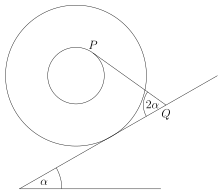
TikZ diagram
A uniform circular cylinder of radius \(2a\) with a groove of radius \(a\) cut in its central cross-section has mass \(M\). It rests, as shown in the diagram, on a rough plane inclined at an acute angle \(\alpha\) to the horizontal. It is supported by a light inextensible string would round the groove and attached to the cylinder at one end. The other end of the string is attached to the plane at \(Q\), the free part of the string, \(PQ,\) making an angle \(2\alpha\) with the inclined plane. The coefficient of friction at the contact between the cylinder and the plane is \(\mu.\) Show that \(\mu\geqslant\frac{1}{3}\tan\alpha.\) The string \(PQ\) is now detached from the plane and the end \(Q\) is fastened to a particle of mass \(3M\) which is placed on the plane, the position of the string remain unchanged. Given that \(\tan\alpha=\frac{1}{2}\) and that the system remains in equilibrium, find the least value of the coefficient of friction between the particle and the plane.