Problems
Filters
19 problems found
2023 Paper 2 Q10
In this question, the \(x\)- and \(y\)-axes are horizontal and the \(z\)-axis is vertically upwards.
- A particle \(P_\alpha\) is projected from the origin with speed \(u\) at an acute angle \(\alpha\) above the positive \(x\)-axis. The curve \(E\) is given by \(z = A - Bx^2\) and \(y = 0\). If \(E\) and the trajectory of \(P_\alpha\) touch exactly once, show that \[u^2 - 2gA = u^2(1 - 4AB)\cos^2\alpha\,.\] \(E\) and the trajectory of \(P_\alpha\) touch exactly once for all \(\alpha\) with \(0 < \alpha < \frac{1}{2}\pi\). Write down the values of \(A\) and \(B\) in terms of \(u\) and \(g\).
- Describe the set of points which can be hit by particles from the explosion, explaining your answer.
- Show that, at a time \(t\) after the explosion, the particles lie on a sphere whose centre and radius you should find.
- Another particle \(Q\) is projected horizontally from the point \((0, 0, A)\) with speed \(u\) in the positive \(x\) direction. Show that, at all times, \(Q\) lies on the curve \(E\).
- Show that for particles \(Q\) and \(P_\alpha\) to collide, \(Q\) must be projected a time \(\dfrac{u(1-\cos\alpha)}{g\sin\alpha}\) after the explosion.
2013 Paper 3 Q3
The four vertices \(P_i\) (\(i= 1, 2, 3, 4\)) of a regular tetrahedron lie on the surface of a sphere with centre at \(O\) and of radius 1. The position vector of \(P_i\) with respect to \(O\) is \({\bf p}_i\) (\(i= 1, 2, 3, 4\)). Use the fact that \({\bf p}_1+ {\bf p}_2+{\bf p}_3+{\bf p}_4={\bf 0}\,\) to show that \({\bf p}_i \,.\, {\bf p}_j =-\frac13\,\) for \(i\ne j\). Let \(X\) be any point on the surface of the sphere, and let \(XP_i\) denote the length of the line joining \(X\) and \(P_i\) (\(i= 1, 2, 3, 4\)).
- By writing \((XP_i) ^2\) as \(({\bf p}_i- {\bf x)}\,.\,({\bf p}_i- {\bf x})\), where \({\bf x}\) is the position vector of \(X\) with respect to \(O\), show that \[ \sum_{i=1}^4(XP_i) ^2 =8\,. \]
- Given that \(P_1\) has coordinates \((0,0,1)\) and that the coordinates of \(P_2\) are of the form \((a,0,b)\), where \(a > 0\), show that \(a=2\sqrt2/3\) and \(b=-1/3\), and find the coordinates of \(P_3\) and \(P_4\).
- Show that \[ \sum_{i=1}^4 (XP_i)^4 = 4 \sum_{i=1}^4 (1- {\bf x}\,.\,{\bf p}_i)^2\,. \] By letting the coordinates of \(X\) be \( (x,y,z)\), show further that \(\sum\limits_{i=1}^4 (XP_i)^4\) is independent of the position of \(X\).
Solution: Note that \({\bf p}_i \cdot {\bf p}_i = 1\) and \({\bf p}_i \cdot {\bf p}_j\) are all equal when \(i \neq j\) by symmetry and commutativity. \begin{align*} && 0 &= {\bf p}_i \cdot \left ( {\bf p}_1+ {\bf p}_2+{\bf p}_3+{\bf p}_4 \right) \\ &&&= 1 + \sum_{j \neq i} {\bf p}_i \cdot {\bf p}_j \\ &&&= 1 + 3 {\bf p}_i \cdot {\bf p}_j \\ \Rightarrow && {\bf p}_i \cdot {\bf p}_j &= -\frac13 \end{align*}
- \(\,\) \begin{align*} && (XP_i)^2 &= ({\bf p}_i- {\bf x)}\,.\,({\bf p}_i- {\bf x}) \\ &&&= {\bf p}_i \cdot {\bf p}_i - 2 {\bf p}_i \cdot {\bf x} + {\bf x} \cdot {\bf x} \\ &&&= 2 - 2 {\bf p}_i \cdot {\bf x} \\ \Rightarrow && \sum_i (XP_i)^2 &= \sum_i \left (2 - 2 {\bf p}_i \cdot {\bf x} \right) \\ &&&= 8 - 2 \sum_i {\bf p}_i \cdot {\bf x} \\ &&&= 8 - 2 \left ( {\bf p}_1+ {\bf p}_2+{\bf p}_3+{\bf p}_4 \right) \cdot {\bf x} \\ &&&= 8 \end{align*}
- Notice we have \(1 = \left \|\begin{pmatrix} a \\0 \\b \end{pmatrix} \right \|= a^2 + b^2\) and \(-\frac13 = \begin{pmatrix} a \\0 \\b \end{pmatrix} \cdot \begin{pmatrix} 0 \\0 \\ 1 \end{pmatrix} = b\). So \(b = -1/3\) and \(a = \sqrt{1-b^2} = 2\sqrt{2}/3\). Suppose another of the vertices has coordinates \((u,v,w)\) we must have \begin{align*} && 1 &= u^2+v^2+w^2 \\ && -\frac13&=w \\ && -\frac13 &= \frac{2\sqrt{2}}3 u +\frac19 \\ \Rightarrow && u &= -\frac{\sqrt2}3 \\ \Rightarrow && 1 &= \frac19 + \frac29 + v^2 \\ \Rightarrow && v &= \pm \sqrt{\frac{2}{3}} \end{align*} So \(P_3, P_4 = (-\frac{\sqrt2}3, \pm \frac{\sqrt{6}}3, -\frac13)\)
- \(\,\) \begin{align*} && \sum_{i=1}^4 (XP_i)^4 &= \sum_i \left (2 - 2 {\bf p}_i \cdot {\bf x} \right)^2 \\ &&&= 4 \sum_i \left (1 - {\bf p}_i \cdot {\bf x} \right)^2 \\ &&&= 4 \sum_i (1 - 2{\bf p}_i \cdot {\bf x} + ({\bf p}_i \cdot {\bf x})^2) \\ &&&= 16 + 4\sum_i ({\bf p}_i \cdot {\bf x})^2 \\ &&&=16+ 4\left ( z^2+\left (\frac{2\sqrt{2}}3x-\frac13z \right)^2 +\left (-\frac{\sqrt{2}}3x-\frac{\sqrt{6}}3y-\frac13z \right)^2 +\left (-\frac{\sqrt{2}}3x+\frac{\sqrt{6}}3y-\frac13z \right)^2 \right) \\ &&&= 16+4 \left ( \frac43z^2 + \left (\frac89 + \frac29+\frac29 \right)x^2+\left (\frac69 + \frac69 \right)y^2 + 0xz + 0yz + 0zx \right) \\ &&&= 16+ 4\cdot\frac43(x^2+y^2+z^2) \\ &&&=16+\frac{16}{3}=\frac{64}{3} \end{align*}
2013 Paper 3 Q9
A sphere of radius \(R\) and uniform density \(\rho_{\text{s}}\) is floating in a large tank of liquid of uniform density \(\rho\). Given that the centre of the sphere is a distance \(x\) above the level of the liquid, where \(x < R\), show that the volume of liquid displaced is \[ \frac \pi 3 (2R^3-3R^2x +x^3)\,. \] The sphere is acted upon by two forces only: its weight and an upward force equal in magnitude to the weight of the liquid it has displaced. Show that \[ 4 R^3\rho_{\text{s}} (g+\ddot x) = (2R^3 -3R^2x +x^3)\rho g\,. \] Given that the sphere is in equilibrium when \(x=\frac12 R\), find \(\rho_{\text{s}}\) in terms of \(\rho\). Find, in terms of \(R\) and \(g\), the period of small oscillations about this equilibrium position.
2010 Paper 3 Q6
The points \(P\), \(Q\) and \(R\) lie on a sphere of unit radius centred at the origin, \(O\), which is fixed. Initially, \(P\) is at \(P_0(1, 0, 0)\), \(Q\) is at \(Q_0(0, 1, 0)\) and \(R\) is at \(R_0(0, 0, 1)\).
- The sphere is then rotated about the \(z\)-axis, so that the line \(OP\) turns directly towards the positive \(y\)-axis through an angle \(\phi\). The position of \(P\) after this rotation is denoted by \(P_1\). Write down the coordinates of \(P_1\).
- The sphere is now rotated about the line in the \(x\)-\(y\) plane perpendicular to \(OP_1\), so that the line \(OP\) turns directly towards the positive \(z\)-axis through an angle \(\lambda\). The position of \(P\) after this rotation is denoted by \(P_2\). Find the coordinates of \(P_2\). Find also the coordinates of the points \(Q_2\) and \(R_2\), which are the positions of \(Q\) and \(R\) after the two rotations.
- The sphere is now rotated for a third time, so that \(P\) returns from \(P_2\) to its original position~\(P_0\). During the rotation, \(P\) remains in the plane containing \(P_0\), \(P_2\) and \(O\). Show that the angle of this rotation, \(\theta\), satisfies \[ \cos\theta = \cos\phi \cos\lambda\,, \] and find a vector in the direction of the axis about which this rotation takes place.
2001 Paper 1 Q6
A spherical loaf of bread is cut into parallel slices of equal thickness. Show that, after any number of the slices have been eaten, the area of crust remaining is proportional to the number of slices remaining. A European ruling decrees that a parallel-sliced spherical loaf can only be referred to as `crusty' if the ratio of volume \(V\) (in cubic metres) of bread remaining to area \(A\) (in square metres) of crust remaining after any number of slices have been eaten satisfies \(V/A<1\). Show that the radius of a crusty parallel-sliced spherical loaf must be less than \(2\frac23\) metres. [{\sl The area \(A\) and volume \(V\) formed by rotating a curve in the \(x\)--\(y\) plane round the \(x\)-axis from \(x=-a\) to \(x=-a+t\) are given by \[ A= 2\pi\int_{-a}^{-a+t} { y}\left( 1+ \Big(\frac{\d {y}}{\d x}\Big)^2\right)^{\frac12} \d x\;, \ \ \ \ \ \ \ \ \ \ \ V= \pi \int_{-a}^{-a+t} {y}^2 \d x \;. \ \ ] \] }
2000 Paper 3 Q10
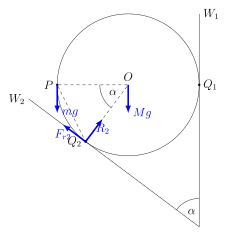
A sphere of radius \(a\) and weight \(W\) rests on horizontal ground. A thin uniform beam of weight \(3\sqrt3\,W\) and length \(2a\) is freely hinged to the ground at \(X\), which is a distance \({\sqrt 3} \, a\) from the point of contact of the sphere with the ground. The beam rests on the sphere, lying in the same vertical plane as the centre of the sphere. The coefficients of friction between the beam and the sphere and between the sphere and the ground are \(\mu_1\) and \(\mu_2\) respectively. Given that the sphere is on the point of slipping at its contacts with both the ground and the beam, find the values of \(\mu_1\) and \(\mu_2\).
Solution:

1998 Paper 3 Q8
- Consider the sphere of radius \(a\) and centre the origin. %Show that the line through the point with position vector %\({\bf b}\) and parallel to a unit %vector \({\bf m}\) intersects the sphere at two points if %$$ %a^2 > {\bf b}.{\bf b} -({\bf b}.{\bf m})^2 \,. %$$ %What is the corresponding condition for there to be precisely one %point of intersection? %If this point has position vector \({\bf p}\), show that the line %is perpendicular to \({\bf p}\).
- Show that the line \({\bf r} ={\bf b} + \lambda {\bf m}\), where \(\bf m\) is a unit vector, intersects the sphere \({\bf r}\cdot {\bf r} = a^2\) at two points if $$ a^2 > {\bf b}\cdot{\bf b} -({\bf b}\cdot{\bf m})^2 \,. $$ Write down the corresponding condition for there to be precisely one point of intersection. If this point has position vector \({\bf p}\), show that \({\bf m}\cdot{\bf p}=0\).
- Now consider a second sphere of radius \(a\) and a plane perpendicular to a unit vector~\({\bf n}\). The centre of the sphere has position vector \({\bf d}\) and the minimum distance from the origin to the plane is \(l\). What is the condition for the plane to be tangential to this second sphere?
- Show that the first and second spheres intersect at right angles ({\em i.e.\ }the two radii to each point of intersection are perpendicular) if $$ {\bf d}\cdot{\bf d} = 2 a^2 \,. $$
1997 Paper 2 Q9
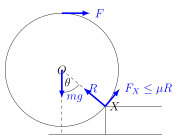
A uniform solid sphere of diameter \(d\) and mass \(m\) is drawn very slowly and without slipping from horizontal ground onto a step of height \(d/4\) by a horizontal force which is always applied to the highest point of the sphere and is always perpendicular to the vertical plane which forms the face of the step. Find the maximum horizontal force throughout the movement, and prove that the coefficient of friction between the sphere and the edge of the step must exceed \(1/\sqrt{3}\).
Solution:
1997 Paper 3 Q10
By pressing a finger down on it, a uniform spherical marble of radius \(a\) is made to slide along a horizontal table top with an initial linear velocity \(v_0\) and an initial {\em backward} angular velocity \(\omega_0\) about the horizontal axis perpendicular to \(v_0\). The frictional force between the marble and the table is constant (independent of speed). For what value of \(v_0/(a\omega_0)\) does the marble
- slide to a complete stop,
- come to a stop and then roll back towards its initial position with linear speed \(v_0/7\).
Solution:
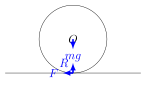
- If the ball completely stops, then \(\omega = v = 0 \Rightarrow \frac{2}{5}a \omega_0 - v_0 = 0 \Rightarrow \frac{v_0}{a \omega_0} = \frac25\).
- If the ball rolls backwards with linear speed \(v_0/7\), \(v = - \frac{v_0}{7}\) and \(a \omega = \frac{v_0}{7}\), \begin{align*} && \frac{2}{5}a \omega_0 - v_0 &= \frac{2}{5} \frac{v_0}{7} + \frac{v_0}{7} \\ && &= \frac{1}{5} v_0 \\ \Rightarrow && \frac{v_0}{a \omega_0} &= \frac{1}{3} \end{align*}
1996 Paper 1 Q1
A cylindrical biscuit tin has volume \(V\) and surface area \(S\) (including the ends). Show that the minimum possible surface area for a given value of \(V\) is \(S=3(2\pi V^{2})^{1/3}.\) For this value of \(S\) show that the volume of the largest sphere which can fit inside the tin is \(\frac{2}{3}V\), and find the volume of the smallest sphere into which the tin fits.
Solution: Suppose we have height \(h\) and radius \(r\), then: \(V = \pi r^2 h\) and \(S = 2\pi r^2 + 2\pi r h\). \(h = \frac{V}{\pi r^2}\), so \begin{align*} S &= 2 \pi r^2 + 2 \pi r\frac{V}{\pi r^2} \\ &= 2\pi r^2 +V \frac1{r}+V \frac1{r} \\ &\underbrace{ \geq }_{\text{AM-GM}} 3 \sqrt[3]{2\pi r^2 \frac{V^2}{r^2} } = 3 (2 \pi V^2)^{1/3} \end{align*} Equality holds when \(r = \sqrt[3]{\frac{V}{2 \pi}}, h = \frac{V}{\pi (V/2\pi)^{2/3}} = \sqrt[3]{\frac{4V}{\pi}}\) Since \(h > r\) the sphere has a maximum radius of \(r\) and so it's largest volume is \(\frac43 \pi r^3 = \frac43 \pi \frac{V}{2 \pi} = \frac23 V\).

1995 Paper 2 Q7
The diagram shows a circle, of radius \(r\) and centre \(I\), touching the three sides of a triangle \(ABC\). We write \(a\) for the length of \(BC\) and \(\alpha\) for the angle \(\angle BAC\) and so on. Let \(s=\frac{1}{2}\left(a+b+c\right)\) and let \(\triangle\) be the area of the triangle.

- By considering the area of the triangles \(AIB,\) \(BIC\) and \(CIA\), or otherwise, show that \(\Delta=rs\).
- By using the formula \(\Delta=\frac{1}{2}bc\sin\alpha\), show that \[ \Delta^{2}=\tfrac{1}{16}[4b^{2}c^{2}-\left(2bc\cos\alpha\right)^{2}]. \] Now use the formula \(a^{2}=b^{2}+c^{2}-2bc\cos\alpha\) to show that \[ \Delta^{2}=\tfrac{1}{16}[(a^{2}-\left(b-c\right)^{2})(\left(b+c\right)^{2}-a^{2})] \] and deduce that \[ \Delta=\sqrt{s\left(s-a\right)\left(s-b\right)\left(s-c\right)}. \]
- A hole in the shape of the triangle \(ABC\) is cut in the top of a level table. A sphere of radius \(R\) rests in the hole. Find the height of the centre of the sphere above the level of the table top, expressing your answer in terms of \(a,b,c,s\) and \(R\).
Solution:
- \([AIB] = \frac12br\), \([BIC] = \frac12ar\), \([CIA] = \frac12 rc\), therefore \(\Delta = [AIB] +[BIC] + [CIA] = \frac12r(a+b+c) = sr\)
- \(\,\) \begin{align*} && \Delta &= \frac12 bc \sin \alpha \\ \Rightarrow && \Delta^2 &= \frac14 b^2c^2 \sin^2 \alpha \\ &&&= \frac14 \left (b^2c^2 - b^2c^2\cos^2 \alpha \right) \\ &&&= \frac1{16} \left (4b^2c^2 - (2bc\cos \alpha )^2\right) \\ \\ \Rightarrow && \Delta^2 &= \frac1{16} \left (4b^2c^2 - (b^2+c^2-a^2 )^2\right) \\ &&&= \frac1{16} (2bc-b^2-c^2+a^2)(2bc+b^2+c^2-a^2) \\ &&&= \frac{1}{16}(a^2-(b-c)^2)((b+c)^2-a^2) \\ &&&= \frac1{16}(a-b+c)(a+b-c)(b+c-a)(b+c+a) \\ &&&= (s - b)(s-c)(s-a)s \\ \Rightarrow && \Delta &= \sqrt{s(s-a)(s-b)(s-c)} \end{align*}
- We have the setting like this,
so \begin{align*} && h & = \sqrt{R^2-r^2} \\ &&&= \sqrt{R^2-\frac{\Delta^2}{s^2}} \\ &&&= \sqrt{R^2 - \frac{(s-a)(s-b)(s-c)}{s}} \end{align*}

1995 Paper 3 Q8
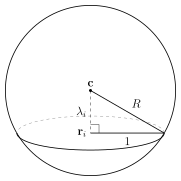
A plane \(\pi\) in 3-dimensional space is given by the vector equation \(\mathbf{r}\cdot\mathbf{n}=p,\) where \(\mathbf{n}\) is a unit vector and \(p\) is a non-negative real number. If \(\mathbf{x}\) is the position vector of a general point \(X\), find the equation of the normal to \(\pi\) through \(X\) and the perpendicular distance of \(X\) from \(\pi\). The unit circles \(C_{i},\) \(i=1,2,\) with centres \(\mathbf{r}_{i},\) lie in the planes \(\pi_{i}\) given by \(\mathbf{r}\cdot\mathbf{n}_{i}=p_{i},\) where the \(\mathbf{n}_{i}\) are unit vectors, and \(p_{i}\) are non-negative real numbers. Prove that there is a sphere whose surface contains both circles only if there is a real number \(\lambda\) such that \[ \mathbf{r}_{1}+\lambda\mathbf{n}_{1}=\mathbf{r}_{2}\pm\lambda\mathbf{n}_{2}. \] Hence, or otherwise, deduce the necessary conditions that \[ (\mathbf{r}_{1}-\mathbf{r}_{2})\cdot(\mathbf{n}_{1}\times\mathbf{n}_{2})=0 \] and that \[ (p_{1}-\mathbf{n}_{1}\cdot\mathbf{r}_{2})^{2}=(p_{2}-\mathbf{n}_{2}\cdot\mathbf{r}_{1})^{2}. \] Interpret each of these two conditions geometrically.
Solution: The equation of the normal to \(\pi\) through \(X\) is \(\mathbf{x} + \lambda \mathbf{n}\). The distance is \(|\mathbf{x}\cdot \mathbf{n}-p|\) We know that the centre of the sphere must lie above the centre of the circle following the normal, ie \(\mathbf{c} = \mathbf{r}_1+\lambda_1 \mathbf{n}_1 = \mathbf{r}_2+\lambda_2 \mathbf{n}_2\)
1994 Paper 3 Q3
Describe geometrically the possible intersections of a plane with a sphere. Let \(P_{1}\) and \(P_{2}\) be the planes with equations \begin{alignat*}{1} 3x-y-1 & =0,\\ x-y+1 & =0, \end{alignat*} respectively, and let \(S_{1}\) and \(S_{2}\) be the spheres with equations \begin{alignat*}{1} x^{2}+y^{2}+z^{2} & =7,\\ x^{2}+y^{2}+z^{2}-6y-4z+10 & =0, \end{alignat*} respectively. Let \(C_{1}\) be the intersection of \(P_{1}\) and \(S_{1},\) let \(C_{2}\) be the intersection of \(P_{2}\) and \(S_{2}\) and let \(L\) be the intersection of \(P_{1}\) and \(P_{2}.\) Find the points where \(L\) meets each of \(S_{1}\) and \(S_{2}.\) Determine, giving your reasons, whether the circles \(C_{1}\) and \(C_{2}\) are linked.
1993 Paper 1 Q8
- Prove that the intersection of the surface of a sphere with a plane is always a circle, a point or the empty set. Prove that the intersection of the surfaces of two spheres with distinct centres is always a circle, a point or the empty set. {[}If you use coordinate geometry, a careful choice of origin and axes may help.{]}
- The parish council of Little Fitton have just bought a modern sculpture entitled `Truth, Love and Justice pouring forth their blessings on Little Fitton.' It consists of three vertical poles \(AD,BE\) and \(CF\) of heights 2 metres, 3 metres and 4 metres respectively. Show that \(\angle DEF=\cos^{-1}\frac{1}{5}.\) Vandals now shift the pole \(AD\) so that \(A\) is unchanged and the pole is still straight but \(D\) is vertically above \(AB\) with \(\angle BAD=\frac{1}{4}\pi\) (in radians). Find the new angle \(\angle DEF\) in radians correct to four figures.
1993 Paper 2 Q12
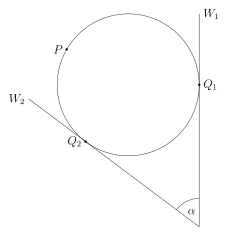
Solution: