1995 Paper 3 Q8
Year: 1995
Paper: 3
Question Number: 8
Course: UFM Pure
Section: Vectors
Difficulty: 1700.0
Banger: 1500.0
vectors
plane geometry
scalar product
cross product
perpendicular distance
sphere
geometric proof
normal to plane
3D geometry
Problem
A plane \(\pi\) in 3-dimensional space is given by the vector equation \(\mathbf{r}\cdot\mathbf{n}=p,\) where \(\mathbf{n}\) is a unit vector and \(p\) is a non-negative real number. If \(\mathbf{x}\) is the position vector of a general point \(X\), find the equation of the normal to \(\pi\) through \(X\) and the perpendicular distance of \(X\) from \(\pi\).
The unit circles \(C_{i},\) \(i=1,2,\) with centres \(\mathbf{r}_{i},\) lie in the planes \(\pi_{i}\) given by \(\mathbf{r}\cdot\mathbf{n}_{i}=p_{i},\) where the \(\mathbf{n}_{i}\) are unit vectors, and \(p_{i}\) are non-negative real numbers. Prove that there is a sphere whose surface contains both circles only if there is a real number \(\lambda\) such that
\[
\mathbf{r}_{1}+\lambda\mathbf{n}_{1}=\mathbf{r}_{2}\pm\lambda\mathbf{n}_{2}.
\]
Hence, or otherwise, deduce the necessary conditions that
\[
(\mathbf{r}_{1}-\mathbf{r}_{2})\cdot(\mathbf{n}_{1}\times\mathbf{n}_{2})=0
\]
and that
\[
(p_{1}-\mathbf{n}_{1}\cdot\mathbf{r}_{2})^{2}=(p_{2}-\mathbf{n}_{2}\cdot\mathbf{r}_{1})^{2}.
\]
Interpret each of these two conditions geometrically.
Solution
The equation of the normal to \(\pi\) through \(X\) is \(\mathbf{x} + \lambda \mathbf{n}\). The distance is \(|\mathbf{x}\cdot \mathbf{n}-p|\)
We know that the centre of the sphere must lie above the centre of the circle following the normal, ie \(\mathbf{c} = \mathbf{r}_1+\lambda_1 \mathbf{n}_1 = \mathbf{r}_2+\lambda_2 \mathbf{n}_2\)
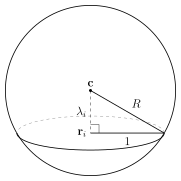 We can also see that \(R^2 = 1 + \lambda_1^2 = 1 + \lambda_2^2 \Rightarrow \lambda_1 = \pm \lambda_2 \), from which we obtain the desired result.
Therefore the condition is
\begin{align*}
&& \mathbf{r}_1+\lambda \mathbf{n}_1 &= \mathbf{r}_2 \pm \lambda \mathbf{n}_2 \tag{1}\\
&& \mathbf{r}_1 - \mathbf{r}_2 &= \lambda(\pm \mathbf{n}_1 - \mathbf{n}_2) \\
\Rightarrow && (\mathbf{r}_{1}-\mathbf{r}_{2})\cdot(\mathbf{n}_{1}\times\mathbf{n}_{2}) &= (\lambda(\pm \mathbf{n}_1 - \mathbf{n}_2))\cdot(\mathbf{n}_{1}\times\mathbf{n}_{2}) \\
&&&= \lambda \left (\pm \mathbf{n}_1 \cdot ( \mathbf{n}_{1}\times\mathbf{n}_{2}) - \mathbf{n}_2 \cdot (\mathbf{n}_{1}\times\mathbf{n}_{2})\right) \\
&&&= 0 \\
\\
\mathbf{n}_1 \cdot (1)&& \mathbf{r}_1 \cdot \mathbf{n}_1+\lambda \mathbf{n}_1 \cdot \mathbf{n}_1 &= \mathbf{r}_2 \cdot \mathbf{n}_1 \pm \lambda \mathbf{n}_2 \cdot \mathbf{n}_1 \\
&& p_1 + \lambda &= \mathbf{r}_2 \cdot \mathbf{n}_1 \pm \lambda \mathbf{n}_2 \cdot \mathbf{n}_1 \\ \\
\mathbf{n}_2 \cdot (1)&& \mathbf{r}_1 \cdot \mathbf{n}_2+\lambda \mathbf{n}_1 \cdot \mathbf{n}_2 &= \mathbf{r}_2 \cdot \mathbf{n}_2 \pm \lambda \mathbf{n}_2 \cdot \mathbf{n}_2 \\
&& \mathbf{r}_1 \cdot \mathbf{n}_2+\lambda \mathbf{n}_1 \cdot \mathbf{n}_2 &= p_2 \pm \lambda \\
&& \pm \lambda -\lambda \mathbf{n}_1\cdot\mathbf{n}_2 &= \mathbf{r}_1 \cdot \mathbf{n}_2 - p_2 \\
&&&= \pm (\mathbf{r}_2\cdot \mathbf{n}_1 - p_1) \\
\Rightarrow && (p_{1}-\mathbf{n}_{1}\cdot\mathbf{r}_{2})^{2}&=(p_{2}-\mathbf{n}_{2}\cdot\mathbf{r}_{1})^{2}
\end{align*}
The first condition means the line between the centres lies in the plane spanned by the normal of the two planes \(\pi_1\) and \(\pi_2\).
The second condition means that the distance of the center to the other plane is the same for both centres/planes.
We can also see that \(R^2 = 1 + \lambda_1^2 = 1 + \lambda_2^2 \Rightarrow \lambda_1 = \pm \lambda_2 \), from which we obtain the desired result.
Therefore the condition is
\begin{align*}
&& \mathbf{r}_1+\lambda \mathbf{n}_1 &= \mathbf{r}_2 \pm \lambda \mathbf{n}_2 \tag{1}\\
&& \mathbf{r}_1 - \mathbf{r}_2 &= \lambda(\pm \mathbf{n}_1 - \mathbf{n}_2) \\
\Rightarrow && (\mathbf{r}_{1}-\mathbf{r}_{2})\cdot(\mathbf{n}_{1}\times\mathbf{n}_{2}) &= (\lambda(\pm \mathbf{n}_1 - \mathbf{n}_2))\cdot(\mathbf{n}_{1}\times\mathbf{n}_{2}) \\
&&&= \lambda \left (\pm \mathbf{n}_1 \cdot ( \mathbf{n}_{1}\times\mathbf{n}_{2}) - \mathbf{n}_2 \cdot (\mathbf{n}_{1}\times\mathbf{n}_{2})\right) \\
&&&= 0 \\
\\
\mathbf{n}_1 \cdot (1)&& \mathbf{r}_1 \cdot \mathbf{n}_1+\lambda \mathbf{n}_1 \cdot \mathbf{n}_1 &= \mathbf{r}_2 \cdot \mathbf{n}_1 \pm \lambda \mathbf{n}_2 \cdot \mathbf{n}_1 \\
&& p_1 + \lambda &= \mathbf{r}_2 \cdot \mathbf{n}_1 \pm \lambda \mathbf{n}_2 \cdot \mathbf{n}_1 \\ \\
\mathbf{n}_2 \cdot (1)&& \mathbf{r}_1 \cdot \mathbf{n}_2+\lambda \mathbf{n}_1 \cdot \mathbf{n}_2 &= \mathbf{r}_2 \cdot \mathbf{n}_2 \pm \lambda \mathbf{n}_2 \cdot \mathbf{n}_2 \\
&& \mathbf{r}_1 \cdot \mathbf{n}_2+\lambda \mathbf{n}_1 \cdot \mathbf{n}_2 &= p_2 \pm \lambda \\
&& \pm \lambda -\lambda \mathbf{n}_1\cdot\mathbf{n}_2 &= \mathbf{r}_1 \cdot \mathbf{n}_2 - p_2 \\
&&&= \pm (\mathbf{r}_2\cdot \mathbf{n}_1 - p_1) \\
\Rightarrow && (p_{1}-\mathbf{n}_{1}\cdot\mathbf{r}_{2})^{2}&=(p_{2}-\mathbf{n}_{2}\cdot\mathbf{r}_{1})^{2}
\end{align*}
The first condition means the line between the centres lies in the plane spanned by the normal of the two planes \(\pi_1\) and \(\pi_2\).
The second condition means that the distance of the center to the other plane is the same for both centres/planes.
Rating Information
Difficulty Rating: 1700.0
Difficulty Comparisons: 0
Banger Rating: 1500.0
Banger Comparisons: 0
Show LaTeX source
Problem source
A plane $\pi$ in 3-dimensional space is given by the vector equation $\mathbf{r}\cdot\mathbf{n}=p,$ where $\mathbf{n}$ is a unit vector and $p$ is a non-negative real number. If $\mathbf{x}$ is the position vector of a general point $X$, find the equation of the normal to $\pi$ through $X$ and the perpendicular distance of $X$ from $\pi$.
The unit circles $C_{i},$ $i=1,2,$ with centres $\mathbf{r}_{i},$ lie in the planes $\pi_{i}$ given by $\mathbf{r}\cdot\mathbf{n}_{i}=p_{i},$ where the $\mathbf{n}_{i}$ are unit vectors, and $p_{i}$ are non-negative real numbers. Prove that there is a sphere whose surface contains both circles only if there is a real number $\lambda$ such that
\[
\mathbf{r}_{1}+\lambda\mathbf{n}_{1}=\mathbf{r}_{2}\pm\lambda\mathbf{n}_{2}.
\]
Hence, or otherwise, deduce the necessary conditions that
\[
(\mathbf{r}_{1}-\mathbf{r}_{2})\cdot(\mathbf{n}_{1}\times\mathbf{n}_{2})=0
\]
and that
\[
(p_{1}-\mathbf{n}_{1}\cdot\mathbf{r}_{2})^{2}=(p_{2}-\mathbf{n}_{2}\cdot\mathbf{r}_{1})^{2}.
\]
Interpret each of these two conditions geometrically.
Solution source
The equation of the normal to $\pi$ through $X$ is $\mathbf{x} + \lambda \mathbf{n}$. The distance is $|\mathbf{x}\cdot \mathbf{n}-p|$

We know that the centre of the sphere must lie above the centre of the circle following the normal, ie $\mathbf{c} = \mathbf{r}_1+\lambda_1 \mathbf{n}_1 = \mathbf{r}_2+\lambda_2 \mathbf{n}_2$

\begin{center}
    \begin{tikzpicture}
    % 1. Define Variables
    \def\R{3}       % Radius of the sphere
    \def\h{1.5}     % Height (distance from center to cross-section)
    \def\ang{15}    % Perspective angle for the ellipse flatness

    % Calculate the radius of the cross-section (r) using Pythagoras
    % r = sqrt(R^2 - h^2)
    \pgfmathsetmacro{\r}{sqrt(\R*\R - \h*\h)}

    % 2. Define Coordinates
    \coordinate (O) at (0,0);           % Center of sphere
    \coordinate (C) at (0,-\h);         % Center of cross-section
    \coordinate (P) at (\r,-\h);        % Point on the edge of cross-section

    % 3. Draw the Sphere
    \draw[thick] (O) circle (\R);

    % 4. Draw the Cross-Section (Ellipse)
    % We draw it in two parts: dashed for the back, solid for the front
    % The vertical radius of the ellipse is set to 0.6 for perspective
    \draw[dashed, color=gray] (\r,-\h) arc (0:180:{\r} and {0.6});
    \draw[thick] (\r,-\h) arc (0:-180:{\r} and {0.6});

    % 5. Draw the Triangle connecting R, r, and h
    \draw[dashed] (O) -- (C) node[midway, left] {$\lambda_i$};
    \draw[thick] (C) -- (P) node[midway, below] {$1$};
    \draw[thick] (O) -- (P) node[midway, above right] {$R$};

    % 6. Mark the Right Angle
    \draw ($(C) + (0, 0.3)$) -| ($(C) + (0.3, 0)$);

    % 7. Add Center Point
    \fill (O) circle (1.5pt) node[above] {$\mathbf{c}$};
    \node[left] at (C)  {$\mathbf{r}_i$};

    % Optional: Add a faint equator for better 3D effect
    %\draw[gray!30] (\R,0) arc (0:-180:{\R} and {0.3});
    %\draw[gray!30, dashed] (\R,0) arc (0:180:{\R} and {0.3});

\end{tikzpicture}
\end{center}

We can also see that $R^2 = 1 + \lambda_1^2 = 1 + \lambda_2^2 \Rightarrow \lambda_1 = \pm \lambda_2 $, from which we obtain the desired result.

Therefore the condition is

\begin{align*}
&& \mathbf{r}_1+\lambda \mathbf{n}_1 &= \mathbf{r}_2 \pm \lambda \mathbf{n}_2  \tag{1}\\
&& \mathbf{r}_1 - \mathbf{r}_2 &=  \lambda(\pm \mathbf{n}_1 - \mathbf{n}_2) \\
\Rightarrow && (\mathbf{r}_{1}-\mathbf{r}_{2})\cdot(\mathbf{n}_{1}\times\mathbf{n}_{2}) &= (\lambda(\pm \mathbf{n}_1 - \mathbf{n}_2))\cdot(\mathbf{n}_{1}\times\mathbf{n}_{2}) \\
&&&= \lambda  \left (\pm \mathbf{n}_1 \cdot ( \mathbf{n}_{1}\times\mathbf{n}_{2}) - \mathbf{n}_2 \cdot (\mathbf{n}_{1}\times\mathbf{n}_{2})\right)  \\
&&&= 0 \\
\\
\mathbf{n}_1 \cdot (1)&& \mathbf{r}_1 \cdot \mathbf{n}_1+\lambda \mathbf{n}_1 \cdot \mathbf{n}_1 &= \mathbf{r}_2 \cdot \mathbf{n}_1 \pm \lambda \mathbf{n}_2 \cdot \mathbf{n}_1 \\
&& p_1 + \lambda &= \mathbf{r}_2 \cdot \mathbf{n}_1 \pm \lambda \mathbf{n}_2 \cdot \mathbf{n}_1 \\ \\
\mathbf{n}_2 \cdot (1)&& \mathbf{r}_1 \cdot \mathbf{n}_2+\lambda \mathbf{n}_1 \cdot \mathbf{n}_2 &= \mathbf{r}_2 \cdot \mathbf{n}_2 \pm \lambda \mathbf{n}_2 \cdot \mathbf{n}_2 \\
&& \mathbf{r}_1 \cdot \mathbf{n}_2+\lambda \mathbf{n}_1 \cdot \mathbf{n}_2 &= p_2 \pm \lambda \\
&& \pm \lambda -\lambda \mathbf{n}_1\cdot\mathbf{n}_2 &= \mathbf{r}_1 \cdot \mathbf{n}_2 - p_2 \\
&&&= \pm (\mathbf{r}_2\cdot \mathbf{n}_1 - p_1) \\
\Rightarrow &&  (p_{1}-\mathbf{n}_{1}\cdot\mathbf{r}_{2})^{2}&=(p_{2}-\mathbf{n}_{2}\cdot\mathbf{r}_{1})^{2}
\end{align*}

The first condition means the line between the centres lies in the plane spanned by the normal of the two planes $\pi_1$ and $\pi_2$.

The second condition means that the distance of the center to the other plane is the same for both centres/planes.