Problems
Filters
43 problems found
2019 Paper 1 Q6
In both parts of this question, \(x\) is real and \(0 < \theta < \pi\).
- By completing the square, find in terms of \(\theta\) the minimum value as \(x\) varies of $$9x^2 - 12x \cos \theta + 4.$$ Find also the maximum value as \(x\) varies of \(12x^2 \sin \theta - 9x^4\). Hence determine the values of \(x\) and \(\theta\) that satisfy the equation $$9x^4 + (9 - 12 \sin \theta)x^2 - 12x \cos \theta + 4 = 0.$$
- Sketch the curve $$y = \frac{x^2}{x - \theta},$$ where \(\theta\) is a constant. Deduce that either \(\frac{x^2}{x - \theta} \leq 0\) or \(\frac{x^2}{x - \theta} \geq 4\theta\). By considering the numerator and denominator separately, or otherwise, show that $$\frac{\sin^2 \theta \cos^2 x}{1 + \cos^2 \theta \sin^2 x} \leq 1.$$ Hence determine the values of \(x\) and \(\theta\) that satisfy the equation $$\frac{x^2}{4\theta(x - \theta)} = \frac{\sin^2 \theta \cos^2 x}{1 + \cos^2 \theta \sin^2 x}.$$
Solution:
- \(\,\) \begin{align*} && y &= 9x^2 - 12x \cos \theta + 4 \\ &&&= (3x-2\cos \theta)^2+4-4\cos^2 \theta \\ &&&= (3x-2\cos \theta)^2 + 4 \sin^2 \theta \end{align*} Therefore the minimum is \(4\sin^2 \theta\) when \(x = \frac23 \cos \theta\). \begin{align*} && y &= 12x^2 \sin \theta - 9x^4 \\ &&&=4\sin^2 \theta -(3x^2-2\sin\theta)^2 \end{align*} Therefore the maximum is \(4\sin^2 \theta\) when \(x^2 = \frac23\sin \theta\) Therefore \begin{align*} && 0 &= 9x^4 + (9 - 12 \sin \theta)x^2 - 12x \cos \theta + 4 \\ && \underbrace{-9x^4+12x^2\sin \theta}_{\leq 4\sin^2 \theta } &= \underbrace{9x^2 - 12x \cos \theta + 4 }_{\geq 4 \sin^2 \theta} \end{align*} Therefore the equality cases must be achieved in both cases, ie \(x = \frac23 \cos \theta\) and \(x^2 = \frac23 \sin \theta\) \begin{align*} && x^2 &= \frac49\cos^2 \theta \\ &&&= \frac49(1-\sin^2 \theta) \\ &&&= \frac49(1-\frac94 x^2) \\ \Rightarrow && 2x^2 &= \frac49 \\ \Rightarrow && x &= \pm \frac{\sqrt{2}}3\\ \Rightarrow && \cos \theta &=\pm \frac32 \frac{\sqrt{2}}3 \\ &&&= \pm \frac{1}{\sqrt{2}} \\ \Rightarrow && \theta &= \frac{\pi}{4}, \frac{3\pi}{4} \\ \Rightarrow && (x, \theta) &= \left (\frac{\sqrt{2}}{3}, \frac{\pi}{4} \right), \left (-\frac{\sqrt{2}}{3}, \frac{3\pi}{4} \right) \end{align*}
- Sketching we obtain, noticing we can find the turning point by:
\begin{align*}
&& \frac{x^2}{x-\theta} &= \lambda \\
\Leftrightarrow && x^2 - \lambda x +\theta \lambda &= 0 \\
\Leftrightarrow && 0 &\leq \Delta = \lambda^2 -4\lambda \theta \\
\Leftrightarrow && \lambda &\geq 4 \theta, \lambda \leq 0
\end{align*}
Notice that \(\sin^2 \theta \cos^2 x \leq 1\) and \(1 + cos^2 \theta \sin^2 x \geq 1\) and therefore we must have the inequality desired. \begin{align*} && \underbrace{\frac{x^2}{4\theta(x - \theta)}}_{\geq 1 \text{ or } \leq 0} &= \underbrace{\frac{\sin^2 \theta \cos^2 x}{1 + \cos^2 \theta \sin^2 x}}_{\in [0,1]} \\ \text{both}=0: && x = 0 &, \sin \theta = 0 \\ \text{both}=1: && x = 2\theta &, \sin^2 \theta = 1,\cos^2 x = 1 \\ && 1 &= \cos^2 2 \theta \\ &&&= (1-2 \sin^2 \theta)^2 \\ &&&= 1 \\ \Rightarrow && (x, \theta) &= \left(\frac{\pi}{2}, \pi\right) \end{align*}

2019 Paper 3 Q5
- Let $$f(x) = \frac{x}{\sqrt{x^2 + p}},$$ where \(p\) is a non-zero constant. Sketch the curve \(y = f(x)\) for \(x \geq 0\) in the case \(p > 0\).
- Let $$I = \int \frac{1}{(b^2 - y^2)\sqrt{c^2 - y^2}} \, dy,$$ where \(b\) and \(c\) are positive constants. Use the substitution \(y = \frac{cx}{\sqrt{x^2 + p}}\), where \(p\) is a suitably chosen constant, to show that $$I = \int \frac{1}{b^2 + (b^2 - c^2)x^2} \, dx.$$ Evaluate $$\int_1^{\sqrt{2}} \frac{1}{(3 - y^2)\sqrt{2 - y^2}} \, dy.$$ [ Note: \(\int \frac{1}{a^2 + x^2} \, dx = \frac{1}{a} \tan^{-1} \frac{x}{a} + \text{constant.}\) ] Hence evaluate $$\int_{\frac{1}{\sqrt{2}}}^1 \frac{y}{(3y^2 - 1)\sqrt{2y^2 - 1}} \, dy.$$
- By means of a suitable substitution, evaluate $$\int_{\frac{1}{\sqrt{2}}}^1 \frac{1}{(3y^2 - 1)\sqrt{2y^2 - 1}} \, dy.$$
Solution:
- \(\,\)
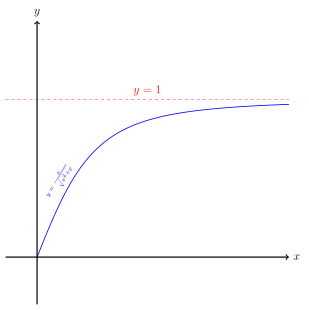
- \(\,\) \begin{align*} && y &= \frac{cx}{\sqrt{x^2+p}} \\ && \d y &= \frac{c(x^2+p)-cx^2}{(x^2+p)^{3/2}} \d x \\ &&&= \frac{cp^2}{(x^2+p)^{3/2}} \d x\\ && I &= \int \frac1{(b^2-y^2)\sqrt{c^2-y^2}} \d y \\ &&&= \int \frac{1}{\left ( b^2 - \frac{c^2x^2}{x^2+p} \right) \sqrt{c^2 - \frac{c^2x^2}{x^2+p} }} \d y \\ &&&= \int \frac{(x^2+p)^{3/2}}{((b^2-c^2)x^2+pb^2)\sqrt{c^2p}}\frac{cp}{(x^2+p)^{3/2}} \d x \\ &&&= \int \frac{\sqrt{p}}{((b^2-c^2)x^2+pb^2)} \d x \\ p=1: &&&= \int \frac{1}{(b^2-c^2)x^2+b^2} \d x \end{align*} When \(b = \sqrt{3}, c = \sqrt{2}\) \begin{align*} && I_1 &= \int_1^{\sqrt{2}} \frac{1}{(3 - y^2)\sqrt{2 - y^2}} \d y\\ &&&= \int_{x =1 }^{x=\infty} \frac{1}{3+x^2} \d x \\ &&&= \left [ \frac{1}{\sqrt{3}} \tan^{-1} \frac{x}{\sqrt{3}} \right]_1^\infty \\ &&&= \frac{\pi}{2\sqrt{3}} - \frac{1}{\sqrt{3}} \frac{\pi}{6} \\ &&&= \frac{\pi}{3\sqrt{3}} \end{align*} \begin{align*} && I_2 &= \int_{\frac{1}{\sqrt{2}}}^1 \frac{y}{(3y^2 - 1)\sqrt{2y^2 - 1}} \d y \\ x = \frac1y, \d x = -\frac1{y^2} \d y &&&= \int_{x=\sqrt{2}}^{x=1} \frac{x^2}{(3-x^2)\sqrt{2-x^2}}\cdot \left ( -\frac{1}{x^2} \right ) \d x \\ &&&= \int_1^{\sqrt{2}} \frac{1}{(3-x^2)\sqrt{2-x^2}} \d x \\ &&&= I_1 = \frac{\pi}{3\sqrt{3}} \end{align*}
- \(\,\) \begin{align*} && I_3 &= \int_{\frac{1}{\sqrt{2}}}^1 \frac{1}{(3y^2 - 1)\sqrt{2y^2 - 1}} \d y \\ x = 1/y, \d x = -1/y^2 \d y &&&= \int_{x=1}^{x=\sqrt{2}} \frac{x}{(3-x^2)\sqrt{2-x^2}} \d x \\ u = x^2, \d u = 2x \d x &&&= \int_{u=1}^{u=2} \frac{\frac12}{(3-u)\sqrt{2-u}} \d u \\ v=2-u, \d v = -\d u &&&= \frac12\int_{v=0}^{v=1} \frac{1}{(1+v)\sqrt{v}} \d v \\ &&&=\left [\tan^{-1}\sqrt{v}\right]_0^1 \\ &&&= \frac{\pi}{4} \end{align*}
2018 Paper 3 Q1
- The function \(\f\) is given by \[ \f(\beta)=\beta - \frac 1 \beta - \frac 1 {\beta^2} \ \ \ \ \ \ \ \ (\beta\ne0) \,. \] Find the stationary point of the curve \(y=\f(\beta)\,\) and sketch the curve. Sketch also the curve \(y=\g(\beta)\,\), where \[ \g(\beta) = \beta + \frac 3 \beta - \frac 1 {\beta^2} \ \ \ \ \ \ \ \ (\beta\ne0)\,. \]
- Let \(u\) and \(v\) be the roots of the equation \[ x^2 +\alpha x +\beta = 0 \,, \] where \(\beta\ne0\,\). Obtain expressions in terms of \(\alpha\) and \(\beta\) for \(\displaystyle u+v + \frac 1 {uv}\) and \( \displaystyle \frac 1 u + \frac 1 v + uv\,\).
- Given that \(\displaystyle u+v + \frac 1 {uv} = -1\,\), and that \(u\) and \(v\) are real, show that \(\displaystyle \frac 1 u+ \frac 1 v + {uv} \le -1\;\).
- Given instead that \(\displaystyle u+v + \frac 1 {uv} = 3 \;\), and that \(u\) and \(v\) are real, find the greatest value of \(\displaystyle \frac 1 u+ \frac 1v + {uv}\,\).
Solution:
- \begin{align*}
&& f(\beta) &= \beta - \frac1{\beta}-\frac1{\beta^2} \\
\Rightarrow && f'(\beta) &= 1 +\frac{1}{\beta^2}+\frac{2}{\beta^3} \\
\Rightarrow && 0 &= f'(\beta) \\
&&&= 1 + \frac1{\beta^2} + \frac{2}{\beta^3} \\
\Rightarrow && 0 &= \beta^3 + \beta + 2 \\
&&&= (\beta+1)(\beta^2-\beta+2)
\end{align*}
Therefore the only stationary point is at \(\beta = -1, f(-1) = -1\)
\begin{align*} && g(\beta) &= \beta + \frac3{\beta}-\frac1{\beta^2} \\ \Rightarrow && g'(\beta) &= 1 -\frac{3}{\beta^2}+\frac{2}{\beta^3} \\ \Rightarrow && 0 &= f'(\beta) \\ &&&= 1 - \frac3{\beta^2} + \frac{2}{\beta^3} \\ \Rightarrow && 0 &= \beta^3 - 3\beta + 2 \\ &&&= (\beta-1)^2(\beta+2) \end{align*} Therefore there are stationary points at \(\beta=1,f(1) = 3, \beta=-2, f(-2) = \frac14\)
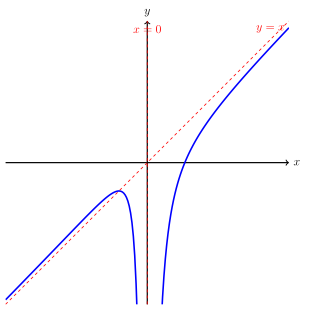
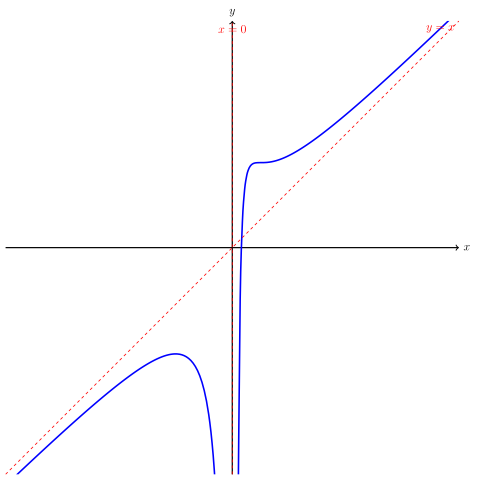
- Let \(u,v\) be the roots of \(x^2 + \alpha x + \beta = 0\), then since \((x-u)(x-v) = 0\) we must have \(\alpha = -(u+v), \beta = uv\). Therefore: \begin{align*} && u+v +\frac{1}{uv} &= -\alpha + \frac{1}{\beta} \\ && \frac1u+\frac1v + uv &= \frac{u+v}{uv} + uv \\ &&&= -\frac{\alpha}{\beta} + \beta \end{align*} Given \(u+v + \frac 1 {uv} = -1\), ie \(-\alpha + \frac{1}{\beta} = -1\). Since the roots are real, we must also have that \(\alpha^2 - 4\beta \geq 0\), so \begin{align*} && -\alpha + \frac1\beta &= -1 \\ \Rightarrow && \alpha &= 1 +\frac1\beta \\ \Rightarrow && -\frac{\alpha}{\beta}+\beta &= -\frac{1}{\beta} \l1+\frac1{\beta}\r + \beta \\ &&&=\beta - \frac{1}{\beta}-\frac{1}{\beta^2} \end{align*} So we want to maximise \(f(\beta)\) subject to \(\alpha ^2 - 4\beta \geq 0\) \begin{align*} && 0 &\leq \alpha^2 -4 \beta \\ &&&= \l 1 + \frac1{\beta} \r^2 - 4\beta \\ &&&= 1+ \frac2{\beta} + \frac1{\beta^2} - 4\beta \\ \Leftrightarrow && 0 &\leq -4\beta^3+\beta^2 + 2\beta + 1 \\ &&&=-(\beta-1)(4\beta^2+3\beta+1)\\ \Leftrightarrow && \beta &\leq 1 \end{align*} But we know \(f(\beta) \leq -1\) on \((-\infty,1]\) so we're done.
- Given that \(-\alpha + \frac{1}{\beta} = 3\) we have \begin{align*} && -\alpha + \frac1\beta &= 3 \\ \Rightarrow && \alpha &= -3 +\frac1\beta \\ \Rightarrow && -\frac{\alpha}{\beta}+\beta &= -\frac{1}{\beta} \l-3+\frac1{\beta}\r + \beta \\ &&&=\beta + \frac{3}{\beta}-\frac{1}{\beta^2} \end{align*} which we want to maximise, subject to: \begin{align*} && 0 &\leq \alpha^2 -4 \beta \\ &&&= \l -3 + \frac1{\beta} \r^2 - 4\beta \\ &&&= 9- \frac6{\beta} + \frac1{\beta^2} - 4\beta \\ \Leftrightarrow && 0 &\leq -4\beta^3+9\beta^2 - 6\beta + 1 \\ &&&=-(\beta-1)^2(4\beta-1)\\ \Leftrightarrow && \beta &\leq \frac14 \end{align*} Therefore the maximum will either be \(f(-2) = \frac14\) or \(f(\frac14) = -\frac{15}4\). Therefore the maximum is \(\frac14\)
2016 Paper 2 Q4
Let \[ y=\dfrac{x^2+x\sin\theta+1}{x^2+x\cos\theta+1} \,.\]
- Given that \(x\) is real, show that \[ (y\cos\theta -\sin\theta)^2 \ge 4 (y-1)^2 \,. \] Deduce that \[ y^2+1 \ge 4(y-1)^2 \,, \] and hence that \[ \dfrac {4-\sqrt7}3 \le y \le \dfrac {4+\sqrt7}3 \,. \]
- In the case $y= \dfrac {4+\sqrt7}3 \,$, show that \[\sqrt{y^2+1}=2(y-1)\] and find the corresponding values of \(x\) and \(\tan\theta\).
Solution:
- \(\,\) \begin{align*} && y&=\frac{x^2+x\sin\theta+1}{x^2+x\cos\theta+1} \\ \Leftrightarrow && 0 &= x^2(y-1) + x(y \cos \theta - \sin \theta) + y-1 \\ \Leftrightarrow && 0 &\leq \Delta = (y\cos \theta - \sin \theta)^2 - 4(y-1)^2 \\ \Leftrightarrow && (y\cos \theta - \sin \theta)^2 &\geq 4(y-1)^2 \end{align*} [Assuming that \(y \neq 1\), if \(y = 1\) then the RHS is \(0\) and it is automatically satisfied]. Notice that \((y\cos \theta - \sin \theta)^2 \leq (y^2+1)(\cos^2 \theta + \sin^2 \theta)\) by Cauchy-Schwarz, so \(y^2 + 1 \geq 4(y-1)^2\). \begin{align*} && y^2 + 1 &\geq 4(y-1)^2 \\ \Leftrightarrow && 0 &\geq 3y^2-8y+3 \\ \text{c.v.} && y&= \frac{8 \pm \sqrt{64-4\cdot3 \cdot 3}}{6} \\ &&&= \frac{4 \pm \sqrt{16-9}}{3} = \frac{4 \pm \sqrt{7}}3 \end{align*} so \(\frac{4-\sqrt{7}}3 \leq y \leq \frac{4+\sqrt7}3\).
- If \(y = \frac{4+\sqrt7}3\) then \(y - 1 = \frac{1+\sqrt7}3\) and since \(y^2+1 = 4(y-1)^2\) taking square roots we obtain \(\sqrt{y^2+1} = 2(y-1)\). Since equality must hold in our C-S identity, we must have \(\langle y, -1 \rangle\) parallel to \( \langle \cos \theta , \sin \theta \rangle\), ie \(\tan \theta = -\frac{3}{4+\sqrt{7}}\) and \begin{align*} && x & = \frac{-(y \cos \theta - \sin \theta) \pm \sqrt{\Delta}}{2(y-1)} \\ &&&= \frac{\pm2(y-1)}{2(y-1)} \\ &&&= \pm1 \end{align*}
2016 Paper 3 Q3
- Given that \[ \int \frac {x^3-2}{(x+1)^2}\, \e ^x \d x = \frac{\P(x)}{Q(x)}\,\e^x + \text{constant} \,, \] where \(\P(x)\)and \(Q(x)\) are polynomials, show that \(Q(x)\) has a factor of \(x + 1\). Show also that the degree of \(\P(x)\) is exactly one more than the degree of \(Q(x)\), and find \(\P(x)\) in the case \(Q(x) =x+1\).
- Show that there are no polynomials \(\P(x)\) and \(Q(x)\) such that \[ \int \frac 1 {x+1} \, \, \e^x \d x = \frac{\P(x)}{Q(x)}\,\e^x +\text{constant} \,. \] You need consider only the case when \(\P(x)\) and \(Q(x)\) have no common factors.
Solution:
- \begin{align*} && \int \frac {x^3-2}{(x+1)^2}\, \e ^x \d x &= \frac{\P(x)}{Q(x)}\,\e^x + \text{constant} \\ \underbrace{\Rightarrow}_{\frac{\d}{\d x}} && \frac{x^3-2}{(x+1)^2}e^x &= \frac{P'(x)Q(x)-Q'(x)P(x)}{Q(x)^2}e^x + \frac{P(x)}{Q(x)}e^x \\ \Rightarrow && \frac{x^3-2}{(x+1)^2} &= \frac{(P(x)+P'(x))Q(x)-Q'(x)P(x)}{Q(x)^2} \\ \Rightarrow && Q(x)^2(x^3-2) &= ((P(x)+P'(x))Q(x)-Q'(x)P(x))(x+1)^2 \\ \Rightarrow && Q(-1) &= 0 \\ \Rightarrow && x+1 &\mid Q(x) \end{align*} We have \(\frac{x^3-2}{(x+1)^2}\) has degree \(1\) (plus some remainder term). Therefore \begin{align*} 1 &= \deg \l (P(x)+P'(x))Q(x)-Q'(x)P(x)\r - 2 \deg Q(x) \\ &= \deg P(x) + \deg Q(x) - 2 \deg Q(x) \\ &= \deg P(x) - \deg Q(x) \end{align*} as required. Suppose \(Q(x) = x+1, P(x) = ax^2+bx+c\) then \begin{align*} && \frac{x^3-2}{(x+1)^2} &= \frac{(P(x)+P'(x))(x+1)-P(x)}{(x+1)^2} \\ \Rightarrow && x^3-2 &= (P(x)+P'(x))(x+1) - P(x) \\ \Rightarrow && x^3-2 &= (ax^2+bx+c+2ax+b)(x+1) - (ax^2+bx+c) \\ &&&= a x^3+ x^2 (2 a + b) + x (2 a + b + c)+b \\ \Rightarrow && a &= 1 \\ && b &= -2 \\ && c &= 0 \end{align*} So \(P(x) = x^2-2x\)
- \begin{align*} && \int \frac1{x+1}e^x \d x &= \frac{P(x)}{Q(x)}e^x + c \\ \Rightarrow && \frac{1}{x+1} e^x &= \frac{P'(x)Q(x)-Q'(x)P(x)}{Q(x)^2}e^x + \frac{P(x)}{Q(x)}e^x \\ \Rightarrow && \frac{1}{x+1} &= \frac{(P(x)+P'(x))Q(x)-Q'(x)P(x)}{Q(x)^2} \end{align*} Therefore \(Q(-1) = 0\) and so \(x +1 \mid Q(x)\). Considering degrees, we must have that \(P(x)\) has degree \(1\) less than \(Q(x)\). Consider also the number of factors of \(x+1\) in the numerator and denominator. Since \(P(x)\) and \(Q(x)\) have no common factors, the \(Q(x)\) could have \(q\) factors and \(P(x)\) must have none. The denominator therefore has \(2q\) factors and the numerator must have \(q-1\) factors (coming from \(Q'(x)\)), we must have \(2q = (q-1) + 1\), but that implies \(q = 0\). Contradiction! \end{align*}
2016 Paper 3 Q8
- The function f satisfies, for all \(x\), the equation \[ \f(x) + (1- x)\f(-x) = x^2\, . \] Show that \(\f(-x) + (1 + x)\f(x) = x^2\,\). Hence find \(\f(x)\) in terms of \(x\). You should verify that your function satisfies the original equation.
- The function \({\rm K}\) is defined, for \(x\ne 1\), by \[{\rm K}(x) = \dfrac{x+1}{x-1}\,.\] Show that, for \(x\ne1\), \({\rm K(K(}x)) =x\,\). The function g satisfies the equation \[ \g(x)+ x\, \g\Big(\frac{ x+1 }{x-1}\Big) = x \ \ \ \ \ \ \ \ \ \ \ ( x\ne 1) \,. \] Show that, for \(x\ne1\), \(\g(x)= \dfrac{2x}{x^2+1}\,\).
- Find \(\h(x)\), for \(x\ne0\), \(x\ne1\), given that \[ \h(x)+ \h\Big(\frac 1 {1-x}\Big)= 1-x -\frac1{1-x} \ \ \ \ \ \ ( x\ne0, \ \ x\ne1 ) \,. \]
Solution:
- \(\,\) Let \(P(x)\) mean the proposition that \(f(x) + (1-x)f(-x) = x^2\) so \begin{align*} P(x): && f(x) + (1-x)f(-x) &= x^2 \\ P(-x): && f(-x)+(1+x)f(x) &= (-x)^2 = x^2 \\ \Rightarrow && f(x)+(1-x)\left (x^2-(1+x)f(x) \right) &= x^2 \\ \Rightarrow && f(x) \left (1 -(1-x^2) \right) &= x^2 + (x-1)x^2 \\ \Rightarrow && f(x)x^2 &= x^3 \\ \Rightarrow && f(x) &= x \end{align*} Notice that \(x + (1-x)(-x) = x^2\) so it does satisfy the functional equation.
- Let \(K(x) = \frac{x+1}{x-1}\) if \(x \neq 1\) so \begin{align*} && K(K(x)) &= \frac{K(x)+1}{K(x)-1} \\ &&&= \frac{\frac{x+1}{x-1}+1}{\frac{x+1}{x-1}-1} \\ &&&= \frac{\frac{2x}{x-1}}{\frac{2}{x-1}} \\ &&&= x \end{align*} Let \(Q(x)\) denote the proposition that \(g(x) + xg(K(x)) = x\) so \begin{align*} Q(x): && g(x) + xg(K(x)) &= x \\ Q(K(x)): && g(K(x)) + K(x)g(x) &= K(x) \\ \Rightarrow && g(x) +xK(x)[1-g(x)] &= x \\ \Rightarrow && g(x)[1-xK(x)] &= x(1-K(x)) \\ \Rightarrow && g(x) \frac{x-1-x^2-x}{x-1} &= \frac{-2x}{x-1} \\ \Rightarrow && g(x) &= \frac{2x}{x^2+1} \end{align*}. And notice that \(\frac{2x}{x^2+1} + x \frac{2\frac{x+1}{x-1}}{\left( \frac{x+1}{x-1}\right)^2+1} = \frac{2x}{x^2+1} + \frac{2x(x^2-1)}{2x^2+2} = x\)
- Consider \(H(x) = \frac{1}{1-x}\) then notice that \(H(H(x)) = \frac{1}{1-\frac{1}{1-x}} = \frac{x-1}{x}\) and \(H^3(x) = \frac{\frac{1}{1-x}-1}{\frac{1}{1-x}} = 1-(1-x) = x\). So So letting \(S(x)\) be the statement that \(h(x) + h(H(x)) = 1 - x - \frac{1}{1-x}\) we have \begin{align*} S(x): && h(x) + h(H(x)) &= 1 - x - H(x) \\ S(H(x)): && h(H(x)) + h(H^2(x)) &= 1 - H(x) - H^2(x) \\ S(H^2(x)): && h(H^2(x)) + h(x) &= 1 - H^2(x) - x \\ S(x) - S(H(x)) + S(H^2(x)): && 2h(x) &= 1 - 2x \\ \Rightarrow && h(x)& = \frac12 - x \end{align*} and notice that \(\frac12 -x +\frac12 - \frac{1}{1-x} = 1 - x - \frac{1}{1-x}\) so it does satisfy the equation.
2015 Paper 1 Q5
- The function \(\f\) is defined, for \(x>0\), by \[ \f(x) =\int_{1}^3 (t-1)^{x-1} \, \d t \,. \] By evaluating the integral, sketch the curve \(y=\f(x)\).
- The function \(\g\) is defined, for \(-\infty < x < \infty\), by \[ \g(x)= \int_{-1}^1 \frac 1 {\sqrt{1-2xt +x^2} \ }\, \d t \,.\] By evaluating the integral, sketch the curve \(y=\g(x)\).
Solution:
- \(\,\)
\begin{align*}
&& f(x) &= \int_1^3 (t-1)^{x-1} \d t \\
&&&= \left [ \frac1x(t-1)^{x} \right]_1^3 \\
&&&= \frac{2^x}{x}
\end{align*}

- \(\,\)
\begin{align*}
&& g(x) &= \int_{-1}^1 \frac{1}{\sqrt{1-2xt+x^2}} \d t \\
&&&= \left [ -\frac{1}{x}(1 +x^2 - 2xt)^{\frac12} \right]_{-1}^1 \\
&&&= \frac1x \left ( \sqrt{1+x^2+2x}-\sqrt{1+x^2-2x}\right) \\
&&&= \frac1x \left ( |1+x|-|1-x| \right)
\end{align*}

2015 Paper 3 Q1
- Let \[ I_n= \int_0^\infty \frac 1 {(1+u^2)^n}\, \d u \,, \] where \(n\) is a positive integer. Show that \[ I_n - I_{n+1} = \frac 1 {2n} I_n \] and deduce that \[ I_{n+1} = \frac{(2n)!\, \pi}{2^{2n+1}(n!)^2} \,. \]
- Let \[ J = \int_0^\infty \f\big( (x- x^{-1})^2\big ) \, \d x \,, \] where \(\f\) is any function for which the integral exists. Show that \[ J = \int_0^\infty x^{-2} \f\big( (x- x^{-1})^2\big) \, \d x \, = \frac12 \int_0^\infty (1 + x^{-2}) \f\big( (x- x^{-1})^2\big ) \, \d x \, = \int_0^\infty \f\big(u^2\big) \,\d u \,. \]
- Hence evaluate \[ \int_0^\infty \frac {x^{2n-2}}{(x^4-x^2+1)^n} \, \d x \,, \] where \(n\) is a positive integer.
Solution: \begin{align*} I_n - I_{n+1} &= \int_0^\infty \frac 1 {(1+u^2)^n}\, \d u - \int_0^\infty \frac 1 {(1+u^2)^{n+1}}\, \d u \\ &= \int_0^\infty \l \frac 1 {(1+u^2)^n}- \frac 1 {(1+u^2)^{n+1}} \r\, \d u \\ &= \int_0^\infty \frac {u^2} {(1+u^2)^{n+1}} \, \d u \\ &= \left [ u \frac{u}{(1+u^2)^{n+1}} \right]_0^{\infty} - \frac{-1}{2n}\int_0^{\infty} \frac{1}{(1+u^2)^n} \d u \tag{\(IBP: u = u, v' = \frac{u}{(1+u^2)^{n+1}}\)}\\ &= \frac{1}{2n} I_n \end{align*} \(\displaystyle I_1 = \int_0^{\infty} \frac{1}{1+u^2} \d u = \left [ \tan^{-1} u \right]_0^\infty = \frac{\pi}{2}\) as expected. We also have, \(I_{n+1} = \frac{2n(2n-1)}{2n \cdot 2n} I_n \), by rearranging the recurrence relation. Therefore, when we multiply out the top we will have \(2n!\) and the bottom we will have two factors of \(n!\) and two factors of \(2^n\) combined with the original \(\frac{\pi}{2}\) we get \[ I_{n+1} = \frac{(2n)! \pi}{2^{2n+1} (n!)^2} \] \begin{align*} J = \int_0^\infty f\big( (x- x^{-1})^2\big ) \, \d x &= \int_{u = \infty}^{u = 0} f((u^{-1}-u)^2)(-u^{-2} )\d u \tag{\(u = x^{-1}, \d u = -x^{-2} \d x\)} \\ &= \int^{u = \infty}_{u = 0} f((u^{-1}-u)^2)u^{-2} \d u \\ &= \int^{\infty}_{0} u^{-2}f((u-u^{-1})^2) \d u \\ \end{align*} Therefore adding the two forms for \(J\) we have \begin{align*} 2 J &= \int_0^\infty f\big( (x- x^{-1})^2\big ) \, \d x + \int_0^\infty x^{-2} f\big( (x- x^{-1})^2\big ) \, \d x \\ &= \int_0^\infty (1+x^{-2}) f\big( (x- x^{-1})^2\big ) \, \d x \end{align*} And letting \(u = x - x^{-1}\), we have \(\d u = (1 + x^{-2}) \d x\), and \(u\) runs from \(-\infty\) to \(\infty\) so we have: \begin{align*} \int_0^\infty (1+x^{-2}) f\big( (x- x^{-1})^2\big ) \, \d x &= \int_{-\infty}^\infty f(u^2) \, \d u \\ &=2 \int_{0}^\infty f(u^2) \, \d u \end{align*} Since both of these are \(2J\) we have the result we are after. Finally, \begin{align*} \int_0^\infty \frac {x^{2n-2}}{(x^4-x^2+1)^n} \, \d x &= \int_0^{\infty} \frac{x^{2n-2}}{x^{2n}(x^2-1+x^{-2})^n} \d x \\ &= \int_0^{\infty} \frac{x^{-2}}{((x-x^{-1})^2+1)^n} \d x \\ &= \int_0^{\infty} \frac{1}{(x^2+1)^n} \d x \tag{Where \(f(x) = (1+x^2)^{-n}\) in \(J\) integral} \\ &= I_n = \frac{(2n-2)! \pi}{2^{2n-1} ((n-1)!)^2} \end{align*}
2013 Paper 1 Q2
In this question, \(\lfloor x \rfloor\) denotes the greatest integer that is less than or equal to \(x\), so that \(\lfloor 2.9 \rfloor = 2 = \lfloor 2.0 \rfloor\) and \(\lfloor -1.5 \rfloor = -2\). The function \(\f\) is defined, for \(x\ne0\), by \(\f(x) = \dfrac{\lfloor x \rfloor}{x}\,\).
- Sketch the graph of \(y=\f(x)\) for \(-3\le x \le 3\) (with \(x\ne0\)).
- By considering the line \(y= \frac7{12}\) on your graph, or otherwise, solve the equation \(\f(x) = \frac7 {12}\,\). Solve also the equations \(\f(x) =\frac{17}{24}\) and \(\f(x) = \frac{4 }{3 }\,\).
- Find the largest root of the equation \(\f(x) =\frac9{10}\,\).
Solution:

- Notice that there are no solutions when \(x < 0\) since \(f(x) \geq 1\) in that region. Suppose \(x = n + \epsilon, 0 < \epsilon < 1\), then \(f(x) = \frac{n}{n+\epsilon}\), ie \(12n = 7n + 7 \epsilon \Rightarrow 5 n = 7\epsilon \Rightarrow \epsilon = \frac{5}{7}n \Rightarrow n < \frac75\), so \(n = 1 ,\epsilon = \frac57, x = \frac{12}5\). \begin{align*} && \frac{17}{24} &= f(x) \\ \Rightarrow && 17n + 17 \epsilon &= 24 n \\ \Rightarrow && 17 \epsilon &= 7 n \\ \Rightarrow && n &< \frac{17}{7} \\ \Rightarrow && n &= 1, 2 \\ \Rightarrow && x &= \frac{24}{17}, \frac{48}{17} \end{align*}. For \(f(x) = \frac{4}{3}\) we notice that \(x < 0\), so let \(x = -n +\epsilon\), ie \begin{align*} && \frac43 &= f(x) \\ \Rightarrow && \frac43 &= \frac{-n}{-n+\epsilon} \\ \Rightarrow && 4\epsilon &= n \\ \Rightarrow && n &= 1,2,3 \\ \Rightarrow && x &= -\frac{5}{4}, -\frac{3}{2}, -\frac{9}{4} \end{align*}
- \begin{align*} && \frac9{10} &= f(x) \\ \Rightarrow && 9n + 9 \epsilon &= 10 n \\ \Rightarrow && 9 \epsilon &= n \\ \Rightarrow && n < 9 \end{align} So largest will be when \(n = 8, \epsilon = \frac{8}{9}\), ie \(\frac{80}{9}\)
2013 Paper 2 Q5
- A function \(\f(x)\) satisfies \(\f(x) = \f(1-x)\) for all \(x\). Show, by differentiating with respect to \(x\), that \(\f'(\frac12) =0\,\). If, in addition, \(\f(x) = \f(\frac1x)\) for all (non-zero) \(x\), show that \(\f'(-1)=0\) and that \(\f'(2)=0\).
- The function \(\f\) is defined, for \(x\ne0\) and \(x\ne1\), by \[ \f(x) = \frac {(x^2-x+1)^3}{(x^2-x)^2} \,. \] Show that \(\f(x)= \f(\frac 1 x)\) and \(\f(x) = \f(1-x)\). Given that it has exactly three stationary points, sketch the curve \(y=\f(x)\).
- Hence, or otherwise, find all the roots of the equation \(\f(x) = \dfrac {27} 4\,\) and state the ranges of values of \(x\) for which \(\f(x) > \dfrac{27} 4\,\). Find also all the roots of the equation \(\f(x) = \dfrac{343}{36}\,\) and state the ranges of values of \(x\) for which \(\f(x) > \dfrac{343}{36}\).
Solution:
- \(\,\) \begin{align*} && f(x) &= f(1-x) \\ \Rightarrow && f'(x) &= -f'(1-x) \\ \Rightarrow && f'(\tfrac12) &= -f'(\tfrac12) \\ \Rightarrow && f'(\tfrac12) &= 0 \\ \\ && f(x) &= f(\tfrac1x) \\ \Rightarrow && f'(x) &= f'(\tfrac1x) \cdot \frac{-1}{x^2} \\ \Rightarrow && f'(-1) &= -f'(-1) \\ \Rightarrow && f'(-1) &= 0 \\ \\ && f'(2) &= -\frac{1}{4}f'(\tfrac12) \\ &&&= 0 \end{align*}
- Suppose \begin{align*}
&& f(x) &= \frac{(x^2-x+1)^3}{(x^2-x)^2} \\
&& f(1/x) &= \frac{(x^{-2}-x^{-1}+1)^3}{(x^{-2}-x^{-1})^2} \\
&&&= \frac{(1-x+x^2)^3/x^6}{((x-x^2)^2/x^6} \\
&&&= f(x) \\
\\
&& f(1-x) &= \frac{((1-x)^2-(1-x)+1)^3}{((1-x)^2-(1-x))^2} \\
&&&= \frac{(1-x+x^2)^3}{(x^2-x)^2} = f(x)
\end{align*}
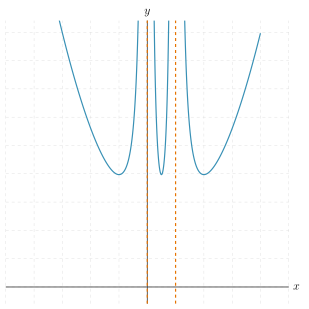
- Clearly \(x = -1\) is a root of \(f(x) = \frac{27}{4}\), so we must also have \(x=2\) and \(x = \frac12\), therefore \(f(x) > \frac{27}{4}\) if \(x \in \mathbb{R} \setminus \{-1, 2, \tfrac12, 0, 1 \}\). Clearly \(x = 3\) and \(x = -2\) are solutions so we also have: \(\frac13, -\frac12, \frac32, \frac23\) and these must be all solutions so we must have: \(f(x) > \frac{343}{36} \Leftrightarrow x \in (-\infty, -2) \cup (-\frac12, 0) \cup (0, \frac13) \cup (\frac23, 1) \cup (1, \frac32) \cup (3, \infty)\)
2012 Paper 2 Q3
Show that, for any function f (for which the integrals exist), \[ \int_0^\infty \f\big(x+\sqrt{1+x^2}\big) \,\d x = \frac12 \int_1^\infty \left(1+\frac 1 {t^2}\right) \f(t)\, \d t \,. \] Hence evaluate \[ \int_0^\infty \frac1 {2x^2 +1 + 2 x\sqrt{x^2+1} \ } \, \, \d x \,, \] and, using the substitution \(x=\tan\theta\), \[ \int_0^{\frac12\pi} \frac{1}{(1+\sin\theta)^3}\,\d \theta \,. \]
Solution: \begin{align*} && t &= x + \sqrt{1+x^2} \\ &&\frac1t &= \frac{1}{x+\sqrt{1+x^2}} \\ &&&= \frac{\sqrt{1+x^2}-x}{1+x^2-1} \\ &&&= \sqrt{1+x^2}-x \\ \Rightarrow && x &=\frac12 \left ( t - \frac1t\right) \\ \Rightarrow && \d x &=\frac12 \left (1 + \frac1{t^2} \right)\d t \\ \\ \Rightarrow && \int_0^\infty \f\big(x+\sqrt{1+x^2}\big) \,\d x &= \int_{t=1}^{t = \infty}f(t) \frac12\left (1 + \frac1{t^2} \right)\d t \\ &&&= \frac12 \int_1^\infty \left (1 + \frac1{t^2} \right)f(t) \d t \end{align*} \begin{align*} && I &= \int_0^\infty \frac1 {2x^2 +1 + 2 x\sqrt{x^2+1} \ } \d x \\ &&&= \int_0^\infty \frac1 {(x+\sqrt{x^2+1})^2} \d x \\ &&&= \frac12 \int_1^\infty \left (1 + \frac1{t^2} \right) \frac{1}{t^2} \d t \\ &&&= \frac12 \left [-\frac1t-\frac13\frac1{t^3} \right]_1^{\infty} \\ &&&= \frac12 \cdot \frac43 = \frac23 \end{align*} \begin{align*} && J &= \int_0^{\frac12 \pi} \frac{1}{(1+\sin \theta)^3} \d \theta \\ &&x &= \tan \theta\\ && \d x &= \sec^2 \theta = (1+x^2) \d \theta\\ && \tan\theta &= \frac{s}{\sqrt{1-s^2}}\\ \Rightarrow && \tan^2 \theta &= \frac{s^2}{1-s^2} \\ \Rightarrow && \sin \theta &= \frac{\tan\theta}{\sqrt{1+\tan^2\theta}} \\ && J &= \int_0^{\frac12 \pi} \frac{1}{(1+\sin \theta)^3} \d \theta \\ &&&= \int_0^{\frac12 \pi} \frac{1}{\left (1+ \frac{\tan\theta}{\sqrt{1+\tan^2\theta}} \right )^3} \d \theta \\ &&&= \int_{x=0}^{x=\infty} \frac{1}{\left(1 + \frac{x}{\sqrt{1+x^2}} \right)^3} \frac{1}{1+x^2} \d x \\ &&&= \int_0^{\infty} \frac{\sqrt{1+x^2}}{(\sqrt{1+x^2}+x)^3} \d x \\ &&J_a &= \int_0^{\infty} \frac{\sqrt{1+x^2}+x}{(\sqrt{1+x^2}+x)^3} \d x \\ &&&= \frac23 \\ &&J_b &= \int_0^{\infty} \frac{\sqrt{1+x^2}-x}{(\sqrt{1+x^2}+x)^3} \d x \\ &&&= \int_0^{\infty} \frac{1}{(\sqrt{1+x^2}+x)^4} \d x\\ &&&= \frac12\int_1^{\infty} \left (1 +\frac1{t^2} \right)\frac{1}{t^4} \d t \\ &&&= \frac12 \left [-\frac13 t^{-3}-\frac15t^{-5} \right]_1^{\infty} \\ &&&= \frac12 \cdot \frac8{15} = \frac4{15} \\ \Rightarrow && J &= \frac12(J_a+J_b) = \frac7{15} \end{align*}
2012 Paper 2 Q5
- Sketch the curve \(y=\f(x)\), where \[ \f(x) = \frac 1 {(x-a)^2 -1} \hspace{2cm}(x\ne a\pm1), \] and \(a\) is a constant.
- The function \(\g(x)\) is defined by \[ \g(x) = \frac 1 {\big( (x-a)^2-1 \big) \big( (x-b)^2 -1\big)} \hspace{1cm}(x\ne a\pm1, \ x\ne b\pm1), \] where \(a\) and \(b\) are constants, and \(b>a\). Sketch the curves \(y=\g(x)\) in the two cases \(b>a+2\) and \(b=a+2\), finding the values of \(x\) at the stationary points.
Solution:
- \(\,\)

- \(\,\) \begin{align*}
&& \frac{\d}{\d x} \left ( \frac{1}{g(x)} \right) &= \frac{\d }{\d x} \left ( \big( (x-a)^2-1 \big) \big( (x-b)^2 -1\big)\right) \\
&&&= ((x-a)^2-1)(2(x-b))+((x-b)^2-1)(2(x-a)) \\
&&&= 2(2x-a-b)(x^2-(a+b)x+ab-1) \\
\Rightarrow && x &= \frac{a+b}{2}, \frac{a+b \pm \sqrt{(a+b)^2-4ab+4}}{2} \\
&&&= \frac{a+b}{2}, \frac{a+b \pm \sqrt{(a-b)^2+4}}{2}
\end{align*}
If \(b > a+2\):
If \(b = a+2\):


2011 Paper 1 Q2
The number \(E\) is defined by $\displaystyle E= \int_0^1 \frac{\e^x}{1+x} \, \d x\,.$ Show that \[ \int_0^1 \frac{x \e^x}{1+x} \, \d x = \e -1 -E\, ,\] and evaluate \(\ds \int_0^1 \frac{x^2\e^x}{1+x} \, \d x\) in terms of \(\e\) and \(E\). Evaluate also, in terms of \(E\) and \(\rm e\) as appropriate:
- \[ \int_0^1 \frac{\e^{\frac{1-x}{1+x}}}{1+x}\, \d x\,\]
- \[ \int_1^{\sqrt2} \frac {\e^{x^2}}x \, \d x \, \]
Solution: \begin{align*} \int_0^1 \frac{x \e^x}{1+x} \, \d x &= \int_0^1 \frac{(x+1-1) \e^x}{1+x} \, \d x \\ &= \int_0^1 \left ( e^x -\frac{\e^x}{1+x} \right )\, \d x \\ &= \e-1-E \end{align*} \begin{align*} \int_0^1 \frac{x^2 \e^x}{1+x} \, \d x &= \int_0^1 \frac{(x^2+x-x) \e^x}{1+x} \, \d x \\ &= \int_0^1 \left ( xe^x -\frac{x\e^x}{1+x} \right )\, \d x \\ &= \left [xe^{x} \right]_0^1 - \int_0^1 e^x \, \d x -(\e-1-E) \\ &= \e-(\e-1)-(\e -1 -E) \\ &= 2-\e + E \end{align*}
- Since \(\displaystyle u = \frac{1-x}{1+x},\frac{\d u}{\d x} = \frac{-(1+x)-(1-x)}{(1+x)^2}\), \begin{align*} && \int_0^1 \frac{\e^{\frac{1-x}{1+x}}}{1+x}\, \d x &= \int_{u=1}^{u=0} \frac{e^u}{1+x} \cdot \frac{(1+x)^2}{-2} \d u \\ &&&= \int_0^1 \frac{(1+x) e^u}{2} \d u \\ &&&= \int_0^1 \frac{\left ( 1 + \frac{1-u}{1+u} \right) e^u}{2}\, \d u \\ &&&= \frac12 \int_0^1 \left (e^u + \frac{e^{u}}{1+u} - \frac{ue^u}{1+u} \right) \, \d u \\ &&&= \frac12 \left( \e-1 + E - (\e - 1 - E) \right) \\ &&&= E \end{align*}
- Since \(\displaystyle u = x^2-1, \d u = 2x \d x\)\begin{align*} \int_1^{\sqrt2} \frac {\e^{x^2}}x \, \d x &= \int_{u=0}^{u=1} \frac{e^{u+1}}{x} \frac{1}{2x} \d u \\ &= \int_0^1 \frac{e^{u+1}}{2(u+1)} \d u \\ &= \frac{\e}{2} E \\ &= \frac{E\e}{2} \end{align*}
2010 Paper 1 Q2
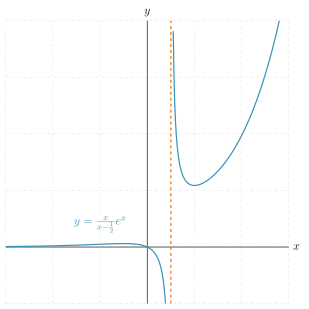
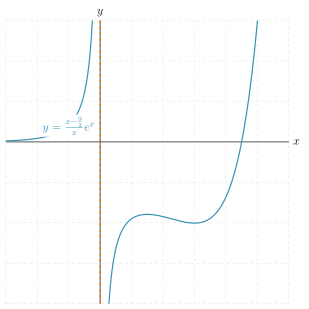
The curve \(\displaystyle y=\Bigl(\frac{x-a}{x-b}\Bigr)\e^{x}\), where \(a\) and \(b\) are constants, has two stationary points. Show that \[ a-b<0 \ \ \ \text{or} \ \ \ a-b>4 \,. \]
- Show that, in the case \(a=0\) and \(b= \frac12\), there is one stationary point on either side of the curve's vertical asymptote, and sketch the curve.
- Sketch the curve in the case \( a=\tfrac{9}{2}\) and \(b=0\,\).
Solution: \begin{align*} && y &= \left ( \frac{x-a}{x-b} \right )e^x \\ &&y'& = \left ( \frac{x-a}{x-b} \right )e^x + \left ( \frac{(x-b)-(x-a)}{(x-b)^2}\right )e^x \\ &&&= \left ( \frac{(x-b)(x-a) +a-b}{(x-b)^2} \right)e^x \\ &&&= \left ( \frac{x^2-(a+b)x+a-b+ab}{(x-b)^2} \right)e^x \\ && 0 &< \Delta = (a+b)^2 - 4 \cdot 1 \cdot (a-b+ab) \\ &&&= a^2+2ab+b^2-4a+4b-4ab \\ &&&= a^2-2ab+b^2-4a+4b\\ &&&= (a-b)^2-4(a-b) \\ &&&= (a-b)(a-b-4) \\ \end{align*} Considered as a quadratic in \(a-b\) we can see \(a-b < 0\) or \(a-b > 4\)
- If \(a = 0, b = \frac12\), we have \(x^2-\frac12x -\frac12 = 0 \Rightarrow (2x+1)(x-1) = 0 \Rightarrow x = -\frac12, x=1\). The asymptote is at \(x = \frac12\) so they are on either side.
- \(\,\)
2010 Paper 3 Q8
Given that \({\rm P} (x) = {\rm Q} (x){\rm R}'(x) - {\rm Q}'(x){\rm R}(x)\), write down an expression for \[ \int \frac{{\rm P} ( x)}{ \big( {\rm Q} ( x)\big )^ 2}\, \d x\, . \]
- By choosing the function \({\rm R}(x)\) to be of the form \(a +bx+c x^2\), find \[ \int \frac{5x^2 - 4x - 3} {(1 + 2x + 3x^2 )^2 } \, \d x \,.\] Show that the choice of \({\rm R}(x)\) is not unique and, by comparing the two functions \({\rm R}(x)\) corresponding to two different values of \(a\), explain how the different choices are related.
- Find the general solution of \[ (1+\cos x +2 \sin x) \frac {\d y}{\d x} +(\sin x -2 \cos x)y = 5 - 3 \cos x + 4 \sin x\,. \]
Solution: \begin{align*} && \int \frac{{\rm P} ( x)}{ \big( {\rm Q} ( x)\big )^ 2}\, \d x &= \int \frac{{\rm Q} (x){\rm R}'(x) - {\rm Q}'(x){\rm R}(x)}{ \big( {\rm Q} ( x)\big )^ 2}\, \d x \\ &&&= \int \frac{\d}{\d x} \left ( \frac{R(x)}{Q(x)} \right) \d x \\ &&&= \frac{R(x)}{Q(x)} + C \end{align*}
- Suppose \(Q(x) = 1 + 2x + 3x^2, P(x) = 5x^2-4x-3\), and \(R(x) = a +bx + cx^2\), then \begin{align*} && 5x^2-4x-3 &= (1 + 2x + 3x^2)(2cx+b) - (6x+2)(a+bx+cx^2) \\ &&&= (6c-6c)x^3 + (3b+4c-6b-2c)x^2 + \\ &&&\quad+(2c+2b-6a-2b)x + (b-2a) \\ \Rightarrow && 2c-3b &= 5 \\ && 2c-6a &= -4 \\ && b - 2a &= -3 \\ \Rightarrow && b &= 2a - 3\\ && c &= 3a-2 \end{align*} So say \(a = 0, b = -3, c = -2\) we will have \begin{align*} \int \frac{5x^2 - 4x - 3} {(1 + 2x + 3x^2 )^2 } \, \d x &= \frac{-3x-2x^2}{1+2x+3x^2} + C \end{align*} Suppose we have a different value of \(a\), then we end up with: \begin{align*} \frac{a+(2a-3)x+(3a-2)x^2}{1+2x+3x^2} = a +\frac{-3x-2x^2}{1+2x+3x^2} \end{align*} So the different antiderivatives differ by a constant.
- \(\,\) \begin{align*} && \frac{\d }{\d x} \left ( \frac{1}{1+\cos x + 2 \sin x } y\right) &= \frac{5-3\cos x + 4 \sin x }{(1+\cos x + 2 \sin x)^2} \\ \end{align*} We want to find \(R(x) = A \cos x + B\sin x + C\) such that \begin{align*} &&5-3\cos x + 4 \sin x &= (1+\cos x + 2 \sin x)R'(x) - R(x)(-\sin x + 2 \cos x) \\ &&&= (1+\cos x + 2 \sin x)(-A\sin x + B \cos x) \\ &&&\quad- (A\cos x + B \sin x + C)(-\sin x + 2 \cos x) \\ &&&=(-A+C) \sin x + (B-2C)\cos x +\\ &&&\quad\quad (2B-A+A-2B)\sin x \cos x \\ &&&\quad\quad (-2A+B)\sin^2x+(B-2A)\cos^2x \\ &&&= (-A+C)\sin x + (B-2C)\cos x +(B-2A) \\ \Rightarrow && B-2A &= 5\\ && C-A &= 4 \\ && B-2C &= -3 \\ \end{align*} There are many solutions so WLOG \(C=4, A = 0, B = 5\) and so \begin{align*} && \int \frac{5-3\cos x + 4 \sin x }{(1+\cos x + 2 \sin x)^2} \d x &= \frac{5\sin x +4}{1+\cos x + 2 \sin x} + K \\ \Rightarrow && y &= 5\sin x + 4 + K(1 + \cos x + 2 \sin x) \end{align*}