Problems
Filters
7 problems found
2022 Paper 2 Q5
- Given that \(a > b > c > 0\) are constants, and that \(x\), \(y\), \(z\) are non-negative variables, show that \[ax + by + cz \leqslant a(x + y + z).\]
- Find \(\Delta\) in terms of \(a\), \(b\), \(c\), \(x\), \(y\) and \(z\).
- Find both the minimum value of the sum of the perpendicular distances from \(P\) to the three sides of the triangle and the values of \(x\), \(y\) and \(z\) which give this minimum sum, expressing your answers in terms of some or all of \(a\), \(b\), \(c\) and \(\Delta\).
- Show that, for all real \(a\), \(b\), \(c\), \(x\), \(y\) and \(z\), \[(a^2+b^2+c^2)(x^2+y^2+z^2) = (bx-ay)^2 + (cy-bz)^2 + (az-cx)^2 + (ax+by+cz)^2.\]
- Find both the minimum value of the sum of the squares of the perpendicular distances from \(P\) to the three sides of the triangle and the values of \(x\), \(y\) and \(z\) which give this minimum sum, expressing your answers in terms of some or all of \(a\), \(b\), \(c\) and \(\Delta\).
- Find both the maximum value of the sum of the squares of the perpendicular distances from \(P\) to the three sides of the triangle and the values of \(x\), \(y\) and \(z\) which give this maximum sum, expressing your answers in terms of some or all of \(a\), \(b\), \(c\) and \(\Delta\).
2021 Paper 3 Q1
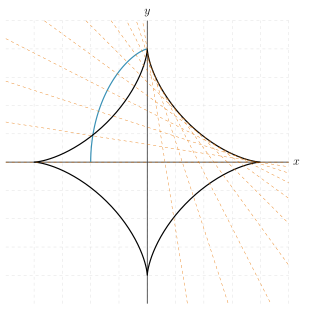
- A curve has parametric equations \[ x = -4\cos^3 t, \qquad y = 12\sin t - 4\sin^3 t. \] Find the equation of the normal to this curve at the point \[ \bigl(-4\cos^3\phi,\; 12\sin\phi - 4\sin^3\phi\bigr), \] where \(0 < \phi < \tfrac{1}{2}\pi\). Verify that this normal is a tangent to the curve \[ x^{2/3} + y^{2/3} = 4 \] at the point \((8\cos^3\phi,\; 8\sin^3\phi)\).
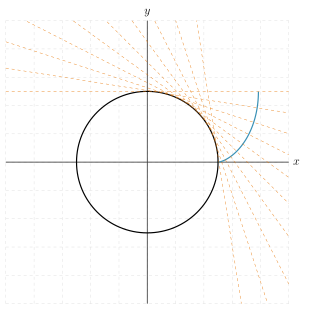
- A curve has parametric equations \[ x = \cos t + t\sin t, \qquad y = \sin t - t\cos t. \] Find the equation of the normal to this curve at the point \[ \bigl(\cos\phi + \phi\sin\phi,\; \sin\phi - \phi\cos\phi\bigr), \] where \(0 < \phi < \tfrac{1}{2}\pi\). Determine the perpendicular distance from the origin to this normal, and hence find the equation of a curve, independent of \(\phi\), to which this normal is a tangent.
Solution:
- \(\,\) \begin{align*}
&& \dot{x} &=12 \cos^2 t \sin t \\
&& \dot{y} &= 12 \cos t - 12 \sin^2 t \cos t \\
&& \frac{\d y}{\d x} &= \frac{12 \cos t - 12 \sin^2 t \cos t}{12 \cos^2 t \sin t} \\
&&&= \frac{1 - \sin^2 t}{\cos t \sin t} \\
&&&= \cot t \\
\\
&& \frac{y - (12\sin\phi - 4\sin^3\phi)}{x - (-4 \cos^3 \phi)} &= - \tan \phi \\
&& y &= -\tan \phi x -4 \cos^3 \phi \tan \phi + 12 \sin \phi -4\sin^3 \phi \\
&&&= -\tan \phi x -4 \cos^2 \phi \sin \phi + 12 \sin \phi -4\sin^3 \phi \\
&&&= -\tan \phi x - 4\sin \phi+12 \sin \phi \\
&&y&= -\tan \phi x + 8 \sin \phi
\end{align*}
Note that when \(x = 8\cos^3 \phi\) we have \(y =-8 \cos^2 \phi \sin \phi + 8 \sin \phi = 8 \sin^3 \phi\). So the point lies on the curve. Notice also that \((8\cos^3 \phi, 8 \sin^ 3\phi)\) is a parametrisation of \(x^{2/3} + y^{2/3} = 4\) and so we can use parametric differentiation to see the gradient is \(\frac{24\sin^2 \phi \cos \phi}{-24\cos^2 \phi\sin\phi} = - \tan \phi\) so it also has the same gradient as required.
- \(\,\) \begin{align*}
&& \dot{x} &= -\sin t + \sin t + t \cos t \\
&&&= t \cos t \\
&& \dot{y} &= \cos t - \cos t + t \sin t \\
&&&= t \sin t \\
&& \frac{\d y}{\d x} &= \frac{t \sin t}{t \cos t} = \tan t \\
\\
&& \frac{y - (\sin \phi - \phi \cos \phi)}{x - (\cos \phi + \phi \sin \phi)} &= -\cot \phi \\
\Rightarrow && y &= -\cot \phi x + (\cos \phi + \phi \sin \phi) \cot \phi + \sin \phi - \phi \cos \phi \\
&&&= -\cot \phi x + \cos \phi \cot \phi + \phi \cos \phi + \sin \phi - \phi \cos \phi \\
&&&= -\cot \phi x + \frac{\cos^2 \phi + \sin^2 \phi}{\sin \phi} \\
&&&= -\cot \phi x + \cosec \phi
\end{align*}
The distance to the origin is \(\displaystyle \frac{|\cosec \phi|}{\sqrt{1 + \cot^2 \phi}} = 1\) so this normal is a tangent to \(x^2 + y^2 = 1\)
2008 Paper 1 Q7
The point \(P\) has coordinates \((x,y)\) with respect to the origin \(O\). By writing \(x=r\cos\theta\) and \(y=r\sin\theta\), or otherwise, show that, if the line \(OP\) is rotated by \(60^\circ\) clockwise about \(O\), the new \(y\)-coordinate of \(P\) is \(\frac12(y-\sqrt3\,x)\). What is the new \(y\)-coordinate in the case of an anti-clockwise rotation by \(60^\circ\,\)? An equilateral triangle \(OBC\) has vertices at \(O\), \((1,0)\) and \((\frac12,\frac12 \sqrt3)\), respectively. The point \(P\) has coordinates \((x,y)\). The perpendicular distance from \(P\) to the line through \(C\) and \(O\) is \(h_1\); the perpendicular distance from \(P\) to the line through \(O\) and \(B\) is \(h_2\); and the perpendicular distance from \(P\) to the line through \(B\) and \(C\) is \(h_3\). Show that \(h_1=\frac12 \big\vert y-\sqrt3\,x\big\vert\) and find expressions for \(h_2\) and \(h_3\). Show that \(h_1+h_2+h_3=\frac12 \sqrt3\) if and only if \(P\) lies on or in the triangle \(OBC\).
2006 Paper 1 Q8
{\it Note that the volume of a tetrahedron is equal to \(\frac1 3\) \(\times\) the area of the base \(\times\) the height.} The points \(O\), \(A\), \(B\) and \(C\) have coordinates \((0,0,0)\), \((a,0,0)\), \((0,b,0)\) and \((0,0,c)\), respectively, where \(a\), \(b\) and \(c\) are positive.
- Find, in terms of \(a\), \(b\) and \(c\), the volume of the tetrahedron \(OABC\).
- Let angle \(ACB = \theta\). Show that \[ \cos\theta = \frac {c^2} { { \sqrt{\vphantom{ \dot b} (a^2+c^2)(b^2+c^2)} } ^{\vphantom A} \ } \] and find, in terms of \(a\), \(b\) and \(c\), the area of triangle \(ABC\). % is %\(\displaystyle \tfrac12 \sqrt{ \vphantom{\dot A } a^2b^2 +b^2c^2 + c^2 a^2 \;} \;\).
2003 Paper 2 Q4
The line \(y=d\,\), where \(d>0\,\), intersects the circle \(x^2+y^2=R^2\) at \(G\) and \(H\). Show that the area of the minor segment \(GH\) is equal to \begin{equation} R^2\arccos \left({d \over R}\right) -d\sqrt{R^2 - d^2}\;. \tag {\(*\)} \end{equation} In the following cases, the given line intersects the given circle. Determine how, in each case, the expression \((*)\) should be modified to give the area of the minor segment.
- Line: \(y=c\,\); \ \ \ circle: \((x-a)^2+(y-b)^2=R^2\,\).
- Line: \(y=mx+c\, \); \ \ \ circle: \(x^2+y^2=R^2\,\).
- Line: \(y=mx+c\,\); \ \ \ circle: \((x-a)^2+(y-b)^2=R^2\,\).
1996 Paper 2 Q7
Consider a fixed square \(ABCD\) and a variable point \(P\) in the plane of the square. We write the perpendicular distance from \(P\) to \(AB\) as \(p\), from \(P\) to \(BC\) as \(q\), from \(P\) to \(CD\) as \(r\) and from \(P\) to \(DA\) as \(s\). (Remember that distance is never negative, so \(p,q,r,s\geqslant 0\).) If \(pr=qs\), show that the only possible positions of \(P\) lie on two straight lines and a circle and that every point on these two lines and a circle is indeed a possible position of \(P\).
1995 Paper 3 Q8
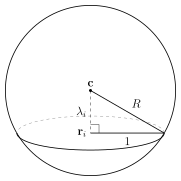
A plane \(\pi\) in 3-dimensional space is given by the vector equation \(\mathbf{r}\cdot\mathbf{n}=p,\) where \(\mathbf{n}\) is a unit vector and \(p\) is a non-negative real number. If \(\mathbf{x}\) is the position vector of a general point \(X\), find the equation of the normal to \(\pi\) through \(X\) and the perpendicular distance of \(X\) from \(\pi\). The unit circles \(C_{i},\) \(i=1,2,\) with centres \(\mathbf{r}_{i},\) lie in the planes \(\pi_{i}\) given by \(\mathbf{r}\cdot\mathbf{n}_{i}=p_{i},\) where the \(\mathbf{n}_{i}\) are unit vectors, and \(p_{i}\) are non-negative real numbers. Prove that there is a sphere whose surface contains both circles only if there is a real number \(\lambda\) such that \[ \mathbf{r}_{1}+\lambda\mathbf{n}_{1}=\mathbf{r}_{2}\pm\lambda\mathbf{n}_{2}. \] Hence, or otherwise, deduce the necessary conditions that \[ (\mathbf{r}_{1}-\mathbf{r}_{2})\cdot(\mathbf{n}_{1}\times\mathbf{n}_{2})=0 \] and that \[ (p_{1}-\mathbf{n}_{1}\cdot\mathbf{r}_{2})^{2}=(p_{2}-\mathbf{n}_{2}\cdot\mathbf{r}_{1})^{2}. \] Interpret each of these two conditions geometrically.
Solution: The equation of the normal to \(\pi\) through \(X\) is \(\mathbf{x} + \lambda \mathbf{n}\). The distance is \(|\mathbf{x}\cdot \mathbf{n}-p|\) We know that the centre of the sphere must lie above the centre of the circle following the normal, ie \(\mathbf{c} = \mathbf{r}_1+\lambda_1 \mathbf{n}_1 = \mathbf{r}_2+\lambda_2 \mathbf{n}_2\)