Problems
Filters
21 problems found
2018 Paper 3 Q10
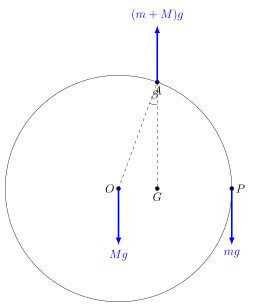
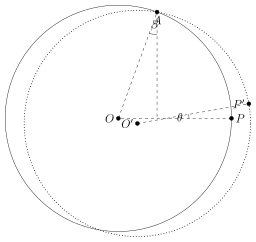
A uniform disc with centre \(O\) and radius \(a\) is suspended from a point \(A\) on its circumference, so that it can swing freely about a horizontal axis \(L\) through \(A\). The plane of the disc is perpendicular to \(L\). A particle \(P\) is attached to a point on the circumference of the disc. The mass of the disc is \(M\) and the mass of the particle is \(m\). In equilibrium, the disc hangs with \(OP\) horizontal, and the angle between \(AO\) and the downward vertical through \(A\) is \(\beta\). Find \(\sin\beta\) in terms of \(M\) and \(m\) and show that \[ \frac{AP}{a} = \sqrt{\frac{2M}{M+m}} \,. \] The disc is rotated about \(L\) and then released. At later time \(t\), the angle between \(OP\) and the horizontal is \(\theta\); when \(P\) is higher than \(O\), \(\theta\) is positive and when \(P\) is lower than \(O\), \(\theta\) is negative. Show that \[ \tfrac12 I \dot\theta^2 + (1-\sin\beta)ma^2 \dot \theta^2 + (m+M)g a\cos\beta \, (1- \cos\theta) \] is constant during the motion, where \(I\) is the moment of inertia of the disc about \(L\). Given that \(m= \frac 32 M\) and that \(I=\frac32Ma^2\), show that the period of small oscillations is \[ 3\pi \sqrt{\frac {3a}{5g}} \,. \]
Solution:

2017 Paper 3 Q10
A uniform rod \(PQ\) of mass \(m\) and length \(3a\) is freely hinged at \(P\). The rod is held horizontally and a particle of mass \(m\) is placed on top of the rod at a distance~\(\ell\) from \(P\), where \(\ell <2a\). The coefficient of friction between the rod and the particle is \(\mu\). The rod is then released. Show that, while the particle does not slip along the rod, \[ (3a^2+\ell^2)\dot \theta^2 = g(3a+2\ell)\sin\theta \,, \] where \(\theta\) is the angle through which the rod has turned, and the dot denotes the time derivative. Hence, or otherwise, find an expression for \(\ddot \theta\) and show that the normal reaction of the rod on the particle is non-zero when~\(\theta\) is acute. Show further that, when the particle is on the point of slipping, \[ \tan\theta = \frac{\mu a (2a-\ell)}{2(\ell^2 + a\ell +a^2)} \,. \] What happens at the moment the rod is released if, instead, \(\ell>2a\)?
Solution:

| Inital | \@ \(\theta\) | |
| Rotational KE of rod | \(0\) | \(\frac{1}{2}I\dot{\theta}^2 = \frac{1}{2} \frac{1}{3} m (3a)^2 \dot{\theta}^2 = \frac32 m a^2 \dot{\theta}^2\) |
| KE of particle | \(0\) | \(\frac12 m \ell^2\dot{\theta}^2\) |
| GPE of rod | \(0\) | \(-\frac{3}{2}mga \sin \theta\) |
| GPE of particle | \(0\) | \(-mg \ell \sin \theta\) |
| Total | \(0\) | \(\frac12m \l \l 3a^2 + \ell^2\r \dot{\theta}^2 - \l 3a + 2\ell \r g \sin \theta \r\) |
2013 Paper 3 Q10
A uniform rod \(AB\) has mass \(M\) and length \(2a\). The point \(P\) lies on the rod a distance \(a-x\) from~\(A\). Show that the moment of inertia of the rod about an axis through \(P\) and perpendicular to the rod is \[ \tfrac13 M(a^2 +3x^2)\,. \] The rod is free to rotate, in a horizontal plane, about a fixed vertical axis through \(P\). Initially the rod is at rest. The end \(B\) is struck by a particle of mass \(m\) moving horizontally with speed \(u\) in a direction perpendicular to the rod. The coefficient of restitution between the rod and the particle is \(e\). Show that the angular velocity of the rod immediately after impact is \[ \frac{3mu(1+e)(a+x)}{M(a^2+3x^2) +3m(a+x)^2}\,. \] In the case \(m=2M\), find the value of \(x\) for which the angular velocity is greatest and show that this angular velocity is \(u(1+e)/a\,\).
2012 Paper 3 Q9
A pulley consists of a disc of radius \(r\) with centre \(O\) and a light thin axle through \(O\) perpendicular to the plane of the disc. The disc is non-uniform, its mass is \(M\) and its centre of mass is at \(O\). The axle is fixed and horizontal. Two particles, of masses \(m_1\) and \(m_2\) where \(m_1>m_2\), are connected by a light inextensible string which passes over the pulley. The contact between the string and the pulley is rough enough to prevent the string sliding. The pulley turns and the vertical force on the axle is found, by measurement, to be~\(P+Mg\).
- The moment of inertia of the pulley about its axle is calculated assuming that the pulley rotates without friction about its axle. Show that the calculated value is \[ \frac{((m_1 + m_2)P - 4m_1m_2g)r^2} {(m_1 + m_2)g - P}\,. \tag{\(*\)}\]
- Instead, the moment of inertia of the pulley about its axle is calculated assuming that a couple of magnitude \(C\) due to friction acts on the axle of the pulley. Determine whether this calculated value is greater or smaller than \((*)\). Show that \(C<(m_1-m_2)rg\).
2008 Paper 3 Q11
A circular wheel of radius \(r\) has moment of inertia \(I\) about its axle, which is fixed in a horizontal position. A light string is wrapped around the circumference of the wheel and a particle of mass \(m\) hangs from the free end. The system is released from rest and the particle descends. The string does not slip on the wheel. As the particle descends, the wheel turns through \(n_1\) revolutions, and the string then detaches from the wheel. At this moment, the angular speed of the wheel is \(\omega_0\). The wheel then turns through a further \(n_2\) revolutions, in time \(T\), before coming to rest. The couple on the wheel due to resistance is constant. Show that \[ \frac12 \omega_0 T = 2 \pi n_2\] and \[ I =\dfrac {mgrn_1T^2 -4\pi mr^2n_2^2}{4\pi n_2(n_1+n_2)}\;. \]
2006 Paper 3 Q10
A disc rotates freely in a horizontal plane about a vertical axis through its centre. The moment of inertia of the disc about this axis is \(mk^2\) (where \(k>0\)). Along one diameter is a smooth narrow groove in which a particle of mass \(m\) slides freely. At time \(t=0\,\), the disc is rotating with angular speed \(\Omega\), and the particle is a distance \(a\) from the axis and is moving with speed~\(V\) along the groove, towards the axis, where \(k^2V^2 = \Omega^2a^2(k^2+a^2)\,\). Show that, at a later time \(t\), while the particle is still moving towards the axis, the angular speed \(\omega\) of the disc and the distance \(r\) of the particle from the axis are related by \[ \omega = \frac{\Omega(k^2+a^2)}{k^2+r^2} \text{ \ \ and \ \ } \left(\frac{\d r}{\d t}\right)^{\!2} = \frac{\Omega^2r^2(k^2+a^2)^2}{k^2(k^2+r^2)}\;. \] Deduce that \[ k\frac{\d r}{\d\theta} = -r(k^2+r^2)^{\frac12}\,, \] where \(\theta \) is the angle through which the disc has turned by time \(t\). By making the substitution \(u=k/r\), or otherwise, show that \(r\sinh (\theta+\alpha) = k\), where \(\sinh \alpha = k/a\,\). Deduce that the particle never reaches the axis.
2001 Paper 3 Q11
A uniform cylinder of radius \(a\) rotates freely about its axis, which is fixed and horizontal. The moment of inertia of the cylinder about its axis is \(I\,\). A light string is wrapped around the cylinder and supports a mass \(m\) which hangs freely. A particle of mass \(M\) is fixed to the surface of the cylinder. The system is held at rest with the particle vertically below the axis of the cylinder, and then released. Find, in terms of \(I\), \(a\), \(M\), \(m\), \(g\) and \(\theta\), the angular velocity of the cylinder when it has rotated through angle \(\theta\,\). Show that the cylinder will rotate without coming to a halt if \(m/M>\sin\alpha\,\), where \(\alpha\) satisifes \(\alpha=\tan \frac12\alpha\) and \(0<\alpha<\pi\,\).
2000 Paper 3 Q11
A thin beam is fixed at a height \(2a\) above a horizontal plane. A uniform straight rod \(ACB\) of length \(9a\) and mass \(m\) is supported by the beam at \(C\). Initially, the rod is held so that it is horizontal and perpendicular to the beam. The distance \(AC\) is \(3a\), and the coefficient of friction between the beam and the rod is \(\mu\). The rod is now released. Find the minimum value of \(\mu\) for which \(B\) strikes the horizontal plane before slipping takes place at \(C\).
1999 Paper 3 Q11
Calculate the moment of inertia of a uniform thin circular hoop of mass \(m\) and radius \(a\) about an axis perpendicular to the plane of the hoop through a point on its circumference. The hoop, which is rough, rolls with speed \(v\) on a rough horizontal table straight towards the edge and rolls over the edge without initially losing contact with the edge. Show that the hoop will lose contact with the edge when it has rotated about the edge of the table through an angle \(\theta\), where \[ \cos\theta = \frac 12 +\frac {v^2}{2ag}. \] %Give the corresponding result for a smooth hoop and table.
1998 Paper 3 Q9
A uniform right circular cone of mass \(m\) has base of radius \(a\) and perpendicular height \(h\) from base to apex. Show that its moment of inertia about its axis is \({3\over 10} ma^2\), and calculate its moment of inertia about an axis through its apex parallel to its base. \newline[{\em Any theorems used should be stated clearly.}] The cone is now suspended from its apex and allowed to perform small oscillations. Show that their period is $$ 2\pi\sqrt{ 4h^2 + a^2\over 5gh} \,. $$ \newline[{\em You may assume that the centre of mass of the cone is a distance \({3\over 4}h\) from its apex.}]
1997 Paper 3 Q10
By pressing a finger down on it, a uniform spherical marble of radius \(a\) is made to slide along a horizontal table top with an initial linear velocity \(v_0\) and an initial {\em backward} angular velocity \(\omega_0\) about the horizontal axis perpendicular to \(v_0\). The frictional force between the marble and the table is constant (independent of speed). For what value of \(v_0/(a\omega_0)\) does the marble
- slide to a complete stop,
- come to a stop and then roll back towards its initial position with linear speed \(v_0/7\).
Solution:
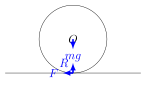
- If the ball completely stops, then \(\omega = v = 0 \Rightarrow \frac{2}{5}a \omega_0 - v_0 = 0 \Rightarrow \frac{v_0}{a \omega_0} = \frac25\).
- If the ball rolls backwards with linear speed \(v_0/7\), \(v = - \frac{v_0}{7}\) and \(a \omega = \frac{v_0}{7}\), \begin{align*} && \frac{2}{5}a \omega_0 - v_0 &= \frac{2}{5} \frac{v_0}{7} + \frac{v_0}{7} \\ && &= \frac{1}{5} v_0 \\ \Rightarrow && \frac{v_0}{a \omega_0} &= \frac{1}{3} \end{align*}
1997 Paper 3 Q11
\(\,\)
1995 Paper 3 Q9
A thin circular disc of mass \(m\), radius \(r\) and with its centre of mass at its centre \(C\) can rotate freely in a vertical plane about a fixed horizontal axis through a point \(O\) of its circumference. A particle \(P\), also of mass \(m,\) is attached to the circumference of the disc so that the angle \(OCP\) is \(2\alpha,\) where \(\alpha\leqslant\pi/2\).
- In the position of stable equilibrium \(OC\) makes an angle \(\beta\) with the vertical. Prove that \[ \tan\beta=\frac{\sin2\alpha}{2-\cos2\alpha}. \]
- The density of the disc at a point distant \(x\) from \(C\) is \(\rho x/r.\) Show that its moment of inertia about the horizontal axis through \(O\) is \(8mr^{2}/5\).
- The mid-point of \(CP\) is \(Q\). The disc is held at rest with \(OQ\) horizontal and \(C\) lower than \(P\) and it is then released. Show that the speed \(v\) with which \(C\) is moving when \(P\) passes vertically below \(O\) is given by \[ v^{2}=\frac{15gr\sin\alpha}{2(2+5\sin^{2}\alpha)}. \] Find the maximum value of \(v^{2}\) as \(\alpha\) is varied.
1993 Paper 3 Q11
In this question, all gravitational forces are to be neglected. A rigid frame is constructed from 12 equal uniform rods, each of length \(a\) and mass \(m,\) forming the edges of a cube. Three of the edges are \(OA,OB\) and \(OC,\) and the vertices opposite \(O,A,B\) and \(C\) are \(O',A',B'\) and \(C'\) respectively. Forces act along the lines as follows, in the directions indicated by the order of the letters: \begin{alignat*}{3} 2mg\mbox{ along }OA, & \qquad & mg\mbox{ along }AC', & \qquad & \sqrt{2}mg\mbox{ along }O'A,\\ \sqrt{2}mg\mbox{ along }OA', & & 2mg\mbox{ along }C'B, & & mg\mbox{ along }A'C. \end{alignat*}
- The frame is freely pivoted at \(O\). Show that the direction of the line about which it will start to rotate is $\begin{pmatrix}1\\ 1\\ 2 \end{pmatrix}$ with respect to axes along \(OA\), \(OB\) and \(OC\) respectively.
- Show that the moment of inertia of the rod \(OA\) about the axis \(OO'\) is \(2ma^2/9\) and about a parallel axis through its mid-point is \(ma^2/18\). Hence find the moment of inertia of \(B'C\) about \(OO'\) and show that the moment of inertia of the frame about \(OO'\) is \(14ma^2/3\). If the frame is freely pivoted about the line \(OO'\) and the forces continue to act along the specified lines, find the initial angular acceleration of the frame.
1993 Paper 3 Q13
\(\ \)\vspace{-1cm} \noindent