2018 Paper 3 Q10
Year: 2018
Paper: 3
Question Number: 10
Course: zNo longer examinable
Section: Moments of inertia
Problem
Solution

Examiner's report
— 2018 STEP 3, Question 10The total entry was a record number, an increase of over 6% on 2017. Only question 1 was attempted by more than 90%, although question 2 was attempted by very nearly 90%. Every question was attempted by a significant number of candidates with even the two least popular questions being attempted by 9%. More than 92% restricted themselves to attempting no more than 7 questions with very few indeed attempting more than 8. As has been normal in the past, apart from a handful of very strong candidates, those attempting six questions scored better than those attempting more than six.
Rating Information
Difficulty Rating: 1700.0
Difficulty Comparisons: 0
Banger Rating: 1484.0
Banger Comparisons: 1
Show LaTeX source
Problem source
A uniform disc with centre $O$ and radius $a$ is suspended from a point $A$ on its circumference, so that it can swing freely about a horizontal axis $L$ through $A$. The plane of the disc is perpendicular to $L$.
A particle $P$ is attached to a point on the circumference of the disc. The mass of the disc is $M$ and the mass of the particle is $m$.
In equilibrium, the disc hangs with $OP$ horizontal, and the angle between $AO$ and the downward vertical through $A$ is $\beta$.
Find $\sin\beta$ in terms of $M$ and $m$
and show that
\[
\frac{AP}{a}  = \sqrt{\frac{2M}{M+m}}
\,.
\]
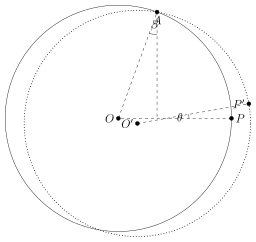
The disc is rotated about $L$  and then released. At later time $t$, the angle between $OP$ and the horizontal is $\theta$; when $P$ is higher than $O$, $\theta$ is positive and when $P$ is lower than $O$, $\theta$ is negative. Show that
\[
\tfrac12 I \dot\theta^2 + (1-\sin\beta)ma^2 \dot \theta^2
+ (m+M)g a\cos\beta \, (1- \cos\theta)
\]
is constant during the motion, where $I$ is the moment of inertia of the disc about $L$.
Given that $m= \frac 32 M$ and that $I=\frac32Ma^2$, show  that the period of small oscillations  is
\[
3\pi \sqrt{\frac {3a}{5g}}
\,.
\]
Solution source
\begin{center}
    \begin{tikzpicture}[scale=2]
        \coordinate (O) at (0,0);
        \coordinate (P) at (2,0);
        \coordinate (A) at ({2*cos(70)},{2*sin(70)});
        \coordinate (G) at ({2*cos(70)},{0});
        \draw (O) circle (2);

        \filldraw (O) circle (1pt) node [left] {$O$};
        \filldraw (P) circle (1pt) node [right] {$P$};
        \filldraw (A) circle (1pt) node [below] {$A$};
        \filldraw (G) circle (1pt) node [below] {$G$};
        % \draw (O) -- (P);

        \draw[dashed] (O) -- (A) -- (G);

        \pic [draw, angle radius=0.8cm, "$\beta$"] {angle = O--A--G};

        \draw[-latex, blue, ultra thick] (P) -- ++(0, -1) node[below] {$mg$};
        \draw[-latex, blue, ultra thick] (O) -- ++(0, -1) node[below] {$Mg$};
        \draw[-latex, blue, ultra thick] (A) -- ++(0, 1) node[above] {$(m+M)g$};


    \end{tikzpicture}
\end{center}

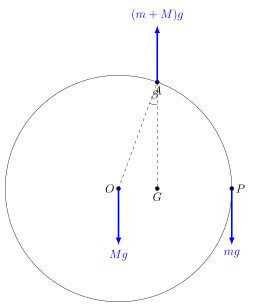
First, notice that the centre of mass will lie directly below $A$ and will be $\frac{m}{M+m}$ of the way between $O$ and $P$.

Therefore $\sin \beta  = \frac{m}{M+m}$.

The cosine rule states that:

\begin{align*}
&& AP^2 &= a^2 + a^2 - 2a^2 \cos \angle AOP \\
\Rightarrow && \frac{AP^2}{a^2} &= 2 - 2 \sin \beta \\
&&&= \frac{2M+2m-2m}{M+m} \\
&&&= \frac{2M}{M+m} \\
\Rightarrow && \frac{AP}{a} &= \sqrt{\frac{2M}{M+m}}
\end{align*}


\begin{center}
    \begin{tikzpicture}[scale=2]
        \coordinate (O) at (0,0);
        \coordinate (P) at (2,0);
        \coordinate (A) at ({2*cos(70)},{2*sin(70)});
        \coordinate (Aa) at ({2*cos(80)},{2*sin(80)});
        \coordinate (OPa) at ({2*cos(10)},{2*sin(10)});
        \coordinate (G) at ({2*cos(70)},{0});
        \coordinate (Oa) at ($(A)-(Aa)$);
        \coordinate (Pa) at ($(Oa)+(OPa)$);
        \coordinate (X) at (intersection of  O--P and Oa--Pa);

        \draw (O) circle (2);
        \draw[dotted, thick] (Oa) circle (2);


        \filldraw (O) circle (1pt) node [left] {$O$};
        \filldraw (Oa) circle (1pt) node [left] {$O'$};
        \filldraw (Pa) circle (1pt) node [left] {$P'$};
        \filldraw (P) circle (1pt) node [right] {$P$};
        \filldraw (A) circle (1pt) node [below] {$A$};
        % \filldraw (G) circle (1pt) node [below] {$G$};
        % \draw (O) -- (P);

        \draw[dashed] (P) -- (O) -- (A) -- (G);
        \draw[dashed] (Oa) -- (Pa);

        \pic [draw, angle radius=0.8cm, "$\beta$"] {angle = O--A--G};
        \pic [draw, angle radius=0.8cm, "$\theta$"] {angle = P--X--Pa};


    \end{tikzpicture}
\end{center}

Considering conservation of energy, we have:

Rotational kinetic energy for the disc: $\frac12 I \dot{\theta}^2$
Kinetic energy for the particle: $\frac12 m (\dot{\theta} \sqrt{2-2\sin \beta} a)^2 = (1- \sin \beta)ma^2 \dot{\theta}^2$


\begin{center}
    \begin{tikzpicture}[scale=2]
        \coordinate (A) at (0,0);
        \coordinate (O) at ({2*cos(250)}, {2*sin(250)});
        \coordinate (Oa) at ({2*cos(260)}, {2*sin(260)});
        \coordinate (G) at ({0}, {2*sin(250)});
        \coordinate (Gd) at ({2*abs(cos(250))*cos(10)}, {2*abs(cos(250))*sin(10)});
        \coordinate (Ga) at ($(Oa)+(Gd)$);
        \coordinate (Gc) at ($(Ga)+(0,1)$);
        \coordinate (Oc) at ($(Oa)+(1,0)$);

        \filldraw (A) circle (1pt) node [above] {$A$};
        % \filldraw (O) circle (1pt) node [left] {$O$};
        \filldraw (Oa) circle (1pt) node [left] {$O'$};
        % \filldraw (G) circle (1pt) node [right] {$G$};
        \filldraw (Ga) circle (1pt) node [right] {$G'$};

        \draw (A) -- (Oa) -- (Ga) -- cycle;
        \draw[dashed] (Ga) -- (Gc);
        \draw[dashed] (Oa) -- (Oc);

        \pic [draw, angle radius=0.8cm, "$\theta$"] {angle = Oc--Oa--Ga};
        \pic [draw, angle radius=0.8cm, "$\theta$"] {angle = Gc--Ga--A};


    \end{tikzpicture}
\end{center}

GPE: The important thing is the vertical location of $G$. The triangle $OAG$ will still have angle $\beta$ at $A$. The vertical height below is:

$\cos \theta \cdot AG = \cos \theta a \cos \beta$.

The distance from when $\theta = 0$ will be $a \cos \beta (1- \cos \theta)$ and so the GPE will be $(M+m)ga \cos \beta ( 1- \cos \theta)$ we can therefore say by conservation of energy:

\[ \frac12 I \dot{\theta}^2 + (1- \sin \beta)ma^2 \dot{\theta}^2+(M+m)ga \cos \beta ( 1- \cos \theta) \]
is constant. Suppose $m = \frac32 M$ and $I = \frac32 Ma^2$ then differentiating the constant wrt to $\theta$ gives $\sin \beta = \frac{m}{M+m} = \frac{3}{5}, \cos \beta = \frac45$

\begin{align*}
&& 0 &= \frac12 \frac32 M a^2  \cdot 2 \dot{\theta}\ddot{\theta} + (1- \sin \beta)\frac32M a^2 2 \dot{\theta}\ddot{\theta} + (M+\frac32M) ga \cos \beta \sin \theta \cdot \dot{\theta} \\
\Rightarrow && 0 &= \frac32 \ddot{\theta} + 3(1-\sin \beta) \ddot{\theta} + \frac{5}{2}\frac{g}{a} \cos \beta \sin \theta \\
&&&= (\frac32 + \frac65) \ddot{\theta} + \frac{2g}{a} \sin \theta \\
&&&= \frac{27}{10} \ddot{\theta} + \frac{2g}{a} \sin \theta
\end{align*}

If $\theta$ is small, we can approximate this by: $\frac{27}{10} \ddot{\theta} + \frac{2g}{a} \theta = 0$ which will have period $\displaystyle 2 \pi \sqrt{\frac{27a}{10\cdot2 g}} = 2 \pi \sqrt{\frac{3a}{5g}}$ as required.
9% of the candidates attempted this question, exactly as many as attempted question 13, which meant that they were the joint least popular questions. With a mean score of just over 8/20, it was slightly more successfully done than question 7. Most candidates managed to draw the correct diagram, those that did not performed poorly in the rest of the question. The majority of candidates managed to find sin and a wide variety of techniques were used to find AP, some of which led them astray due to their algebraic nature. They often struggled to justify the forms of each of the terms in the energy expression, in particular, the kinetic energy of the disc and the potential energy. In the latter case, often the zero potential energy level was not defined, too. Few were put off if their energy expression was incorrect and continued to attempt the question using either their expression or that given. Some candidates attempted to find the equation of motion by taking moments, but these solutions tended to be poor. In general, candidates struggled with the algebra and would often find their way to the solution erroneously from incorrect working.