Problems
Filters
9 problems found
2020 Paper 3 Q9
Two inclined planes \(\Pi_1\) and \(\Pi_2\) meet in a horizontal line at the lowest points of both planes and lie on either side of this line. \(\Pi_1\) and \(\Pi_2\) make angles of \(\alpha\) and \(\beta\), respectively, to the horizontal, where \(0 < \beta < \alpha < \frac{1}{2}\pi\). A uniform rigid rod \(PQ\) of mass \(m\) rests with \(P\) lying on \(\Pi_1\) and \(Q\) lying on \(\Pi_2\) so that the rod lies in a vertical plane perpendicular to \(\Pi_1\) and \(\Pi_2\) with \(P\) higher than \(Q\).
- It is given that both planes are smooth and that the rod makes an angle \(\theta\) with the horizontal. Show that \(2\tan\theta = \cot\beta - \cot\alpha\).
- It is given instead that \(\Pi_1\) is smooth, that \(\Pi_2\) is rough with coefficient of friction \(\mu\) and that the rod makes an angle \(\phi\) with the horizontal. Given that the rod is in limiting equilibrium, with \(P\) about to slip down the plane \(\Pi_1\), show that \[ \tan\theta - \tan\phi = \frac{\mu}{(\mu + \tan\beta)\sin 2\beta} \] where \(\theta\) is the angle satisfying \(2\tan\theta = \cot\beta - \cot\alpha\).
2017 Paper 1 Q11
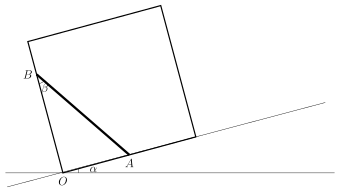
A plane makes an acute angle \(\alpha\) with the horizontal. A box in the shape of a cube is fixed onto the plane in such a way that four of its edges are horizontal and two of its sides are vertical. A uniform rod of length \(2L\) and weight \(W\) rests with its lower end at \(A\) on the bottom of the box and its upper end at \(B\) on a side of the box, as shown in the diagram below. The vertical plane containing the rod is parallel to the vertical sides of the box and cuts the lowest edge of the box at \(O\). The rod makes an acute angle~\(\beta\) with the side of the box at \(B\). The coefficients of friction between the rod and the box at the two points of contact are both \(\tan \gamma\), where \(0 < \gamma < \frac12\pi\). %The frictional force on the rod at \(A\) acts toward \(O\), %and the frictional force on the rod at~\(B\) %acts away from \(O\). The rod is in limiting equilibrium, with the end at \(A\) on the point of slipping in the direction away from \(O\) and the end at \(B\) on the point of slipping towards \(O\). Given that \(\alpha < \beta\), show that \(\beta = \alpha + 2\gamma\). [\(Hint\): You may find it helpful to take moments about the midpoint of the rod.]
Solution:

2016 Paper 1 Q9
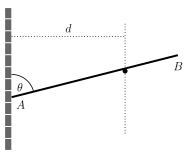
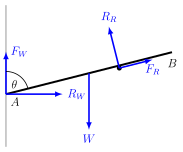
A horizontal rail is fixed parallel to a vertical wall and at a distance \(d\) from the wall. A uniform rod \(AB\) of length \(2a\) rests in equilibrium on the rail with the end \(A\) in contact with the wall. The rod lies in a vertical plane perpendicular to the wall. It is inclined at an angle \(\theta\) to the vertical (where \(0 < \theta < \frac12\pi\)) and \(a\sin\theta < d\), as shown in the diagram.
Solution:
2014 Paper 2 Q9
A uniform rectangular lamina \(ABCD\) rests in equilibrium in a vertical plane with the \(A\) in contact with a rough vertical wall. The plane of the lamina is perpendicular to the wall. It is supported by a light inextensible string attached to the side \(AB\) at a distance \(d\) from \(A\). The other end of the string is attached to a point on the wall above \(A\) where it makes an acute angle \(\theta\) with the downwards vertical. The side \(AB\) makes an acute angle \(\phi\) with the upwards vertical at \(A\). The sides \(BC\) and \(AB\) have lengths \(2a\) and \(2b\) respectively. The coefficient of friction between the lamina and the wall is \(\mu\).
- Show that, when the lamina is in limiting equilibrium with the frictional force acting upwards, \begin{equation} d\sin(\theta +\phi) = (\cos\theta +\mu \sin\theta)(a\cos\phi +b\sin\phi)\,. \tag{\(*\)} \end{equation}
- How should \((*)\) be modified if the lamina is in limiting equilibrium with the frictional force acting downwards?
- Find a condition on \(d\), in terms of \(a\), \(b\), \(\tan\theta\) and \(\tan\phi\), which is necessary and sufficient for the frictional force to act upwards. Show that this condition cannot be satisfied if \(b(2\tan\theta+ \tan \phi) < a\).
Solution:
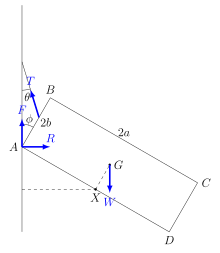
- \begin{align*} \text{N2}(\uparrow): && T \cos \theta + F -W &= 0 \\ && W &= T\cos \theta + \mu R \tag{1} \\ \text{N2}(\rightarrow): && R-T\sin \theta &= 0 \\ && R &= T \sin \theta \tag{2}\\ \\ (1)+(2): && W&=(\cos \theta + \mu \sin \theta)T \tag{3} \\ \overset{\curvearrowright}{A}: && 0 &= W(b\sin \phi + a \cos \phi) - Td\sin(\phi+\theta) \tag{4} \\ \\ (3)+(4): && 0 &= (\cos \theta + \mu \sin \theta)(b\sin \phi + a \cos \phi)-d\sin(\phi+\theta) \\ \Rightarrow && d\sin(\phi+\theta) &= (\cos \theta + \mu \sin \theta)(b\sin \phi + a \cos \phi) \end{align*} as required.
- If \(F\) is operating downwards, it's equivalent to \(-\mu\), ie: \[d\sin(\phi+\theta) = (\cos \theta - \mu \sin \theta)(b\sin \phi + a \cos \phi)\]
- For the frictional force to be acting upwards, we need \begin{align*} && d\sin(\phi+\theta) &\geq \cos \theta(b\sin \phi + a \cos \phi) \\ \Rightarrow && d &\geq \frac{\cos \theta(b\sin \phi + a \cos \phi)}{\sin(\phi + \theta)} \\ &&&= \frac{\cos \theta(b\sin \phi + a \cos \phi)}{\sin\phi \cos\theta+\cos\phi\sin \theta)}\\ &&&= \frac{(b\sin \phi + a \cos \phi)}{\sin\phi+\cos \phi \tan \theta)}\\ &&&= \frac{a+b\tan \phi}{\tan\theta+\tan\phi }\\ \end{align*} We know that \(d < 2b\), so \begin{align*} && 2b &>\frac{a+b\tan \phi}{\tan\theta+\tan\phi }\\ \Rightarrow && 2b \tan \theta + 2b \tan \phi &> a + b \tan \phi \\ \Rightarrow &&b(2 \tan \theta + \tan \phi) &> a\\ \end{align*} Therefore we will have problems if the inequality is reversed!
2010 Paper 1 Q9

Solution:


2008 Paper 1 Q11
A straight uniform rod has mass \(m\). Its ends \(P_1\) and \(P_2\) are attached to small light rings that are constrained to move on a rough rigid circular wire with centre \(O\) fixed in a vertical plane, and the angle \(P_1OP_2\) is a right angle. The rod rests with \(P_1\) lower than \(P_2\), and with both ends lower than \(O\). The coefficient of friction between each of the rings and the wire is \(\mu\). Given that the rod is in limiting equilibrium (i.e. \ on the point of slipping at both ends), show that \[ \tan \alpha = \frac{1-2\mu -\mu^2}{1+2\mu -\mu^2}\,, \] where \(\alpha\) is the angle between \(P_1O\) and the vertical (\(0<\alpha<45^\circ\)). Let \(\theta\) be the acute angle between the rod and the horizontal. Show that \(\theta =2\lambda\), where \(\lambda \) is defined by \(\tan \lambda= \mu\) and \(0<\lambda<22.5^\circ\).
2002 Paper 2 Q11
A rigid straight beam \(AB\) has length \(l\) and weight \(W\). Its weight per unit length at a distance \(x\) from \(B\) is \(\alpha Wl^{-1} (x/l)^{\alpha-1}\,\), where \(\alpha\) is a positive constant. Show that the centre of mass of the beam is at a distance \(\alpha l/(\alpha+1)\) from \(B\). The beam is placed with the end \(A\) on a rough horizontal floor and the end \(B\) resting against a rough vertical wall. The beam is in a vertical plane at right angles to the plane of the wall and makes an angle of \(\theta\) with the floor. The coefficient of friction between the floor and the beam is \(\mu\) and the coefficient of friction between the wall and the beam is also \(\mu\,\). Show that, if the equilibrium is limiting at both \(A\) and \(B\), then \[ \tan\theta = \frac{1-\alpha \mu^2}{(1+\alpha)\mu}\;. \] Given that \(\alpha =3/2\,\) and given also that the beam slides for any \(\theta<\pi/4\,\) find the greatest possible value of \(\mu\,\).
1992 Paper 1 Q12
The diagram shows a crude step-ladder constructed by smoothly hinging-together two light ladders \(AB\) and \(AC,\) each of length \(l,\) at \(A\). A uniform rod of wood, of mass \(m\), is pin-jointed to \(X\) on \(AB\) and to \(Y\) on \(AC\), where \(AX=\frac{3}{4}l=AY.\) The angle \(\angle XAY\) is \(2\theta.\) \noindent
1987 Paper 2 Q11
A rough ring of radius \(a\) is fixed so that it lies in a plane inclined at an angle \(\alpha\) to the horizontal. A uniform heavy rod of length \(b(>a)\) has one end smoothly pivoted at the centre of the ring, so that the rod is free to move in any direction. It rests on the circumference of the ring, making an angle \(\theta\) with the radius to the highest point on the circumference. Find the relation between \(\alpha,\theta\) and the coefficient of friction, \(\mu,\) which must hold when the rod is in limiting equilibrium.
Solution:

- The mass of the rod
- The reaction where it meets the ring
- The friction at the ring