Problems
Filters
12 problems found
2021 Paper 3 Q10
The origin \(O\) of coordinates lies on a smooth horizontal table and the \(x\)- and \(y\)-axes lie in the plane of the table. A cylinder of radius \(a\) is fixed to the table with its axis perpendicular to the \(x\)--\(y\) plane and passing through \(O\), and with its lower circular end lying on the table. One end, \(P\), of a light inextensible string \(PQ\) of length \(b\) is attached to the bottom edge of the cylinder at \((a, 0)\). The other end, \(Q\), is attached to a particle of mass \(m\), which rests on the table. Initially \(PQ\) is straight and perpendicular to the radius of the cylinder at \(P\), so that \(Q\) is at \((a, b)\). The particle is then given a horizontal impulse parallel to the \(x\)-axis so that the string immediately begins to wrap around the cylinder. At time \(t\), the part of the string that is still straight has rotated through an angle \(\theta\), where \(a\theta < b\).
- Obtain the Cartesian coordinates of the particle at this time. Find also an expression for the speed of the particle in terms of \(\theta\), \(\dot{\theta}\), \(a\) and \(b\).
- Show that \[ \dot{\theta}(b - a\theta) = u, \] where \(u\) is the initial speed of the particle.
- Show further that the tension in the string at time \(t\) is \[ \frac{mu^2}{\sqrt{b^2 - 2aut}}. \]
Solution:
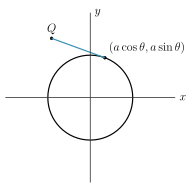
- The line to the circle is tangent, and the point it meets the circle is \((a \cos \theta, a \sin \theta)\) and it will be a distance \(b - a \theta\) away, therefore it is at \((a \cos \theta - (b-a \theta) \sin \theta, a \sin \theta + (b-a \theta) \cos \theta)\)
- The velocity will be \(\displaystyle \binom{-a \dot{\theta}\sin \theta-b \dot{\theta}\cos \theta + a \dot{\theta} \sin \theta + a \theta \dot{\theta} \cos \theta}{ a \dot{\theta} \cos \theta - b \dot{\theta} \sin \theta -a \dot{\theta} \cos \theta + a \theta \dot{\theta} \sin \theta}= \binom{-b \dot{\theta}\cos \theta + a \theta \dot{\theta} \cos \theta}{ - b \dot{\theta} \sin \theta + a \theta \dot{\theta} \sin \theta}\) Therefore the speed will be \(\dot{\theta}(b-a\theta)\)
- Conservation of energy and the fact that the tension is perpendicular to the velocity means no work is being done on the particle and hence it's speed is unchanged. So \(u = \dot{\theta}(b-a\theta)\).
- Note that the acceleration is \begin{align*} && \mathbf{a} &= \frac{\d}{\d t} \left (-\dot{\theta}(b-a\theta) \binom{\cos \theta}{\sin \theta} \right) \\ &&&=-u \dot{\theta}\binom{-\sin \theta}{\cos \theta} \\ \Rightarrow && T &= ma \\ &&&= \frac{mu^2}{b - a \theta} \end{align*} It would be valuable to have \(\theta\) in terms of \(t\), so we want to solve \begin{align*} &&\frac{\d \theta}{\d t} (b-a\theta) &= u \\ \Rightarrow && b \theta - a\frac{\theta^2}{2} + C &= ut \\ t = 0, \theta = 0: && C &= 0 \\ \Rightarrow && b\theta - \frac{a}{2} \theta^2 &= ut \\ \Rightarrow && \theta &= \frac{b \pm \sqrt{b^2-2aut}}{a} \end{align*} At \(t\) increases, \(\theta\) increases so \(a\theta = b -\sqrt{b^2-2aut}\) or \(b-a \theta = \sqrt{b^2-2aut}\) and the result follows
2015 Paper 2 Q11
Three particles, \(A\), \(B\) and \(C\), each of mass \(m\), lie on a smooth horizontal table. Particles \(A\) and \(C\) are attached to the two ends of a light inextensible string of length \(2a\) and particle \(B\) is attached to the midpoint of the string. Initially, \(A\), \(B\) and \(C\) are at rest at points \((0,a)\), \((0,0)\) and \((0,-a)\), respectively. An impulse is delivered to \(B\), imparting to it a speed \(u\) in the positive \(x\) direction. The string remains taut throughout the subsequent motion.
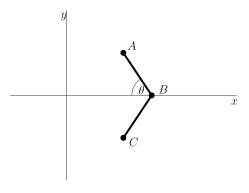
- At time \(t\), the angle between the \(x\)-axis and the string joining \(A\) and \(B\) is \(\theta\), as shown in the diagram, and \(B\) is at \((x,0)\). Write down the coordinates of \(A\) in terms of \(x,a\) and \(\theta\). Given that the velocity of \(B\) is \((v,0)\), show that the velocity of \(A\) is \((\dot x + a\sin\theta \,\dot \theta\,,\, a\cos\theta\, \dot\theta)\), where the dot denotes differentiation with respect to time.
- Show that, before particles \(A\) and \(C\) first collide, \[ 3\dot x + 2a \dot\theta \sin\theta =u \text{ and } \dot \theta^2 = \frac{u^2}{a^2(3-2\sin^2\theta)} \,. \]
- When \(A\) and \(C\) collide, the collision is elastic (no energy is lost). At what value of \(\theta\) does the second collision between particles \(A\) and \(C\) occur? (You should justify your answer.)
- When \(v=0\), what are the possible values of \(\theta\)? Is \(v =0\) whenever \(\theta\) takes these values?
Solution:
- \(A\) has coordinates \((x-a\cos \theta, a\sin \theta)\). Differentiating with respect to \(t\) the velocity of \(A\) is \((\dot{x}+a\sin \theta \cdot \dot{\theta}, a \cos \theta \cdot \dot{\theta})\)
- By considervation of momentum \(\rightarrow\) we must have \(mu = m(\dot{x}+a\dot{\theta}\sin \theta) + m\dot{x} + m(\dot{x}+a\dot{\theta}\sin \theta) = m(3\dot{x} + 2a \dot{\theta} \sin \theta)\) and the first equation follows. By conservation of energy, we must have \begin{align*} && \frac12 m u^2 &= \frac12 m \dot{x}^2 + \frac12m((\dot{x}+a\dot{\theta}\sin \theta)^2 + a^2 \dot{\theta}^2 \cos^2\theta ) + \frac12m((\dot{x}+a\dot{\theta}\sin \theta)^2 + a^2 \dot{\theta}^2 \cos^2\theta ) \\ &&&= \frac32m\dot{x}^2 + 2m a\dot{x}\dot{\theta}\sin \theta + ma^2\dot{\theta}^2(\sin^2\theta+\cos^2\theta) \\ \Rightarrow && u^2 &= \dot{x}(3\dot{x} + 4a \dot{\theta} \sin \theta) + 2a^2\dot{\theta}^2 \\ &&&= \left ( \frac{u-2a\dot{\theta}\sin \theta}{3}\right)\left ( 3\left ( \frac{u-2a\dot{\theta}\sin \theta}{3}\right)+ 4a \dot{x}\dot{\theta} \sin \theta \right) + 2a^2\dot{\theta}^2 \\ \Rightarrow && 3u^2 &= (u - 2a\dot{\theta} \sin \theta)^2 + 4a(u - 2 a \dot{\theta} \sin \theta) \dot{\theta}\sin \theta + 6a^2 \dot{\theta}^2 \\ &&&= u^2 + 4a^2\dot{\theta}^2 \sin^2 \theta - 8a^2\dot{\theta}^2\sin^2\theta + 6a^2 \dot{\theta}^2 \\ \Rightarrow && \dot{\theta}^2 &= \frac{u^2}{a^2(3-2\sin^2\theta)} \end{align*}
- Since \(\dot{\theta}^2 > 0\) \(\theta\) is strictly increasing or decreasing, therefore the first collision will be when \(\theta = 0\), the second when \(\theta = \pi\)
- If \(v = 0\), from our first equation we have \(2a \dot{\theta} \sin \theta = u \Rightarrow \dot{\theta}^2 = \frac{u^2}{4a^2 \sin^2 \theta} = \frac{u^2}{a^2(3-2\sin^2\theta)}\) so \(4\sin^2 \theta = 3 - 2\sin^2 \theta \Rightarrow \sin^2 \theta = \frac{1}{2}\) therefore the angles are all the multiples of \(\frac{\pi}{4}\).
2014 Paper 2 Q11
A small smooth ring \(R\) of mass \(m\) is free to slide on a fixed smooth horizontal rail. A light inextensible string of length~\(L\) is attached to one end,~\(O\), of the rail. The string passes through the ring, and a particle~\(P\) of mass~\(km\) (where \(k>0\)) is attached to its other end; this part of the string hangs at an acute angle \(\alpha\) to the vertical and it is given that \(\alpha\) is constant in the motion. Let \(x\) be the distance between \(O\) and the ring. Taking the \(y\)-axis to be vertically upwards, write down the Cartesian coordinates of~\(P\) relative to~\(O\) in terms of \(x\), \(L\) and~\(\alpha\).
- By considering the vertical component of the equation of motion of \(P\), show that \[ km\ddot x \cos\alpha = T \cos\alpha - kmg\,, \] where \(T\) is the tension in the string. Obtain two similar equations relating to the horizontal components of the equations of motion of \(P\) and \(R\).
- Show that \(\dfrac {\sin\alpha}{(1-\sin\alpha)^2_{\vphantom|}} = k\), and deduce, by means of a sketch or otherwise, that motion with \(\alpha\) constant is possible for all values of~\(k\).
- Show that \(\ddot x = -g\tan\alpha\,\).
2011 Paper 2 Q10
A particle is projected from a point on a horizontal plane, at speed \(u\) and at an angle~\(\theta\) above the horizontal. Let \(H\) be the maximum height of the particle above the plane. Derive an expression for \(H\) in terms of \(u\), \(g\) and \(\theta\). A particle \(P\) is projected from a point \(O\) on a smooth horizontal plane, at speed \(u\) and at an angle~\(\theta\) above the horizontal. At the same instant, a second particle \(R\) is projected horizontally from \(O\) in such a way that \(R\) is vertically below \(P\) in the ensuing motion. A light inextensible string of length \(\frac12 H\) connects \(P\) and \(R\). Show that the time that elapses before the string becomes taut is \[ (\sqrt2 -1)\sqrt{H/g\,}\,. \] When the string becomes taut, \(R\) leaves the plane, the string remaining taut. Given that \(P\) and \(R\) have equal masses, determine the total horizontal distance, \(D\), travelled by \(R\) from the moment its motion begins to the moment it lands on the plane again, giving your answer in terms of \(u\), \(g\) and \(\theta\). Given that \(D=H\), find the value of \(\tan\theta\).
2006 Paper 3 Q9
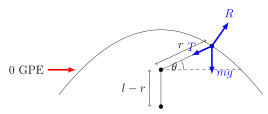
A long, light, inextensible string passes through a small, smooth ring fixed at the point \(O\). One end of the string is attached to a particle \(P\) of mass \(m\) which hangs freely below \(O\). The other end is attached to a bead, \(B\), also of mass \(m\), which is threaded on a smooth rigid wire fixed in the same vertical plane as \(O\). The distance \(OB\) is \(r\), the distance \(OH\) is \(h\) and the height of the bead above the horizontal plane through~\(O\) is \(y\), as shown in the diagram.
2003 Paper 2 Q10
A bead \(B\) of mass \(m\) can slide along a rough horizontal wire. A light inextensible string of length \(2\ell\) has one end attached to a fixed point \(A\) of the wire and the other to \(B\,\). A particle \(P\) of mass \(3m\) is attached to the mid-point of the string and \(B\) is held at a distance \(\ell\) from~\(A\,\). The bead is released from rest. Let \(a_1\) and \(a_2\) be the magnitudes of the horizontal and vertical components of the initial acceleration of \(P\,\). Show by considering the motion of \(P\) relative to \(A\,\), or otherwise, that \(a_1= \sqrt 3 a_2\,\). Show also that the magnitude of the initial acceleration of \(B\) is \(2a_1\,\). Given that the frictional force opposing the motion of \(B\) is equal to \(({\sqrt{3}}/6)R\), where \(R\) is the normal reaction between \(B\) and the wire, show that the magnitude of the initial acceleration of \(P\) is~\(g/18\,\).
2000 Paper 2 Q10
A long light inextensible string passes over a fixed smooth light pulley. A particle of mass 4~kg is attached to one end \(A\) of this string and the other end is attached to a second smooth light pulley. A long light inextensible string \(BC\) passes over the second pulley and has a particle of mass 2 kg attached at \(B\) and a particle of mass of 1 kg attached at \(C\). The system is held in equilibrium in a vertical plane. The string \(BC\) is then released from rest. Find the accelerations of the two moving particles. After \(T\) seconds, the end \(A\) is released so that all three particles are now moving in a vertical plane. Find the accelerations of \(A\), \(B\) and \(C\) in this second phase of the motion. Find also, in terms of \(g\) and \(T\), the speed of \(A\) when \(B\) has moved through a total distance of \(0.6gT^{2}\)~metres.
1993 Paper 3 Q14
A particle rests at a point \(A\) on a horizontal table and is joined to a point \(O\) on the table by a taut inextensible string of length \(c\). The particle is projected vertically upwards at a speed \(64\surd(6gc)\). It next strikes the table at a point \(B\) and rebounds. The coefficient of restitution for any impact between the particle and the table is \({1\over 2}\). After rebounding at \(B\), the particle will rebound alternately at \(A\) and \(B\) until the string becomes slack. Show that when the string becomes slack the particle is at height \(c/2\) above the table. Determine whether the first rebound between \(A\) and \(B\) is nearer to \(A\) or to \(B\).
Solution: \begin{align*} \text{N2}(radially): && T + mg \cos \theta &= m\frac{v^2}{r} \\ \Rightarrow && v^2-gc \cos \theta &\geq 0 \\ \text{COE}: && \frac12 m u^2 &= \frac12mv^2 + mgc\cos \theta \\ \Rightarrow && u^2 &= v^2 + 2gc\cos \theta \\ && u^2 &\geq gc \cos \theta+2gc\cos \theta \\ \Rightarrow && u^2 &\geq 3gc\cos \theta \end{align*} Therefore it will complete bounces with the string taught if it leaves the table with \(u^2 \geq 3gc\). After \(6\) bounces it will leave the table with speed \(\sqrt{6gc} > \sqrt{3gc}\) and after \(7\) bounces it will leave the table with speed \(\sqrt{\frac{3}{2} gc} < \sqrt{3 gc}\). When it leaves the table with speed \(\sqrt{\tfrac32 gc}\), the string will go slack when \begin{align*} && \tfrac32 gc &= 3gc \cos \theta \\ \Rightarrow && \cos \theta &= \frac{1}{2} \end{align*} ie at a height \(c\cos \theta = \frac12c\) above the table. Once the string goes slack, the particle travels under circular motion, \begin{align*} && u^2 &= \frac12 gc \\ \Rightarrow && u_\rightarrow &= \sqrt{\tfrac12 gc} \cos \theta \\ && u_{\uparrow} &= \sqrt{\tfrac12 gc} \sin \theta \\ \Rightarrow && s &= ut - \tfrac12 gt^2 \\ \Rightarrow && -\frac{c}{2} &= \sqrt{\tfrac12 gc} \frac{\sqrt{3}}{2} t - \tfrac12 g t^2 \\ \Rightarrow && t &= \sqrt{\frac{c}{g}} \left ( \frac{\sqrt{6}+\sqrt{22}}{4} \right) \\ \Rightarrow && s_{\rightarrow} &= \tfrac12 \sqrt{\tfrac12 gc} \sqrt{\frac{c}{g}} \left ( \frac{\sqrt{6}+\sqrt{22}}{4} \right) - \frac{\sqrt{3}}{2}c \\ &&&= \left ( \frac{\sqrt{11}-3\sqrt{3}}{8} \right)c \\ \end{align*} We need to establish whether this position is positive or negative (ie if we cross the centre line. Clearly \(\sqrt{11} < 3\sqrt{3}\) so we haven't crossed the centre line and we land closer to where we took off. Since it's the 7th take off, this is closer to \(B\).
1992 Paper 2 Q13
Two particles \(P_{1}\) and \(P_{2}\), each of mass \(m\), are joined by a light smooth inextensible string of length \(\ell.\) \(P_{1}\) lies on a table top a distance \(d\) from the edge, and \(P_{2}\) hangs over the edge of the table and is suspended a distance \(b\) above the ground. The coefficient of friction between \(P_{1}\) and the table top is \(\mu,\) and \(\mu<1\). The system is released from rest. Show that \(P_{1}\) will fall off the edge of the table if and only if \[ \mu<\frac{b}{2d-b}. \] Suppose that \(\mu>b/(2d-b)\) , so that \(P_{1}\) comes to rest on the table, and that the coefficient of restitution between \(P_{2}\) and the floor is \(e\). Show that, if \(e>1/(2\mu),\) then \(P_{1}\) comes to rest before \(P_{2}\) bounces a second time.
1992 Paper 2 Q14
\noindent
1988 Paper 2 Q11
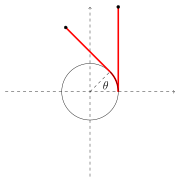
A heavy particle lies on a smooth horizontal table, and is attached to one end of a light inextensible string of length \(L\). The other end of the string is attached to a point \(P\) on the circumference of the base of a vertical post which is fixed into the table. The base of the post is a circle of radius \(a\) with its centre at a point \(O\) on the table. Initially, at time \(t=0\), the string is taut and perpendicular to the line \(OP.\) The particle is then struck in such a way that the string starts winding round the post and remains taut. At a later time \(t\), a length \(a\theta(t)\ (< L)\) of the string is in contact with the post. Using cartesian axes with origin \(O\), find the position and velocity vectors of the particle at time \(t\) in terms of \(a,L,\theta\) and \(\dot{\theta},\) and hence show that the speed of the particle is \((L-a\theta)\dot{\theta}.\) If the initial speed of the particle is \(v\), show that the particle hits the post at a time \(L^{2}/(2av).\)
Solution:
1987 Paper 2 Q12
A long, inextensible string passes through a small fixed ring. One end of the string is attached to a particle of mass \(m,\) which hangs freely. The other end is attached to a bead also of mass \(m\) which is threaded on a smooth rigid wire fixed in the same vertical plane as the ring. The curve of the wire is such that the system can be in static equilibrium for all positions of the bead. The shortest distance between the wire and the ring is \(d(>0).\) Using plane polar coordinates centred on the ring, find the equation of the curve. The bead is set in motion. Assuming that the string remains taut, show that the speed of the bead when it is a distance \(r\) from the ring is \[ \left(\frac{r}{2r-d}\right)^{\frac{1}{2}}v, \] where \(v\) is the speed of the bead when \(r=d.\)
Solution: