Problems
Filters
29 problems found
2025 Paper 3 Q4
- \(x_2\) and \(y_2\) are defined in terms of \(x_1\) and \(y_1\) by the equation $$\begin{pmatrix} x_2 \\ y_2 \end{pmatrix} = \begin{pmatrix} \frac{1}{\sqrt{2}} & -\frac{1}{\sqrt{2}} \\ \frac{1}{\sqrt{2}} & \frac{1}{\sqrt{2}} \end{pmatrix} \begin{pmatrix} x_1 \\ y_1 \end{pmatrix}$$ \(G_1\) is the graph with equation $$\frac{x^2}{9} + \frac{y^2}{4} = 1$$ and \(G_2\) is the graph with equation $$\frac{\left(\frac{x}{\sqrt{2}} + \frac{y}{\sqrt{2}}\right)^2}{9} + \frac{\left(-\frac{x}{\sqrt{2}} + \frac{y}{\sqrt{2}}\right)^2}{4} = 1$$ Show that, if \((x_1, y_1)\) is a point on \(G_1\), then \((x_2, y_2)\) is a point on \(G_2\). Show that \(G_2\) is an anti-clockwise rotation of \(G_1\) through \(45^\circ\) about the origin.
- The matrix $$\begin{pmatrix} -0.6 & 0.8 \\ 0.8 & 0.6 \end{pmatrix}$$ represents a reflection. Find the line of invariant points of this matrix.
- Sketch, on the same axes, the graphs with equations $$y = 2^x \text{ and } 0.8x + 0.6y = 2^{-0.6x+0.8y}$$
- Sketch, on the same axes, for \(0 \leq x \leq 2\pi\), the graphs with equations $$y = \sin x \text{ and } y = \sin(x - 2y)$$ You should determine the exact co-ordinates of the points on the graph with equation \(y = \sin(x - 2y)\) where the tangent is horizontal and those where it is vertical.
Solution:
- Suppose \begin{align*} && \begin{pmatrix} x_2 \\ y_2 \end{pmatrix} &= \begin{pmatrix} \frac{1}{\sqrt{2}} & -\frac{1}{\sqrt{2}} \\ \frac{1}{\sqrt{2}} & \frac{1}{\sqrt{2}} \end{pmatrix} \begin{pmatrix} x_1 \\ y_1 \end{pmatrix} \\ \Rightarrow && \binom{x_1}{y_1} &= \begin{pmatrix} \frac{1}{\sqrt{2}} & \frac{1}{\sqrt{2}} \\ -\frac{1}{\sqrt{2}} & \frac{1}{\sqrt{2}} \end{pmatrix} \binom{x_2}{y_2} \end{align*} Therefore if \(\frac{x_1^2}9+\frac{y_1^2}{4} = 1\) we must have \begin{align*} \frac{(\frac{x_2}{\sqrt{2}}+\frac{y_2}{\sqrt{2}})^2 }{9} + \frac{(-\frac{x_2}{\sqrt{2}}+\frac{y_2}{\sqrt{2}})^2}{4} = 1 \end{align*} but this is precisely the statement that \((x_1, y_1)\) is on \(G_1\) is equivalent to \((x_2,y_2)\) being on the \(G_2\). Since the point \((x_2,y_2)\) is a \(45^{\circ}\) rotation of \((x_1,y_1)\) anticlockwise about the origin, this means \(G_2\) is a \(45^{\circ}\) anticlockwise rotation of \(G_1\).
- \begin{align*} && \begin{pmatrix} -0.6 & 0.8 \\ 0.8 & 0.6 \end{pmatrix} \begin{pmatrix} x \\ y \end{pmatrix} &= \begin{pmatrix} x \\ y \end{pmatrix} \\ \Rightarrow && \begin{pmatrix} -0.6 x + 0.8y \\ 0.8x + 0.6y \end{pmatrix} &= \begin{pmatrix} x \\ y \end{pmatrix} \\ \Rightarrow && \begin{pmatrix} -1.6 x + 0.8y \\ 0.8x -0.4y \end{pmatrix} &= \begin{pmatrix} 0 \\ 0 \end{pmatrix} \\ \Rightarrow && y &=2 x \end{align*}

- Consider the transformation \(\begin{pmatrix} 1 & 2 \\ 0 & 1 \end{pmatrix}\) which is a shear, leaving the \(x\)-axis invariant. Then we must have:
Since the shear leaves lines of the form \(y = k\) invariant, the points where \(\frac{\d y}{\d x} = 0\) must also map to points where this is true, ie \((\tfrac{\pi}{2}, 1), (\tfrac{3\pi}{2}, -1)\) map to points \((\tfrac{\pi}{2}+2,1), (\tfrac{3\pi}{2} -2,-1)\) where the tangent is horizontal. The line \(x = c\) map back to lines \(\begin{pmatrix} 1 & -2 \\ 0 & 1\end{pmatrix} \begin{pmatrix} c \\ t\end{pmatrix} = \begin{pmatrix}c - 2t \\ t \end{pmatrix}\), ie \(y = -\frac12 x- \frac{c}{2}\). Therefore we are interested in points on the original curve where the gradient is \(-\frac12\), ie \((\frac{2\pi}{3}, \frac{\sqrt{3}}{2}), (\frac{4\pi}{3}, -\frac{\sqrt{3}}{2})\), these map to \((\frac{2\pi}{3}+\sqrt{3},\frac{\sqrt{3}}{2}), (\frac{4\pi}{3}-\sqrt{3}, -\frac{\sqrt{3}}{2})\)

2022 Paper 2 Q6
In this question, you should consider only points lying in the first quadrant, that is with \(x > 0\) and \(y > 0\).
- The equation \(x^2 + y^2 = 2ax\) defines a \emph{family} of curves in the first quadrant, one curve for each positive value of \(a\). A second family of curves in the first quadrant is defined by the equation \(x^2 + y^2 = 2by\), where \(b > 0\).
- Differentiate the equation \(x^2 + y^2 = 2ax\) implicitly with respect to \(x\), and hence show that every curve in the first family satisfies the differential equation \[2xy\frac{\mathrm{d}y}{\mathrm{d}x} = y^2 - x^2.\] Find similarly a differential equation, independent of \(b\), for the second family of curves.
- Hence, or otherwise, show that, at every point with \(y \neq x\) where a curve in the first family meets a curve in the second family, the tangents to the two curves are perpendicular. A curve in the first family meets a curve in the second family at \((c,\,c)\), where \(c > 0\). Find the equations of the tangents to the two curves at this point. Is it true that where a curve in the first family meets a curve in the second family on the line \(y = x\), the tangents to the two curves are perpendicular?
- Given the family of curves in the first quadrant \(y = c\ln x\), where \(c\) takes any non-zero value, find, by solving an appropriate differential equation, a second family of curves with the property that at every point where a curve in the first family meets a curve in the second family, the tangents to the two curves are perpendicular.
- A family of curves in the first quadrant is defined by the equation \(y^2 = 4k(x + k)\), where \(k\) takes any non-zero value. Show that, at every point where one curve in this family meets a second curve in the family, the tangents to the two curves are perpendicular.
2022 Paper 3 Q3
- The curve \(C_1\) has equation \[ ax^2 + bxy + cy^2 = 1 \] where \(abc \neq 0\) and \(a > 0\). Show that, if the curve has two stationary points, then \(b^2 < 4ac\).
- The curve \(C_2\) has equation \[ ay^3 + bx^2y + cx = 1 \] where \(abc \neq 0\) and \(b > 0\). Show that the \(x\)-coordinates of stationary points on this curve satisfy \[ 4cb^3 x^4 - 8b^3 x^3 - ac^3 = 0\,. \] Show that, if the curve has two stationary points, then \(4ac^6 + 27b^3 > 0\).
- Consider the simultaneous equations \begin{align*} ay^3 + bx^2 y + cx &= 1 \\ 2bxy + c &= 0 \\ 3ay^2 + bx^2 &= 0 \end{align*} where \(abc \neq 0\) and \(b > 0\). Show that, if these simultaneous equations have a solution, then \(4ac^6 + 27b^3 = 0\).
2021 Paper 3 Q1
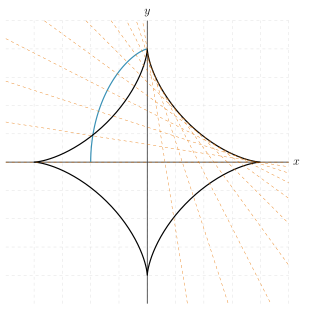
- A curve has parametric equations \[ x = -4\cos^3 t, \qquad y = 12\sin t - 4\sin^3 t. \] Find the equation of the normal to this curve at the point \[ \bigl(-4\cos^3\phi,\; 12\sin\phi - 4\sin^3\phi\bigr), \] where \(0 < \phi < \tfrac{1}{2}\pi\). Verify that this normal is a tangent to the curve \[ x^{2/3} + y^{2/3} = 4 \] at the point \((8\cos^3\phi,\; 8\sin^3\phi)\).
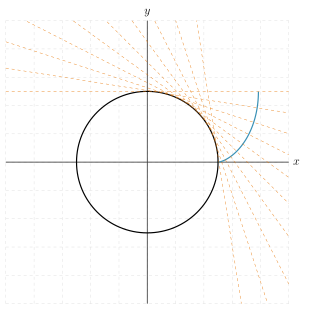
- A curve has parametric equations \[ x = \cos t + t\sin t, \qquad y = \sin t - t\cos t. \] Find the equation of the normal to this curve at the point \[ \bigl(\cos\phi + \phi\sin\phi,\; \sin\phi - \phi\cos\phi\bigr), \] where \(0 < \phi < \tfrac{1}{2}\pi\). Determine the perpendicular distance from the origin to this normal, and hence find the equation of a curve, independent of \(\phi\), to which this normal is a tangent.
Solution:
- \(\,\) \begin{align*}
&& \dot{x} &=12 \cos^2 t \sin t \\
&& \dot{y} &= 12 \cos t - 12 \sin^2 t \cos t \\
&& \frac{\d y}{\d x} &= \frac{12 \cos t - 12 \sin^2 t \cos t}{12 \cos^2 t \sin t} \\
&&&= \frac{1 - \sin^2 t}{\cos t \sin t} \\
&&&= \cot t \\
\\
&& \frac{y - (12\sin\phi - 4\sin^3\phi)}{x - (-4 \cos^3 \phi)} &= - \tan \phi \\
&& y &= -\tan \phi x -4 \cos^3 \phi \tan \phi + 12 \sin \phi -4\sin^3 \phi \\
&&&= -\tan \phi x -4 \cos^2 \phi \sin \phi + 12 \sin \phi -4\sin^3 \phi \\
&&&= -\tan \phi x - 4\sin \phi+12 \sin \phi \\
&&y&= -\tan \phi x + 8 \sin \phi
\end{align*}
Note that when \(x = 8\cos^3 \phi\) we have \(y =-8 \cos^2 \phi \sin \phi + 8 \sin \phi = 8 \sin^3 \phi\). So the point lies on the curve. Notice also that \((8\cos^3 \phi, 8 \sin^ 3\phi)\) is a parametrisation of \(x^{2/3} + y^{2/3} = 4\) and so we can use parametric differentiation to see the gradient is \(\frac{24\sin^2 \phi \cos \phi}{-24\cos^2 \phi\sin\phi} = - \tan \phi\) so it also has the same gradient as required.
- \(\,\) \begin{align*}
&& \dot{x} &= -\sin t + \sin t + t \cos t \\
&&&= t \cos t \\
&& \dot{y} &= \cos t - \cos t + t \sin t \\
&&&= t \sin t \\
&& \frac{\d y}{\d x} &= \frac{t \sin t}{t \cos t} = \tan t \\
\\
&& \frac{y - (\sin \phi - \phi \cos \phi)}{x - (\cos \phi + \phi \sin \phi)} &= -\cot \phi \\
\Rightarrow && y &= -\cot \phi x + (\cos \phi + \phi \sin \phi) \cot \phi + \sin \phi - \phi \cos \phi \\
&&&= -\cot \phi x + \cos \phi \cot \phi + \phi \cos \phi + \sin \phi - \phi \cos \phi \\
&&&= -\cot \phi x + \frac{\cos^2 \phi + \sin^2 \phi}{\sin \phi} \\
&&&= -\cot \phi x + \cosec \phi
\end{align*}
The distance to the origin is \(\displaystyle \frac{|\cosec \phi|}{\sqrt{1 + \cot^2 \phi}} = 1\) so this normal is a tangent to \(x^2 + y^2 = 1\)
2020 Paper 3 Q2
The curve \(C\) has equation \(\sinh x + \sinh y = 2k\), where \(k\) is a positive constant.
- Show that the curve \(C\) has no stationary points and that \(\dfrac{\mathrm{d}^2 y}{\mathrm{d}x^2} = 0\) at the point \((x,y)\) on the curve if and only if \[ 1 + \sinh x \sinh y = 0. \] Find the co-ordinates of the points of inflection on the curve \(C\), leaving your answers in terms of inverse hyperbolic functions.
- Show that if \((x,y)\) lies on the curve \(C\) and on the line \(x + y = a\), then \[ \mathrm{e}^{2x}(1 - \mathrm{e}^{-a}) - 4k\mathrm{e}^x + (\mathrm{e}^a - 1) = 0 \] and deduce that \(1 < \cosh a \leqslant 2k^2 + 1\).
- Sketch the curve \(C\).
2019 Paper 2 Q2
The function f satisfies \(f(0) = 0\) and \(f'(t) > 0\) for \(t > 0\). Show by means of a sketch that, for \(x > 0\), $$\int_0^x f(t) \, dt + \int_0^{f(x)} f^{-1}(y) \, dy = xf(x).$$
- The (real) function g is defined, for all \(t\), by $$(g(t))^3 + g(t) = t.$$ Prove that \(g(0) = 0\), and that \(g'(t) > 0\) for all \(t\). Evaluate \(\int_0^2 g(t) \, dt\).
- The (real) function h is defined, for all \(t\), by $$(h(t))^3 + h(t) = t + 2.$$ Evaluate \(\int_0^8 h(t) \, dt\).
Solution:

- Suppose \((g(t))^3 + g(t) = t\). Notice that \((g(0))^3 + g(0) =0 \Rightarrow g(0)((g(0))^2 + 1) = 0 \Rightarrow g(0) = 0\).
\begin{align*}
&& t &= (g(t))^3 + g(t) \\
\Rightarrow && 1 &= 3(g(t))^2 g'(t) + g'(t) \\
\Rightarrow && g'(t) &= \frac{1}{1 + 3(g(t))^2} > 0
\end{align*}
From our sketch, we can see we are interested in: \begin{align*} && \int_0^2 g(t) \d t &= 2 - \int_0^1 (x^3 + x) \d x \\ &&&= 2 - \frac14 - \frac12 = \frac54 \end{align*}

- \(\,\)
From our second sketch, we can see that: \begin{align*} && \int_0^8 h(t) \d t &= 16 - \int_1^2 (x^3+x-2) \d x \\ &&&= 16 - \left ( \frac{8}{4} + \frac{2^2}{2} - 2 \cdot 2 \right)+ \left ( \frac{1}{4} + \frac{1}{2} - 2 \right) \\ &&&= \frac{59}{4} \end{align*}

2017 Paper 1 Q5
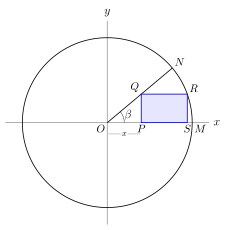
A circle of radius \(a\) is centred at the origin \(O\). A rectangle \(PQRS\) lies in the minor sector \(OMN\) of this circle where \(M\) is \((a,0)\) and \(N\) is \((a \cos \beta, a \sin \beta)\), and \(\beta\) is a constant with \(0 < \beta < \frac{\pi}{2}\,\). Vertex \(P\) lies on the positive \(x\)-axis at \((x,0)\); vertex \(Q\) lies on \(ON\); vertex \(R\) lies on the arc of the circle between \(M\) and \(N\); and vertex \(S\) lies on the positive \(x\)-axis at \((s,0)\). Show that the area \(A\) of the rectangle can be written in the form \[ A= x(s-x)\tan\beta \,. \] Obtain an expression for \(s\) in terms of \(a\), \(x\) and \(\beta\), and use it to show that \[ \frac{\d A}{\d x} = (s-2x) \tan \beta - \frac {x^2} s \tan^3\beta \,. \] Deduce that the greatest possible area of rectangle \(PQRS\) occurs when \(s= x(1+\sec\beta)\) and show that this greatest area is \(\tfrac12 a^2 \tan \frac12 \beta\,\). Show also that this greatest area occurs when \(\angle ROS = \frac12\beta\,\).
Solution:
2017 Paper 2 Q3
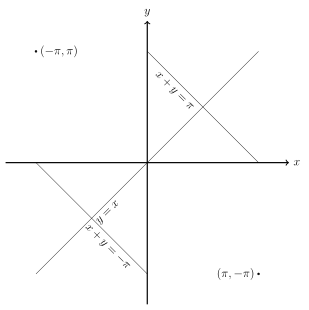
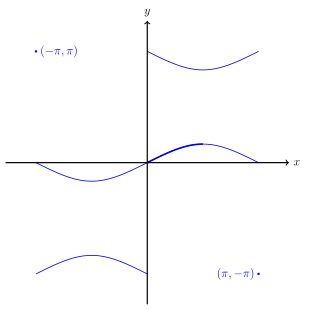
- Sketch, on \(x\)-\(y\) axes, the set of all points satisfying \(\sin y = \sin x\), for \(-\pi \le x \le \pi\) and \(-\pi \le y \le \pi\). You should give the equations of all the lines on your sketch.
- Given that \[ \sin y = \tfrac12 \sin x \] obtain an expression, in terms of \(x\), for \(y'\) when \(0\le x \le \frac12 \pi\) and \(0\le y \le \frac12 \pi\), and show that \[ y'' = - \frac {3\sin x}{(4-\sin^2 x)^{\frac32}} \;. \] Use these results to sketch the set of all points satisfying \(\sin y = \tfrac12 \sin x\) for \(0 \le x \le \frac12 \pi\) and \(0 \le y \le \frac12 \pi\). Hence sketch the set of all points satisfying \(\sin y = \tfrac12 \sin x\) for \(-\pi\! \le \! x \! \le \! \pi\) and \mbox{\( -\pi \, \le\, y\, \le\, \pi\,\)}.
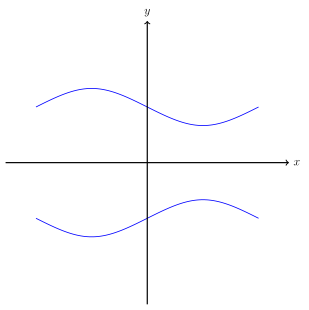
- Without further calculation, sketch the set of all points satisfying \(\cos y = \tfrac12 \sin x\) for \(- \pi \le x \le \pi\) and \( -\pi \le y \le \pi\).
Solution:
- \(\,\)
- \(\,\) \begin{align*}
&& \sin y &= \tfrac12 \sin x \\
\Rightarrow && \frac{\d y}{\d x} \cos y &= \tfrac12 \cos x \\
\Rightarrow && \frac{\d y}{\d x} &= \frac{\cos x}{2 \cos y} \\
&&&= \frac{\cos x}{2 \sqrt{1-\sin^2 y}} \\
&&&= \frac{\cos x}{2 \sqrt{1-\frac14 \sin^2 x}} \\
&&&= \frac{\cos x}{\sqrt{4-\sin^2 x}} \\
\\
&& y'' &= \frac{-\sin x \cdot (4-\sin^2 x)^{\frac12} - \cos x \cdot (4-\sin^2 x)^{-\frac12} \cdot 2 \sin x \cos x}{(4-\sin^2 x)} \\
&&&= \frac{-\sin x \cdot (4-\sin^2 x) - \cos x \cdot 2 \sin x \cos x}{(4-\sin^2x)^{\frac32}} \\
&&&= \frac{-\sin x \cdot (4-\sin^2 x) - \sin x (1-\sin^2x)}{(4-\sin^2x)^{\frac32}} \\
&&&= \frac{-3\sin x }{(4-\sin^2x)^{\frac32}} \\
\end{align*}
- \(\,\)
2015 Paper 3 Q8
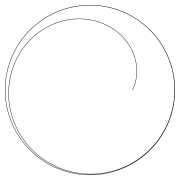
- Show that under the changes of variable \(x= r\cos\theta\) and \(y = r\sin\theta\), where \(r\) is a function of \(\theta\) with \(r>0\), the differential equation \[ (y+x)\frac{\d y}{\d x} = y-x \] becomes \[ \frac{\d r}{\d\theta} + r=0 \,. \] Sketch a solution in the \(x\)-\(y\) plane.
- Show that the solutions of \[ \left( y+x -x(x^2+y^2) \right) \, \frac{\d y }{\d x} = y-x - y(x^2+y^2) \] can be written in the form \\ \[ r^2 = \dfrac 1 {1+A\e^{2\theta}}\, \]\\ and sketch the different forms of solution that arise according to the value of \(A\).
Solution:
- \begin{align*}
&& (y+x)\frac{\d y}{\d x} &= y-x \\
\Rightarrow && (r \sin \theta + r \cos\theta) \frac{\frac{dy}{d\theta}}{\frac{dx}{d\theta}} &= (r \sin\theta - r \cos\theta) \\
\Rightarrow && ( \sin \theta + \cos\theta) \frac{dy}{d\theta} &= (\sin\theta - \cos\theta){\frac{dx}{d\theta}} \\
\Rightarrow && ( \sin \theta + \cos\theta) \left ( \frac{dr}{d\theta} \cos \theta - r \sin \theta\right ) &= (\sin\theta - \cos\theta)\left ( \frac{dr}{d\theta} \sin\theta + r \cos \theta\right) \\
\Rightarrow && \frac{dr}{d\theta} \left (\sin \theta \cos \theta + \cos^2 \theta - \sin^2 \theta + \sin \theta \cos \theta \right)&= r \left (\sin \theta \cos \theta - \cos^2 \theta + \sin^2 \theta + \sin\theta \cos \theta\right) \\
\Rightarrow && \frac{dr}{d\theta}&= -r \\
\end{align*}
Therefore \(r = Ae^{-\theta}\)

- \begin{align*}
&& \left( y+x -x(x^2+y^2) \right) \, \frac{\d y }{\d x} &= y-x - y(x^2+y^2) \\
\Rightarrow && \left( r \sin \theta+r\cos \theta -r^3\cos \theta \right) \, \frac{\d y }{\d \theta} &= \left ( r \sin \theta- r \cos \theta- r^3\sin \theta \right)\frac{\d x }{\d \theta} \\
\Rightarrow && \left( r \sin \theta+r\cos \theta -r^3\cos \theta \right) \, \left (\frac{\d r}{\d \theta} \sin \theta + r \cos \theta \right) &= \\
&& \left ( r \sin \theta- r \cos \theta- r^3\sin \theta \right)&\left (\frac{\d r}{\d \theta} \cos \theta - r \sin \theta \right) \\
\Rightarrow && \frac{\d r}{\d \theta} \left (\sin \theta ( \sin \theta + \cos \theta - r^2 \cos \theta) - \cos \theta (\sin \theta - \cos \theta - r^2 \sin \theta) \right) &= \\
&& r ( -\sin \theta (\sin \theta - \cos \theta - r^2 \sin \theta) - \cos \theta ( \sin \theta + \cos \theta &- r^2 \cos \theta)) \\
\Rightarrow && \frac{\d r}{\d \theta} &= r ( -1 +r^2) \\
\Rightarrow && \int \frac{1}{r(r-1)(r+1)} \d r &= \int \d \theta \\
\Rightarrow && \int \l \frac{-1}{r} + \frac{1}{2(r-1)} + \frac{1}{2(r+1)} \r \d r &= \int \d \theta \\
\Rightarrow && \l -\log r+ \frac12 \log (1+r)+ \frac12 \log (1-r)\r + C &= \theta \\
\Rightarrow && \frac12 \log \left (\frac{1-r^2}{r^2} \right) + C &= \theta \\
\Rightarrow && \log \left (\frac{1}{r^2}-1 \right) + C &= 2\theta \\
\Rightarrow && r &= \frac{1}{1 + Ae^{2\theta}} \\
\end{align*}


2014 Paper 2 Q3
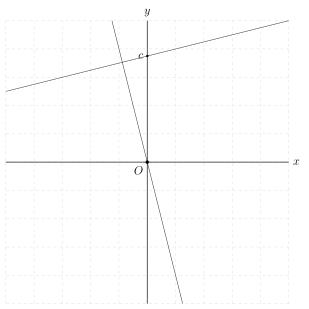
- Show, geometrically or otherwise, that the shortest distance between the origin and the line \(y= mx+c\), where \(c\ge0\), is \(c(m^2+1)^{-\frac12}\).
- The curve \(C\) lies in the \(x\)-\(y\) plane. Let the line \(L\) be tangent to \(C\) at a point \(P\) on \(C\), and let \(a\) be the shortest distance between the origin and \(L\). The curve \(C\) has the property that the distance \(a\) is the same for all points \(P\) on \(C\). Let \(P\) be the point on \(C\) with coordinates \((x,y(x))\). Given that the tangent to \(C\) at \(P\) is not vertical, show that \begin{equation} (y-xy')^2 = a^2\big (1+(y')^2 \big) \,. \tag{\(*\)} \end{equation} By first differentiating \((*)\) with respect to \(x\), show that either \(y= mx \pm a(1+m^2)^{\frac12}\) for some \(m\) or \(x^2+y^2 =a^2\).
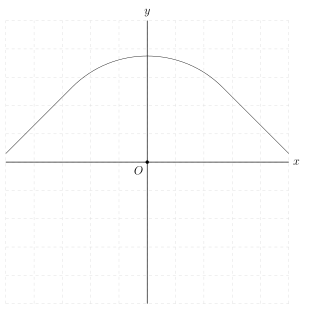
- Now suppose that \(C\) (as defined above) is a continuous curve for \(-\infty < x < \infty\), consisting of the arc of a circle and two straight lines. Sketch an example of such a curve which has a non-vertical tangent at each point.
Solution:
- \(\,\)
Note that we have a right angled triangle, with the sides in a ratio of \(m\). So if our target length is \(x\) we have \(x^2 + (mx)^2 = c^2\) and so \(x = c(m^2+1)^{-\frac12}\)
- The distance from the origin to \(L\) is \(a = c(m^2+1)^{-\frac12}\) so \begin{align*} && a^2(m^2+1) &= c^2 \\ && \frac{c-y(x)}{0-x} &= y' \\ \Rightarrow && c-y &= -xy' \\ \Rightarrow && a^2((y')^2+1) &= (y-xy')^2 \\ \\ && 2a^2y'y'' &= 2(y-xy')(y'-xy''-y') \\ &&&= 2(xy'-y)xy'' \\ \Rightarrow && y'' &= 0 \\ \text{ or } && 2a^2y' &= 2(xy'-y)x \end{align*} If \(y'' = 0\) then \(y = mx + c\) and the result follows immediately. \begin{align*} && 0 &= (a^2-x^2)y' + yx \\ \Rightarrow &&\frac1{y} y' &= -\frac{x}{a^2-x^2} \\ \Rightarrow && \ln y &= \frac12\ln (a^2-x^2) + K \\ \Rightarrow && y^2 &= M(a^2-x^2) \\ \Rightarrow && x^2 + y^2 &= a^2 \end{align*} Where in the last step we know the tangents from an ellipse are not all equidistant to the origin.
2011 Paper 1 Q1
- Show that the gradient of the curve \(\; \dfrac a x + \dfrac by =1\), where \(b\ne0\), is \(\; -\dfrac{ay^2}{bx^2}\,\). The point \((p,q)\) lies on both the straight line \(ax+by=1\) and the curve \(\dfrac a x + \dfrac by =1\,\), where \(ab\ne0\). Given that, at this point, the line and the curve have the same gradient, show that \( p=\pm q\,\). Show further that either \((a-b)^2 =1\,\) or \((a+b)^2 =1\,\).
- Show that if the straight line \(ax+by=1\), where \(ab\ne0\), is a normal to the curve \(\dfrac a x - \dfrac by =1\), then \(a^2-b^2 = \frac12\,\).
Solution:
- \(\,\) \begin{align*} && 1 &= \frac{a}{x} + \frac{b}{y} \\ \frac{\d}{\d x}: && 0 &= -\frac{a}{x^2} - \frac{b}{y^2} \frac{\d y}{\d x} \\ \Rightarrow && \frac{\d y}{\d x} &= -\frac{ay^2}{bx^2} \\ \\ (p,q): && -\frac{aq^2}{bp^2} &= -\frac{a}{b} \\ \Rightarrow && p^2 &= q^2 \\ \Rightarrow && p &= \pm q \\ \\ \Rightarrow && ap \pm b p &= 1 \\ \Rightarrow && (a\pm b)p &= 1 \\ \Rightarrow && \frac{a}{p} \pm \frac{b}{p} &= 1 \\ \Rightarrow && (a \pm b)\frac{1}{p} &= 1 \\ \Rightarrow && (a \pm b)^2 &= 1 \end{align*}
- \(\,\) \begin{align*} && 1 &= \frac{a}{x} - \frac{b}{y} \\ \Rightarrow && \frac{\d y}{\d x} &= \frac{ay^2}{bx^2} \\ \Rightarrow && \frac{aq^2}{bp^2} &= \frac{b}{a} \\ \Rightarrow && aq &= \pm bp \\ \Rightarrow && 1 &= \frac{a}{p} - \frac{b}{q} \\ &&&= \frac{aq-bp}{pq} \\ \Rightarrow && aq &= -bp \\ \Rightarrow && 1 &= \frac{2aq}{pq} \\ \Rightarrow && p &= 2a \\ \Rightarrow && q &= -2b \\ \Rightarrow && 1 &= 2a^2-2b^2 \\ \Rightarrow && \frac12 &= a^2-b^2 \end{align*}
2009 Paper 1 Q2
A curve has the equation \[ y^3 = x^3 +a^3+b^3\,, \] where \(a\) and \(b\) are positive constants. Show that the tangent to the curve at the point \((-a,b)\) is \[ b^2y-a^2x = a^3+b^3\,. \] In the case \(a=1\) and \(b=2\), show that the \(x\)-coordinates of the points where the tangent meets the curve satisfy \[ 7x^3 -3x^2 -27x-17 =0\,. \] Hence find positive integers \(p\), \(q\), \(r\) and \(s\) such that \[ p^3 = q^3 +r^3 +s^3\,. \]
Solution: \begin{align*} && y^3 &= x^3 + a^3 + b^3 \\ \Rightarrow && 3y^2 \frac{\d y}{\d x} &= 3x^2 \\ \Rightarrow && \frac{\d y}{\d x} &= \frac{x^2}{y^2} \end{align*} Therefore the tangent at the point \((-a,b)\) has gradient \(\frac{a^2}{b^2}\), ie \begin{align*} && \frac{y-b}{x+a} &= \frac{a^2}{b^2} \\ \Rightarrow && b^2y - b^3 &= a^2 x + a^3 \\ \Rightarrow && b^2 y-a^2 x &= a^3 + b^3 \end{align*} Notice that tangent will be, \(4y-x = 9\) so substituting this we obtain: \begin{align*} && \left (\frac{9+x}{4} \right)^3 &= x^3 + 9 \\ \Rightarrow && 9^3 + 3 \cdot 9^2 x + 3 \cdot 9x^2 + x^3 &= 64x^3 + 64 \cdot 9 \\ \Rightarrow && 9 \cdot (9^2 - 8^2) + 9 \cdot (3 \cdot 9) + 9 \cdot 3x^2 -9 \cdot 7x^3 &= 0 \\ \Rightarrow && 7x^3-3x^2-27x-17 &= 0 \\ \Rightarrow && (x+1)^2(7x-17) &= 0 \tag{repeated root since tangent} \end{align*} So we have another point on the curve \(y^3 = x^3 + 2^3 + 1^3\), namely \((\frac{17}7, \frac{17+9 \cdot 7}{28}) = (\frac{17}7, \frac{20}{7})\), so \begin{align*} 20^3 &= 17^3 + 14^3 + 7^3 \end{align*}
2009 Paper 1 Q5
A right circular cone has base radius \(r\), height \(h\) and slant length \(\ell\). Its volume \(V\), and the area \(A\) of its curved surface, are given by \[ V= \tfrac13 \pi r^2 h \,, \ \ \ \ \ \ \ A = \pi r\ell\,. \]
- Given that \(A\) is fixed and \(r\) is chosen so that \(V\) is at its stationary value, show that \(A^2 = 3\pi^2r^4\) and that \(\ell =\sqrt3\,r\).
- Given, instead, that \(V\) is fixed and \(r\) is chosen so that \(A\) is at its stationary value, find \(h\) in terms of \(r\).
Solution:
- Given \(A\) is fixed, and \(h^2 + r^2 = \ell^2\), we can look at \begin{align*} && V^2 &= \frac19 \pi^2 r^4 h^2 \\ &&&= \frac19\pi^2r^4(\ell^2 - r^2) \\ &&&= \frac19\pi^2 r^4\left (\frac{A^2}{\pi^2r^2} - r^2 \right) \\ &&&= \frac{A^2r^2 - \pi^2r^6}{9} \end{align*} Differentiating wrt to \(r\) we find that \(2rA^2-6\pi^2 r^5 = 0\) or hence \(A^2 = 3\pi^2 r^4 \Rightarrow A = \sqrt{3}\pi r^2\). Therefore \(\sqrt{3}\pi r^2 = \pi r \ell \Rightarrow \ell = \sqrt{3}r\).
- Supposing \(V\) is fixed, then \begin{align*} && A^2 &= \pi^2 r^2\ell^2 \\ &&&= \pi^2 r^2 (h^2+r^2) \\ &&&= \pi^2 r^2 \left ( \frac{9V^2}{\pi^2r^4} + r^2 \right) \\ &&&= 9V^2r^{-2} + \pi^2r^4 \\ \end{align*} Differentiating wrt to \(r\) we find \(-18V^2r^{-3} + 4\pi^2 r^3 = 0\) so \(V^2 = \frac{2\pi^2}{9}r^6\) or \(V = \frac{\sqrt{2}\pi}{3}r^3\), from which it follows: \(\frac{\sqrt{2}\pi}{3}r^3 = \frac13\pi r^2 h \Rightarrow h = \sqrt{2}r\)
2008 Paper 1 Q2
The variables \(t\) and \(x\) are related by \(t=x+ \sqrt{x^2+2bx+c\;} \,\), where \(b\) and \(c\) are constants and \(b^2 < c\). Show that \[ \frac{\d x}{\d t} = \frac{t-x}{t+b}\;, \] and hence integrate \(\displaystyle \frac1 {\sqrt{x^2+2bx+c}}\,\). Verify by direct integration that your result holds also in the case \(b^2=c\) if \(x+b > 0\) but that your result does not hold in the case \(b^2=c\) if \(x+b < 0\,\).
Solution: \begin{align*} && t &= x+ \sqrt{x^2+2bx+c} \\ && \frac{\d t}{\d x} &= 1 + \frac{x+b}{\sqrt{x^2+2bx+c}} \\ &&&= \frac{x + \sqrt{x^2+2bx+c} + b}{\sqrt{x^2+2bx+c}} \\ &&&= \frac{t+b}{t-x} \\ \Rightarrow && \frac{\d x}{\d t} &= \frac{t-x}{t+b} \\ \\ && \int \frac{1}{\sqrt{x^2+2bx+c}} \d x &= \int \frac{1}{t-x} \frac{t-x}{t+b} \d t \\ &&&= \int \frac{1}{t+b} \d t \\ &&&= \ln (t + b) +C \\ &&&= \ln \left (x + \sqrt{x^2+2bx+c} + b \right) + C \end{align*} If \(b^2 = c\) then we have \(x^2+2bx+b^2 = (x+b)^2\) so \(\sqrt{x^2+2bx+c^2} = x+b\) (if \(x+b>0\)), so \begin{align*} && \int \frac{1}{\sqrt{x^2+2bx+c}} \d x &= \int \frac{1}{x+b} \d x\\ &&&= \ln (x + b) + C \\ &&&= \ln(x+b) + \ln 2 + C' \\ &&&= \ln (2(x+b)) + C' \\ &&&= \ln \left(x + b + \sqrt{(x+b)^2} \right)+C'\\ &&&= \ln \left(x + b + \sqrt{x^2+2bx+c} \right)+C'\\ \end{align*} If \(x+b < 0\) then the antiderivative is \(\ln 0\). \begin{align*} && \int \frac{1}{\sqrt{x^2+2bx+c}} \d x &= -\int \frac{1}{x+b} \d x\\ &&&= -\ln |x + b| + C \\ \end{align*} which are clearly different.
2008 Paper 1 Q8
- The gradient \(y'\) of a curve at a point \((x,y)\) satisfies \[ (y')^2 -xy'+y=0\,. \tag{\(*\)} \] By differentiating \((*)\) with respect to \(x\), show that either \(y''=0\) or \(2y'=x\,\). Hence show that the curve is either a straight line of the form \(y=mx+c\), where \(c=-m^2\), or the parabola \(4y=x^2\).
- The gradient \(y'\) of a curve at a point \((x,y)\) satisfies \[ (x^2-1)(y')^2 -2xyy'+y^2-1=0\,. \] Show that the curve is either a straight line, the form of which you should specify, or a circle, the equation of which you should determine.
Solution:
- \(\,\) \begin{align*} && 0 &= (y')^2 -xy'+y\\ \Rightarrow && 0 &= 2y' y'' -y' - xy'' + y' \\ &&&= 2y'y'' - xy'' \\ &&&= y'' (2y'-x) \end{align*} Therefore \(y'' = 0 \Rightarrow y = mx + c\) or \(y' = \frac12 x \Rightarrow x = \frac14x^2 + C\). Plugging these into the original equation we have \(m^2 - xm+mx+c = 0 \Rightarrow c = -m^2\) \(\frac14 x^2 - \frac12 x^2 + \frac14x^2 + C = 0 \Rightarrow C = 0\). Therefore \(4y = x^2\)
- \begin{align*} && 0 &= (x^2-1)(y')^2 -2xyy'+y^2-1 \\ \Rightarrow && 0 &= 2x(y')^2 +(x^2-1)2y'y'' - 2yy' - 2x(y')^2-2xyy''+2yy' \\ &&&= (x^2-1)2y'y'' -2xyy'' \\ &&&= 2y'' ((x^2-1)y'-xy) \end{align*} Therefore \(y'' = 0\) so \(y = mx + c\) or \begin{align*} && \frac{\d y}{\d x} &= \frac{xy}{x^2-1} \\ \Rightarrow && \int \frac1y \d y &= \int \frac{x}{x^2-1} \d x \\ \Rightarrow && \ln |y| &= \frac12 \ln |x^2-1| + C \\ \Rightarrow && y^2 &= A(x^2-1) \end{align*} Suppose \(y = mx+c\) then we must have \((x^2-1)m^2-2xm(mx+c)+(mx+c)^2 = -m^2+c^2 \Rightarrow c^2 = m^2\) If \(y^2 = A(x^2-1)\) then \(2yy' = 2xA\) and \begin{align*} && 0 &= \frac{y^2}{A}\left ( \frac{xA}{y} \right)^2 - 2x^2A+A(x^2-1)-1 \\ &&&= x^2A-2x^2A+x^2A-A-1 \\ \Rightarrow && A &= -1 \end{align*} Therefore \(x^2 + y^2 = 1\)