Problems
Filters
11 problems found
2017 Paper 2 Q9
Two identical rough cylinders of radius \(r\) and weight \(W\) rest, not touching each other but a negligible distance apart, on a horizontal floor. A thin flat rough plank of width \(2a\), where \(a < r\), and weight \(kW\) rests symmetrically and horizontally on the cylinders, with its length parallel to the axes of the cylinders and its faces horizontal. A vertical cross-section is shown in the diagram below.
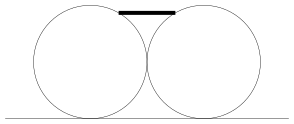
- Let \(F\) be the frictional force between one cylinder and the floor, and let \(R\) be the normal reaction between the plank and one cylinder. Show that \[ R\sin\theta = F(1+\cos\theta)\,, \] where \(\theta\) is the acute angle between the plank and the tangent to the cylinder at the point of contact. Deduce that \(2\sin\theta \le 1+\cos\theta\,\).
- Show that \[ N= \left( 1+\frac2 k\right)\left(\frac{1+\cos\theta}{\sin\theta} \right) F \,, \] where \(N\) is the normal reaction between the floor and one cylinder. Write down the condition that the cylinder does not slip on the floor and show that it is satisfied with no extra restrictions on \(\theta\).
- Show that \(\sin\theta\le\frac45\,\) and hence that \(r\le5a\,\).
Solution:
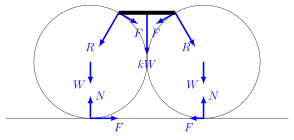
- \(\,\) \begin{align*} \text{N2}(\rightarrow, \text{ one cylinder}): && F\cos \theta + F - R \sin \theta &= 0 \\ \Rightarrow && F(1+\cos \theta) &= R \sin \theta \\ && F \leq \tfrac12 R \\ \Rightarrow && R \sin \theta &\leq \frac12 R(1+\cos \theta) \\ \Rightarrow && 2 \sin \theta &\leq 1 + \cos \theta \end{align*}
- \(\,\) \begin{align*} \text{N2}(\uparrow, \text{system}): && 2N-(k+2)W &= 0 \\ \Rightarrow && W &= \left ( \frac{2}{k+2} \right)N \\ \text{N2}(\uparrow, \text{one cylinder}): && N - W - R\cos \theta -F\sin \theta &= 0 \\ \Rightarrow && N - \left ( \frac{2}{k+2} \right)N - F \left ( \frac{1+\cos \theta}{\sin \theta} \right) \cos \theta - F \sin \theta &= 0 \\ \Rightarrow && \left ( \frac{k}{k+2} \right)N &= \left ( \frac{\cos \theta + \cos^2 \theta + \sin^2 \theta}{\sin \theta} \right) F\\ \Rightarrow && N &= \left ( 1 + \frac2{k} \right) \left ( \frac{\cos \theta + 1}{\sin \theta} \right) F \end{align*} The cylinder does not slip if \(F \leq \tfrac12 N\), ie \begin{align*} && N &\leq \left ( 1 + \frac2{k} \right) \left ( \frac{\cos \theta + 1}{\sin \theta} \right) \frac12 N \\ \Rightarrow && 2\sin \theta &\leq \left ( 1 + \frac2{k} \right) \left ( \cos \theta + 1 \right) \end{align*} but since \(2 \sin \theta \leq (1 + \cos \theta)\) and \((1+\frac2k) > 1\) this inequality is obviously satisfied.
- We can notice that \(2\sin \theta = 1 + \cos \theta\) is satisfied by a \(3-4-5\) triangle, where \(\sin \theta = 4/5, \cos \theta = 3/5\) and hence if \(\sin \theta \leq \frac45\) the condition must hold.
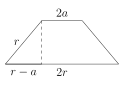
So \(\sin \theta = \frac{r-a}{r} \leq \frac45 \Rightarrow 5r-5a \leq 4r \Rightarrow r \leq 5a\)
2011 Paper 3 Q9
Particles \(P\) and \(Q\) have masses \(3m\) and \(4m\), respectively. They lie on the outer curved surface of a~smooth circular cylinder of radius~\(a\) which is fixed with its axis horizontal. They are connected by a light inextensible string of length \(\frac12 \pi a\), which passes over the surface of the cylinder. The particles and the string all lie in a vertical plane perpendicular to the axis of the cylinder, and the axis intersects this plane at \(O\). Initially, the particles are in equilibrium. Equilibrium is slightly disturbed and \(Q\) begins to move downwards. Show that while the two particles are still in contact with the cylinder the angle \(\theta\) between \(OQ\) and the vertical satisfies \[ 7a\dot\theta^2 +8g \cos\theta + 6 g\sin\theta = 10g\,. \]
- Given that \(Q\) loses contact with the cylinder first, show that it does so when~\(\theta=\beta\), where \(\beta\) satisfies \[ 15\cos\beta +6\sin\beta =10. \]
- Show also that while \(P\) and \(Q\) are still in contact with the cylinder the tension in the string is $\frac {12}7 mg(\sin\theta +\cos\theta)\,$.
2007 Paper 2 Q10
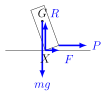
A solid figure is composed of a uniform solid cylinder of density \(\rho\) and a uniform solid hemisphere of density \(3\rho\). The cylinder has circular cross-section, with radius \(r\), and height \(3r\), and the hemisphere has radius \(r\). The flat face of the hemisphere is joined to one end of the cylinder, so that their centres coincide. The figure is held in equilibrium by a force \(P\) so that one point of its flat base is in contact with a rough horizontal plane and its base is inclined at an angle \(\alpha\) to the horizontal. The force \(P\) is horizontal and acts through the highest point of the base. The coefficient of friction between the solid and the plane is \(\mu\). Show that \[\mu \ge \left\vert \tfrac98 -\tfrac12 \cot\alpha\right\vert\,. \]
Solution: The centre of mass of the sphere will be at \((0, \frac{3}{2}r)\) and the centre of mass of the hemisphere will be at \((0, 3r + \frac38r)\), their masses will be \(3\pi r^3 \cdot \rho \) and \(\frac23 \pi r^3 \cdot 3\rho \), meaning the center of mass will be \(\frac{\frac92r + \frac{27}{8} \cdot 2r}{3 + 2} = \frac{45/4}{5}r = \frac{9}{4}r\) above the center of the base.
2003 Paper 2 Q9
\(AB\) is a uniform rod of weight \(W\,\). The point \(C\) on \(AB\) is such that \(AC>CB\,\). The rod is in contact with a rough horizontal floor at \(A\,\) and with a cylinder at \(C\,\). The cylinder is fixed to the floor with its axis horizontal. The rod makes an angle \({\alpha}\) with the horizontal and lies in a vertical plane perpendicular to the axis of the cylinder. The coefficient of friction between the rod and the floor is \(\tan \lambda_1\) and the coefficient of friction between the rod and the cylinder is \(\tan \lambda_2\,\). Show that if friction is limiting both at \(A\) and at \(C\), and \({\alpha} \ne {\lambda}_2 - {\lambda}_1\,\), then the frictional force acting on the rod at \(A\) has magnitude $$ \frac{ W\sin {\lambda}_1 \, \sin({\alpha}-{\lambda}_2)} {\sin ({\alpha}+{\lambda}_1-{\lambda}_2)} \;.$$ %and that %$$ %p=\frac{\cos{\alpha} \, \sin({\alpha}+{\lambda}_1-{\lambda}_2)} %{2\cos{\lambda}_1 \, \sin {\lambda}_2}\;. %$$
2001 Paper 1 Q11
A smooth cylinder with circular cross-section of radius \(a\) is held with its axis horizontal. A~light elastic band of unstretched length \(2\pi a\) and modulus of elasticity \(\lambda\) is wrapped round the circumference of the cylinder, so that it forms a circle in a plane perpendicular to the axis of the cylinder. A particle of mass \(m\) is then attached to the rubber band at its lowest point and released from rest.
- Given that the particle falls to a distance \(2a\) below the below the axis of the cylinder, but no further, show that \[ \lambda = \frac{9\pi m g}{(3\sqrt3-\pi)^2} \;. \]
- Given instead that the particle reaches its maximum speed at a distance \(2a\) below the axis of the cylinder, find a similar expression for \(\lambda\)\,.
2001 Paper 3 Q11
A uniform cylinder of radius \(a\) rotates freely about its axis, which is fixed and horizontal. The moment of inertia of the cylinder about its axis is \(I\,\). A light string is wrapped around the cylinder and supports a mass \(m\) which hangs freely. A particle of mass \(M\) is fixed to the surface of the cylinder. The system is held at rest with the particle vertically below the axis of the cylinder, and then released. Find, in terms of \(I\), \(a\), \(M\), \(m\), \(g\) and \(\theta\), the angular velocity of the cylinder when it has rotated through angle \(\theta\,\). Show that the cylinder will rotate without coming to a halt if \(m/M>\sin\alpha\,\), where \(\alpha\) satisifes \(\alpha=\tan \frac12\alpha\) and \(0<\alpha<\pi\,\).
1997 Paper 2 Q10
\noindent{\it In this question the effect of gravity is to be neglected.} A small body of mass \(M\) is moving with velocity \(v\) along the axis of a long, smooth, fixed, circular cylinder of radius \(L\). An internal explosion splits the body into two spherical fragments, with masses \(qM\) and \((1-q)M\), where \(q\le\frac{1}{2}\). After bouncing perfectly elastically off the cylinder (one bounce each) the fragments collide and coalesce at a point \(\frac{1}{2}L\) from the axis. Show that \(q=\frac{3}{ 8}\). The collision occurs at a time \(5L/v\) after the explosion. Find the energy imparted to the fragments by the explosion, and find the velocity after coalescence.
1996 Paper 1 Q1
A cylindrical biscuit tin has volume \(V\) and surface area \(S\) (including the ends). Show that the minimum possible surface area for a given value of \(V\) is \(S=3(2\pi V^{2})^{1/3}.\) For this value of \(S\) show that the volume of the largest sphere which can fit inside the tin is \(\frac{2}{3}V\), and find the volume of the smallest sphere into which the tin fits.
Solution: Suppose we have height \(h\) and radius \(r\), then: \(V = \pi r^2 h\) and \(S = 2\pi r^2 + 2\pi r h\). \(h = \frac{V}{\pi r^2}\), so \begin{align*} S &= 2 \pi r^2 + 2 \pi r\frac{V}{\pi r^2} \\ &= 2\pi r^2 +V \frac1{r}+V \frac1{r} \\ &\underbrace{ \geq }_{\text{AM-GM}} 3 \sqrt[3]{2\pi r^2 \frac{V^2}{r^2} } = 3 (2 \pi V^2)^{1/3} \end{align*} Equality holds when \(r = \sqrt[3]{\frac{V}{2 \pi}}, h = \frac{V}{\pi (V/2\pi)^{2/3}} = \sqrt[3]{\frac{4V}{\pi}}\) Since \(h > r\) the sphere has a maximum radius of \(r\) and so it's largest volume is \(\frac43 \pi r^3 = \frac43 \pi \frac{V}{2 \pi} = \frac23 V\).

1996 Paper 3 Q10
Two rough solid circular cylinders, of equal radius and length and of uniform density, lie side by side on a rough plane inclined at an angle \(\alpha\) to the horizontal, where \(0<\alpha<\pi/2\). Their axes are horizontal and they touch along their entire length. The weight of the upper cylinder is \(W_1\) and the coefficient of friction between it and the plane is \(\mu_1\). The corresponding quantities for the lower cylinder are \(W_2\) and \(\mu_2\) respectively and the coefficient of friction between the two cylinders is \(\mu\). Show that for equilibrium to be possible:
- \(W_1\ge W_2\);
- \(\mu\geqslant\dfrac{W_1+W_2}{W_1-W_2}\);
- \(\mu_{1}\geqslant\left(\dfrac{2W_{1}\cot\alpha}{W_{1}+W_{2}}-1\right)^{-1}\,.\)
Solution:
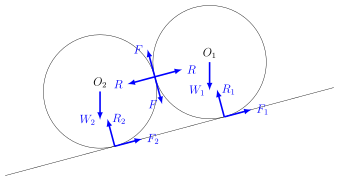
- \begin{align*} \overset{\curvearrowright}{O_2}: && 0 &= F_2 - F \\ \Rightarrow && F_2 &= F \\ \overset{\curvearrowright}{O_1}: && 0 &= F_1- F \\ \Rightarrow && F_1 &= F \\ \text{N2}(\swarrow, 2): && 0 &= R+W_2\sin\alpha -F \tag{1}\\ \text{N2}(\swarrow, 1): && 0 &= W_1\sin\alpha -F-R\tag{2}\\ \Rightarrow && W_1 \sin \alpha-R &= W_2 \sin \alpha+R \\ \Rightarrow && W_1 &\geq W_2 \end{align*}
- \begin{align*} (1)+(2)\Rightarrow && F &= \frac12 \sin \alpha (W_1 + W_2) \\ (1)-(2) \Rightarrow && R &= \frac12 \sin \alpha (W_1-W_2) \\ \Rightarrow && \frac{F}{R} &= \frac{W_1+W_2}{W_1-W_2} \\ \underbrace{\Rightarrow}_{F \leq \mu R} && \mu &\geq \frac{W_1+W_2}{W_1-W_2}\\ \end{align*}
- \begin{align*} \text{N2}(\nwarrow, 1): && 0 &= F+R_1-W_1\cos \alpha \\ \Rightarrow && R_1 &= W_1\cos \alpha - F \\ &&&= W_1 \cos \alpha - \frac12 \sin \alpha (W_1 + W_2) \\ \Rightarrow && \frac{R_1}{F_1} &= \frac{R_1}{F} \\ &&&= \frac{W_1 \cos \alpha - \frac12 \sin \alpha (W_1 + W_2)}{\frac12 \sin \alpha (W_1 + W_2) } \\ &&&= \frac{2W_1 \cot \alpha}{W_1+W_2} - 1 \\ \Rightarrow && \mu_1 & \geq \left ( \frac{2W_1 \cot \alpha}{W_1+W_2} - 1 \right)^{-1} \end{align*}
1991 Paper 3 Q11
1987 Paper 1 Q10
A rubber band band of length \(2\pi\) and modulus of elasticity \(\lambda\) encircles a smooth cylinder of unit radius, whose axis is horizontal. A particle of mass \(m\) is attached to the lowest point of the band, and hangs in equilibrium at a distance \(x\) below the axis of the cylinder. Obtain an expression in terms of \(x\) for the stretched length of the band in equilibrium. What is the value of \(\lambda\) if \(x=2\)?
Solution:
