Problems
Filters
10 problems found
2020 Paper 2 Q8
In this question, \(\mathrm{f}(x)\) is a quartic polynomial where the coefficient of \(x^4\) is equal to \(1\), and which has four real roots, \(0\), \(a\), \(b\) and \(c\), where \(0 < a < b < c\). \(\mathrm{F}(x)\) is defined by \(\mathrm{F}(x) = \displaystyle\int_0^x \mathrm{f}(t)\,\mathrm{d}t\). The area enclosed by the curve \(y = \mathrm{f}(x)\) and the \(x\)-axis between \(0\) and \(a\) is equal to that between \(b\) and \(c\), and half that between \(a\) and \(b\).
- Sketch the curve \(y = \mathrm{F}(x)\), showing the \(x\) co-ordinates of its turning points. Explain why \(\mathrm{F}(x)\) must have the form \(\mathrm{F}(x) = \frac{1}{5}x^2(x-c)^2(x-h)\), where \(0 < h < c\). Find, in factorised form, an expression for \(\mathrm{F}(x) + \mathrm{F}(c-x)\) in terms of \(c\), \(h\) and \(x\).
- If \(0 \leqslant x \leqslant c\), explain why \(\mathrm{F}(b) + \mathrm{F}(x) \geqslant 0\) and why \(\mathrm{F}(b) + \mathrm{F}(x) > 0\) if \(x \neq a\). Hence show that \(c - b = a\) or \(c > 2h\). By considering also \(\mathrm{F}(a) + \mathrm{F}(x)\), show that \(c = a + b\) and that \(c = 2h\).
- Find an expression for \(\mathrm{f}(x)\) in terms of \(c\) and \(x\) only. Show that the points of inflection on \(y = \mathrm{f}(x)\) lie on the \(x\)-axis.
2019 Paper 2 Q2
The function f satisfies \(f(0) = 0\) and \(f'(t) > 0\) for \(t > 0\). Show by means of a sketch that, for \(x > 0\), $$\int_0^x f(t) \, dt + \int_0^{f(x)} f^{-1}(y) \, dy = xf(x).$$
- The (real) function g is defined, for all \(t\), by $$(g(t))^3 + g(t) = t.$$ Prove that \(g(0) = 0\), and that \(g'(t) > 0\) for all \(t\). Evaluate \(\int_0^2 g(t) \, dt\).
- The (real) function h is defined, for all \(t\), by $$(h(t))^3 + h(t) = t + 2.$$ Evaluate \(\int_0^8 h(t) \, dt\).
Solution:

- Suppose \((g(t))^3 + g(t) = t\). Notice that \((g(0))^3 + g(0) =0 \Rightarrow g(0)((g(0))^2 + 1) = 0 \Rightarrow g(0) = 0\).
\begin{align*}
&& t &= (g(t))^3 + g(t) \\
\Rightarrow && 1 &= 3(g(t))^2 g'(t) + g'(t) \\
\Rightarrow && g'(t) &= \frac{1}{1 + 3(g(t))^2} > 0
\end{align*}
From our sketch, we can see we are interested in: \begin{align*} && \int_0^2 g(t) \d t &= 2 - \int_0^1 (x^3 + x) \d x \\ &&&= 2 - \frac14 - \frac12 = \frac54 \end{align*}

- \(\,\)
From our second sketch, we can see that: \begin{align*} && \int_0^8 h(t) \d t &= 16 - \int_1^2 (x^3+x-2) \d x \\ &&&= 16 - \left ( \frac{8}{4} + \frac{2^2}{2} - 2 \cdot 2 \right)+ \left ( \frac{1}{4} + \frac{1}{2} - 2 \right) \\ &&&= \frac{59}{4} \end{align*}

2018 Paper 1 Q1
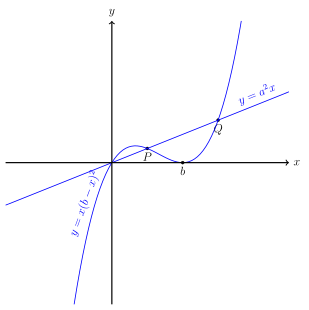
The line \(y=a^2 x\) and the curve \(y=x(b-x)^2\), where \(0 < a < b\,\), intersect at the origin \(O\) and at points \(P\) and \(Q \). The \(x\)-coordinate of \(P\) is less than the \(x\)-coordinate of \(Q\). Find the coordinates of \(P\) and \(Q\), and sketch the line and the curve on the same axes. Show that the equation of the tangent to the curve at \(P\) is \[ y = a(3a-2b)x + 2a(b-a)^2 . \] This tangent meets the \(y\)-axis at \(R\). The area of the region between the curve and the line segment \(OP\) is denoted by \(S\). Show that \[ S= \frac1{12}(b-a)^3(3a+b)\,. \] The area of triangle \(OPR\) is denoted by \(T\). Show that \(S>\frac{1}{3}T\,\).
Solution:
2014 Paper 1 Q2
- Show that \(\int \ln (2-x) \d x = -(2-x)\ln (2-x) + (2-x) + c \,,\ \) where \(x<2\).
- Sketch the curve \(A\) given by \(y= \ln \vert x^2-4\vert\).
- Show that the area of the finite region enclosed by the positive \(x\)-axis, the \(y\)-axis and the curve \(A\) is \(4\ln(2+\sqrt3)-2\sqrt3\,\).
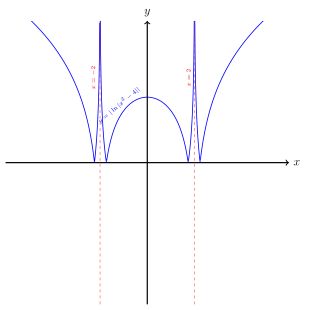
- The curve \(B\) is given by \(y= \vert \ln \vert x^2-4\vert \vert\,\). Find the area between the curve \(B\) and the \(x\)-axis with \(| x| <2\). Note: you may assume that \(t \ln t \to 0\) as \(t\to 0\).
Solution:
- \(\,\) \begin{align*} && \int \ln (2- x) \d x &= \left [ (x-2) \ln (2- x) \right] - \int -\frac{x-2}{2-x} \d x \\ && \int \ln (2- x) \d x &= \left [ (x-2) \ln (2- x) \right] + \int 1 \d x \\ &&&= -(2-x) \ln (2-x) +(2-x) + C \end{align*}
- \(\,\)
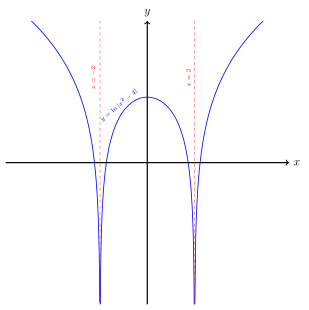
- \begin{align*} && \text{Area} &= \int_0^{\sqrt{3}} \ln | x^2 - 4 | \d x \\ &&&= \int_0^\sqrt{3} \ln(4-x^2) \d x \\ &&&= \int_0^\sqrt{3} \left ( \ln(2-x) + \ln (2+x) \right) \d x \\ &&&= \left [ -(2-x) \ln (2-x) +(2-x) +(2+x)\ln(2+x)-(2+x)\right]_0^{\sqrt{3}} \\ &&&= \left ( -(2-\sqrt{3}) \ln (2-\sqrt{3}) +(2-\sqrt{3}) +(2+\sqrt{3})\ln(2+\sqrt{3})-(2+\sqrt{3}) \right) - \\ &&&\quad \quad \left (- 2\ln (2)+2 +2\ln(2)-2 \right) \\ &&&=\left ( -(2-\sqrt{3}) \ln \left ( \frac{1}{2+\sqrt{3}} \right) -2\sqrt{3} +(2+\sqrt{3})\ln(2+\sqrt{3}) \right) \\ &&&= 4\ln(2 + \sqrt{3}) - 2 \sqrt{3} \end{align*}
- \begin{align*} && \text{Area} &= 2 \left ( \int_0^\sqrt{3} \ln (4-x^2) \d x - \lim_{t \to 2}\int_{\sqrt{3}}^t \ln(4-x^2) \d x \right) \\ &&&= 8\ln(2 + \sqrt{3})-4\sqrt{3} - 2 \lim_{t \to 2}\int_{\sqrt{3}}^t \left ( \ln (2-x) + \ln (2+x) \right) \d x \\ &&&= 8\ln(2 + \sqrt{3})-4\sqrt{3} - 2 \lim_{t \to 2} \left [ -(2-x) \ln (2-x) +(2-x) +(2+x)\ln(2+x)-(2+x)\right]_{\sqrt{3}}^{t} \\ &&&= 16 \ln(2+\sqrt{3})-8\sqrt{3} - 2 \lim_{t \to 2} \left(-(2-t) \ln (2-t) +(2-t) +(2+t)\ln(2+t)-(2+x) \right) \\ &&&= 16 \ln(2+\sqrt{3})-8\sqrt{3} -2(4 \ln4-4) \\ &&&= 16 \ln(2 + \sqrt{3}) - 16 \ln 2 +8(1-\sqrt{3}) \end{align*}
2010 Paper 2 Q8
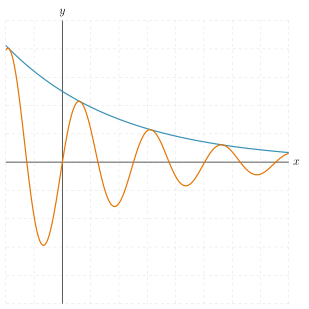
The curves \(C_1\) and \(C_2\) are defined by \[ y= \e^{-x} \quad (x>0) \quad \text{ and } \quad y= \e^{-x}\sin x \quad (x>0), \] respectively. Sketch roughly \(C_1\) and \(C_2\) on the same diagram. Let \(x_n\) denote the \(x\)-coordinate of the \(n\)th point of contact between the two curves, where \(0 < x_1 < x_2 < \cdots\), and let \(A_n\) denote the area of the region enclosed by the two curves between \(x_n\) and \(x_{n+1}\). Show that \[ A_n = \tfrac12(\e^{2\pi}-1) \e^{-(4n+1)\pi/2} \] and hence find \(\displaystyle \sum_{n=1}^\infty A_n\).
Solution:
2008 Paper 1 Q6
The function \(\f\) is defined by \[ \f(x) = \frac{\e^x-1}{\e-1}, \ \ \ \ \ x\ge0, \] and the function \(\g\) is the inverse function to \(\f\), so that \(\g(\f(x))=x\). Sketch \(\f(x)\) and \(\g(x)\) on the same axes. Verify, by evaluating each integral, that \[ \int_0^\frac12 \f(x) \,\d x + \int_0^k \g(x) \,\d x = \frac1 {2(\sqrt \e +1)}\,, \] where \(\displaystyle k= \frac 1{\sqrt\e+1}\), and explain this result by means of a diagram.
2007 Paper 2 Q2
A curve has equation \(y=2x^3-bx^2+cx\). It has a maximum point at \((p,m)\) and a minimum point at \((q,n)\) where \(p>0\) and \(n>0\). Let \(R\) be the region enclosed by the curve, the line \(x=p\) and the line \(y=n\).
- Express \(b\) and \(c\) in terms of \(p\) and \(q\).
- Sketch the curve. Mark on your sketch the point of inflection and shade the region \(R\). Describe the symmetry of the curve.
- Show that \(m-n=(q-p)^3\).
- Show that the area of \(R\) is \(\frac12 (q-p)^4\).
Solution:
- \(\,\) \begin{align*} && y &= 2x^3-bx^2+cx \\ \Rightarrow && y' &= 6x^2-2bx+c \end{align*} We must have \(p, q\) are the roots of this equation, ie \(\frac13b = p+q, \frac16c = pq\)
- The point of inflection will be at \(\frac{b}6\)
The graph will have rotational symmetry of \(180^{\circ}\) about the point of inflection.

- \begin{align*} && m-n &= 2(p^3-q^3)-b(p^2-q^2)+c(p-q) \\ &&&= (p-q)(2(p^2+qp+q^2)-b(p+q)+c) \\ &&&= (p-q)(2(p^2+qp+q^2)-3(p+q)^2+6pq) \\ &&&= (p-q)(-p^2-q^2+2pq) \\ &&&= (q-p)^3 \end{align*}
- The area of \(R\) is \begin{align*} A &= \frac12 bh \\ &= \frac12 (q-p)(m-n) = \frac12(q-p)^4 \end{align*} as required.
2006 Paper 1 Q7
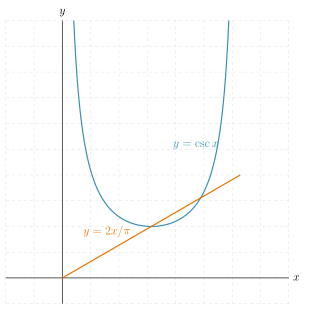
- Sketch on the same axes the functions \({\rm cosec}\, x\) and \(2x/ \pi\), for \(0 < x < \pi\,\). Deduce that the equation \(x\sin x = \pi/2 \) has exactly two roots in the interval \(0 < x < \pi\,\). Show that \[ \displaystyle \int_{\pi/2}^{\pi} \left \vert x\sin x - \frac{\pi} { 2} \right \vert \; \mathrm{d}x = 2\sin\alpha +\frac{3\pi^2} 4 - \alpha \pi -\pi -2\alpha \cos\alpha -1 \] where \(\alpha\) is the larger of the roots referred to above.
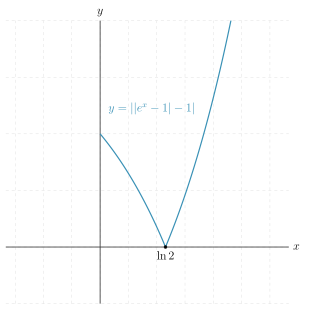
- Show that the region bounded by the positive \(x\)-axis, the \(y\)-axis and the curve \[y = \Bigl| \vert \e^x - 1 \vert - 1 \Bigr|\] has area \(\ln 4-1\).
Solution:
- \(\,\)
Notice that they are equal at \(1\) when \(x = \pi/2\), but this is a local minimum for \(\csc x\) whereas \(2x/\pi\) is increasing so there is a second intersection. Notice that \(\csc x = \frac{2x}{\pi} \Leftrightarrow x \sin x = \frac{\pi}{2}\) therefore our intersections are also the roots of \(x \sin x = \frac{\pi}{2}\) and the larger one is greater than \(\pi/2\) \begin{align*} && I &= \int_{\pi/2}^{\pi} \Bigl| x \sin x - \frac{\pi}{2} \Bigr| \d x \\ &&&= \int_{\pi/2}^{\alpha} \left ( x \sin x - \frac{\pi}{2} \right )\d x +\int_{\alpha}^{\pi} \left ( \frac{\pi}{2} -x \sin x \right) \d x \\ &&&= \left ( \pi - 2\alpha + \frac{\pi}{2}\right) \frac{\pi}{2} + \int_{\pi/2}^{\alpha} x \sin x\d x -\int_{\alpha}^{\pi} x \sin x \d x \\ &&&= \frac{3\pi^2}{4} - \alpha \pi + \left [-x \cos x \right]_{\pi/2}^{\alpha}+\left[x \cos x \right]_{\alpha}^{\pi} + \int_{\pi/2}^{\alpha} \cos x \d x - \int_{\alpha}^{\pi} \cos x \d x \\ &&&= \frac{3\pi^2}{4} - \alpha \pi -\alpha \cos \alpha -\pi -\alpha \cos \alpha+ \sin \alpha - 1+\sin \alpha \\ &&&= 2\sin \alpha + \frac{3\pi^2}{4} - \alpha \pi - 2\alpha \cos \alpha - 1 \end{align*}
- \(\,\)
\begin{align*} && A &= \int_0^{\ln 2} ||e^x-1|-1| \d x \\ &&&= \int_0^{\ln 2} |e^x-2| \d x \\ &&&=\int_0^{\ln 2} (2-e^x) \d x \\ &&&= 2 \ln 2 - \left [e^x \right]_0^{\ln 2} \\ &&&= \ln 4 - (2-1) = \ln 4 - 1 \end{align*}
2006 Paper 2 Q5
The notation \({\lfloor } x \rfloor\) denotes the greatest integer less than or equal to the real number \(x\). Thus, for example, \(\lfloor \pi\rfloor =3\,\), \(\lfloor 18\rfloor =18\,\) and \(\lfloor-4.2\rfloor = -5\,\).
- Two curves are given by \(y= x^2+3x-1\) and \(y=x^2 +3\lfloor x\rfloor -1\,\). Sketch the curves, for \(1\le x \le 3\,\), on the same axes. Find the area between the two curves for \(1\le x \le n\), where \(n\) is a positive integer.
- Two curves are given by \(y= x^2+3x-1\) and \(y=\lfloor x\rfloor ^2+3\lfloor x\rfloor -1\,\). Sketch the curves, for \(1\le x \le 3\,\), on the same axes. Show that the area between the two curves for \(1\le x \le n\), where \(n\) is a positive integer, is \[ \tfrac 16 (n-1)(3n+11)\,. \]
Solution:
- \(\,\)
The difference between the curves is \(3x - 3\lfloor x \rfloor\), which has area \(\frac32\) for each step. Therefore the area between the curves from \(1 \leq x \leq n\) is \(\frac32 (n-1)\)

- \(\,\)
The area between the curves is \(x^2 - \lfloor x \rfloor ^2 + 3(x - \lfloor x \rfloor)\). Looking at \begin{align*} && A &= \int_1^n \left ( x^2 - \lfloor x \rfloor ^2 \right )\d x \\ &&&= \frac{n^3-1^3}{3} - \sum_{k=1}^{n-1} k^2 \\ &&&= \frac{(n-1)(n^2+n+1)}{3} - \frac{(n-1)n(2n-1)}{6} \\ &&&= \frac{(n-1) \left (2n^2+2n+2-2n^2+n \right)}{6} \\ &&&= \frac{(n-1)(3n+2)}{6} \end{align*} Therefore the total area is \(\frac{(n-1)(3n+2)}{6}+\frac32(n-1) = \frac{(n-1)}{6}\left ( 3n+2+9\right) =\frac{(n-1)(3n+11)}{6}\)

2001 Paper 3 Q2
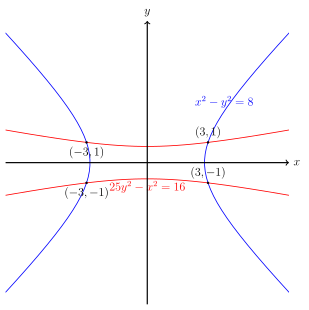
Show that \( \cosh^{-1} x = \ln ( x + \sqrt{x^2-1})\). Show that the area of the region defined by the inequalities \(\displaystyle y^2 \ge x^2-8\) and \(\displaystyle x^2\ge 25y^2 -16 \) is \((72/5) \ln 2\).
Solution: \begin{align*} && x &= \cosh y \\ \Rightarrow && x &= \tfrac12 (e^y + e^{-y} ) \\ \Rightarrow && 0 &= e^{2y} - 2xe^y + 1 \\ \Rightarrow && e^y &= \frac{2x \pm \sqrt{4x^2-4}}{2} \\ &&&= x \pm \sqrt{x^2-1} \\ \Rightarrow &&e^y &= x + \sqrt{x^2-1} \tag{by convention \(\cosh^{-1} > 0\)} \\ \Rightarrow && y &= \ln (x + \sqrt{x^2-1}) \end{align*}