2018 Paper 1 Q1
Year: 2018
Paper: 1
Question Number: 1
Course: LFM Pure and Mechanics
Section: Differentiation from first principles
Problem
Solution
Examiner's report
— 2018 STEP 1, Question 1In order to get the fullest picture, this document should be read in conjunction with the question paper, the marking scheme and (for comments on the underlying purpose and motivation for finding the right solution-approaches to questions) the Hints and Solutions document. The purpose of the STEPs is to learn what students are able to achieve mathematically when applying the knowledge, skills and techniques that they have learned within their standard A-level (or equivalent) courses … but seldom within the usual range of familiar settings. STEP questions require candidates to work at an extended piece of mathematics, often with the minimum of specific guidance, and to make the necessary connections. This requires a very different mind-set to that which is sufficient for success at A-level, and the requisite skills tend only to develop with prolonged and determined practice at such longer questions. One of the most crucial features of the STEPs is that the routine technical and manipulative skills are almost taken for granted; it is necessary for candidates to produce them with both speed and accuracy so that the maximum amount of time can be spent in thinking their way through the problem and the various hurdles and obstacles that have been set before them. Most STEP questions begin by asking the solver to do something relatively routine or familiar before letting them loose on the real problem. Almost always, such an opening has not been put there to allow one to pick up a few easy marks, but rather to point the solver in the right direction for what follows. Very often, the opening result or technique will need to be used, adapted or extended in the later parts of the question, with the demands increasing the further on that one goes. So a candidate should never think that they are simply required to 'go through the motions'; rather they will, sooner or later, be required to show either genuine skill or real insight in order to make a reasonably complete effort. The more successful candidates are the ones who manage to figure out how to move on from the given starting-point. Finally, reading through a finished solution is often misleading – even unhelpful – unless you have attempted the problem for yourself. This is because the thinking has been done for you. So, when you read through the report and look at the solutions (either in the mark scheme or the Hints and Solutions booklet), try to figure out how you could have arrived at the solution, learn from your mistakes and pick up as many tips as you can whilst working through past paper questions. This year far too many candidates wasted time by attempting more than six questions, with many of these candidates picking up 0-4 marks on several 'false starts' which petered out the moment some understanding was required. There were almost 2000 candidates for this SI paper. Almost one-sixth of candidates failed to reach a total of 30 and around two-thirds fell below half-marks overall. This highlights the fact that many candidates don't find this test an easy one. At the other end of the spectrum, almost one-in-ten managed a total of 84 out of 120 – these candidates usually marked out by their ability to complete whole questions – with almost 4% of the entry achieving the highly praiseworthy feat of getting into three-figures with their overall score. The paper is constructed so that question 1 is very approachable indeed, the intention being to get everyone started with some measure of success; unsurprisingly, Q1 was the most popular question of all, with almost all candidates attempting it, and it also turned out to be the most successful question on the paper with a mean score of more than 15 out of 20. Around 7% of candidates didn't make any kind of attempt at it at all. In order of popularity, Q1 was followed by Qs. 2, 7, 4 and 3. Indeed, it was the pure maths questions in Section A that attracted the majority of attention from candidates, with the most popular applied question (Q9, mechanics) still getting fewer 'hits' than the least popular pure question (Q5). Questions 10, 11 and 13 proved to attract very little attention from candidates and many of the attempts were minimal.
Rating Information
Difficulty Rating: 1516.0
Difficulty Comparisons: 1
Banger Rating: 1516.0
Banger Comparisons: 1
Show LaTeX source
Problem source
The line $y=a^2 x$
and  the curve
 $y=x(b-x)^2$, where $0 < a <  b\,$,
intersect at the origin
$O$ and at points $P$ and $Q $. The $x$-coordinate of
$P$ is less than the $x$-coordinate  of $Q$.
Find the coordinates of $P$  and $Q$,
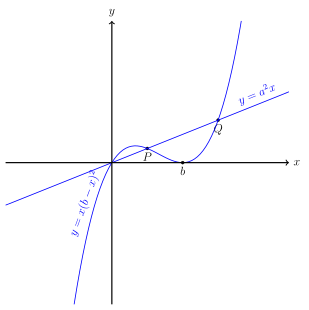
and sketch the line and the
curve   on the same axes.
Show that the equation
of the tangent to the curve at $P$ is
\[
y = a(3a-2b)x + 2a(b-a)^2
.
\]
This tangent meets the $y$-axis at $R$.
The area of the region between the curve and the line
segment $OP$ is denoted by $S$.
Show that
\[
S= \frac1{12}(b-a)^3(3a+b)\,.
\]
The area of triangle
$OPR$ is denoted by $T$.
Show  that $S>\frac{1}{3}T\,$.
Solution source
\begin{center}
    \begin{tikzpicture}
    \def\a{1};
    \def\b{2};
    \def\functionf(#1){(#1)*(\b-(#1))^2};
    \def\xl{-3};
    \def\xu{5};
    \def\yl{-10};
    \def\yu{10};

    % Calculate scaling factors to make the plot square
    \pgfmathsetmacro{\xrange}{\xu-\xl}
    \pgfmathsetmacro{\yrange}{\yu-\yl}
    \pgfmathsetmacro{\xscale}{10/\xrange}
    \pgfmathsetmacro{\yscale}{10/\yrange}

    % Define the styles for the axes and grid
    \tikzset{
        axis/.style={very thick, ->},
        grid/.style={thin, gray!30},
        x=\xscale cm,
        y=\yscale cm
    }

    % Define the bounding region with clip
    \begin{scope}
        % You can modify these values to change your plotting region
        \clip (\xl,\yl) rectangle (\xu,\yu);

        % Draw a grid (optional)
        % \draw[grid] (-5,-3) grid (5,3);

        \filldraw (\b, 0) circle (1.5pt) node[below]{$b$};
        \filldraw (1, 1) circle (1.5pt) node[below]{$P$};
        \filldraw (3, 3) circle (1.5pt) node[below]{$Q$};

        \draw[thick, blue, smooth, domain=\xl:\xu, samples=100]
            plot (\x, {\functionf(\x)});

        \draw[thick, blue] (\xl, {\a*\a*\xl}) -- (\xu, {\a*\a*\xu}) node[pos=0.9, above, sloped] {$y = a^2x$};

        \node[blue, above, rotate=70] at (-.5, {\functionf(-.5)}) { $y = x(b-x)^2$};
    \end{scope}

    % Set up axes
    \draw[axis] (\xl,0) -- (\xu,0) node[right] {$x$};
    \draw[axis] (0,\yl) -- (0,\yu) node[above] {$y$};

    \end{tikzpicture}
\end{center}

\begin{align*}
    && a^2x &= x(b-x)^2 \\
    \Rightarrow && 0 &= x((b-x)^2-a^2) \\
    &&&= x(b-a-x)(b+a-x)\\
    && y &= x(b-x)^2 \\
    \Rightarrow && y' &= (b-x)^2-2x(b-x) \\
    P(b-a,a^2(b-a)): &&y' &= (b-(b-a))^2-2(b-a)(b-(b-a)) \\
    &&&= a^2-2a(b-a) =  a(3a-2b) \\
    \Rightarrow && y &= a(3a-2b)(x-(b-a)) + a^2(b-a) \\
    &&&= a(3a-2b)x + (b-a)(a^2-3a^2+2ba) \\
    &&&= a(3a-2b)x + (b-a)2a(b-a) \\
    &&&= a(3a-2b)x + 2a(b-a)^2 \\
\end{align*}

Therefore the tangent at $P$ is $a(3a-2b)x + 2a(b-a)^2$

The area between the curve and $OP$ is \begin{align*}
    &&S &= \int_0^{b-a} \left (x(b-x)^2-a^2x \right) \d x\\
    &&&= \left [\frac{x^2}{2}b^2 - \frac{2x^3}{3}b +\frac{x^4}{4} - \frac{a^2x^2}{2}\right]_0^{b-a} \\
    &&&= (b-a)^2 \tfrac12 (b^2-a^2) - \tfrac23(b-a)^3b + \tfrac14(b-a)^4 \\
    &&&= \tfrac1{12}(b-a)^3(6(b+a)-8b+3(b-a)) \\
    &&&= \tfrac1{12}(b-a)^3(b+3a)
\end{align*}

The area $[OPR] = T= \tfrac12 \cdot (b-a) \cdot 2a(b-a)^2 = a(b-a)^3$

Clearly $S > \frac4{12}(b-a)^3a = \frac13T$
This was the most popular question and elicited the highest average score of any question on the paper. This is hardly surprising, given that it is the question that most closely resembles a long question from an A-level paper and that its demands stand out as, at least, manageable. This proved to be the case with almost all takers, the most noticeable shortcomings arising with the inequality result at the end: many candidates didn't seem to realise that it is (almost) always easier to consider the sign of some variable quantity than to prove that one variable is greater or less than another. In this case, all it takes is to turn S > 13 T into either S – 13 T > 0 or 3S – T > 0. Another common fault amongst candidates is to arrive at a given answer (there are two here) without producing thoroughly convincing working to support it. The final point to be made here is that a diagram (even a hastily drawn one that covers the basic features required) can be of immense value, even when not directly requested. In this question, rather a lot of solutions arose from (effectively) mistakenly having the point R on the x-axis.