Problems
Filters
14 problems found
2022 Paper 2 Q5
- Given that \(a > b > c > 0\) are constants, and that \(x\), \(y\), \(z\) are non-negative variables, show that \[ax + by + cz \leqslant a(x + y + z).\]
- Find \(\Delta\) in terms of \(a\), \(b\), \(c\), \(x\), \(y\) and \(z\).
- Find both the minimum value of the sum of the perpendicular distances from \(P\) to the three sides of the triangle and the values of \(x\), \(y\) and \(z\) which give this minimum sum, expressing your answers in terms of some or all of \(a\), \(b\), \(c\) and \(\Delta\).
- Show that, for all real \(a\), \(b\), \(c\), \(x\), \(y\) and \(z\), \[(a^2+b^2+c^2)(x^2+y^2+z^2) = (bx-ay)^2 + (cy-bz)^2 + (az-cx)^2 + (ax+by+cz)^2.\]
- Find both the minimum value of the sum of the squares of the perpendicular distances from \(P\) to the three sides of the triangle and the values of \(x\), \(y\) and \(z\) which give this minimum sum, expressing your answers in terms of some or all of \(a\), \(b\), \(c\) and \(\Delta\).
- Find both the maximum value of the sum of the squares of the perpendicular distances from \(P\) to the three sides of the triangle and the values of \(x\), \(y\) and \(z\) which give this maximum sum, expressing your answers in terms of some or all of \(a\), \(b\), \(c\) and \(\Delta\).
2019 Paper 1 Q1
A straight line passes through the fixed point \((1 , k)\) and has gradient \(- \tan \theta\), where \(k > 0\) and \(0 < \theta < \frac{1}{2}\pi\). Find, in terms of \(\theta\) and \(k\), the coordinates of the points \(X\) and \(Y\) where the line meets the \(x\)-axis and the \(y\)-axis respectively.
- Find an expression for the area \(A\) of triangle \(OXY\) in terms of \(k\) and \(\theta\). (The point \(O\) is the origin.) You are given that, as \(\theta\) varies, \(A\) has a minimum value. Find an expression in terms of \(k\) for this minimum value.
- Show that the length \(L\) of the perimeter of triangle \(OXY\) is given by $$L = 1 + \tan \theta + \sec \theta + k(1 + \cot \theta + \cosec \theta).$$ You are given that, as \(\theta\) varies, \(L\) has a minimum value. Show that this minimum value occurs when \(\theta = \alpha\) where $$\frac{1 - \cos \alpha}{1 - \sin \alpha} = k.$$ Find and simplify an expression for the minimum value of \(L\) in terms of \(\alpha\).
Solution: \(y = (-\tan \theta)(x-1)+k\) so when \(x = 0\), \(y = k + \tan \theta\), so \(Y = (0, k+\tan \theta)\). When \(y = 0\), \(x = 1 + \frac{k}{\tan \theta}\)
- \(A = \frac12 (k+\tan \theta)\left ( 1 + \frac{k}{\tan \theta} \right) = k + \frac12 \left (\tan \theta + \frac{k^2}{\tan \theta} \right)\) Notice that \(x + \frac{k^2}{x} \geq 2 k\) by AM-GM, so the minimum is \(k + \frac12 \cdot 2k = 2k\)
- \(\,\) \begin{align*} L &= k + \tan \theta + 1 + k \cot \theta + \sqrt{(k + \tan \theta)^2 + \left (1 + \frac{k}{\tan \theta} \right)^2} \\ &= k + \tan \theta + 1 + k \cot \theta + \sqrt{k^2 + 2 k \tan \theta +\tan^2 \theta + 1 + 2k \cot \theta + k^2\cot^2 \theta} \\ &= k + \tan \theta + 1 + k \cot \theta + \sqrt{\sec^2 \theta+ 2k \sec\theta\cosec \theta + k^2\cosec^2 \theta} \\ &= k + \tan \theta + 1 + k \cot \theta +\sec \theta + k\cosec \theta\\ &= 1 + \tan \theta + \sec \theta + k (1 + \cot \theta + \cosec \theta) \end{align*} \begin{align*} && \frac{\d L}{\d \theta} &= \sec^2 \theta + \tan \theta \sec \theta + k(-\cosec^2 \theta - \cot \theta \cosec \theta ) \\ \Rightarrow && 0 &=\sec^2 \alpha+ \tan \theta \sec \alpha+ k(-\cosec^2 \alpha- \cot \alpha\cosec \alpha) \\ \Rightarrow && k &= \frac{\sec^2 \alpha+ \tan \alpha\sec \alpha}{\cosec^2 \alpha+ \cot \alpha\cosec \alpha} \\ &&&= \frac{\sin^2 \alpha(1 + \sin \alpha)}{\cos^2 \alpha (1+ \cos \alpha)} \\ &&&= \frac{(1-\cos^2 \alpha)(1 + \sin \alpha)}{(1-\sin^2 \alpha )(1+ \cos \alpha)} \\ &&&= \frac{1-\cos \alpha}{1-\sin \alpha} \\ \Rightarrow && L &= 1 + \tan \alpha + \sec \alpha + \frac{1-\cos \alpha}{1-\sin \alpha} \left (1 + \cot \alpha + \cosec \alpha \right) \\ &&&= \frac{1+\tan \alpha + \sec \alpha -\sin \alpha-\sin \alpha \tan \alpha-\tan \alpha}{1-\sin \alpha} + \\ &&&\quad \quad \frac{1+\cot \alpha + \cosec \alpha-\cos \alpha-\cos \alpha \cot \alpha -\cot \alpha}{1-\sin \alpha} \\ &&&= \frac{2+\sec \alpha(1-\sin^2 \alpha)-\sin \alpha + \cosec \alpha(1-\cos^2 \alpha)-\cos \alpha}{1-\sin \alpha} \\ &&&= \frac{2+\cos\alpha-\sin \alpha + \sin\alpha-\cos \alpha}{1-\sin \alpha} \\ &&&= \frac{2}{1-\sin \alpha} \end{align*}
2017 Paper 1 Q7
The triangle \(ABC\) has side lengths \(\left| BC \right| = a\), \(\left| CA \right| = b\) and \(\left| AB \right| = c\). Equilateral triangles \(BXC\), \(CYA\) and \(AZB\) are erected on the sides of the triangle \(ABC\), with \(X\) on the other side of \(BC\) from \(A\), and similarly for \(Y\) and \(Z\). Points \(L\), \(M\) and \(N\) are the centres of rotational symmetry of triangles \(BXC\), \(CY\!A\) and \(AZB\) respectively.
- Show that \(| CM| = \dfrac {\ b} {\sqrt3} \,\) and write down the corresponding expression for \(| CL|\).
- Use the cosine rule to show that \[ 6 \left| LM \right|^2 = a^2+b^2+c^2 + 4\sqrt3 \, \Delta \,, \] where \(\Delta\) is the area of triangle \(ABC\). Deduce that \(LMN\) is an equilateral triangle. Show further that the areas of triangles \(LMN\) and \(ABC\) are equal if and only if \[ a^2+b^2 +c^2 = 4\sqrt3 \, \Delta \,. \]
- Show that the conditions \[ (a -b)^2 = -2ab \big( 1 -\cos(C-60^\circ)\big) \,\] and \[ a^2+b^2 +c^2 = 4\sqrt3 \, \Delta \] are equivalent. Deduce that the areas of triangles \(LMN\) and \(ABC\) are equal if and only if \(ABC\) is equilateral.
Solution:
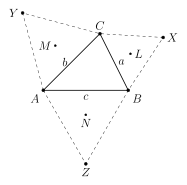
- Consider the equilateral triangle \(CYA\), notice that \(YM\) is a vertical line of symmetry, and \(\angle ACM = 30^\circ\) therefore \(\frac{AC/2}{CM} = \cos 30^\circ \Rightarrow |CM| = \frac{b}{2} \cdot \frac{2}{\sqrt{3}} = \frac{b}{\sqrt{3}}\). Similarly \(|CL| = \frac{a}{\sqrt{3}}\)
- \(\,\) \begin{align*} && |LM|^2 &= |CM|^2 + |CL|^2 - 2 \cdot |CM| \cdot |CL| \cdot \cos \angle MCL \\ &&&= \frac{b^2}{3} + \frac{a^2}{3} - 2 \frac{ab}{3} \cos \left (\angle CMA + \angle CAB + \angle BCL \right) \\ &&&= \frac13 \left (b^2 + a^2 - 2ab \cos \left ( \frac{\pi}{3} + \angle CAB \right) \right) \\ &&&= \frac13 \left (b^2 + a^2 - ab \cos \left ( \angle CAB \right) + \sqrt{3}ab \sin \angle CAB \right) \\ &&&= \frac13 \left (b^2 + a^2 - ab \cos \angle CAB + 2\sqrt{3} \Delta\right) \\ &&&= \frac13 \left (b^2 + a^2 - ab \left (\frac{a^2+b^2-c^2}{2ab} \right) + 2\sqrt{3} \Delta\right) \\ &&&= \frac13 \left ( \frac12(a^2+b^2+c^2) + 2\sqrt{3}\Delta \right) \\ \Rightarrow && 6|LM|^2 &= a^2 + b^2 + c^2 + 4\sqrt{3} \Delta \end{align*} However, nothing in our reasoning here was special about \(LM\), therefore \(LN\) and \(MN\) also equal this value, and we find that the triangle is equilateral. The area of equilateral triangle [LMN] is \(\frac{\sqrt{3}}4 |LM|^2\), ie \begin{align*} &&& \text{areas are equal} \\ \Leftrightarrow && \Delta &= \frac{\sqrt{3}}4 |LM|^2 \\ &&&= \frac{\sqrt{3}}4 \frac{a^2+b^2+c^2+4\sqrt{3}\Delta}{6} \\ &&&= \frac{\sqrt{3}}{24} (a^2+b^2+c^2) + \frac12 \Delta \\ \Leftrightarrow && \Delta &= \frac{\sqrt{3}}{12}(a^2+b^2+c^2)\\ \Leftrightarrow && 4\sqrt{3}\Delta &=a^2+b^2+c^2\\ \end{align*}
- \(\,\) \begin{align*} && (a-b)^2 &= -2ab(1 - \cos(C - 60^{\circ})) \\ \Leftrightarrow && a^2+b^2 - 2ab &=-2ab + 2ab \cos(C - 60^{\circ}) \\ \Leftrightarrow && a^2+b^2 &= ab \cos C+\sqrt{3}ab\sin C \\ \Leftrightarrow && a^2+b^2 &= ab \frac{a^2+b^2-c^2}{2ab} + 2\sqrt{3} \Delta \\ \Leftrightarrow && a^2+b^2+c^2 &= 4\sqrt{3}\Delta \end{align*} Since the LHS is non-positive, and the RHS is positive, the only way they can be equal is if they are both \(0\), ie \(a=b\) and \(C = 60^{\circ}\) ie \(ABC\) is equilateral.
2012 Paper 2 Q6
A cyclic quadrilateral \(ABCD\) has sides \(AB\), \(BC\), \(CD\) and \(DA\) of lengths \(a\), \(b\), \(c\) and \(d\), respectively. The area of the quadrilateral is \(Q\), and angle \(DAB\) is \(\theta\). Find an expression for \(\cos\theta\) in terms of \(a\), \(b\), \(c\) and \(d\), and an expression for \(\sin\theta\) in terms of \(a\), \(b\), \(c\), \(d\) and \(Q\). Hence show that \[ 16Q^2 = 4(ad+bc)^2 - (a^2+d^2-b^2-c^2)^2 \,, \] and deduce that \[ Q^2 = (s-a)(s-b)(s-c)(s-d)\,, \] where \(s= \frac12(a+b+c+d)\). Deduce a formula for the area of a triangle with sides of length \(a\), \(b\) and \(c\).
Solution:

2009 Paper 2 Q1
Two curves have equations \(\; x^4+y^4=u\;\) and \(\; xy = v\;\), where \(u\) and \(v\) are positive constants. State the equations of the lines of symmetry of each curve. The curves intersect at the distinct points \(A\), \(B\), \(C\) and \(D\) (taken anticlockwise from \(A\)). The coordinates of \(A\) are \((\alpha,\beta)\), where \(\alpha > \beta > 0\). Write down, in terms of \(\alpha\) and \(\beta\), the coordinates of \(B\), \(C\) and \(D\). Show that the quadrilateral \(ABCD\) is a rectangle and find its area in terms of \(u\) and \(v\) only. Verify that, for the case \(u=81\) and \(v=4\), the area is \(14\).
Solution: The curve \(x^4 + y^4 = u\) has lines of symmetry:
- \(y = 0\)
- \(x = 0\)
- \(y = x\)
- \(y = -x\)
- \(y = x\)
- \(y = -x\)

2006 Paper 1 Q2
A small goat is tethered by a rope to a point at ground level on a side of a square barn which stands in a large horizontal field of grass. The sides of the barn are of length \(2a\) and the rope is of length \(4a\). Let \(A\) be the area of the grass that the goat can graze. Prove that \(A\le14\pi a^2\) and determine the minimum value of \(A\).
Solution:

2005 Paper 2 Q5
The angle \(A\) of triangle \(ABC\) is a right angle and the sides \(BC\), \(CA\) and \(AB\) are of lengths \(a\), \(b\) and \(c\), respectively. Each side of the triangle is tangent to the circle \(S_1\) which is of radius \(r\). Show that \(2r = b+c-a\). Each vertex of the triangle lies on the circle~\(S_2\). The ratio of the area of the region between~\(S_1\) and the triangle to the area of \(S_2\) is denoted by \(R\,\). Show that $$ \pi R = -(\pi-1)q^2 + 2\pi q -(\pi+1) \;, $$ where \(q=\dfrac{b+c}a\,\). Deduce that $$ R\le \frac1 {\pi( \pi - 1)} \;. $$
1992 Paper 3 Q10
Sketch the curve \(C\) whose polar equation is \[ r=4a\cos2\theta\qquad\mbox{ for }-\tfrac{1}{4}\pi<\theta<\tfrac{1}{4}\pi. \] The ellipse \(E\) has parametric equations \[ x=2a\cos\phi,\qquad y=a\sin\phi. \] Show, without evaluating the integrals, that the perimeters of \(C\) and \(E\) are equal. Show also that the areas of the regions enclosed by \(C\) and \(E\) are equal.
Solution:

1991 Paper 1 Q4
\(\ \)
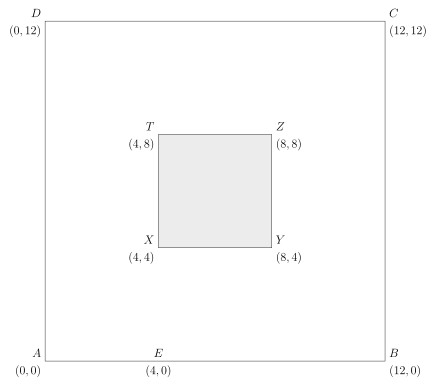
- as small as possible,
- as large as possible.
Solution:
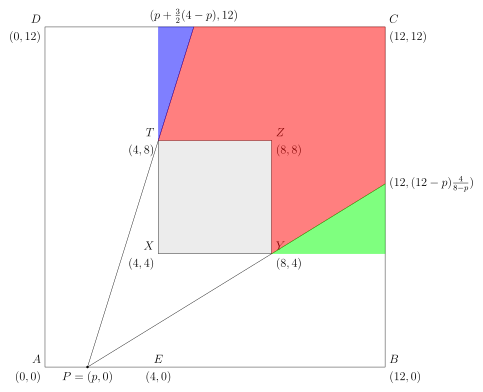
- Since the area not visible is increasing as \(p\) increases, we would like \(p\) to be as large as possible, ie \(p = 4\).
- Similarly, he can see the most when \(p =0\)
1990 Paper 1 Q1
\(\,\)
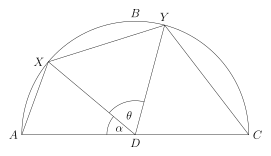
Solution: The area for \(\alpha\) fixed is \(\frac12 r^2 \sin \alpha + \frac12 r^2 \sin \theta + \frac12 r^2 \sin (\pi - \theta - \alpha)\) So we wish to maximise \(V = \sin \theta + \sin(\pi - \theta-\alpha)\) \begin{align*} && V &= \sin \theta + \sin(\pi - \theta-\alpha)\\ &&&= 2\sin \l \frac{\pi-\alpha}2\r\cos \l \frac{2\theta + \alpha - \pi}{2}\r \end{align*} The largest \(\cos\) can be is \(1\) when \(\displaystyle 2\theta + \alpha - \pi = 0 \Rightarrow \theta = \frac{\pi-\alpha}2\). (ie we split the remaining area exactly in half). We are now trying to maximise \(W = \sin \alpha + 2 \sin \frac{\pi - \alpha}2\) ie \begin{align*} && W &= \sin \alpha + 2 \cos \frac{\alpha}{2} \\ \Rightarrow && \frac{\d W}{\d \alpha} &= \cos \alpha-\sin \frac{\alpha}{2} \\ &&&= 1-2 \sin^2 \frac{\alpha}{2} - \sin \frac{\alpha}{2} \\ &&&= (1+\sin \frac{\alpha}{2})(1-2\sin \frac{\alpha}{2}) \end{align*} Therefore \(\frac{\alpha}{2} = -\frac{3\pi}{2}, \frac{\alpha}{2} = \frac{\pi}{6}, \frac{5\pi}{6} \Rightarrow \alpha = -3\pi, \frac{\pi}{3}, \frac{5\pi}{3}\). The only turning point in our range is \(\frac{\pi}{3}\). This is obvious a a maximum by symmetry or checking the end points, but we could also check the second derivative \(\frac{\d^2 W}{\d \alpha^2} = -\sin \frac{\pi}{3}-\cos \frac{\pi}{3} < 0\) so we have a maximum. Therefore the largest possible area is: \(\displaystyle \frac{3\sqrt{3}}{4}r^2\)
1990 Paper 1 Q6
Let \(ABCD\) be a parallelogram. By using vectors, or otherwise, prove that:
- \(AB^{2}+BC^{2}+CD^{2}+DA^{2}=AC^{2}+BD^{2}\);
- \(|AC^{2}-BD^{2}|\) is 4 times the area of the rectangle whose sides are any side of the parallelogram and the projection of an adjacent side on that side.
Solution: Set up coordinates such that \(A\) at the origin and \(\vec{AB} = \mathbf{x}\) and \(\vec{AD} = \mathbf{y}\) and so \(\vec{AC} = \mathbf{x}+\mathbf{y}\)
- \begin{align*} AC^2 + BD^2 &= (\mathbf{x}+\mathbf{y})\cdot (\mathbf{x}+\mathbf{y}) + (\mathbf{y}-\mathbf{x})\cdot(\mathbf{y}-\mathbf{x}) \\ &= 2\mathbf{x}\cdot\mathbf{x} + 2\mathbf{y}\cdot\mathbf{y} \\ &= AB^2 + CD^2 +AD^2 + BC^2 \end{align*}
- \begin{align*} AC^2 -BD^2 &= (\mathbf{x}+\mathbf{y})\cdot (\mathbf{x}+\mathbf{y}) - (\mathbf{y}-\mathbf{x})\cdot(\mathbf{y}-\mathbf{x}) \\ &= 4 \mathbf{x}\cdot \mathbf{y} \end{align*} \(\mathbf{x}\cdot\mathbf{y} = |\mathbf{x}||\mathbf{y}|\cos \theta\) which is exactly the lenth of one side mutliplied by the length of the projection to that same side.
1990 Paper 3 Q6
The transformation \(T\) from \(\begin{pmatrix} x \\ y \end{pmatrix}\) to \(\begin{pmatrix} X \\ Y \end{pmatrix}\) is given by \[ \begin{pmatrix}X\\ Y \end{pmatrix}=\frac{2}{5}\begin{pmatrix}9 & -2\\ -2 & 6 \end{pmatrix}\begin{pmatrix}x\\ y \end{pmatrix}. \] Show that \(T\) leaves the vector \(\begin{pmatrix} 1\\ 2 \end{pmatrix}\) unchanged in direction but multiplied by a scalar, and that \(\begin{pmatrix} 2\\ -1 \end{pmatrix}\) is similarly transformed. The circle \(C\) whose equation is \(x^{2}+y^{2}=1\) transforms under \(T\) to a curve \(E\). Show that \(E\) has equation \[ 8X^{2}+12XY+17Y^{2}=80, \] and state the area of the region bounded by \(E\). Show also that the greatest value of \(X\) on \(E\) is \(2\sqrt{17/5}.\) Find the equation of the tangent to \(E\) at the point which corresponds to the point \(\frac{1}{5}(3,4)\) on \(C\).
Solution: \begin{align*} T\begin{pmatrix}1\\ 2 \end{pmatrix} &= \frac{2}{5}\begin{pmatrix}9 & -2\\ -2 & 6 \end{pmatrix}\begin{pmatrix}1\\ 2 \end{pmatrix} \\ &= \frac25\begin{pmatrix}9 - 4\\ -2+12 \end{pmatrix} \\ &= \begin{pmatrix}2\\ 4 \end{pmatrix} \\ &= 2 \begin{pmatrix}1\\ 2 \end{pmatrix} \end{align*} \begin{align*} T\begin{pmatrix}1\\ 2 \end{pmatrix} &= \frac{2}{5}\begin{pmatrix}9 & -2\\ -2 & 6 \end{pmatrix}\begin{pmatrix}2\\ -1 \end{pmatrix} \\ &= \frac25\begin{pmatrix}18+2\\ -4-6 \end{pmatrix} \\ &= \begin{pmatrix}8\\ -4 \end{pmatrix} \\ &= 4 \begin{pmatrix}2\\ -1 \end{pmatrix} \end{align*} Consider $T^{-1} = \frac{5}{2} \frac{1}{50}\begin{pmatrix}6 & 2\\ 2 & 9 \end{pmatrix}\(, so \)T^{-1} \begin{pmatrix}X\\ Y \end{pmatrix} = \begin{pmatrix}x\\ y \end{pmatrix}$ and so: \begin{align*} x^2 + y^2 & = \begin{pmatrix}x& y \end{pmatrix}\begin{pmatrix}x\\ y \end{pmatrix} \\ &= \begin{pmatrix}X& Y \end{pmatrix} (T^{-1})^T T^{-1} \begin{pmatrix}X\\ Y \end{pmatrix} \\ &= \frac{1}{400}\begin{pmatrix}X& Y \end{pmatrix}\begin{pmatrix}6 & 2\\ 2 & 9 \end{pmatrix}\begin{pmatrix}6 & 2\\ 2 & 9 \end{pmatrix} \begin{pmatrix}X\\ Y \end{pmatrix} \\ &= \frac{1}{400}\begin{pmatrix}X& Y \end{pmatrix}\begin{pmatrix}6 & 2\\ 2 & 9 \end{pmatrix} \begin{pmatrix}6X+2Y\\ 2X+9Y \end{pmatrix} \\ &= \frac{1}{400}\begin{pmatrix}X& Y \end{pmatrix} \begin{pmatrix}6(6X+2Y)+2(2X+9Y)\\ 2(6X+2Y)+9(2X+9Y) \end{pmatrix} \\ &= \frac{1}{400}\begin{pmatrix}X& Y \end{pmatrix} \begin{pmatrix}40X+30Y\\ 30X +85Y \end{pmatrix} \\ &= \frac{1}{80}\begin{pmatrix}X& Y \end{pmatrix} \begin{pmatrix}8X+6Y\\ 6X +17Y \end{pmatrix} \\ &= \frac{1}{80} \l 8X^2 + 12XY + 17Y^2\r \end{align*} Therefore \(8X^2 + 12XY + 17Y^2 = 80\). The area will be \(\det T \cdot \pi = \frac{4}{25} \cdot 50 \cdot \pi = 8 \pi\). Differentiating we obtain \(2 \cdot 8 \cdot X \cdot \frac{dX}{dY} + 2 \cdot 6 \cdot X + 2 \cdot 6 \cdot Y \cdot \frac{dX}{dY} + 2 \cdot 17 Y \Rightarrow \frac{dX}{dY} = -\frac{6X + 17Y}{8X+6Y}\), at a maximum (or minimum, \(6X = -17Y\)). Therefore \begin{align*} \Rightarrow && 8X^2 + 12 \cdot \frac{6}{17}X^2 + 17 ( -\frac{6}{17} X)^2 &= 80 \\ \Rightarrow && \frac{100}{17}X^2 &= 80 \\ \Rightarrow &&X^2 &= \frac{17 \cdot 4}{5} \\ \Rightarrow && |X| = 2 \sqrt {\frac{17}{5}} \end{align*} The point \(\frac15 (3,4)\) maps to \begin{align*} \frac{2}{5}\frac{1}{5}\begin{pmatrix}9 & -2\\ -2 & 6 \end{pmatrix}\begin{pmatrix}3\\ 4 \end{pmatrix} &= \frac{2}{25} \begin{pmatrix}19\\ 18 \end{pmatrix} \end{align*} So the point is \((\frac{38}{25}, \frac{36}{25})\), with gradient \(\frac{dY}{dX} = -\frac{8X+6Y}{6X + 17Y}\) which is \(-\frac{8 \cdot 19+6 \cdot 18}{6\cdot 19 + 17 \cdot 18} = -\frac{13}{21}\) therefore the equation is \(21Y+13X = 50\)
1989 Paper 1 Q1

Solution: \(AG = r\), therefore the area is: \begin{align*} A &= [AHG] - 2*[ABC] + [CDE] \\ &= \frac12 \pi r^2 - \pi h^2 + \frac12 \pi (r-2h)^2 \\ &= \frac12 \pi \l r^2 - 2h^2 + r^2 -4rh+4h^2 \r \\ &= \frac12 \pi \l 2r^2 -4rh + 2h^2\r \\ &= \pi (r-h)^2 \end{align*} This is the same area as a circle radius \(r-h\) But \(HD = r + (r-2d) = 2(r-d)\), ie the circle with diameter \(HD\) has radius \(r-h\) as required. Suppose \(A = (-h, 0), C = (h, 0), B = (0, h)\) then our parabola is \(y = \frac1{h}(h^2-x^2)\)

1987 Paper 3 Q8
Show that, if the lengths of the diagonals of a parallelogram are specified, then the parallogram has maximum area when the diagonals are perpendicular. Show also that the area of a parallelogram is less than or equal to half the square of the length of its longer diagonal. The set \(A\) of points \((x,y)\) is given by \begin{alignat*}{1} \left|a_{1}x+b_{1}y-c_{1}\right| & \leqslant\delta,\\ \left|a_{2}x+b_{2}y-c_{2}\right| & \leqslant\delta, \end{alignat*} with \(a_{1}b_{2}\neq a_{2}b_{1}.\) Sketch this set and show that it is possible to find \((x_{1},y_{1}),(x_{2},y_{2})\in A\) with \[ (x_{1}-x_{2})^{2}+(y_{1}-y_{2})^{2}\geqslant\frac{8\delta^{2}}{\left|a_{1}b_{2}-a_{2}b_{1}\right|}. \]
Solution: In a parallelogram the diagonals meet at their mid points. Fixing one diagonal, we can look at the two triangles formed by the other diagonal. Suppose the angle between them is \(\theta\). Then the area of the triangles will be \(\frac12 \frac{l_1}{2} \frac{l_2}2 \sin \theta+\frac12 \frac{l_1}{2} \frac{l_2}2 \sin (\pi -\theta) = \frac{l_1l_2}{4} \sin \theta\). This will be true on both sides. Therefore we can maximise this area by setting \(\theta = \frac{\pi}{2}\).
