Problems
Filters
11 problems found
2018 Paper 1 Q10
A train is made up of two engines, each of mass \(M\), and \(n\) carriages, each of mass \(m\). One of the engines is at the front of the train, and the other is coupled between the \(k\)th and \((k+1)\)th carriages. When the train is accelerating along a straight, horizontal track, the resistance to the motion of each carriage is \(R\) and the driving force on each engine is \(D\), where \(2D >nR\,\). The tension in the coupling between the engine at the front and the first carriage is \(T\).
- Show that \[ T = \frac{n(mD+MR)}{nm+2M}\,. \]
- Show that \(T\) is greater than the tension in any other coupling provided that \(k> \frac12n\,\).
- Show also that, if \(k> \frac12n\,\), then at least one of the couplings is in compression (that is, there is a negative tension in the coupling).
Solution:
- \(\,\)
\begin{align*} \text{N2}(\leftarrow, \text{first engine}): && D-T &= Ma \\ \text{N2}(\leftarrow, \text{rest of train}): && T-nR+D &= (M+nm)a \\ \Rightarrow && \frac{D-T}{M} &= \frac{T+D-nR}{M+nm} \\ \Rightarrow && T \left ( \frac{1}{M+nm}+\frac{1}{M} \right) &= \frac{D}{M} + \frac{nR-D}{M+nm} \\ \Rightarrow && T \left ( 2M+nm\right) &= DM +Dnm + nRM - DM \\ &&&= n(mD+MR) \\ \Rightarrow && T &= \frac{n(mD+MR)}{2M+nm} \end{align*}
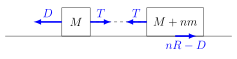
- The greatest coupling must occur behind an engine, because each carriage behind an engine acts as a drag.
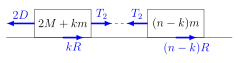
Therefore we need only consider the couple between the second engine and the rest of the carriages:
\begin{align*} \text{N2}(\leftarrow, \text{up to second engine}): && 2D - T_2 - kR &= (2M+km)a \\ \text{N2}(\leftarrow, \text{everything else}): && T_2 - (n-k)R &= (n-k)ma \\ \Rightarrow && \frac{2D-T_2-kR}{2M+km} &= \frac{T_2-(n-k)R}{(n-k)m} \\ \Rightarrow && T_2 \left (\frac{1}{(n-k)m} + \frac{1}{2M+km} \right) &= \frac{2D-kR}{2M+km} + \frac{R}{m} \\ \Rightarrow && T_2 \left (2M+ nm \right) &= (2D-kR)m(n-k) + R(2M+km)(n-k) \\ \Rightarrow && T_2 &= \frac{(n-k)\left (2Dm+2RM \right)}{2M+nm} \\ &&&= \frac{2(n-k)(mD + MR)}{2M+nm} \end{align*} Therefore \(T > T_2\) provided \(2(n-k) < n \Leftrightarrow k > \frac12n\)
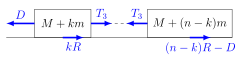
- If there is a coupling which is in negative tension, it must be between the two engines. In particular, if there is one, there must be one directly in front of the first engine.
\begin{align*} \text{N2}(\leftarrow, \text{before second engine}): && D - T_3 - kR &= (M+km)a \\ \text{N2}(\leftarrow, \text{everything else}): && T_3 +D- (n-k)R &= (M+(n-k)m)a \\ \Rightarrow && \frac{D-T_3-kR}{M+km} &= \frac{T_3+D-(n-k)R}{M+(n-k)m} \\ \Rightarrow && T_3 \left ( \frac{1}{M+(n-k)m} + \frac{1}{M+km} \right) &= \frac{D-(n-k)R}{M+(n-k)m}+\frac{kR-D}{M+km} \\ \Rightarrow && T_3 (2M+nm) &= (D-(n-k)R)(M+km)+(kR-D)(M+(n-k)m) \\ &&&= D(M+km-M-(n-k)m) + R(kM+k(n-k)m-(n-k)M-k(n-k)m) \\ &&&= D(n-2k)m+RM(2k-n)m \\ &&&= (n-2k)m(D-RM) \end{align*} Therefore \(T_3\) is negative if \(k > \frac12n\) so there are some connections in compression.
2018 Paper 2 Q11
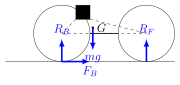
The axles of the wheels of a motorbike of mass \(m\) are a distance \(b\) apart. Its centre of mass is a horizontal distance of \(d\) from the front axle, where \(d < b\), and a vertical distance \(h\) above the road, which is horizontal and straight. The engine is connected to the rear wheel. The coefficient of friction between the ground and the rear wheel is \(\mu\), where \(\mu < b/h\), and the front wheel is smooth. You may assume that the sum of the moments of the forces acting on the motorbike about the centre of mass is zero. By taking moments about the centre of mass show that, as the acceleration of the motorbike increases from zero, the rear wheel will slip before the front wheel loses contact with the road if \[ \mu < \frac {b-d}h\,. \tag{*} \] If the inequality \((*)\) holds and the rear wheel does not slip, show that the maximum acceleration is \[ \frac{ \mu dg}{b-\mu h} \,. \] If the inequality \((*)\) does not hold, find the maximum acceleration given that the front wheel remains in contact with the road.
Solution:
2016 Paper 3 Q11
A car of mass \(m\) travels along a straight horizontal road with its engine working at a constant rate \(P\). The resistance to its motion is such that the acceleration of the car is zero when it is moving with speed \(4U\).
- Given that the resistance is proportional to the car's speed, show that the distance \(X_1\) travelled by the car while it accelerates from speed \(U\) to speed \(2U\), is given by \[ \lambda X_1 = 2\ln \tfrac 9 5 - 1 \,, \] where \(\lambda= P/(16mU^3)\).
- Given instead that the resistance is proportional to the square of the car's speed, show that the distance \(X_2\) travelled by the car while it accelerates from speed \(U\) to speed \(2U\) is given by \[ \lambda X_2 = \tfrac43 \ln \tfrac 98 \,. \]
- Given that \(3.17<\ln 24 < 3.18\) and \(1.60<\ln 5 < 1.61\), determine which is the larger of \(X_1\) and \(X_2\).
Solution:
- \(\,\) \begin{align*} && F_{res} &= kv \\ && P &= Fv \\ v = 4U: && 0 &= F-F_{res} \\ \Rightarrow && 0 &= \frac{P}{4U} - 4Uk \\ \Rightarrow && k &= \frac{P}{16U^2} \\ \\ &&m v \frac{\d v}{\d x}&= \frac{P}{v} - \frac{P}{16U^2}v \\ \Rightarrow && X_1 &= \int_{v=U}^{v=2U} \frac{16U^2mv^2}{P(16U^2-v^2)} \d v \\ v = Ut&& &= \frac{16mU^2}{P} \int_{t=1}^{t=2}\left ( \frac{t^2}{16-t^2} \right)U\d t \\ &&&= \frac{16mU^3}{P} \int_1^2 \left ( -1 + \frac{16}{16-t^2} \right) \d t \\ &&&= \frac{16mU^3}{P} \int_1^2 \left ( -1 +\frac{2}{4+t} +\frac{2}{4-t} \right) \d t \\ &&&= \frac{1}{\lambda}\left (-1 + 2\ln(6)-2\ln(2)-2\ln(5)+2\ln(3) \right) \\ \Rightarrow && \lambda X_1 &= 2\ln \tfrac95-1 \end{align*}
- \(\,\) \begin{align*} && F_{res} = kv^2 \\ v = 4U: && 0 &= \frac{P}{4U} - 16U^2k \\ \Rightarrow && k &= \frac{P}{64U^3} \\ \\ && mv \frac{\d v}{\d x} &= \frac{P}{v} - \frac{P}{64U^3}v^2 \\ \Rightarrow && X_2 &= \int_{v=U}^{v=2U} \frac{64U^3mv^2}{P(64U^3-v^3)} \d v \\ &&&= \frac{64U^3m}{P} \int_{v=U}^{v=2U} \frac{v^2}{64U^3-v^3} \d v\\ v = Ut &&&= \frac{64U^3m}{P} \int_{t=1}^{t=2} \frac{U^2t^2}{64U^3-U^3v^3} U \d t\\ &&&= \frac{4}{\lambda} \int_1^2 \frac{t^2}{64-t^3} \d t \\ &&&= \frac{4}{\lambda} \left [ -\frac13\ln(64-t^3) \right]_1^2 \\ &&&= \frac{4}{3\lambda} \ln (63/56) \\ \Rightarrow && \lambda X_2 &= \tfrac43 \ln \tfrac98 \end{align*}
- \(\,\) \begin{align*} && 2\ln \tfrac95 - 1 &\overset{?}{>} \frac43 \ln \frac98 \\ \Leftrightarrow && 4 \ln 3 - 2\ln 5 - 1 &\overset{?}{>} \frac83\ln 3 -4 \ln 2 \\ \Leftrightarrow && \frac43(3\ln 3 + 3\ln 2 - 2 \ln 3) &\overset{?}{>} 2 \ln 5 + 1\\ \Leftrightarrow && \frac43\ln 24 &\overset{?}{>} 2 \ln 5 + 1\\ \end{align*} The \(LHS\) is \(>4.22\). The \(RHS\) is \(< 4.22\), and therefore our inequality holds, in particular, \(X_1 > X_2\).
2015 Paper 2 Q10
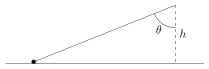
A particle of mass \(m\) is pulled along the floor of a room in a straight line by a light string which is pulled at constant speed \(V\) through a hole in the ceiling. The floor is smooth and horizontal, and the height of the room is \(h\). Find, in terms of \(V\) and \(\theta\), the speed of the particle when the string makes an angle of \(\theta\) with the vertical (and the particle is still in contact with the floor). Find also the acceleration, in terms of \(V\), \(h\) and \(\theta\). Find the tension in the string and hence show that the particle will leave the floor when \[ \tan^4\theta = \frac{V^2}{gh}\,. \]
Solution:
2014 Paper 1 Q11
The diagrams below show two separate systems of particles, strings and pulleys.In both systems, the pulleys are smooth and light, the strings are light and inextensible, the particles move vertically and the pulleys labelled with \(P\) are fixed. The masses of the particles are as indicated on the diagrams.
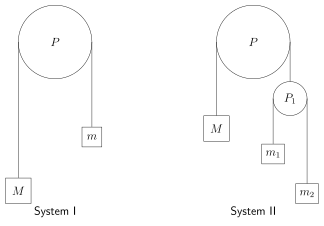
- For system I show that the acceleration, \(a_1\), of the particle of mass \(M\), measured in the downwards direction, is given by \[ a_1= \frac{M-m}{M+m} \, g \,, \] where \(g\) is the acceleration due to gravity. Give an expression for the force on the pulley due to the tension in the string.
- For system II show that the acceleration, \(a_2\), of the particle of mass \(M\), measured in the downwards direction, is given by \[ a_2= \frac{ M - 4\mu}{M+4\mu}\,g \,, \] where \(\mu = \dfrac{m_1m_2}{m_1+m_2}\). In the case \(m= m_1+m_2\), show that \(a_1= a_2\) if and only if \(m_1=m_2\).
Solution:
- \(\,\)
\begin{align*} \text{N2}(\uparrow, m): && T - mg &= ma_1 \\ \text{N2}(\uparrow, M): && T-Mg &= -Ma_1 \\ \Rightarrow && (M-m)g &= a_1(m+M) \\ \Rightarrow && a_1 &= \frac{M-m}{M+m}g \\ && T &= mg + ma_1 \\ &&&= \frac{2mM}{M+m}g \end{align*}
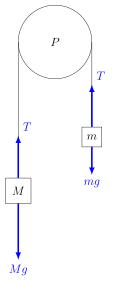
- System II is the same as system I, but with \(m\) replaced with \(2\frac{T}{g} = \frac{4mM}{M+m}\). In particular, this means that: \begin{align*} && a_2 &= \frac{M - \frac{4m_1m_2}{m_1+m_2}}{M + \frac{4m_1m_2}{m_1+m_2}} g \\ &&&= \frac{M-4\mu}{M+4\mu}g \end{align*} If \(m = m_1 + m_2\) then \begin{align*} && a_1 &= a_2 \\ \Leftrightarrow && \frac{M-m_1-m_2}{M+m_1+m_2} &= \frac{M - \frac{4m_1m_2}{m_1+m_2}}{M + \frac{4m_1m_2}{m_1+m_2}} \\ \Leftrightarrow && \frac{M-m_1-m_2}{M+m_1+m_2} &= \frac{M(m_1+m_2) -4m_1m_2}{M(m_1+m_2) + 4m_1m_2} \\ \Leftrightarrow && M^2(m_1+m_2)+4m_1m_2M &- M(m_1+m_2)^2 - 4m_1m_2(m_1+m_2) \\ &&\quad \quad = M^2(m_1+m_2) - 4m_1m_2M &+M(m_1+m_2)^2-4m_1m_2(m_1+m_2) \\ \Leftrightarrow && 8m_1m_2M&= 2M(m_1+m_2)^2 \\ \Leftrightarrow && 0 &= (m_1-m_2)^2 \\ \Leftrightarrow && m_1 &= m_2 \end{align*}
2014 Paper 2 Q11
A small smooth ring \(R\) of mass \(m\) is free to slide on a fixed smooth horizontal rail. A light inextensible string of length~\(L\) is attached to one end,~\(O\), of the rail. The string passes through the ring, and a particle~\(P\) of mass~\(km\) (where \(k>0\)) is attached to its other end; this part of the string hangs at an acute angle \(\alpha\) to the vertical and it is given that \(\alpha\) is constant in the motion. Let \(x\) be the distance between \(O\) and the ring. Taking the \(y\)-axis to be vertically upwards, write down the Cartesian coordinates of~\(P\) relative to~\(O\) in terms of \(x\), \(L\) and~\(\alpha\).
- By considering the vertical component of the equation of motion of \(P\), show that \[ km\ddot x \cos\alpha = T \cos\alpha - kmg\,, \] where \(T\) is the tension in the string. Obtain two similar equations relating to the horizontal components of the equations of motion of \(P\) and \(R\).
- Show that \(\dfrac {\sin\alpha}{(1-\sin\alpha)^2_{\vphantom|}} = k\), and deduce, by means of a sketch or otherwise, that motion with \(\alpha\) constant is possible for all values of~\(k\).
- Show that \(\ddot x = -g\tan\alpha\,\).
2012 Paper 3 Q11
One end of a thin heavy uniform inextensible perfectly flexible rope of length \(2L\) and mass \(2M\) is attached to a fixed point \(P\). A particle of mass \(m\) is attached to the other end. Initially, the particle is held at \(P\) and the rope hangs vertically in a loop below \(P\). The particle is then released so that it and a section of the rope (of decreasing length) fall vertically as shown in the diagram.
2010 Paper 1 Q10
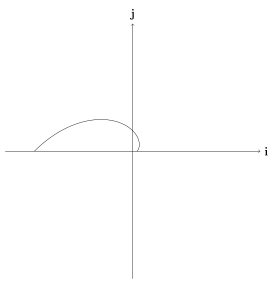
A particle \(P\) moves so that, at time \(t\), its displacement \( \bf r \) from a fixed origin is given by \[ {\bf r} =\left( \e^{t}\cos t \right) {\bf i}+ \left(\e^t \sin t\right) {\bf j}\,.\] Show that the velocity of the particle always makes an angle of \(\frac{\pi}{4}\) with the particle's displacement, and that the acceleration of the particle is always perpendicular to its displacement. Sketch the path of the particle for \(0\le t \le \pi\). A second particle \(Q\) moves on the same path, passing through each point on the path a fixed time \(T\) after \(P\) does. Show that the distance between \(P\) and \(Q\) is proportional to \(\e^{t}\).
Solution: \begin{align*} && {\bf r} &=\left( \e^{t}\cos t \right) {\bf i}+ \left(\e^t \sin t\right) {\bf j} \\ \Rightarrow && \dot{\bf r} &= \left( \e^{t}\cos t -\e^t \sin t\right) {\bf i}+ \left(\e^t \sin t+\e^t \cos t\right) {\bf j} \\ \Rightarrow && \mathbf{r}\cdot\dot{ \mathbf{r}} &= e^{2t}(\cos^2 t - \sin t \cos t) + e^{2t}(\sin^2 t+ \sin t \cos t) \\ &&&= e^{2t} (\cos^2 t + \sin ^2 t)\\ &&&= e^{2t} \\ \\ && | {\bf r}| &= e^{t} \\ && |{\bf \dot{r}}| &= e^t \sqrt{(\cos t - \sin t)^2 + (\sin t + \cos t)^2} \\ &&&= e^t \sqrt{2 \cos^2 t + 2 \sin^2 t} \\ &&&= \sqrt{2} e^t \\ \\ \Rightarrow && \frac{\mathbf{r}\cdot\dot{ \mathbf{r}}}{ |{\bf {r}}| |{\bf \dot{r}}|} &= \frac{e^{2t}}{\sqrt{2}e^te^t} \\ &&&= \frac{1}{\sqrt{2}} \end{align*} Therefore the angle between the velocity and displacement is \(\frac{\pi}{4}\). \begin{align*} && \ddot{\bf{r}} &= \left( \e^{t}(\cos t - \sin t) - \e^t (\sin t + \cos t)\right) {\bf i}+ \left(\e^t (\sin t + \cos t) + \e^t(\cos t - \sin t)\right) {\bf j} \\ &&&= \left ( -2\e^{t} \sin t \right) {\bf i}+ \left ( 2\e^{t} \cos t \right) {\bf j} \\ \Rightarrow && {\bf r} \cdot \ddot{\bf{r}} &= 2e^{2t} \left ( -\sin t \cos t + \sin t \cos t \right) \\ &&&= 0 \end{align*} Therefore the acceleration is perpendicular.
2006 Paper 1 Q9
A block of mass \(4\,\)kg is at rest on a smooth, horizontal table. A smooth pulley \(P\) is fixed to one edge of the table and a smooth pulley \(Q\) is fixed to the opposite edge. The two pulleys and the block lie in a straight line. Two horizontal strings are attached to the block. One string runs over pulley \(P\); a particle of mass \(x\,\)kg hangs at the end of this string. The other string runs over pulley \(Q\); a particle of mass \(y\,\)kg hangs at the end of this string, where \(x > y\) and \(x + y = 6\,\). The system is released from rest with the strings taut. When the \(4\,\)kg block has moved a distance \(d\), the string connecting it to the particle of mass \(x\,\)kg is cut. Show that the time taken by the block from the start of the motion until it first returns to rest (assuming that it does not reach the edge of the table) is \(\sqrt{d/(5g)\,} \,\f(y)\), where \[ \f(y)= \frac{10}{ \sqrt{6-2y}}+ \left(1 + \frac{4}{ y} \right) \sqrt {6 -2y}. \] Calculate the value of \(y\) for which \(\f'(y)=0\).
2000 Paper 2 Q10
A long light inextensible string passes over a fixed smooth light pulley. A particle of mass 4~kg is attached to one end \(A\) of this string and the other end is attached to a second smooth light pulley. A long light inextensible string \(BC\) passes over the second pulley and has a particle of mass 2 kg attached at \(B\) and a particle of mass of 1 kg attached at \(C\). The system is held in equilibrium in a vertical plane. The string \(BC\) is then released from rest. Find the accelerations of the two moving particles. After \(T\) seconds, the end \(A\) is released so that all three particles are now moving in a vertical plane. Find the accelerations of \(A\), \(B\) and \(C\) in this second phase of the motion. Find also, in terms of \(g\) and \(T\), the speed of \(A\) when \(B\) has moved through a total distance of \(0.6gT^{2}\)~metres.
1992 Paper 2 Q14
\noindent