Problems
Filters
28 problems found
2025 Paper 3 Q10
A plank \(AB\) of length \(L\) initially lies horizontally at rest along the \(x\)-axis on a flat surface, with \(A\) at the origin. Point \(C\) on the plank is such that \(AC\) has length \(sL\), where \(0 < s < 1\). End \(A\) is then raised vertically along the \(y\)-axis so that its height above the horizontal surface at time \(t\) is \(h(t)\), while end \(B\) remains in contact with the flat surface and on the \(x\)-axis. The function \(h(t)\) satisfies the differential equation $$\frac{d^2h}{dt^2} = -\omega^2 h, \text{ with } h(0) = 0 \text{ and } \frac{dh}{dt} = \omega L \text{ at } t = 0$$ where \(\omega\) is a positive constant. A particle \(P\) of mass \(m\) remains in contact with the plank at point \(C\).
- Show that the \(x\)-coordinate of \(P\) is \(sL\cos\omega t\), and find a similar expression for its \(y\)-coordinate.
- Find expressions for the \(x\)- and \(y\)-components of the acceleration of the particle.
- \(N\) and \(F\) are the upward normal and frictional components, respectively, of the force of the plank on the particle. Show that $$N = mg(1 - k\sin\omega t)\cos\omega t$$ and that $$F = mgsk\frac{\omega^2}{g}\tan\omega t$$ where \(k = \frac{L\omega^2}{g}\).
- The coefficient of friction between the particle and the plank is \(\tan\alpha\), where \(\alpha\) is an acute angle.
Show that the particle will not slip initially, provided \(sk < \tan\alpha\).
Show further that, in this case, the particle will slip
- while \(N\) is still positive,
- when the plank makes an angle less than \(\alpha\) to the horizontal.
Solution:
- Since we have \(h'' + \omega^2 h = 0\) we must have that \(h(t) = A \cos \omega t + B \sin \omega t\). The initial conditions tell us that \(A = 0\) and \(B = L\), so \(h(t) = L \sin \omega t\).
Therefore we can see the angle at \(B\) is \(\omega t\) and so \(P\) has \(y\)-coordinate \((1-s)L \sin \omega t\) and \(x\)-coordinate \(sL \cos \omega t\)
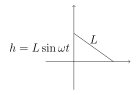
- If the position is \(\binom{sL \cos \omega t}{(1-s) L \sin \omega t}\) then the acceleration is \(-\omega^2 \binom{sL \cos \omega t}{(1-s) L \sin \omega t}\)
- \begin{align*} \text{N2}(\rightarrow): && - F\cos \omega t + N \sin \omega t &= -m\omega^2 sL \cos \omega t\\ \text{N2}(\uparrow): && -mg + F\sin \omega t + N \cos \omega t &= -m\omega^2 (1-s) L \sin \omega t \\ \Rightarrow && \begin{pmatrix} \cos \omega t & -\sin \omega t \\ \sin \omega t & \cos \omega t \end{pmatrix} \begin{pmatrix} F \\ N \end{pmatrix} &= \begin{pmatrix} m\omega^2 s L \cos \omega t \\ mg - m\omega^2(1-s)L \sin \omega t \end{pmatrix} \\ \Rightarrow && \begin{pmatrix}F \\ N \end{pmatrix} &= \begin{pmatrix} \cos \omega t & \sin \omega t \\ -\sin \omega t & \cos \omega t \end{pmatrix} \begin{pmatrix} m\omega^2 s L \cos \omega t \\ mg - m\omega^2(1-s)L \sin \omega t \end{pmatrix} \\ \Rightarrow && N &= m \omega^2 s L (-\sin \omega t \cos \omega t) + mg \cos \omega t - m \omega^2 (1-s)L \sin \omega t \cos \omega t \\ &&&=mg \cos \omega t - m \omega^2 L \sin \omega t \cos \omega t \\ &&&= mg \cos \omega t \left (1 - \frac{L \omega^2}{g} \sin \omega t \right) \\ &&&= mg (1 - k \sin \omega t) \cos \omega t \\ \Rightarrow && F &= m \omega^2 s L \cos^2 \omega t + mg \sin \omega t - m \omega^2 (1-s) L \sin ^2 \omega t \\ &&&= m \omega^2 s L + mg \sin \omega t - m \omega^2 L \sin^2 \omega t \\ &&&= mg \frac{\omega^2 L}{g} s + mg(1-\frac{\omega^2 L}{g} \sin \omega t)\sin \omega t \\ &&&= mg sk + mg(1-k \sin \omega t) \cos \omega t \tan \omega t \\ &&&= mgsk + N \tan \omega t \end{align*}
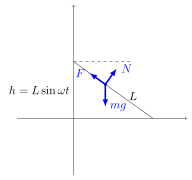
- The particle will not slip if \(F < \tan \alpha N\). When \(t = 0\), \(N = mg, F = mgsk\), but clearly \(sk < \tan \alpha \Rightarrow mgsk = F < \tan \alpha mg = \tan \alpha N\). The particle will slip when: \(F > \tan \alpha N\), but we have \(F = mgsk + N \tan \omega t\). Clearly when \(\omega t = \alpha\) we have reached a point where \(F > \tan \alpha N\). Therefore we must slip before we reach this point, ie at a point where the plank makes an angle of less than \(\alpha\) to the horizontal. Notice also that \(N\) changes sign when \(1-k \sin \omega t = 0\), however, to do this \(N\) must become very small, smaller than \(mgsk\), therefore we must slip before this point too. Since we slip before either condition occurs, we must be in a position when \(N\) is positive AND the plank still makes a shallow angle.
2017 Paper 3 Q9
Two particles \(A\) and \(B\) of masses \(m\) and \(2 m\), respectively, are connected by a light spring of natural length \(a\) and modulus of elasticity \(\lambda\). They are placed on a smooth horizontal table with \(AB\) perpendicular to the edge of the table, and \(A\) is held on the edge of the table. Initially the spring is at its natural length. Particle \(A\) is released. At a time \(t\) later, particle \(A\) has dropped a distance \(y\) and particle \( B\) has moved a distance \(x\) from its initial position (where \(x < a\)). Show that \( y + 2x= \frac12 gt^2\). The value of \(\lambda\) is such that particle \(B\) reaches the edge of the table at a time \(T\) given by \(T= \sqrt{6a/g\,}\,\). By considering the total energy of the system (without solving any differential equations), show that the speed of particle \(B\) at this time is \(\sqrt{2ag/3\,}\,\).
Solution: \begin{align*} \text{N2}(\downarrow): && mg -T &= m\ddot{y} \\ \text{N2}(\rightarrow): && T &= 2m\ddot{x} \\ \Rightarrow && g &= \ddot{y}+2\ddot{x} \\ \Rightarrow && \tfrac12gt^2 &= y + 2x \end{align*} At time \(T = \sqrt{6a/g}\), we have \(y + 2x = 3a\), note also that \(\dot{y}+2\dot{x} = gt\) \begin{array}{ccc} & \text{KE} & \text{GPE} & \text{EPE} \\ \text{Initial} & 0 & 0 & 0 \\ \text{Final} & \frac12m\dot{y}^2 + \frac12(2m)\dot{x}^2 & -mgy & \frac{\lambda (y-x)^2}{2a} \end{array} Also note when we head over the table, \(x = a\) and \(y = a\) \begin{align*} \text{COE}: && 0 &= \frac12m(gT-2\dot{x})^2+m\dot{x}^2-mga+\frac{\lambda(0)^2}{2a} \\ \Rightarrow && 0 &= (gT-2\dot{x})^2+2\dot{x}^2-2ga \\ &&&= (\sqrt{6ag}-2\dot{x})^2+2\dot{x}^2-2ga \\ &&&= 6\dot{x}^2-4\sqrt{6ag}+4ag \\ \Rightarrow &&&= (\sqrt{6}\dot{x} - 2\sqrt{ag})^2 \\ \Rightarrow && \dot{x} &= \sqrt{2ag/3} \end{align*} as required.
2016 Paper 3 Q11
A car of mass \(m\) travels along a straight horizontal road with its engine working at a constant rate \(P\). The resistance to its motion is such that the acceleration of the car is zero when it is moving with speed \(4U\).
- Given that the resistance is proportional to the car's speed, show that the distance \(X_1\) travelled by the car while it accelerates from speed \(U\) to speed \(2U\), is given by \[ \lambda X_1 = 2\ln \tfrac 9 5 - 1 \,, \] where \(\lambda= P/(16mU^3)\).
- Given instead that the resistance is proportional to the square of the car's speed, show that the distance \(X_2\) travelled by the car while it accelerates from speed \(U\) to speed \(2U\) is given by \[ \lambda X_2 = \tfrac43 \ln \tfrac 98 \,. \]
- Given that \(3.17<\ln 24 < 3.18\) and \(1.60<\ln 5 < 1.61\), determine which is the larger of \(X_1\) and \(X_2\).
Solution:
- \(\,\) \begin{align*} && F_{res} &= kv \\ && P &= Fv \\ v = 4U: && 0 &= F-F_{res} \\ \Rightarrow && 0 &= \frac{P}{4U} - 4Uk \\ \Rightarrow && k &= \frac{P}{16U^2} \\ \\ &&m v \frac{\d v}{\d x}&= \frac{P}{v} - \frac{P}{16U^2}v \\ \Rightarrow && X_1 &= \int_{v=U}^{v=2U} \frac{16U^2mv^2}{P(16U^2-v^2)} \d v \\ v = Ut&& &= \frac{16mU^2}{P} \int_{t=1}^{t=2}\left ( \frac{t^2}{16-t^2} \right)U\d t \\ &&&= \frac{16mU^3}{P} \int_1^2 \left ( -1 + \frac{16}{16-t^2} \right) \d t \\ &&&= \frac{16mU^3}{P} \int_1^2 \left ( -1 +\frac{2}{4+t} +\frac{2}{4-t} \right) \d t \\ &&&= \frac{1}{\lambda}\left (-1 + 2\ln(6)-2\ln(2)-2\ln(5)+2\ln(3) \right) \\ \Rightarrow && \lambda X_1 &= 2\ln \tfrac95-1 \end{align*}
- \(\,\) \begin{align*} && F_{res} = kv^2 \\ v = 4U: && 0 &= \frac{P}{4U} - 16U^2k \\ \Rightarrow && k &= \frac{P}{64U^3} \\ \\ && mv \frac{\d v}{\d x} &= \frac{P}{v} - \frac{P}{64U^3}v^2 \\ \Rightarrow && X_2 &= \int_{v=U}^{v=2U} \frac{64U^3mv^2}{P(64U^3-v^3)} \d v \\ &&&= \frac{64U^3m}{P} \int_{v=U}^{v=2U} \frac{v^2}{64U^3-v^3} \d v\\ v = Ut &&&= \frac{64U^3m}{P} \int_{t=1}^{t=2} \frac{U^2t^2}{64U^3-U^3v^3} U \d t\\ &&&= \frac{4}{\lambda} \int_1^2 \frac{t^2}{64-t^3} \d t \\ &&&= \frac{4}{\lambda} \left [ -\frac13\ln(64-t^3) \right]_1^2 \\ &&&= \frac{4}{3\lambda} \ln (63/56) \\ \Rightarrow && \lambda X_2 &= \tfrac43 \ln \tfrac98 \end{align*}
- \(\,\) \begin{align*} && 2\ln \tfrac95 - 1 &\overset{?}{>} \frac43 \ln \frac98 \\ \Leftrightarrow && 4 \ln 3 - 2\ln 5 - 1 &\overset{?}{>} \frac83\ln 3 -4 \ln 2 \\ \Leftrightarrow && \frac43(3\ln 3 + 3\ln 2 - 2 \ln 3) &\overset{?}{>} 2 \ln 5 + 1\\ \Leftrightarrow && \frac43\ln 24 &\overset{?}{>} 2 \ln 5 + 1\\ \end{align*} The \(LHS\) is \(>4.22\). The \(RHS\) is \(< 4.22\), and therefore our inequality holds, in particular, \(X_1 > X_2\).
2015 Paper 3 Q10
A light rod of length \(2a\) has a particle of mass \(m\) attached to each end and it moves in a vertical plane. The midpoint of the rod has coordinates \((x,y)\), where the \(x\)-axis is horizontal (within the plane of motion) and \(y\) is the height above a horizontal table. Initially, the rod is vertical, and at time \(t\) later it is inclined at an angle \(\theta\) to the vertical. Show that the velocity of one particle can be written in the form \[ \begin{pmatrix} \dot x + a \dot\theta \cos\theta \\ \dot y - a \dot\theta \sin\theta \end{pmatrix} \] and that \[ m\begin{pmatrix} \ddot x + a\ddot\theta \cos\theta - a \dot\theta^2 \sin\theta \\ \ddot y- a\ddot\theta \sin\theta - a \dot\theta^2 \cos\theta \end{pmatrix} =-T\begin{pmatrix} \sin\theta \\ \cos\theta \end{pmatrix} -mg \begin{pmatrix} 0 \\ 1 \end{pmatrix} \] where the dots denote differentiation with respect to time \(t\) and \(T\) is the tension in the rod. Obtain the corresponding equations for the other particle. Deduce that \(\ddot x =0\), \(\ddot y = -g\) and \(\ddot\theta =0\). Initially, the midpoint of the rod is a height \(h\) above the table, the velocity of the higher particle is \(\Big(\begin{matrix} \, u \, \\ v \end{matrix}\Big)\), and the velocity of the lower particle is \(\Big(\begin{matrix}\, 0 \, \\ v\end{matrix}\Big)\). Given that the two particles hit the table for the first time simultaneously, when the rod has rotated by \(\frac12\pi\), show that \[ 2hu^2 = \pi^2a^2 g - 2\pi uva \,. \]
2014 Paper 1 Q11
The diagrams below show two separate systems of particles, strings and pulleys.In both systems, the pulleys are smooth and light, the strings are light and inextensible, the particles move vertically and the pulleys labelled with \(P\) are fixed. The masses of the particles are as indicated on the diagrams.
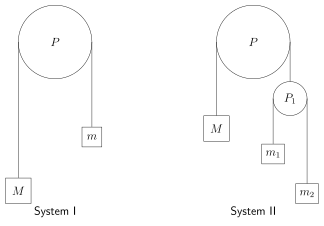
- For system I show that the acceleration, \(a_1\), of the particle of mass \(M\), measured in the downwards direction, is given by \[ a_1= \frac{M-m}{M+m} \, g \,, \] where \(g\) is the acceleration due to gravity. Give an expression for the force on the pulley due to the tension in the string.
- For system II show that the acceleration, \(a_2\), of the particle of mass \(M\), measured in the downwards direction, is given by \[ a_2= \frac{ M - 4\mu}{M+4\mu}\,g \,, \] where \(\mu = \dfrac{m_1m_2}{m_1+m_2}\). In the case \(m= m_1+m_2\), show that \(a_1= a_2\) if and only if \(m_1=m_2\).
Solution:
- \(\,\)
\begin{align*} \text{N2}(\uparrow, m): && T - mg &= ma_1 \\ \text{N2}(\uparrow, M): && T-Mg &= -Ma_1 \\ \Rightarrow && (M-m)g &= a_1(m+M) \\ \Rightarrow && a_1 &= \frac{M-m}{M+m}g \\ && T &= mg + ma_1 \\ &&&= \frac{2mM}{M+m}g \end{align*}
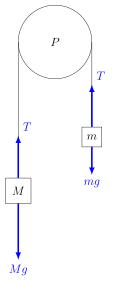
- System II is the same as system I, but with \(m\) replaced with \(2\frac{T}{g} = \frac{4mM}{M+m}\). In particular, this means that: \begin{align*} && a_2 &= \frac{M - \frac{4m_1m_2}{m_1+m_2}}{M + \frac{4m_1m_2}{m_1+m_2}} g \\ &&&= \frac{M-4\mu}{M+4\mu}g \end{align*} If \(m = m_1 + m_2\) then \begin{align*} && a_1 &= a_2 \\ \Leftrightarrow && \frac{M-m_1-m_2}{M+m_1+m_2} &= \frac{M - \frac{4m_1m_2}{m_1+m_2}}{M + \frac{4m_1m_2}{m_1+m_2}} \\ \Leftrightarrow && \frac{M-m_1-m_2}{M+m_1+m_2} &= \frac{M(m_1+m_2) -4m_1m_2}{M(m_1+m_2) + 4m_1m_2} \\ \Leftrightarrow && M^2(m_1+m_2)+4m_1m_2M &- M(m_1+m_2)^2 - 4m_1m_2(m_1+m_2) \\ &&\quad \quad = M^2(m_1+m_2) - 4m_1m_2M &+M(m_1+m_2)^2-4m_1m_2(m_1+m_2) \\ \Leftrightarrow && 8m_1m_2M&= 2M(m_1+m_2)^2 \\ \Leftrightarrow && 0 &= (m_1-m_2)^2 \\ \Leftrightarrow && m_1 &= m_2 \end{align*}
2012 Paper 1 Q11
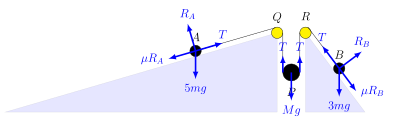
The diagram shows two particles, \(A\) of mass \(5m\) and \(B\) of mass \(3m\), connected by a light inextensible string which passes over two smooth, light, fixed pulleys, \(Q\) and \(R\), and under a smooth pulley \(P\) which has mass \(M\) and is free to move vertically. Particles \(A\) and \(B\) lie on fixed rough planes inclined to the horizontal at angles of \(\arctan \frac 7{24}\) and \(\arctan\frac43\) respectively. The segments \(AQ\) and \(RB\) of the string are parallel to their respective planes, and segments \(QP\) and \(PR\) are vertical. The coefficient of friction between each particle and its plane is \(\mu\).

- Given that the system is in equilibrium, with both \(A\) and \(B\) on the point of moving up their planes, determine the value of \(\mu\) and show that \(M = 6m\).
- In the case when \(M = 9m\), determine the initial accelerations of \(A\), \(B\) and \(P\) in terms of \(g\).
Solution:
2012 Paper 3 Q9
A pulley consists of a disc of radius \(r\) with centre \(O\) and a light thin axle through \(O\) perpendicular to the plane of the disc. The disc is non-uniform, its mass is \(M\) and its centre of mass is at \(O\). The axle is fixed and horizontal. Two particles, of masses \(m_1\) and \(m_2\) where \(m_1>m_2\), are connected by a light inextensible string which passes over the pulley. The contact between the string and the pulley is rough enough to prevent the string sliding. The pulley turns and the vertical force on the axle is found, by measurement, to be~\(P+Mg\).
- The moment of inertia of the pulley about its axle is calculated assuming that the pulley rotates without friction about its axle. Show that the calculated value is \[ \frac{((m_1 + m_2)P - 4m_1m_2g)r^2} {(m_1 + m_2)g - P}\,. \tag{\(*\)}\]
- Instead, the moment of inertia of the pulley about its axle is calculated assuming that a couple of magnitude \(C\) due to friction acts on the axle of the pulley. Determine whether this calculated value is greater or smaller than \((*)\). Show that \(C<(m_1-m_2)rg\).
2010 Paper 3 Q11
A bullet of mass \(m\) is fired horizontally with speed \(u\) into a wooden block of mass \(M\) at rest on a horizontal surface. The coefficient of friction between the block and the surface is \(\mu\). While the bullet is moving through the block, it experiences a constant force of resistance to its motion of magnitude \(R\), where \(R>(M+m)\mu g\). The bullet moves horizontally in the block and does not emerge from the other side of the block.
- Show that the magnitude, \(a\), of the deceleration of the bullet relative to the block while the bullet is moving through the block is given by \[ a= \frac R m + \frac {R-(M+m)\mu g}{M}\, . \]
- Show that the common speed, \(v\), of the block and bullet when the bullet stops moving through the block satisfies \[ av = \frac{Ru-(M+m)\mu gu}M\,. \]
- Obtain an expression, in terms of \(u\), \(v\) and \(a\), for the distance moved by the block while the bullet is moving through the block.
- Show that the total distance moved by the block is \[ \frac{muv}{2(M+m)\mu g}\,. \]
2009 Paper 1 Q10
A triangular wedge is fixed to a horizontal surface. The base angles of the wedge are \(\alpha\) and \(\frac\pi 2-\alpha\). Two particles, of masses \(M\) and \(m\), lie on different faces of the wedge, and are connected by a light inextensible string which passes over a smooth pulley at the apex of the wedge, as shown in the diagram. The contacts between the particles and the wedge are smooth.
- Show that if \(\tan \alpha> \dfrac m M \) the particle of mass \(M\) will slide down the face of the wedge.
- Given that \(\tan \alpha = \dfrac{2m}M\), show that the magnitude of the acceleration of the particles is \[ \frac{g\sin\alpha}{\tan\alpha +2} \] and that this is maximised at \(4m^3=M^3\,\).
2009 Paper 2 Q11
A train consists of an engine and \(n\) trucks. It is travelling along a straight horizontal section of track. The mass of the engine and of each truck is \(M\). The resistance to motion of the engine and of each truck is \(R\), which is constant. The maximum power at which the engine can work is \(P\). Obtain an expression for the acceleration of the train when its speed is \(v\) and the engine is working at maximum power. The train starts from rest with the engine working at maximum power. Obtain an expression for the time \(T\) taken to reach a given speed \(V\), and show that this speed is only achievable if \[ P>(n+1)RV\,. \]
- In the case when \((n+1) RV/P\) is small, use the approximation \(\ln (1-x) \approx -x -\frac12 x^2\) (valid for small \( x \)) to obtain the approximation \[ PT\approx \tfrac 12 (n+1) MV^2\, \] and interpret this result.
- In the general case, the distance moved from rest in time \(T\) is \(X\). {\em Write down}, with explanation, an equation relating \(P\), \(T\), \(X\), \(M\), \(V\), \(R\) and \(n\) and hence show that \[ X= \frac{2PT - (n+1)MV^2}{2(n+1)R} \,. \]
2009 Paper 3 Q11
A comet in deep space picks up mass as it travels through a large stationary dust cloud. It is subject to a gravitational force of magnitude \(M\!f\) acting in the direction of its motion. When it entered the cloud, the comet had mass \(M\) and speed \(V\). After a time \(t\), it has travelled a distance \(x\) through the cloud, its mass is \(M(1+bx)\), where~\(b\) is a positive constant, and its speed is \(v\).
- In the case when \(f=0\), write down an equation relating \(V\), \(x\), \(v\) and \(b\). Hence find an expression for \(x\) in terms of \(b\), \(V\) and \(t\).
- In the case when \(f\) is a non-zero constant, use Newton's second law in the form \[ \text{force} = \text{rate of change of momentum} \] to show that \[ v = \frac{ft+V}{1+bx}\,. \] Hence find an expression for \(x\) in terms of \(b\), \(V\), \(f\) and \(t\). Show that it is possible, if \(b\), \(V\) and \(f\) are suitably chosen, for the comet to move with constant speed. Show also that, if the comet does not move with constant speed, its speed tends to a constant as \(t\to\infty\).
2008 Paper 3 Q9
A particle of mass \(m\) is initially at rest on a rough horizontal surface. The particle experiences a force \(mg\sin \pi t\), where \(t\) is time, acting in a fixed horizontal direction. The coefficient of friction between the particle and the surface is \(\mu\). Given that the particle starts to move first at \(t=T_0\), state the relation between \(T_0\) and \(\mu\).
- For \(\mu = \mu_0\), the particle comes to rest for the first time at \(t=1\). Sketch the acceleration-time graph for \(0\le t \le 1\). Show that \[ 1+\left(1-\mu_0^2\right)^{\frac12} -\mu_0\pi +\mu_0 \arcsin \mu_0 =0\,. \]
- For \(\mu=\mu_0\) sketch the acceleration-time graph for \(0\le t\le 3\). Describe the motion of the particle in this case and in the case \(\mu=0\).
2006 Paper 1 Q9
A block of mass \(4\,\)kg is at rest on a smooth, horizontal table. A smooth pulley \(P\) is fixed to one edge of the table and a smooth pulley \(Q\) is fixed to the opposite edge. The two pulleys and the block lie in a straight line. Two horizontal strings are attached to the block. One string runs over pulley \(P\); a particle of mass \(x\,\)kg hangs at the end of this string. The other string runs over pulley \(Q\); a particle of mass \(y\,\)kg hangs at the end of this string, where \(x > y\) and \(x + y = 6\,\). The system is released from rest with the strings taut. When the \(4\,\)kg block has moved a distance \(d\), the string connecting it to the particle of mass \(x\,\)kg is cut. Show that the time taken by the block from the start of the motion until it first returns to rest (assuming that it does not reach the edge of the table) is \(\sqrt{d/(5g)\,} \,\f(y)\), where \[ \f(y)= \frac{10}{ \sqrt{6-2y}}+ \left(1 + \frac{4}{ y} \right) \sqrt {6 -2y}. \] Calculate the value of \(y\) for which \(\f'(y)=0\).
2005 Paper 2 Q11
A plane is inclined at an angle \(\arctan \frac34\) to the horizontal and a small, smooth, light pulley~\(P\) is fixed to the top of the plane. A string, \(APB\), passes over the pulley. A particle of mass~\(m_1\) is attached to the string at \(A\) and rests on the inclined plane with \(AP\) parallel to a line of greatest slope in the plane. A particle of mass \(m_2\), where \(m_2>m_1\), is attached to the string at \(B\) and hangs freely with \(BP\) vertical. The coefficient of friction between the particle at \(A\) and the plane is \( \frac{1}{2}\). The system is released from rest with the string taut. Show that the acceleration of the particles is \(\ds \frac{m_2-m_1}{m_2+m_1}g\). At a time \(T\) after release, the string breaks. Given that the particle at \(A\) does not reach the pulley at any point in its motion, find an expression in terms of \(T\) for the time after release at which the particle at \(A\) reaches its maximum height. It is found that, regardless of when the string broke, this time is equal to the time taken by the particle at \(A\) to descend from its point of maximum height to the point at which it was released. Find the ratio \(m_1 : m_2\). \noindent [Note that \(\arctan \frac34\) is another notation for \(\tan^{-1} \frac34\,\).]
2004 Paper 2 Q11
The maximum power that can be developed by the engine of train \(A\), of mass \(m\), when travelling at speed \(v\) is \(Pv^{3/2}\,\), where \(P\) is a constant. The maximum power that can be developed by the engine of train \(B\), of mass \(2m\), when travelling at speed \(v\) is \(2Pv^{3/2}.\) For both \(A\) and \(B\) resistance to motion is equal to \(kv\), where \(k\) is a constant. For \(t\le0\), the engines are crawling along at very low equal speeds. At \(t = 0\,\), both drivers switch on full power and at time \(t\) the speeds of \(A\) and \(B\) are \(v_{\vphantom{\dot A}\!A}\) and \(v_{\vphantom{\dot B}\hspace{-1pt}B},\) respectively.
- Show that \[ v_{\vphantom{\dot A}\!A} = \frac{P^2 \left(1-\e^{-kt/2m}\right)^2}{k^2} \] and write down the corresponding result for \(v_{\vphantom{\dot B}B}\).
- Find \(v_{\vphantom{\dot B}A}\) and \(v_{\vphantom{\dot B}B}\) when \(9 v_{\vphantom{\dot B}A} =4v_{\vphantom{\dot B}B}\;\). [Not on original paper] Show that \(1 < v_{\vphantom{\dot B}\hspace{-1pt}B} /v_{\vphantom{\dot A}\!A} < 4\) for \(t > 0\,\).
- Both engines are switched off when \(9 v_{\vphantom{\dot B}A} =4v_{\vphantom{\dot B}B}\,\). Show that thereafter \(k^2 v_{\vphantom{\dot B}B}^2 = 4 P^2 v_{\vphantom{\dot B}A}\,\).
Solution:
- \(\,\) \begin{align*} && P &= Fv \\ \text{N2}(\rightarrow): && Pv^{1/2} - kv &= ma \\ \Rightarrow && \dot{v} &= \frac{P}{m} \sqrt{v}-\frac{k}{m}v \\ \Rightarrow && \int \d t & = \int \frac{m}{\sqrt{v}\left (P-k\sqrt{v} \right)} \d v \\ &&t &= -\frac{2m}k\ln\left (P - k\sqrt{v_A}\right) + C \\ t = 0, v_A \approx 0: && 0 & =-\frac{2m}{k} \ln P+ C \\ \Rightarrow && C &= \frac{2m}{k} \ln P \\ \Rightarrow && e^{-kt/2m} &= \frac{P- k \sqrt{v_A}}{P} \\ \Rightarrow && v_A &= \frac{P^2(1-e^{-kt/2m})^2}{k^2} \end{align*} The equation of motion for \(B\) is \(\dot{v_B} = \frac{P}{m}\sqrt{v} - \frac{k}{2m} v\), ie \(k \to \frac{k}{2}\), so \[ v_B = \frac{4P^2(1-e^{-kt/4m})^2}{k^2} \]
- Suppose \(9v_A = 4v_B\), then and let \(e^{-kt/4m} = X\) \begin{align*} && 9 \frac{P^2(1-e^{-kt/2m})^2}{k^2} &= 4 \frac{4P^2(1-e^{-kt/4m})^2}{k^2} \\ \Rightarrow && \frac{3}{4} &= \frac{1-X}{1-X^2} \\ \Rightarrow && 0 &= 3X^2-4X+1 \\ &&&= (3X-1)(X-1) \\ \Rightarrow && X &= 1, \frac13 \\ X = 1: && t &= 0 \\ X = \frac13: && e^{-kt/4m} &= \frac13\\ \Rightarrow && t &= \frac{4m}{k}\ln 3 \\ && v_A &= \frac{P^2(1-\frac19)^2}{k^2} \\ &&&= \frac{64P^2}{81k^2} \\ && v_B &= \frac{P^2(1-\frac13)^2}{k^2} \\ &&&= \frac{4P^2}{9k^2} \end{align*} Notice also that \begin{align*} && \frac{v_B}{v_A} &= 4\left ( \frac{1-X}{1-X^2} \right)^2 \\ &&&= 4 \frac{1}{(1+X)^2} \end{align*} Since \(X \in (0,1)\) \(\frac{v_B}{v_A} \in (1, 4)\)
- Once the engines are switched off, the equation of motion for \(A\) is (where \(t\) is measured from that point) \begin{align*} && \dot{v} &= -\frac{k}{m}v \\ \Rightarrow && v &= Ae^{-kt/m} \\ \Rightarrow && v_A &= \frac{64P^2}{81k^2}e^{-kt/m} \end{align*} Similarly, \(v_B = \frac{4P^2}{9k^2}e^{-kt/2m}\) so \begin{align*} && \frac{v_A}{v_B^2} &= \frac{64P^2}{81k^2} \cdot \frac{81k^4}{16P^4} = \frac{4k^2}{P^2} \end{align*} as required.