Problems
Filters
14 problems found
2005 Paper 2 Q1
Find the three values of \(x\) for which the derivative of \(x^2 \e^{-x^2}\) is zero. Given that \(a\) and \(b\) are distinct positive numbers, find a polynomial \(\P(x)\) such that the derivative of \(\P(x)\e^{-x^2}\) is zero for \(x=0\), \(x=\pm a\) and \(x=\pm b\,\), but for no other values of \(x\).
Solution: \begin{align*} && y &= x^2e^{-x^2} \\ \Rightarrow && y' &= 2xe^{-x^2} +x^2 \cdot (-2x)e^{-x^2} \\ &&&= e^{-x^2}(2x-2x^3) \\ &&&= 2e^{-x^2}x(1-x^2) \end{align*} Therefore the derivative is zero iff \(x = 0, \pm 1\) \begin{align*} && y &= \P(x) e^{-x^2} \\ \Rightarrow && y' &= e^{-x^2} (\P'(x)-2x\P(x)) \end{align*} Therefore we want \(\P'(x) - 2x\P(x) = Kx(x^2-a^2)(x^2-b^2)\) Since this has degree \(5\), we should look at polynomials degree \(4\) for \(\P\). We can also immediately see that \(0\) is a root of \(\P'(x)\), so \(\P(x) = a_4x^4+a_3x^3+a_2x^2+a_0\). WLOG \(a_4 = 1\) and \(K = -2\), so \begin{align*} && -2(x^5-(a^2+b^2)x^3+a^2b^2x) &= 4x^3+3a_3x^2+2a_2x- 2x(x^4+a_3x^3+a_2x^2+a_0) \\ &&&= -2x^5-2a_3 x^4+(4-2a_2)x^3+(2a_2-2a_0)x \\ \Rightarrow && a_3 &= 0 \\ && a^2+b^2 &= 2-a_2 \\ \Rightarrow && a_2 &= 2-a^2-b^2 \\ && a^2b^2 &= a_0-a_2 \\ \Rightarrow && a_0 &= a^2b^2 + 2-a^2-b^2 \\ \Rightarrow && \P(x) &= x^4+(2-a^2-b^2)x^2+(a^2-1)(b^2-1)x \end{align*}
2005 Paper 2 Q2
For any positive integer \(N\), the function \(\f(N)\) is defined by \[ \f(N) = N\Big(1-\frac1{p_1}\Big)\Big(1-\frac1{p_2}\Big) \cdots\Big(1-\frac1{p_k}\Big) \] where \(p_1\), \(p_2\), \(\dots\) , \(p_k\) are the only prime numbers that are factors of \(N\). Thus \(\f(80)=80(1-\frac12)(1-\frac15)\,\).
- (a) Evaluate \(\f(12)\) and \(\f(180)\). (b) Show that \(\f(N)\) is an integer for all \(N\).
- Prove, or disprove by means of a counterexample, each of the following: (a) \(\f(m) \f(n) = \f(mn)\,\); (b) \(\f(p) \f(q) = \f(pq)\) if \(p\) and \(q\) are distinct prime numbers; (c) \(\f(p) \f(q) = \f(pq)\) only if \(p\) and \(q\) are distinct prime numbers.
- Find a positive integer \(m\) and a prime number \(p\) such that \(\f(p^m) = 146410\,\).
Solution:
- \(f(12) = f(2^2 \cdot 3) = 12 \cdot (1-\frac12)\cdot(1-\frac13) = 12 \cdot \frac12 \cdot \frac 23 = 4\) \(f(180) = f(2^2 \cdot 3^2 \cdot 5) = 180 \cdot \frac12 \cdot \frac23 \cdot \frac 45 = 12 \cdot 4 = 48\) Suppose \(N\) has prime decomposition \(p_1^{a_1} \cdots p_k^{a_k}\), then \(f(N) = p_1^{a_1} \cdots p_k^{a_k} (1 - \frac{1}{p_1})\cdots ( 1- \frac{1}{p_k}) = p_1^{a_1-1} \cdots p_k^{a_k-1}(p_1-1) \cdots (p_k-1)\) which is clearly an integer.
- \(f(2) = 1, f(4) = 2 \neq f(2) \cdot f(2)\) If \(p, q\) are distinct primes then \(f(p) = p \cdot \frac{p-1}{p} = p-1\) and \(f(q) = q-1\). \(f(pq) = pq \frac{p-1}{p} \cdot \frac{q-1}{q} = (p-1)(q-1) = f(p)f(q)\) \(f(12) = 4 = 2\cdot 2 = f(4) \cdot f(3)\)
- \(f(p^m) = p^{m-1} (p-1)\) \(146410 = 10 \cdot 14641 = 10 \cdot 11^4\). Therefore \(p = 11, m = 5\)
2005 Paper 2 Q3
Give a sketch, for \(0 \le x \le \frac{1}{2}\pi\), of the curve $$ y = (\sin x - x\cos x)\;, $$ and show that \(0\le y \le 1\,\). Show that:
- \(\displaystyle \int_0^{\frac{1}{2}\pi}\,y\;\d x = 2 -\frac \pi 2 \)
- \(\displaystyle \int_0^{\frac{1}{2}\pi}\,y^2\,\d x = \frac{\pi^3}{48}-\frac \pi 8 \)
Solution:
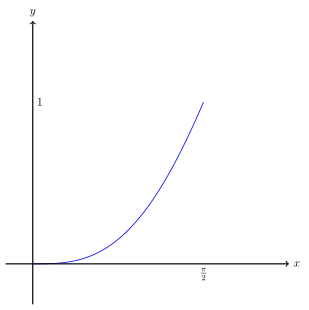
- \(\,\) \begin{align*} \int_0^{\frac{1}{2}\pi}\,y\;\d x &= \int_0^{\frac{1}{2}\pi} (\sin x - x \cos x) \d x \\ &= \left [-\cos x \right]_0^{\frac{1}{2}\pi} +\left [ -x \sin x \right]_0^{\frac{1}{2}\pi} + \int_0^{\frac{1}{2}\pi} \sin x \d x \\ &= 1-\frac{\pi}{2} + 1 = 2 - \frac{\pi}{2} \end{align*}
- \(\,\) \begin{align*} \int_0^{\frac{1}{2}\pi}y^2\d x &= \int_0^{\frac{1}{2}\pi} (\sin x - x \cos x)^2 \d x \\ &= \int_0^{\frac{1}{2}\pi} (\sin^2x - 2x\sin x \cos x+x^2\cos^2 x) \d x\\ &= \int_0^{\frac{1}{2}\pi} (\sin^2x -x \sin 2x+\tfrac12x^2(\cos 2 x + 1)) \d x\\ &= \frac{\pi}{4} + \frac{\pi^3}{48} + \int_0^{\frac{1}{2}\pi} (-x \sin 2x+\tfrac12x^2\cos 2 x) \d x \\ &= \frac{\pi}{4} + \frac{\pi^3}{48} + \left [\frac12 x \cos 2x +\frac14 x^2 \sin2x\right]_0^{\frac{1}{2}\pi}-\int_0^{\frac{1}{2}\pi}(\tfrac12 \cos 2x +\tfrac12 x \sin 2x) \d x\\ &= \frac{\pi}{4} + \frac{\pi^3}{48} - \frac{\pi}{4} - \left [ \frac14 \sin 2x \right]_0^{\frac{1}{2}\pi} - \int_0^{\frac{1}{2}\pi} \tfrac12 x \sin 2x \d x\\ &= \frac{\pi^3}{48} - \left( \left[ -\frac14 x \cos 2x \right]_0^{\frac{1}{2}\pi} - \int_0^{\frac{1}{2}\pi} -\frac14 \cos 2x \d x \right)\\ &= \frac{\pi^3}{48} - \left( \frac{\pi}{8} + \left[ \frac18 \sin 2x \right]_0^{\frac{1}{2}\pi} \right)\\ &= \frac{\pi^3}{48} - \frac{\pi}{8} \end{align*}
2005 Paper 2 Q4
The positive numbers \(a\), \(b\) and \(c\) satisfy \(bc=a^2+1\). Prove that $$ \arctan\left(\frac1 {a+b}\right)+ \arctan\left(\frac1 {a+c}\right)= \arctan\left(\frac1 a \right). $$ The positive numbers \(p\), \(q\), \(r\), \(s\), \(t\), \(u\) and \(v\) satisfy $$ st = (p+q)^2 + 1 \;, \ \ \ \ \ \ uv=(p+r)^2 + 1 \;, \ \ \ \ \ \ qr = p^2+1\;. $$ Prove that $$ \arctan \! \!\left(\!\frac1 {p+q+s}\!\right) + \arctan \! \!\left(\!\frac 1{p+q+t}\!\right) + \arctan \! \!\left(\!\frac 1 {p+r+u}\!\right) + \arctan \! \!\left(\!\frac1 {p+r+v}\!\right) =\arctan \! \!\left( \! \frac1 p \! \right) . $$ Hence show that $$ \arctan\left(\frac1 {13}\right) +\arctan\left(\frac1 {21}\right) +\arctan\left(\frac1 {82}\right) +\arctan\left(\frac1 {187}\right) =\arctan\left(\frac1 {7}\right). $$ [Note that \(\arctan x\) is another notation for \( \tan^{-1}x \,.\,\)]
Solution: \begin{align*} && \tan \left (\arctan\left(\frac1 {a+b}\right)+ \arctan\left(\frac1 {a+c}\right) \right) &= \frac{\frac1{a+b}+\frac1{a+c}}{1-\frac{1}{(a+b)(a+c)}} \\ &&&= \frac{a+c+a+b}{(a+b)(a+c)-1} \\ &&&= \frac{2a+b+c}{a^2+ab+ac+bc-1} \\ &&&= \frac{2a+b+c}{2a^2+ab+ac} \\ &&&= \frac{1}{a} \\ &&&= \tan \arctan \frac1a\\ \Rightarrow && \arctan\left(\frac1 {a+b}\right)+ \arctan\left(\frac1 {a+c}\right) &= \arctan \frac{1}{a} + n \pi \end{align*} Since \(\arctan x \in (-\frac{\pi}{2}, \frac{\pi}{2})\) the LHS \(\in (0, \pi)\) so \(n = 0\). \begin{align*} a=p+q, b = s, c = t:&& \arctan \! \!\left(\!\frac1 {p+q+s}\!\right) + \arctan \! \!\left(\!\frac 1{p+q+t}\!\right) &= \arctan \left ( \frac{1}{p+q} \right) \\ a=p+r, b= u, c = v && \arctan \! \!\left(\!\frac 1 {p+r+u}\!\right) + \arctan \! \!\left(\!\frac1 {p+r+v}\!\right) &= \arctan \! \!\left(\!\frac1 {p+r}\!\right) \\ a = p, b = q, c = r:&& \arctan \left ( \frac{1}{p+q} \right) +\arctan \! \!\left(\!\frac1 {p+r}\!\right) &= \arctan \left ( \frac1p \right) \end{align*} and the result follows. Taking \(p = 7\) we need to solve \[ \begin{cases} q+s &= 6 \\ q+t &= 14 \\ r+u &= 75 \\ r+v &= 180 \end{cases} \] also satisfying \(qr = 50\) etc, so say \(q = 1, r = 50, s = 5, v=25\)
2005 Paper 2 Q5
The angle \(A\) of triangle \(ABC\) is a right angle and the sides \(BC\), \(CA\) and \(AB\) are of lengths \(a\), \(b\) and \(c\), respectively. Each side of the triangle is tangent to the circle \(S_1\) which is of radius \(r\). Show that \(2r = b+c-a\). Each vertex of the triangle lies on the circle~\(S_2\). The ratio of the area of the region between~\(S_1\) and the triangle to the area of \(S_2\) is denoted by \(R\,\). Show that $$ \pi R = -(\pi-1)q^2 + 2\pi q -(\pi+1) \;, $$ where \(q=\dfrac{b+c}a\,\). Deduce that $$ R\le \frac1 {\pi( \pi - 1)} \;. $$
2005 Paper 2 Q6
- Write down the general term in the expansion in powers of \(x\) of \((1-x)^{-1}\), \((1-x)^{-2}\) and \((1-x)^{-3}\), where \(|x| <1\). Evaluate \(\displaystyle \sum_{n=1}^\infty n 2^{-n}\) and \(\displaystyle \sum_{n=1}^\infty n^22^{-n}\).
- Show that $\displaystyle (1-x)^{-\frac12} = \sum_{n=0}^\infty \frac{(2n)!}{(n!)^2} \frac{x^n}{2^{2n}}\( , for \)|x|<1$. Evaluate \(\displaystyle \sum_{n=0}^\infty \frac{(2n)!} {(n!)^2 2^{2n}3^{n}} \) and \(\displaystyle \sum_{n=1}^\infty \frac{n(2n)!} {(n!)^2 2^{2n}3^{n}}\).
Solution:
- \(\displaystyle (1-x)^{-1} = \sum_{n=0}^\infty x^n\), \(\displaystyle (1-x)^{-2} = \sum_{n=0}^\infty (n+1)x^n\), \(\displaystyle (1-x)^{-3} = \sum_{n=0}^\infty \frac{(n+2)(n+1)}{2}x^n\) \begin{align*} && \sum_{n=1}^{\infty} n2^{-n} &= \frac12\sum_{n=0}^{\infty}(n+1)2^{-n} \\ &&&= \frac12 (1-\tfrac12)^{-2} = 2 \\ \\ && \sum_{n=1}^{\infty} nx^n&= x(1-x)^{-2} \\ \Rightarrow && \sum_{n=1}^{\infty} n^2x^{n-1}&= (1-x)^{-2}+2x(1-x)^{-3} \\ \Rightarrow && \sum_{n=1}^{\infty} n^22^{-n} &= \frac12 \left ( (1-\tfrac12)^{-2}+2\cdot \tfrac12 \cdot (1-\tfrac12)^{-3} \right) \\ &&&= \frac12 \left ( 4 +8\right) = 6 \end{align*}
- By the generalised binomial theorem, \begin{align*} && (1-x)^{-\frac12} &= 1 + \sum_{n=1}^{\infty} \frac{(-\tfrac12)\cdot(-\tfrac32)\cdots(-\tfrac12-n+1)}{n!}(-x)^n \\ &&&= 1 + \sum_{n=1}^{\infty} \frac{(-1)^n(\tfrac12)\cdot(\tfrac32)\cdots(\tfrac{2n-1}2)}{n!}(-x)^n \\ &&&= 1 + \sum_{n=1}^{\infty} \frac{1 \cdot 3 \cdot 5 \cdots (2n-1)}{2^nn!}x^n \\ &&&= 1 + \sum_{n=1}^{\infty} \frac{(2n)!}{2^nn! \cdot 2^n n!}x^n \\ &&&= 1 + \sum_{n=1}^{\infty} \frac{(2n)!}{2^{2n}(n!)^2}x^n \\ &&&= \sum_{n=0}^{\infty} \frac{(2n)!}{2^{2n}(n!)^2}x^n \\ \end{align*} \begin{align*} && \sum_{n=0}^\infty \frac{(2n)!} {(n!)^2 2^{2n}3^{n}} &= (1-\tfrac13)^{-\frac12} \\ &&&= \sqrt{\frac32} \\ \\ && (1-x)^{-\frac12} &= \sum_{n=0}^{\infty} \frac{(2n)!}{2^{2n}(n!)^2}x^n \\ \Rightarrow && \tfrac12(1-x)^{-\frac32} &= \sum_{n=0}^{\infty} \frac{n(2n)!}{2^{2n}(n!)^2}x^{n-1} \\ \Rightarrow && \sum_{n=1}^\infty \frac{n(2n)!} {(n!)^2 2^{2n}3^{n}} &= \frac16(1-\tfrac13)^{-3/2} \\ &&&= \frac16 \sqrt{\frac{27}{8}} = \frac14\sqrt{\frac{3}2} \end{align*}
2005 Paper 2 Q7
The position vectors, relative to an origin \(O\), at time \(t\) of the particles \(P\) and \(Q\) are $$\cos t \; {\bf i} + \sin t\;{\bf j} + 0 \; {\bf k} \text{ and } \cos (t+\tfrac14{\pi})\, \big[{\tfrac32}{\bf i} + { \tfrac {3\sqrt{3}}2} {\bf k}\big] + 3\sin(t+\tfrac14{\pi}) \; {\bf j}\;,$$ respectively, where \(0\le t \le 2\pi\,\).
- Give a geometrical description of the motion of \(P\) and \(Q\).
- Let \(\theta\) be the angle \(POQ\) at time \(t\) that satisfies \(0\le\theta\le\pi\,\). Show that \[ \cos\theta = \tfrac{3\surd2}{8} -\tfrac14 \cos( 2t +\tfrac14 \pi)\;. \]
- Show that the total time for which \(\theta \ge \frac14 \pi\) is \(\tfrac32 \pi\,\).
Solution:
- \(P\) is travelling in a unit circle about the origin in the \(\mathbf{i}-\mathbf{j}\) plane. \(Q\) is travelling in a circle (also about the origin, but in a different plane with radius \(3\)).
- \(\,\) \begin{align*} && \mathbf{p}\cdot \mathbf{q} &= |\mathbf{p}||\mathbf{q}| \cos \theta \\ \Rightarrow && \cos \theta &= \frac{\tfrac32\cos t \cos(t + \tfrac{\pi}4)+3\sin t \sin (t + \tfrac{\pi}{4})}{3} \\ &&&= \tfrac12\cos t \cos(t + \tfrac{\pi}4)+\sin t \sin (t + \tfrac{\pi}{4}) \\ &&&= \tfrac14 (\cos (2t + \tfrac{\pi}{4}) + \cos(\tfrac{\pi}{4} ))+\tfrac12(\cos(\tfrac{\pi}{4})-\cos(2t + \tfrac{\pi}{4})) \\ &&&= \tfrac{3\sqrt{2}}8 - \tfrac14 \cos ( 2t +\tfrac{\pi}{4}) \end{align*}
- If \(\theta \geq \frac14\pi\), then \(\cos \theta \leq \frac{\sqrt{2}}2\) \begin{align*} && \frac{\sqrt{2}}2 & \geq \frac{3\sqrt{2}}8 - \frac14 \cos ( 2t +\tfrac{\pi}{4}) \\ \Rightarrow && \frac{\sqrt{2}}2 &\geq -\cos(2t + \tfrac{\pi}{4}) \\ \Rightarrow && \cos(2t + \tfrac{\pi}{4}) &\geq -\frac{1}{\sqrt{2}} \\ \Rightarrow && 2t + \tfrac{\pi}{4} &\not\in (\tfrac{3\pi}{4},\tfrac{5\pi}{4}) \cup (\tfrac{11\pi}{4},\tfrac{13\pi}{4}) \\ \Rightarrow && t &\not\in (\tfrac{\pi}{4}, \tfrac{\pi}{2})\cup (\tfrac{5\pi}{4}, \tfrac{3\pi}{2}) \end{align*} which is is a time of \(\frac{\pi}{2}\), therefore the left over time is \(\frac32\pi\)
2005 Paper 2 Q8
For \(x \ge 0\) the curve \(C\) is defined by $$ {\frac{\d y} {\d x}} = \frac{x^3y^2}{(1 + x^2)^{5/2}} $$ with \(y = 1\) when \(x=0\,\). Show that \[ \frac 1 y = \frac {2+3x^2}{3(1+x^2)^{3/2}} +\frac13 \] and hence that for large positive \(x\) $$ y \approx 3 - \frac 9 x\;. $$ Draw a sketch of \(C\). On a separate diagram, draw a sketch of the two curves defined for \(x \ge 0\) by $$ \frac {\d z} {\d x} = \frac{x^3z^3}{2(1 + x^2)^{5/2}} $$ with \(z = 1\) at \(x=0\) on one curve, and \(z = -1\) at \(x=0\) on the other.
Solution: \begin{align*} && {\frac{\d y} {\d x}} &= \frac{x^3y^2}{(1 + x^2)^{5/2}} \\ \Rightarrow &&\int \frac{1}{y^2} \d y &= \int \frac{x^3}{(1+x^2)^{5/2}} \d x \\ \Rightarrow && -\frac1y &= \int \frac{x^3+x-x}{(1+x^2)^{5/2}} \d x \\ &&&= \int \left ( \frac{x}{(1+x^2)^{3/2}}-\frac{x}{(1+x^2)^{5/2}} \right) \d x \\ &&&= \frac{-1}{(1+x^2)^{1/2}} + \frac{1}{3(1+x^2)^{3/2}} + C \\ &&&= \frac{1-3(1+x^2)}{3(1+x^2)^{3/2}} + C \\ &&&= \frac{-3x^2-2}{3(1+x^2)^{3/2}} + C \\ (x,y) = (0,1): &&-1 &= -\frac23 + C \\ \Rightarrow && C &= -\frac13 \\ \Rightarrow && \frac1y &= \frac{3x^2+2}{3(1+x^2)^{3/2}} + \frac13 \end{align*} \begin{align*} y &= \frac{1}{\frac13 +\frac{3x^2+2}{3(1+x^2)^{3/2}} } \\ &= \frac{3}{1+ \frac{3x^2+2}{3(1+x^2)^{3/2}}} \\ &= \frac{3}{1+ \frac{3}{x} + \cdots} \\ &\approx 3 - \frac{9}{x} \end{align*}


2005 Paper 2 Q9
Two particles, \(A\) and \(B\), of masses \(m\) and \(2m\), respectively, are placed on a line of greatest slope, \(\ell\), of a rough inclined plane which makes an angle of \(30^{\circ}\) with the horizontal. The coefficient of friction between \(A\) and the plane is \(\frac16\sqrt{3}\) and the coefficient of friction between \(B\) and the plane is \(\frac13 \sqrt{3}\). The particles are at rest with \(B\) higher up \(\ell\) than \(A\) and are connected by a light inextensible string which is taut. A force \(P\) is applied to \(B\).
- Show that the least magnitude of \(P\) for which the two particles move upwards along \(\ell\) is \(\frac{11}8 \sqrt{3}\, mg\) and give, in this case, the direction in which \(P\) acts.
- Find the least magnitude of \(P\) for which the particles do not slip downwards along~\(\ell\).
2005 Paper 2 Q10
The points \(A\) and \(B\) are \(180\) metres apart and lie on horizontal ground. A missile is launched from \(A\) at speed of \(100\,\)m\,s\(^{-1}\) and at an acute angle of elevation to the line \(AB\) of \(\arcsin \frac35\). A time \(T\) seconds later, an anti-missile missile is launched from \(B\), at speed of \(200\,\)m\,s\(^{-1}\) and at an acute angle of elevation to the line \(BA\) of \(\arcsin \frac45\). The motion of both missiles takes place in the vertical plane containing \(A\) and \(B\), and the missiles collide. Taking \(g =10\,\)m\,s\(^{-2}\) and ignoring air resistance, find \(T\). \noindent [Note that \(\arcsin \frac35\) is another notation for \(\sin^{-1} \frac35\,\).]
2005 Paper 2 Q11
A plane is inclined at an angle \(\arctan \frac34\) to the horizontal and a small, smooth, light pulley~\(P\) is fixed to the top of the plane. A string, \(APB\), passes over the pulley. A particle of mass~\(m_1\) is attached to the string at \(A\) and rests on the inclined plane with \(AP\) parallel to a line of greatest slope in the plane. A particle of mass \(m_2\), where \(m_2>m_1\), is attached to the string at \(B\) and hangs freely with \(BP\) vertical. The coefficient of friction between the particle at \(A\) and the plane is \( \frac{1}{2}\). The system is released from rest with the string taut. Show that the acceleration of the particles is \(\ds \frac{m_2-m_1}{m_2+m_1}g\). At a time \(T\) after release, the string breaks. Given that the particle at \(A\) does not reach the pulley at any point in its motion, find an expression in terms of \(T\) for the time after release at which the particle at \(A\) reaches its maximum height. It is found that, regardless of when the string broke, this time is equal to the time taken by the particle at \(A\) to descend from its point of maximum height to the point at which it was released. Find the ratio \(m_1 : m_2\). \noindent [Note that \(\arctan \frac34\) is another notation for \(\tan^{-1} \frac34\,\).]
2005 Paper 2 Q12
The twins Anna and Bella share a computer and never sign their e-mails. When I e-mail them, only the twin currently online responds. The probability that it is Anna who is online is \(p\) and she answers each question I ask her truthfully with probability \(a\), independently of all her other answers, even if a question is repeated. The probability that it is Bella who is online is~\(q\), where \(q=1-p\), and she answers each question truthfully with probability \(b\), independently of all her other answers, even if a question is repeated.
- I send the twins the e-mail: `Toss a fair coin and answer the following question. Did the coin come down heads?'. I receive the answer `yes'. Show that the probability that the coin did come down heads is \(\frac{1}{2}\) if and only if \(2(ap+bq)=1\).
- I send the twins the e-mail: `Toss a fair coin and answer the following question. Did the coin come down heads?'. I receive the answer `yes'. I then send the e-mail: `Did the coin come down heads?' and I receive the answer `no'. Show that the probability (taking into account these answers) that the coin did come down heads is \(\frac{1}{2}\,\).
- I send the twins the e-mail: `Toss a fair coin and answer the following question. Did the coin come down heads?'. I receive the answer `yes'. I then send the e-mail: `Did the coin come down heads?' and I receive the answer `yes'. Show that, if \(2(ap+bq)=1\), the probability (taking into account these answers) that the coin did come down heads is \(\frac{1}{2}\,\).
2005 Paper 2 Q13
The number of printing errors on any page of a large book of \(N\) pages is modelled by a Poisson variate with parameter \(\lambda\) and is statistically independent of the number of printing errors on any other page. The number of pages in a random sample of \(n\) pages (where \(n\) is much smaller than \(N\) and \(n\ge2\)) which contain fewer than two errors is denoted by \(Y\). Show that \(\P(Y=k) = \binom n k p^kq^{n-k}\) where \(p=(1+\lambda)e^{-\lambda}\) and \(q=1-p\,\). Show also that, if \(\lambda\) is sufficiently small,
- \(q\approx \frac12 \lambda^2\,\);
- the largest value of \(n\) for which \(\P(Y=n)\ge 1-\lambda\) is approximately \(2/\lambda\,\);
- \(\P(Y>1 \;\vert\; Y>0) \approx 1-n(\lambda^2/2)^{n-1}\;.\)
Solution: First notice that the the probability a page contains fewer than two errors is \(\mathbb{P}(X < 2)\) where \(X \sim Po(\lambda)\), ie \(\mathbb{P}(X<2) = e^{-\lambda} + \lambda e^{-\lambda} = (1+\lambda)e^{-\lambda}\). Therefore the number of pages \(Y\) with fewer than two errors out of our sample of \(n\) is \(Bin(n, p)\) where \(p\) is as before. ie \(\mathbb{P}(Y = k) = \binom{n}{k} p^kq^{n-k}\).
- \(\,\) \begin{align*} && q &= 1- p = 1-(1+\lambda)e^{-\lambda} \\ &&&= 1 - (1+ \lambda)(1 - \lambda + \tfrac12 \lambda^2 + o(\lambda^3)) \\ &&&= 1 - 1+ \lambda - \lambda+\lambda^2 - \tfrac12 \lambda^2 + o(\lambda^3) \\ &&&= \tfrac12 \lambda^2 + o(\lambda^3) \end{align*}
- \(\,\) \begin{align*} && \mathbb{P}(Y = n) &= p^n \\ &&&= (1+\lambda)^ne^{-\lambda n} \\ &&&= (1 + n \lambda + \frac{n(n-1)}{2} \lambda^2 + \cdots)(1 - \lambda n + \frac{\lambda^2 n^2}{2} + \cdots) \\ &&&= 1 + 0 \lambda + \left ( \frac{n(n-1)}{2} + \frac{n^2}{2} - n^2 \right) \lambda^2 + o(\lambda^3) \\ &&&= 1 - \frac{n}{2} \lambda^2 + o(\lambda^3) \end{align*} So if \(\frac{n}{2} \lambda \leq 1\) or \(n \leq \frac{2}{\lambda}\) \(\mathbb{P}(Y = n) \leq 1- \lambda\).
- \(\,\) \begin{align*} && \mathbb{P}(Y > 1 | Y > 0) &= \frac{1-(q^n + npq^{n-1})}{1-q^n} \\ &&&= 1 - \frac{npq^{n-1}}{1-q^n} \\ &&&= 1 -n \frac{(1+ \lambda)e^{-\lambda} (\tfrac12 \lambda^2 + o(\lambda^3))^{n-1}}{1-(\tfrac12 \lambda^2 + o(\lambda^3))^n} \\ &&&= 1 - n \left (\frac{\lambda^2}{2} \right)^{n-1} \frac{(1+ \lambda)(1-\lambda + \lambda^2/2 - \cdots)(1+o(\lambda)^{n-1}}{1-(\tfrac12 \lambda^2 + o(\lambda^3))^n} \\ &&&= 1 - n \left (\frac{\lambda^2}{2} \right)^{n-1} (1 + o(\lambda)) \\ &&&\approx 1 - n \left (\frac{\lambda^2}{2} \right)^{n-1} \end{align*}
2005 Paper 2 Q14
The probability density function \(\f(x)\) of the random variable \(X\) is given by $$\f(x) = k\left[{\phi}(x) + {\lambda}\g(x)\right]$$ where \({\phi}(x)\) is the probability density function of a normal variate with mean 0 and variance 1, \(\lambda \) is a positive constant, and \(\g(x)\) is a probability density function defined by \[ \g(x)= \begin{cases} 1/\lambda & \mbox{for \(0 \le x \le {\lambda}\)}\,;\\ 0& \mbox{otherwise} . \end{cases} \] Find \(\mu\), the mean of \(X\), in terms of \(\lambda\), and prove that \(\sigma\), the standard deviation of \(X\), satisfies. $$\sigma^2 = \frac{\lambda^4 +4{\lambda}^3+12{\lambda}+12} {12(1 + \lambda )^2}\;.$$ In the case \(\lambda=2\):
- draw a sketch of the curve \(y=\f(x)\);
- express the cumulative distribution function of \(X\) in terms of \(\Phi(x)\), the cumulative distribution function corresponding to \(\phi(x)\);
- evaluate \(\P(0 < X < \mu+2\sigma)\), given that \(\Phi (\frac 23 + \frac23 \surd7)=0.9921\).
Solution: \begin{align*} && 1 &= \int_{-\infty}^{\infty} f(x) \d x \\ &&&= k[1 + \lambda] \\ \Rightarrow && k &= \frac{1}{1+\lambda} \\ \\ && \mu &= \int_{-\infty}^\infty x f(x) \d x \\ &&&= k \int_{-\infty}^\infty x \phi(x) \d x + k \lambda \int_{-\infty}^{\infty} x g(x) \d x \\ &&&= k \cdot 0 + k \lambda \cdot \frac{\lambda}{2} \\ &&&= \frac{\lambda^2}{2(1+\lambda)} \\ \\ && \E[X^2] &= \int_{-\infty}^\infty x^2 f(x) \d x \\ &&&= k \int_{-\infty}^\infty x^2 \phi(x) \d x + k \lambda \int_{-\infty}^{\infty} x^2 g(x) \d x \\ &&&= k \cdot 1 + k \lambda \int_0^{\lambda} \frac{x^2}{\lambda} \d \lambda \\ &&&= k + \frac{k \lambda^3}{3} \\ &&&= \frac{3+\lambda^3}{3(1+\lambda)} \\ && \var[X] &= \frac{3+\lambda^3}{3(1+\lambda)} - \frac{\lambda^4}{4(1+\lambda)^2} \\ &&& = \frac{(3+\lambda^3)4(1+\lambda) - 3\lambda^4}{12(1+\lambda)^2} \\ &&&= \frac{\lambda^4+4\lambda^3+12\lambda + 12}{12(1+\lambda)^2} \end{align*}
- \(\,\)
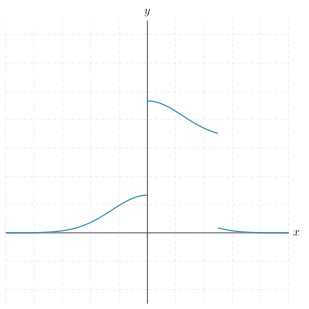
- \(\,\) \begin{align*} && \mathbb{P}(X \leq x) &= \int_{-\infty}^x f(x) \d x \\ &&&= \begin{cases} \frac13 \Phi(x) & \text{if } x < 0 \\ \frac13\Phi(x) + \frac13x & \text{if } 0 \leq x \leq 2 \\ \frac13 \Phi(x) + \frac23 & \text{if } 2 < x \end{cases} \end{align*} When \(\lambda = 2\), \(\mu = \frac{4}{6} = \frac23\), \(\sigma^2 = \frac{16+32+24+12}{12 \cdot 9} = \frac{7}{9}\), so \(\mu + 2 \sigma = \frac23 + \frac{2\sqrt7}{3}>2\). Therefore \begin{align*} && \P(0 < X < \mu + 2\sigma) &= \frac13 \Phi\left (\frac{2+2\sqrt{7}}{3} \right) + \frac23 - \Phi(0) \\ &&&= \tfrac13 \cdot 0.9921 +\tfrac23 - \tfrac12 \\ &&&= 0.4974 \end{align*}