Problems
Filters
14 problems found
2002 Paper 1 Q1
Show that the equation of any circle passing through the points of intersection of the ellipse \((x+2)^2 +2y^2 =18\) and the ellipse \(9(x-1)^2 +16y^2 = 25\) can be written in the form \[ x^2-2ax +y^2 =5-4a\;. \]
Solution: \begin{align*} && (x+2)^2 +2y^2 &=18 \\ && 9(x-1)^2 +16y^2 &= 25 \\ \Rightarrow && 2y^2 &= 18 - (x+2)^2 \\ && 16y^2 &= 25 - 9(x-1)^2 \\ \Rightarrow && 25-9(x-1)^2 &= 8 \cdot 18 - 8(x+2)^2 \\ \Rightarrow && 25 -9+18x-9x^2 &= 144 -32- 32x +8x^2 \\ \Rightarrow && 0 &= 96 - 50x+x^2 \\ &&&= (x-48)(x-2) \\ \Rightarrow && x &= 2,48 \\ \Rightarrow && 2y^2 &= 2, 18-50^2 \\ \Rightarrow && (x,y) &= (2,\pm1) \end{align*} Therefore any circle must have it's centre on there perpendicular bisector of \((2, \pm 1)\), ie on the \(x\)-axis. Therefore it will have equation \((x-a)^2+y^2 = r^2\) and also contain the point \((2,1)\), therefore: \begin{align*} r^2 &= (2-a)^2 + 1^2 \\ &= 4 -2a+a^2 + 1 \\ &= 5-2a+a^2 \end{align*} and the equation is: \begin{align*} && (x-a)^2 + y^2 &= 5-4a+a^2 \\ \Rightarrow && x^2-2ax+a^2 +y^2 &= 5-4a+a^2 \\ \Rightarrow && x^2-2ax+y^2 &= 5-4a \end{align*} as required.
2002 Paper 1 Q2
Let \(f(x) = x^m(x-1)^n\), where \(m\) and \(n\) are both integers greater than \(1\). Show that the curve \(y=f(x)\) has a stationary point with \(0 < x < 1\). By considering \(f''(x)\), show that this stationary point is a maximum if \(n\) is even and a minimum if \(n\) is odd. Sketch the graphs of \(f(x)\) in the four cases that arise according to the values of \(m\) and \(n\).
Solution: \begin{align*} && f'(x) &= mx^{m-1}(x-1)^n + nx^m(x-1)^{n-1} \\ &&&= (m(x-1)+nx)x^{m-1}(x-1)^{n-1} \\ &&&= (x(m+n) - m)x^{m-1}(x-1)^{n-1} \\ \end{align*} Therefore when \(x = \frac{m}{m+n}\) there is a stationary point with \(0 < x < 1\). \begin{align*} && f''(x) &= m(m-1)x^{m-2}(x-1)^n + 2mnx^{m-1}(x-1)^{n-1} + n(n-1)x^{m}(x-1)^{n-2} \\ &&&= (m(m-1)(x-1)^2 +2mnx(x-1)+n(n-1)x^2)x^{m-2}(1-x)^{n-2} \\ \Rightarrow && f'' \left ( \frac{m}{m+n} \right) &= \left ( m(m-1) \frac{n^2}{(m+n)^2} - 2mn\frac{mn}{(m+n)^2} + n(n-1) \frac{m^2}{(m+n)^2} \right) \frac{m^{m-2}}{(m+n)^{m-2}} \frac{(-1)^{n-2}n^{n-2}}{(m+n)^{n-2}} \\ &&&= (-1)^{n-2}\frac{m^{m-1}n^{n-1}}{(m+n)^{m+n-2}} \left ( (m-1)n-2mn+(n-1)m\right) \\ &&&= (-1)^{n-2}\frac{m^{m-1}n^{n-1}}{(m+n)^{m+n-2}} \left ( -m-n\right) \\ &&&= (-1)^{n-1} \frac{m^{m-1}n^{n-1}}{(m+n)^{m+n-3}} \end{align*} Therefore this is positive (and a minimum) when \(n\) is odd and negative (and a maximum) when \(n\) is even.


2002 Paper 1 Q3
Show that \((a+b)^2\le 2a^2+2b^2\,\). Find the stationary points on the curve $y=\big(a^2\cos^2\theta +b^2\sin^2\theta\big)^{\frac12} + \big(a^2\sin^2\theta +b^2\cos^2\theta\big)^{\frac12}\,$, where \(a\) and \(b\) are constants. State, with brief reasons, which points are maxima and which are minima. Hence prove that \[ \vert a\vert +\vert b \vert \le \big(a^2\cos^2\theta +b^2\sin^2\theta\big)^{\frac12} + \big(a^2\sin^2\theta +b^2\cos^2\theta\big)^{\frac12} \le \big(2a^2+2b^2\big)^{\frac12} \;. \]
Solution: \begin{align*} && 2a^2+2b^2 &= a^2 + b^2 + (a^2+b^2) \\ &&&\underbrace{\geq}_{AM-GM} a^2+b^2+2\sqrt{a^2b^2} \\ &&&= a^2+b^2 + 2|a||b| \\ &&&\geq a^2+b^2 + 2ab \\ &&&= (a+b)^2 \end{align*} Assume \(a^2 \neq b^2\), otherwise the curve is a constant. \begin{align*} && y & = \big(a^2\cos^2\theta +b^2\sin^2\theta\big)^{\frac12} + \big(a^2\sin^2\theta +b^2\cos^2\theta\big)^{\frac12}\\ && \frac{\d y}{\d \theta} &= \tfrac12 \left (a^2\cos^2\theta +b^2\sin^2\theta \right)^{-\frac12} \cdot (2 \sin \theta \cos \theta (b^2 - a^2)) + \tfrac12 (a^2\sin^2\theta +b^2\cos^2\theta)^{-\frac12} \cdot (2 \sin \theta \cos \theta (a^2 - b^2) \\ &&&= \tfrac12\sin2 \theta (b^2 - a^2) \left ( \left (a^2\cos^2\theta +b^2\sin^2\theta \right)^{-\frac12} - (a^2\sin^2\theta +b^2\cos^2\theta)^{-\frac12}\right) \\ \therefore \frac{\d y}{\d x} = 0 \Rightarrow && \sin 2\theta = 0 & \text{ or } a^2\cos^2\theta +b^2\sin^2\theta = a^2\sin^2\theta +b^2\cos^2\theta \\ \Rightarrow && \theta &= 0, \frac{\pi}{2}, \pi, \frac{3\pi}{2}, 2\pi \\ && (a^2-b^2) \cos ^2\theta &= (a^2-b^2) \sin^2 \theta \\ \Rightarrow && \theta &= \frac{\pi}{4}, \frac{3\pi}{4}, \frac{5\pi}{4}, \frac{7\pi}{4} \end{align*} WLOG \(b^2 - a^2 > 0\), then the two parts of the derivative look like:

2002 Paper 1 Q4
Give a sketch of the curve \( \;\displaystyle y= \frac1 {1+x^2}\;\), for \(x\ge0\). Find the equation of the line that intersects the curve at \(x=0\) and is tangent to the curve at some point with \(x>0\,\). Prove that there are no further intersections between the line and the curve. Draw the line on your sketch. By considering the area under the curve for \(0\le x\le1\), show that \(\pi>3\,\). Show also, by considering the volume formed by rotating the curve about the \(y\) axis, that \(\ln 2 >2/3\,\). [Note: \(\displaystyle \int_0^ 1 \frac1 {1+x^2}\, \d x = \frac\pi 4\,.\;\)]
Solution:

2002 Paper 1 Q5
Let \[ \f(x) = x^n + a_1 x^{n-1} + \cdots + a_n\;, \] where \(a_1\), \(a_2\), \(\ldots\), \(a_n\) are given numbers. It is given that \(\f(x)\) can be written in the form \[ \f(x) = (x+k_1)(x+k_2)\cdots(x+k_n)\;. \] By considering \(\f(0)\), or otherwise, show that \(k_1k_2 \ldots k_n =a_n\). Show also that $$(k_1+1)(k_2+1)\cdots(k_n+1)= 1+a_1+a_2+\cdots+a_n$$ and give a corresponding result for \((k_1-1)(k_2-1)\cdots(k_n-1)\). Find the roots of the equation \[ x^4 +22x^3 +172x^2 +552x+576=0\;, \] given that they are all integers.
Solution: \begin{align*} && f(0) &= 0^n + a_1\cdot 0^{n-1} + \cdots + a_n \\ &&&= a_n \\ && f(0) &= (0+k_1)(0+k_2) \cdots (0+k_n) \\ &&&= k_1 k_2 \cdots k_n \\ \Rightarrow && a_n &= k_1 k_2 \cdots k_n \\ \\ &&f(1) &= 1^n + a_1 \cdot 1^{n-1} + \cdots + a_n \\ &&&= 1 + a_1 + a_2 + \cdots + a_n \\ && f(1) &= (1 + k_1) (1 + k_2) \cdots (1+k_n) \\ \Rightarrow && (k_1+1)\cdots (k_n+1) &= 1 + a_1 + \cdots + a_n \\ \\ && f(-1) &= (-1)^{n} + a_1 \cdot (-1)^{n-1} + \cdots + a_n \\ &&&= a_n - a_{n-1} + \cdots + (-1)^{n-1} a_1 + (-1)^{n} \\ && f(-1) &= (-1+k_1)(-1+k_2) \cdots (-1+k_n) \\ &&&= (k_1-1)(k_2-1)\cdots(k_n-1) \\ \Rightarrow && (k_1-1)\cdots(k_n-1) &= a_n - a_{n-1} + \cdots + (-1)^{n-1} a_1 + (-1)^{n} \end{align*} \(576 = 2^6 \cdot 3^2\). Notice that \(1 - 22 + 172 -552 + 576 = 175 = 5^2 \cdot 7\) and \(1+22 + 172+552+576 = 1323 = 3^3 \cdot 7^2\). \(k_i = 2, 6, 6, 8\) therefore the roots are \(-2, -6, -6, -8\)
2002 Paper 1 Q6
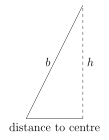
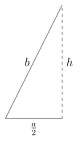
A pyramid stands on horizontal ground. Its base is an equilateral triangle with sides of length~\(a\), the other three sides of the pyramid are of length \(b\) and its volume is \(V\). Given that the formula for the volume of any pyramid is $ \textstyle \frac13 \times \mbox{area of base} \times \mbox {height} \,, $ show that \[ V= \frac1{12} {a^2(3b^2-a^2)}^{\frac12}\;. \] The pyramid is then placed so that a non-equilateral face lies on the ground. Show that the new height, \(h\), of the pyramid is given by \[ h^2 = \frac{a^2(3b^2-a^2)}{4b^2-a^2}\;. \] Find, in terms of \(a\) and \(b\,\), the angle between the equilateral triangle and the horizontal.
Solution: First let's consider the area of the base. It is an equilateral triangle with side length \(a\), so \(\frac12 a^2 \sin 60^\circ = \frac{\sqrt{3}}4a^2\).
2002 Paper 1 Q7
Let \[ I= \int_0^a \frac {\cos x}{\sin x + \cos x} \; \d x \, \quad \mbox{ and } \quad J= \int_0^a \frac {\sin x}{\sin x + \cos x} \; \d x \;, \] where \(0\le a < \frac{3}{4}\pi\,\). By considering \(I+J\) and \(I-J\), show that $ 2I= a + \ln (\sin a +\cos a)\;. $ Find also:
- \(\displaystyle \int_0^{\frac{1}{2}\pi} \frac {\cos x}{p\sin x + q\cos x} \; \d x \,\), where \(p\) and \(q\) are positive numbers; %
- [(ii)] %\(\displaystyle \int_0^{\frac{1}{2}\pi/2} \frac {\cos x}{\sin (x+k)} \; \d x \,\), where \(0 < k < \pi/2\,\);
- \(\displaystyle \int_0^{\frac{1}{2}\pi} \frac {\cos x+4}{3\sin x + 4\cos x+ 25} \; \d x \,\).
Solution: \begin{align*} && I + J &= \int_0^a \frac{\sin x + \cos x}{\sin x + \cos x } \d x = a \\ && I - J &= \int_0^a \frac{\cos x - \sin x}{\sin x + \cos x} \d x \\ &&&= \left [\ln ( \sin x + \cos x) \right]_0^a = \ln (\sin a + \cos a) - \ln 1 = \ln(\sin a + \cos a) \\ \\ \Rightarrow && 2I &= a + \ln(\sin a + \cos a) \end{align*}
- Let \(\displaystyle I = \int_0^{\frac12 \pi} \frac{\cos x}{p \sin x + q \cos x} \d x, J = \int_0^{\frac12 \pi} \frac{\sin x}{p \sin x + q \cos x} \d x\) so \begin{align*} && qI + pJ &= \frac{\pi}{2} \\ && pI - qJ &= \int_0^{\frac12 \pi} \frac{p \cos x - q \sin x}{p \sin x + q \cos x } \d x \\ &&&= \left [\ln (p \sin x + q \cos x) \right]_0^{\pi/2} \\ &&&= \ln(p) - \ln(q) = \ln \frac{p}{q} \end{align*}
- \(\,\) \begin{align*} && \int_0^{\frac{\pi}{2}} \frac{\cos x}{\sin(x + k)} \d x &= \int_0^{\frac{\pi}{2}} \frac{\cos x}{\sin(x) \cos(k) + \cos(x) \sin (k)} \d x \\ &&&= \ln \tan k \end{align*}
- Let \(\displaystyle I = \int_0^{\pi/2} \frac{\cos x + 4}{3 \sin x + 4 \cos x + 25} \d x, J = \int_0^{\pi/2} \frac{\sin x + 3}{3 \sin x + 4 \cos x + 25} \d x\), so \begin{align*} && 4I + 3J &= \int_0^{\pi/2} \frac{3 \sin x + 4 \cos x + 25}{3 \sin x + 4 \cos x + 25} \d x \\ &&&= \frac{\pi}{2} \\ && 3I - 4J &= \int_0^{\pi/2} \frac{3\cos x - 4 \sin x}{3 \sin x + 4 \cos x + 25} \d x \\ &&&= \left [\ln(3 \sin x + 4 \cos x + 25) \right]_0^{\pi/2} \\ &&&= \ln (28) - \ln (29) = \ln \frac{28}{29} \\ \Rightarrow && 25I &= 2\pi + 3 \ln \frac{28}{29} \\ \Rightarrow && I &= \frac{2}{25} \pi + \frac{3}{25} \ln \frac{28}{29} \end{align*}
2002 Paper 1 Q8
I borrow \(C\) pounds at interest rate \(100\alpha \,\%\) per year. The interest is added at the end of each year. Immediately after the interest is added, I make a repayment. The amount I repay at the end of the \(k\)th year is \(R_k\) pounds and the amount I owe at the beginning of \(k\)th year is \(C_k\) pounds (with \(C_1=C\)). Express \(C_{n+1}\) in terms of \(R_k\) (\(k= 1\), \(2\), \(\ldots\), \(n\)), \(\alpha\) and \(C\) and show that, if I pay off the loan in \(N\) years with repayments given by \(R_k= (1+\alpha)^kr\,\), where \(r\) is constant, then \(r=C/N\,\). If instead I pay off the loan in \(N\) years with \(N\) equal repayments of \(R\) pounds, show that \[ \frac R C = \frac{\alpha (1+\alpha)^{N} }{(1+\alpha)^N-1} \;, \] and that \(R/C\approx 27/103\) in the case \(\alpha =1/50\), \(N=4\,\).
2002 Paper 1 Q9
\(\,\) \vspace*{-0.5in}
- If the normal reactions on the lower and higher wheels of the lorry are equal, show that the sum of the frictional forces between the wheels and the ground is zero.
- If \(P\) is such that the lorry does not tip over (but the normal reactions on the lower and higher wheels of the lorry need not be equal), show that \[ W\tan(\alpha - \beta) \le P \le W\tan(\alpha+\beta)\;, \] where \(\tan\beta = d/h\,\).
2002 Paper 1 Q10
A bicycle pump consists of a cylinder and a piston. The piston is pushed in with steady speed~\(u\). A particle of air moves to and fro between the piston and the end of the cylinder, colliding perfectly elastically with the piston and the end of the cylinder, and always moving parallel with the axis of the cylinder. Initially, the particle is moving towards the piston at speed \(v\). Show that the speed, \(v_n\), of the particle just after the \(n\)th collision with the piston is given by \(v_n=v+2nu\). Let \(d_n\) be the distance between the piston and the end of the cylinder at the \(n\)th collision, and let \(t_n\) be the time between the \(n\)th and \((n+1)\)th collisions. Express \(d_n - d_{n+1}\) in terms of \(u\) and \(t_n\), and show that \[ d_{n+1} = \frac{v+(2n-1)u}{v+(2n+1)u} \, d_n \;. \] Express \(d_n\) in terms of \(d_1\), \(u\), \(v\) and \(n\). In the case \(v=u\), show that \(ut_n = \displaystyle \frac {d_1} {n(n+1)}\). %%%%%Verify that \(\sum\limits_1^\infty t_n = d/u\).
2002 Paper 1 Q11
\(\,\)
2002 Paper 1 Q12
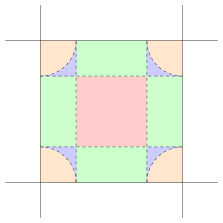
Harry the Calculating Horse will do any mathematical problem I set him, providing the answer is 1, 2, 3 or 4. When I set him a problem, he places a hoof on a large grid consisting of unit squares and his answer is the number of squares partly covered by his hoof. Harry has circular hoofs, of radius \(1/4\) unit. After many years of collaboration, I suspect that Harry no longer bothers to do the calculations, instead merely placing his hoof on the grid completely at random. I often ask him to divide 4 by 4, but only about \(1/4\) of his answers are right; I often ask him to add 2 and 2, but disappointingly only about \(\pi/16\) of his answers are right. Is this consistent with my suspicions? I decide to investigate further by setting Harry many problems, the answers to which are 1, 2, 3, or 4 with equal frequency. If Harry is placing his hoof at random, find the expected value of his answers. The average of Harry's answers turns out to be 2. Should I get a new horse?
Solution: Without loss of generality, let's assume that Harry is putting the center of his hoof within one square.
2002 Paper 1 Q13
The random variable \(U\) takes the values \(+1\), \(0\) and \(-1\,\), each with probability \(\frac13\,\). The random variable \(V\) takes the values \(+1\) and \(-1\) as follows:
| if \(U=1\,\), | then \(\P(V=1)= \frac13\) and \(\P(V=-1)=\frac23\,\); |
| if \(U=0\,\), | then \(\P(V=1)= \frac12\) and \(\P(V=-1)=\frac12\,\); |
| if \(U=-1\,\), | then \(\P(V=1)= \frac23\) and \(\P(V=-1)=\frac13\,\). |
- Show that the probability that both roots of the equation \(x^2+Ux+V=0\) are real is \(\frac12\;\).
- Find the expected value of the larger root of the equation \(x^2+Ux+V=0\,\), given that both roots are real.
- Find the probability that the roots of the equation $$x^3+(U-2V)x^2+(1-2UV)x + U=0$$ are all positive.
Solution:
- \(\,\) \begin{align*} && \mathbb{P}(\text{both roots real}) &= \mathbb{P}(\Delta \geq 0) \\ &&&= \mathbb{P}(U^2 \geq 4V) \\ &&&= \mathbb{P}(V = -1) \\ &&&= \tfrac13 ( \tfrac23 + \tfrac12 + \tfrac13) \\ &&&= \tfrac13 \cdot \tfrac 32 = \frac12 \end{align*}
- Our equations will be: \(x^2+x-1 = 0\) with larger root \(\frac{-1 + \sqrt{5}}{2}\) \(x^2-1 = 0\) with larger root \(1\) \(x^2-x-1 = 0\) with larger root \(\frac{1 + \sqrt5}{2}\) and the expected value is \begin{align*} && \E[\text{larger root}|\text{both real}] &= \frac23 \left ( \frac23 \cdot \frac{-1+\sqrt5}{2} + \frac12 \cdot 1 + \frac13 \cdot \frac{1+\sqrt5}{2} \right) \\ &&&= \frac23 \left ( \frac{2+3\sqrt5}{6} \right) \\ &&&= \frac{2+3\sqrt5}{9} \end{align*}
- Suppose we have \(x^3+(U-2V)x^2+(1-2UV)x + U = 0\), then for all roots to be positive, we need \(U < 0 \Rightarrow U = -1\) (otherwise there is a root at or below zero). Therefore our two possible cubics are: \(x^3 -3x^2+3x-1 = (x-1)^3\) (all roots positive) \(x^3+x^2-x-1 = (x-1)(x+1)^2\) (not all roots positive!) Therefore the probability is \(\frac13 \cdot \frac23 = \frac29\)
2002 Paper 1 Q14
In order to get money from a cash dispenser I have to punch in an identification number. I have forgotten my identification number, but I do know that it is equally likely to be any one of the integers \(1\), \(2\), \ldots , \(n\). I plan to punch in integers in order until I get the right one. I can do this at the rate of \(r\) integers per minute. As soon as I punch in the first wrong number, the police will be alerted. The probability that they will arrive within a time \(t\) minutes is \(1-\e^{-\lambda t}\), where \(\lambda\) is a positive constant. If I follow my plan, show that the probability of the police arriving before I get my money is \[ \sum_{k=1}^n \frac{1-\e^{-\lambda(k-1)/r}}n\;. \] Simplify the sum. On past experience, I know that I will be so flustered that I will just punch in possible integers at random, without noticing which I have already tried. Show that the probability of the police arriving before I get my money is \[ 1-\frac1{n-(n-1)\e^{-\lambda/r}} \;. \]