Problems
Filters
2 problems found
2008 Paper 1 Q4
A function \(\f(x)\) is said to be convex in the interval \(a < x < b\) if \(\f''(x)\ge0\) for all \(x\) in this interval.
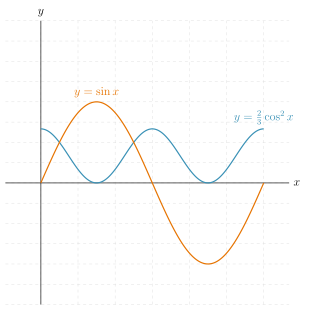
- Sketch on the same axes the graphs of \(y= \frac23 \cos^2 x\) and \(y=\sin x\) in the interval \(0\le x \le 2\pi\). The function \(\f(x)\) is defined for \(0 < x < 2\pi\) by \[\f(x) = \e^{\frac23 \sin x}. \] Determine the intervals in which \(\f(x)\) is convex.
- The function \(\g(x)\) is defined for \(0 < x < \frac12\pi\) by \[\g(x) = \e^{-k \tan x}. \] If \(k=\sin 2 \alpha\) and \(0 < \alpha < \frac{1}{4}\pi\), show that \(\g(x)\) is convex in the interval \(0 < x < \alpha\), and give one other interval in which \(\g(x)\) is convex.
Solution:
- \begin{align*} && f(x) &= \exp\left (\tfrac23\sin x \right) \\ && f'(x) &= \exp\left (\tfrac23\sin x \right) \cdot \tfrac23 \cos x \\ && f''(x) &= \left ( \exp\left (\tfrac23\sin x \right) \cdot \tfrac23\right) \left ( \tfrac23 \cos^2 x - \sin x \right) \end{align*} Therefore \(f(x)\) is convex when \(\frac23 \cos^2 x \geq \sin x\). Note that we can find the equality points when \begin{align*} && \sin x &= \frac23 \cos^2 x \\ &&&= \frac23 (1- \sin^2 x) \\ \Rightarrow && 0 &= 2\sin^2 x + 3 \sin x - 2 \\ &&&= (2 \sin x -1) (\sin x+2) \end{align*} ie \(\sin x = \frac12 \Rightarrow x = \frac{\pi}{6}, \frac{5\pi}{6}\). Therefore \(f\) is convex on \([0, \frac{\pi}{6}] \cup [\frac{5\pi}{6}, 2\pi]\)
- Suppose \(g(x) = \exp \left ( -k \tan x \right)\) then \begin{align*} && g'(x) &= \exp \left ( -k \tan x \right) \cdot (-k \sec^2 x ) \\ && g''(x) &= \left ( -k \exp \left ( -k \tan x \right) \right) \left ( -k\sec^4 x + 2 \sec x \cdot \sec x \tan x\right) \\ &&&= -k \exp \left ( -k \tan x \right) \sec^4 x \left ( -k + 2\sin x \cos x \right) \\ &&&= -k \exp \left ( -k \tan x \right) \sec^4 x \left ( -k + \sin 2x \right) \\ \end{align*} If \(0 < \alpha < \frac{\pi}{4}\) then \(k > 0\) so \(g\) is convex if \(-k + \sin 2x < 0\), ie \(\sin 2x < \sin 2\alpha\), ie on \((0, \alpha)\) and \((\frac{\pi}{2} - \alpha, \frac{\pi}{2})\)
2004 Paper 3 Q3
Given that \(\f''(x) > 0\) when \(a \le x \le b\,\), explain with the aid of a sketch why \[ (b-a) \, \f \Big( {a+b \over 2} \Big) < \int^b_a \f(x) \, \mathrm{d}x < (b-a) \, \displaystyle \frac{\f(a) + \f(b)}{2} \;. \] By choosing suitable \(a\), \(b\) and \(\f(x)\,\), show that \[ {4 \over (2n-1)^2} < {1 \over n-1} - {1 \over n} < {1 \over 2} \l {1 \over n^2} + {1 \over (n-1)^2}\r \,, \] where \(n\) is an integer greater than 1. Deduce that \[ 4 \l {1 \over 3^2} +{1 \over 5^2} + {1 \over 7^2} + \cdots \r < 1 < {1 \over 2} + \left( {1 \over 2^2} +{1 \over 3^2} + {1 \over 4^2} + \cdots \right)\,. \] Show that \[ {1 \over 2} \l {1 \over 3^2} + {1 \over 4^2} + {1 \over 5^2} + \frac 1 {6^2} + \cdots \r < {1 \over 3^2} +{1 \over 5^2} + {1 \over 7^2} + \cdots \] and hence show that \[ {3 \over 2} \displaystyle < \sum_{n=1}^\infty {1 \over n^2} <{7 \over 4}\;. \]