Problems

Filters
Clear Filters

4 problems found

2018 Paper 1 Q1
D: 1516.0 B: 1516.0

The line \(y=a^2 x\) and the curve \(y=x(b-x)^2\), where \(0 < a < b\,\), intersect at the origin \(O\) and at points \(P\) and \(Q \). The \(x\)-coordinate of \(P\) is less than the \(x\)-coordinate of \(Q\). Find the coordinates of \(P\) and \(Q\), and sketch the line and the curve on the same axes. Show that the equation of the tangent to the curve at \(P\) is \[ y = a(3a-2b)x + 2a(b-a)^2 . \] This tangent meets the \(y\)-axis at \(R\). The area of the region between the curve and the line segment \(OP\) is denoted by \(S\). Show that \[ S= \frac1{12}(b-a)^3(3a+b)\,. \] The area of triangle \(OPR\) is denoted by \(T\). Show that \(S>\frac{1}{3}T\,\).


Solution:
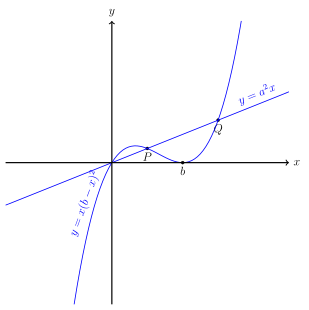
TikZ diagram
\begin{align*} && a^2x &= x(b-x)^2 \\ \Rightarrow && 0 &= x((b-x)^2-a^2) \\ &&&= x(b-a-x)(b+a-x)\\ && y &= x(b-x)^2 \\ \Rightarrow && y' &= (b-x)^2-2x(b-x) \\ P(b-a,a^2(b-a)): &&y' &= (b-(b-a))^2-2(b-a)(b-(b-a)) \\ &&&= a^2-2a(b-a) = a(3a-2b) \\ \Rightarrow && y &= a(3a-2b)(x-(b-a)) + a^2(b-a) \\ &&&= a(3a-2b)x + (b-a)(a^2-3a^2+2ba) \\ &&&= a(3a-2b)x + (b-a)2a(b-a) \\ &&&= a(3a-2b)x + 2a(b-a)^2 \\ \end{align*} Therefore the tangent at \(P\) is \(a(3a-2b)x + 2a(b-a)^2\) The area between the curve and \(OP\) is \begin{align*} &&S &= \int_0^{b-a} \left (x(b-x)^2-a^2x \right) \d x\\ &&&= \left [\frac{x^2}{2}b^2 - \frac{2x^3}{3}b +\frac{x^4}{4} - \frac{a^2x^2}{2}\right]_0^{b-a} \\ &&&= (b-a)^2 \tfrac12 (b^2-a^2) - \tfrac23(b-a)^3b + \tfrac14(b-a)^4 \\ &&&= \tfrac1{12}(b-a)^3(6(b+a)-8b+3(b-a)) \\ &&&= \tfrac1{12}(b-a)^3(b+3a) \end{align*} The area \([OPR] = T= \tfrac12 \cdot (b-a) \cdot 2a(b-a)^2 = a(b-a)^3\) Clearly \(S > \frac4{12}(b-a)^3a = \frac13T\)

2006 Paper 1 Q8
D: 1500.0 B: 1484.0

{\it Note that the volume of a tetrahedron is equal to \(\frac1 3\) \(\times\) the area of the base \(\times\) the height.} The points \(O\), \(A\), \(B\) and \(C\) have coordinates \((0,0,0)\), \((a,0,0)\), \((0,b,0)\) and \((0,0,c)\), respectively, where \(a\), \(b\) and \(c\) are positive.

  1. Find, in terms of \(a\), \(b\) and \(c\), the volume of the tetrahedron \(OABC\).
  2. Let angle \(ACB = \theta\). Show that \[ \cos\theta = \frac {c^2} { { \sqrt{\vphantom{ \dot b} (a^2+c^2)(b^2+c^2)} } ^{\vphantom A} \ } \] and find, in terms of \(a\), \(b\) and \(c\), the area of triangle \(ABC\). % is %\(\displaystyle \tfrac12 \sqrt{ \vphantom{\dot A } a^2b^2 +b^2c^2 + c^2 a^2 \;} \;\).
Hence show that \(d\), the perpendicular distance of the origin from the triangle \(ABC\), satisfies \[ \frac 1{d^2} = \frac 1 {a^2} + \frac 1 {b^2} + \frac 1 {c^2} \,. \]

2006 Paper 3 Q13
D: 1700.0 B: 1530.6

Two points are chosen independently at random on the perimeter (including the diameter) of a semicircle of unit radius. The area of the triangle whose vertices are these two points and the midpoint of the diameter is denoted by the random variable \(A\). Show that the expected value of \(A\) is \((2+\pi)^{-1}\).


Solution: There are \(3\) possible numbers of points on the curved part of the perimeter. \(0\): The area is \(0\) \(1\):

TikZ diagram
The area of the triangle is \(\frac12 |x| \sin \theta\) Where \(X\) is the point along the diameter which is \(U[-1,1]\) and \(\theta \sim U(0, \pi)\) Therefore \begin{align*} \mathbb{E}(A|\text{one on diameter}) &= \int_{0}^\pi \frac{1}{\pi} \int_{-1}^1\frac{1}{2}\frac12 |x| \sin \theta \d x \d \theta \\ &= \frac{1}{2\pi}\frac12 \int_{0}^\pi \sin \theta \d \theta \cdot 2\int_{0}^1 x\d x \\ &=\frac{1}{2\pi}\cdot 2 \cdot \frac12 = \frac{1}{2\pi} \end{align*} \(2\): If both are on the curved section
TikZ diagram
Then the area is \(\frac12 \sin \theta\) where \(\theta = |\theta_1 - \theta_2|\) and \(\theta_i \sim U[0, \pi]\) Therefore the area is \begin{align*} \mathbb{E}(A|\text{none on diameter}) &= \int_{0}^\pi\frac{1}{\pi} \int_{0}^\pi\frac{1}{\pi} \frac12 \sin |\theta_1 - \theta_2| \d \theta_1 \d \theta_2 \\ &= \frac{1}{\pi^2}\frac12 \int_{0}^\pi \left (\int_{0}^{\theta_2} \sin (\theta_2 - \theta_1) \d \theta_1-\int_{\theta_2}^{\pi} \sin (\theta_2 - \theta_1) \d \theta_1 \right)\d \theta_2 \\ &= \frac{1}{\pi^2}\frac12 \int_{0}^\pi \left [2\cos(\theta_2 - \theta_2)-\cos(\theta_2 - 0)-\cos(\theta_2 - \pi) \right]\d \theta_2 \\ &= \frac{1}{\pi} \end{align*} Therefore the expected area is: \begin{align*} \mathbb{E}(A ) &= \mathbb{E}(A|\text{one on diameter})\cdot \mathbb{P}(\text{one on diameter}) + \mathbb{E}(A|\text{none on diameter})\cdot \mathbb{P}(\text{none on diameter}) \\ &= \frac{1}{2\pi}\mathbb{P}(\text{one on diameter}) + \frac{1}{\pi}\cdot \mathbb{P}(\text{none on diameter}) \\ &= \frac{1}{2\pi} \cdot 2 \cdot \frac{\pi}{\pi + 2} \cdot \frac{2}{\pi + 2} + \frac1{\pi} \cdot \frac{\pi}{\pi + 2} \cdot \frac{\pi}{\pi+2} \\ &= \frac{2 + \pi}{(\pi+2)^2} \\ &= \frac{1}{\pi+2} \end{align*}

1989 Paper 2 Q15
D: 1600.0 B: 1484.0

Two points are chosen independently at random on the perimeter (including the diameter) of a semicircle of unit radius. What is the probability that exactly one of them lies on the diameter? Let the area of the triangle formed by the two points and the midpoint of the diameter be denoted by the random variable \(A\).

  1. Given that exactly one point lies on the diameter, show that the expected value of \(A\) is \(\left(2\pi\right)^{-1}\).
  2. Given that neither point lies on the diameter, show that the expected value of \(A\) is \(\pi^{-1}\). [You may assume that if two points are chosen at random on a line of length \(\pi\) units, the probability density function for the distance \(X\) between the two points is \(2\left(\pi-x\right)/\pi^{2}\) for \(0\leqslant x\leqslant\pi.\)]
Using these results, or otherwise, show that the expected value of \(A\) is \(\left(2+\pi\right)^{-1}\).


Solution:

  1. TikZ diagram
    \begin{align*} \mathbb{E}(A \mid \text{exactly one point on diameter}) &= \int_{-1}^1\int_0^\pi \frac12 (x-0)\cdot 1 \cdot \sin(\pi - \theta) \frac{1}{\pi} \d \theta \frac{1}{2} \d x \\ &= \int_{-1}^1\frac1{2\pi} x \d x \cdot \left [ -\cos \theta \right]_0^\pi \\ &= \frac{1}{2\pi} \end{align*}
  2. TikZ diagram
    \begin{align*} \mathbb{E}(A \mid \text{no point on diameter}) &= \int_0^{\pi} \frac12 \cdot 1 \cdot 1 \cdot \sin x \cdot 2(\pi - x)/\pi^2 \d x \\ &= \frac1{\pi^2} \int_0^\pi \sin x (\pi - x) \d x \\ &= \frac1{\pi^2} \int_0^\pi x\sin x \d x \\ &= \frac1{\pi^2} \left [ \sin x - x \cos x \right]_0^{\pi} \\ &= \frac{1}{\pi} \end{align*}
If both points lie on the diameter the area of the triangle is \(0\). Therefore: \begin{align*} \mathbb{E}(A) &= \frac{1}{2\pi} \mathbb{P}(\text{exactly one point on diameter}) + \frac{1}{\pi}\mathbb{P}(\text{no points on diameter}) \\ &= \frac1{2\pi} \cdot \left (2 \cdot \frac{2}{2+\pi} \cdot \frac{\pi}{2+\pi} \right) + \frac{1}{\pi} \cdot \left ( \frac{\pi}{2+\pi} \cdot \frac{\pi}{2+\pi}\right) \\ &= \frac{1}{\pi} \frac{2\pi + \pi^2}{(2+\pi)^2} \\ &= \frac{1}{2+\pi} \end{align*}