Problems
Filters
12 problems found
2025 Paper 2 Q4
Let \(\lfloor x \rfloor\) denote the largest integer that satisfies \(\lfloor x \rfloor \leq x\). For example, if \(x = -4.2\), then \(\lfloor x \rfloor = -5\).
- Show that, if \(n\) is an integer, then \(\lfloor x + n \rfloor = \lfloor x \rfloor + n\).
- Let \(n\) be a positive integer and define function \(f_n\) by
\[f_n(x) = \lfloor x \rfloor + \left\lfloor x + \frac{1}{n} \right\rfloor + \left\lfloor x + \frac{2}{n} \right\rfloor + \ldots + \left\lfloor x + \frac{n-1}{n} \right\rfloor - \lfloor nx \rfloor\]
- Show that \(f_n\left(x + \frac{1}{n}\right) = f_n(x)\).
- Evaluate \(f_n(t)\) for \(0 \leq t < \frac{1}{n}\).
- Hence show that \(f_n(x) \equiv 0\).
- Show that \(\left\lfloor \frac{x}{2} \right\rfloor + \left\lfloor \frac{x+1}{2} \right\rfloor = \lfloor x \rfloor\).
- Hence, or otherwise, simplify \[\left\lfloor \frac{x+1}{2} \right\rfloor + \left\lfloor \frac{x+2}{2^2} \right\rfloor + \ldots + \left\lfloor \frac{x+2^k}{2^{k+1}} \right\rfloor + \ldots\]
Solution:
- Claim: If \(n \in \mathbb{Z}\) then \(\lfloor x + n \rfloor = \lfloor x \rfloor + n\) Proof: Since \(\lfloor x \rfloor \leq x\) then \(\lfloor x \rfloor + n \leq x + n\) and \(\lfloor x \rfloor + n \in \mathbb{Z}\) we must have that \(\lfloor x \rfloor +n \leq \lfloor x + n \rfloor\). However, since \(\lfloor x \rfloor + 1 > x\) we must also have that \(\lfloor x \rfloor + 1 + n > x + n\), therefore \(\lfloor x \rfloor + n\) is the largest integer less than \(x + n\) as required.
- Claim: \(f_n\left(x + \frac{1}{n}\right) = f_n(x)\) Proof: \begin{align*} f_n\left(x + \frac{1}{n}\right) &=\left \lfloor x+ \frac{1}{n} \right \rfloor + \left\lfloor x + \frac{1}{n}+ \frac{1}{n} \right\rfloor + \left\lfloor x+ \frac{1}{n} + \frac{2}{n} \right\rfloor + \ldots + \left\lfloor x+ \frac{1}{n} + \frac{n-1}{n} \right\rfloor - \left \lfloor n\left ( x + \frac{1}{n} \right) \right \rfloor \\ &= \left \lfloor x+ \frac{1}{n} \right \rfloor + \left\lfloor x + \frac{2}{n}\right\rfloor + \left\lfloor x+ \frac{3}{n} \right\rfloor + \ldots + \left\lfloor x+ \frac{n}{n} \right\rfloor - \left \lfloor nx + 1 \right \rfloor \\ &= \left \lfloor x+ \frac{1}{n} \right \rfloor + \left\lfloor x + \frac{2}{n}\right\rfloor + \left\lfloor x+ \frac{3}{n} \right\rfloor + \ldots + \left\lfloor x+ 1 \right\rfloor - \left \lfloor nx + 1 \right \rfloor \\ &= \left \lfloor x+ \frac{1}{n} \right \rfloor + \left\lfloor x + \frac{2}{n}\right\rfloor + \left\lfloor x+ \frac{3}{n} \right\rfloor + \ldots + \lfloor x \rfloor + 1 - \left ( \lfloor nx \rfloor + 1 \right) \\ &= \lfloor x \rfloor + \left\lfloor x + \frac{1}{n} \right\rfloor + \left\lfloor x + \frac{2}{n} \right\rfloor + \ldots + \left\lfloor x + \frac{n-1}{n} \right\rfloor - \lfloor nx \rfloor \\ &= f_n(x) \end{align*}
- Suppose \(0 \leq t < \frac1n\), then note that \(\left \lfloor t + \frac{k}{n} \right \rfloor = 0\) for \(0 \leq k \leq n - 1\) and \(\lfloor n t \rfloor = 0\) since \(nt < 1\)
- Since \(f_n(x)\) is zero on \([0, \tfrac1n)\) and periodic with period \(\tfrac1n\) it must be constantly zero
- Claim: \(\left\lfloor \frac{x}{2} \right\rfloor + \left\lfloor \frac{x+1}{2} \right\rfloor = \lfloor x \rfloor\) Proof: Suppose \(x = n + \epsilon\) where \(0 \leq \epsilon < 1\), ie \(n = \lfloor x \rfloor\), then consider two cases: Case 1: \(n = 2k\) \begin{align*} \left\lfloor \frac{x}{2} \right\rfloor + \left\lfloor \frac{x+1}{2} \right\rfloor &= \left\lfloor \frac{n + \epsilon}{2} \right\rfloor + \left\lfloor \frac{n + \epsilon+1}{2} \right\rfloor \\ &= \left\lfloor \frac{2k + \epsilon}{2} \right\rfloor + \left\lfloor \frac{2k + \epsilon+1}{2} \right\rfloor \\ &= k + \left\lfloor \frac{\epsilon}{2} \right\rfloor + k + \left\lfloor \frac{\epsilon+1}{2} \right\rfloor \\ &= 2k \\ &= n \end{align*} Case 2: \(n = 2k + 1\) \begin{align*} \left\lfloor \frac{x}{2} \right\rfloor + \left\lfloor \frac{x+1}{2} \right\rfloor &= \left\lfloor \frac{n + \epsilon}{2} \right\rfloor + \left\lfloor \frac{n + \epsilon+1}{2} \right\rfloor \\ &= \left\lfloor \frac{2k +1+ \epsilon}{2} \right\rfloor + \left\lfloor \frac{2k +1+ \epsilon+1}{2} \right\rfloor \\ &= k + \left\lfloor \frac{\epsilon+1}{2} \right\rfloor + k +1+ \left\lfloor \frac{\epsilon}{2} \right\rfloor \\ &= 2k +1\\ &= n \end{align*} as required.
- Since \(\left \lfloor \frac{x+1}{2} \right \rfloor = \lfloor x \rfloor - \lfloor \frac{x}{2} \rfloor\) and in general, \(\left \lfloor \frac{x+2^k}{2^{k+1}} \right \rfloor = \lfloor \frac{x}{2^k} \rfloor - \lfloor \frac{x}{2^{k+1}} \rfloor\) and so in general: \begin{align*} \sum_{k=0}^\infty \left \lfloor \frac{x+2^k}{2^{k+1}} \right \rfloor &= \sum_{k=0}^\infty \left ( \left \lfloor \frac{x}{2^k} \right \rfloor -\left \lfloor \frac{x}{2^{k+1}} \right \rfloor \right) \\ &= \lfloor x \rfloor \end{align*}
2017 Paper 3 Q8
Prove that, for any numbers \(a_1, a_2, \ldots\,,\) and \(b_1, b_2, \ldots\,,\) and for \(n\ge1\), \[ \sum_{m=1}^n a_m(b_{m+1} -b_m) = a_{n+1}b_{n+1} -a_1b_1 -\sum_{m=1}^n b_{m+1}(a_{m+1} -a_m) \,. \]
- By setting \(b_m = \sin mx\), show that \[ \sum_{m=1}^n \cos (m+\tfrac12)x = \tfrac12 \big(\sin (n+1)x - \sin x \big) \cosec \tfrac12 x \,. \] Note: $\sin A - \sin B = \displaystyle 2 \cos \big( \tfrac{{\displaystyle A+B\vphantom{_1}}} {\displaystyle 2\vphantom{^1}} \big)\, \sin\big( \tfrac{{\displaystyle A-B\vphantom{_1}}}{\displaystyle 2\vphantom{^1}} \big)\, $.
- Show that \[ \sum_{m=1}^n m\sin mx = \big (p \sin(n+1)x +q \sin nx\big) \cosec^2 \tfrac12 x \,, \] where \(p\) and \(q\) are to be determined in terms of \(n\). Note: \(2\sin A \sin B = \cos (A-B) - \cos (A+B)\,\); Note: \(2\cos A \sin B = \sin (A+B) - \sin (A-B)\,\).
Solution: \begin{align*} \sum_{m=1}^n a_m(b_{m+1} -b_m) +\sum_{m=1}^n b_{m+1}(a_{m+1} -a_m) &= \sum_{m=1}^n \left (a_{m+1}b_{m+1}-a_mb_m \right) \\ &= a_{n+1}b_{n+1} - a_1b_1 \end{align*} And the result follows.
- Let \(b_m = \sin m x \), \(a_m = \cosec \frac{x}{2}\), so \begin{align*} && \sum_{m=1}^n \cosec \frac{x}{2} \left (\sin (m+1)x - \sin mx \right) &= \sum_{m=1}^n \cosec \frac{x}{2} 2 \cos \left ( \frac{2m+1}{2}x \right) \sin \left ( \frac{(m+1)-m}{2}x \right) \\ &&&=2 \sum_{m=1}^n\cos \left ( (m + \tfrac12)x \right)\\ \\ \Rightarrow && \sum_{m=1}^n\cos \left ( (m + \tfrac12)x \right) &= \tfrac12 \cosec \tfrac{x}{2}\left ( \sin(n+1)x - \sin x \right) \end{align*}
- \(\,\) \begin{align*} && b_{m+1}-b_m &= \sin m x \sin \tfrac12 x \\ &&&= \frac12 \left ( \cos (m-\tfrac12)x - \cos (m+\tfrac12)x \right)\\ \Rightarrow && b_m &= -\tfrac12 \cos (m - \tfrac12)x\\ && a_m &= m \\ \Rightarrow && \sum_{m=1}^n m \sin m x \sin \tfrac12 x &= (n+1) b_{n+1} - 1 \cdot b_1 - \sum_{m=1}^n b_{m+1} \cdot 1 \\ &&&= -(n+1) \tfrac12\cos(n+1-\tfrac12)x+\tfrac12\cos(\tfrac12x) + \tfrac12\sum_{m=1}^n \cos(m+\tfrac12)x \\ &&&= -(n+1) \tfrac12\cos(n+1-\tfrac12)x+\tfrac12\cos(\tfrac12x) + \tfrac14 \cosec \tfrac{x}{2}\left ( \sin(n+1)x - \sin x \right) \\ &&&= -(n+1) \tfrac12\cos(n+1-\tfrac12)x+ \tfrac14 \cosec \tfrac{x}{2}\sin(n+1)x \\ &&&= \tfrac12\cosec\tfrac{x}2 \left (\tfrac12 \sin (n+1)x-(n+1)\cos(n+\tfrac12)x\sin\tfrac12x \right) \\ &&&= \tfrac12\cosec\tfrac{x}2 \left (\tfrac12 \sin (n+1)x-(n+1)\tfrac12 \left ( \sin (n+1)x - \sin nx \right) \right) \\ &&&= \tfrac14 \cosec \tfrac{x}{2} \left ( -n \sin (n+1)x +(n+1) \sin n x \right) \end{align*} Therefore \(p = -\frac{n}4, q = \frac{n+1}{4}\)
2015 Paper 2 Q5
In this question, the \(\mathrm{arctan}\) function satisfies \(0\le \arctan x <\frac12 \pi\) for \(x\ge0\,\).
- Let \[ S_n= \sum_{m=1}^n \arctan \left(\frac1 {2m^2}\right) \,, \] for \(n=1, 2, 3, \ldots\) . Prove by induction that \[ \tan S_n = \frac n {n+1} \,. \] Prove also that \[ S_n = \arctan \frac n {n+1} \,. \]
- In a triangle \(ABC\), the lengths of the sides \(AB\) and \(BC\) are \(4n^2\) and \(4n^4-1\), respectively, and the angle at \(B\) is a right angle. Let \(\angle BCA = 2\alpha_n\). Show that \[ \sum_{n=1}^\infty \alpha_n = \tfrac14\pi \,. \]
Solution:
- Claim: \(\tan S_n = \frac n {n+1}\) Proof: (By Induction) Base case: (\(n=1\)): \begin{align*} && \tan \left ( \sum_{m=1}^1 \arctan \left ( \frac{1}{2m^2} \right) \right) &= \tan \left ( \arctan \left ( \frac{1}{2} \right) \right) \\ &&&= \frac12 = \frac{1}{1+1} \end{align*} Therefore the base case is true. Inductive step: Suppose our statement is true for some \(n = k\), ie \begin{align*} && \frac{k}{k+1} &= \tan \left ( \sum_{m=1}^k \arctan \left ( \frac{1}{2m^2} \right) \right) \\ \Rightarrow && \tan S_{k+1} &= \tan \left ( \sum_{m=1}^k \arctan \left ( \frac{1}{2m^2} \right) + \arctan \left ( \frac{1}{2 (k+1)^2} \right) \right) \\ &&&= \frac{\tan S_k + \tan \left ( \arctan \left ( \frac{1}{2 (k+1)^2} \right) \right)}{1-\tan S_k \tan \left ( \arctan \left ( \frac{1}{2 (k+1)^2} \right) \right)} \\ &&&= \frac{\frac{k}{k+1} + \frac{1}{2(k+1)^2}}{1-\frac{k}{k+1} \frac{1}{2(k+1)^2}} \\ &&&= \frac{2k(k+1)^2+(k+1)}{2(k+1)^3-k} \\ &&&= \frac{k+1}{(k+1)+1} \end{align*} Therefore it is true for \(n=k+1\). Conclusion: Therefore by the principle of mathematical induction since our statement is true for \(n=1\) and if it is true for \(n=k\) it is true for \(n=k+1\) it is true for all \(n\geq1\) Since \(S_n < \frac12 \pi\) for all \(n\), we must have \(\arctan \frac{n}{n+1} = S_n\)
- \(\tan (2\alpha_n) = \frac{4n^2}{4n^4-1} = \frac{2n^2+2n^2}{(2n^2)(2n^2)-1} = \frac{\frac{1}{2n^2}+\frac{1}{2n^2}}{1-\frac{1}{2n^2}\frac{1}{2n^2}} \Rightarrow \tan (\alpha_n) = \arctan \frac{1}{2n^2}\). In particular \(\displaystyle \sum_{n=1}^{N} \alpha_n = \arctan \frac{n}{n+1} \Rightarrow \sum_{n=1}^{\infty} \alpha_n \to \arctan 1 = \frac{\pi}{4} \)
2014 Paper 2 Q6
By simplifying \(\sin(r+\frac12)x - \sin(r-\frac12)x\) or otherwise show that, for \(\sin\frac12 x \ne0\), \[ \cos x + \cos 2x +\cdots + \cos nx = \frac{\sin(n+\frac12)x - \sin\frac12 x}{2\sin\frac12x}\,. \] The functions \(S_n\), for \(n=1, 2, \dots\), are defined by \[ S_n(x) = \sum_{r=1}^n \frac 1 r \sin rx \qquad (0\le x \le \pi). \]
- Find the stationary points of \(S_2(x)\) for \(0\le x\le\pi\), and sketch this function.
- Show that if \(S_n(x)\) has a stationary point at \(x=x_0\), where \(0< x_0 < \pi\), then \[ \sin nx_0 = (1-\cos nx_0) \tan\tfrac12 x_0 \] and hence that \(S_n(x_0) \ge S_{n-1}(x_0)\). Deduce that if \(S_{n-1}(x) > 0\) for all \(x\) in the interval \(0 < x < \pi\), then \(S_{n}(x) > 0\) for all \(x\) in this interval.
- Prove that \(S_n(x)\ge0\) for \(n\ge1\) and \(0\le x\le\pi\).
Solution: \begin{align*} && \sin(r + \tfrac12)x - \sin(r - \tfrac12) x &= \sin rx \cos \tfrac12x + \cos r x\sin\tfrac12x - \sin r x \cos \tfrac12 x + \cos rx \sin \tfrac12 x \\ &&&= 2\cos r x \sin\tfrac12 x \\ \\ && S &= \cos x + \cos 2x + \cdots + \cos n x \\ && 2\sin \tfrac12 x S &= \sin(1 + \tfrac12)x - \sin \tfrac12 x + \\ &&&\quad+ \sin(2+\tfrac12)x - \sin(2- \tfrac12)x + \\ &&&\quad+ \sin(3+\tfrac12)x - \sin(3 - \tfrac12)x + \\ &&& \quad + \cdots + \\ &&&\quad + \sin(n+\tfrac12)x - \sin(n-\tfrac12)x \\ &&&=\sin(n+\tfrac12)x - \sin\tfrac12 x \\ \Rightarrow && S &= \frac{\sin(n+\tfrac12)x - \sin\tfrac12 x}{2 \sin \tfrac12 x} \end{align*}
- \(\,\) \begin{align*}
&& S_2(x) &= \sin x + \tfrac12 \sin 2 x \\
&& S'_2(x) &= \cos x + \cos 2x \\
&&&= \cos x + 2\cos^2 x - 1 \\
&&&= (2\cos x -1)(\cos x + 1) \\
\end{align*}
Therefore the turning points are \(\cos x= \frac12 \Rightarrow x = \frac{\pi}{3}\) and \(\cos x = -1 \Rightarrow x = \pi\)
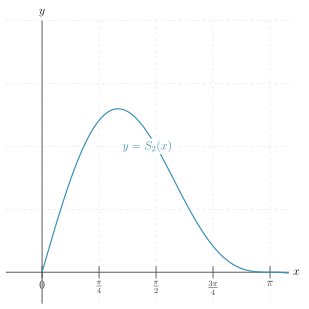
- Suppose \(S_n(x)\) has a stationary point at \(x_0\), then $$ therefore \begin{align*} &&0 &= S_n'(x_0) \\ &&&= \cos x_0 + \cos 2x_0 + \cdots + \cos n x_0 \\ &&&= \frac{\sin(n+\tfrac12)x_0 - \sin \tfrac12x_0}{2 \sin \tfrac12 x_0} \\ \Rightarrow &&\sin\tfrac12 x_0&= \sin nx_0 \cos \tfrac12 x_0 + \cos nx_0 \sin \tfrac12x_0 \\ \Rightarrow && \sin nx_0 &= (1-\cos nx_0)\tan \tfrac12 x_0 \end{align*} Therefore \(S_n(x_0) -S_{n-1}(x_0) = \tfrac1n \sin n x_0 = \tfrac1n \underbrace{(1-\cos nx_0)}_{\geq 0}\underbrace{\tan\tfrac12 x_0}_{\geq 0} \geq 0\). Therefore if \(S_{n-1}(x) > 0\) for all \(x\) on \(0 < x < \pi\) then since \(S_n(x) > S_{n-1}(x)\) at the turning points and since they agree at the end points, it must be larger at all points inbetween.
- Notice that \(S_1(x) = \sin x \geq 0\) for all \(x \in [0,1]\) and by our previous argument we can show \(S_n > S_{n-1}\) inside the interval and equal on the boundary we must have \(S_n(x) \geq 0\) for \(x \in [0, \pi]\)
2012 Paper 3 Q2
In this question, \(\vert x \vert <1\) and you may ignore issues of convergence.
- Simplify \[ (1-x)(1+x)(1+x^2)(1+x^4) \cdots (1+x^{2^n})\,, \] where \(n\) is a positive integer, and deduce that \[ \frac1{1-x} = (1+x)(1+x^2)(1+x^4) \cdots (1+x^{2^n}) + \frac {x^{2^{n+1}}}{1-x}\,. \] Deduce further that \[ \ln(1-x) = - \sum_{r=0}^\infty \ln \left (1+ x ^{2^r}\right) \,, \] and hence that \[ \frac1 {1-x} = \frac 1 {1+x} + \frac {2x}{1+x^2} + \frac {4x^3}{1+x^4} +\cdots\,. \]
- Show that \[ \frac{1+2x}{1+x+x^2} = \frac{1-2x}{1-x+x^2} + \frac{2x-4x^3}{1-x^2+x^4} + \frac {4x^3-8x^7}{1-x^4+x^8} + \cdots\,. \]
Solution:
- \begin{align*} (1-x)&(1+x)(1+x^2)(1+x^4) \cdots (1+x^{2^n}) \\ &= (1-x^2)(1+x^2)(1+x^4) \cdots (1+x^{2^n}) \\ &= (1-x^4)(1+x^4) \cdots (1+x^{2^n}) \\ &= 1-x^{2^{n+1}} \\ \end{align*} Therefore, \begin{align*} && \frac{1}{1-x} - \frac{x^{2^{n+1}}}{1-x} &= (1+x)(1+x^2)\cdots(1+x^{2^n}) \\ \Rightarrow && \frac{1}{1-x} &=(1+x)(1+x^2)\cdots(1+x^{2^n})+ \frac{x^{2^{n+1}}}{1-x} \\ \Rightarrow && -\ln (1-x) &= \sum_{r=0}^{\infty} \ln (1+x^{2^r}) \\ \Rightarrow && \ln(1-x) &= - \sum_{r=0}^{\infty} \ln (1+x^{2^r}) \\ \underbrace{\Rightarrow}_{\frac{\d}{\d x}} && \frac{1}{1-x} &= \sum_{r=0}^{\infty} \frac{2^r x^{2^r-1}}{1+x^{2^r}} \\ &&&= \frac{1}{1+x} + \frac{2x}{1+x^2} + \frac{4x^3}{1+x^4} + \cdots \end{align*}
- Consider \begin{align*}(1+x+x^2)&(1-x+x^2)(1-x^2+x^4)\cdots(1-x^{2^n}+x^{2^{n+1}}) \\ &= (1+x^2 + x^4)(1-x^2+x^4) \cdots (1-x^{2^n}+x^{2^{n+1}}) \\ &= (1-x^{2^{n+1}}+x^{2^{n+2}}) \\ \end{align*} Therefore, \begin{align*} && \frac{1}{1+x+x^2} &= (1-x+x^2)(1-x^2+x^4)\cdots(1-x^{2^n}+x^{2^{n+1}}) + \frac{x^{2^{n+1}}}{1+x+x^2} -\frac{x^{2^{n+2}}}{1+x+x^2} \\ \Rightarrow && -\ln(1+x+x^2) &= \sum_{r=0}^\infty \ln (1 - x^{2^r}+x^{2^{r+1}}) \\ \underbrace{\Rightarrow}_{\frac{\d}{\d x}} && -\frac{1+2x}{1+x+x^2} &= \sum_{r=0}^{\infty} \frac{ -2^r x^{2^r-1}+2^{r+1}x^{2^{r+1}-1}}{1 - x^{2^r}+x^{2^{r+1}}} \\ &&&= \frac{-1+2x}{1-x+x^2}+\frac{-2x+4x^3}{1-x^2+x^4} + \frac{-4x^3+8x^7}{1-x^4+x^8} + \cdots \end{align*} Which is the desired result when we multiply both sides by \(-1\)
2011 Paper 2 Q7
The two sequences \(a_0\), \(a_1\), \(a_2\), \(\ldots\) and \(b_0\), \(b_1\), \(b_2\), \(\ldots\) have general terms \[ a_n = \lambda^n +\mu^n \text { \ \ \ and \ \ \ } b_n = \lambda^n - \mu^n\,, \] respectively, where \(\lambda = 1+\sqrt2\) and \(\mu= 1-\sqrt2\,\).
- Show that $\displaystyle \sum_{r=0}^nb_r = -\sqrt2 + \frac 1 {\sqrt2} \,a_{\low n+1}\,$, and give a corresponding result for \(\displaystyle \sum_{r=0}^na_r\,\).
- Show that, if \(n\) is odd, $$\sum_{m=0}^{2n}\left( \sum_{r=0}^m a_{\low r}\right) = \tfrac12 b_{n+1}^2\,,$$ and give a corresponding result when \(n\) is even.
- Show that, if \(n\) is even, $$\left(\sum_{r=0}^na_r\right)^{\!2} -\sum_{r=0}^n a_{\low 2r+1} =2\,,$$ and give a corresponding result when \(n\) is odd.
2004 Paper 3 Q3
Given that \(\f''(x) > 0\) when \(a \le x \le b\,\), explain with the aid of a sketch why \[ (b-a) \, \f \Big( {a+b \over 2} \Big) < \int^b_a \f(x) \, \mathrm{d}x < (b-a) \, \displaystyle \frac{\f(a) + \f(b)}{2} \;. \] By choosing suitable \(a\), \(b\) and \(\f(x)\,\), show that \[ {4 \over (2n-1)^2} < {1 \over n-1} - {1 \over n} < {1 \over 2} \l {1 \over n^2} + {1 \over (n-1)^2}\r \,, \] where \(n\) is an integer greater than 1. Deduce that \[ 4 \l {1 \over 3^2} +{1 \over 5^2} + {1 \over 7^2} + \cdots \r < 1 < {1 \over 2} + \left( {1 \over 2^2} +{1 \over 3^2} + {1 \over 4^2} + \cdots \right)\,. \] Show that \[ {1 \over 2} \l {1 \over 3^2} + {1 \over 4^2} + {1 \over 5^2} + \frac 1 {6^2} + \cdots \r < {1 \over 3^2} +{1 \over 5^2} + {1 \over 7^2} + \cdots \] and hence show that \[ {3 \over 2} \displaystyle < \sum_{n=1}^\infty {1 \over n^2} <{7 \over 4}\;. \]
2004 Paper 3 Q6
Given a sequence \(w_0\), \(w_1\), \(w_2\), \(\ldots\,\), the sequence \(F_1\), \(F_2\), \(\ldots\) is defined by $$F_n = w_n^2 + w_{n-1}^2 - 4w_nw_{n-1} \,.$$ Show that $\; F_{n}-F_{n-1} = \l w_n-w_{n-2} \r \l w_n+w_{n-2}-4w_{n-1} \r \; \( for \)n \ge 2\,$.
- The sequence \(u_0\), \(u_1\), \(u_2\), \(\ldots\) has \(u_0 = 1\), and \(u_1 = 2\) and satisfies \[ u_n = 4u_{n-1} -u_{n-2} \quad (n \ge 2)\;. \] Prove that \ $ u_n^2 + u_{n-1}^2 = 4u_nu_{n-1}-3 \; $ for \(n \ge 1\,\).
- A sequence \(v_0\), \(v_1\), \(v_2\), \(\ldots\,\) has \(v_0=1\) and satisfies \begin{equation*} v_n^2 + v_{n-1}^2 = 4v_nv_{n-1}-3 \quad (n \ge 1). \tag{\(\ast\)} \end{equation*} \makebox[7mm]{(a) \hfill}Find \(v_1\) and prove that, for each \(n\ge2\,\), either \(v_n= 4v_{n-1} -v_{n-2}\) or \(v_n=v_{n-2}\,\). \makebox[7mm]{(b) \hfill}Show that the sequence, with period 2, defined by \begin{equation*} v_n = \begin{cases} 1 & \mbox{for \(n\) even} \\ 2 & \mbox{for \(n\) odd} \end{cases} \end{equation*} \makebox[7mm]{\hfill}satisfies \((\ast)\). \makebox[7mm]{(c) \hfill}Find a sequence \(v_n\) with period 4 which has \(v_0=1\,\), and satisfies~\((\ast)\).
1994 Paper 1 Q7
From the facts \begin{alignat*}{2} 1 & \quad=\quad & & 0\\ 2+3+4 & \quad=\quad & & 1+8\\ 5+6+7+8+9 & \quad=\quad & & 8+27\\ 10+11+12+13+14+15+16 & \quad=\quad & & 27+64 \end{alignat*} guess a general law. Prove it. Hence, or otherwise, prove that \[ 1^{3}+2^{3}+3^{3}+\cdots+N^{3}=\tfrac{1}{4}N^{2}(N+1)^{2} \] for every positive integer \(N\). [Hint. You may assume that \(1+2+3+\cdots+n=\frac{1}{2}n(n+1)\).]
Solution: \begin{align*} && (n^2+1) + (n^2+2) + \cdots + (n+1)^2 &= n^3+(n+1)^3 \\ \Leftrightarrow && \sum_{i=n^2+1}^{(n+1)^2} i &= n^3 + (n+1)^3 \\ && \sum_{i=n^2+1}^{(n+1)^2} i &= \sum_{i=1}^{(n+1)^2} i- \sum_{i=1}^{n^2} i \\ &&&= \frac{(n+1)^2((n+1)^2+1)}{2} - \frac{n^2(n^2+1)}{2} \\ &&&= \frac{(n+1)^2(n^2+2n+2) - n^2(n^2+1)}{2} \\ &&&= \frac{2(n+1)^3+n^2(n^2+2n+1) - n^2(n^2+1)}{2}\\ &&&= \frac{2(n+1)^3+2n^3 + n^2(n^2+1) - n^2(n^2+1)}{2}\\ &&&= (n+1)^3+n^3 \end{align*} \begin{align*} && \sum_{i=1}^{N^2} i &=(0^3+1^3)+ (1^3+2^3)+(2^3+3^3) + \cdots + ((N-1)^3+N^3) \\ &&&= 2 \left (1^3+2^3 + 3^3 + \cdots + (N-1)^3 \right) + N^3 \\ \Rightarrow && \sum_{i=1}^N i^3 &= \frac12 \left ( N^3+ \sum_{i=1}^{N^2} i \right) \\ &&&= \frac12 \left ( N^3 + \frac{N^2(N^2+1)}{2} \right) \\ &&&= \frac{N^2(N^2+1)+2N^3}{4} \\ &&&= \frac{N^2(N^2+2N+1)}{4} \\ &&&= \frac{N^2(N+1)^2}{4} \\ \end{align*}
1992 Paper 3 Q6
Given that \({\displaystyle I_{n}=\int_{0}^{\pi}\frac{x\sin^{2}(nx)}{\sin^{2}x}\,\mathrm{d}x,}\) where \(n\) is a positive integer, show that \(I_{n}-I_{n-1}=J_{n},\) where \[ J_{n}=\int_{0}^{\pi}\frac{x\sin(2n-1)x}{\sin x}\,\mathrm{d}x. \] Obtain also a reduction formula for \(J_{n}.\) The curve \(C\) is given by the cartesian equation \[ y=\dfrac{x\sin^{2}(nx)}{\sin^{2}x}, \] where \(n\) is a positive integer and \(0\leqslant x\leqslant\pi.\) Show that the area under the curve \(C\) is \(\frac{1}{2}n\pi^{2}.\)
Solution: \begin{align*} I_n - I_{n-1} &= \int_0^{\pi} \frac{x \sin^2(nx)}{\sin ^2 x} \d x-\int_0^{\pi} \frac{x \sin^2((n-1)x)}{\sin ^2 x} \d x \\ &= \int_0^{\pi} \frac{x}{\sin^2 x} \left ( \sin^2 (nx) - \sin^2((n-1)x) \right) \d x \\ &= \int_0^{\pi} \frac{x}{\sin^2 x}\frac12 \left ( \cos (2(n-1)x) - \cos(2nx) \right) \d x \\ &= \int_0^{\pi} \frac{x}{\sin^2 x}\frac12 2 \sin ((2n-1)x )\sin x \d x \\ &= \int_0^{\pi} \frac{x\sin ((2n-1)x )}{\sin x}d x \\ &= J_n \\ \\ J_{n+1} - J_{n} &= \int_0^{\pi} \frac{x \left (\sin ((2n+1)x )-\sin ((2n-1)x )\right)}{\sin x} \d x \\ &= \int_0^{\pi} \frac{x \left ( 2 \cos (\frac{4n x}{2}) \sin \frac{2x}{2} \right)}{\sin x} \d x \\ &= \int_0^{\pi}2x \cos (2n x) \d x \\ &= \left [ \frac{x}{2n} \sin (2n x) \right]_0^{\pi} - \int_0^{\pi} \frac{1}{2n} \sin (2n x) \d x \\ &= \left [ \frac{1}{4n^2} \cos (2n x)\right]_0^{\pi} \\ &= 0 \\ \\ J_1 &= \int_0^\pi x \d x \\ &= \frac{\pi^2}{2} \\ \Rightarrow J_n &= \frac{\pi^2}{2} \\ \end{align*} And so \(I_n = I_1 + (n-1) \frac{\pi^2}{2}\) and \(I_1 = \frac{\pi^2}{2}\) so \(I_n = \frac12 n \pi^2\). But \(I_n\) is exactly the area under the curve described.
1989 Paper 3 Q10
- Prove that \[ \sum_{r=1}^{n}r(r+1)(r+2)(r+3)(r+4)=\tfrac{1}{6}n(n+1)(n+2)(n+3)(n+4)(n+5) \] and deduce that \[ \sum_{r=1}^{n}r^{5}<\tfrac{1}{6}n(n+1)(n+2)(n+3)(n+4)(n+5). \]
- Prove that, if \(n>1,\) \[ \sum_{r=0}^{n-1}r^{5}>\tfrac{1}{6}(n-5)(n-4)(n-3)(n-2)(n-1)n. \]
- Let \(\mathrm{f}\) be an increasing function. If the limits \[ \lim_{n\rightarrow\infty}\sum_{r=0}^{n-1}\frac{a}{n}\mathrm{f}\left(\frac{ra}{n}\right)\qquad\mbox{ and }\qquad\lim_{n\rightarrow\infty}\sum_{r=1}^{n}\frac{a}{n}\mathrm{f}\left(\frac{ra}{n}\right) \] both exist and are equal, the definite integral \({\displaystyle \int_{0}^{a}\mathrm{f}(x)\,\mathrm{d}x}\) is defined to be their common value. Using this definition, prove that \[ \int_{0}^{a}x^{5}\,\mathrm{d}x=\tfrac{1}{6}a^6. \]
Solution:
- Claim: \[ \sum_{r=1}^{n}r(r+1)(r+2)(r+3)(r+4)=\tfrac{1}{6}n(n+1)(n+2)(n+3)(n+4)(n+5) \] Proof: (By Induction) Base case: (n=1) \begin{align*} LHS &= 1 \cdot 2 \cdot 3 \cdot 4 \cdot 5 = 5! \\ RHS &= \frac16 1 \cdot 2 \cdot 3 \cdot 4 \cdot 5 \cdot 6 = 5! \end{align*} Therefore the base case is true. Inductive step: Suppose our statement is true for some \(n=k\), then consider \(n = k+1\) \begin{align*} \sum_{r=1}^{k+1} r(r+1)(r+2)(r+3)(r+4) &= \sum_{r=1}^{k} r(r+1)(r+2)(r+3)(r+4) + (k+1)(k+2)(k+3)(k+4)(k+5) \\ &\underbrace{=}_{\text{assumption}} \frac16 k(k+1)(k+2)(k+3)(k+4)(k+5) + (k+1)(k+2)(k+3)(k+4)(k+5) \\ &= (k+1)(k+2)(k+3)(k+4)(k+5) \l \frac{k}{6} +1\r \\ &= \frac16 (k+1)(k+2)(k+3)(k+4)(k+5)(k+6) \end{align*} Therefore our statement is true for \(n = k+1\). Therefore since our statement is true for \(n=1\) and if it is true for \(n=k\) then it is true for \(n = k+1\) by the principle of mathematical induction it is true for all \(n \geq 1\) Since \begin{align*} \sum_{r=1}^{n}r^5 &< \sum_{r=1}^{n}r(r+1)(r+2)(r+3)(r+4) \\ &= \frac16 n(n+1)(n+2)(n+3)(n+4)(n+5) \end{align*}
- \begin{align*}\sum_{r=0}^{n-1} r^5 &> \sum_{r=0}^{n-1} (r-4)(r-3)(r-2)(r-1)r \\ &= \sum_{r=0}^{n-5} r(r+1)(r+2)(r+3)(r+4) \\ &= \frac16 (n-5)(n-4)(n-3)(n-2)(n-1)n \end{align*}
- Let \(f(x) = x^5\) \begin{align*} S_{1,n} &= \sum_{r=0}^{n-1}\frac{a}{n}f\left(\frac{ra}{n}\right) \\ &= \sum_{r=0}^{n-1}\frac{a}{n}\left(\frac{ra}{n}\right)^5 \\ &=\frac{a^6}{n^6} \sum_{r=0}^{n-1}r^5\\ \end{align*} Therefore \(\frac{a^6}6 \frac{(n-5)(n-4)(n-3)(n-2)(n-1)n}{n^6} < S_{1,n} < \frac{a^6}6 \frac{(n-1)n(n+1)(n+2)(n+3)(n+4)}{n^6}\) and so \(\lim_{n\to\infty} S_{1,n} = \frac{a^6}{6}\). Similarly, \begin{align*} S_{2,n} &= \sum_{r=1}^{n}\frac{a}{n}f\left(\frac{ra}{n}\right) \\ &= \sum_{r=1}^{n}\frac{a}{n}\left(\frac{ra}{n}\right)^5 \\ &= \frac{a^6}{n^6} \sum_{r=1}^{n} r^5 \end{align*} Therefore \(\frac{a^6}6 \frac{(n-4)(n-3)(n-2)(n-1)n(n+1)}{n^6} < S_{2,n} < \frac{a^6}6 \frac{n(n+1)(n+2)(n+3)(n+4)(n+5)}{n^6}\) and so \(\lim_{n\to\infty} S_{2,n} = \frac{a^6}{6}\). Since both limits exist are are equal, we have \[ \int_{0}^{a}x^{5}\,\mathrm{d}x=\tfrac{1}{6}a^6. \]
1987 Paper 3 Q10
The Bernoulli polynomials \(P_{n}(x)\), where \(n\) is a non-negative integer, are defined by \(P_{0}(x)=1\) and, for \(n\geqslant1\), \[ \frac{\mathrm{d}P_{n}}{\mathrm{d}x}=nP_{n-1}(x),\qquad\int_{0}^{1}P_{n}(x)\,\mathrm{d}x=0 \] Show by induction or otherwise, that \[ P_{n}(x+1)-P_{n}(x)=nx^{n-1},\quad\mbox{ for }n\geqslant1. \] Deduce that \[ n\sum_{m=0}^{k}m^{n-1}=P_{n}(k+1)-P_{n}(0) \] Hence show that \({\displaystyle \sum_{m=0}^{1000}m^{3}=(500500)^{2}}\)
Solution: \(\displaystyle \int_x^{x+1} nP_{n-1}(x) \, dx = P_n(x+1) - P_n(x)\) Claim: \(P_{n}(x+1)-P_{n}(x)=nx^{n-1},\) for \(n \geq 1\) Proof: (By induction). (Base case, \(n=1\)). \(P_1(x) = x - \frac12\), \(P_1(x+1) - P_1(x) = 1 x^{0}\) as required. Assume the equation is true for \(n = k\). So \(P_k(x+1) - P_k(x) = kx^{k-1}\) now consider \begin{align*} P_{k+1}(x+1) - P_{k+1}(x) &= \int_0^{x+1} (k+1) P_k(t) \d t + P_{k+1}(0)- \int_0^{x} (k+1) P_k(t) \d t - P_{k+1}(0) \\ &= \int_0^x (k+1)(P_k(t+1)-P_k(t)) \d t + \int_0^1 (k+1)P_k(t) \d t \\ &= (k+1)x^{k} + 0 \end{align*} So by induction we are done. \begin{align*} n\sum_{m=0}^{k}m^{n-1} &= \sum_{m=0}^{k}n \cdot m^{n-1} \\ &= \sum_{m=0}^{k}\l P_n(m+1)-P_n(m) \r \\ &= P_n(k+1) - P_n(0) \end{align*} We need to find \(P_4\) \begin{align*} P_0(x) &= 1 \\ P_1(x) &= x - \frac12 \\ P_2(x) &= x^2 -x - \int_0^1 \l x^2 - x \r \d x \\ &= x^2 - x + \frac16 \\ P_3(x) &= x^3 -\frac{3}{2}x^2 + \frac12x - \int_0^1 \l x^3 -\frac{3}{2}x^2 + \frac12x \r \d x \\ &= x^3 -\frac{3}{2}x^2 + \frac12x \\ P_4(x) &= x^4 - 2x^3 + x^2 + c \end{align*} Therefore the sum we are interested in is \(\frac14 \l P_4(1001) - P_4(0) \r = \frac14 (1001)^2 (1001-1)^2 = (1001 \cdot 500)^2 = (500500)^2\)