Vectors
Scalar product, equation of plane, angles, vector product, shortest distances (point and line, point and plane, two lines)
In this question, if \(O\), \(C\) and \(D\) are non-collinear points in three dimensional space, we will call the non-zero vector \(\mathbf{v}\) a \emph{bisecting vector} for angle \(COD\) if \(\mathbf{v}\) lies in the plane \(COD\), the angle between \(\mathbf{v}\) and \(\overrightarrow{OC}\) is equal to the angle between \(\mathbf{v}\) and \(\overrightarrow{OD}\), and both angles are less than \(90^\circ\).
- Let \(O\), \(X\) and \(Y\) be non-collinear points in three-dimensional space, and define \(\mathbf{x} = \overrightarrow{OX}\) and \(\mathbf{y} = \overrightarrow{OY}\).
Let \(\mathbf{b} = |\mathbf{x}|\mathbf{y} + |\mathbf{y}|\mathbf{x}\).
- Show that \(\mathbf{b}\) is a bisecting vector for angle \(XOY\). Explain, using a diagram, why any other bisecting vector for angle \(XOY\) is a positive multiple of \(\mathbf{b}\).
- Find the value of \(\lambda\) such that the point \(B\), defined by \(\overrightarrow{OB} = \lambda\mathbf{b}\), lies on the line \(XY\). Find also the ratio in which the point \(B\) divides \(XY\).
- Show, in the case when \(OB\) is perpendicular to \(XY\), that the triangle \(XOY\) is isosceles.
- Let \(O\), \(P\), \(Q\) and \(R\) be points in three-dimensional space, no three of which are collinear. A bisecting vector is chosen for each of the angles \(POQ\), \(QOR\) and \(ROP\). Show that the three angles between them are either all acute, all obtuse or all right angles.
A tetrahedron is called isosceles if each pair of edges which do not share a vertex have equal length.
- Prove that a tetrahedron is isosceles if and only if all four faces have the same perimeter.
- By considering the lengths of \(OA\) and \(BC\), show that \[2\mathbf{b}.\mathbf{c} = |\mathbf{b}|^2 + |\mathbf{c}|^2 - |\mathbf{a}|^2.\] Show that \[\mathbf{a}.(\mathbf{b}+\mathbf{c}) = |\mathbf{a}|^2.\]
- Let \(G\) be the centroid of the tetrahedron, defined by \(\overrightarrow{OG} = \frac{1}{4}(\mathbf{a}+\mathbf{b}+\mathbf{c})\). Show that \(G\) is equidistant from all four vertices of the tetrahedron.
- By considering the length of the vector \(\mathbf{a}-\mathbf{b}-\mathbf{c}\), or otherwise, show that, in an isosceles tetrahedron, none of the angles between pairs of edges which share a vertex can be obtuse. Can any of them be right angles?
Let \(\mathbf{n}\) be a vector of unit length and \(\Pi\) be the plane through the origin perpendicular to \(\mathbf{n}\). For any vector \(\mathbf{x}\), the projection of \(\mathbf{x}\) onto the plane \(\Pi\) is defined to be the vector \(\mathbf{x} - (\mathbf{x} \cdot \mathbf{n})\,\mathbf{n}\). The vectors \(\mathbf{a}\) and \(\mathbf{b}\) each have unit length and the angle between them is \(\theta\), which satisfies \(0 < \theta < \pi\). The vector \(\mathbf{m}\) is given by \(\mathbf{m} = \tfrac{1}{2}(\mathbf{a} + \mathbf{b})\).
- Show that \(\mathbf{m}\) bisects the angle between \(\mathbf{a}\) and \(\mathbf{b}\).
- The vector \(\mathbf{c}\) also has unit length. The angle between \(\mathbf{a}\) and \(\mathbf{c}\) is \(\alpha\), and the angle between \(\mathbf{b}\) and \(\mathbf{c}\) is \(\beta\). Both angles are acute and non-zero. Let \(\mathbf{a}_1\) and \(\mathbf{b}_1\) be the projections of \(\mathbf{a}\) and \(\mathbf{b}\), respectively, onto the plane through the origin perpendicular to \(\mathbf{c}\). Show that \(\mathbf{a}_1 \cdot \mathbf{c} = 0\) and, by considering \(|\mathbf{a}_1|^2 = \mathbf{a}_1 \cdot \mathbf{a}_1\), show that \(|\mathbf{a}_1| = \sin\alpha\). Show also that the angle \(\varphi\) between \(\mathbf{a}_1\) and \(\mathbf{b}_1\) satisfies \[ \cos\varphi = \frac{\cos\theta - \cos\alpha\cos\beta}{\sin\alpha\sin\beta}. \]
- Let \(\mathbf{m}_1\) be the projection of \(\mathbf{m}\) onto the plane through the origin perpendicular to \(\mathbf{c}\). Show that \(\mathbf{m}_1\) bisects the angle between \(\mathbf{a}_1\) and \(\mathbf{b}_1\) if and only if \[ \alpha = \beta \qquad \text{or} \qquad \cos\theta = \cos(\alpha - \beta). \]
- \(\,\) \begin{align*} && \cos \angle MOB &= \frac{\mathbf{m} \cdot \mathbf{b}}{|\mathbf{m}||\mathbf{b}|} \\ &&&= \frac{\cos \theta + 1}{2\sqrt{\frac14(\mathbf{a}+\mathbf{b})\cdot(\mathbf{a}+\mathbf{b})}} \\ &&&= \frac{\cos \theta + 1}{\sqrt{1+1+2\cos \theta}} \\ &&&= \frac{1 + \cos \theta}{\sqrt{2(1+\cos \theta})} \\ &&&= \frac1{\sqrt{2}} \sqrt{1+\cos \theta} \\ &&&= \cos \tfrac{\theta}{2} \end{align*} Since \(0 < \theta < \pi\) we must have \(\angle MOB = \tfrac{\theta}{2}\) ie it is the angle bisector.
- The plane through the origin perpendicular to \(\mathbf{c}\) has \(\mathbf{x} \cdot \mathbf{c} = 0\), so \begin{align*} && \mathbf{a}_1 \cdot \mathbf{c} &= (\mathbf{a} - (\mathbf{a} \cdot \mathbf{c}) \mathbf{c}) \cdot \mathbf{c} \\ &&&= \mathbf{a} \cdot \mathbf{c} - \mathbf{a} \cdot \mathbf{c} \\ &&&= 0 \\ \\ && |\mathbf{a}_1|^2 &= \mathbf{a}_1 \cdot \mathbf{a}_1 \\ &&&= (\mathbf{a} - (\mathbf{a} \cdot \mathbf{c}) \mathbf{c}) \cdot (\mathbf{a} - (\mathbf{a} \cdot \mathbf{c}) \mathbf{c}) \\ &&&= 1 - 2(\mathbf{a} \cdot \mathbf{c})^2 + \mathbf{a} \cdot \mathbf{c} \\ &&&= (1-\cos^2 \alpha) \\ &&&= \sin^2 \alpha \\ \Rightarrow && |\mathbf{a}_1| &= \sin \alpha \\ \Rightarrow && |\mathbf{b}_1| &= \sin \beta \tag{changing a and b} \\ \\ && \cos \phi &= \frac{\mathbf{a}_1 \cdot \mathbf{b}_1}{|\mathbf{a}_1||\mathbf{b}_1|} \\ &&&= \frac{(\mathbf{a} - (\mathbf{a} \cdot \mathbf{c}) \mathbf{c}) \cdot (\mathbf{b} - (\mathbf{b} \cdot \mathbf{c}) \mathbf{c})}{\sin \alpha \sin \beta} \\ &&&= \frac{\mathbf{a} \cdot \mathbf{b} - 2(\mathbf{a} \cdot \mathbf{c}) \cdot (\mathbf{b} \cdot \mathbf{c})+(\mathbf{a} \cdot \mathbf{c}) \cdot (\mathbf{b} \cdot \mathbf{c})}{\sin \alpha \sin \beta} \\ &&&= \frac{\cos \theta - \cos \alpha \cos \beta}{\sin \alpha \sin \beta} \end{align*}
- Note that \(\mathbf{m}_1 = \tfrac12(\mathbf{a}_1 + \mathbf{b}_1)\) either by expanding or by noting that projection is linear \begin{align*} && \cos \angle M_1OB_1 &= \frac{\mathbf{m}_1 \cdot \mathbf{b}_1}{|\mathbf{m}_1||\mathbf{b}_1|} \\ &&&= \frac{(\mathbf{a}_1 + \mathbf{b}_1) \cdot \mathbf{b}_1}{2|\mathbf{m}_1||\mathbf{b}_1|} \\ &&&= \frac{\mathbf{a}_1 \cdot \mathbf{b}_1 + |\mathbf{b}_1|^2}{2|\mathbf{m}_1||\mathbf{b}_1|} \\ &&&= \frac{|\mathbf{a}_1 || \mathbf{b}_1| \cos \phi + |\mathbf{b}_1|^2}{2|\mathbf{m}_1||\mathbf{b}_1|} \\ &&&= \frac{|\mathbf{a}_1 |\cos \phi + |\mathbf{b}_1|}{2|\mathbf{m}_1|} \\ &&&= \frac{\sin \alpha \cos \phi + \sin \beta}{2\sin \frac{\theta}{2}} \\ &&&= \frac{\sin \alpha \frac{\cos \theta - \cos \alpha \cos \beta}{\sin \alpha \sin \beta} + \sin \beta}{2\sin \frac{\theta}{2}} \\ &&&= \frac{\cos \theta - \cos \alpha \cos \beta+ \sin^2 \beta}{2\sin \frac{\theta}{2} \sin \beta} \\ \Rightarrow && \cos \angle M_1OA_1 &= \frac{\cos \theta - \cos \beta \cos \alpha+ \sin^2 \alpha}{2\sin \frac{\theta}{2} \sin \alpha} \end{align*} \(M_1\) is a bisector iff these two cosines are equal, ie \begin{align*} && \cos \angle M_1OB_1 &= \cos \angle M_1OA_1 \\ \Leftrightarrow && \frac{\cos \theta - \cos \alpha \cos \beta+ \sin^2 \beta}{2\sin \frac{\theta}{2} \sin \beta} &= \frac{\cos \theta - \cos \beta \cos \alpha+ \sin^2 \alpha}{2\sin \frac{\theta}{2} \sin \alpha} \\ \Leftrightarrow && \cos \theta (\sin \alpha - \sin \beta) &= \cos \alpha \cos \beta(\sin \alpha - \sin \beta) + \sin \alpha \sin \beta (\sin \alpha - \sin \beta) \\ \Leftrightarrow &&0 &= (\sin \alpha - \sin \beta)( \cos \theta - (\cos \alpha \cos \beta + \sin \alpha \sin \beta)) \\ &&&= (\sin \alpha - \sin \beta) (\cos \theta - \cos (\alpha - \beta)) \end{align*} From which the result immediately follows
- The four points \(P\), \(Q\), \(R\) and \(S\) are the vertices of a plane quadrilateral. What is the geometrical shape of \(PQRS\) if \(\vec{PQ} = \vec{SR}\)? What is the geometrical shape of \(PQRS\) if \(\vec{PQ} = \vec{SR}\) and \(|\vec{PQ}| = |\vec{PS}|\)?
- A cube with edges of unit length has opposite vertices at \((0,0,0)\) and \((1,1,1)\). The points
$$P(p,0,0), \quad Q(1,q,0), \quad R(r,1,1) \quad \text{and} \quad S(0,s,1)$$
lie on edges of the cube. Given that the four points lie in the same plane, show that
$$rq = (1-s)(1-p).$$
- Show that \(\vec{PQ} = \vec{SR}\) if and only if the centroid of the quadrilateral \(PQRS\) is at the centre of the cube. Note: the centroid of the quadrilateral \(PQRS\) is the point with position vector $$\frac{1}{4}(\vec{OP} + \vec{OQ} + \vec{OR} + \vec{OS}),$$ where \(O\) is the origin.
- Given that \(\vec{PQ} = \vec{SR}\) and \(|\vec{PQ}| = |\vec{PS}|\), express \(q\), \(r\) and \(s\) in terms of \(p\). Show that $$\cos PQR = \frac{4p-1}{5-4p+8p^2}.$$ Write down the values of \(p\), \(q\), \(r\) and \(s\) if \(PQRS\) is a square, and show that the length of each side of this square is greater than \(\frac{21}{20}\).
- If \(\vec{PQ} = \vec{SR}\) we have a parallelogram. \(\vec{PQ} = \vec{SR}\) and \(|\vec{PQ}| = |\vec{PS}|\) then we have a rhombus.
- If the four points lie in a plane then
\((\vec{RS} \times \vec{RP}) \cdot \vec{RQ} =0\), so
\begin{align*}
&& 0 &=\left ( \begin{pmatrix}-r\\ s-1 \\ 0 \end{pmatrix} \times \begin{pmatrix}p-r\\ -1 \\ -1 \end{pmatrix}\right) \cdot \begin{pmatrix}1-r\\ q-1 \\ -1 \end{pmatrix} \\
&& &= \begin{pmatrix}1-s \\ -r \\r+(p-r)(1-s) \end{pmatrix} \cdot \begin{pmatrix}1-r\\ q-1 \\ -1 \end{pmatrix} \\
&&&= (1-s)(1-r)-r(q-1)-r-(p-r)(1-s) \\
&&&=(1-s)(1-r-p+r)-rq \\
\Rightarrow && rq &= (1-s)(1-p)
\end{align*}
- \(\,\) \begin{align*} && \vec{PQ} &= \vec{SR} \\ \Leftrightarrow && \begin{pmatrix}1-p\\q \\ 0 \end{pmatrix} &= \begin{pmatrix}r\\1-s \\ 0 \end{pmatrix} \\ \Leftrightarrow && 1-p = r & \quad ; \quad q = 1-s\\ \Leftrightarrow && 1= r+p & \quad ; \quad 1 = q+s\\ \end{align*} The centroid is \(\frac14 (p+1+r, q+s+1, 2)\) which is clearly \(\frac12(1,1,1)\) iff those equations are true.
- \(\,\) \begin{align*} && |\vec{PQ}| &= |\vec{PS}| \\ \Leftrightarrow && (1-p)^2+q^2+ 0^2 &= p^2+s^2+1)\\ \Leftrightarrow && 1-2p+p^2+q^2 &= p^2 + s^2 + 1 \\ \Leftrightarrow && -2p+q^2 &= s^2 \end{align*} From the previous equations we have \(r = 1-p\), and \(-2p+(1-s)^2 = s^2 \Rightarrow -2p + 1 -2s = 0 \Rightarrow s = \frac12 - p\) and \(q = \frac12 + p\) \begin{align*} && \cos PQR &= \frac{\vec{QP}\cdot \vec{QR}}{|\vec{QP}||\vec{QR}|} \\ &&&= \frac{ \begin{pmatrix}p-1\\ -q \\ 0 \end{pmatrix} \cdot \begin{pmatrix}r-1\\ 1-q \\ 1 \end{pmatrix}}{\sqrt{(p-1)^2+q^2}\sqrt{(r-1)^2+(1-q)^2+1^2}} \\ &&&= \frac{ \begin{pmatrix}p-1\\ -\frac12-p \\ 0 \end{pmatrix} \cdot \begin{pmatrix}-p\\ \frac12-p \\ 1 \end{pmatrix}}{\sqrt{(p-1)^2+(-\frac12-p)^2}\sqrt{p^2+(\frac12-p)^2+1^2}} \\ &&&= \frac{ p-p^2-\frac14+p^2}{\sqrt{p^2-2p+1+\frac14+p+p^2}\sqrt{p^2+\frac14-p+p^2+1}} \\ &&&= \frac{4p-1}{\sqrt{8p^2-4p+5}\sqrt{8p^2-4p+5}}\\ &&&= \frac{4p-1}{8p^2-4p+5}\\ \end{align*} For \(PQRS\) to be a square \(\cos PQR = 0\), ie \(p = \frac14\) and so \((p,q,r,s) = (\frac14, \frac34, \frac34, \frac14)\) and \(|PQ| = \sqrt{(1-p)^2+q^2} = \sqrt{\left ( \frac34 \right)^2 + \left ( \frac34 \right)^2 } = \frac{3\sqrt{2}}4\), notice that \(\left ( \frac{21}{20} \right)^2 = \frac{441}{400} < \frac{9}{8}\) (\(441 < 450\)) therefore the sides are at least as long as \(\frac{21}{20}\)
The points \(O\), \(A\) and \(B\) are the vertices of an acute-angled triangle. The points \(M\) and \(N\) lie on the sides \(OA\) and \(OB\) respectively, and the lines \(AN\) and \(BM\) intersect at \(Q\). The position vector of \(A\) with respect to \(O\) is \(\bf a\), and the position vectors of the other points are labelled similarly. Given that \(\vert MQ \vert = \mu \vert QB\vert \), and that \(\vert NQ \vert = \nu \vert QA\vert \), where \(\mu\) and \(\nu\) are positive and \(\mu \nu <1\), show that \[ {\bf m} = \frac {(1+\mu)\nu}{1+\nu} \, {\bf a} \,. \] The point \(L\) lies on the side \(OB\), and \(\vert OL \vert = \lambda \vert OB \vert \,\). Given that \(ML\) is parallel to \(AN\), express \(\lambda\) in terms of \(\mu\) and \(\nu\). What is the geometrical significance of the condition \(\mu\nu<1\,\)?
Show Solution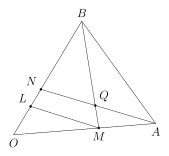
All vectors in this question lie in the same plane. The vertices of the non-right-angled triangle \(ABC\) have position vectors \(\bf a\), \(\bf b\) and \(\bf c\), respectively. The non-zero vectors \(\bf u\) and \(\bf v\) are perpendicular to \(BC\) and \(CA\), respectively. Write down the vector equation of the line through \(A\) perpendicular to \(BC\), in terms of \(\bf u\), \(\bf a\) and a parameter \(\lambda \). The line through \(A\) perpendicular to \(BC\) intersects the line through \(B\) perpendicular to \(CA\) at \(P\). Find the position vector of \(P\) in terms of \(\bf a\), \(\bf b\), \(\bf c\) and \(\bf u\). Hence show that the line \(CP\) is perpendicular to the line \(AB\).
Show SolutionThe sides \(OA\) and \(CB\) of the quadrilateral \(OABC\) are parallel. The point \(X\) lies on \(OA\), between \(O\) and \(A\). The position vectors of \(A\), \(B\), \(C\) and \(X\) relative to the origin \(O\) are \(\bf a\), \(\bf b\), \(\bf c\) and \(\bf x\), respectively. Explain why \(\bf c\) and \(\bf x\) can be written in the form \[ {\bf c} = k {\bf a} + {\bf b} \text{ and } {\bf x} = m {\bf a}\,, \] where \(k\) and \(m\) are scalars, and state the range of values that each of \(k\) and \(m\) can take. The lines \(OB\) and \(AC\) intersect at \(D\), the lines \(XD\) and \(BC\) intersect at \(Y\) and the lines \(OY\) and \(AB\) intersect at \(Z\). Show that the position vector of \(Z\) relative to \(O\) can be written as \[ \frac{ {\bf b} + mk {\bf a}}{mk+1}\,. \] The lines \(DZ\) and \(OA\) intersect at \(T\). Show that \[ OT \times OA = OX\times TA \text{ and } \frac 1 {OT} = \frac 1 {OX} + \frac 1 {OA} \,, \] where, for example, \(OT\) denotes the length of the line joining \(O\) and \(T\).
Show Solution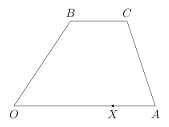
\noindent
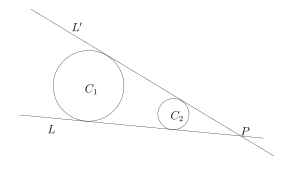
- Let \(\mathbf{x}_1\) and \(\mathbf{x}_2\) be the position vectors of the centres of \(C_1\) and \(C_2\), respectively. Show that the position vector of \(P\) is \[ \frac{r_1 \mathbf{x}_2- r_2 \mathbf{x}_1}{r_1-r_2} \,, \] where \(r_1\) and \(r_2\) are the radii of \(C_1\) and \(C_2\), respectively.
- The circle \(C_3\) does not overlap either \(C_1\) or \(C_2\) and its radius, \(r_3\), satisfies \(r_1 \ne r_3 \ne r_2\). The focus of \(C_1\) and \(C_3\) is \(Q\), and the focus of \(C_2\) and \(C_3\) is \(R\). Show that \(P\), \(Q\) and \(R\) lie on the same straight line.
- Find a condition on \(r_1\), \(r_2\) and \(r_3\) for \(Q\) to lie half-way between \(P\) and \(R\).
- Notice that \(P\) lies on \(C_1C_2\), and that the triangles formed from \(C_iPT_i\) where \(T_i\) are the tangent points are similar, with ratios \(\frac{r_1}{r_2}\). Therefore \(\frac{C_1P}{r_1} = \frac{C_2P}{r_2}\), and hence \(\frac{C_1P}{C_1C_2} = \frac{C_1P}{C_1P-C_2P} = \frac{1}{1-\frac{r_2}{r_1}} = \frac{r_1}{r_1-r_2}\) So we have \(\mathbf{p} = \mathbf{x_1} + (\mathbf{x}_2 - \mathbf{x}_1)\cdot\frac{r_1}{r_1-r_2} = \frac{r_1\mathbf{x}_2 - r_2\mathbf{x}_1}{r_1-r_2}\)
- Suppose \(\mathbf{x}_3 = \binom{\alpha}{\beta}\) in the basis of \(\{ \mathbf{x}_1, \mathbf{x}_2 \}\), then we can see that \begin{align*} && \mathbf{p} &= \frac{1}{r_1-r_2}\binom{-r_2}{r_1} \\ && \mathbf{q} &= \frac{r_1(\alpha \mathbf{x}_1 +\beta \mathbf{x}_2) - r_3\mathbf{x}_1}{r_1-r_3} \\ &&&= \frac{1}{r_1-r_3} \binom{r_1\alpha -r_3}{r_1\beta} \\ && \mathbf{r} &=\frac{1}{r_2-r_3} \binom{r_2\alpha}{r_2\beta - r_3} \\ && \mathbf{p}-\mathbf{q} &= \frac{1}{r_1-r_2}\binom{-r_2}{r_1} - \frac{1}{r_1-r_3} \binom{r_1\alpha -r_3}{r_1\beta} \\ &&&= \frac{1}{(r_1-r_2)(r_1-r_3)} \binom{(r_1-r_3)(-r_2)-(r_1-r_2)(r_1\alpha-r_3)}{(r_1-r_3)r_1 - (r_1-r_2)r_1\beta} \\ &&&= \frac{r_1}{(r_1-r_2)(r_1-r_3)} \binom{(r_3-r_2)-\alpha(r_1-r_2)}{(r_1-r_3)-\beta(r_1-r_2)} \\ && \mathbf{q} - \mathbf{r} &= \frac{1}{r_1-r_3} \binom{r_1\alpha -r_3}{r_1\beta} - \frac{1}{r_2-r_3} \binom{r_2\alpha}{r_2\beta - r_3} \\ &&&= \frac{1}{(r_1-r_3)(r_2-r_3)}\binom{(r_2-r_3)(r_1\alpha-r_3) - (r_1-r_3)r_2\alpha)}{(r_2-r_3)r_1\beta - (r_1-r_3)(r_2\beta - r_3)} \\ &&&= \frac{1}{(r_1-r_3)(r_2-r_3)}\binom{(-r_2r_3+r_3^2) - \alpha(r_1r_3-r_3r_2)}{r_3(r_1-r_3)-\beta(r_1-r_2)} \\ &&&= \frac{r_3}{(r_1-r_3)(r_2-r_3)}\binom{(r_3-r_2)-\alpha(r_1-r_2)}{(r_1-r_3)-\beta(r_1-r_2)} \end{align*} Therefore they are clearly parallel, and hence lie on a line.
- \(Q\) is halfway between \(P\) and \(R\) if \begin{align*} && \frac{r_1}{(r_1-r_2)(r_1-r_3)} &= \frac{r_3}{(r_1-r_3)(r_2-r_3)} \\ \Leftrightarrow && r_1(r_2-r_3) &= r_3(r_1-r_2) \\ \Leftrightarrow && r_1r_2 - r_1r_3 &= r_1r_3 - r_2r_3 \\ \Leftrightarrow && r_2 &= \frac{2r_1r_3}{r_1+r_3} \end{align*}
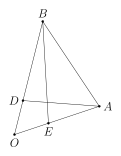
In the triangle \(OAB\), the point \(D\) divides the side \(BO\) in the ratio \(r:1\) (so that \(BD = rDO\)), and the point \(E\) divides the side \(OA\) in the ratio \(s:1\) (so that \(OE =s EA\)), where \(r\) and \(s\) are both positive.
- The lines \(AD\) and \(BE\) intersect at \(G\). Show that \[ \mathbf{g}= \frac{rs}{1+r+rs} \, \mathbf{a} + \frac 1 {1+r+rs} \, \mathbf{b} \,, \] where \(\mathbf{a}, \mathbf{b}\) and \(\mathbf{g}\) are the position vectors with respect to \(O\) of \(A\), \(B\) and \(G\), respectively.
- The line through \(G\) and \(O\) meets \(AB\) at \(F\). Given that \(F\) divides \(AB\) in the ratio \(t:1\), find an expression for \(t\) in terms of \(r\) and \(s\).
The four distinct points \(P_i\) (\(i=1\), \(2\), \(3\), \(4\)) are the vertices, labelled anticlockwise, of a cyclic quadrilateral. The lines \(P_1P_3\) and \(P_2P_4\) intersect at \(Q\).
- By considering the triangles \(P_1QP_4\) and \(P_2QP_3\) show that \((P_1Q)( QP_3) = (P_2Q) (QP_4)\,\).
- Let \(\+p_i\) be the position vector of the point \(P_i\) (\(i=1\), \(2\), \(3\), \(4\)). Show that there exist numbers \(a_i\), not all zero, such that \begin{equation} \sum\limits_{i=1}^4 a_i =0 \qquad\text{and}\qquad \sum\limits_{i=1}^4 a_i \+p_i ={\bf 0} \,. \tag{\(*\)} \end{equation}
- Let \(a_i\) (\(i=1\),~\(2\), \(3\),~\(4\)) be any numbers, not all zero, that satisfy~\((*)\). Show that \(a_1+a_3\ne 0\) and that the lines \(P_1P_3\) and \(P_2P_4\) intersect at the point with position vector \[ \frac{a_1 \+p_1 + a_3 \+p_3}{a_1+a_3} \,. \] Deduce that \(a_1a_3 (P_1P_3)^2 = a_2a_4 (P_2P_4)^2\,\).
The four vertices \(P_i\) (\(i= 1, 2, 3, 4\)) of a regular tetrahedron lie on the surface of a sphere with centre at \(O\) and of radius 1. The position vector of \(P_i\) with respect to \(O\) is \({\bf p}_i\) (\(i= 1, 2, 3, 4\)). Use the fact that \({\bf p}_1+ {\bf p}_2+{\bf p}_3+{\bf p}_4={\bf 0}\,\) to show that \({\bf p}_i \,.\, {\bf p}_j =-\frac13\,\) for \(i\ne j\). Let \(X\) be any point on the surface of the sphere, and let \(XP_i\) denote the length of the line joining \(X\) and \(P_i\) (\(i= 1, 2, 3, 4\)).
- By writing \((XP_i) ^2\) as \(({\bf p}_i- {\bf x)}\,.\,({\bf p}_i- {\bf x})\), where \({\bf x}\) is the position vector of \(X\) with respect to \(O\), show that \[ \sum_{i=1}^4(XP_i) ^2 =8\,. \]
- Given that \(P_1\) has coordinates \((0,0,1)\) and that the coordinates of \(P_2\) are of the form \((a,0,b)\), where \(a > 0\), show that \(a=2\sqrt2/3\) and \(b=-1/3\), and find the coordinates of \(P_3\) and \(P_4\).
- Show that \[ \sum_{i=1}^4 (XP_i)^4 = 4 \sum_{i=1}^4 (1- {\bf x}\,.\,{\bf p}_i)^2\,. \] By letting the coordinates of \(X\) be \( (x,y,z)\), show further that \(\sum\limits_{i=1}^4 (XP_i)^4\) is independent of the position of \(X\).
- \(\,\) \begin{align*} && (XP_i)^2 &= ({\bf p}_i- {\bf x)}\,.\,({\bf p}_i- {\bf x}) \\ &&&= {\bf p}_i \cdot {\bf p}_i - 2 {\bf p}_i \cdot {\bf x} + {\bf x} \cdot {\bf x} \\ &&&= 2 - 2 {\bf p}_i \cdot {\bf x} \\ \Rightarrow && \sum_i (XP_i)^2 &= \sum_i \left (2 - 2 {\bf p}_i \cdot {\bf x} \right) \\ &&&= 8 - 2 \sum_i {\bf p}_i \cdot {\bf x} \\ &&&= 8 - 2 \left ( {\bf p}_1+ {\bf p}_2+{\bf p}_3+{\bf p}_4 \right) \cdot {\bf x} \\ &&&= 8 \end{align*}
- Notice we have \(1 = \left \|\begin{pmatrix} a \\0 \\b \end{pmatrix} \right \|= a^2 + b^2\) and \(-\frac13 = \begin{pmatrix} a \\0 \\b \end{pmatrix} \cdot \begin{pmatrix} 0 \\0 \\ 1 \end{pmatrix} = b\). So \(b = -1/3\) and \(a = \sqrt{1-b^2} = 2\sqrt{2}/3\). Suppose another of the vertices has coordinates \((u,v,w)\) we must have \begin{align*} && 1 &= u^2+v^2+w^2 \\ && -\frac13&=w \\ && -\frac13 &= \frac{2\sqrt{2}}3 u +\frac19 \\ \Rightarrow && u &= -\frac{\sqrt2}3 \\ \Rightarrow && 1 &= \frac19 + \frac29 + v^2 \\ \Rightarrow && v &= \pm \sqrt{\frac{2}{3}} \end{align*} So \(P_3, P_4 = (-\frac{\sqrt2}3, \pm \frac{\sqrt{6}}3, -\frac13)\)
- \(\,\) \begin{align*} && \sum_{i=1}^4 (XP_i)^4 &= \sum_i \left (2 - 2 {\bf p}_i \cdot {\bf x} \right)^2 \\ &&&= 4 \sum_i \left (1 - {\bf p}_i \cdot {\bf x} \right)^2 \\ &&&= 4 \sum_i (1 - 2{\bf p}_i \cdot {\bf x} + ({\bf p}_i \cdot {\bf x})^2) \\ &&&= 16 + 4\sum_i ({\bf p}_i \cdot {\bf x})^2 \\ &&&=16+ 4\left ( z^2+\left (\frac{2\sqrt{2}}3x-\frac13z \right)^2 +\left (-\frac{\sqrt{2}}3x-\frac{\sqrt{6}}3y-\frac13z \right)^2 +\left (-\frac{\sqrt{2}}3x+\frac{\sqrt{6}}3y-\frac13z \right)^2 \right) \\ &&&= 16+4 \left ( \frac43z^2 + \left (\frac89 + \frac29+\frac29 \right)x^2+\left (\frac69 + \frac69 \right)y^2 + 0xz + 0yz + 0zx \right) \\ &&&= 16+ 4\cdot\frac43(x^2+y^2+z^2) \\ &&&=16+\frac{16}{3}=\frac{64}{3} \end{align*}
Three distinct points, \(X_1\), \(X_2\) and \(X_3\), with position vectors \({\bf x}_1\), \({\bf x}_2\) and \({\bf x}_3\) respectively, lie on a circle of radius 1 with its centre at the origin \(O\). The point \(G\) has position vector \(\frac13({\bf x}_1+{\bf x}_2+{\bf x}_3)\). The line through \(X_1\) and \(G\) meets the circle again at the point \(Y_1\) and the points \(Y_2\) and \(Y_3\) are defined correspondingly. Given that \(\overrightarrow{GY_1} =-\lambda_1\overrightarrow{GX_1}\), where \(\lambda_1\) is a positive scalar, show that \[ \overrightarrow{OY_1}= \tfrac13 \big( (1-2\lambda_1){\bf x}_1 +(1+\lambda_1)({\bf x}_2+{\bf x}_3)\big) \] and hence that \[ \lambda_1 = \frac {3-\alpha-\beta-\gamma} {3+\alpha -2\beta-2\gamma} \,,\] where \(\alpha = {\bf x}_2 \,.\, {\bf x}_3\), \(\beta = {\bf x}_3\,.\, {\bf x}_1\) and \(\gamma = {\bf x}_1\,.\, {\bf x}_2\). Deduce that $\dfrac {GX_1}{GY_1} + \dfrac {GX_2}{GY_2} + \dfrac {GX_3}{GY_3} =3 \,$.
Show Solution
The points \(A\) and \(B\) have position vectors \(\bf a \) and \(\bf b\) with respect to an origin \(O\), and \(O\), \(A\)~and~\(B\) are non-collinear. The point \(C\), with position vector \(\bf c\), is the reflection of \(B\) in the line through \(O\) and \(A\). Show that \(\bf c\) can be written in the form \[ \bf c = \lambda \bf a -\bf b \] where \(\displaystyle \lambda = \frac{2\,{\bf a .b}}{{\bf a.a}}\). The point \(D\), with position vector \(\bf d\), is the reflection of \(C\) in the line through \(O\) and \(B\). Show that \(\bf d\) can be written in the form \[ \bf d = \mu\bf b - \lambda \bf a \] for some scalar \(\mu\) to be determined. Given that \(A\), \(B\) and \(D\) are collinear, find the relationship between \(\lambda\) and \(\mu\). In the case \(\lambda = -\frac12\), determine the cosine of \(\angle AOB\) and describe the relative positions of \(A\), \(B\) and \(D\).
Relative to a fixed origin \(O\), the points \(A\) and \(B\) have position vectors \(\bf{a}\) and \(\bf{b}\), respectively. (The points \(O\), \(A\) and \(B\) are not collinear.) The point \(C\) has position vector \(\bf c\) given by \[ {\bf c} =\alpha {\bf a}+ \beta {\bf b}\,, \] where \(\alpha\) and \(\beta\) are positive constants with \(\alpha+\beta<1\,\). The lines \(OA\) and \(BC\) meet at the point \(P\) with position vector \(\bf p\) and the lines \(OB\) and \(AC\) meet at the point \(Q\) with position vector \(\bf q\). Show that \[ {\bf p} =\frac{\alpha {\bf a} }{1-\beta}\,, \] and write down \(\bf q\) in terms of \(\alpha,\ \beta\) and \(\bf {b}\). Show further that the point \(R\) with position vector \(\bf r\) given by \[ {\bf r} =\frac{\alpha {\bf a} + \beta {\bf b}}{\alpha + \beta}\,, \] lies on the lines \(OC\) and \(AB\). The lines \(OB\) and \(PR\) intersect at the point \(S\). Prove that $ \dfrac{OQ}{BQ} = \dfrac{OS}{BS}\,$.
The points \(A\) and \(B\) have position vectors \(\bf i +j+k\) and \(5{\bf i} - {\bf j} -{\bf k}\), respectively, relative to the origin \(O\). Find \(\cos2\alpha\), where \(2\alpha\) is the angle \(\angle AOB\).
- The line \(L _1\) has equation \({\bf r} =\lambda(m{\bf i}+n {\bf j} + p{\bf k})\). Given that \(L _1\) is inclined equally to \(OA\) and to \(OB\), determine a relationship between \(m\), \(n\) and~\(p\). Find also values of \(m\), \(n\) and~\(p\) for which \(L _1\) is the angle bisector of \(\angle AOB\).
- The line \(L _2\) has equation \({\bf r} =\mu(u{\bf i}+v {\bf j} + w{\bf k})\). Given that \( L _2\) is inclined at an angle \(\alpha\) to \(OA\), where \(2\alpha = \angle AOB\), determine a relationship between \(u\), \(v\) and \(w\). Hence describe the surface with Cartesian equation \(x^2+y^2+z^2 =2(yz+zx+xy)\).
The non-collinear points \(A\), \(B\) and \(C\) have position vectors \(\bf a\), \(\bf b\) and \(\bf c\), respectively. The points \(P\) and \(Q\) have position vectors \(\bf p\) and \(\bf q\), respectively, given by \[ {\bf p}= \lambda {\bf a} +(1-\lambda){\bf b} \text{ \ \ \ and \ \ \ } {\bf q}= \mu {\bf a} +(1-\mu){\bf c} \] where \(0<\lambda<1\) and \(\mu>1\). Draw a diagram showing \(A\), \(B\), \(C\), \(P\) and \(Q\). Given that \(CQ\times BP = AB\times AC\), find \(\mu\) in terms of \(\lambda\), and show that, for all values of \(\lambda\), the the line \(PQ\) passes through the fixed point \(D\), with position vector \({\bf d}\) given by \({\bf d= -a +b +c}\,\). What can be said about the quadrilateral \(ABDC\)?
The points \(A\) and \(B\) have position vectors \(\bf a\) and \(\bf b\), respectively, relative to the origin \(O\). The points \(A\), \(B\) and \(O\) are not collinear. The point \(P\) lies on \(AB\) between \(A\) and \(B\) such that \[ AP : PB = (1-\lambda):\lambda\,. \] Write down the position vector of \(P\) in terms of \(\bf a\), \(\bf b\) and \(\lambda\). Given that \(OP\) bisects \(\angle AOB\), determine \(\lambda\) in terms of \(a\) and \(b\), where \(a=\vert \bf a\vert\) and $b=\vert \mathbf{b}\vert\(. The point \)Q\( also lies on \)AB\( between \)A\( and \)B\(, and is such that \)AP=BQ$. Prove that $$OQ^2-OP^2=(b-a)^2\,.$$
Show Solution
- The line \(L_1\) has vector equation $\displaystyle {\bf r} = \begin{pmatrix} 1 \\ 0 \\ 2 \end{pmatrix} + \lambda \begin{pmatrix} \hphantom{-} 2 \\ \hphantom{-} 2 \\ -3 \end{pmatrix} $. The line \(L_2\) has vector equation $\displaystyle {\bf r} = \begin{pmatrix} \hphantom{-} 4 \\ -2 \\ \hphantom{-} 9 \end{pmatrix} + \mu \begin{pmatrix} \hphantom{-} 1 \\ \hphantom{-} 2 \\ -2 \end{pmatrix} . $ Show that the distance \(D\) between a point on \(L_1\) and a point on \(L_2\) can be expressed in the form \[ D^2 = \left(3\mu -4 \lambda-5 \right)^2 + \left( \lambda -1 \right)^2 + 36\,. \] Hence determine the minimum distance between these two lines and find the coordinates of the points on the two lines that are the minimum distance apart.
- The line \(L_3\) has vector equation ${\bf r} = \begin{pmatrix} 2 \\ 3 \\ 5 \end{pmatrix} + \alpha \begin{pmatrix} 0 \\ 1 \\ 0 \end{pmatrix} . $ The line \(L_4\) has vector equation $ {\bf r} = \begin{pmatrix} \hphantom{-} 3 \\ \hphantom{-} 3 \\ -2 \end{pmatrix} + \beta \begin{pmatrix} \, 4k\\ 1-k \\ \!\!\! -3k \end{pmatrix} . $ Determine the minimum distance between these two lines, explaining geometrically the two different cases that arise according to the value of \(k\).
The points \(B\) and \(C\) have position vectors \(\mathbf{b}\) and \(\mathbf{c}\), respectively, relative to the origin \(A\), and \(A\), \(B\) and \(C\) are not collinear.
- The point \(X\) has position vector \(s \mathbf{b}+t\mathbf{c}\). Describe the locus of \(X\) when \(s+t=1\).
- The point \(P\) has position vector \(\beta \mathbf{b}+\gamma\mathbf{c}\), where \(\beta\) and \(\gamma\) are non-zero, and \(\beta+\gamma\ne1\). The line \(AP\) cuts the line \(BC\) at \(D\). Show that \(BD:DC=\gamma:\beta\).
- The line \(BP\) cuts the line \(CA\) at \(E\), and the line \(CP\) cuts the line \(AB\) at \(F\). Show that \[ \frac{AF}{FB} \times \frac{BD}{DC} \times \frac{CE}{EA}=1\,. \]
- \(X\) lies on the line including \(B\) and \(C\).
- points on the line \(AP\) have the form \(\lambda(\beta \mathbf{b}+\gamma\mathbf{c})\), and the point \(D\) will be the point where \(\lambda\beta + \lambda \gamma = 1\). \begin{align*} && \frac{|BD|}{|DC|} &= \frac{|\mathbf{b} -\lambda(\beta \mathbf{b}+\gamma\mathbf{c})| }{|\lambda(\beta \mathbf{b}+\gamma\mathbf{c})- \mathbf{c}|} \\ &&&= \frac{|(1-\lambda \beta)\mathbf{b} - \lambda \gamma \mathbf{c}|}{|\lambda \beta \mathbf{b}+(\lambda \gamma -1)\mathbf{c}|}\\ &&&= \frac{|\lambda \gamma\mathbf{b} - \lambda \gamma \mathbf{c}|}{|\lambda \beta \mathbf{b}-(\lambda \beta)\mathbf{c}|} \\ &&&= \frac{\gamma}{\beta} \end{align*}
- The line \(BP\) is \(\mathbf{b} + \mu(\beta \mathbf{b}+\gamma\mathbf{c})\) and will meet \(CA\) when \(1+\mu\beta = 0\), ie \(\mu = -\frac{1}{\beta}\), therefore \(E\) is \(-\frac{\gamma}{\beta}\mathbf{c}\), and so \(\frac{|CE|}{|EA|} = \frac{1+\gamma/\beta}{\gamma/\beta} = \frac{\beta+\gamma}{\gamma}\). Similarly, \(F\) is \(-\frac{\beta}{\gamma}\mathbf{b}\) and \(\frac{|AF|}{|FB|} = \frac{\beta/\gamma}{1+\frac{\beta}{\gamma}} = \frac{\beta}{\gamma+\beta}\), and so \[\frac{AF}{FB} \times \frac{BD}{DC} \times \frac{CE}{EA} = \frac{\beta}{\gamma+\beta} \frac{\gamma}{\beta} \frac{\beta+\gamma}{\gamma} = 1 \]
Show that the line through the points with position vectors \(\bf x\) and \(\bf y\) has equation \[{\bf r} = (1-\alpha){\bf x} +\alpha {\bf y}\,, \] where \(\alpha\) is a scalar parameter. The sides \(OA\) and \(CB\) of a trapezium \(OABC\) are parallel, and \(OA>CB\). The point \(E\) on \(OA\) is such that \(OE : EA = 1:2\), and \(F\) is the midpoint of \(CB\). The point \(D\) is the intersection of \(OC\) produced and \(AB\) produced; the point \(G\) is the intersection of \(OB\) and \(EF\); and the point \(H\) is the intersection of \(DG\) produced and \(OA\). Let \(\bf a\) and \(\bf c\) be the position vectors of the points \(A\) and \(C\), respectively, with respect to the origin \(O\).
- Show that \(B\) has position vector \(\lambda {\bf a} + {\bf c}\) for some scalar parameter \(\lambda\).
- Find, in terms of \(\bf a\), \(\bf c\) and \(\lambda\) only, the position vectors of \(D\), \(E\), \(F\), \(G\) and \(H\). Determine the ratio \(OH:HA\).
The position vectors, relative to an origin \(O\), at time \(t\) of the particles \(P\) and \(Q\) are $$\cos t \; {\bf i} + \sin t\;{\bf j} + 0 \; {\bf k} \text{ and } \cos (t+\tfrac14{\pi})\, \big[{\tfrac32}{\bf i} + { \tfrac {3\sqrt{3}}2} {\bf k}\big] + 3\sin(t+\tfrac14{\pi}) \; {\bf j}\;,$$ respectively, where \(0\le t \le 2\pi\,\).
- Give a geometrical description of the motion of \(P\) and \(Q\).
- Let \(\theta\) be the angle \(POQ\) at time \(t\) that satisfies \(0\le\theta\le\pi\,\). Show that \[ \cos\theta = \tfrac{3\surd2}{8} -\tfrac14 \cos( 2t +\tfrac14 \pi)\;. \]
- Show that the total time for which \(\theta \ge \frac14 \pi\) is \(\tfrac32 \pi\,\).
- \(P\) is travelling in a unit circle about the origin in the \(\mathbf{i}-\mathbf{j}\) plane. \(Q\) is travelling in a circle (also about the origin, but in a different plane with radius \(3\)).
- \(\,\) \begin{align*} && \mathbf{p}\cdot \mathbf{q} &= |\mathbf{p}||\mathbf{q}| \cos \theta \\ \Rightarrow && \cos \theta &= \frac{\tfrac32\cos t \cos(t + \tfrac{\pi}4)+3\sin t \sin (t + \tfrac{\pi}{4})}{3} \\ &&&= \tfrac12\cos t \cos(t + \tfrac{\pi}4)+\sin t \sin (t + \tfrac{\pi}{4}) \\ &&&= \tfrac14 (\cos (2t + \tfrac{\pi}{4}) + \cos(\tfrac{\pi}{4} ))+\tfrac12(\cos(\tfrac{\pi}{4})-\cos(2t + \tfrac{\pi}{4})) \\ &&&= \tfrac{3\sqrt{2}}8 - \tfrac14 \cos ( 2t +\tfrac{\pi}{4}) \end{align*}
- If \(\theta \geq \frac14\pi\), then \(\cos \theta \leq \frac{\sqrt{2}}2\) \begin{align*} && \frac{\sqrt{2}}2 & \geq \frac{3\sqrt{2}}8 - \frac14 \cos ( 2t +\tfrac{\pi}{4}) \\ \Rightarrow && \frac{\sqrt{2}}2 &\geq -\cos(2t + \tfrac{\pi}{4}) \\ \Rightarrow && \cos(2t + \tfrac{\pi}{4}) &\geq -\frac{1}{\sqrt{2}} \\ \Rightarrow && 2t + \tfrac{\pi}{4} &\not\in (\tfrac{3\pi}{4},\tfrac{5\pi}{4}) \cup (\tfrac{11\pi}{4},\tfrac{13\pi}{4}) \\ \Rightarrow && t &\not\in (\tfrac{\pi}{4}, \tfrac{\pi}{2})\cup (\tfrac{5\pi}{4}, \tfrac{3\pi}{2}) \end{align*} which is is a time of \(\frac{\pi}{2}\), therefore the left over time is \(\frac32\pi\)
The line \(l\) has vector equation \({\bf r} = \lambda {\bf s}\), where \[ {\bf s} = (\cos\theta+\sqrt3\,) \; {\bf i} +(\surd2\;\sin\theta)\;{\bf j} +(\cos\theta-\sqrt3\,)\;{\bf k} \] and \(\lambda\) is a scalar parameter. Find an expression for the angle between \(l\) and the line \mbox{\({\bf r} = \mu(a\, {\bf i} + b\,{\bf j} +c\, {\bf k})\)}. Show that there is a line \(m\) through the origin such that, whatever the value of \(\theta\), the acute angle between \(l\) and \(m\) is \(\pi/6\). A plane has equation \(x-z=4\sqrt3\). The line \(l\) meets this plane at \(P\). Show that, as \(\theta\) varies, \(P\) describes a circle, with its centre on \(m\). Find the radius of this circle.
Given two non-zero vectors $\mathbf{a}=\begin{pmatrix}a_{1}\\ a_{2} \end{pmatrix}\( and \)\mathbf{b}=\begin{pmatrix}b_{1}\\ b_{2} \end{pmatrix}\( define \)\Delta\!\! \left( \bf a, \bf b \right)\( by \)\Delta\!\! \left( \bf a, \bf b \right) = a_1 b_2 - a_2 b_1$. Let \(A\), \(B\) and \(C\) be points with position vectors \(\bf a\), \(\bf b\) and \(\bf c\), respectively, no two of which are parallel. Let \(P\), \(Q\) and \(R\) be points with position vectors \(\bf p\), \(\bf q\) and \(\bf r\), respectively, none of which are parallel.
- Show that there exists a \(2 \times 2\) matrix \(\bf M\) such that \(P\) and \(Q\) are the images of \(A\) and \(B\) under the transformation represented by \(\bf M\).
- Show that \( \Delta\!\! \left( \bf a, \bf b \right) \bf c + \Delta\!\! \left( \bf c, \bf a \right) \bf b + \Delta\!\! \left( \bf b, \bf c \right) \bf a = 0. \) Hence, or otherwise, prove that a necessary and sufficient condition for the points \(P\), \(Q\), and \(R\) to be the images of points \(A\), \(B\) and \(C\) under the transformation represented by some \(2 \times 2\) matrix \(\bf M\) is that \[ \Delta\!\! \left( \bf a, \bf b \right) : \Delta\!\! \left( \bf b, \bf c \right) : \Delta\!\! \left( \bf c, \bf a \right) = \Delta\!\! \left( \bf p, \bf q \right) : \Delta\!\! \left( \bf q, \bf r \right) : \Delta\!\! \left( \bf r, \bf p \right). \]
- First notice that there is a matrix taking \((1,0)\) and \((0,1)\) to \(P\) and \(Q\). Notice there is also a matrix taking \((1,0)\) and \((0,1)\) to \(A\) and \(B\). Since \(A\) and \(B\) are not parallel, this map is invertible. Then we must be able to compose this inverse with the second map to obtain a matrix \(\mathbf{M}\) satisfying our conditions.
- \(\,\) \begin{align*} && LHS &= \Delta\!\! \left( \bf a, \bf b \right) \bf c + \Delta\!\! \left( \bf c, \bf a \right) \bf b + \Delta\!\! \left( \bf b, \bf c \right) \bf a \\ &&&= (a_1b_2-a_2b_1) \binom{c_1}{c_2} + (c_1a_2-c_2a_1)\binom{b_1}{b_2} + (b_1c_2-b_2c_1)\binom{a_1}{a_2} \\ &&&= \binom{a_1b_2c_1-a_2b_1c_1+c_1a_2b_1-c_2a_1b_1+b_1c_2a_1-b_2c_1a_1}{a_1b_2c_2-a_2b_1c_2+c_1a_2b_2-c_2a_1b_2+b_1c_1a_2-b_2c_1a_2} \\ &&&= \binom{0}{0} \\ &&&= \mathbf{0} \end{align*} First note that the matrix taking \(P\), \(Q\) to \(A\), \(B\) is unique. (\(\Rightarrow\)) Suppose \(\mathbf{Ma} = \mathbf{p}\) and \(\mathbf{Mb} = \mathbf{q}\) and \(\mathbf{Mc} = \mathbf{r}\). Then notice that \begin{align*} && \mathbf{0} &= \mathbf{M0} \\ &&&= \mathbf{M}\left ( \Delta\!\! \left( \bf a, \bf b \right) \bf c + \Delta\!\! \left( \bf c, \bf a \right) \bf b + \Delta\!\! \left( \bf b, \bf c \right) \bf a\right) \\ &&&= \Delta\!\! \left( \bf a, \bf b \right)\mathbf{M} \bf c + \Delta\!\! \left( \bf c, \bf a \right) \mathbf{M}\bf b + \Delta\!\! \left( \bf b, \bf c \right) \mathbf{M}\bf a\\ &&&= \Delta\!\! \left( \bf a, \bf b \right)\bf r + \Delta\!\! \left( \bf c, \bf a \right)\bf q + \Delta\!\! \left( \bf b, \bf c \right) \bf p\\ \end{align*} However, since \(\mathbf{p}, \mathbf{q}, \mathbf{r}\) are not parallel, then these coefficients must be a scalar multiples of \(\Delta(\mathbf{p}, \mathbf{q}), \cdots\) as required. \((\Leftarrow)\) Suppose we have this relationship, and \(\mathbf{Ma} = \mathbf{p}\) and \(\mathbf{Mb} = \mathbf{q}\), then \begin{align*} && \mathbf{0} &= \mathbf{M0} \\ &&&= \mathbf{M}\left ( \Delta\!\! \left( \bf a, \bf b \right) \bf c + \Delta\!\! \left( \bf c, \bf a \right) \bf b + \Delta\!\! \left( \bf b, \bf c \right) \bf a\right) \\ &&&= \Delta\!\! \left( \bf a, \bf b \right)\mathbf{M} \bf c + \Delta\!\! \left( \bf c, \bf a \right) \mathbf{M}\bf b + \Delta\!\! \left( \bf b, \bf c \right) \mathbf{M}\bf a\\ &&&= \Delta\!\! \left( \bf a, \bf b \right)\mathbf{Mc} + \Delta\!\! \left( \bf c, \bf a \right)\bf q + \Delta\!\! \left( \bf b, \bf c \right) \bf p\\ \end{align*} Since these are scalar multiples of \(\Delta(\mathbf{p}, \mathbf{q}), \cdots\) and we write this as \begin{align*} && \mathbf{0} &= \Delta(\mathbf{p}, \mathbf{q})\mathbf{Mc} + \Delta(\mathbf{r}, \mathbf{p})\mathbf{q} + \Delta (\mathbf{q}, \mathbf{r})\mathbf{p} \end{align*} But since \(\mathbf{p}, \mathbf{q}, \mathbf{r}\) are not parallel, this means that \(\mathbf{Mc}\) is uniquely defined to be \(\mathbf{r}\) as required.
- Consider the sphere of radius \(a\) and centre the origin. %Show that the line through the point with position vector %\({\bf b}\) and parallel to a unit %vector \({\bf m}\) intersects the sphere at two points if %$$ %a^2 > {\bf b}.{\bf b} -({\bf b}.{\bf m})^2 \,. %$$ %What is the corresponding condition for there to be precisely one %point of intersection? %If this point has position vector \({\bf p}\), show that the line %is perpendicular to \({\bf p}\).
- Show that the line \({\bf r} ={\bf b} + \lambda {\bf m}\), where \(\bf m\) is a unit vector, intersects the sphere \({\bf r}\cdot {\bf r} = a^2\) at two points if $$ a^2 > {\bf b}\cdot{\bf b} -({\bf b}\cdot{\bf m})^2 \,. $$ Write down the corresponding condition for there to be precisely one point of intersection. If this point has position vector \({\bf p}\), show that \({\bf m}\cdot{\bf p}=0\).
- Now consider a second sphere of radius \(a\) and a plane perpendicular to a unit vector~\({\bf n}\). The centre of the sphere has position vector \({\bf d}\) and the minimum distance from the origin to the plane is \(l\). What is the condition for the plane to be tangential to this second sphere?
- Show that the first and second spheres intersect at right angles ({\em i.e.\ }the two radii to each point of intersection are perpendicular) if $$ {\bf d}\cdot{\bf d} = 2 a^2 \,. $$
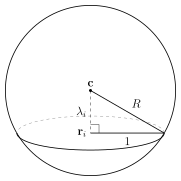
A plane \(\pi\) in 3-dimensional space is given by the vector equation \(\mathbf{r}\cdot\mathbf{n}=p,\) where \(\mathbf{n}\) is a unit vector and \(p\) is a non-negative real number. If \(\mathbf{x}\) is the position vector of a general point \(X\), find the equation of the normal to \(\pi\) through \(X\) and the perpendicular distance of \(X\) from \(\pi\). The unit circles \(C_{i},\) \(i=1,2,\) with centres \(\mathbf{r}_{i},\) lie in the planes \(\pi_{i}\) given by \(\mathbf{r}\cdot\mathbf{n}_{i}=p_{i},\) where the \(\mathbf{n}_{i}\) are unit vectors, and \(p_{i}\) are non-negative real numbers. Prove that there is a sphere whose surface contains both circles only if there is a real number \(\lambda\) such that \[ \mathbf{r}_{1}+\lambda\mathbf{n}_{1}=\mathbf{r}_{2}\pm\lambda\mathbf{n}_{2}. \] Hence, or otherwise, deduce the necessary conditions that \[ (\mathbf{r}_{1}-\mathbf{r}_{2})\cdot(\mathbf{n}_{1}\times\mathbf{n}_{2})=0 \] and that \[ (p_{1}-\mathbf{n}_{1}\cdot\mathbf{r}_{2})^{2}=(p_{2}-\mathbf{n}_{2}\cdot\mathbf{r}_{1})^{2}. \] Interpret each of these two conditions geometrically.
Show Solution