Integration using inverse trig and hyperbolic functions
Let \(f(x) = \sqrt{x^2 + 1} - x\).
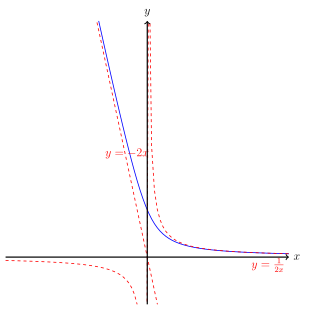
- Using a binomial series, or otherwise, show that, for large \(|x|\), \(\sqrt{x^2 + 1} \approx |x| + \frac{1}{2|x|}\). Sketch the graph \(y = f(x)\).
- Let \(g(x) = \tan^{-1} f(x)\) and, for \(x \neq 0\), let \(k(x) = \frac{1}{2}\tan^{-1}\frac{1}{x}\).
- Show that \(g(x) + g(-x) = \frac{1}{2}\pi\).
- Show that \(k(x) + k(-x) = 0\).
- Show that \(\tan k(x) = \tan g(x)\) for \(x > 0\).
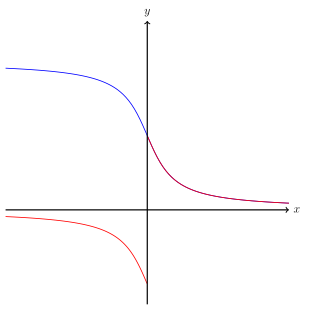
- Sketch the graphs \(y = g(x)\) and \(y = k(x)\) on the same axes.
- Evaluate \(\int_0^1 k(x) \, dx\) and hence write down the value of \(\int_{-1}^0 g(x) \, dx\).
- \begin{align*}
\sqrt{x^2+1} &= |x|\sqrt{1+\frac{1}{x^2}} \\
&=|x| \left (1 + \frac12 \frac{1}{x^2} + \cdots \right) & \text{if } \left (\frac{1}{x^2} < 1 \right) \\
&= |x| + \frac12 \frac{1}{|x|} + \cdots \\
&\approx |x| + \frac{1}{2|x|}
\end{align*}
- \begin{align*} && \tan( g(x) + g(-x)) &= \tan \left ( \tan^{-1}(\sqrt{x^2+1}-x) + \tan^{-1}(\sqrt{x^2+1}+x) \right) \\ &&&= \frac{\sqrt{x^2+1}-x+\sqrt{x^2+1}+x}{1-1} \\ \Rightarrow && g(x) + g(-x) &\in \left \{\cdots, -\frac{\pi}{2}, \frac{\pi}{2}, \cdots \right\} \end{align*} But \(g(x), g(-x) > 0\) and \(g(x), g(-x) \in (-\frac{\pi}{2}, \frac{\pi}{2})\), therefore it must be \(\frac{\pi}{2}\).
- \begin{align*} && \tan(2(k(x) + k(-x))) &= \tan(\tan^{-1}x + \tan^{-1}(-x)) \\ &&&= 0 \\ \Rightarrow && k(x)+k(-x) &\in \left \{\cdots, -\frac{\pi}{2}, 0, \frac{\pi}{2}, \cdots \right\} \\ \end{align*} But \(k(x) \in (-\frac{\pi}{4}, \frac{\pi}{4})\), therefore \(k(x) + k(-x) = 0\).
- Let \(t = \tan k(x)\). \begin{align*} && \tan \left ( \tan^{-1} \frac{1}{x} \right) &= \frac{2 \tan\left ( \frac12 \tan^{-1} \frac1x \right)}{ 1-\tan^2\left ( \frac12 \tan^{-1} \frac1x \right)} \\ \Rightarrow && \frac1x &= \frac{2t}{1-t^2} \\ \Rightarrow && 1-t^2 &= 2tx \\ \Rightarrow && 0 &= t^2+2tx - 1 \\ \Rightarrow && 0 &= (t+x)^2 - 1-x^2 \\ \Rightarrow && t &= -x \pm \sqrt{1+x^2} \end{align*} Since \(t > 0\), \(t = \sqrt{1+x^2}-x = f(x) = \tan g(x)\)
- \begin{align*} \int_0^1 k(x) \d x &= \int_0^1 \frac12 \tan^{-1} \left ( \frac1x \right) \d x \\ &= \left [ \frac{x}{2} \tan^{-1}\left ( \frac1x \right) \right]_0^1 - \int_0^1 \frac{x}{2} \frac{-1/x^2}{1+1/x^2} \d x \\ &= \left [ \frac{x}{2} \tan^{-1}\left ( \frac1x \right) \right]_0^1 + \frac14 \int_0^1 \frac{2x}{1+x^2} \d x \\ &= \frac12 \frac{\pi}{4} + \frac14 \ln(2) \\ &= \frac{\pi + \ln 4}{8}\end{align*} Therefore \(\displaystyle \int_{-1}^0 g(x) \d x = -\frac{\pi + \ln 4}{8}\)
- Show, by means of the substitution \(u=\cosh x\,\), that \[ \int \frac{\sinh x}{\cosh 2x} \d x = \frac 1{2\sqrt2} \ln \left\vert \frac{\sqrt2 \cosh x - 1}{\sqrt2 \cosh x + 1 } \right\vert + C \,.\]
- Use a similar substitution to find an expression for \[ \int \frac{\cosh x}{\cosh 2x} \d x \,.\]
- Using parts (i) and (ii) above, show that \[ \int_0^1 \frac 1{1+u^4} \d u = \frac{\pi + 2\ln(\sqrt2 +1)}{4\sqrt2}\,. \]
- \begin{align*} && \int \frac{\sinh x}{\cosh 2x} \d x &= \int \frac{\sinh x}{2\cosh^2 x -1} \d x \\ u = \cosh x, \d u = \sinh x \d x &&&= \int \frac{1}{2u^2 -1} \d u \\ &&&= \int\frac12 \left ( \frac{1}{\sqrt{2}u-1}-\frac{1}{\sqrt{2}u+1} \right) \d u \\ &&&= \frac1{2\sqrt{2}} \left (\ln (\sqrt{2}u-1) - \ln(\sqrt{2}u+1) \right) + C \\ &&&= \frac{1}{2\sqrt{2}} \ln \left ( \frac{\sqrt{2}\cosh x -1}{\sqrt{2}\cosh x +1} \right) + C \end{align*}
- \begin{align*} && \int \frac{\cosh x}{\cosh 2x} \d x &= \int \frac{\cosh x}{1+2\sinh^2 x} \d x \\ u = \sinh x && &= \int \frac{1}{1+2u^2} \d u \\ &&&=\frac{1}{\sqrt{2}} \tan^{-1} (\sqrt{2}u) + C \\ &&&= \frac{1}{\sqrt{2}} \tan^{-1}(\sqrt{2}\sinh x) + C \end{align*}
- \begin{align*} u = e^x : && \int_0^1 \frac{1}{1+u^4} \d u &= \int_{x=-\infty}^{x=0} \frac{1}{1+e^{4x}}e^{x} \d x \\ &&&= \int_{-\infty}^{0} \frac{e^{-x}}{e^{2x}+e^{-2x}} \d x \\ &&&= \int_{-\infty}^{0} \frac{\cosh x - \sinh x}{2\cosh 2x } \d x \\ &&&= \frac12 \int_{-\infty}^{0} \frac{\cosh x}{\cosh 2x} \d x - \frac12 \int_{-\infty}^{0} \frac{\sinh x}{\cosh 2x} \\ &&&= \frac12 \left [\frac{1}{\sqrt{2}} \tan^{-1}(\sqrt{2}\sinh x) \right]_{-\infty}^{0}-\frac12 \left [ \frac{1}{2\sqrt{2}}\ln \left ( \frac{\sqrt{2}\cosh x -1}{\sqrt{2}\cosh x +1} \right) \right]_{-\infty}^{0} \\ &&&= 0 - \frac1{2\sqrt{2}} \frac{-\pi}{2}-\left (\frac1{4\sqrt{2}} \ln \left (\frac{\sqrt{2}-1}{\sqrt{2}+1} \right) - 0 \right) \\ &&&= \frac{\pi - \ln((\sqrt{2}-1)^2)}{4\sqrt{2}} \\ &&&= \frac{\pi + 2 \ln(1+\sqrt{2})}{4\sqrt{2}} \end{align*}
The following result applies to any function \(\f\) which is continuous, has positive gradient and satisfies \(\f(0)=0\,\): \[ ab\le \int_0^a\f(x)\, \d x + \int_0^b \f^{-1}(y)\, \d y\,, \tag{\(*\)}\] where \(\f^{-1}\) denotes the inverse function of \(\f\), and \(a\ge 0\) and \(b\ge 0\).
- By considering the graph of \(y=\f(x)\), explain briefly why the inequality \((*)\) holds. In the case \(a>0\) and \(b>0\), state a condition on \(a\) and \(b\) under which equality holds.
- By taking \(\f(x) = x^{p-1}\) in \((*)\), where \(p>1\), show that if \(\displaystyle \frac 1p + \frac 1q =1\) then \[ ab \le \frac{a^p}p + \frac{b^q}q\,. \] Verify that equality holds under the condition you stated above.
- Show that, for \(0\le a \le \frac12 \pi\) and \(0\le b \le 1\), \[ ab \le b\arcsin b + \sqrt{1-b^2} \, - \cos a\,. \] Deduce that, for \(t\ge1\), \[ \arcsin (t^{-1}) \ge t - \sqrt{t^2-1}\,. \]
The definite integrals \(T\), \(U\), \(V\) and \(X\) are defined by \begin{align*} T&= \int_{\frac13}^{\frac12} \frac{{\rm artanh}\, t}t \,\d t\,, & U&= \int _{\ln 2 }^{\ln 3 } \frac{u}{2\sinh u}\, \d u \,, \\[3mm] V&= - \int_{\frac13}^{\frac12} \frac{\ln v}{1-v^2} \,\d v \,, & X&= \int _{\frac12\ln2}^{\frac12\ln3} \ln ({\coth x})\, \d x\,. \end{align*} Show, without evaluating any of them, that \(T\), \(U\), \(V\) and \(X\) are all equal.
Show SolutionIn this question, \(a\) is a positive constant.
- Express \(\cosh a\) in terms of exponentials. By using partial fractions, prove that \[ \int_0^1 \frac 1{ x^2 +2x\cosh a +1} \, \d x = \frac a {2\sinh a}\,. \]
- Find, expressing your answers in terms of hyperbolic functions, \[ \int_1^\infty \frac 1 {x^2 +2x \sinh a -1} \,\d x \, \] and \[ \int_0^\infty \frac 1 {x^4 +2x^2\cosh a +1} \,\d x \,.\]
- \(\cosh a = \frac12 (e^a + e^{-a})\) \begin{align*} \int_0^1 \frac 1{ x^2 +2x\cosh a +1} \, \d x &= \int_0^1 \frac{1}{x^2+(e^a+e^{-a})x+e^ae^{-a}} \d x \\ &= \int_0^1 \frac{1}{e^a-e^{-a}}\left (\frac{1}{x+e^{-a}}-\frac{1}{x+e^a} \right)\d x \\ &= \frac{1}{2 \sinh a} \int_0^1 \left (\frac{1}{x+e^{-a}}-\frac{1}{x+e^a} \right)\d x \\ &= \frac{1}{2 \sinh a}\left [\ln(x+e^{-a})-\ln(x+e^a) \right]_0^1 \\ &= \frac{1}{2 \sinh a} \left (\ln(1+e^a)-\ln(1+e^{-a}) - (\ln e^{-a}-\ln e^a) \right) \\ &= \frac{1}{2\sinh a}\left (2a + \ln \frac{1+e^a}{1+e^{-a}}\right) \\ &= \frac1{2\sinh a} \left ( 2a -a \right) \\ &= \frac{a}{2 \sinh a} \end{align*}
- \begin{align*} \int_1^\infty \frac 1 {x^2 +2x \sinh a -1} \,\d x &= \int_1^{\infty} \frac{1}{(x+e^a)(x-e^{-a})} \d x \\ &= \int_1^{\infty} \frac{1}{e^a+e^{-a}} \left ( \frac{1}{x-e^{-a}} - \frac{1}{x+e^{a}} \right)\d x \\ &= \frac{1}{2\cosh a} \int_1^{\infty} \left ( \frac{1}{x-e^{-a}} - \frac{1}{x+e^{a}} \right)\d x \\ &= \frac{1}{2\cosh a} \left [\ln(x-e^{-a}) - \ln (x + e^{a} ) \right]_1^{\infty} \\ &= \frac1{2\cosh a} \left [ \ln \frac{x-e^{-a}}{x+e^{a}} \right]_1^{\infty} \\ &= \frac{1}{2\cosh a} \left ( 0 - \ln \frac{1-e^{-a}}{1+e^a}{}\right) \\ &= \frac{1}{2\cosh a} \ln \frac{1+e^a}{1-e^{-a}}\\ &= \frac{1}{2\cosh a} \left ( a + \ln \coth \frac{a}{2} \right) \end{align*} and \begin{align*} \int_0^\infty \frac 1 {x^4 +2x^2\cosh a +1} \,\d x &= \int_0^\infty\frac{1}{(x^2+e^a)(x^2+e^{-a})} \d x \\ &= \int_0^\infty \frac{1}{e^a-e^{-a}} \left ( \frac{1}{x^2+e^{-a}} - \frac{1}{x^2+e^{a}} \right) \d x \\ &= \frac{1}{2\sinh a} \left [ \frac{1}{e^{-a/2}} \tan^{-1} \frac{x}{e^{-a/2}} - \frac{1}{e^{a/2}}\tan^{-1} \frac{x}{e^{a/2}} \right]_0^{\infty} \\ &= \frac{1}{2\sinh a} \left (e^{a/2}\frac{\pi}{2}-e^{-a/2}\frac{\pi}{2} - 0 \right) \\ &= \frac{1}{2\sinh a} \pi \sinh \frac{a}{2} \\ &= \frac{\pi \sinh \tfrac{a}{2}}{2\sinh a} \\ &= \frac{\pi \sinh \tfrac{a}{2}}{4\sinh \tfrac{a}{2} \cosh \tfrac{a}{2}} \\ &= \frac{\pi}{4\cosh \tfrac{a}{2}} \end{align*}
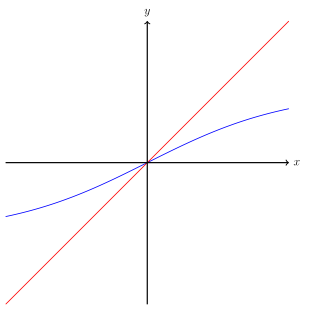
- Show, with the aid of a sketch, that \(y> \tanh (y/2)\) for \(y>0\) and deduce that \begin{equation} \textrm{arcosh} x > \dfrac{x-1}{\sqrt{x^2-1}} \text{ for } x>1. \tag{\(*\)} \end{equation}
- By integrating \((*)\), show that $\textrm{arcosh} x > 2 \dfrac{{x-1}}{\sqrt{x^2-1}} \( for \)x>1$.
- Show that $\textrm{arcosh} x >3 \dfrac{\sqrt{x^2-1}}{{x+2}} \( for \)x>1$.
- If \(y = \textrm{arcosh} x \), then \(\tanh\textrm{arcosh} x/2 = \sqrt{\frac{\cosh \textrm{arcosh} x-1}{\cosh \textrm{arcosh} x+1}} = \sqrt{\frac{x-1}{x+1}} = \frac{x-1}{\sqrt{x^2-1}}\)
- \begin{align*} \int \textrm{arcosh} x \d x &= \left [x \textrm{arcosh} x \right] - \int \frac{x}{\sqrt{x^2-1}} \d x \\ &= x \textrm{arcosh} x - \sqrt{x^2-1}+C \\ \int \frac{x-1}{\sqrt{x^2-1}} &= \sqrt{x^2-1} - \textrm{arcosh} x +C \end{align*} Therefore \begin{align*} && \int_1^x \textrm{arcosh} t \d t &> \int_1^x \frac{t-1}{\sqrt{t^2-1}} \d t \\ \Rightarrow && x \textrm{arcosh} x - \sqrt{x^2-1} - 0 &> \sqrt{x^2-1} - \textrm{arcosh} x - 0 \\ \Rightarrow && (x+1) \textrm{arcosh} x &> 2\sqrt{x^2-1} \\ \Rightarrow && \textrm{arcosh} x & > 2\frac{\sqrt{x^2-1}}{x+1} \\ &&&= 2 \frac{\sqrt{x-1}}{\sqrt{x+1}} \\ &&&= 2 \frac{x-1}{\sqrt{x^2-1}} \end{align*}
- Integrating both sides again, \begin{align*} && \int_1^x \textrm{arcosh} t \d t &> 2 \int_1^x \frac{t-1}{\sqrt{t^2-1}} \d t \\ \Rightarrow && x \textrm{arcosh} x - \sqrt{x^2-1} &> 2\left (\sqrt{x^2-1} - \textrm{arcosh}x \right) \\ \Rightarrow && (x+2)\textrm{arcosh} x &> 3 \sqrt{x^2-1} \\ \Rightarrow && \textrm{arcosh} x &> 3 \frac{\sqrt{x^2-1}}{x+2} \end{align*}
Show that if \(\displaystyle \int\frac1{u \, \f(u)}\; \d u = \F(u) + c\;\), then \(\displaystyle \int\frac{m}{x \, \f(x^m)} \;\d x = \F(x^m) + c\;\), where \(m\ne0\). Find:
- \(\displaystyle\int\frac1{x^n-x} \, \d x\,\);
- \(\displaystyle\int\frac1 {\sqrt{x^n+x^2}}\, \d x\,\).
- \begin{align*} && \int \frac{1}{u(u-1)} \d u &= \int \left ( \frac{1}{u-1}-\frac{1}{u} \right ) \d u \\ &&&= \ln \left ( \frac{u-1}{u} \right) + c \\ &&&= \ln \left ( 1 - \frac{1}{u} \right) + c \\ && \int \frac{1}{x^n - x} \d x &= \int \frac{1}{x (x^{n-1}-1)} \d x \\ f(u) = u - 1: && &= \frac{1}{n-1} \ln \left ( 1 - \frac{1}{x^{n-1}} \right) + c \end{align*}
- \begin{align*} v = \sqrt{u+1}, \d v = \tfrac12 (u+1)^{-1/2} \d u && \int \frac{1}{u\sqrt{u+1}} \d u &= \int \frac{1}{(v^2-1)} (u+1)^{-1/2} \d u \\ &&&= \int \frac{2}{v^2-1} \d v \\ &&&=\ln \frac{1-v}{1+v} + c \\ &&&= \ln \left (\frac{1-\sqrt{u+1}}{1+\sqrt{u+1}} \right)+ c \\ f(u) = \sqrt{x+1}:&& \int \frac{1}{\sqrt{x^n + x^2}} \d x &= \int \frac{1}{x\sqrt{x^{n-2}+1}} \d x \\ &&&= \frac{1}{n-2} \ln \left ( \frac{1-\sqrt{x^{n-2}+1}}{1+\sqrt{x^{n-2}+1}} \right)+c \end{align*}
Show that \[ \int_0^a \frac{\sinh x}{2\cosh^2 x -1} \, \mathrm{d} x = \frac{1}{2 \sqrt{2}} \ln \l \frac{\sqrt{2}\cosh a -1}{\sqrt{2}\cosh a +1}\r + \frac{1}{2 \sqrt{2}} \ln \l \frac{\sqrt{2}+1}{\sqrt{2}-1}\r \] and find \[ \int_0^a \frac{\cosh x}{1+2\sinh^2 x} \, \mathrm{d} x \, . \] Hence show that \[ \int_0^\infty \frac{\cosh x - \sinh x}{1+2\sinh^2 x} \, \mathrm{d} x = \frac{\pi}{2\sqrt{2}} - \frac{1}{2 \sqrt{2}} \ln \l \frac{\sqrt{2}+1}{\sqrt{2}-1}\r \, . \] By substituting \(u = \e^x\) in this result, or otherwise, find \[ \int_1^\infty \frac{1}{1+u^4} \, \mathrm{d} u \, . \]
Given that \(x+a>0\) and \(x+b>0\,\), and that \(b>a\,\), show that \[ \frac{\mathrm{d} \ }{\mathrm{d} x} \arcsin \left ( \frac{x + a }{ \ x + b} \right) = \frac{ \sqrt{\;b - a\;}} {( x + b ) \sqrt{ a + b + 2x} \ \ } \] and find $\displaystyle \frac{\mathrm{d} \ }{ \mathrm{d} x} \; \mathrm{arcosh} \left ( \frac{x + b }{ \ x + a} \right)$. Hence, or otherwise, integrate, for \(x > -1\,\),
- \[ \int \frac{1}{ ( x + 1) \sqrt{x + 3} } \mathrm{d} x \]
- \[ \int \frac{1} {( x + 3 ) \sqrt{x + 1} } \mathrm{d} x \] .
- \begin{align*} \int \frac{1}{ ( x + 1) \sqrt{x + 3} } \mathrm{d} x &= \int \frac{1}{(x+1)\sqrt{\frac12 (2x+6)}} \d x\\ &= \int \frac{\sqrt{2}}{(x+1)\sqrt{2x+1+5}} \d x \\ &= \frac{\sqrt{2}}{2}\int \frac{\sqrt{5-1}}{(x+1)\sqrt{2x+1+5}} \d x \\ &= - \frac{\sqrt{2}}{2}\textrm{arcosh} \left ( \frac{x+5}{x+1} \right) + C \end{align*}
- \begin{align*} \int \frac{1}{(x+3)\sqrt{x+1}} \d x &= \int \frac{1}{(x+3)\sqrt{\tfrac12(2x+2)}} \d x + C \\ &= \int \frac{\sqrt{3-1}}{(x+3)\sqrt{2x+3-1}} \d x \\ &= \textrm{arcsin} \left ( \frac{x-1}{x+3} \right) \end{align*}
Show that \( \cosh^{-1} x = \ln ( x + \sqrt{x^2-1})\). Show that the area of the region defined by the inequalities \(\displaystyle y^2 \ge x^2-8\) and \(\displaystyle x^2\ge 25y^2 -16 \) is \((72/5) \ln 2\).
Show Solution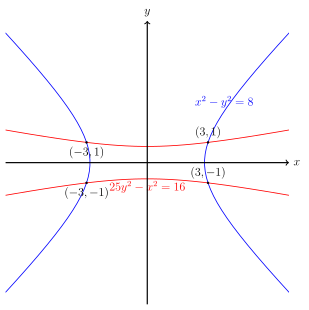
Calculate the following integrals
- \({\displaystyle \int\frac{x}{(x-1)(x^{2}-1)}\,\mathrm{d}x}\);
- \({\displaystyle \int\frac{1}{3\cos x+4\sin x}\,\mathrm{d}x}\);
- \({\displaystyle \int\frac{1}{\sinh x}\,\mathrm{d}x}.\)
- \begin{align*} \int\frac{x}{(x-1)(x^{2}-1)}\,\mathrm{d}x &= \int \frac{x}{(x-1)^2 (x+1)} \d x \\ &= \int \frac{1}{2(x-1)^2} + \frac{1}{4(x-1)} - \frac{1}{4(x+1)} \d x \\ &= -\frac12 (x-1)^{-1} + \frac14 \ln(x-1) - \frac14 \ln (x+1) + C \end{align*}
- \begin{align*} \int \frac{1}{3 \cos x + 4 \sin x } \d x &= \int \frac{1}{5 \cos (x - \cos^{-1}(3/5))} \d x \\ &= \frac15 \int \sec (x - \cos^{-1}(3/5)) \d x\\ &= \frac15 \left (\ln | \sec (x - \cos^{-1}(3/5)) + \tan (x - \cos^{-1}(3/5)) | \right) + C \end{align*}
- \begin{align*} \int \frac{1}{\sinh x} \d x &= \int \frac{2}{e^x - e^{-x}} \\ &= \int \frac{2e^x}{e^{2x}-1} \d x \\ &=\int \frac{e^x}{e^x-1} - \frac{e^x}{e^x+1} \d x \\ &= \ln (e^x - 1) + \ln (e^x+1) + C \end{align*}