Show that \(\sin A = \cos B\) if and only if \(A = (4n+1)\frac{\pi}{2}\pm B\) for some integer \(n\).
Show also that \(\big\vert\sin x \pm \cos x \big\vert \le \sqrt{2}\) for all values of \(x\) and deduce that there are no solutions to the equation \(\sin\left( \sin x \right) = \cos \left( \cos x \right)\).
Sketch, on the same axes, the graphs of \(y= \sin \left( \sin x \right)\) and \(y = \cos \left( \cos x \right)\). Sketch, not on the previous axes, the graph of \(y= \sin \left(2 \sin x \right)\).
An attempt is made to move a rod of length \(L\) from a corridor
of width \(a\) into a corridor of width~\(b\), where \(a \ne b.\) The corridors
meet at right angles, as shown in Figure 1 and the rod remains horizontal.
Show that if the attempt is to be successful then
$$
L \le a \cosec {\alpha} + b \sec {\alpha} \;,
$$
where \({\alpha}\) satisfies
$$
\tan^3\alpha =\frac a b \;.
$$
An attempt is made to move a rectangular table-top, of width \(w\) and length \(l\),
from one corridor to the other, as shown in the Figure 2.
The table-top remains horizontal.
Show that if the attempt is to be successful then
$$
l\le a \cosec {\beta} + b \sec {\beta} -2w \cosec 2{\beta},
$$
where \({\beta}\) satisfies
$$
w= \left(\frac {a -b \tan^3 \beta} {1 - \tan^2 \beta} \right)
\cos \beta \;.
$$
The triangle \(OAB\) is isosceles,
with \(OA = OB\) and angle \(AOB = 2 \alpha\) where \(0< \alpha < {\pi \over 2}\,\).
The semi-circle \(\mathrm{C}_0\) has its centre at the midpoint of the base \(AB\) of the triangle,
and the sides \(OA\) and \(OB\) of the triangle are both tangent to the semi-circle.
\(\mathrm{C}_1, \mathrm{C}_2, \mathrm{C}_3, \ldots\)
are circles such that \(\mathrm{C}_n\) is tangent to \(\mathrm{C}_{n-1}\)
and to sides \(OA\) and \(OB\) of the triangle.
Let \(r_n\) be the radius of \(\mathrm{C}_n\,\). Show that
\[
\frac{r_{n+1}}{r_n} = \frac{1-\sin\alpha}{1+\sin\alpha}\;.
\]
Let \(S\) be the total area of the semi-circle \(\mathrm{C}_0\) and the
circles \(\mathrm{C}_1\), \(\mathrm{C}_2\), \(\mathrm{C}_3\), \(\ldots\;\).
Show that
\[
S = {1 + \sin^2 \alpha \over 4 \sin \alpha} \, \pi r_0^2 \;.
\]
Show that there are values of \(\alpha\) for which \(S\) is more than four fifths
of the area of triangle~\(OAB\).
Show that if \(\, \cos(x - \alpha) = \cos \beta \,\)
then either \(\, \tan x = \tan ( \alpha + \beta)\,\) or
\(\; \tan x = \tan ( \alpha - \beta)\,\).
By choosing suitable values of \(x\), \(\alpha\) and \(\beta\,\),
give an example to show that if
\(\,\tan x = \tan ( \alpha + \beta)\,\),
then \(\,\cos(x - \alpha) \, \) need not equal \( \cos \beta \,\).
Let \(\omega\) be the acute angle such that \(\tan \omega = \frac 43\,\).
For \(0 \le x \le 2 \pi\), solve the equation
\[
\cos x -7 \sin x = 5
\]
giving both solutions in terms of \(\omega\,\).
For \(0 \le x \le 2 \pi\), solve the equation
\[
2\cos x + 11 \sin x = 10
\]
showing that one solution is twice the other and giving both in terms of \(\omega\,\).
Show that \( 2\sin(\frac12\theta)=\sin \theta\) if and only if \(\sin(\frac12\theta)=0\,\).
Solve the equation \(2\tan (\frac12\theta) = \tan\theta\,\).
Show that \(2\cos(\frac12\theta)=\cos \theta\) if and only if \(\theta=(4n+2)\pi\pm 2\phi\) where \(\phi\) is
defined by \(\cos \phi=\frac12(\sqrt 3-1)\;\), \(0\le \phi\le \frac{1}{2}\pi\), and \(n\) is any integer.
\(\theta \in \{0\} \cup (\frac{\pi}{2}, 2\pi]\). In \((0, \frac{\pi}{2})\) \(\cos \theta < 1 + \sin \theta\), and then it's either negative or greater than \(1+ \sin \theta\)
Write down a value of \(\theta\,\) in the interval \(\frac{1}{4}\pi< \theta <\frac{1}{2}\pi\) that satisfies
the equation
\[
4\cos\theta+ 2\sqrt3\, \sin\theta = 5 \;.
\]
Hence, or otherwise, show that
\[
\pi=3\arccos(5/\sqrt{28}) + 3\arctan(\sqrt3/2)\;.
\]
Show that
\[
\pi=4\arcsin(7\sqrt2/10) - 4\arctan(3/4)\;.
\]
The lines \(l_1\), \(l_2\) and \(l_3\) lie in an inclined plane \(P\) and pass through
a common point \(A\). The line \(l_2\) is a
line of greatest slope in \(P\). The line \(l_1\) is perpendicular to \(l_3\) and
makes an acute angle \(\alpha\) with \(l_2\).
The angles between the horizontal and
\(l_1\), \(l_2\) and \(l_3\) are \(\pi/6\), \(\beta\) and \(\pi/4\), respectively.
Show that \(\cos\alpha\sin\beta = \frac12\,\)
and find the value of \(\sin\alpha \sin\beta\,\). Deduce that
\(\beta = \pi/3\,\).
The lines \(l_1\) and \(l_3\) are rotated in \(P\) about
\(A\) so that \(l_1\) and \(l_3\) remain perpendicular to each other.
The new acute angle between
\(l_1\) and \(l_2\) is \(\theta\). The new angles which \(l_1\) and \(l_3\)
make with the horizontal are \(\phi\) and \(2\phi\), respectively. Show that
\[
\tan^2\theta = \frac{3+\sqrt{13}}2\;.
\]
Show that \(\displaystyle \tan 3\theta = \frac{3\tan\theta -\tan^3\theta}{1-3\tan^2\theta}\) .
Given that \(\theta= \cos^{-1} (2/\sqrt5)\) and
\(0<\theta<\pi/2\), show that \(\tan 3\theta =11/2\)
Hence, or otherwise, find all solutions of the equations
Let
$$
\f(x) = P \, {\sin x} + Q\, {\sin 2x} + R\, {\sin 3x} \;.
$$
Show that if \(Q^2 < 4R(P-R)\),
then the only values of \(x\) for which \(\f(x) = 0\) are given by \(x=m\pi\), where \(m\) is
an integer.
\newline
[You may assume that \(\sin 3x = \sin x(4\cos^2 x -1)\).]
Now let
$$
\g(x) = {\sin 2nx} + {\sin 4nx} - {\sin 6nx},
$$
where \(n\) is a positive integer and \(0 < x < \frac{1}{2}\pi \).
Find an expression for the largest root of the equation
\(\g(x)=0\), distinguishing between the
cases where \(n\) is even and \(n\) is odd.
In this question, the function \(\sin^{-1}\) is defined to have domain \( -1\le x \le 1\)
and range \linebreak \( - \frac{1}{2}\pi \le x \le \frac{1}{2}\pi\) and the function \(\tan^{-1}\) is defined to have the real numbers as its
domain and range \( - \frac{1}{2}\pi < x < \frac{1}{2}\pi\).
Show that if \(\alpha\) is a solution of the equation
$$
5{\cos x} + 12{\sin x} = 7,
$$
then either
$$
{\cos }{\alpha} = \frac{35 -12\sqrt{120}}{169}
$$
or \(\cos \alpha\) has one other value which you should find.
Prove carefully that if
\(\frac{1}{2}\pi< \alpha < \pi\), then \(\alpha < \frac{3}{4}\pi\).
True. \begin{align*}
&& \ln a \cdot \ln b &= \ln b \cdot \ln a \\
\Leftrightarrow && \exp ( \ln a \cdot \ln b) &= \exp ( \ln b \cdot \ln a) \\
\Leftrightarrow && \exp ( \ln a )^{\ln b} &= \exp ( \ln b )^{\ln a} \\
\Leftrightarrow && a^{\ln b} &= b^{\ln a} \\
\end{align*}
False. Consider \(\theta = 0\). We'd need \(\cos 0 = 1 = \sin 1\), but \(0 < 1 < \frac{\pi}{2}\) so \(\sin 1 \neq 1\)
False. If the polynomial has positive degree, then as \(n \to \infty\), \(\P(x) \to \pm \infty\), in particular it must be well outside the interval \([-1,1]\). Therefore it can't be within \(10^{-6}\) of \(\cos \theta\) which is confined to that interval. The only polynomial which is restricted to that range are constants, but then \(|\cos 0 - c| \leq 10^{-6}\) and \(|\cos \pi - c| \leq 10^{-6}\) \(2 = |1-(-1)| \leq |1-c| + |-1-c| \leq 2\cdot 10^{-6}\) contradiction.
Let \(a_{1}=\cos x\) with \(0 < x < \pi/2\)
and let \(b_{1}=1\). Given that
\begin{eqnarray*}
a_{n+1}&=&{\textstyle \frac{1}{2}}(a_{n}+b_{n}),\\[2mm]
b_{n+1}&=&(a_{n+1}b_{n})^{1/2},
\end{eqnarray*}
find \(a_{2}\) and \(b_{2}\) and show that
\[a_{3}=\cos\frac{x}{2}\cos^{2}\frac{x}{4}
\ \quad\mbox{and}\quad
\ b_{3}=\cos\frac{x}{2}\cos\frac{x}{4}.\]
Guess general expressions for \(a_{n}\) and \(b_{n}\) (for \(n\ge2\))
as products of cosines
and verify that they satisfy the given equations.
Show that, if \(\,\tan^2\phi=2\tan\phi+1\), then \(\tan2\phi=-1\).
Find all solutions of the equation
$$\tan\theta=2+\tan3\theta$$
which satisfy \(0<\theta< 2\pi\),
expressing your answers as rational multiples of \(\pi\).
Find all solutions of the equation
the equation
$$\cot\theta=2+\cot3\theta$$
which satisfy $$-\frac{3\pi}{2}<\theta<\frac{\pi}{2}.$$
Let
\[
\mathrm{C}_{n}(\theta)=\sum_{k=0}^{n}\cos k\theta
\]
and let
\[
\mathrm{S}_{n}(\theta)=\sum_{k=0}^{n}\sin k\theta,
\]
where \(n\) is a positive integer and \(0<\theta<2\pi.\) Show that
\[
\mathrm{C}_{n}(\theta)=\frac{\cos(\tfrac{1}{2}n\theta)\sin\left(\frac{1}{2}(n+1)\theta\right)}{\sin(\frac{1}{2}\theta)},
\]
and obtain the corresponding expression for \(\mathrm{S}_{n}(\theta)\).
Hence, or otherwise, show that for \(0<\theta<2\pi,\)
\[
\left|\mathrm{C}_{n}(\theta)-\frac{1}{2}\right|\leqslant\frac{1}{2\sin(\frac{1}{2}\theta)}.
\]
The function \(\mathrm{f}\) satisfies \(\mathrm{f}(0)=1\) and
\[
\mathrm{f}(x-y)=\mathrm{f}(x)\mathrm{f}(y)-\mathrm{f}(a-x)\mathrm{f}(a+y)
\]
for some fixed number \(a\) and all \(x\) and \(y\). Without making any further assumptions about the nature of the function show that \(\mathrm{f}(a)=0\).
Show that, for all \(t\),
\(\mathrm{f}(t)=\mathrm{f}(-t)\),
\(\mathrm{f}(2a)=-1\),
\(\mathrm{f}(2a-t)=-\mathrm{f}(t)\),
\(\mathrm{f}(4a+t)=\mathrm{f}(t)\).
Give an example of a non-constant function satisfying the conditions of the first paragraph with \(a=\pi/2\). Give an example of an non-constant function satisfying the conditions of the first paragraph with \(a=-2\).
Show Solution
Let \(P(x,y)\) be the statement that the functional equation holds, then:
\begin{align*}
P(0,0): && f(0) &= f(0)f(0)-f(a)f(a) \\
\Rightarrow && 1 &= 1 - f(a)^2 \\
\Rightarrow && f(a)^2 &= 0 \\
\Rightarrow && f(a) &= 0
\end{align*}
Let \(f(x) = \cos x\) then \(f(\frac{\pi}{2}-x) = \sin x\) and \(f(\frac{\pi}{2}+y) = -\sin y\) so the equation becomes
\(\cos(x-y) = \cos x \cos y + \sin x \sin y\) which is the normal cosine addition formula.
Similarly, consider \(f(x) = \cos \frac{\pi}{4} x\).
Prove by induction, or otherwise, that, if \(0<\theta<\pi\),
\[
\frac{1}{2}\tan\frac{\theta}{2}+\frac{1}{2^{2}}\tan\frac{\theta}{2^{2}}+\cdots+\frac{1}{2^{n}}\tan\frac{\theta}{2^{n}}=\frac{1}{2^{n}}\cot\frac{\theta}{2^{n}}-\cot\theta.
\]
Deduce that
\[
\sum_{r=1}^{\infty}\frac{1}{2^{r}}\tan\frac{\theta}{2^{r}}=\frac{1}{\theta}-\cot\theta.
\]
If \(\theta+\phi+\psi=\tfrac{1}{2}\pi,\) show that
\[
\sin^{2}\theta+\sin^{2}\phi+\sin^{2}\psi+2\sin\theta\sin\phi\sin\psi=1.
\]
By taking \(\theta=\phi=\tfrac{1}{5}\pi\) in this equation, or otherwise, show that \(\sin\tfrac{1}{10}\pi\) satisfies the equation
\[
8x^{3}+8x^{2}-1=0.
\]
Let \(y=\cos\phi+\cos2\phi\), where \(\phi=\dfrac{2\pi}{5}.\) Verify by direct substitution that \(y\) satisfies the quadratic equation \(2y^{2}=3y+2\) and deduce that the value of \(y\) is \(-\frac{1}{2}.\)
Let \(\theta=\dfrac{2\pi}{17}.\) Show that
\[
\sum_{k=0}^{16}\cos k\theta=0.
\]
If \(z=\cos\theta+\cos2\theta+\cos4\theta+\cos8\theta,\) show that the value of \(z\) is \(-(1-\sqrt{17})/4\).
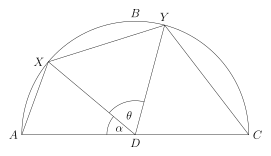
In the above diagram, \(ABCD\) represents a semicircular window of fixed radius \(r\) and centre \(D\), and \(AXYC\) is a quadrilateral blind. If \(\angle XDY=\alpha\) is fixed and \(\angle ADX=\theta\) is
variable, determine the value of \(\theta\) which gives the blind \(maximum\) area.
If now \(\alpha\) is allowed to vary but \(r\) remains fixed, find the maximum possible area of the blind.
Show Solution
The area for \(\alpha\) fixed is \(\frac12 r^2 \sin \alpha + \frac12 r^2 \sin \theta + \frac12 r^2 \sin (\pi - \theta - \alpha)\)
So we wish to maximise \(V = \sin \theta + \sin(\pi - \theta-\alpha)\)
\begin{align*}
&& V &= \sin \theta + \sin(\pi - \theta-\alpha)\\
&&&= 2\sin \l \frac{\pi-\alpha}2\r\cos \l \frac{2\theta + \alpha - \pi}{2}\r
\end{align*}
The largest \(\cos\) can be is \(1\) when \(\displaystyle 2\theta + \alpha - \pi = 0 \Rightarrow \theta = \frac{\pi-\alpha}2\). (ie we split the remaining area exactly in half).
We are now trying to maximise \(W = \sin \alpha + 2 \sin \frac{\pi - \alpha}2\) ie
\begin{align*}
&& W &= \sin \alpha + 2 \cos \frac{\alpha}{2} \\
\Rightarrow && \frac{\d W}{\d \alpha} &= \cos \alpha-\sin \frac{\alpha}{2} \\
&&&= 1-2 \sin^2 \frac{\alpha}{2} - \sin \frac{\alpha}{2} \\
&&&= (1+\sin \frac{\alpha}{2})(1-2\sin \frac{\alpha}{2})
\end{align*}
Therefore \(\frac{\alpha}{2} = -\frac{3\pi}{2}, \frac{\alpha}{2} = \frac{\pi}{6}, \frac{5\pi}{6} \Rightarrow \alpha = -3\pi, \frac{\pi}{3}, \frac{5\pi}{3}\). The only turning point in our range is \(\frac{\pi}{3}\). This is obvious a a maximum by symmetry or checking the end points, but we could also check the second derivative \(\frac{\d^2 W}{\d \alpha^2} = -\sin \frac{\pi}{3}-\cos \frac{\pi}{3} < 0\) so we have a maximum.
Therefore the largest possible area is: \(\displaystyle \frac{3\sqrt{3}}{4}r^2\)
Prove that if \(A+B+C+D=\pi,\) then
\[
\sin\left(A+B\right)\sin\left(A+D\right)-\sin B\sin D=\sin A\sin C.
\]
The points \(P,Q,R\) and \(S\) lie, in that order, on a circle of centre \(O\). Prove that
\[
PQ\times RS+QR\times PS=PR\times QS.
\]
\begin{align*}
\sin(A+B)\sin(A+D) - \sin B \sin D &= \sin (A+B)\sin(\pi - B-C) - \sin B \sin (\pi - A - B - C) \\
&= \sin (A+B)\sin(B+C) - \sin B \sin(A+B+C) \\
&= \sin(A+B)\sin (B+C) - \sin B (\sin (A+B)\cos C +\cos(A+B) \sin C) \\
&= \sin(A+B)\cos B \sin C + \cos(A+B)\sin B \sin C \\
&= \sin A \sin C \cos^2 B + \cos A \sin B \cos B \sin C - \cos A \cos B \sin B \sin C + \sin A \sin^2 B \sin C \\
&= \sin A \sin C (\cos^2 B + \sin^2 B) \\
&= \sin A \sin C
\end{align*}
Using the extended form of the sine rule: \(\frac{a}{\sin A} = \frac{b}{\sin B} = \frac{c}{\sin C} = 2R\) where \(R\) is the circumradius, we have
\begin{align*}
PR \times QS &= 2R \sin (A+D) \times 2R \sin (A+B) \\
&= 4R^2 \l \sin A \sin C + \sin B \sin D \r \\
&= 2R \sin A \times 2R \sin C + 2R \sin B 2R \sin D \\
&= PS \times QR + PQ \times RS
\end{align*}
as required.
Prove that \(\cos3\theta=4\cos^{3}\theta-3\cos\theta\).
Show how the cubic equation
\[
24x^{3}-72x^{2}+66x-19=0\tag{*}
\]
can be reduced to the form
\[
4z^{3}-3z=k
\]
by means of the substitution \(y=x+a\) and \(z=by\), for suitable values
of the constants \(a\) and \(b\). Hence find the three roots of the
equation \((*)\), to three significant figures.
Show, by means of a counterexample, or otherwise, that not all cubic
equations of the form
\[
x^{3}+\alpha x^{2}+\beta x+\gamma=0
\]
can be solved by this method.