Introduction to trig
Sine and cosine rule, graphs of trig functions, solving trig equations
In both parts of this question, \(x\) is real and \(0 < \theta < \pi\).
- By completing the square, find in terms of \(\theta\) the minimum value as \(x\) varies of $$9x^2 - 12x \cos \theta + 4.$$ Find also the maximum value as \(x\) varies of \(12x^2 \sin \theta - 9x^4\). Hence determine the values of \(x\) and \(\theta\) that satisfy the equation $$9x^4 + (9 - 12 \sin \theta)x^2 - 12x \cos \theta + 4 = 0.$$
- Sketch the curve $$y = \frac{x^2}{x - \theta},$$ where \(\theta\) is a constant. Deduce that either \(\frac{x^2}{x - \theta} \leq 0\) or \(\frac{x^2}{x - \theta} \geq 4\theta\). By considering the numerator and denominator separately, or otherwise, show that $$\frac{\sin^2 \theta \cos^2 x}{1 + \cos^2 \theta \sin^2 x} \leq 1.$$ Hence determine the values of \(x\) and \(\theta\) that satisfy the equation $$\frac{x^2}{4\theta(x - \theta)} = \frac{\sin^2 \theta \cos^2 x}{1 + \cos^2 \theta \sin^2 x}.$$
- \(\,\) \begin{align*} && y &= 9x^2 - 12x \cos \theta + 4 \\ &&&= (3x-2\cos \theta)^2+4-4\cos^2 \theta \\ &&&= (3x-2\cos \theta)^2 + 4 \sin^2 \theta \end{align*} Therefore the minimum is \(4\sin^2 \theta\) when \(x = \frac23 \cos \theta\). \begin{align*} && y &= 12x^2 \sin \theta - 9x^4 \\ &&&=4\sin^2 \theta -(3x^2-2\sin\theta)^2 \end{align*} Therefore the maximum is \(4\sin^2 \theta\) when \(x^2 = \frac23\sin \theta\) Therefore \begin{align*} && 0 &= 9x^4 + (9 - 12 \sin \theta)x^2 - 12x \cos \theta + 4 \\ && \underbrace{-9x^4+12x^2\sin \theta}_{\leq 4\sin^2 \theta } &= \underbrace{9x^2 - 12x \cos \theta + 4 }_{\geq 4 \sin^2 \theta} \end{align*} Therefore the equality cases must be achieved in both cases, ie \(x = \frac23 \cos \theta\) and \(x^2 = \frac23 \sin \theta\) \begin{align*} && x^2 &= \frac49\cos^2 \theta \\ &&&= \frac49(1-\sin^2 \theta) \\ &&&= \frac49(1-\frac94 x^2) \\ \Rightarrow && 2x^2 &= \frac49 \\ \Rightarrow && x &= \pm \frac{\sqrt{2}}3\\ \Rightarrow && \cos \theta &=\pm \frac32 \frac{\sqrt{2}}3 \\ &&&= \pm \frac{1}{\sqrt{2}} \\ \Rightarrow && \theta &= \frac{\pi}{4}, \frac{3\pi}{4} \\ \Rightarrow && (x, \theta) &= \left (\frac{\sqrt{2}}{3}, \frac{\pi}{4} \right), \left (-\frac{\sqrt{2}}{3}, \frac{3\pi}{4} \right) \end{align*}
- Sketching we obtain, noticing we can find the turning point by:
\begin{align*}
&& \frac{x^2}{x-\theta} &= \lambda \\
\Leftrightarrow && x^2 - \lambda x +\theta \lambda &= 0 \\
\Leftrightarrow && 0 &\leq \Delta = \lambda^2 -4\lambda \theta \\
\Leftrightarrow && \lambda &\geq 4 \theta, \lambda \leq 0
\end{align*}
Notice that \(\sin^2 \theta \cos^2 x \leq 1\) and \(1 + cos^2 \theta \sin^2 x \geq 1\) and therefore we must have the inequality desired. \begin{align*} && \underbrace{\frac{x^2}{4\theta(x - \theta)}}_{\geq 1 \text{ or } \leq 0} &= \underbrace{\frac{\sin^2 \theta \cos^2 x}{1 + \cos^2 \theta \sin^2 x}}_{\in [0,1]} \\ \text{both}=0: && x = 0 &, \sin \theta = 0 \\ \text{both}=1: && x = 2\theta &, \sin^2 \theta = 1,\cos^2 x = 1 \\ && 1 &= \cos^2 2 \theta \\ &&&= (1-2 \sin^2 \theta)^2 \\ &&&= 1 \\ \Rightarrow && (x, \theta) &= \left(\frac{\pi}{2}, \pi\right) \end{align*}

The triangle \(ABC\) has side lengths \(\left| BC \right| = a\), \(\left| CA \right| = b\) and \(\left| AB \right| = c\). Equilateral triangles \(BXC\), \(CYA\) and \(AZB\) are erected on the sides of the triangle \(ABC\), with \(X\) on the other side of \(BC\) from \(A\), and similarly for \(Y\) and \(Z\). Points \(L\), \(M\) and \(N\) are the centres of rotational symmetry of triangles \(BXC\), \(CY\!A\) and \(AZB\) respectively.
- Show that \(| CM| = \dfrac {\ b} {\sqrt3} \,\) and write down the corresponding expression for \(| CL|\).
- Use the cosine rule to show that \[ 6 \left| LM \right|^2 = a^2+b^2+c^2 + 4\sqrt3 \, \Delta \,, \] where \(\Delta\) is the area of triangle \(ABC\). Deduce that \(LMN\) is an equilateral triangle. Show further that the areas of triangles \(LMN\) and \(ABC\) are equal if and only if \[ a^2+b^2 +c^2 = 4\sqrt3 \, \Delta \,. \]
- Show that the conditions \[ (a -b)^2 = -2ab \big( 1 -\cos(C-60^\circ)\big) \,\] and \[ a^2+b^2 +c^2 = 4\sqrt3 \, \Delta \] are equivalent. Deduce that the areas of triangles \(LMN\) and \(ABC\) are equal if and only if \(ABC\) is equilateral.
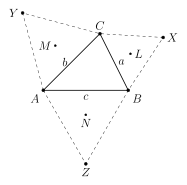
- Consider the equilateral triangle \(CYA\), notice that \(YM\) is a vertical line of symmetry, and \(\angle ACM = 30^\circ\) therefore \(\frac{AC/2}{CM} = \cos 30^\circ \Rightarrow |CM| = \frac{b}{2} \cdot \frac{2}{\sqrt{3}} = \frac{b}{\sqrt{3}}\). Similarly \(|CL| = \frac{a}{\sqrt{3}}\)
- \(\,\) \begin{align*} && |LM|^2 &= |CM|^2 + |CL|^2 - 2 \cdot |CM| \cdot |CL| \cdot \cos \angle MCL \\ &&&= \frac{b^2}{3} + \frac{a^2}{3} - 2 \frac{ab}{3} \cos \left (\angle CMA + \angle CAB + \angle BCL \right) \\ &&&= \frac13 \left (b^2 + a^2 - 2ab \cos \left ( \frac{\pi}{3} + \angle CAB \right) \right) \\ &&&= \frac13 \left (b^2 + a^2 - ab \cos \left ( \angle CAB \right) + \sqrt{3}ab \sin \angle CAB \right) \\ &&&= \frac13 \left (b^2 + a^2 - ab \cos \angle CAB + 2\sqrt{3} \Delta\right) \\ &&&= \frac13 \left (b^2 + a^2 - ab \left (\frac{a^2+b^2-c^2}{2ab} \right) + 2\sqrt{3} \Delta\right) \\ &&&= \frac13 \left ( \frac12(a^2+b^2+c^2) + 2\sqrt{3}\Delta \right) \\ \Rightarrow && 6|LM|^2 &= a^2 + b^2 + c^2 + 4\sqrt{3} \Delta \end{align*} However, nothing in our reasoning here was special about \(LM\), therefore \(LN\) and \(MN\) also equal this value, and we find that the triangle is equilateral. The area of equilateral triangle [LMN] is \(\frac{\sqrt{3}}4 |LM|^2\), ie \begin{align*} &&& \text{areas are equal} \\ \Leftrightarrow && \Delta &= \frac{\sqrt{3}}4 |LM|^2 \\ &&&= \frac{\sqrt{3}}4 \frac{a^2+b^2+c^2+4\sqrt{3}\Delta}{6} \\ &&&= \frac{\sqrt{3}}{24} (a^2+b^2+c^2) + \frac12 \Delta \\ \Leftrightarrow && \Delta &= \frac{\sqrt{3}}{12}(a^2+b^2+c^2)\\ \Leftrightarrow && 4\sqrt{3}\Delta &=a^2+b^2+c^2\\ \end{align*}
- \(\,\) \begin{align*} && (a-b)^2 &= -2ab(1 - \cos(C - 60^{\circ})) \\ \Leftrightarrow && a^2+b^2 - 2ab &=-2ab + 2ab \cos(C - 60^{\circ}) \\ \Leftrightarrow && a^2+b^2 &= ab \cos C+\sqrt{3}ab\sin C \\ \Leftrightarrow && a^2+b^2 &= ab \frac{a^2+b^2-c^2}{2ab} + 2\sqrt{3} \Delta \\ \Leftrightarrow && a^2+b^2+c^2 &= 4\sqrt{3}\Delta \end{align*} Since the LHS is non-positive, and the RHS is positive, the only way they can be equal is if they are both \(0\), ie \(a=b\) and \(C = 60^{\circ}\) ie \(ABC\) is equilateral.
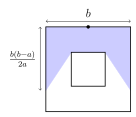
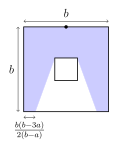
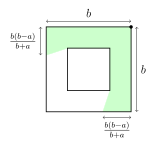
A prison consists of a square courtyard of side \(b\) bounded by a perimeter wall and a square building of side \(a\) placed centrally within the courtyard. The sides of the building are parallel to the perimeter walls. Guards can stand either at the middle of a perimeter wall or in a corner of the courtyard. If the guards wish to see as great a length of the perimeter wall as possible, determine which of these positions is preferable. You should consider separately the cases \(b<3a\) and \(b>3a\,\).
Show Solution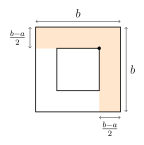
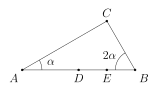
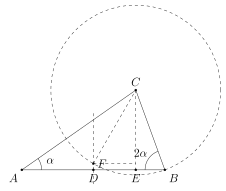
In the triangle \(ABC\), angle \(BAC = \alpha\) and angle \(CBA= 2\alpha\), where \(2\alpha\) is acute, and \(BC= x\). Show that \(AB = (3-4 \sin^2\alpha)x\). The point \(D\) is the midpoint of \(AB\) and the point \(E\) is the foot of the perpendicular from \(C\) to \(AB\). Find an expression for \(DE\) in terms of \(x\). The point \(F\) lies on the perpendicular bisector of \(AB\) and is a distance \(x\) from \(C\). The points \(F\) and \(B\) lie on the same side of the line through \(A\) and \(C\). Show that the line \(FC\) trisects the angle \(ACB\).
Show Solution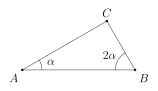
In the triangle \(ABC\), the base \(AB\) is of length 1 unit and the angles at~\(A\) and~\(B\) are \(\alpha\) and~\(\beta\) respectively, where \(0<\alpha\le\beta\). The points \(P\) and~\(Q\) lie on the sides \(AC\) and \(BC\) respectively, with \(AP=PQ=QB=x\). The line \(PQ\) makes an angle of~\(\theta\) with the line through~\(P\) parallel to~\(AB\).
- Show that \(x\cos\theta = 1- x\cos\alpha - x\cos\beta\), and obtain an expression for \(x\sin\theta\) in terms of \(x\), \(\alpha\) and~\(\beta\). Hence show that \begin{equation} \label{eq:2*} \bigl(1+2\cos(\alpha+\beta)\bigr)x^2 - 2(\cos\alpha + \cos\beta)x + 1 = 0\,. \tag{\(*\)} \end{equation} Show that \((*)\) is also satisfied if \(P\) and \(Q\) lie on \(AC\) produced and \(BC\) produced, respectively. [By definition, \(P\) lies on \(AC\) produced if \(P\) lies on the line through \(A\) and~\(C\) and the points are in the order \(A\), \(C\), \(P\)\,.]
- State the condition on \(\alpha\) and \(\beta\) for \((*)\) to be linear in \(x\). If this condition does not hold (but the condition \(0<\alpha \le \beta\) still holds), show that \((*)\) has distinct real roots.
- Find the possible values of~\(x\) in the two cases (a) \(\alpha = \beta = 45^\circ\) and (b) \(\alpha = 30^\circ\), \(\beta = 90^\circ\), and illustrate each case with a sketch.
A cyclic quadrilateral \(ABCD\) has sides \(AB\), \(BC\), \(CD\) and \(DA\) of lengths \(a\), \(b\), \(c\) and \(d\), respectively. The area of the quadrilateral is \(Q\), and angle \(DAB\) is \(\theta\). Find an expression for \(\cos\theta\) in terms of \(a\), \(b\), \(c\) and \(d\), and an expression for \(\sin\theta\) in terms of \(a\), \(b\), \(c\), \(d\) and \(Q\). Hence show that \[ 16Q^2 = 4(ad+bc)^2 - (a^2+d^2-b^2-c^2)^2 \,, \] and deduce that \[ Q^2 = (s-a)(s-b)(s-c)(s-d)\,, \] where \(s= \frac12(a+b+c+d)\). Deduce a formula for the area of a triangle with sides of length \(a\), \(b\) and \(c\).
Show Solution
Each edge of the tetrahedron \(ABCD\) has unit length. The face \(ABC\) is horizontal, and \(P\) is the point in \(ABC\) that is vertically below \(D\).
- Find the length of \(PD\).
- Show that the cosine of the angle between adjacent faces of the tetrahedron is \(1/3\).
- Find the radius of the largest sphere that can fit inside the tetrahedron.
- \(D\) must be above the centre (of any kind) of the equilateral triangle \(ABC\). Therefore it is a distance \(\frac23 \frac{\sqrt{3}}2 = \frac{\sqrt{3}}3\) from \(A\). \(D\) is \(1\) from \(A\), therefore by Pythagoras \(PD = \sqrt{1-\frac13} = \sqrt{\frac23}\)
- We can place \(D\) at \(\langle 0,0,\sqrt{\frac23}\rangle\) and \(A'\) (the midpoint of \(BC\)) at \(\langle-\frac{\sqrt{3}}{6},0,0 \rangle\) and we find: \begin{align*} && \cos \theta &= \frac{(\mathbf{a}'-\mathbf{d})\cdot \mathbf{a}'}{|\mathbf{a}'-\mathbf{d}|| \mathbf{a}'|} \\ &&&= \frac{|\mathbf{a}'|}{|\mathbf{a}'-\mathbf{d}|} \\ &&&= \frac{\frac{\sqrt{3}}{6}}{\sqrt{\frac23+\frac{3}{36}}} = \frac13 \end{align*}
- We have And therefore we must have \(\tan \frac{\cos^{-1} \frac13}{2} = \frac{r}{\frac{\sqrt{3}}{6}}\) therefore \begin{align*} && r &= \frac{\sqrt{3}}{6} \tan \left (\frac{\cos^{-1} \frac13}{2} \right) \\ &&&= \frac{\sqrt{3}}6 \sqrt{\frac{1-\cos(\cos^{-1}\frac13)}{1+\cos(\cos^{-1}\frac13)}} \\ &&&= \frac{\sqrt{3}}6 \sqrt{\frac{\frac23}{\frac43}} \\ &&&= \frac{\sqrt{6}}{12} \end{align*}

The sides of a triangle have lengths \(p-q\), \(p\) and \(p+q\), where \(p>q> 0\,\). The largest and smallest angles of the triangle are \(\alpha\) and \(\beta\), respectively. Show by means of the cosine rule that \[ 4(1-\cos\alpha)(1-\cos\beta) = \cos\alpha + \cos\beta \,. \] In the case \(\alpha = 2\beta\), show that \(\cos\beta=\frac34\) and hence find the ratio of the lengths of the sides of the triangle.
Show Solution- The equation of the circle \(C\) is \[ (x-2t)^2 +(y-t)^2 =t^2, \] where \(t\) is a positive number. Show that \(C\) touches the line \(y=0\,\). Let \(\alpha\) be the acute angle between the \(x\)-axis and the line joining the origin to the centre of \(C\). Show that \(\tan2\alpha=\frac43\) and deduce that \(C\) touches the line \(3y=4x\,\).
- Find the equation of the incircle of the triangle formed by the lines \(y=0\), \(3y=4x\) and \(4y+3x=15\,\). Note: The incircle of a triangle is the circle, lying totally inside the triangle, that touches all three sides.
- This is a circle centre \((2t,t)\) with radius \(t\). Therefore it is exactly \(t\) away from the line \(y = 0\) so just touches that line. Not that \(\tan \alpha = \frac{t}{2t} = \frac12\) so \(\tan 2\alpha = \frac{2\tan \alpha}{1-\tan^2\alpha} = \frac{1}{1-\frac14} = \frac43\). Therefore the line \(y = \frac43x\) or \(3y = 4x\) is tangent to \(C\).
- Note that \(3y=4x\) and \(4y+3x=15\) are perpendicular, so this is a right-angled triangle with incenter \((2t,t)\) for some \(t\) and hypotenuse \(15\) We can find the third coordinate when \(3y-4x = 0\) and \(4y+3x = 15\) meet, ie \((\frac{9}{5}, \frac{12}5)\) The incentre lies on the bisector of the right angle at this point, which is the line through \((\frac{9}{5}, \frac{12}5)\) and \((\frac{15}{2}, 0)\), so \begin{align*} && \frac{2t-\frac{12}{5}}{t - \frac{9}{5}} &= \frac{-\frac{12}{5}}{\frac{15}2-\frac95} \\ \Rightarrow && \frac{10t-12}{5t-9} &= \frac{-24}{57} = -\frac{8}{19} \\ \Rightarrow && 190t - 12 \cdot 19 &= -40t + 72 \\ \Rightarrow && t &= 2 \end{align*} Therefore the center is \((4, 2)\) and the equation is \((x-4)^2+(y-2)^2=2^2\)
Prove that \[ \tan \left ( \tfrac14 \pi -\tfrac12 x \right)\equiv \sec x -\tan x\,. \tag{\(*\)} \]
- Use \((*)\) to find the value of \(\tan\frac18\pi\,\). Hence show that \[ \tan \tfrac{11}{24} \pi = \frac{\sqrt3 + \sqrt2 -1}{\sqrt3 -\sqrt6+1}\;. \]
- Show that \[ \frac{\sqrt3 + \sqrt2 -1}{\sqrt3 -\sqrt6+1}= 2+\sqrt2+\sqrt3+\sqrt6\,. \]
- Use \((*)\) to show that \[ \tan \tfrac1{48}\pi = \sqrt{16+10\sqrt2+8\sqrt3 +6\sqrt6 \ }-2-\sqrt2-\sqrt3-\sqrt6\,. \]
- \(\tan \tfrac18 \pi = \tan(\tfrac14 \pi - \tfrac12 \tfrac14\pi) = \sec \tfrac14 \pi - \tan \tfrac14 \pi = \sqrt{2} - 1\) \begin{align*} && \tan \tfrac{11}{24} \pi &= \tan (\tfrac13 \pi +\tfrac18 \pi) \\ &&&= \frac{\tan \tfrac13 \pi +\tan \tfrac18 \pi}{1-\tan \tfrac13 \pi \tan \tfrac18 \pi} \\ &&&= \frac{\sqrt{3} + \sqrt{2} - 1}{1 - \sqrt{3}(\sqrt{2}-1)} \\ &&&= \frac{\sqrt{3} + \sqrt{2} - 1}{1 +\sqrt{3}-\sqrt{6}} \\ \end{align*}
- \(\,\) \begin{align*} && (\sqrt{3}-\sqrt{6}+1)(2+\sqrt{2}+\sqrt{3}+\sqrt{6}) &= (2\sqrt{3}+\sqrt{6}+3+3\sqrt{2}) + \\ &&&\quad+(-2\sqrt{6}-2\sqrt{3}-3\sqrt{2}-6) + \\ &&&\quad+(2+\sqrt{2}+\sqrt{3}+\sqrt{6}) \\ &&&= \sqrt{3}+\sqrt{2}-1 \end{align*}
- \(\,\) \begin{align*} && \tan \tfrac{1}{48} \pi &= \tan (\tfrac14\pi - \tfrac{11}{48} \pi) \\ &&&= \sec \tfrac{11}{24} \pi - \tan \tfrac{11}{24} \pi \\ &&&= \sqrt{1+\tan^2 \tfrac{11}{24}\pi} - \tan \tfrac{11}{24} \pi \\ &&&= \sqrt{1 + (2+\sqrt{2}+\sqrt{3}+\sqrt{6})^2} - (2+\sqrt{2}+\sqrt{3}+\sqrt{6}) \\ &&&= \sqrt{16+10\sqrt{2} + 8\sqrt{3}+6\sqrt{6}} - 2 - \sqrt2 - \sqrt3-\sqrt6 \end{align*}
{\it Note that the volume of a tetrahedron is equal to \(\frac1 3\) \(\times\) the area of the base \(\times\) the height.} The points \(O\), \(A\), \(B\) and \(C\) have coordinates \((0,0,0)\), \((a,0,0)\), \((0,b,0)\) and \((0,0,c)\), respectively, where \(a\), \(b\) and \(c\) are positive.
- Find, in terms of \(a\), \(b\) and \(c\), the volume of the tetrahedron \(OABC\).
- Let angle \(ACB = \theta\). Show that \[ \cos\theta = \frac {c^2} { { \sqrt{\vphantom{ \dot b} (a^2+c^2)(b^2+c^2)} } ^{\vphantom A} \ } \] and find, in terms of \(a\), \(b\) and \(c\), the area of triangle \(ABC\). % is %\(\displaystyle \tfrac12 \sqrt{ \vphantom{\dot A } a^2b^2 +b^2c^2 + c^2 a^2 \;} \;\).
Given that \(\alpha\) and \(\beta\) are acute angles, show that \(\alpha + \beta = \tfrac{1}{2}\pi\) if and only if \(\cos^2 \alpha + \cos^2 \beta = 1\). In the \(x\)--\(y\) plane, the point \(A\) has coordinates \((0,s)\) and the point \(C\) has coordinates \((s,0)\), where \(s>0\). The point \(B\) lies in the first quadrant (\(x>0\), \(y>0\)). The lengths of \(AB\), \(OB\) and \(CB\) are respectively \(a\), \(b\) and \(c\). Show that \[ (s^2 +b^2 - a^2)^2 + (s^2 +b^2 -c^2)^2 = 4s^2b^2 \] and hence that \[ (2s^2 -a^2-c^2)^2 + (2b^2 -a^2-c^2)^2 =4a^2c^2\;. \] Deduce that $$ \l a - c \r^2 \le 2b^2 \le \l a + c \r^2\;. $$ %Show, %by considering the case \(a=1+\surd2\,\), \(b=c=1\,\), % that the condition \(\l \ast \r\,\) %is not sufficient to ensure that \(B\) lies in the first quadrant.
Arthur and Bertha stand at a point \(O\) on an inclined plane. The steepest line in the plane through \(O\) makes an angle \(\theta\) with the horizontal. Arthur walks uphill at a steady pace in a straight line which makes an angle \(\alpha\) with the steepest line. Bertha walks uphill at the same speed in a straight line which makes an angle \(\beta\) with the steepest line (and is on the same side of the steepest line as Arthur). Show that, when Arthur has walked a distance \(d\), the distance between Arthur and Bertha is \(2d \vert\sin\frac12(\alpha-\beta)\vert\). Show also that, if \(\alpha\ne\beta\), the line joining Arthur and Bertha makes an angle \(\phi\) with the vertical, where \[ \cos\phi = \sin\theta \sin \frac12(\alpha+\beta). \]