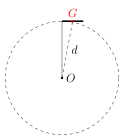
Circular Motion 2
Two particles of mass \(M\) and \(m\) \((M>m)\) are attached to the ends of a light rod of length \(2l.\) The rod is fixed at its midpoint to a point \(O\) on a horizontal axle so that the rod can swing freely about \(O\) in a vertical plane normal to the axle. The axle rotates about a vertical axis through \(O\) at a constant angular speed \(\omega\) such that the rod makes a constant angle \(\alpha\) \((0<\alpha<\frac{1}{2}\pi)\) with the vertical. Show that \[ \omega^{2}=\left(\frac{M-m}{M+m}\right)\frac{g}{l\cos\alpha}. \] Show also that the force of reaction of the rod on the axle is inclined at an angle \[ \tan^{-1}\left[\left(\frac{M-m}{M+m}\right)^{2}\tan\alpha\right] \] with the downward vertical.
Show Solution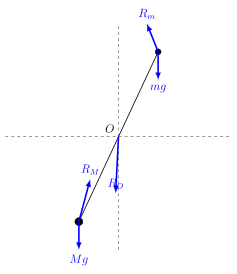
A smooth sphere of radius \(r\) stands fixed on a horizontal floor. A particle of mass \(m\) is displaced gently from equilibrium on top of the sphere. Find the angle its velocity makes with the horizontal when it loses contact with the sphere during the subsequent motion. By energy considerations, or otherwise, find the vertical component of the momentum of the particle as it strikes the floor.
Show Solution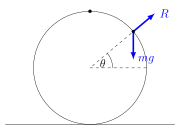
A firework consists of a uniform rod of mass \(M\) and length \(2a\), pivoted smoothly at one end so that it can rotate in a fixed horizontal plane, and a rocket attached to the other end. The rocket is a uniform rod of mass \(m(t)\) and length \(2l(t)\), with \(m(t)=2\alpha l(t)\) and \(\alpha\) constant. It is attached to the rod by its front end and it lies at right angles to the rod in the rod's plane of rotation. The rocket burns fuel in such a way that \(\mathrm{d}m/\mathrm{d}t=-\alpha\beta,\) with \(\beta\) constant. The burnt fuel is ejected from the back of the rocket, with speed \(u\) and directly backwards relative to the rocket. Show that, until the fuel is exhausted, the firework's angular velocity \(\omega\) at time \(t\) satisfies \[ \frac{\mathrm{d}\omega}{\mathrm{d}t}=\frac{3\alpha\beta au}{2[Ma^{2}+2\alpha l(3a^{2}+l^{2})]}. \]
Show Solution