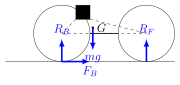
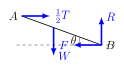
The axles of the wheels of a motorbike of mass \(m\) are a distance \(b\) apart. Its centre of mass is a horizontal distance of \(d\) from the front axle, where \(d < b\), and a vertical distance \(h\) above the road, which is horizontal and straight.
The engine is connected to the rear wheel.
The coefficient of friction between the ground and the rear wheel is \(\mu\), where \(\mu < b/h\), and the front wheel is smooth.
You may assume that the sum of the moments of the forces acting on the motorbike about the centre of mass is zero. By taking moments about the centre of mass show that, as the acceleration of the motorbike increases from zero, the rear wheel will slip before the front wheel loses contact with the road if
\[
\mu < \frac {b-d}h\,.
\tag{*}
\]
If the inequality \((*)\) holds and the rear wheel does not slip, show that the maximum acceleration is
\[
\frac{ \mu dg}{b-\mu h}
\,.
\]
If the inequality \((*)\) does not hold, find the maximum acceleration given that the front wheel remains in contact with the road.
\begin{align*}
% \text{N2}(\uparrow): && R_B+ R_F &= mg \\
\overset{\curvearrowright}{G}: && -R_Fd - F_B h + R_B (b-d) &= 0 \\
\Rightarrow && -d R_F - \mu h R_B +R_B(b-d) &= 0 \\
\Rightarrow && R_B(b-d-\mu h) &= d R_F \\
\underbrace{\Rightarrow}_{R_F > 0 \text{ if not leaving ground}} && R_B(b-d-\mu h) & > 0 \\
\Rightarrow && \frac{b-d}{h} > \mu
\end{align*}
The acceleration is \(\frac{F_B}{m}\), so we wish to maximize \(F_B\) which is the same as maximising \(R_B\). Since the bike will slip before the front wheel lifts, we want the bike to be on the point of slipping, ie $$
\begin{align*}
&& R_B(b-d-\mu h) &= d R_F \\
\text{N2}(\uparrow): && R_B + R_F &= mg \\
\Rightarrow && R_B(b-d-\mu h) &= d(mg - R_B) \\
\Rightarrow && R_B(b-\mu h) &= dmg \\
\Rightarrow && R_B &= \frac{dmg}{b-\mu h} \\
\Rightarrow && a &= \frac{F_B}{m} \\
&&&= \frac{\mu R_B}{m} \\
&&&= \frac{\mu dg}{b-\mu h} \\
\end{align*}
If the inequality doesn't hold, we want to be at the point just before \(R_F = 0\), since that gives us maximum friction at \(F_B\), ie
\begin{align*}
&& R_B &= mg \\
\Rightarrow && a &= \frac{F_B}{m} \\
&&&= \frac{\mu mg}{m} \\
&&&= \mu g
\end{align*}
A thin uniform wire is bent into the shape of an isosceles triangle \(ABC\), where \(AB\) and \(AC\) are of equal length and the angle at \(A\) is \(2\theta\).
The triangle \(ABC\) hangs on a small rough horizontal peg with the side \(BC\) resting on the peg. The coefficient of friction between the wire and the peg is \(\mu\). The plane containing \(ABC\) is vertical. Show that the triangle can rest in equilibrium with the peg in contact with any point on \(BC\) provided
\[
\mu \ge 2\tan\theta(1+\sin\theta)
\,.
\]
Clearly the centre of mass will lie on the perpendicular from \(A\). We can also consider each side's wire as equivalent to a point mass at the centre of the side with mass proportional to the length of the side. Recalling that \(b = c\) (the triangle is isoceles we must have (for the \(y\)-coordinate
\begin{align*}
&& a \cdot 0 + b \cdot \frac12 b \cos \theta + c \cdot \frac12 c \cos \theta &= (a+b+c) \overline{y} \\
\Rightarrow && b^2 \cos \theta &= (2b + 2b\sin \theta) \overline{y} \\
\Rightarrow && \overline{y} &= \frac{b \cos \theta}{2(1+\sin \theta)}
\end{align*}
\begin{align*}
\text{N2}(\nearrow): && R - mg \cos \phi &= 0 \\
\text{N2}(\nwarrow): && F -mg \sin \phi &= 0 \\
\Rightarrow && F &\leq \mu R \\
\Rightarrow && \sin \phi &\leq \mu \cos \phi \\
\Rightarrow && \tan \phi &\leq \mu
\end{align*}
When the peg is at \(C\)
\begin{align*}
\tan \phi &= \frac{CM}{MG} \\
&= \frac{b\sin \theta}{\frac{b \cos \theta}{2(1+\sin \theta)}} \\
&= 2 \tan \theta(1+\sin \theta)
\end{align*}
Therefore \(2 \tan \theta(1+\sin \theta) \leq \mu\) as required.
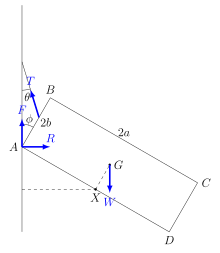
A uniform rectangular lamina \(ABCD\) rests in equilibrium in a vertical plane with the \(A\) in contact with a rough vertical wall. The plane of the lamina is perpendicular to the wall.
It is supported by a light inextensible string attached to the side \(AB\) at a distance \(d\) from \(A\). The other end of the string is attached to a point on the wall above \(A\) where it makes an acute angle \(\theta\) with the downwards vertical. The side \(AB\) makes an acute angle \(\phi\) with the upwards vertical at \(A\). The sides \(BC\) and \(AB\) have lengths \(2a\) and \(2b\) respectively. The coefficient of friction between the lamina and the wall is \(\mu\).
Show that, when the lamina is in limiting equilibrium with the frictional force acting upwards,
\begin{equation}
d\sin(\theta +\phi) = (\cos\theta +\mu \sin\theta)(a\cos\phi
+b\sin\phi)\,. \tag{\(*\)}
\end{equation}
How should \((*)\) be modified if the lamina is in limiting equilibrium with the frictional force acting downwards?
Find a condition on \(d\), in terms of \(a\), \(b\), \(\tan\theta\) and \(\tan\phi\), which is necessary and sufficient for the frictional force to act upwards. Show that this condition cannot be satisfied if \(b(2\tan\theta+ \tan \phi) < a\).
\begin{align*}
\text{N2}(\uparrow): && T \cos \theta + F -W &= 0 \\
&& W &= T\cos \theta + \mu R \tag{1} \\
\text{N2}(\rightarrow): && R-T\sin \theta &= 0 \\
&& R &= T \sin \theta \tag{2}\\
\\
(1)+(2): && W&=(\cos \theta + \mu \sin \theta)T \tag{3} \\
\overset{\curvearrowright}{A}: && 0 &= W(b\sin \phi + a \cos \phi) - Td\sin(\phi+\theta) \tag{4} \\
\\
(3)+(4): && 0 &= (\cos \theta + \mu \sin \theta)(b\sin \phi + a \cos \phi)-d\sin(\phi+\theta) \\
\Rightarrow && d\sin(\phi+\theta) &= (\cos \theta + \mu \sin \theta)(b\sin \phi + a \cos \phi)
\end{align*}
as required.
If \(F\) is operating downwards, it's equivalent to \(-\mu\), ie:
\[d\sin(\phi+\theta) = (\cos \theta - \mu \sin \theta)(b\sin \phi + a \cos \phi)\]
For the frictional force to be acting upwards, we need
\begin{align*}
&& d\sin(\phi+\theta) &\geq \cos \theta(b\sin \phi + a \cos \phi) \\
\Rightarrow && d &\geq \frac{\cos \theta(b\sin \phi + a \cos \phi)}{\sin(\phi + \theta)} \\
&&&= \frac{\cos \theta(b\sin \phi + a \cos \phi)}{\sin\phi \cos\theta+\cos\phi\sin \theta)}\\
&&&= \frac{(b\sin \phi + a \cos \phi)}{\sin\phi+\cos \phi \tan \theta)}\\
&&&= \frac{a+b\tan \phi}{\tan\theta+\tan\phi }\\
\end{align*}
We know that \(d < 2b\), so
\begin{align*}
&& 2b &>\frac{a+b\tan \phi}{\tan\theta+\tan\phi }\\
\Rightarrow && 2b \tan \theta + 2b \tan \phi &> a + b \tan \phi \\
\Rightarrow &&b(2 \tan \theta + \tan \phi) &> a\\
\end{align*}
Therefore we will have problems if the inequality is reversed!
The diagram shows a uniform rectangular lamina with sides of lengths \(2a\) and \(2b\) leaning against a rough vertical wall, with one corner resting on a rough horizontal plane. The plane of the lamina is vertical and perpendicular to the wall, and one edge makes an angle of \(\alpha\) with the horizontal plane. Show that the centre of mass of the lamina is a distance \(a\cos\alpha + b\sin\alpha\) from the wall.
The coefficients of friction at the two points of contact are each \(\mu\) and the friction is limiting at both contacts. Show that
\[
a\cos(2\lambda +\alpha) = b\sin\alpha \,,
\]
where \(\tan\lambda = \mu\).
Show also that if the lamina is square, then \(\lambda = \frac{1}{4}\pi -\alpha\).
Show Solution
The horizontal distance to \(X\) is \(a\cos \alpha\).
The horizontal distance to \(G\) from \(X\) is \(b \sin \alpha\), therefore the centre of mass is a distance \(a \cos \alpha + b \sin \alpha\) from the wall.
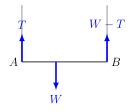
A non-uniform rod \(AB\) has weight \(W\) and length \(3l\). When the rod is suspended horizontally in equilibrium by vertical strings attached to the ends \(A\) and \(B\), the tension in the string attached to \(A\) is \(T\).
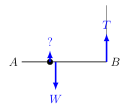
When instead the rod is held in equilibrium in a horizontal position by means of a smooth pivot at a distance \(l\) from \(A\) and a vertical string attached to \(B\), the tension in the string is \(T\). Show that \(5T = 2W\).
When instead the end \(B\) of the rod rests on rough horizontal ground and the rod is held in equilibrium at an angle \(\theta\) to the horizontal by means of a string that is perpendicular to the rod and attached to \(A\), the tension in the string is \(\frac12 T\). Calculate \(\theta\) and find the smallest value of the coefficient of friction between the rod and the ground that will prevent slipping.
Suppose the centre of mass of the rod is \(x\) away from \(A\).
\begin{align*}
\overset{\curvearrowleft}{B}: && (3l-x)W - 3lT &= 0 \\
\Rightarrow && x &= \frac{3l(W-T)}{W} \tag{1}
\end{align*}
In the second set up we have:
\begin{align*}
\overset{\curvearrowleft}{\text{pivot}}: && 2lT - (x-l)W &= 0 \\
\Rightarrow && x &= \frac{2lT + lW}{W} \tag{2} \\
\\
(1) \text{ & } (2): && 3l(W-T) &= l(2T+W) \\
\Rightarrow && 2W &= 5T
\end{align*}
\begin{align*}
&& x&= \frac{3l(W-T)}{W}\\
&&&= \frac{3l(W - \frac25 W)}{W} \\
&&&= \frac{9}{5}l\\
\overset{\curvearrowleft}{B}: && -\frac12 T (3l \sin \theta) + W \frac{6}{5}l \cos \theta &= 0 \\
\Rightarrow && \tan \theta &= \frac{4}{5} \frac{W}{T} \\
&&&= \frac45 \frac52 \\
&&&= 2 \\
\Rightarrow && \theta &= \tan^{-1} 2 \\
\\
\text{N2}(\uparrow): && R &= W \\
\text{N2}(\rightarrow): && F &= \frac12 T \\
\Rightarrow && F & \leq \mu R \\
\Rightarrow && \frac12 T &\leq \mu W \\
\Rightarrow && \mu &\geq \frac12 \frac{T}{W} = \frac12 \frac25 = \frac15
\end{align*}
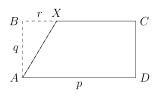
\(ABCD\) is a uniform rectangular lamina and \(X\) is a point on \(BC\,\). The lengths of \(AD\), \(AB\) and \(BX\) are \(p\,\), \(q\) and \(r\) respectively.
The triangle \(ABX\) is cut off the lamina.
Let \((a,b)\) be the position of the centre of gravity of the lamina, where the axes are such that the coordinates of \(A\,\), \(D\) and \(C\) are \((0,0)\,\), \((p,0)\) and \((p,q)\) respectively. Derive equations for \(a\) and \(b\) in terms of \(p\,\), \(q\) and \(r\,\).
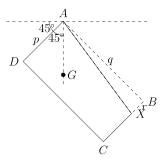
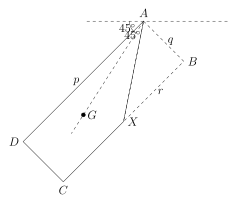
When the resulting trapezium is freely suspended from the point \(A\,\), the side \(AD\) is inclined at \(45^\circ\) below the horizontal.
Show that \(\displaystyle r = q - \sqrt{q^2 - 3pq + 3p^2}\,\). You should justify carefully the choice of sign in front of the square root.
A piece of uniform wire is bent into three sides of a square \(ABCD\) so that the side \(AD\) is missing. Show that if it is first hung up by the point \(A\) and then by the point \(B\) then the angle between the two directions of \(BC\) is \(\tan^{-1}18.\)
In the coordinate system where \(A\) is \((0,0)\) and \(AD\) is the \(x\)-axis and \(AB\) the \(y\)-axis and all side lengths are \(2\), we find the centre of mass of each of the sides are:
\begin{align*}
AB :& (0,1) \\
BC :& (1,2) \\
CD :& (2,1) \\
\\
ABCD:& \l 1, \frac{4}{3} \r
\end{align*}
When hung from \(A\), the angle \(AB\) makes to the vertical is \(\alpha\) and the angle \(BC\) makes to the vertical will be \(90^{\circ} + \alpha\).
When hung from \(B\) the angle \(BC\) makes to the vertical will be \(\beta\). The value we are interested in therefore is \(\beta + 90^{\circ} + \alpha\)
\begin{align*}
&& \tan \alpha &= \frac{1}{\frac{4}{3}} \\
&&& = \frac{4}{3} \\
\\
&& \tan \beta &= \frac{\frac{2}{3}}{1} \\
&&&= \frac{2}{3} \\
\\
&& \tan \l \beta + (90^{\circ} + \alpha) \r &= \frac{\tan \beta + \tan\l 90^{\circ} + \alpha \r}{1 - \tan \beta \tan\l 90^{\circ} + \alpha \r} \\
&&&= \frac{\frac23 + \frac43}{1- \frac23 \frac43} \\
&&&= \frac{2}{1 - \frac89} \\
&&&= 18
\end{align*}
A thin non-uniform rod \(PQ\) of length \(2a\) has its centre of gravity a distance \(a+d\) from \(P\). It hangs (not vertically) in equilibrium suspended from a small smooth peg \(O\) by means of a light inextensible string of length \(2b\) which passes over the peg and is attached at its ends to \(P\) and \(Q\). Express \(OP\) and \(OQ\) in terms of \(a,b\) and \(d\). By considering the angle \(POQ\), or otherwise, show that \(d < a^{2}/b\).