Integration as Area
Numerical integration, area between curves, volumes of revolution
In this question, you may assume that, if a continuous function takes both positive and negative values in an interval, then it takes the value \(0\) at some point in that interval.
- The function \(\f\) is continuous and \(\f(x)\) is non-zero for some value of \(x\) in the interval \(0\le x \le 1\). Prove by contradiction, or otherwise, that if \[ \int_0^1 \f(x) \d x = 0\,, \] then \(\f(x)\) takes both positive and negative values in the interval \(0\le x\le 1\).
- The function \(\g\) is continuous and \[ \int_0^1 \g(x) \, \d x = 1\,, \quad \int_0^1 x\g(x) \, \d x = \alpha\, , \quad \int_0^1 x^2\g(x) \, \d x = \alpha^2\,. \tag{\(*\)} \] Show, by considering \[ \int_0^1 (x - \alpha)^2 \g(x) \, \d x \,, \] that \(\g(x)=0\) for some value of \(x\) in the interval \(0\le x\le 1\). Find a function of the form \(\g(x) = a+bx\) that satisfies the conditions \((*)\) and verify that \(\g(x)=0\) for some value of \(x\) in the interval \(0\le x \le 1\).
- The function \(\h\) has a continuous derivative \(\h'\) and \[ \h(0) = 0\,, \quad \h(1) = 1\,, \quad \int_0^1 \h(x) \, \d x = \beta\,, \quad \int_0^1 x \h(x) \, \d x = \tfrac{1}{2}\beta (2 - \beta) \,. \] Use the result in part (ii) to show that \(\h^\prime(x)=0\) for some value of \(x\) in the interval \(0\le x\le 1\).
- Claim: If \(f(x)\) non-zero for some \(x \in [0,1]\) and \(\int_0^1 f(x) \d x =0\) then \(f\) takes both positive and negative values in the interval \([0,1]\). Proof: Suppose not, then WLOG suppose \(f(x) > 0\) for some \(x \in [0,1]\). Then notice (since \(f\) is continuous) that there is some interval where \(f(x) > 0\) around the \(x\) we have already shown exists. But then \(\int_{\text{interval}} f(x) \d x > 0\) and since \(f(x) \geq 0\) everywhere \(\int_0^1 f(x) \d x > 0\), which is a contradiction.
- \(\,\) \begin{align*} && \int_0^1 (x - \alpha)^2 g(x) \d x &= \int_0^1 x^2g(x) \d x - 2 \alpha \int_0^1 x g(x) \d x + \alpha^2 \int_0^1 g(x) \d x \\ &&&= \alpha^2 - 2\alpha \cdot \alpha + \alpha^2 \cdot 1 \\ &&&= 0 \end{align*} Therefore \(g(x)(x-\alpha)^2\) is a continuous function which is either exactly \(0\) (in which case we've already found our \(0\)) or it is a continuous function which is both positive somewhere and has \(0\) integral, and therefore by part (i) must take both positive and negative values (and therefore takes \(0\) in between those points by continuity). \begin{align*} &&1 &= \int_0^1 a+bx \d x \\ &&&= a + \frac12 b \\ && \alpha &= \int_0^1 ax + bx^2 \d x \\ &&&= \frac12 a + \frac13 b \\ && \alpha^2 &= \int_0^1 ax^2 + bx^3 \d x\\ &&&= \frac13 a + \frac14 b \\ \Rightarrow && \frac1{36}(3a+2b)^2 &= \frac1{12}(4a+3b) \\ \Rightarrow && \frac1{36}(3a+2(2-2a))^2 &= \frac1{12}(4a+3(2-2a)) \\ \Rightarrow && (4-a)^2 &= 3(6-2a) \\ \Rightarrow && 16-8a+a^2 &= 18-6a \\ \Rightarrow && a^2-2a-2 &= 0 \\ \Rightarrow && (a-1)^2 - 3 &= 0 \\ \Rightarrow && a &= \pm \sqrt{3}+1 \\ && b &= \mp 2\sqrt{3} \end{align*} So say \(a = \sqrt{3}+1, b = -2\sqrt{3}\) This has a root at \(-\frac{a}{b} = \frac{1+\sqrt{3}}{2\sqrt{3}} = \frac{\sqrt{3}+3}{6} < 1\) so we have met our condition.
- Consider \(h'\), we must have \begin{align*} && \int_0^1 h'(x)\d x &= h(1)-h(0) =1\\ && \int_0^1 xh'(x) \d x &= \left [x h(x) \right]_0^1 - \int_0^1 h(x) \d x \\ &&&= 1 - \beta \\ && \int_0^1 x^2 h'(x) \d x &= \left [ x^2h(x) \right]_0^1 - \int_0^1 2xh(x) \d x \\ &&&= 1 - 2\tfrac12 \beta(2-\beta) \\ &&&= (1-\beta)^2 \end{align*} Therefore \(h'\) satisfies the conditions with \(\alpha = 1-\beta\), so \(h'\) must have a root in our interval.
A spherical loaf of bread is cut into parallel slices of equal thickness. Show that, after any number of the slices have been eaten, the area of crust remaining is proportional to the number of slices remaining. A European ruling decrees that a parallel-sliced spherical loaf can only be referred to as `crusty' if the ratio of volume \(V\) (in cubic metres) of bread remaining to area \(A\) (in square metres) of crust remaining after any number of slices have been eaten satisfies \(V/A<1\). Show that the radius of a crusty parallel-sliced spherical loaf must be less than \(2\frac23\) metres. [{\sl The area \(A\) and volume \(V\) formed by rotating a curve in the \(x\)--\(y\) plane round the \(x\)-axis from \(x=-a\) to \(x=-a+t\) are given by \[ A= 2\pi\int_{-a}^{-a+t} { y}\left( 1+ \Big(\frac{\d {y}}{\d x}\Big)^2\right)^{\frac12} \d x\;, \ \ \ \ \ \ \ \ \ \ \ V= \pi \int_{-a}^{-a+t} {y}^2 \d x \;. \ \ ] \] }
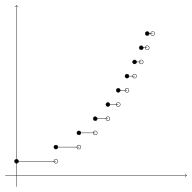
For any number \(x\), the largest integer less than or equal to \(x\) is denoted by \([x]\). For example, \([3.7]=3\) and \([4]=4\). Sketch the graph of \(y=[x]\) for \(0\le x<5\) and evaluate \[ \int_0^5 [x]\;\d x. \] Sketch the graph of \(y=[\e^{x}]\) for \(0\le x< \ln n\), where \(n\) is an integer, and show that \[ \int_{0}^{\ln n}[\e^{x}]\, \d x =n\ln n - \ln (n!). \]
Show Solution
Find constants \(a_{1}\), \(a_{2}\), \(u_{1}\) and \(u_{2}\) such that, whenever \({\mathrm P}\) is a cubic polynomial, \[\int_{-1}^{1}{\mathrm P}(t)\,{\mathrm d}t =a_{1}{\mathrm P}(u_{1})+a_{2}{\mathrm P}(u_{2}).\]
Show SolutionIf \({\rm f}(t)\ge {\rm g}(t)\) for \(a\le t\le b\), explain very briefly why \(\displaystyle \int_a^b {\rm f}(t) \d t \ge \int_a^b {\rm g}(t) \d t\). Prove that if \(p>q>0\) and \(x\ge1\) then $$\frac{x^p-1}{ p}\ge\frac{x^q-1}{ q}.$$ Show that this inequality also holds when \(p>q>0\) and \(0\le x\le1\). Prove that, if \(p>q>0\) and \(x\ge0\), then $$\frac{1}{ p}\left(\frac{x^p}{ p+1}-1\right)\ge \frac{1}{q}\left(\frac{x^q}{ q+1}-1\right).$$
Show SolutionExplain diagrammatically, or otherwise, why \[ \frac{\mathrm{d}}{\mathrm{d}x}\int_{a}^{x}\mathrm{f}(t)\,\mathrm{d}t=\mathrm{f}(x). \] Show that, if \[ \mathrm{f}(x)=\int_{0}^{x}\mathrm{f}(t)\,\mathrm{d}t+1, \] then \(\mathrm{f}(x)=\mathrm{e}^{x}.\) What is the solution of \[ \mathrm{f}(x)=\int_{0}^{x}\mathrm{f}(t)\,\mathrm{d}t? \] Given that \[ \int_{0}^{x}\mathrm{f}(t)\,\mathrm{d}t=\int_{x}^{1}t^{2}\mathrm{f}(t)\,\mathrm{d}t+x-\frac{x^{5}}{5}+C, \] find \(\mathrm{f}(x)\) and show that \(C=-2/15.\)
Criticise each step of the following arguments. You should correct the arguments where necessary and possible, and say (with justification) whether you think the conclusion are true even though the argument is incorrect.
- The function \(g\) defined by \[ \mathrm{g}(x)=\frac{2x^{3}+3}{x^{4}+4} \] satisfies \(\mathrm{g}'(x)=0\) only for \(x=0\) or \(x=\pm1.\) Hence the stationary values are given by \(x=0\), \(\mathrm{g}(x)=\frac{3}{4}\) and \(x=\pm1,\) \(\mathrm{g}(x)=1.\) Since \(\frac{3}{4}<1,\) there is a minimum at \(x=0\) and maxima at \(x=\pm1.\) Thus we must have \(\frac{3}{4}\leqslant\mathrm{g}(x)\leqslant1\) for all \(x\).
- \({\displaystyle \int(1-x)^{-3}\,\mathrm{d}x=-3(1-x)^{-4}}\quad\) and so \(\quad{\displaystyle \int_{-1}^{3}(1-x)^{-3}\,\mathrm{d}x=0.}\)
- \begin{align*} && g(x) &= \frac{2x^3+3}{x^4+4} \\ \Rightarrow && g'(x) &= \frac{6x^2(x^4+4) - (2x^3+3)(4x^3)}{(x^4+4)^2} \\ &&&= \frac{-2x^6-12x^3+24x^2}{(x^4+4)} \\ &&&= \frac{-2x^2(x^4+6x-12)}{(x^4+4)} \end{align*} So \(g'(x)\) is not \(0\) for \(x = \pm 1\). We can also note that \(g(-1) = \frac1{5} \neq 1\) Even if the other turning point was \(1\), we would also need to check the behaviour as \(x \to \pm \infty\). We can also note that \(g(-1) = \frac{1}{5} < \frac34\) so the conclusion is also not true.
- There are several errors. \[ \int (1-x)^{-3} \d x = \underbrace{\frac{1}{4}}_{\text{correct constant}}(1-x)^{-4} + \underbrace{C}_{\text{constant of integration}} \] We cannot integrate through the asymptote at \(1\). There is a sense in which we could argue \(\displaystyle \int_{-1}^3 (1-x)^{-3} \d x = 0\), specifically using Cauchy principal value \begin{align*} \mathrm {p.v.} \int_{-1}^3 (1-x)^{-3} &=\lim_{\epsilon \to 0} \left [ \int_{-1}^{1-\epsilon} (1-x)^{-3} \d x+ \int_{1+\epsilon}^{3} (1-x)^{-3} \d x\right] \\ &=\lim_{\epsilon \to 0} \left [ \left[ \frac14 (1-x)^{-4}\right]_{-1}^{1-\epsilon}+ \left[ \frac14 (1-x)^{-4}\right]_{1+\epsilon}^3\right] \\ &=\lim_{\epsilon \to 0} \left [ \frac14 \epsilon^{-4}-\frac14 \frac1{2^4} + \frac14 \frac1{2^4} - \frac14 \epsilon^{-4} \right] \\ &= \lim_{\epsilon \to 0} 0 \\ &= 0 \end{align*} However, in many normal ways of treating this integral it would be undefined.
The function \(\mathrm{f}\) satisfies the condition \(\mathrm{f}'(x)>0\) for \(a\leqslant x\leqslant b\), and \(\mathrm{g}\) is the inverse of \(\mathrm{f}.\) By making a suitable change of variable, prove that \[ \int_{a}^{b}\mathrm{f}(x)\,\mathrm{d}x=b\beta-a\alpha-\int_{\alpha}^{\beta}\mathrm{g}(y)\,\mathrm{d}y, \] where \(\alpha=\mathrm{f}(a)\) and \(\beta=\mathrm{f}(b)\). Interpret this formula geometrically, in the case where \(\alpha\) and \(a\) are both positive. Prove similarly and interpret (for \(\alpha>0\) and \(a>0\)) the formula \[ 2\pi\int_{a}^{b}x\mathrm{f}(x)\,\mathrm{d}x=\pi(b^{2}\beta-a^{2}\alpha)-\pi\int_{\alpha}^{\beta}\left[\mathrm{g}(y)\right]^{2}\,\mathrm{d}y. \]
Show Solution
- Prove that \[ \sum_{r=1}^{n}r(r+1)(r+2)(r+3)(r+4)=\tfrac{1}{6}n(n+1)(n+2)(n+3)(n+4)(n+5) \] and deduce that \[ \sum_{r=1}^{n}r^{5}<\tfrac{1}{6}n(n+1)(n+2)(n+3)(n+4)(n+5). \]
- Prove that, if \(n>1,\) \[ \sum_{r=0}^{n-1}r^{5}>\tfrac{1}{6}(n-5)(n-4)(n-3)(n-2)(n-1)n. \]
- Let \(\mathrm{f}\) be an increasing function. If the limits \[ \lim_{n\rightarrow\infty}\sum_{r=0}^{n-1}\frac{a}{n}\mathrm{f}\left(\frac{ra}{n}\right)\qquad\mbox{ and }\qquad\lim_{n\rightarrow\infty}\sum_{r=1}^{n}\frac{a}{n}\mathrm{f}\left(\frac{ra}{n}\right) \] both exist and are equal, the definite integral \({\displaystyle \int_{0}^{a}\mathrm{f}(x)\,\mathrm{d}x}\) is defined to be their common value. Using this definition, prove that \[ \int_{0}^{a}x^{5}\,\mathrm{d}x=\tfrac{1}{6}a^6. \]
- Claim: \[ \sum_{r=1}^{n}r(r+1)(r+2)(r+3)(r+4)=\tfrac{1}{6}n(n+1)(n+2)(n+3)(n+4)(n+5) \] Proof: (By Induction) Base case: (n=1) \begin{align*} LHS &= 1 \cdot 2 \cdot 3 \cdot 4 \cdot 5 = 5! \\ RHS &= \frac16 1 \cdot 2 \cdot 3 \cdot 4 \cdot 5 \cdot 6 = 5! \end{align*} Therefore the base case is true. Inductive step: Suppose our statement is true for some \(n=k\), then consider \(n = k+1\) \begin{align*} \sum_{r=1}^{k+1} r(r+1)(r+2)(r+3)(r+4) &= \sum_{r=1}^{k} r(r+1)(r+2)(r+3)(r+4) + (k+1)(k+2)(k+3)(k+4)(k+5) \\ &\underbrace{=}_{\text{assumption}} \frac16 k(k+1)(k+2)(k+3)(k+4)(k+5) + (k+1)(k+2)(k+3)(k+4)(k+5) \\ &= (k+1)(k+2)(k+3)(k+4)(k+5) \l \frac{k}{6} +1\r \\ &= \frac16 (k+1)(k+2)(k+3)(k+4)(k+5)(k+6) \end{align*} Therefore our statement is true for \(n = k+1\). Therefore since our statement is true for \(n=1\) and if it is true for \(n=k\) then it is true for \(n = k+1\) by the principle of mathematical induction it is true for all \(n \geq 1\) Since \begin{align*} \sum_{r=1}^{n}r^5 &< \sum_{r=1}^{n}r(r+1)(r+2)(r+3)(r+4) \\ &= \frac16 n(n+1)(n+2)(n+3)(n+4)(n+5) \end{align*}
- \begin{align*}\sum_{r=0}^{n-1} r^5 &> \sum_{r=0}^{n-1} (r-4)(r-3)(r-2)(r-1)r \\ &= \sum_{r=0}^{n-5} r(r+1)(r+2)(r+3)(r+4) \\ &= \frac16 (n-5)(n-4)(n-3)(n-2)(n-1)n \end{align*}
- Let \(f(x) = x^5\) \begin{align*} S_{1,n} &= \sum_{r=0}^{n-1}\frac{a}{n}f\left(\frac{ra}{n}\right) \\ &= \sum_{r=0}^{n-1}\frac{a}{n}\left(\frac{ra}{n}\right)^5 \\ &=\frac{a^6}{n^6} \sum_{r=0}^{n-1}r^5\\ \end{align*} Therefore \(\frac{a^6}6 \frac{(n-5)(n-4)(n-3)(n-2)(n-1)n}{n^6} < S_{1,n} < \frac{a^6}6 \frac{(n-1)n(n+1)(n+2)(n+3)(n+4)}{n^6}\) and so \(\lim_{n\to\infty} S_{1,n} = \frac{a^6}{6}\). Similarly, \begin{align*} S_{2,n} &= \sum_{r=1}^{n}\frac{a}{n}f\left(\frac{ra}{n}\right) \\ &= \sum_{r=1}^{n}\frac{a}{n}\left(\frac{ra}{n}\right)^5 \\ &= \frac{a^6}{n^6} \sum_{r=1}^{n} r^5 \end{align*} Therefore \(\frac{a^6}6 \frac{(n-4)(n-3)(n-2)(n-1)n(n+1)}{n^6} < S_{2,n} < \frac{a^6}6 \frac{n(n+1)(n+2)(n+3)(n+4)(n+5)}{n^6}\) and so \(\lim_{n\to\infty} S_{2,n} = \frac{a^6}{6}\). Since both limits exist are are equal, we have \[ \int_{0}^{a}x^{5}\,\mathrm{d}x=\tfrac{1}{6}a^6. \]