Curve Sketching
The function \(\mathrm{Min}\) is defined as \[ \mathrm{Min}(a, b) = \begin{cases} a & \text{if } a \leq b \\ b & \text{if } a > b \end{cases} \]
- Sketch the graph \(y = \mathrm{Min}(x^2, 2x)\).
- Solve the equation \(2\mathrm{Min}(x^2, 2x) = 5x - 3\).
- Solve the equation \(\mathrm{Min}(x^2, 2x) + \mathrm{Min}(x^3, 4x) = mx\) in the cases \(m = 2\) and \(m = 6\).
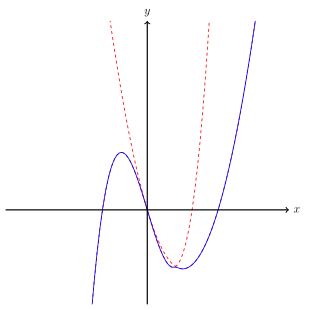
- Show that \((1, -3)\) is a local maximum point on the curve \(y = 2\mathrm{Min}(x^2, x^3) - 5x\) and find the other three local maxima and minima on this curve. Sketch the curve.
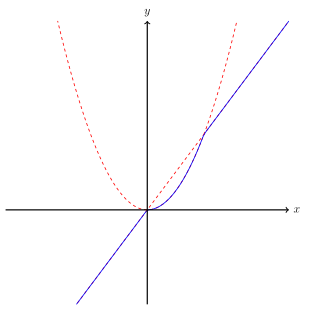
- \(2 \textrm{Min}(x^2,2x) = 5x-3\) tells us either \(2x^2 = 5x-3 \Rightarrow 2x^2 - 5x +3 = 0 \Rightarrow (2x-3)(x-1) \Rightarrow x = 1, \frac32\) and \(0 \leq x \leq 2\) or \(4x = 5x-3 \Rightarrow x= 3\) and \(x < 0\) or \(2 > x\), therefore our solutions are \(x = 1, \frac32, 3\)
- We have different cases based on \(x\) vs \(-2, 0, 2\), ie Case \(x \leq -2\): \begin{align*} && mx &= \mathrm{Min}(x^2, 2x) + \mathrm{Min}(x^3, 4x) \\ &&&= 2x + x^3 \end{align*} So \(2x = 2x + x^3 \Rightarrow x^3 = 0\), but \(x \leq -2\) so no solutions. or \(6x = 2x + x^3 \Rightarrow 0 = x(x^2-4) \Rightarrow x = 0, 2, -2\) so \(x = -2\). Case \(-2 < x \leq 0\): \begin{align*} && mx &= \mathrm{Min}(x^2, 2x) + \mathrm{Min}(x^3, 4x) \\ &&&= 2x + 4x \end{align*} So \(2x = 2x + 4x\) ie \(x = 0\) which is valid. Or \(6x = 2x + 4x\) ie valid for all values in \(-2 \leq x \leq 0\) Case \(0 < x \leq 2\): \begin{align*} && mx &= \mathrm{Min}(x^2, 2x) + \mathrm{Min}(x^3, 4x) \\ &&&= x^2 + x^3 \end{align*} So \(2x = x^2 + x^3 \Rightarrow 0 = x(x^2+x-2) = x(x-1)(x+2)\) so \(x = 0, 1, -2\), but the range means \(x = 0\) or \(x = 1\) Or \(6x = x^2 + x^3 \Rightarrow 0 = x(x^2+x-6) = x(x-2)(x+3)\) so \(x = 0, 2, -3\), but the range means \(x = 0\) or \(x = 2\) Case \(2 \leq x \): \begin{align*} && mx &= \mathrm{Min}(x^2, 2x) + \mathrm{Min}(x^3, 4x) \\ &&&=2x + 4x \end{align*} So \(2x = 2x + 4x \Rightarrow x = 0\) so no solutions. Or \(6x = 2x + 4x\) so a range of solutions. Therefore the final solutions for \(m = 2\) are \(x = 0, x = 1\) and for \(m = 2\) are \(x \in [-2,0] \cup [2, \infty)\)
- \(\mathrm{Min}(x^2, x^3)\) switches when \(x = 1\), so we must consider both limits:
\begin{align*}
&& \frac{\d y}{\d x}\vert_{x > 1} &= 4x - 5 \\
\\
&& \frac{\d y}{\d x}\vert_{x < 1} &= 6x^2 - 5 \\
\end{align*}
so when \(x = 1\) the sign of the derivative changes from positive to negative, hence a local maximum.
The other local maxima and minima will be when \(x = \frac54\) or \(x = \pm \sqrt{5/6}\)
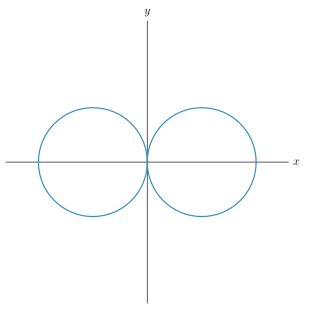
- Sketch the curve \(C_1\) with equation \[ \left(y^2 + (x-1)^2 - 1\right)\left(y^2 + (x+1)^2 - 1\right) = 0. \]
- Consider the curve \(C_2\) with equation
\[ \left(y^2 + (x-1)^2 - 1\right)\left(y^2 + (x+1)^2 - 1\right) = \tfrac{1}{16}. \]
- Show that the line \(y = k\) meets the curve \(C_2\) at points for which \[ x^4 + 2(k^2 - 2)x^2 + \left(k^4 - \tfrac{1}{16}\right) = 0. \] Hence determine the number of intersections between curve \(C_2\) and the line \(y = k\) for each positive value of \(k\).
- Determine whether the points on curve \(C_2\) with the greatest possible \(y\)-coordinate are further from, or closer to, the \(y\)-axis than those on curve \(C_1\).
- Show that it is not possible for both \(y^2 + (x-1)^2 - 1\) and \(y^2 + (x+1)^2 - 1\) to be negative, and deduce that curve \(C_2\) lies entirely outside curve \(C_1\).
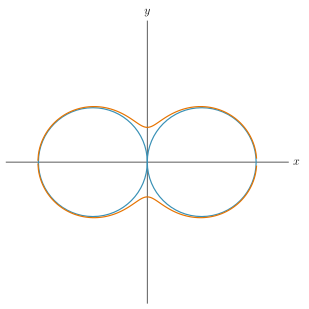
- Sketch the curves \(C_1\) and \(C_2\) on the same axes.
- \(\,\)
- Suppose \(y=k\) meets the curve \(C_2\) then \begin{align*} && \tfrac1{16} &= (k^2+(x-1)^2-1)(k^2+(x+1)^2-1) \\ &&&= (k^2+x^2-2x)(k^2+x^2+2x) \\ &&&= k^4+2k^2x^2+x^4-4x^2 \\ &&&= x^4+(2k^2-4)x^2+k^4 \\ \Rightarrow && 0 &= x^4+(2k^2-4)x^2+(k^4-\tfrac1{16}) \\ \\ && \Delta &= 4(k^2-2)^2 - 4 \cdot 1 \cdot (k^4-\tfrac1{16}) \\ &&&= 4(k^4-4k^2+4 - k^4 +\tfrac{1}{16}) \\ &&&= 16(1+\tfrac{1}{64} - k^2) \\ &&&= 16(\tfrac{65}{64} - k^2) \end{align*} Therefore if \(|k| < \frac{\sqrt{65}}{8}\) there are \(4\) intersections. If \(|k| = \frac{\sqrt{65}}{8}\) there are \(2\) intersections, otherwise there are \(0\).
- The greatest possible \(y\) value is \( \frac{\sqrt{65}}{8}\) and at this point \(x^2 = \frac{2(2-\frac{65}{64}}{2} =1 - \frac{1}{64} < 1\) so they are close to the \(y\)-axis.
- The regions where \(y^2+(x-1)^2-1 < 0\) and \(y^2+(x+1)^2-1 < 0\) is the interior of the two circles from the first part. However, since they don't overlap they can never both be negative. Therefore in our equation both are positive and therefore \(C_2\) is entirely outside \(C_1\)
- \(\,\)
The Devil's Curve is given by $$y^2(y^2 - b^2) = x^2(x^2 - a^2),$$ where \(a\) and \(b\) are positive constants.
- In the case \(a = b\), sketch the Devil's Curve.
- Now consider the case \(a = 2\) and \(b = \sqrt{5}\), and \(x \geq 0\), \(y \geq 0\).
- Show by considering a quadratic equation in \(x^2\) that either \(0 \leq y \leq 1\) or \(y \geq 2\).
- Describe the curve very close to and very far from the origin.
- Find the points at which the tangent to the curve is parallel to the \(x\)-axis and the point at which the tangent to the curve is parallel to the \(y\)-axis.
- Sketch the Devil's Curve in the case \(a = 2\) and \(b = \sqrt{5}\) again, but with \(-\infty < x < \infty\) and \(-\infty < y < \infty\).
- Suppose \(a=b\), ie
\begin{align*}
&& y^2(y^2-a^2) &= x^2(x^2-a^2) \\
\Rightarrow && 0 &= x^4-y^4-a^2(x^2-y^2) \\
&&&= (x^2-y^2)(x^2+y^2-a^2)
\end{align*}
Therefore we have the lines \(y = \pm x\) and a circle radius \(a\).

- Since \(x^4 - 4x^2 - y^2(y^2-5)= 0\), we must have \(0 \leq \Delta = 16 + 4y^2(y^2-5) \Rightarrow y^4-5y^2+4 = (y^2-4)(y^2-1) \geq 0\), therefore \(0 \leq y \leq 1\) or \(y \geq 2\) (since we are only considering positive values of \(y\)).
- When \((x, y) \approx 0\) the equation is more like \(4x^2 \approx 5y^2\) or \(y \approx \frac{2}{\sqrt{5}}x\) If \(|x|, |y|\) are very large, it is more like \(x^4 \approx y^4\), ie \(y \approx x\)
- \(\,\) \begin{align*} && (2y(y^2-5)+y^2(2y))y' &= 2x(x^2-4)+2x^3 \\ \Rightarrow && (4y^3-10y)y' &= 4x^3-8x \end{align*} Therefore the gradient is parallel to the \(x\)-axis when \(x = 0, x = \sqrt{2}\). We need \(x = 0, y \neq 0\), ie \(y = \sqrt{5}\), so \((0, \sqrt{5})\) and \((\sqrt{2}, 0)\) It is parallel to the \(y\)-axis when \(y = 0\) or \(y = \sqrt{\frac52}\), ie \((2, 0)\)

- \(\,\)

In this question, \(\lfloor x \rfloor\) denotes the greatest integer that is less than or equal to \(x\), so that (for example) \(\lfloor 2.9 \rfloor = 2\), \(\lfloor 2\rfloor = 2\) and \(\lfloor -1.5 \rfloor = -2\). On separate diagrams draw the graphs, for \(-\pi \le x \le \pi\), of:


- Sketch the curve \(y = \e^x (2x^2 -5x+ 2)\,.\) Hence determine how many real values of \(x\) satisfy the equation \(\e^x (2x^2 -5x+ 2)= k\) in the different cases that arise according to the value of \(k\). {\em You may assume that \(x^n \e^x\to 0\) as \(x\to-\infty\) for any integer \(n\).}
- Sketch the curve \(\displaystyle y = \e^{x^2} (2x^4 -5x^2+ 2)\,\).
- \(y = e^x(2x^2-5x+2) = e^x(2x-1)(x-2)\), we also have \(y' = e^x(2x^2-5x+2 + 4x-5) = e^x(2x^2-x-3) = e^x(2x-3)(x+1)\)
\(y(-1) = \frac{9}{e}\), \(y(\frac32) = -e^{3/2}\)
If \(k < -e^{3/2}\) there are no solutions. If \(k = -e^{3/2}\) there is a unique solution. If \(-e^{3/2} < k \leq 0\) there are two solutions. If \(0 < k < \frac{9}{e}\) there are three solutions. Otherwise there is a unique solution.


In this question, \(\lfloor x \rfloor\) denotes the greatest integer that is less than or equal to \(x\), so that \(\lfloor 2.9 \rfloor = 2 = \lfloor 2.0 \rfloor\) and \(\lfloor -1.5 \rfloor = -2\). The function \(\f\) is defined, for \(x\ne0\), by \(\f(x) = \dfrac{\lfloor x \rfloor}{x}\,\).
- Sketch the graph of \(y=\f(x)\) for \(-3\le x \le 3\) (with \(x\ne0\)).
- By considering the line \(y= \frac7{12}\) on your graph, or otherwise, solve the equation \(\f(x) = \frac7 {12}\,\). Solve also the equations \(\f(x) =\frac{17}{24}\) and \(\f(x) = \frac{4 }{3 }\,\).
- Find the largest root of the equation \(\f(x) =\frac9{10}\,\).

- Notice that there are no solutions when \(x < 0\) since \(f(x) \geq 1\) in that region. Suppose \(x = n + \epsilon, 0 < \epsilon < 1\), then \(f(x) = \frac{n}{n+\epsilon}\), ie \(12n = 7n + 7 \epsilon \Rightarrow 5 n = 7\epsilon \Rightarrow \epsilon = \frac{5}{7}n \Rightarrow n < \frac75\), so \(n = 1 ,\epsilon = \frac57, x = \frac{12}5\). \begin{align*} && \frac{17}{24} &= f(x) \\ \Rightarrow && 17n + 17 \epsilon &= 24 n \\ \Rightarrow && 17 \epsilon &= 7 n \\ \Rightarrow && n &< \frac{17}{7} \\ \Rightarrow && n &= 1, 2 \\ \Rightarrow && x &= \frac{24}{17}, \frac{48}{17} \end{align*}. For \(f(x) = \frac{4}{3}\) we notice that \(x < 0\), so let \(x = -n +\epsilon\), ie \begin{align*} && \frac43 &= f(x) \\ \Rightarrow && \frac43 &= \frac{-n}{-n+\epsilon} \\ \Rightarrow && 4\epsilon &= n \\ \Rightarrow && n &= 1,2,3 \\ \Rightarrow && x &= -\frac{5}{4}, -\frac{3}{2}, -\frac{9}{4} \end{align*}
- \begin{align*} && \frac9{10} &= f(x) \\ \Rightarrow && 9n + 9 \epsilon &= 10 n \\ \Rightarrow && 9 \epsilon &= n \\ \Rightarrow && n < 9 \end{align} So largest will be when \(n = 8, \epsilon = \frac{8}{9}\), ie \(\frac{80}{9}\)
- Sketch the curve \(y=\sqrt{1-x} + \sqrt{3+x}\;\). Use your sketch to show that only one real value of \(x\) satisfies \[ \sqrt{1-x} + \sqrt{3+x} = x+1\,, \] and give this value.
- Determine graphically the number of real values of \(x\) that satisfy \[ 2\sqrt{1-x} = \sqrt{3+x} + \sqrt{3-x}\;. \] Solve this equation.
- Clearly the only solution is \(x = 1\)

- There is clearly only one solution, with \(x \approx -2\) \begin{align*} && 4(1-x) &= 6+2\sqrt{9-x^2} \\ && -2x-1 &=\sqrt{9-x^2} \\ \Rightarrow && 4x^2+4x+1 &= 9-x^2 \\ \Rightarrow && 0 &= 5x^2+4x-8 \\ &&x&= \frac{-2\pm 2\sqrt{11}}{5} \\ \Rightarrow && x &= -\left ( \frac{2+2\sqrt{11}}{5} \right) \end{align*}

A curve has equation \(y=2x^3-bx^2+cx\). It has a maximum point at \((p,m)\) and a minimum point at \((q,n)\) where \(p>0\) and \(n>0\). Let \(R\) be the region enclosed by the curve, the line \(x=p\) and the line \(y=n\).
- Express \(b\) and \(c\) in terms of \(p\) and \(q\).
- Sketch the curve. Mark on your sketch the point of inflection and shade the region \(R\). Describe the symmetry of the curve.
- Show that \(m-n=(q-p)^3\).
- Show that the area of \(R\) is \(\frac12 (q-p)^4\).
- \(\,\) \begin{align*} && y &= 2x^3-bx^2+cx \\ \Rightarrow && y' &= 6x^2-2bx+c \end{align*} We must have \(p, q\) are the roots of this equation, ie \(\frac13b = p+q, \frac16c = pq\)
- The point of inflection will be at \(\frac{b}6\)
The graph will have rotational symmetry of \(180^{\circ}\) about the point of inflection.

- \begin{align*} && m-n &= 2(p^3-q^3)-b(p^2-q^2)+c(p-q) \\ &&&= (p-q)(2(p^2+qp+q^2)-b(p+q)+c) \\ &&&= (p-q)(2(p^2+qp+q^2)-3(p+q)^2+6pq) \\ &&&= (p-q)(-p^2-q^2+2pq) \\ &&&= (q-p)^3 \end{align*}
- The area of \(R\) is \begin{align*} A &= \frac12 bh \\ &= \frac12 (q-p)(m-n) = \frac12(q-p)^4 \end{align*} as required.
The notation \({\lfloor } x \rfloor\) denotes the greatest integer less than or equal to the real number \(x\). Thus, for example, \(\lfloor \pi\rfloor =3\,\), \(\lfloor 18\rfloor =18\,\) and \(\lfloor-4.2\rfloor = -5\,\).
- Two curves are given by \(y= x^2+3x-1\) and \(y=x^2 +3\lfloor x\rfloor -1\,\). Sketch the curves, for \(1\le x \le 3\,\), on the same axes. Find the area between the two curves for \(1\le x \le n\), where \(n\) is a positive integer.
- Two curves are given by \(y= x^2+3x-1\) and \(y=\lfloor x\rfloor ^2+3\lfloor x\rfloor -1\,\). Sketch the curves, for \(1\le x \le 3\,\), on the same axes. Show that the area between the two curves for \(1\le x \le n\), where \(n\) is a positive integer, is \[ \tfrac 16 (n-1)(3n+11)\,. \]
- \(\,\)
The difference between the curves is \(3x - 3\lfloor x \rfloor\), which has area \(\frac32\) for each step. Therefore the area between the curves from \(1 \leq x \leq n\) is \(\frac32 (n-1)\)

- \(\,\)
The area between the curves is \(x^2 - \lfloor x \rfloor ^2 + 3(x - \lfloor x \rfloor)\). Looking at \begin{align*} && A &= \int_1^n \left ( x^2 - \lfloor x \rfloor ^2 \right )\d x \\ &&&= \frac{n^3-1^3}{3} - \sum_{k=1}^{n-1} k^2 \\ &&&= \frac{(n-1)(n^2+n+1)}{3} - \frac{(n-1)n(2n-1)}{6} \\ &&&= \frac{(n-1) \left (2n^2+2n+2-2n^2+n \right)}{6} \\ &&&= \frac{(n-1)(3n+2)}{6} \end{align*} Therefore the total area is \(\frac{(n-1)(3n+2)}{6}+\frac32(n-1) = \frac{(n-1)}{6}\left ( 3n+2+9\right) =\frac{(n-1)(3n+11)}{6}\)

Sketch the curve with cartesian equation \[ y = \frac{2x(x^2-5)}{x^2-4} \] and give the equations of the asymptotes and of the tangent to the curve at the origin. Hence determine the number of real roots of the following equations:
- \(3x(x^2-5)= (x^2-4)(x+3)\,\);
- \(4x(x^2-5)= (x^2-4)(5x-2)\,\);
- \(4x^2(x^2-5)^2= (x^2-4)^2(x^2+1)\,\).

- We are looking for the intersections of \(y = \frac23(x+3)\) and \(y = f(x)\)
Therefore 3 real roots.

- We are looking for intersections of \(y = \frac12(5x-2)\) and \(y = f(x)\)
so one solution.

- We are looking for intersections of \(y = f(x)^2\) and \(y = x^2+1\), or \(y = \sqrt{x^2+1}\) and \(y = f(x)\) where \(f(x) \geq 0\)
So \(3\) solutions.

The curve \(C\) has equation $$ y = x(x+1)(x-2)^4. $$ Determine the coordinates of all the stationary points of \(C\) and the nature of each. Sketch \(C\). In separate diagrams draw sketches of the curves whose equations are:
- \( y^2 = x(x+1)(x-2)^4\;\);
- \(y = x^2(x^2+1)(x^2-2)^4\,\).

- \(\,\)

- \(\,\)

The equation of a curve is \(y=\f ( x )\) where \[ \f ( x ) = x-4-\frac{16 \l 2x+1 \r^2}{x^2 \l x - 4 \r} \;. \]
- Write down the equations of the vertical and oblique asymptotes to the curve and show that the oblique asymptote is a tangent to the curve.
- Show that the equation \(\f ( x ) =0\) has a double root.
- Sketch the curve.
- Clearly \(x = 0\) and \(x = 4\) are vertical asymptotes. Notice that \(\frac{16 \l 2x+1 \r^2}{x^2 \l x - 4 \r}\) tends to \(0\) as \(x \to \infty\). Therefore the oblique asymptote is \(y = x-4\).
- \begin{align*} && 0 &= \frac{x^2(x-4)^2-4^2(2x+1)^2}{x^2(x-4)} \\ &&&= \frac{(x(x-4)-4(2x+1))(x(x-4)+4(2x+1))}{x^2(x-4)} \\ &&&= \frac{(x^2-12x-4)(x^2+4x+4)}{x^2(x-4)}\\ &&&= \frac{(x^2-12x-4)(x+2)^2}{x^2(x-4)} \end{align*} Therefore \(f(x) = 0\) has a double root at \(x = -2\). Notice it also has roots at \(6 \pm 2\sqrt{10}\)

Find the coordinates of the turning point on the curve \(y = x^2 - 2bx + c\,\). Sketch the curve in the case that the equation \(x^2 - 2bx + c=0\) has two distinct real roots. Use your sketch to determine necessary and sufficient conditions on \(b\) and \(c\) for the equation \(x^2 - 2bx + c = 0\) to have two distinct real roots. Determine necessary and sufficient conditions on \(b\) and \(c\) for this equation to have two distinct positive roots. Find the coordinates of the turning points on the curve \(y = x^3 - 3b^2x + c\) (with \(b>0\)) and hence determine necessary and sufficient conditions on \(b\) and \(c\) for the equation \(x^3 - 3b^2x + c = 0\) to have three distinct real roots. Determine necessary and sufficient conditions on \(a\,\), \(b\) and \(c\) for the equation \(\l x - a \r^3 - 3b^2 \l x - a \r + c = 0\) to have three distinct positive roots. Show that the equation \(2x^3 - 9x^2 + 7x - 1 = 0\) has three distinct positive roots.
Show Solution

Sketch the graph of the function \([x/N]\), for \(0 < x < 2N\), where the notation \([y]\) means the integer part of \(y\). (Thus \([2.9] = 2\), \ \([4]=4\).)
- Prove that \[ \sum_{k=1}^{2N} (-1)^{[k/N]} k = 2N-N^2. \]
- Let \[ S_N = \sum_{k=1}^{2N} (-1)^{[k/N]} 2^{-k}. \] Find \(S_N\) in terms of \(N\) and determine the limit of \(S_N\) as \(N\to\infty\).
The function \(\f(x)\) is defined by $$ \f(x) = \frac{x( x - 2 )(x-a)}{ x^2 - 1}. $$ Prove algebraically that the line \(y = x + c\) intersects the curve \(y = \f ( x )\) if \(\vert a \vert \ge1\), but there are values of \(c\) for which there are no points of intersection if \(\vert a \vert <1\). Find the equation of the oblique asymptote of the curve \(y=\f(x)\). Sketch the graph in the two cases
- \(a<-1\)
- \(-1 < a < -\frac12\)


The curve \(C\) has equation $$ y = \frac x {\sqrt{x^2-2x+a}}\; , $$ where the square root is positive. Show that, if \(a>1\), then \(C\) has exactly one stationary point. Sketch \(C\) when (i) \(a=2\) and (ii) \(a=1\).
Show Solution

Let $$y^2=x^2(a^2-x^2),$$ where \(a\) is a real constant. Find, in terms of \(a\), the maximum and minimum values of \(y\). Sketch carefully on the same axes the graphs of \(y\) in the cases \(a=1\) and \(a=2\).
Show Solution
- Show that the equation \[ (x-1)^{4}+(x+1)^{4}=c \] has exactly two real roots if \(c>2,\) one root if \(c=2\) and no roots if \(c<2\).
- How many real roots does the equation \(\left(x-3\right)^{4}+\left(x-1\right)^{4}=c\) have?
- How many real roots does the equation \(\left|x-3\right|+\left|x-1\right|=c\) have?
- How many real roots does the equation \(\left(x-3\right)^{3}+\left(x-1\right)^{3}=c\) have?
- \(\,\) \begin{align*} && c &= (x-1)^4+(x+1)^4 \\ &&&= 2x^4+12x^2+2 \\ \Rightarrow && 0 &= (x^2+6)^2-\frac{c}{2} - 35 \\ \Rightarrow && \underbrace{x^2+6}_{\geq 6} &= \pm \sqrt{35 + \frac{c}{2}}\\ \end{align*} Therefore there are two solutions if \(c > 2\), one solution if \(c = 2\) and no solutions otherwise.
- \(\,\) This equation is the same equation if \(y = x-2\), ie there are two solutions if \(c > 2\), one solution if \(c = 2\) and no solutions otherwise.
- Rewriting as \(|x-1|+|x+1| = c\) we have For \(x < -1\): \(1-x-1-x = -2x\) For \(-1 \leq x \leq 1\): \(1-x+x+1 = 2\) For \(x > 1\): \(x-1+x+1 = 2x\) Therefore there are infinitely many solutions if \(c = 2\) (the interval \([-3,-1]\)), two solutions if \(c > 2\) and none otherwise.
- Rewriting as \((x-1)^3+(x+1)^3\) we have \(x^3+6x = c\). Notice that \(3x^2+6 > 0\) so the function is increasing, ie there is one solution for all \(c\)
`24 Hour Spares' stocks a small, widely used and cheap component. Every \(T\) hours \(X\) units arrive by lorry from the wholesaler, for which the owner pays a total \(\pounds (a+qX)\). It costs the owner \(\pounds b\) per hour to store one unit. If she has the units in stock she expects to sell \(r\) units per hour at \(\pounds(p+q)\) per unit. The other running costs of her business remain at \(\pounds c\) pounds an hour irrespective of whether she has stock or not. (All of the quantities \(T,X,a,b,r,q,p\) and \(c\) are greater than 0.) Explain why she should take \(X\leqslant rT\). Given that the process may be assumed continuous (the items are very small and she sells many each hour), sketch \(S(t)\) the amount of stock remaining as a function of \(t\) the time from the last delivery. Compute the total profit over each period of \(T\) hours. Show that, if \(T\) is fixed with \(T\geqslant p/b\), the business can be made profitable if \[ p^{2}>2\frac{(a+cT)b}{r}. \]
Let \(N=10^{100}.\) The graph of \[ \mathrm{f}(x)=\frac{x^{N}}{1+x^{N}}+2 \] for \(-3\leqslant x\leqslant3\) is sketched in the following diagram. \noindent
Sketch the curve \[ \mathrm{f}(x)=x^{3}+Ax^{2}+B \] first in the case \(A>0\) and \(B>0\), and then in the case \(A<0\) and \(B>0.\) Show that the equation \[ x^{3}+ax^{2}+b=0, \] where \(a\) and \(b\) are real, will have three distinct real roots if \[ 27b^{2}+3a^{3}b<0, \] but will have fewer than three if \[ 27b^{2}+4a^{3}b<0. \]
Sketch the curves given by \[ y=x^{3}-2bx^{2}+c^{2}x, \] where \(b\) and \(c\) are non-negative, in the cases: \begin{questionparts} \item \(2b < c\sqrt{3}\) \item \(2b=c\sqrt{3}\neq0\) \item \(c\sqrt{3} < 2b < 2c\), \item \(b=c\neq0\) \item \(b > c > 0\), \item \(c=0,b\neq0\) \item \(c=b=0\). \end{questionpart} Sketch also the curves given by \(y^{2}=x^{3}-2bx^{2}+c^{2}x\) in the cases \((i), (v)\) and \((vii)\).
Show Solution


Sketch the graph of \(8y=x^{3}-12x\) for \(-4\leqslant x\leqslant4\), marking the coordinates of the turning points. Similarly marking the turning points, sketch the corresponding graphs in the \((X,Y)\)-plane, if \begin{alignat*}{3} \rm{(a)} & \quad & & X=\tfrac{1}{2}x, & \qquad & Y=y,\\ \rm{(b)} & & & X=x, & & Y=\tfrac{1}{2}y,\\ \rm{(c)} & & & X=\tfrac{1}{2}x+1, & & Y=y,\\ \rm{(d)} & & & X=x, & & Y=\tfrac{1}{2}y+1. \end{alignat*} Find values for \(a,b,c,d\) such that, if \(X=ax+b,\) \(Y=cy+d\), then the graph in the \((X,Y)\)-plane corresponding to \(8y=x^{3}-12x\) has turning points at \((X,Y)=(0,0)\) and \((X,Y)=(1,1)\).
Show Solution


The function \(\mathrm{f}\) is defined by \[ \mathrm{f}(x)=\frac{\left(x-a\right)\left(x-b\right)}{\left(x-c\right)\left(x-d\right)}\qquad\left(x\neq c,\ x\neq d\right), \] where \(a,b,c\) and \(d\) are real and distinct, and \(a+b\neq c+d\). Show that \[ \frac{x\mathrm{f}'(x)}{\mathrm{f}(x)}=\left(1-\frac{a}{x}\right)^{-1}+\left(1-\frac{b}{x}\right)^{-1}-\left(1-\frac{c}{x}\right)^{-1}-\left(1-\frac{d}{x}\right)^{-1}, \] \((x\neq0,x\neq a,x\neq b)\) and deduce that when \(\left|x\right|\) is much larger than each of \(\left|a\right|,\left|b\right|,\left|c\right|\) and \(\left|d\right|,\) the gradient of \(\mathrm{f}(x)\) has the same sign as \((a+b-c-d).\) It is given that there is a real value of real value of \(x\) for which \(\mathrm{f}(x)\) takes the real value \(z\) if and only if \[ [\left(c-d\right)^{2}z+\left(a-c\right)\left(b-d\right)+\left(a-d\right)\left(b-c\right)]^{2}\geqslant4\left(a-c\right)\left(b-d\right)\left(a-d\right)\left(b-c\right). \] Describe briefly a method by which this result could be proved, but do not attempt to prove it. Given that \(a < b\) and \(a < c < d\), make sketches of the graph of \(\mathrm{f}\) in the four distinct cases which arise, indicating the cases for which the range of \(\mathrm{f}\) is not the whole of \(\mathbb{R}.\)
Show Solution


Sketch the curve whose cartesian equation is \[ y=\frac{2x(x^{2}-5)}{x^{2}-4}, \] and give the equations of the asymptotes and of the tangent to the curve at the origin. Hence, or otherwise, determine (giving reasons) the number of real roots of the following equations:
- \(4x^{2}(x^{2}-5)=(5x-2)(x^{2}-4)\);
- \(4x^{2}(x^{2}-5)^{2}=(x^{2}-4)^{2}(x^{2}+1)\);
- \(4z^{2}(z-5)^{2}=(z-4)^{2}(z+1)\).

- \begin{align*} && 4x^{2}(x^{2}-5)&=(5x-2)(x^{2}-4) \\ && \frac{2x(x^2-5)}{x^2-4} &= \frac{5x-2}{2x} = \frac52 -\frac1x \end{align*} Therefore it will have two roots as the hyperbola will intersect our graph in two places. (In the upper left and lower right quadrants).
- \begin{align*}
&& 4x^{2}(x^{2}-5)^{2}&=(x^{2}-4)^{2}(x^{2}+1) \\
&& \frac{2x(x^2-5)}{x^2-4} &= \frac{(x^2-4)(x^2+1)}{2x}
\end{align*}
No solutions \begin{align*} && 4z^{2}(z-5)^{2}&=(z-4)^{2}(z+1) \\ && \frac{2z(z^2-5)}{z^2-4} &= \frac{(z+5)(z-4)(z+1)}{(z-5)(z+4)} \end{align*}
 5 solutions