Problems
Filters
38 problems found
2018 Paper 1 Q1
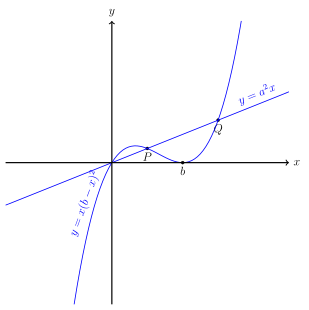
The line \(y=a^2 x\) and the curve \(y=x(b-x)^2\), where \(0 < a < b\,\), intersect at the origin \(O\) and at points \(P\) and \(Q \). The \(x\)-coordinate of \(P\) is less than the \(x\)-coordinate of \(Q\). Find the coordinates of \(P\) and \(Q\), and sketch the line and the curve on the same axes. Show that the equation of the tangent to the curve at \(P\) is \[ y = a(3a-2b)x + 2a(b-a)^2 . \] This tangent meets the \(y\)-axis at \(R\). The area of the region between the curve and the line segment \(OP\) is denoted by \(S\). Show that \[ S= \frac1{12}(b-a)^3(3a+b)\,. \] The area of triangle \(OPR\) is denoted by \(T\). Show that \(S>\frac{1}{3}T\,\).
Solution:
2018 Paper 1 Q2
If \(x=\log_bc\,\), express \(c\) in terms of \(b\) and \(x\) and prove that $ \dfrac{\log_a c}{\log_a b} = \ds \log_b c \,$.
- Given that \(\pi^2 < 10\,\), prove that \[ \frac{1}{\log_2 \pi}+\frac{1}{\log_5 \pi} > 2\,. \]
- Given that \(\ds \log_2 \frac{\pi}{\e} > \frac{1}{5}\) and that \(\e^2 < 8\), prove that \(\ln \pi > \frac{17}{15}\,\).
- Given that \(\e^3 >20\), \, \(\pi^2 < 10\,\) and \(\log_{10}2 >\frac{3}{10}\,\), prove that \(\ln \pi < \frac{15}{13}\,\).
Solution: \(x = \log_bc\) means that \(b^x = c\) Therefore, we can write \(\frac{\log_ac}{\log_ab} = \frac{\log_ab^{x}}{\log_ab} = \frac{x \log_ab}{\log_ab} = x = \log_bc\), giving us the change of base rule. Rearranging the chance of base rule, we get \(\frac{1}{\log_bc} = \frac{\log_ab}{\log_ac}\)
- Since \(\pi^2 < 10\), we have \begin{align*} \Leftrightarrow && \pi^2 &< 10 \\ \Leftrightarrow && 2\log_{10} \pi &< 1 \\ \Leftrightarrow && 2 &< \frac{1}{\log_{10} \pi} \\ \Leftrightarrow && 2 &< \frac{\log_{10} 2 + \log_{10} 5}{\log_{10} \pi} \\ \Leftrightarrow && 2 &< \frac{\log_{10} 2}{\log_{10} \pi} + \frac{\log_{10} 5}{\log_{10} \pi} \\ \Leftrightarrow && 2 &< \frac1{\log_2\pi}+ \frac1{\log_5\pi} \\ \end{align*}
- Since \(e^2 < 8 \Rightarrow 2 < 3 \ln 2 \Rightarrow \ln 2 > \frac23\) \begin{align*} && \log_2 \frac{\pi}{e} &= \frac{\ln \frac{\pi}{e}}{\ln 2} \\ &&&= \frac{\ln \frac{\pi}{e}}{\ln 2} \\ &&&< \frac{3(\ln \pi - 1)}{2} \\ \Rightarrow && \frac{1}{5} &< \frac{3 \ln \pi - 1}{2} \\ \Rightarrow && \frac{2}{15} + 1 = \frac{17}{15}&< \ln \pi \end{align*}
- From the inequalities given we can set up two linear inequalities in \(\ln 2\) and \(\ln 5\) \begin{align*} && 20 &< e^3 \\ \Rightarrow && 2\ln 2 + \ln 5 &< 3 \tag{*}\\ \\ && \frac{3}{10} &< \log_{10} 2 \\ \Rightarrow && \frac{3}{10} &< \frac{\ln 2}{\ln 10} \\ \Rightarrow && 3 \ln 2 + 3 \ln 5 &< 10 \ln 2 \\ \Rightarrow && -7 \ln 2 + 3 \ln 5 &< 0 \tag{**}\\ \\ \\ && \pi^2 & < 10 \\ \Rightarrow && 2 \ln \pi &< \ln 2 + \ln 5 \tag{***}\\ \end{align*} It would be nice to combine \((*)\) and \((**)\) to bound \(\ln 2+ \ln 5\), so we want to use a linear combination such that \begin{align*} && \begin{cases} 2x -7y &= 1 \\ x + 3y &= 1\end{cases} \\ \Rightarrow && \begin{cases} y &= \frac1{13} \\ x &= \frac{10}{13}\end{cases} \\ \\ \Rightarrow && \ln 2 + \ln 5 < \frac{30}{13} + 0 \\ \Rightarrow && \ln \pi < \frac{15}{13} \end{align*}
2018 Paper 1 Q3
The points \(R\) and \(S\) have coordinates \((-a,\, 0)\) and \((2a,\, 0)\), respectively, where \(a > 0\,\). The point \(P\) has coordinates \((x,\, y)\) where \(y > 0\) and \(x < 2a\). Let \(\angle PRS = \alpha \) and \(\angle PSR = \beta\,\).
- Show that, if \(\beta = 2 \alpha\,\), then \(P\) lies on the curve \(y^2=3(x^2-a^2)\,\).
- Find the possible relationships between \(\alpha\) and \(\beta\) when \(0 < \alpha < \pi\,\) and \(P\) lies on the curve \(y^2=3(x^2-a^2)\,\).
Solution:

- \begin{align*} &&\tan \beta &= \frac{y}{2a - x} \\ &&\tan \alpha &= \frac{y}{x+a} \\ && \tan \beta &= \tan 2 \alpha \\ && &= \frac{\tan \alpha}{1 - \tan^2 (\alpha)} \\ \Leftrightarrow && \frac{y}{2a-x}&= \frac{\l \frac{y}{x+a} \r}{1 - \l \frac{y}{x+a} \r^2} \\ && &= \frac{2y(x+a)}{(x+a)^2 - y^2} \\ \Leftrightarrow && (x+a)^2 - y^2 &= 2(x+a)(2a-x) \tag{\(y \neq 0\)} \\ \Leftrightarrow && x^2 + 2ax + a^2 - y^2 &= -2x^2 + 2ax - 4a^2 \\ \Leftrightarrow && y^2 &= 3(x^2-a^2) \end{align*}
- Therefore if \(y^2 = 3(x^2-a^2)\) we know that \(\tan \beta = \tan 2\alpha\), so \(2\alpha = \beta + n \pi\). Since \(0 < \alpha + \beta < \pi\) (since they are angles in a triangle we must have that \(0 < \alpha + 2\alpha - n \pi = 3\alpha - n\pi < \pi\), so \(0 < \alpha - \frac{n\pi}{3} < \frac{\pi}3\), therefore we have \(3\) cases:
2018 Paper 1 Q4
The function \(\f\) is defined by \[ \phantom{\ \ \ \ \ \ \ \ \ \ \ \ (x>0, \ \ x\ne1)} \f(x) = \frac{1}{x\ln x} \left(1 - (\ln x)^2 \right)^2 \ \ \ \ \ \ \ \ \ \ \ \ (x>0, \ \ x\ne1) \,.\] Show that, when \(( \ln x )^2 = 1\,\), both \(\f(x)=0\) and \(\f'(x)=0\,\). The function \(F\) is defined by \begin{align*} F(x) = \begin{cases} \displaystyle \int_{ 1/\text{e}}^x \f(t) \; \mathrm{d}t & \text{ for } 0 < x < 1\,, \\[7mm] \displaystyle \int_{\text{e}}^x \f(t) \; \mathrm{d}t & \text{ for } x > 1\,. \\ \end{cases} \end{align*}
- Find \(F(x)\) explicitly and hence show that \(F(x^{-1})=F(x)\,\).
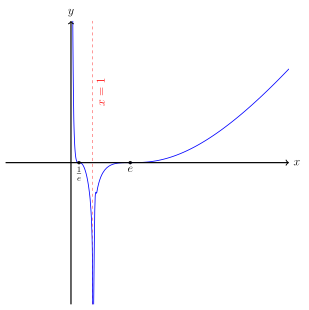
- Sketch the curve with equation \(y=F(x)\,\). [You may assume that \(\dfrac{ (\ln x)^k} x\to 0\) as \(x\to\infty\) for any constant \(k\).]
Solution: When \((\ln x)^2 = 1\) we have \(f(x) = \frac{1}{x\ln x}(1 - 1^2)^2 = 0\) \(f'(x) = \frac{2(1 - (\ln x)^2) \cdot (-2 \ln x ) \cdot \frac1x \cdot (x \ln x) - (\ln x +1)(1-(\ln x)^2)^2}{(x\ln x)^2} = \frac{2\cdot 0 \cdot (-2 \ln x ) \cdot \frac1x \cdot (x \ln x) - (\ln x +1) \cdot 0}{(x\ln x)^2} = 0\)
- First consider \(0 < x < 1\), so \begin{align*} && F(x) &= \int_{1/e}^x f(t) \d t \\ &&&= \int_{1/e}^x \frac{1}{t\ln t} \left(1 - (\ln t)^2 \right)^2 \d t \\ u = \ln t, \d u = \frac1t \d t: &&&= \int_{u=-1}^{u=\ln x} \frac{1}{u}(1-u^2)^2 \d u \\ &&&= \int_{-1}^{\ln x} \left ( u^3 - 2u+\frac1u \right) \d u \\ &&&= \left [ \frac{u^4}{4} - u^2+ \ln |u| \right]_{-1}^{\ln x} \\ &&&= \frac{(\ln x)^4}{4} -(\ln x)^2 + \ln |\ln x| - \frac14+1 \end{align*} Now consider \(x > 1\) \begin{align*} && F(x) &= \int_{e}^x f(t) \d t \\ &&&= \int_{e}^x \frac{1}{t\ln t} \left(1 - (\ln t)^2 \right)^2 \d t \\ u = \ln t, \d u = \frac1t \d t: &&&= \int_{u=1}^{u=\ln x} \frac{1}{u}(1-u^2)^2 \d u \\ &&&= \int_{1}^{\ln x} \left ( u^3 - 2u+\frac1u \right) \d u \\ &&&= \left [ \frac{u^4}{4} - u^2+ \ln |u| \right]_{1}^{\ln x} \\ &&&= \frac{(\ln x)^4}{4} -(\ln x)^2 + \ln| \ln x| - \frac14+1 \end{align*} Notice that \begin{align*} F(x^{-1}) &= \frac{(\ln x^{-1})^4}{4} -(\ln x^{-1})^2 + \ln| \ln x^{-1}| - \frac14+1 \\ &= \frac{(-\ln x)^4}{4} -(-\ln x)^2 + \ln| -\ln x| - \frac14+1 \\ &= \frac{(\ln x)^4}{4} -(\ln x)^2 + \ln| \ln x| - \frac14+1 \\ &= F(x) \end{align*}
- \(\,\)
2018 Paper 1 Q5
- Write down the most general polynomial of degree 4 that leaves a remainder of 1 when divided by any of \(x-1\,\), \(x-2\,\), \(x-3\,\) or \(x-4\,\).
- The polynomial \(\P(x)\) has degree \(N\), where \(N\ge1\,\), and satisfies \[ \P(1) = \P(2) = \cdots = \P(N) =1\,. \] Show that \(\P(N+1) \ne 1\,\). Given that \(\P(N+1)= 2\,\), find \(\P(N+r)\) where \(r\) is a positive integer. Find a positive integer \(r\), independent of \(N,\) such that \(\P(N+r) = N+r\,\).
- The polynomial \({\rm S}(x)\) has degree 4. It has integer coefficients and the coefficient of \(x^4\) is 1. It satisfies
\[
{\rm S}(a) =
{\rm S}(b) =
{\rm S}(c) =
{\rm S}(d) = 2001\,,
\]
where \(a\), \(b\), \(c\) and \(d\) are distinct (not necessarily positive)
integers.
- Show that there is no integer \(e\) such that \({\rm S}(e) = 2018\,\).
- Find the number of ways the (distinct) integers \(a\), \(b\), \(c\) and \(d\) can be chosen such that \({\rm S}(0) = 2017\) and \(a < b< c< d\,.\)
Solution:
- \(p(x) = C(x-1)(x-2)(x-3)(x-4)+1\)
- Suppose \(P(N+1) = 1\) them we could consider \(f(x) = P(x) - 1\) to be a polynomial of degree \(N\) with at least \(N+1\) roots, which would be a contradiction. Therefore \(P(N+1) \neq 1\). Since \(P(x) = C(x-1)(x-2)\cdots(x-N) + 1\) and \(P(N+1) = 2\) we must have \(C \cdot N! + 1 = 2 \Rightarrow C = \frac{1}{N!}\), hence \(P(x) = \binom{x-1}{N} + 1\) ie \(P(N+r) = \binom{N+r-1}{N}+1\) so \(P(N+2) = \binom{N+1}{N} +1= N+2\), so we can take \(r=2\).
- Suppose consider \(p(x) = S(x) - 2001\), then \(p(x)\) has roots \(a,b,c,d\) and suppose we can find \(e\) such that \(p(e) = 17\) then we must have \((e-a)(e-b)(e-c)(e-d) = 17\) but the only possible factors of \(17\) are \(-17,-1,1,17\) and we cannot have all \(4\) of them. Hence this is not possible.
- Now we have \(abcd = 16\), so we can have factors \(-16,-8,-4, -2, -1, 1, 2, 4,8,16\) (and we need to have \(4\) of them). If we have \(0\) negatives, the smallest product is \(1 \cdot 2 \cdot 4 \cdot 8 > 16\) If we have \(2\) negatives we must have \(1\) and \(-1\) (otherwise we have the same problem of being too large. So \(\{-1,1,-2,8\},\{-1,1,2,-8\},\{-1,1,-4,4\},\) If we have \(4\) negatives that's the same issue as with \(0\) negatives.
2018 Paper 1 Q6
Use the identity \[ 2 \sin P\,\sin Q = \cos(Q-P)-\cos(Q+P)\, \] to show that \[ 2\sin\theta \,\big (\sin\theta + \sin 3\theta + \cdots + \sin (2n-1)\theta\,\big ) = 1-\cos 2n\theta \,. \]
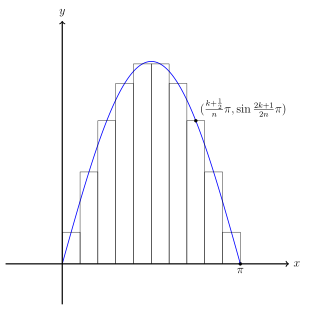
- Let \(A_n\) be the approximation to the area under the curve \(y=\sin x\) from \(x=0\) to \(x=\pi\), using \(n\) rectangular strips each of width \(\frac{{\displaystyle \pi}}{\displaystyle n}\), such that the midpoint of the top of each strip lies on the curve. Show that \[ A_n \sin \left( \frac{\pi}{2n} \right) = \frac \pi n\,. \]
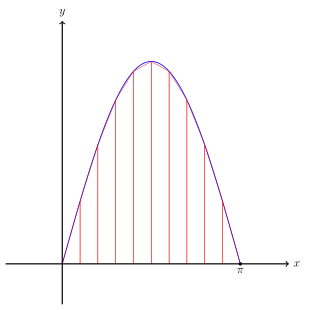
- Let \(B_n\) be the approximation to the area under the curve \(y=\sin x\) from \(x=0\) to \(x=\pi\,\), using the trapezium rule with \(n\) strips each of width \(\frac{\displaystyle \pi}{ \displaystyle n}\). Show that \[B_n \sin \left( \frac{\pi}{2n} \right) = \frac{\pi}{n} \cos \left( \frac{\pi}{2n} \right) . \]
- Show that \[ \frac{1}{2}(A_n + B_n) = B_{2n}\,, \] and that \[ A_n B_{2n} = A^2_{2n}\, . \]
Solution: \begin{align*} && 2\sin\theta \,\big (\sin\theta + \sin 3\theta + \cdots + \sin (2n-1)\theta\,\big ) &= 2\sin\theta\sin\theta + 2\sin\theta\sin 3\theta + \cdots + 2\sin\theta\sin (2n-1)\theta \\ &&&= \cos((1-1)\theta) - \cos((1+1)\theta)+\cos((3-1)\theta)-\cos((3+1)\theta) + \cdots + \cos (((2n-1)-1)\theta) -\cos(((2n-1)+1)\theta) \\ &&&= \cos 0 - \cos(2n\theta) \\ &&&= 1 - \cos 2n \theta \end{align*}
- \(\,\)
Therefore the area is: \begin{align*} A_n &= \frac{\pi}{n} \sin \left ( \frac{\pi}{2n} \right) + \frac{\pi}{n} \sin \left ( \frac{3\pi}{2n} \right) + \frac{\pi}{n} \sin \left ( \frac{5\pi}{2n} \right) + \cdots \frac{\pi}{n} \sin \left ( \frac{(2n-1)\pi}{2n} \right) \\ &= \frac{\pi}{n} \left( \frac{1-\cos \frac{2n \pi}{2n}}{2\sin \frac{\pi}{2n}} \right) \\ &= \frac{\pi}{n} \frac{1}{\sin \frac{\pi}{2n}} \end{align*} as required
- Therefore the area is: \begin{align*} && B_n &= \frac{\pi}{n} \frac{\sin(0)+\sin(\frac{\pi}{n})}{2}+\frac{\pi}{n} \frac{\sin(\frac{\pi}n)+\sin(\frac{2\pi}{n})}{2} + \cdots \frac{\pi}{n} \frac{\sin(\frac{(n-1)\pi}{n})+\sin(\frac{n\pi}{n})}{2} \\ &&&= \frac{\pi}{n} \left ( \sin \frac{\pi}{n} + \sin \frac{2\pi}{n} + \cdots+\sin \frac{(n-1)\pi}{n} \right) \\ \Rightarrow && 2\sin \left ( \frac{\pi}{2n} \right)B_n &= \frac{\pi}{2} \left (2\sin \left ( \frac{\pi}{2n} \right)\sin \frac{\pi}{n} + 2\sin \left ( \frac{\pi}{2n} \right)\sin \frac{2\pi}{n} + \cdots+2\sin \left ( \frac{\pi}{2n} \right)\sin \frac{(n-1)\pi}{n} \right) \\ &&&= \frac{\pi}2 \left ( \cos \frac{\pi}{2n} - \cos \frac{3\pi}{n} + \cos\frac{3\pi}{2n} - \cos \frac{5\pi}{2n} + \cos \frac{(2n-3)\pi}{2n} - \cos \frac{(2n-1)\pi}{2n} \right) \\ &&&= \frac{\pi}{n} \left ( \cos \frac{\pi}{2n} - \cos \left ( \pi - \frac{\pi}{2n} \right) \right) \\ &&&= 2 \frac{\pi}{n} \cos \frac{\pi}{2n} \\ \Rightarrow && \sin \left ( \frac{\pi}{2n} \right)B_n &= \frac{\pi}n \cos \frac{\pi}{2n} \end{align*} as required
- \begin{align*} \frac12(A_n+B_n) &= \frac12 \frac{\pi}{n} \frac{1}{\sin \frac{\pi}{2n}} \left ( 1 + \cos \frac{\pi}{2n} \right) \\ &= \frac{\pi}{n}\frac1{2 \sin \frac{\pi}{2n}} \left (2 \cos^2 \frac{\pi}{4n} \right) \\ &=\frac{\pi}{n} \frac{1}{4 \sin \frac{\pi}{4n} \cos \frac{\pi}{4n}} \left (2 \cos^2 \frac{\pi}{4n} \right) \\ &= \frac{\pi}{2n} \frac{\cos \frac{\pi}{4n}}{\sin \frac{\pi}{4n}} \\ &= B_{2n} \\ \\ A_nB_{2n} &= \frac{\pi}{n\sin \frac{\pi}{2n}} \cdot \frac{\pi}{2n} \frac{\cos \frac{\pi}{4n}}{\sin \frac{\pi}{4n}} \\ &= \frac{\pi^2}{(2n)^2} \frac{\cos \frac{\pi}{4n}}{\sin^2 \frac{\pi}{4n} \cos \frac{\pi}{4n}} \\ &= \left ( \frac{\pi}{2n} \frac{1}{\sin \frac{\pi}{4n}}\right)^2 \\ &= A_{2n}^2 \end{align*}
2018 Paper 1 Q7
- In the cubic equation \(x^3-3pqx+pq(p+q)=0\,\), where \(p\) and \(q\) are distinct real numbers, use the substitution \[ x=\frac{pz+q}{z+1} \] to show that the equation reduces to \(az^3+b = 0\,\), where \(a\) and \(b\) are to be expressed in terms of \(p\) and \(q\).
- Show further that the equation \(x^3 - 3cx + d = 0\,\), where \(c\) and \(d\) are non-zero real numbers, can be written in the form \(x^3-3pqx+pq(p+q)=0\,\), where \(p\) and \(q\) are distinct real numbers, provided \(d^2 > 4c^3\,\).
- Find the real root of the cubic equation \(x^3+6x-2=0\,\).
- Find the roots of the equation \(x^3 - 3p^2x +2p^3=0\,\), and hence show how the equation \(x^3 - 3cx + d = 0\) can be solved in the case \(d^2 = 4c^3\,\).
Solution:
- Let \(x = \frac{pz+q}{z+1}\) then \begin{align*} && 0 &= x^3-3pqx+pq(p+q) \\ &&&= \left ( \frac{pz+q}{z+1} \right)^3 - 3pq \left ( \frac{pz+q}{z+1} \right) + pq(p+q) \\ &&&= \frac{(pz+q)^3-3pq(pz+q)(z+1)^2+pq(p+q)(z+1)^3}{(z+1)^3} \\ &&&= \frac{1}{(z+1)^3} \Big ((p^3+pq(p+q)-3p^2q)z^3 + (3p^2q-6p^2q+3pq^2+3p^2q+3pq^2)z^2 + \\ &&&\qquad \qquad\quad\quad +(3pq^2-3p^2q-6pq^2+3p^2q+3qp^2)z+(q^3-3pq^2+p^2q+pq^2) \Big ) \\ &&&= \frac{(p^3+pq^2-2p^2q)z^3+(q^3+p^2q-2pq^2)}{(z+1)^3} \\ \Rightarrow && 0 &= (p^3+pq^2-2p^2q)z^3+(q^3+p^2q-2pq^2) \\ &&&= p(p-q)^2z^3 + q(p-q)^2 \\ \Rightarrow && 0 &= pz^3 + q \end{align*}
- We would like to find \(pq = c\) and \(pq(p+q) = d\), so \(p\) and \(q\) are roots of the quadratic \(x^2-\frac{d}{c}x + c = 0\), which has distinct real roots if \(\Delta = \frac{d^2}{c^2}-4c > 0 \Rightarrow d^2>4c^3\)
- Note that \(c = -2, d = -2\) so \begin{align*} && 0 &= x^3+6x-2 \\ \text{consider} && 0 &= X^2-X-2 \\ && &= (X+1)(X-2) \\ \Rightarrow && p = -1, &q = 2\\ \Rightarrow && 0 &= x^3-3\cdot 2 \cdot(-1) x + 2\cdot(-1) \cdot(-2+1) \\ \Rightarrow && 0 &= -z^3+2 \\ \Rightarrow && z &= \sqrt[3]{2} \\ \Rightarrow && \frac{-z+2}{z+1} &= \sqrt[3]{2} \\ \Rightarrow && -z+2 &= \sqrt[3]{2} z + \sqrt[3]{2} \\ \Rightarrow && z &= \frac{2-\sqrt[3]{2}}{\sqrt[3]{2}+1} \end{align*}
- \(\,\) \begin{align*} && 0 &= x^3 - 3p^2x + 2p^3 \\ &&&= (x-p)(x^2+px-2p^2) \\ &&&=(x-p)^2(x+2p)\\ \Rightarrow && x &= p, p, -2p \end{align*} Therefore if we have a repeated root to our associated quadratic we can find a cubic of the form \(x^3-3p^2x+2p^3\), but we know this has roots we can find.
2018 Paper 1 Q8
The functions \(\s\) and \(\c\) satisfy \(\s(0)= 0\,\), \(\c(0)=1\,\) and \[ \s'(x) = \c(x)^2 ,\] \[ \c'(x)=-\s(x)^2. \] You may assume that \(\s\) and \(\c\) are uniquely defined by these conditions.
- Show that \(\s(x)^3+\c(x)^3\) is constant, and deduce that \(\s(x)^3+\c(x)^3=1\,\).
- Show that \[ \frac{\d }{\d x} \, \Big( \s(x) \c(x) \Big) = 2\c(x)^3-1 \] and find (and simplify) an expression in terms of \(\c(x)\) for $\dfrac{\d }{\d x} \left( \dfrac{\s(x)}{\c(x)} \right) $.
- Find the integrals \[ \int \s(x)^2 \, \d x \ \ \ \ \ \ \text{and} \ \ \ \ \ \ \int \s(x)^5 \, \d x \,. \]
- Given that \(\s\) has an inverse function, \(\s^{-1}\), use the substitution \(u = \s(x)\) to show that \[ \int \frac{1}{(1-u^3)^{\frac{2}{3}}} \, \d u = \s^{-1}(u) \, + \text{constant}. \]
- Find, in terms of \(u\), the integrals \[ \int \frac{1}{{(1-u^3)}^{\frac{4}{3}}} \, \d u \ \ \ \ \ \ \text{and} \ \ \ \ \ \ \int {(1-u^3)}^{\frac{1}{3}} \, \d u \,. \]
Solution: \begin{questionparts} \item \begin{align*} && \dfrac{\d }{\d x} \left( \s(x)^3 + \c(x)^3 \right) &= 3\s(x)^2\s'(x) + 3\c(x)^2 \c'(x) \\ &&&= 3\s(x)^2\c(x)^2 - 3\c(x)^2\s(x)^2 \\ &&&= 0 \\ \\ \Rightarrow && \s(x)^3 + \c(x)^3 &= \text{constant} \\ &&&= \s(0)^3 + \c(0)^3 \\ &&&= 1 \end{align*} \item \begin{align*} \frac{\d }{\d x} \, \Big( \s(x) \c(x) \Big) &= \s'(x) \c(x) + \s(x)\c'(x) \\ &= \c(x)^3 - \s(x)^3 \\ &= \c(x)^3 - (1-\c(x)^3) \\ &= 2\c(x)^3 - 1 \\ \\ \dfrac{\d }{\d x} \left( \dfrac{\s(x)}{\c(x)} \right) &= \frac{\s'(x)\c(x) - \s(x)\c'(x)}{\c(x)^2} \\ &= \frac{\c(x)^3 + \s(x)^3}{\c(x)^2} \\ &= \frac{1}{\c(x)^2} \\ \end{align*} \item \begin{align*} \int \s(x)^2 \d x &= -\int -\s(x)^2 \d x \\ &= -\int \c'(x) \d x \\ &= - \s(x) +C \\ \\ \int \s(x)^5 \, \d x &= \int \s(x)^2 \s(x)^3 \d x \\ &= \int \s(x)^2 (1 - \c(x)^3) \d x \\ &= -\int \c'(x) (1 - \c(x)^3) \d x \\ &= - c(x) + \frac{\c(x)^4}{4} + C \end{align*} \item If \(u = \s(x), \frac{\d u}{\d x} = \c(x)^2\) \begin{align*} \int \frac{1}{(1-u^3)^{\frac{2}{3}}} \, \d u &= \int \frac{1}{(1-\s(x)^3)^{\frac{2}{3}}} \c(x)^2 \d x \\ &= \int 1 \d x \\ &= x + C \\ &= \s^{-1}(u) + C \\ \\ \int \frac{1}{{(1-u^3)^{\frac{4}{3}}}} \d u &= \int \frac1{(1-\s(x)^3)^{\frac43} }\c(x)^2 \d x \\ &= \int \frac1{(\c(x)^3)^{\frac43}} \c(x)^2 \d x \\ &= \int \frac1{\c(x)^2} \d x \\ &= \frac{\s(x)}{\c(x)} + C \\ &= \frac{u}{(1-u^3)^{\frac13}} + C \\ \end{align*} \begin{align*} && \int {(1-u^3)}^{\frac{1}{3}} \, \d u &= \int (1-s(x)^3)^{\frac13} c(x)^2 \d x \\ &&&= \int \c(x)^3 \d x = I\\ &&&= \int \c(x) s'(x) \d x \\ &&&= \left [\c(x) \s(x) \right] + \int \s(x)^2 s(x) \d x \\ &&&= \c(x) \s(x) + \int (1 - \c(x)^3) \d x + C \\ &&&= \c(x) \s(x) + x - I + C \\ \Rightarrow && I &= \frac{x + \c(x) \s(x)}{2} + k \\ \Rightarrow && &= \frac12 \l \s^{-1}(u) + u \sqrt[3](1-u^3)\r + k \end{align*}
2018 Paper 1 Q9
A straight road leading to my house consists of two sections. The first section is inclined downwards at a constant angle \(\alpha\) to the horizontal and ends in traffic lights; the second section is inclined upwards at an angle \(\beta\) to the horizontal and ends at my house. The distance between the traffic lights and my house is \(d\). I have a go-kart which I start from rest, pointing downhill, a distance \(x\) from the traffic lights on the downward-sloping section. The go-kart is not powered in any way, all resistance forces are negligible, and there is no sudden change of speed as I pass the traffic lights. Given that I reach my house, show that \(x \sin \alpha\ge d \sin\beta\,\). Let \(T\) be the total time taken to reach my house. Show that \[ \left(\frac{g\sin\alpha}2 \right)^{\!\frac12} T = (1+k) \sqrt{x} - \sqrt{k^2 x -kd\;} \,, \] where \(k = \dfrac{\sin\alpha}{\sin\beta}\,\). Hence determine, in terms of \(d\) and \(k\), the value of \(x\) which minimises \(T\). [You need not justify the fact that the stationary value is a minimum.]
Solution: Applying conservation of energy, since there are no external forces (other than gravity) the condition to reach the house (with any speed) is the initial GPE is larger than the final GPE, ie: \begin{align*} && m g x \sin \alpha &\geq m g d \sin \beta \\ \Rightarrow && x \sin \alpha &\geq d \sin \beta \end{align*} Let \(T_1\) be the time taken on the downward section, and \(T_2\) the time taken on the upward section, then: \begin{align*} && s &= ut + \frac12 a t^2 \\ \Rightarrow && x &= \frac12 g \sin \alpha T_1^2 \\ \Rightarrow && T_1^2 &= \frac{2x}{g \sin \alpha} \\ && v &= u + at \\ \Rightarrow && v &= T_1 g \sin \alpha \\ && mg x \sin \alpha &= mg d \sin \beta + \frac12 m w^2 \\ \Rightarrow && w &= \sqrt{2(x \sin \alpha - d \sin \beta)} \\ && w &= v - g \sin \beta T_2 \\ \Rightarrow && T_2 &= \frac{v - w}{g \sin \beta} \\ \Rightarrow && T &= T_1 + T_2 \\ &&&= \sqrt{\frac{2x}{g \sin \alpha}} + \frac{\sqrt{\frac{2x}{g \sin \alpha}} g \sin \alpha- \sqrt{2(x \sin \alpha - d \sin \beta)}}{g \sin \beta} \\ &&&= \left ( \frac{2}{g \sin \alpha} \right)^{\tfrac12} \left ( \sqrt{x} + \sqrt{x}k - \sqrt{k^2x-kd}\right) \end{align*} Differentiating wrt to \(x\), we obtain: \begin{align*} && \frac{\d T}{\d x} &= C(-(1+k)x^{-1/2}+k^2(k^2 x - kd)^{-1/2}) \\ \text{set to }0: && 0 &= k^2(k^2 x - kd)^{-1/2} - (1+k)x^{-1/2} \\ \Rightarrow && \sqrt{x} k^2 &= \sqrt{k^2x - kd} (1+k) \\ \Rightarrow && x k^4 &= (k^2x-kd)(1+k)^2 \\ \Rightarrow && x(k^4-k^2(1+k)^2) &= -kd(1+k)^2 \\ \Rightarrow && x(2k^2+k) &= d \\ \Rightarrow && x &= \frac{d}{(2k^2+k)} \end{align*}
2018 Paper 1 Q10
A train is made up of two engines, each of mass \(M\), and \(n\) carriages, each of mass \(m\). One of the engines is at the front of the train, and the other is coupled between the \(k\)th and \((k+1)\)th carriages. When the train is accelerating along a straight, horizontal track, the resistance to the motion of each carriage is \(R\) and the driving force on each engine is \(D\), where \(2D >nR\,\). The tension in the coupling between the engine at the front and the first carriage is \(T\).
- Show that \[ T = \frac{n(mD+MR)}{nm+2M}\,. \]
- Show that \(T\) is greater than the tension in any other coupling provided that \(k> \frac12n\,\).
- Show also that, if \(k> \frac12n\,\), then at least one of the couplings is in compression (that is, there is a negative tension in the coupling).
Solution:
- \(\,\)
\begin{align*} \text{N2}(\leftarrow, \text{first engine}): && D-T &= Ma \\ \text{N2}(\leftarrow, \text{rest of train}): && T-nR+D &= (M+nm)a \\ \Rightarrow && \frac{D-T}{M} &= \frac{T+D-nR}{M+nm} \\ \Rightarrow && T \left ( \frac{1}{M+nm}+\frac{1}{M} \right) &= \frac{D}{M} + \frac{nR-D}{M+nm} \\ \Rightarrow && T \left ( 2M+nm\right) &= DM +Dnm + nRM - DM \\ &&&= n(mD+MR) \\ \Rightarrow && T &= \frac{n(mD+MR)}{2M+nm} \end{align*}
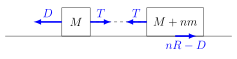
- The greatest coupling must occur behind an engine, because each carriage behind an engine acts as a drag.
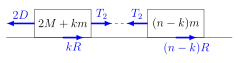
Therefore we need only consider the couple between the second engine and the rest of the carriages:
\begin{align*} \text{N2}(\leftarrow, \text{up to second engine}): && 2D - T_2 - kR &= (2M+km)a \\ \text{N2}(\leftarrow, \text{everything else}): && T_2 - (n-k)R &= (n-k)ma \\ \Rightarrow && \frac{2D-T_2-kR}{2M+km} &= \frac{T_2-(n-k)R}{(n-k)m} \\ \Rightarrow && T_2 \left (\frac{1}{(n-k)m} + \frac{1}{2M+km} \right) &= \frac{2D-kR}{2M+km} + \frac{R}{m} \\ \Rightarrow && T_2 \left (2M+ nm \right) &= (2D-kR)m(n-k) + R(2M+km)(n-k) \\ \Rightarrow && T_2 &= \frac{(n-k)\left (2Dm+2RM \right)}{2M+nm} \\ &&&= \frac{2(n-k)(mD + MR)}{2M+nm} \end{align*} Therefore \(T > T_2\) provided \(2(n-k) < n \Leftrightarrow k > \frac12n\)
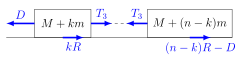
- If there is a coupling which is in negative tension, it must be between the two engines. In particular, if there is one, there must be one directly in front of the first engine.
\begin{align*} \text{N2}(\leftarrow, \text{before second engine}): && D - T_3 - kR &= (M+km)a \\ \text{N2}(\leftarrow, \text{everything else}): && T_3 +D- (n-k)R &= (M+(n-k)m)a \\ \Rightarrow && \frac{D-T_3-kR}{M+km} &= \frac{T_3+D-(n-k)R}{M+(n-k)m} \\ \Rightarrow && T_3 \left ( \frac{1}{M+(n-k)m} + \frac{1}{M+km} \right) &= \frac{D-(n-k)R}{M+(n-k)m}+\frac{kR-D}{M+km} \\ \Rightarrow && T_3 (2M+nm) &= (D-(n-k)R)(M+km)+(kR-D)(M+(n-k)m) \\ &&&= D(M+km-M-(n-k)m) + R(kM+k(n-k)m-(n-k)M-k(n-k)m) \\ &&&= D(n-2k)m+RM(2k-n)m \\ &&&= (n-2k)m(D-RM) \end{align*} Therefore \(T_3\) is negative if \(k > \frac12n\) so there are some connections in compression.
2018 Paper 1 Q11
A bag contains three coins. The probabilities of their showing heads when tossed are \(p_1\), \(p_2\) and \(p_3\).
- A coin is taken at random from the bag and tossed. What is the probability that it shows a head?
- A coin is taken at random from the bag (containing three coins) and tossed; the coin is returned to the bag and again a coin is taken at random from the bag and tossed. Let \(N_1\) be the random variable whose value is the number of heads shown on the two tosses. Find the expectation of \(N_1\) in terms of \(p\), where \(p = \frac{1}{3}(p_1+p_2+p_3)\,\), and show that \(\var(N_1) =2p(1-p)\,\).
- Two of the coins are taken at random from the bag (containing three coins) and tossed. Let \(N_2\) be the random variable whose value is the number of heads showing on the two coins. Find \(\E(N_2)\) and \(\var(N_2)\).
- Show that \(\var(N_2)\le \var(N_1)\), with equality if and only if \(p_1=p_2=p_3\,\).
Solution:
- \(\mathbb{P}(\text{head}) = \mathbb{P}(\text{head}|1)\mathbb{P}(\text{coin 1}) + \mathbb{P}(\text{head}|2)\mathbb{P}(\text{coin 2})+\mathbb{P}(\text{head}|3)\mathbb{P}(\text{coin 3}) = \frac13(p_1+p_2+p_3)\)
- \(N_1 = X_1 + X_2\) where \(X_i \sim Bernoulli(p)\), therefore \(\mathbb{E}(N_1) = 2p\) and \(\textrm{Var}(N_1) = \textrm{Var}(X_1)+ \textrm{Var}(X_2) = p(1-p)+p(1-p) = 2p(1-p)\)
- Let \(Y_i\) be the indicator for the \(i\)th coin is heads. Then \(\mathbb{E}(Y_i) = p\) and so \(\mathbb{E}(N_2) = 2p\). \begin{align*} && \textrm{Var}(N_2) &= \mathbb{E}(N_2^2) - [\mathbb{E}(N_2)]^2\\ &&&= 2^2 \cdot \left (\frac13 \left (p_1p_2+p_2p_3+p_3p_1 \right) \right) + 1 \cdot \left (\frac13 \left (p_1 (1-p_2) + (1-p_1)p_2 + p_2(1-p_3) +(1-p_2)p_3 + p_3(1-p_1) + (1-p_3)p_1 \right) \right) - [\mathbb{E}(N_2)]^2 \\ &&&= \frac43\left (p_1p_2+p_2p_3+p_3p_1 \right) + \frac13 \left ( 2(p_1+p_2+p_3) - 2(p_1p_2+p_2p_3+p_3p_1)\right)-[\mathbb{E}(N_2)]^2 \\ &&&= \frac23\left (p_1p_2+p_2p_3+p_3p_1 \right) + \frac23 \left ( p_1+p_2+p_3 \right)-[\mathbb{E}(N_2)]^2\\ &&&= \frac23\left (p_1p_2+p_2p_3+p_3p_1 \right) + \frac23 \left ( p_1+p_2+p_3 \right)-\left[\frac23(p_1+p_2+p_3)\right]^2\\ &&&= \frac23\left (p_1p_2+p_2p_3+p_3p_1 \right) +2p(1-2p)\\ \end{align*}
- \(\,\) \begin{align*} && \textrm{Var}(N_1) - \textrm{Var}(N_2) &= 2p(1-p) - \left (\frac23\left (p_1p_2+p_2p_3+p_3p_1 \right) +2p(1-2p) \right) \\ &&&= 2p^2-\frac23\left (p_1p_2+p_2p_3+p_3p_1 \right) \\ &&&= \frac23 \left ( \frac13(p_1+p_2+p_3)^2 -\left (p_1p_2+p_2p_3+p_3p_1 \right)\right)\\ &&&= \frac29 \left (p_1^2+p_2^2+p_3^2 -(p_1p_2+p_2p_3+p_3p_1) \right)\\ &&&= \frac19 \left ((p_1-p_2)^2+(p_2-p_3)^2+(p_3-p_1)^2 \right) &\geq 0 \end{align*} with equality iff \(p_1 = p_2 = p_3\)
2018 Paper 1 Q12
A multiple-choice test consists of five questions. For each question, \(n\) answers are given (\(n\ge2\)) only one of which is correct and candidates either attempt the question by choosing one of the \(n\) given answers or do not attempt it. For each question attempted, candidates receive two marks for the correct answer and lose one mark for an incorrect answer. No marks are gained or lost for questions that are not attempted. The pass mark is five. Candidates A, B and C don't understand any of the questions so, for any question which they attempt, they each choose one of the \(n\) given answers at random, independently of their choices for any other question.
- Candidate A chooses in advance to attempt exactly \(k\) of the five questions, where \(k=0, 1, 2, 3, 4\) or \(5\). Show that, in order to have the greatest probability of passing the test, she should choose \(k=4\,\).
- Candidate B chooses at random the number of questions he will attempt, the six possibilities being equally likely. Given that Candidate B passed the test find, in terms of \(n\), the probability that he attempted exactly four questions. [Not on original test: Show that this probability is an increasing function of \(n\).]
- For each of the five questions Candidate C decides whether to attempt the question by tossing a biased coin. The coin has a probability of \(\frac n{n+1}\) of showing a head, and she attempts the question if it shows a head. Find the probability, in terms of \(n\), that Candidate C passes the test.
Solution:
- Her probability of passing if she answers \(k \leq 2\) is \(0\), since she can attain at most \(4\) marks. If she attempts \(3\) questions, she needs to get all of them right, hence \(\mathbb{P}(\text{gets all }3\text{ correct}) = \frac{1}{n^3}\). If she attempts \(4\) questions, we can afford to get one wrong \begin{align*} && \mathbb{P}(\text{passes}|\text{attempts }4) &=\mathbb{P}(4/4) +\mathbb{P}(3/4) \\ &&&= \frac{1}{n^4} + 4\cdot\frac{1}{n^3} \cdot \frac{n-1}{n} \\ &&&= \frac{4n-3}{n^4} \end{align*} If she attempts \(5\) questions she can get \(5\) right (10), \(4\) right, \(1\) wrong (7), but \(3\) right will not work (\(6 - 2 = 4< 5\)), hence: \begin{align*} && \mathbb{P}(\text{passes}|\text{attempts }5) &=\mathbb{P}(5/5) +\mathbb{P}(4/5) \\ &&&= \frac{1}{n^5} + 5\cdot\frac{1}{n^4} \cdot \frac{n-1}{n} \\ &&&= \frac{5n-4}{n^5} \end{align*} If \(4n-3 > n \Leftrightarrow n \geq 2\) then \(4\) attempts is better than \(3\). If \(4n^2-3n > 5n-4 \Leftrightarrow 4n^2-8n+4 = 4(n-1)^2 > 0 \Leftrightarrow n \geq\) then \(4\) is better than \(5\), but \(n\) is \(\geq 2\) so, \(4\) is the best option.
- \(\,\) \begin{align*} && \mathbb{P}(\text{passes}) &= \frac16 \cdot 0 + \frac16 \cdot 0 + \frac16 \cdot 0 + \frac16 \cdot \frac1{n^3} + \frac16 \frac{4n-3}{n^4} + \frac16 \frac{5n-4}{n^5} \\ &&&= \frac{n^2+4n^2-3n+5n-4}{6n^5} \\ &&&= \frac{5n^2+2n-4}{6n^5} \\ && \mathbb{P}(\text{answered }4|\text{passes}) &= \frac{\mathbb{P}(\text{answered }4\text{ and passes})}{ \mathbb{P}(\text{passes})} \\ &&&= \frac{\frac16 \cdot \frac{4n-3}{n^4}}{\frac{5n^2-2n-4}{6n^5} } \\ &&&= \frac{4n^2-3n}{5n^2+2n-4} \end{align*} Notice that the function takes all values for \(n\) between the roots of the denominator (which are either side of \(0\) and below \(3/4\). Therefore after \(3/4\) the function must be increase since otherwise we would have a quadratic equation with more than \(2\) roots.
- \(\,\) \begin{align*} &&\mathbb{P}(C \text{ passes}) &= \binom{5}{3} \left ( \frac{n}{n+1} \right)^3 \left ( \frac{1}{n+1}\right)^2 \frac{1}{n^3} + \binom{5}{4} \left ( \frac{n}{n+1} \right)^4 \left ( \frac{1}{n+1}\right) \frac{4n-3}{n^4} +\\ &&&\quad \quad + \binom{5}{5} \left ( \frac{n}{n+1} \right)^5 \frac{5n-4}{n^5} \\ &&&= \frac{10}{(n+1)^5} + \frac{5(4n-3)}{(n+1)^5} + \frac{(5n-4)}{(n+1)^5} \\ &&&= \frac{10+20n-15+5n-4}{(n+1)^5}\\ &&&= \frac{25n-9}{(n+1)^5}\\ \end{align*}
2018 Paper 2 Q1
Show that, if \(k\) is a root of the quartic equation \[ x^4 + ax^3 + bx^2 + ax + 1 = 0\,, \tag{\(*\)} \] then \(k^{-1}\) is a root. You are now given that \(a\) and \(b\) in \((*)\) are both real and are such that the roots are all real.
- Write down all the values of \(a\) and \(b\) for which \((*)\) has only one distinct root.
- Given that \((*)\) has exactly three distinct roots, show that either \(b=2a-2\) or \(b=-2a-2\,\).
- Solve \((*)\) in the case \(b= 2 a -2\,\), giving your solutions in terms of \(a\).
Solution: Let \(f(x) = x^4 + ax^3 + bx^2 + ax + 1\), and suppose \(f(k) = 0\). Since \(f(0) = 1\), \(k \neq 0\), therefore we can talk about \(k^{-1}\). \begin{align*} && f(k^{-1}) &= k^{-4} + ak^{-3} + bk^{-2} + ak^{-1} + 1 \\ &&&= k^{-4}(1 + ak + bk^2 + ak^3 + k^4) \\ &&&= k^{-4}(k^4+ak^3+bk^2+ak+1) \\ &&&= k^{-4}f(k) = 0 \end{align*} Therefore \(k^{-1}\) is also a root of \(f\)
- If \(f\) has only on distinct root, we must have \(f(x) = (x+k)^4\) therefore \(k = k^{-1} \Rightarrow k^2 = 1 \Rightarrow k = \pm1\), or \(a = 4, b = 6\) or \(a = -4, b = 6\)
- If \(f\) has exactly three distinct roots then one of the roots must be a repeated \(1\) or \(-1\), ie \(0 = f(1) = 1 + a + b + a + 1 = 2 + b +2a \Rightarrow b = -2a-2\) or \(0 = f(-1) = 1 -a + b -a + 1 \Rightarrow b = 2a - 2\)
- If \(b = 2a-2\), we have \begin{align*} && f(x) &= 1 + ax + (2a-2)x^2 + ax^3 + x^4 \\ &&&= (x^2+2x+1)(1+(a-2)x+x^2) \\ \Rightarrow && x &= \frac{2-a \pm \sqrt{(a-2)^2 - 4}}{2} \\ &&&= \frac{2-a \pm \sqrt{a^2-4a}}{2} \end{align*}
2018 Paper 2 Q2
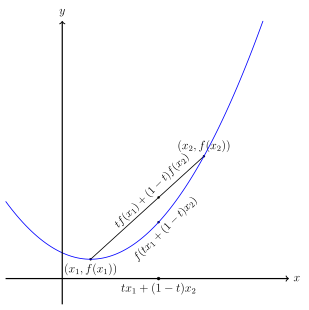
A function \(\f(x)\) is said to be concave for \(a< x < b\) if \[ \ t\,\f(x_1) +(1-t)\,\f(x_2) \le \f\big(tx_1+ (1-t)x_2\big) \, ,\] for \(a< x_1 < b\,\), \(a< x_2< b\) and \(0\le t \le 1\,\). Illustrate this definition by means of a sketch, showing the chord joining the points \(\big(x_1, \f(x_1)\big) \) and \(\big(x_2, \f(x_2)\big) \), in the case \(x_1 < x_2\) and \(\f(x_1)< \f(x_2)\,\). Explain why a function \(\f(x)\) satisfying \(\f''(x)<0\) for \(a< x < b\) is concave for \(a< x < b\,\).
- By choosing \(t\), \(x_1\) and \(x_2\) suitably, show that, if \(\f(x)\) is concave for \(a< x < b\,\), then \[ \f\Big(\frac{u+ v+w}3\Big) \ge \frac{ \f(u) +\f(v) +\f(w)}3 \, ,\] for \(a< u < b\,\), \(a< v < b\,\) and \(a< w < b\,\).
- Show that, if \(A\), \(B\) and \(C\) are the angles of a triangle, then \[ \sin A +\sin B + \sin C \le \frac{3\sqrt3}2 \,. \]
- By considering \(\ln (\sin x)\), show that, if \(A\), \(B\) and \(C\) are the angles of a triangle, then \[ \sin A \times \sin B \times \sin C \le \frac {3 \sqrt 3} 8 \,. \]
Solution:
- \(\,\) \begin{align*} && f \left ( \frac{u+v+w}{3} \right) &= f \left ( \frac{2}{3}\cdot \frac{u+v}2+\frac{1}{3}w \right) \\ &&&\geq \frac23 f \left ( \frac{u+v}{2} \right) + \frac13 f(w) \\ &&&\geq \frac23 \left (\frac12 f(u) + \frac12 f(v) \right) + \frac13 f(w) \\ &&&= \frac{f(u)+f(v)+f(w)}{3} \end{align*}
- Notice that if \(A, B, C\) are angles in a triangle then they add to \(\pi\) \(0 < A,B,C < \pi\). We also have \(f(x) = \sin x \Rightarrow f''(x) = - \sin x < 0\) on this interval. Therefore \(\sin A + \sin B + \sin C \leq 3 \sin \frac{A+B+C}{3} = 3 \sin \frac{\pi}{3} = \frac{3\sqrt{3}}2\)
- Also notice that \begin{align*} && f(x) &= \ln ( \sin x) \\ \Rightarrow && f'(x) &= \frac{\cos x}{ \sin x} \\ && f''(x) &= -\textrm{cosec}^2 x < 0 \\ \\ \Rightarrow && \ln( \sin A) + \ln (\sin B) + \ln (\sin C) &\leq 3 \ln \left (\sin \left ( \frac{A + B+ C}{3} \right) \right) \\ &&&= 3 \ln \left ( \frac{\sqrt{3}}{2} \right) = \ln \frac{3\sqrt{3}}{8} \\ \Rightarrow && \sin A \sin B \sin C &\leq \frac{3\sqrt{3}}8 \end{align*}
2018 Paper 2 Q3
- Let \[ \f(x) = \frac 1 {1+\tan x} \] for \(0\le x < \frac12\pi\,\). Show that \(\f'(x)= -\dfrac{1}{1+\sin 2x}\) and hence find the range of \(\f'(x)\). Sketch the curve \(y=\f(x)\).
- The function \(\g(x)\) is continuous for \(-1\le x \le 1\,\). Show that the curve \(y=\g(x)\) has rotational symmetry of order 2 about the point \((a,b)\) on the curve if and only if \[ \g(x) + \g(2a-x) = 2b\,. \] Given that the curve \(y=\g(x)\) passes through the origin and has rotational symmetry of order 2 about the origin, write down the value of \[\displaystyle \int_{-1}^1 \g(x)\,\d x\,. \]
- Show that the curve \(y=\dfrac{1}{1+\tan^kx}\,\), where \(k\) is a positive constant and \(0 < x < \frac12\pi\,\), has rotational symmetry of order 2 about a certain point (which you should specify) and evaluate \[ \int_{\frac16\pi}^{\frac13\pi} \frac 1 {1+\tan^kx} \, \d x \,. \]
Solution:
- \(\,\) \begin{align*}
&& f(x) &= \frac1{1+\tan x} \\
&& f'(x) &=-(1+\tan x)^{-2} \cdot \sec^2 x \\
&&&= - (\cos x+ \sin x)^{-2} \\
&&&= - (1 + 2 \sin x \cos x)^{-1} \\
&&&= - \frac{1}{1+\sin 2x}
\end{align*}
\(\sin 2x \in [0, 1]\) so \(1+\sin 2x \in [1,2]\) and \(f'(x) \in [-1, -\tfrac12]\)
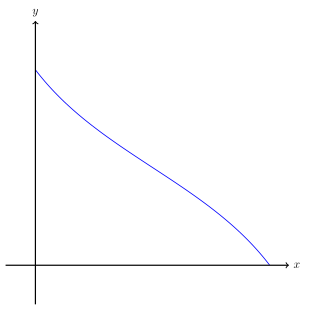
- \(\displaystyle \int_{-1}^1 g(x) \d x = 2g(0) \)
- Let \(g(x) = \frac{1}{1 + \tan^k x}\) then \(g(x)\) has rotational symmetry of order \(2\) about the point \((\frac{\pi}{4}, \frac12)\) which we can see since \begin{align*} g(x) + g(\tfrac12\pi - x) &= \frac{1}{1 + \tan^k x} + \frac{1}{1 + \tan^k(\tfrac12\pi - x)} \\ &= \frac{1}{1+\tan^k x} + \frac{1}{1+\cot^k x} \\ &= \frac{1}{1+\tan^k x} + \frac{\tan^k x}{\tan^k x + 1} \\ &= 1 = 2 \cdot \tfrac12 \end{align*} Therefore \[ \int_{\frac16\pi}^{\frac13\pi} \frac 1 {1+\tan^kx} \, \d x = \frac{\pi}{6} \cdot \frac12 = \frac{\pi}{12}\]