Problems
Filters
12 problems found
2025 Paper 2 Q1
The function \(\mathrm{Min}\) is defined as \[ \mathrm{Min}(a, b) = \begin{cases} a & \text{if } a \leq b \\ b & \text{if } a > b \end{cases} \]
- Sketch the graph \(y = \mathrm{Min}(x^2, 2x)\).
- Solve the equation \(2\mathrm{Min}(x^2, 2x) = 5x - 3\).
- Solve the equation \(\mathrm{Min}(x^2, 2x) + \mathrm{Min}(x^3, 4x) = mx\) in the cases \(m = 2\) and \(m = 6\).
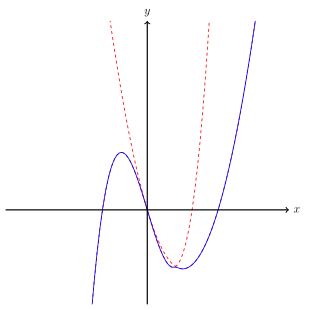
- Show that \((1, -3)\) is a local maximum point on the curve \(y = 2\mathrm{Min}(x^2, x^3) - 5x\) and find the other three local maxima and minima on this curve. Sketch the curve.
Solution:
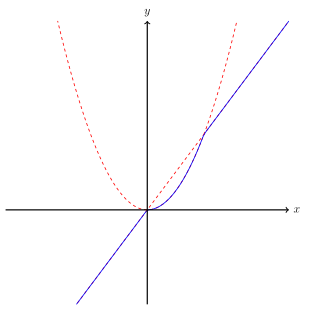
- \(2 \textrm{Min}(x^2,2x) = 5x-3\) tells us either \(2x^2 = 5x-3 \Rightarrow 2x^2 - 5x +3 = 0 \Rightarrow (2x-3)(x-1) \Rightarrow x = 1, \frac32\) and \(0 \leq x \leq 2\) or \(4x = 5x-3 \Rightarrow x= 3\) and \(x < 0\) or \(2 > x\), therefore our solutions are \(x = 1, \frac32, 3\)
- We have different cases based on \(x\) vs \(-2, 0, 2\), ie Case \(x \leq -2\): \begin{align*} && mx &= \mathrm{Min}(x^2, 2x) + \mathrm{Min}(x^3, 4x) \\ &&&= 2x + x^3 \end{align*} So \(2x = 2x + x^3 \Rightarrow x^3 = 0\), but \(x \leq -2\) so no solutions. or \(6x = 2x + x^3 \Rightarrow 0 = x(x^2-4) \Rightarrow x = 0, 2, -2\) so \(x = -2\). Case \(-2 < x \leq 0\): \begin{align*} && mx &= \mathrm{Min}(x^2, 2x) + \mathrm{Min}(x^3, 4x) \\ &&&= 2x + 4x \end{align*} So \(2x = 2x + 4x\) ie \(x = 0\) which is valid. Or \(6x = 2x + 4x\) ie valid for all values in \(-2 \leq x \leq 0\) Case \(0 < x \leq 2\): \begin{align*} && mx &= \mathrm{Min}(x^2, 2x) + \mathrm{Min}(x^3, 4x) \\ &&&= x^2 + x^3 \end{align*} So \(2x = x^2 + x^3 \Rightarrow 0 = x(x^2+x-2) = x(x-1)(x+2)\) so \(x = 0, 1, -2\), but the range means \(x = 0\) or \(x = 1\) Or \(6x = x^2 + x^3 \Rightarrow 0 = x(x^2+x-6) = x(x-2)(x+3)\) so \(x = 0, 2, -3\), but the range means \(x = 0\) or \(x = 2\) Case \(2 \leq x \): \begin{align*} && mx &= \mathrm{Min}(x^2, 2x) + \mathrm{Min}(x^3, 4x) \\ &&&=2x + 4x \end{align*} So \(2x = 2x + 4x \Rightarrow x = 0\) so no solutions. Or \(6x = 2x + 4x\) so a range of solutions. Therefore the final solutions for \(m = 2\) are \(x = 0, x = 1\) and for \(m = 2\) are \(x \in [-2,0] \cup [2, \infty)\)
- \(\mathrm{Min}(x^2, x^3)\) switches when \(x = 1\), so we must consider both limits:
\begin{align*}
&& \frac{\d y}{\d x}\vert_{x > 1} &= 4x - 5 \\
\\
&& \frac{\d y}{\d x}\vert_{x < 1} &= 6x^2 - 5 \\
\end{align*}
so when \(x = 1\) the sign of the derivative changes from positive to negative, hence a local maximum.
The other local maxima and minima will be when \(x = \frac54\) or \(x = \pm \sqrt{5/6}\)
2018 Paper 1 Q4
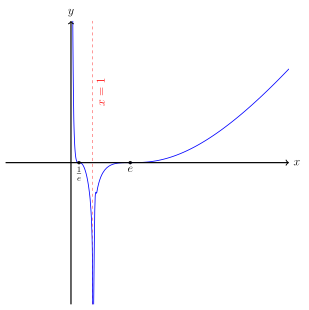
The function \(\f\) is defined by \[ \phantom{\ \ \ \ \ \ \ \ \ \ \ \ (x>0, \ \ x\ne1)} \f(x) = \frac{1}{x\ln x} \left(1 - (\ln x)^2 \right)^2 \ \ \ \ \ \ \ \ \ \ \ \ (x>0, \ \ x\ne1) \,.\] Show that, when \(( \ln x )^2 = 1\,\), both \(\f(x)=0\) and \(\f'(x)=0\,\). The function \(F\) is defined by \begin{align*} F(x) = \begin{cases} \displaystyle \int_{ 1/\text{e}}^x \f(t) \; \mathrm{d}t & \text{ for } 0 < x < 1\,, \\[7mm] \displaystyle \int_{\text{e}}^x \f(t) \; \mathrm{d}t & \text{ for } x > 1\,. \\ \end{cases} \end{align*}
- Find \(F(x)\) explicitly and hence show that \(F(x^{-1})=F(x)\,\).
- Sketch the curve with equation \(y=F(x)\,\). [You may assume that \(\dfrac{ (\ln x)^k} x\to 0\) as \(x\to\infty\) for any constant \(k\).]
Solution: When \((\ln x)^2 = 1\) we have \(f(x) = \frac{1}{x\ln x}(1 - 1^2)^2 = 0\) \(f'(x) = \frac{2(1 - (\ln x)^2) \cdot (-2 \ln x ) \cdot \frac1x \cdot (x \ln x) - (\ln x +1)(1-(\ln x)^2)^2}{(x\ln x)^2} = \frac{2\cdot 0 \cdot (-2 \ln x ) \cdot \frac1x \cdot (x \ln x) - (\ln x +1) \cdot 0}{(x\ln x)^2} = 0\)
- First consider \(0 < x < 1\), so \begin{align*} && F(x) &= \int_{1/e}^x f(t) \d t \\ &&&= \int_{1/e}^x \frac{1}{t\ln t} \left(1 - (\ln t)^2 \right)^2 \d t \\ u = \ln t, \d u = \frac1t \d t: &&&= \int_{u=-1}^{u=\ln x} \frac{1}{u}(1-u^2)^2 \d u \\ &&&= \int_{-1}^{\ln x} \left ( u^3 - 2u+\frac1u \right) \d u \\ &&&= \left [ \frac{u^4}{4} - u^2+ \ln |u| \right]_{-1}^{\ln x} \\ &&&= \frac{(\ln x)^4}{4} -(\ln x)^2 + \ln |\ln x| - \frac14+1 \end{align*} Now consider \(x > 1\) \begin{align*} && F(x) &= \int_{e}^x f(t) \d t \\ &&&= \int_{e}^x \frac{1}{t\ln t} \left(1 - (\ln t)^2 \right)^2 \d t \\ u = \ln t, \d u = \frac1t \d t: &&&= \int_{u=1}^{u=\ln x} \frac{1}{u}(1-u^2)^2 \d u \\ &&&= \int_{1}^{\ln x} \left ( u^3 - 2u+\frac1u \right) \d u \\ &&&= \left [ \frac{u^4}{4} - u^2+ \ln |u| \right]_{1}^{\ln x} \\ &&&= \frac{(\ln x)^4}{4} -(\ln x)^2 + \ln| \ln x| - \frac14+1 \end{align*} Notice that \begin{align*} F(x^{-1}) &= \frac{(\ln x^{-1})^4}{4} -(\ln x^{-1})^2 + \ln| \ln x^{-1}| - \frac14+1 \\ &= \frac{(-\ln x)^4}{4} -(-\ln x)^2 + \ln| -\ln x| - \frac14+1 \\ &= \frac{(\ln x)^4}{4} -(\ln x)^2 + \ln| \ln x| - \frac14+1 \\ &= F(x) \end{align*}
- \(\,\)
2016 Paper 1 Q3
In this question, \(\lfloor x \rfloor\) denotes the greatest integer that is less than or equal to \(x\), so that (for example) \(\lfloor 2.9 \rfloor = 2\), \(\lfloor 2\rfloor = 2\) and \(\lfloor -1.5 \rfloor = -2\). On separate diagrams draw the graphs, for \(-\pi \le x \le \pi\), of:
Solution:


2015 Paper 1 Q7
Let \[ \f(x) = 3ax^2 - 6x^3\, \] and, for each real number \(a\), let \({\rm M}(a)\) be the greatest value of \(\f(x)\) in the interval \(-\frac13 \le x \le 1\). Determine \({\rm M} (a)\) for \(a\ge0\). [The formula for \({\rm M} (a)\) is different in different ranges of \(a\); you will need to identify three ranges.]
Solution: \(f'(x) = 6ax-18x^2\), therefore \(f\) has turning points at \(0\) and \(\frac{a}3\) (ie decreasing for \(x \leq 0\) and \(x \geq \frac{a}{3}\) and increasing otherwise). Therefore possible maxima are \(f(-\tfrac13), f(\frac{a}{3}), f(1)\) where we consider \(\frac{a}{3}\) if \(a \leq 3\) and \(1\) otherwise. \(f(-\frac13) = \frac{a}{3} + \frac{2}{9} = \frac{3a+2}{9}\) \(f(\frac{a}{3}) = \frac{a^3}{3} - \frac{2a^3}{9} = \frac{a^3}{9}\) \(f(1) = 3(a-2)\) Comparing \(\frac{a^3}{9}\) to \(\frac{3a+2}{9}\) we have a double root at \(a = -1\) and a single root at \(a = 2\), therefore \(\frac{a^3}9\) is larger if \(a \geq 2\) Comparing \(3(a-2)\) to \(\frac{3a+2}9\) we have a cross-over at \(a = \frac{7}3\). Therefore we have: \begin{align*} M(a) &= \begin{cases} \frac{3a+2}{9} & 0 \leq a \leq 2 \\ \frac{a^3}{9} & 2 \leq a \leq 3 \\ 3(a-2) & 3 \leq a \end{cases} \end{align*}
2013 Paper 1 Q2
In this question, \(\lfloor x \rfloor\) denotes the greatest integer that is less than or equal to \(x\), so that \(\lfloor 2.9 \rfloor = 2 = \lfloor 2.0 \rfloor\) and \(\lfloor -1.5 \rfloor = -2\). The function \(\f\) is defined, for \(x\ne0\), by \(\f(x) = \dfrac{\lfloor x \rfloor}{x}\,\).
- Sketch the graph of \(y=\f(x)\) for \(-3\le x \le 3\) (with \(x\ne0\)).
- By considering the line \(y= \frac7{12}\) on your graph, or otherwise, solve the equation \(\f(x) = \frac7 {12}\,\). Solve also the equations \(\f(x) =\frac{17}{24}\) and \(\f(x) = \frac{4 }{3 }\,\).
- Find the largest root of the equation \(\f(x) =\frac9{10}\,\).
Solution:

- Notice that there are no solutions when \(x < 0\) since \(f(x) \geq 1\) in that region. Suppose \(x = n + \epsilon, 0 < \epsilon < 1\), then \(f(x) = \frac{n}{n+\epsilon}\), ie \(12n = 7n + 7 \epsilon \Rightarrow 5 n = 7\epsilon \Rightarrow \epsilon = \frac{5}{7}n \Rightarrow n < \frac75\), so \(n = 1 ,\epsilon = \frac57, x = \frac{12}5\). \begin{align*} && \frac{17}{24} &= f(x) \\ \Rightarrow && 17n + 17 \epsilon &= 24 n \\ \Rightarrow && 17 \epsilon &= 7 n \\ \Rightarrow && n &< \frac{17}{7} \\ \Rightarrow && n &= 1, 2 \\ \Rightarrow && x &= \frac{24}{17}, \frac{48}{17} \end{align*}. For \(f(x) = \frac{4}{3}\) we notice that \(x < 0\), so let \(x = -n +\epsilon\), ie \begin{align*} && \frac43 &= f(x) \\ \Rightarrow && \frac43 &= \frac{-n}{-n+\epsilon} \\ \Rightarrow && 4\epsilon &= n \\ \Rightarrow && n &= 1,2,3 \\ \Rightarrow && x &= -\frac{5}{4}, -\frac{3}{2}, -\frac{9}{4} \end{align*}
- \begin{align*} && \frac9{10} &= f(x) \\ \Rightarrow && 9n + 9 \epsilon &= 10 n \\ \Rightarrow && 9 \epsilon &= n \\ \Rightarrow && n < 9 \end{align} So largest will be when \(n = 8, \epsilon = \frac{8}{9}\), ie \(\frac{80}{9}\)
2011 Paper 1 Q13
In this question, you may use without proof the following result: \[ \int \sqrt{4-x^2}\, \d x = 2 \arcsin (\tfrac12 x ) + \tfrac 12 x \sqrt{4-x^2} +c\,. \] A random variable \(X\) has probability density function \(\f\) given by \[ \f(x) = \begin{cases} 2k & -a\le x <0 \\[3mm] k\sqrt{4-x^2} & \phantom{-} 0\le x \le 2 \\[3mm] 0 & \phantom{-}\text{otherwise}, \end{cases} \] where \(k\) and \(a\) are positive constants.
- Find, in terms of \(a\), the mean of \(X\).
- Let \(d\) be the value of \(X\) such that \(\P(X> d)=\frac1 {10}\,\). Show that \(d < 0\) if \(2a> 9\pi\) and find an expression for \(d\) in terms of \(a\) in this case.
- Given that \(d=\sqrt 2\), find \(a\).
Solution: First notice that \begin{align*} && 1 &= \int_{-a}^2 f(x) \d x \\ &&&= 2ka + k\pi \\ \Rightarrow && k &= (\pi + 2a)^{-1} \end{align*}
- \(\,\) \begin{align*} && \E[X] &= \int_{-a}^2 x f(x) \d x\\ &&&= \int_{-a}^0 2kx \d x + k\int_0^{2} x\sqrt{4-x^2} \d x\\ &&&= \left [kx^2 \right]_{-a}^0 +k \left [-\frac13(4-x^2)^{\frac32} \right]_0^2 \\ &&&= -ka^2 + \frac83k \\ &&&= \frac{\frac83-a^2}{\pi + 2a} \end{align*}
- Consider \(\mathbb{P}(X < 0)\) then \(d < 0 \Leftrightarrow \mathbb{P}(X < 0) > \frac{9}{10}\) \begin{align*} && \frac{9}{10} &< \mathbb{P}(X < 0) \\ &&&= \int_{-a}^0 2k \d x \\ &&&= \frac{2a}{\pi+2a} \\ \Leftrightarrow && 9\pi &< 2a \\ \\ && \frac{9}{10} &= \int_{-a}^d 2k \d x \\ &&&= \frac{2(d+a)}{\pi + 2a} \\ \Rightarrow && 9\pi &= 2a + 20d \\ \Rightarrow && d &= \frac{2a-9\pi}{20} \end{align*}
- Suppose \(d=\sqrt 2\) then \begin{align*} && \frac1{10} &= \int_{\sqrt{2}}^2 f(x) \d x \\ &&&= \int_{\sqrt{2}}^2 k\sqrt{4-x^2} \d x \\ &&&= k\left [ 2 \sin^{-1} \tfrac12 x + \tfrac12 x \sqrt{4-x^2}\right]_{\sqrt{2}}^2 \\ &&&= k\left (\pi -\frac{\pi}{2} - 1 \right) \\ \Rightarrow && \pi + 2a &= 5\pi - 10 \\ \Rightarrow && a &= 2\pi-5 \end{align*}
2007 Paper 2 Q14
The random variable \(X\) has a continuous probability density function \(\f(x)\) given by \begin{equation*} \f(x) = \begin{cases} 0 & \text{for } x \le 1 \\ \ln x & \text{for } 1\le x \le k\\ \ln k & \text{for } k\le x \le 2k\\ a-bx & \text{for } 2k \le x \le 4k \\ 0 & \text{for } x\ge 4k \end{cases} \end{equation*} where \(k\), \(a\) and \(b\) are constants.
- Sketch the graph of \(y=\f(x)\).
- Determine \(a\) and \(b\) in terms of \(k\) and find the numerical values of \(k\), \(a\) and \(b\).
- Find the median value of \(X\).
Solution:

- Since \(f(x)\) is continuous, \(a -bx\) joins \((2k, \ln k)\) and \((4k ,0)\). ie it has a gradient of \(\frac{-\ln k}{2k}\) and is zero at \(4k\), hence \(\displaystyle b = -\frac{\ln k}{2k}, a = 2\ln k\). The \(3\) sections have areas \(\int_1^k \ln x \d x = k \ln k -k +1\), \(k \ln k, k \ln k\). Therefore \begin{align*} &&1&= 3k\ln k - k +1 \\ \Rightarrow &&0 &= k(3\ln k - 1) \\ \Rightarrow &&\ln k &= \frac13 \\ \Rightarrow &&k &= e^{1/3} \\ && a &= \frac23 \\ && b&= -\frac16e^{-1/3} \end{align*}
- Clearly \(1 > k \ln k > \frac{1}{3}\), therefore the median must lie between \(k\) and \(2k\). So we need, \(\frac12\) to be the area of the rectangle + the triangle, ie: \begin{align*} && \frac12 &= k \ln k + (2k-M) \ln k \\ &&&= \frac13 k + \frac13 (2k - M) \\ \Rightarrow && M &= 3k - \frac32 \\ \Rightarrow && M &= 3e^{1/3} - \frac32 \end{align*}
2004 Paper 1 Q2
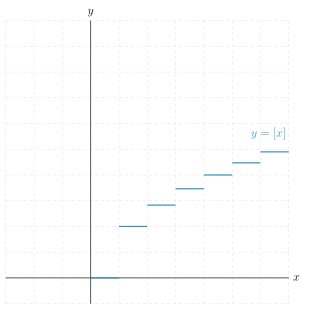
The square bracket notation \(\boldsymbol{[} x\boldsymbol{]}\) means the greatest integer less than or equal to \(x\,\). For example, \(\boldsymbol{[}\pi\boldsymbol{]} = 3\,\), \(\boldsymbol{[}\sqrt{24}\,\boldsymbol{]} = 4\,\) and \(\boldsymbol{[}5\boldsymbol{]}=5\,\).
- Sketch the graph of \(y = \sqrt{\boldsymbol{[}x\boldsymbol{]}}\) and show that \[ \displaystyle \int^a_0 \sqrt{\boldsymbol{[}x\boldsymbol{]}} \; \mathrm{d}x = \sum^{a-1}_{r=0} \sqrt{r} \] when \(a\) is a positive integer.
- Show that $\displaystyle \int^{a}_0 2_{\vphantom{A}}^{\pmb{\boldsymbol {[} } x \pmb{ \boldsymbol{]}} }\; \mathrm{d}x = 2^{a}-1\( when \)a\( is a positive integer.
- Determine an expression for \)\displaystyle \int^{a}_0 2_{\vphantom{\dot A}}^{\pmb{\boldsymbol{[} }x \pmb{ \boldsymbol{]}} } \; \mathrm{d}x\( when \)a$ is positive but not an integer.
Solution:
- \(\,\) \begin{align*} && \int_0^a \sqrt{\boldsymbol{[}x\boldsymbol{]}} \d x &= \sum_{r=0}^{a-1} \int_{x=r}^{x=r+1} \sqrt{\boldsymbol{[}x\boldsymbol{]}} \d x \\ &&&= \sum_{r=0}^{a-1} \int_r^{r+1} \sqrt{r} \d x \\ &&&= \sum_{r=0}^{a-1} \sqrt{r} \\ \end{align*}
- \(\,\) \begin{align*} && \int^{a}_0 2^{\boldsymbol {[} x \boldsymbol{]}} \d x &= \sum_{r=0}^{a-1} \int_{x=r}^{x=r+1} 2^{\boldsymbol {[} x \boldsymbol{]}} \d x \\ &&&= \sum_{r=0}^{a-1} \int_{x=r}^{x=r+1} 2^{r} \d x \\ &&&= \sum_{r=0}^{a-1} 2^{r}\\ &&&= 2^{a}-1 \end{align*}
- \(\,\) \begin{align*} && \int^{a}_0 2^{\boldsymbol {[} x \boldsymbol{]}} \d x &= \int_0^{\boldsymbol {[} a \boldsymbol{]}} 2^{\boldsymbol {[} x \boldsymbol{]}} \d x + \int_{\boldsymbol {[} a \boldsymbol{]}}^a 2^{\boldsymbol {[} x \boldsymbol{]}} \d x \\ &&&= 2^{ \boldsymbol {[} a \boldsymbol{]}}-1 + (a-\boldsymbol {[} a \boldsymbol{]})2^{\boldsymbol {[} a \boldsymbol{]}} \\ &&&= (a-\boldsymbol {[} a \boldsymbol{]}+1)2^{\boldsymbol {[} a \boldsymbol{]}} -1 \end{align*}
2002 Paper 2 Q8
Find \(y\) in terms of \(x\), given that: \begin{eqnarray*} \mbox{for \(x < 0\,\)}, && \frac{\d y}{\d x} = -y \mbox{ \ \ and \ \ } y = a \mbox{ when } x = -1\;; \\ \mbox{for \(x > 0\,\)}, && \frac{\d y}{\d x} = y \mbox{ \ \ \ \ and \ \ } y = b \ \mbox{ when } x = 1\;. \end{eqnarray*} Sketch a solution curve. Determine the condition on \(a\) and \(b\) for the solution curve to be continuous (that is, for there to be no `jump' in the value of \(y\)) at \(x = 0\). Solve the differential equation \[ \frac{\d y}{\d x} = \left\vert \e^x-1\right\vert y \] given that \(y=\e^{\e}\) when \(x=1\) and that \(y\) is continuous at \(x=0\,\). Write down the following limits: \ \[ \text{(i)} \ \ \lim_ {x \to +\infty} y\exp(-\e^x)\;; \ \ \ \ \ \ \ \ \ \text{(ii)} \ \ \lim_{x \to -\infty}y \e^{-x}\,. \]
1999 Paper 3 Q8
The function \(y(x)\) is defined for \(x\ge0\) and satisfies the conditions \[ y=0 \mbox{ \ \ and \ \ } \frac{\d y}{\d x}=1 \mbox{ \ \ at \(x=0\)}. \] When \(x\) is in the range \(2(n-1)\pi< x <2n\pi\), where \(n\) is a positive integer, \(y(t)\) satisfies the differential equation $$ {\d^2y \over \d x^2} + n^2 y=0. $$ Both \(y\) and \(\displaystyle \frac{\d y}{\d x} \) are continuous at \(x=2n\pi\) for \(n=0,\; 1,\;2,\; \ldots\;\).
- Find \(y(x)\) for \(0\le x \le 2\pi\).
- Show that \(y(x) = \frac12 \sin 2x \) for \(2\pi\le x\le 4\pi\), and find \(y(x)\) for all \(x\ge0\).
- Show that $$ \int_0^\infty y^2 \,\d x = \pi \sum_{n=1}^\infty {1\over n^2} \,. $$
1991 Paper 3 Q3
The function \(\mathrm{f}\) is defined for \(x<2\) by \[ \mathrm{f}(x)=2| x^{2}-x|+|x^{2}-1|-2|x^{2}+x|. \] Find the maximum and minimum points and the points of inflection of the graph of \(\mathrm{f}\) and sketch this graph. Is \(\mathrm{f}\) continuous everywhere? Is \(\mathrm{f}\) differentiable everywhere? Find the inverse of the function \(\mathrm{f}\), i.e. expressions for \(\mathrm{f}^{-1}(x),\) defined in the various appropriate intervals.
Solution: \[ f(x) = 2|x(x-1)| + |(x-1)(x+1)|-2|x(x+1)| \] Therefore the absolute value terms will change behaviour at \(x = -1, 0, 1\). Then \begin{align*} f(x) &= \begin{cases} 2(x^2-x)+(x^2-1)-2(x^2+x) & x \leq -1 \\ 2(x^2-x)-(x^2-1)+2(x^2+x) & -1 < x \leq 0 \\ -2(x^2-x)-(x^2-1)-2(x^2+x) & 0 < x \leq 1 \\ 2(x^2-x)+(x^2-1)-2(x^2+x) & 1 < x\end{cases} \\ &= \begin{cases} x^2-4x-1 & x \leq -1 \\ 3x^2+1& -1 < x \leq 0 \\ -5x^2+1& 0 < x \leq 1 \\ x^2-4x-1 & 1 < x\end{cases} \\ \\ f'(x) &= \begin{cases} 2x-4 & x <-1 \\ 6x & -1 < x < 0 \\ -10x & 0 < x < 1 \\ 2x-4 & 1 < x\end{cases} \\ \end{align*} Therefore \(f'(x) = 0 \Rightarrow x = 0, 2\) and so we should check all the turning points. Therefore the minimum is \(x = 2, y = -5\), maximum is \(x = -2, y = 11\) (assuming the range is actually \(|x| < 2\). There is a point of inflection at \(x = 0, y = 1\).

1987 Paper 1 Q13
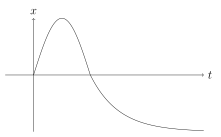
A particle of mass \(m\) moves along the \(x\)-axis. At time \(t=0\) it passes through \(x=0\) with velocity \(v_{0} > 0\). The particle is acted on by a force \(\mathrm{F}(x)\), directed along the \(x\)-axis and measured in the direction of positive \(x\), which is given by \[ \mathrm{F}(x)=\begin{cases} -m\mu^{2}x & \qquad(x\geqslant0),\\ -m\kappa\dfrac{\mathrm{d}x}{\mathrm{d}t} & \qquad(x < 0), \end{cases} \] where \(\mu\) and \(\kappa\) are positive constants. Obtain the particle's subsequent position as a function of time, and give a rough sketch of the \(x\)-\(t\) graph.
Solution: Using Newton's second law in the form, \(\F(x) = m \ddot{x}\). Our two different differential equations can be solved as follows: When \(x \geq 0\) \(-\mu^2x = \ddot{x} \Rightarrow x = A\sin \mu t + B \cos \mu t\) when \(x \geq 0\). And when \(x < 0\) \(-\kappa \dot{x} = \ddot{x} \Rightarrow \dot{x} = Ce^{-\kappa t} \Rightarrow x = De^{-\kappa t} + E\) when \(x < 0\) Following the trajectory of the particle: At \(t = 0, x = 0, \dot{x} = v_0 > 0\), so \(x = \frac{v_0}{\mu} \sin \mu t\) until \(t = \frac{\pi}{\mu}\). When \(t = \frac{\pi}{\mu}\) the particle will head into the negative \(x\)-axis with velocity \(-v_0\). At which point our initial conditions for our differential equations give us that \(De^{-\frac{\pi\kappa}{\mu}} + E = 0, -\kappa De^{-\frac{\pi\kappa}{\mu}} = -v_0 \Rightarrow De^{-\frac{\pi\kappa}{\mu}} = \frac{v_0}{\kappa}, E = -\frac{v_0}{\kappa}\). To summarise: \[ x(t) = \begin{cases} \frac{v_0}{\mu} \sin \mu t & 0 \leq t \leq \frac{\pi}{\mu} \\ -\frac{v_0}{\kappa} \l 1-e^{-\kappa(t-\frac{\pi}{\mu})}\r & t > \frac{\pi}{\mu}\end{cases}\]