Problems
Filters
14 problems found
1999 Paper 3 Q1
Consider the cubic equation \[ x^3-px^2+qx-r=0\;, \] where \(p\ne0\) and \(r\ne 0\).
- If the three roots can be written in the form \(ak^{-1}\), \(a\) and \(ak\) for some constants \(a\) and \(k\), show that one root is \(q/p\) and that \(q^3 -rp^3=0\;.\)
- If \(r=q^3/p^3\;\), show that \(q/p\) is a root and that the product of the other two roots is \((q/p)^2\). Deduce that the roots are in geometric progression.
- Find a necessary and sufficient condition involving \(p\), \(q\) and \(r\) for the roots to be in arithmetic progression.
Solution:
- If the roots are \(ak^{-1}, a, ak\) then we must have that \(p = a(k^{-1}+1+k)\), \(q = a^2(k^{-1}+k+1)\) and \(r = a^3\), therefore \(a = \frac{q}{p}\) (ie one of the roots is \(\frac q p\) and \(r = \left ( \frac{q}{p} \right)^3 \Rightarrow q^3 =rp^3 \Rightarrow q^3-rp^3 = 0\)
- Suppose \(r = q^3/p^3\) then \(\left (\frac{q}{p} \right)^3 - p\left (\frac{q}{p} \right)^2+q\left (\frac{q}{p} \right) - r = \frac{--pq^2+pq^2}{p^2} =0 \), therefore \(q/p\) is a root by the factor theorem. We must also have the product of the three roots is \(q^3/p^3\) but one of the roots is \(q/p\) therefore the product of the other two roots is \(q^2/p^2\), but the condition \(ac = b^2\) is precisely the condition that \(a,b,c\) is a geometric progression.
- If the three roots are \(a-d, a, a+d\) then \(p = 3a\), \(q = a^2-da+a^2+da+a^2-d^2 = 3a^2-d^2\), \(r = a(a^2-q^2)\), therefore \(\frac{p}{3}\left (q-\frac{2p^2}9 \right) = r\) Similarly, suppose \(\frac{p}{3}\) is a root, then the other two roots must sum to twice this and therefore they are in arithmetic progression. The condition \(\frac{p}{3}\) is a root is equivalent to: \(\frac{p^3}{27} - \frac{p^3}{9} + \frac{qp}{3} - r = 0\), ie exactly \(\frac{p}{3}\left (q-\frac{2p^2}9 \right) = r\), therefore this condition is both necessary and sufficient.
1999 Paper 3 Q2
- Let \(\f(x)=(1+x^2)\e^x\). Show that \(\f'(x)\ge 0\) and sketch the graph of \(\f(x)\). Hence, or otherwise, show that the equation \[ (1+x^2)\e^x = k, \] where \(k\) is a constant, has exactly one real root if \(k>0\) and no real roots if \(k\le 0\).
- Determine the number of real roots of the equation $$ (\e^x-1) - k \tan^{-1} x=0 $$ in the cases (a) \(0< k\le 2/\pi\) and (b) \(2/\pi < k < 1\).
Solution:
- \(\,\) \begin{align*}
&& f(x) &= (1+x^2)e^x \\
&& f'(x) &= 2xe^x + (1+x^2)e^x \\
&&&= (1+x)^2e^x \geq 0
\end{align*}
As \(x \to -\infty\), \(f(x) \to 0\) and as \(x \to \infty\), \(f(x) \to +\infty\) and since \(f\) is strictly increasing we have exactly one solution to \(f(x) = k\) on \((0,\infty)\). Since \(f(x) > 0\) there are no solutions if \(k \leq 0\).
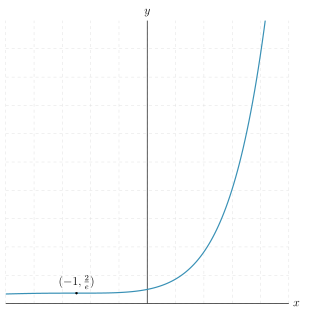
- Considering the function \(g(x) = (e^x-1)-k\tan^{-1} x \) then \(g'(x) = e^x - \frac{k}{1+x^2}\) therefore \(g'(x)\) has exactly one turning point when \(k > 0\) and \(0\) otherwise at the root of \(f(x) = k\) Notice also that \(g(0) = 0\) so we already have one solution, and \(g'(0) = 1 - k > 0\). Notice from our sketch that if \(0 < k < 1\) the root for \(f(x) = k\) has \(x \leq 0\), so our turning point is to the left of the origin and we are interested in the behaviour of \(g(x)\) as \(x \to -\infty\). (ie do we cross the axis again). \(\lim_{x \to -\infty} \left [ e^x - 1 - k \tan^{-1} x \right] = 0 - 1 +k \frac{\pi}{2} = k \frac{\pi}{2} - 1\). if this is positive, ie if \(k > \frac{2}{\pi}\) there are two solutions, otherwise there is only one real root.
1999 Paper 3 Q3
Justify, by means of a sketch, the formula $$ \lim_{n\rightarrow\infty}\left\{{1\over n}\sum_{m=1}^n \f(1+m/n)\right\} = \int_1^2 \f(x)\,\d x \,. $$ Show that $$ \lim_{n\rightarrow\infty}\left\{{1\over n+1} + {1\over n+2} + \cdots + {1\over n+n}\right\} = \ln 2 \,. $$ Evaluate $$ \lim_{n\rightarrow\infty}\left\{{n\over n^2+1} + {n\over n^2+4} + \cdots + {n\over n^2+n^2}\right\}\,. $$
Solution:

1999 Paper 3 Q4
A polyhedron is a solid bounded by \(F\) plane faces, which meet in \(E\) edges and \(V\) vertices. You may assume \textit{Euler's formula}, that \(V-E+F=2\). In a regular polyhedron the faces are equal regular \(m\)-sided polygons, \(n\) of which meet at each vertex. Show that $$ F={4n\over h} \,, $$ where \(h=4-(n-2)(m-2)\). By considering the possible values of \(h\), or otherwise, prove that there are only five regular polyhedra, and find \(V\), \(E\) and \(F\) for each.
Solution: Note that each of the \(F\) faces have \(m\) edges. If we count edges from each face we will get \(mF\) edges, but this counts each edge twice, so \(E = \frac{m}{2}F\). Similarly each edge goes into \(2\) vertices, but this counts each vertex \(n\) times, therefore \(V = \frac{2E}{n} = \frac{m}{n}F\) Therefore \begin{align*} && 2 &= V - E + F \\ &&&= \frac{m}{n}F - \frac{m}{2}F + F \\ &&&= F \left ( \frac{2m-nm+2n}{2n} \right) \\ &&&= F \left ( \frac{4-(n-2)(m-2)}{2n} \right) \\ \Rightarrow && F &= \frac{4n}{4-(n-2)(m-2)} = \frac{4n}{h} \end{align*} Notice that \(1 \leq h \leq 4\), so If \(h = 4\), then \(n = 2\) or \(m = 2\) but we can't have two-sided polygons or polyhedra with two faces making a vertex so this is not possible. If \(h = 3\) then \((n-2)(m-2) = 1\) and \(3 \mid n\), so we have \(n = 3, m = 3\). ie we have triangular faces meeting at \(3\) per point. We also have \(F = \frac{4 \cdot 3 }3\) which is \(4\) faces so this is a tetrahedron and \((V,E, F) = (4, 6, 4)\) If \(h = 2\) then \((n-2)(m-2) = 2\): Case 1: \(n = 4, m = 3\) which is four triangles meeting at each vertex with \((V,E,F) = (6, 12, 8)\), ie an octohedron. Case 2: \(n = 3, m = 4\) so we have three squares meeting at each vertex, with \((V,E,F) = (8,12,6)\) which is a cube. If \(h = 1\) then \((n-2)(m-2) = 3\) Case 1: \(n = 5, m = 3\) which is five triangles meeting at each vertex, with \((V,E,F) = ( 12,30, 20)\) ie an icosahedron. Case 2: \(n = 3, m = 5\) which is three pentagons meeting at each vertex, with \((V,E,F) = (20, 30,12)\) which is a dodecahedron. These are all the possible cases and hence we have found the five platonic solids.
1999 Paper 3 Q5
The sequence \(u_0\), \(u_1\), \(u_2\), ... is defined by $$ u_0=1,\hspace{0.2in} u_1=1, \quad u_{n+1}=u_n+u_{n-1} \hspace{0.2in}{\rm for}\hspace{0.1in}n \ge 1\,. $$ Prove that $$ u^2_{n+2} + u^2_{n-1} = 2( u^2_{n+1} + u^2_n ) \,. $$ Using induction, or otherwise, prove the following result: \[ u_{2n} = u^2_n + u^2_{n-1} \quad \mbox{ and }\quad u_{2n+1} = u^2_{n+1} - u^2_{n-1} \] for any positive integer \(n\).
Solution: Claim: \(u^2_{n+2} + u^2_{n-1} = 2( u^2_{n+1} + u^2_n )\) Proof: (By Induction). (Base Case): \(n = 1\) \begin{align*} && LHS &= u_{n+2}^2 + u_{n-1}^2 \\ &&&= u_3^2 + u_0^2 \\ &&&= 3^2 + 1^2 = 10\\ && RHS &= 2(u_{n+1}^2+u_n^2) \\ &&&= 2(2^2 + 1^2) \\ &&&= 10 \end{align*} Therefore the base case is true. (Inductive hypothesis) Suppose \(u^2_{n+2} + u^2_{n-1} = 2( u^2_{n+1} + u^2_n )\) is true for some \(n = k\), ie \(u^2_{k+2} + u^2_{k-1} = 2( u^2_{k+1} + u^2_k )\), the consider \(n = k+1\) \begin{align*} && LHS &= u_{k+1+2}^2 + u_{k+1-1}^2 \\ &&&= (u_{k+1}+u_{k+2})^2+u_k^2 \\ &&&= u_{k+2}^2+u_{k+1}^2+ u_k^2 + 2u_{k+1}u_{k+2} \\ &&&= u_{k+2}^2+u_{k+1}^2+ u_k^2 + 2u_{k+1}(u_{k+1}+u_k) \\ &&&= u_{k+2}^2 + u_{k+1}^2+u_k^2+2u_{k+1}^2+2u_{k+1}u_k \\ &&&= u_{k+1}^2+2u_{k+1}^2+ u_{k+1}^2+u_k^2+2u_{k+1}u_k \\ &&&= u_{k+2}^2+2u_{k+1}^2+ (u_{k+1}+u_k)^2 \\ &&&= u_{k+2}^2+2u_{k+1}^2+ u_{k+2}^2 \\ &&&=2(u_{k+2}^2+u_{k+1}^2) \\ &&&= RHS \end{align*} Therefore it is true for \(n = k+1\). Therefore by the principle of mathematical induction it is true for all \(n \geq 1\) Claim: $ u_{2n} = u^2_n + u^2_{n-1} \quad \mbox{ and }\quad u_{2n+1} = u^2_{n+1} - u^2_{n-1} $ Proof: Notice that \(\begin{pmatrix}u_{n+1} \\ u_n \end{pmatrix}= \begin{pmatrix} 1 & 1 \\ 1 & 0 \end{pmatrix}^n \begin{pmatrix}1 \\1 \end{pmatrix}\), in particular \begin{align*} && \begin{pmatrix}u_{n}& u_{n-1} \\ u_{n-1} & u_{n-2} \end{pmatrix}&= \begin{pmatrix} 1 & 1 \\ 1 & 0 \end{pmatrix}^{n} \\ \Rightarrow && \begin{pmatrix}u_{2n}& u_{2n-1} \\ u_{2n-1} & u_{2n-2} \end{pmatrix}&= \begin{pmatrix} 1 & 1 \\ 1 & 0 \end{pmatrix}^{2n} \\ &&&= \begin{pmatrix} 1 & 1 \\ 1 & 0 \end{pmatrix}^{n} \begin{pmatrix} 1 & 1 \\ 1 & 0 \end{pmatrix}^{n} \\ &&&=\begin{pmatrix}u_{n}& u_{n-1} \\ u_{n-1} & u_{n-2} \end{pmatrix}\begin{pmatrix}u_{n}& u_{n-1} \\ u_{n-1} & u_{n-2} \end{pmatrix}\\ &&&= \begin{pmatrix}u_{n}^2+u_{n-1}^2& u_{n-1}(u_n+u_{n-2}) \\ u_{n-1}(u_n+u_{n-2}) & u_{n-1}^2+u_{n-2}^2 \end{pmatrix} \end{align*} Therefore \(u_{2n} = u_{n}^2+u_{n-1}^2\) and \(u_{2n+1} = u_n(u_{n+1}+u_{n-1}) =(u_{n+1}-u_{n-1})(u_{n+1}-u_{n-1}) = u_{n+1}^2-u_{n-1}^2\)
1999 Paper 3 Q6
A closed curve is given by the equation $$ x^{2/n} + y^{2/n} = a^{2/n} \eqno(*) $$ where \(n\) is an odd integer and \(a\) is a positive constant. Find a parametrization \(x=x(t)\), \(y=y(t)\) which describes the curve anticlockwise as \(t\) ranges from \(0\) to \(2\pi\). Sketch the curve in the case \(n=3\), justifying the main features of your sketch. The area \(A\) enclosed by such a curve is given by the formula $$ A= {1\over 2} \int_0^{2\pi} \left[ x(t) {\d y(t)\over \d t} - y(t) {\d x(t)\over \d t} \right] \,\d t \,. $$ Use this result to find the area enclosed by (\(*\)) for \(n=3\).
1999 Paper 3 Q7
Let \(a\) be a non-zero real number and define a binary operation on the set of real numbers by $$ x*y = x+y+axy \,. $$ Show that the operation \(*\) is associative. Show that \((G,*)\) is a group, where \(G\) is the set of all real numbers except for one number which you should identify. Find a subgroup of \((G,*)\) which has exactly 2 elements.
Solution: Claim: \(*\) is associative. Proof: Then \(x*(y*z) = x*(y+z+ayz) = x + (y+z+ayz) + ax(y+z+ayz) = x + y + z + a(yz + xy + zx) + a^2xyz\) and \((x*y)*z = (x+y+axy)*z = (x+y+axy) + z+ a(x+y+axy)z = x + y + z + a(yz + xy + zx) + a^2xyz\) so \(x*(y*z) = (x*y)*z\) and we are done. Let \(G = \mathbb{R} \setminus \{-\frac1{a} \}\) In order to show that \((G, *)\) is a group we need to check:
- closure \(x*y = x + y + axy\) is a real number
- associativity we have already checked
- identity \(x*0 = x + 0 + 0 = x = 0*x\), so \(0\) is an identity
- inverses \(x*\left ( \frac{-x}{1+ax} \right ) = x - \frac{x}{1+ax} + ax \frac{-x}{1+ax} = \frac{x +ax^2 - x - ax^2}{1+ax} = 0\) so \(x\) has an identity, assuming \(1+ax \neq 0\) which is true for everything in our set
1999 Paper 3 Q8
The function \(y(x)\) is defined for \(x\ge0\) and satisfies the conditions \[ y=0 \mbox{ \ \ and \ \ } \frac{\d y}{\d x}=1 \mbox{ \ \ at \(x=0\)}. \] When \(x\) is in the range \(2(n-1)\pi< x <2n\pi\), where \(n\) is a positive integer, \(y(t)\) satisfies the differential equation $$ {\d^2y \over \d x^2} + n^2 y=0. $$ Both \(y\) and \(\displaystyle \frac{\d y}{\d x} \) are continuous at \(x=2n\pi\) for \(n=0,\; 1,\;2,\; \ldots\;\).
- Find \(y(x)\) for \(0\le x \le 2\pi\).
- Show that \(y(x) = \frac12 \sin 2x \) for \(2\pi\le x\le 4\pi\), and find \(y(x)\) for all \(x\ge0\).
- Show that $$ \int_0^\infty y^2 \,\d x = \pi \sum_{n=1}^\infty {1\over n^2} \,. $$
1999 Paper 3 Q9
The gravitational force between two point particles of masses \(m\) and \(m'\) is mutually attractive and has magnitude $$ {G m m' \over r^2}\,, $$ where \(G\) is a constant and \(r\) is the distance between them. A particle of unit mass lies on the axis of a thin uniform circular ring of radius \(r\) and mass \(m\), at a distance \(x\) from its centre. Explain why the net force on the particle is directed towards the centre of the ring and show that its magnitude is $$ {G m x \over (x^2 + r^2)^{3/2}} \,. $$ The particle now lies inside a thin hollow spherical shell of uniform density, mass \(M\) and radius \(a\), at a distance \(b\) from its centre. Show that the particle experiences no gravitational force due to the shell. %Explain without calculation the effect on this result if %the shell has finite thickness \(x\).
1999 Paper 3 Q10
A chain of mass \(m\) and length \(l\) is composed of \(n\) small smooth links. It is suspended vertically over a horizontal table with its end just touching the table, and released so that it collapses inelastically onto the table. Calculate the change in momentum of the \((k+1)\)th link from the bottom of the chain as it falls onto the table. Write down an expression for the total impulse sustained by the table in this way from the whole chain. By approximating the sum by an integral, show that this total impulse is approximately \[ {\textstyle \frac23} m \surd(2gl) \] when \(n\) is large.
1999 Paper 3 Q11
Calculate the moment of inertia of a uniform thin circular hoop of mass \(m\) and radius \(a\) about an axis perpendicular to the plane of the hoop through a point on its circumference. The hoop, which is rough, rolls with speed \(v\) on a rough horizontal table straight towards the edge and rolls over the edge without initially losing contact with the edge. Show that the hoop will lose contact with the edge when it has rotated about the edge of the table through an angle \(\theta\), where \[ \cos\theta = \frac 12 +\frac {v^2}{2ag}. \] %Give the corresponding result for a smooth hoop and table.
1999 Paper 3 Q12
In the game of endless cricket the scores \(X\) and \(Y\) of the two sides are such that \[ \P (X=j,\ Y=k)=\e^{-1}\frac{(j+k)\lambda^{j+k}}{j!k!},\] for some positive constant \(\lambda\), where \(j,k = 0\), \(1\), \(2\), \(\ldots\).
- Find \(\P(X+Y=n)\) for each \(n>0\).
- Show that \(2\lambda \e^{2\lambda-1}=1\).
- Show that \(2x \e^{2x-1}\) is an increasing function of \(x\) for \(x>0\) and deduce that the equation in (ii) has at most one solution and hence determine \(\lambda\).
- Calculate the expectation \(\E(2^{X+Y})\).
Solution:
- \begin{align*} && \mathbb{P}(X+Y = n) &= \sum_{i = 0}^n \mathbb{P}(X = i, Y = n-i) \\ &&&= \sum_{i = 0}^n e^{-1} \frac{n \lambda^n}{i! (n-i)!} \\ &&&=e^{-1} n \lambda^n \sum_{i = 0}^n\frac{1}{i! (n-i)!} \\ &&&=\frac{e^{-1} n}{n!} \lambda^n \sum_{i = 0}^n\frac{n!}{i! (n-i)!} \\ &&&= \frac{n\lambda^n}{e n!} 2^n \\ &&&= \frac{n (2 \lambda)^n}{e \cdot n!} \end{align*}
- \begin{align*} && 1 &= \sum_{n = 0}^{\infty} \mathbb{P}(X+Y =n ) \\ &&&= \sum_{n = 0}^{\infty}\frac{n (2 \lambda)^n}{e \cdot n!} \\ &&&= \sum_{n = 1}^\infty \frac{ (2 \lambda)^n}{e \cdot (n-1)!} \\ &&&= \frac{2 \lambda}{e}\sum_{n = 0}^\infty \frac{ (2 \lambda)^n}{n!} \\ &&&= \frac{2 \lambda}{e} e^{2\lambda} \\ &&&= 2 \lambda e^{2\lambda - 1} \end{align*} \\
- Consider \(f(x) = 2xe^{2x-1}\), then \begin{align*} && f'(x) &= 2e^{2x-1} + 2xe^{2x-1} \cdot 2 \\ &&&= e^{2x-1} (2 + 4x) > 0 \end{align*} Therefore \(f(x)\) is an increasing function of \(x\), which means \(f(x) = 1\) has at most one solution for \(\lambda\). Therefore \(\lambda = \frac12\)
- \begin{align*} \mathbb{E}(2^{X+Y}) &= \sum_{n = 0}^\infty \mathbb{P}(X+Y = n) 2^n \\ &= \sum_{n = 1}^\infty \frac{1}{e(n-1)!} 2^{n} \\ &= \frac{2}{e} \sum_{n=0}^\infty \frac{2^n}{n!} \\ &= \frac{2}{e} e^2 \\ &= 2e \end{align*}
1999 Paper 3 Q13
The cakes in our canteen each contain exactly four currants, each currant being randomly placed in the cake. I take a proportion \(X\) of a cake where \(X\) is a random variable with density function \[{\mathrm f}(x)=Ax\] for \(0\leqslant x\leqslant 1\) where \(A\) is a constant.
- What is the expected number of currants in my portion?
- If I find all four currants in my portion, what is the probability that I took more than half the cake?
1999 Paper 3 Q14
In the basic version of Horizons (H1) the player has a maximum of \(n\) turns, where \(n \ge 1\). At each turn, she has a probability \(p\) of success, where \(0 < p < 1\). If her first success is at the \(r\)th turn, where \(1 \le r \le n\), she collects \(r\) pounds and then withdraws from the game. Otherwise, her winnings are nil. Show that in H1, her expected winnings are $$ p^{-1}\left[1+nq^{n+1}-(n+1)q^n\right]\quad\hbox{pounds}, $$ where \(q=1-p\). The rules of H2 are the same as those of H1, except that \(n\) is randomly selected from a Poisson distribution with parameter \(\lambda\). If \(n=0\) her winnings are nil. Otherwise she plays H1 with the selected \(n\). Show that in H2, her expected winnings are $$ {1 \over p}{\left(1-{\e^{-{\lambda}p}}\right)} -{{\lambda}q}{\e^{-{\lambda}p}} \quad\hbox{pounds}. $$
Solution: \begin{align*} && \E[H1] &= \sum_{r=1}^n r \cdot \mathbb{P}(\text{first success on }r\text{th turn}) \\ &&&= \sum_{r=1}^n r \cdot q^{r-1}p \\ &&&= p\sum_{r=1}^n r q^{r-1} \\ \\ && \frac{1-x^{n+1}}{1-x} &= \sum_{r=0}^n x^r \\ \Rightarrow && \sum_{r=1}^n r x^{r-1} &= \frac{-(n+1)x^n(1-x) +(1-x^{n+1})}{(1-x)^2} \\ &&&= \frac{1-(n+1)x^n+nx^{n+1}}{(1-x)^2} \\ \\ && \E[H1] &= p\sum_{r=1}^n r q^{r-1} \\ &&&= p\frac{1-(n+1)q^n+nq^{n+1}}{(1-q)^2} \\ &&&= p^{-1}(1-(n+1)q^{n} + nq^{n+1}) \end{align*} Not that if \(n =0\) , the formula for \(\E[H1] = 0\). So \begin{align*} && \E[H2] &= \E[\E[H1|n=N]] \\ &&&= p^{-1}\E \left [ 1-(N+1)q^{N} + Nq^{N+1}\right] \\ &&&= p^{-1}\E \left [ 1-((1-q)N+1)q^{N} \right] \\ &&&= p^{-1}\left (1 - p\E[Nq^N] - G_{Po(\lambda)}(q) \right) \\ &&&= p^{-1}(1-e^{-\lambda(1-q)}) - \E[Nq^N] \\ &&&= p^{-1}(1-e^{-\lambda(1-q)}) - q\lambda e^{-\lambda(1-q)} \\ &&&= p^{-1}(1-e^{-\lambda p}) - q\lambda e^{-\lambda p} \end{align*}