1999 Paper 3 Q2
Year: 1999
Paper: 3
Question Number: 2
Course: UFM Pure
Section: Sequences and series, recurrence and convergence
Difficulty: 1700.0
Banger: 1486.1
differentiation
curve sketching
stationary points
number of roots
exponential function
inverse trigonometric
inequality
monotonic function
Problem
- Let \(\f(x)=(1+x^2)\e^x\). Show that \(\f'(x)\ge 0\) and sketch the graph of \(\f(x)\). Hence, or otherwise, show that the equation \[ (1+x^2)\e^x = k, \] where \(k\) is a constant, has exactly one real root if \(k>0\) and no real roots if \(k\le 0\).
- Determine the number of real roots of the equation $$ (\e^x-1) - k \tan^{-1} x=0 $$ in the cases (a) \(0< k\le 2/\pi\) and (b) \(2/\pi < k < 1\).
Solution
- \(\,\) \begin{align*}
&& f(x) &= (1+x^2)e^x \\
&& f'(x) &= 2xe^x + (1+x^2)e^x \\
&&&= (1+x)^2e^x \geq 0
\end{align*}
As \(x \to -\infty\), \(f(x) \to 0\) and as \(x \to \infty\), \(f(x) \to +\infty\) and since \(f\) is strictly increasing we have exactly one solution to \(f(x) = k\) on \((0,\infty)\). Since \(f(x) > 0\) there are no solutions if \(k \leq 0\).
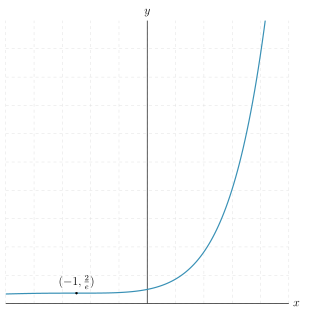
- Considering the function \(g(x) = (e^x-1)-k\tan^{-1} x \) then \(g'(x) = e^x - \frac{k}{1+x^2}\) therefore \(g'(x)\) has exactly one turning point when \(k > 0\) and \(0\) otherwise at the root of \(f(x) = k\) Notice also that \(g(0) = 0\) so we already have one solution, and \(g'(0) = 1 - k > 0\). Notice from our sketch that if \(0 < k < 1\) the root for \(f(x) = k\) has \(x \leq 0\), so our turning point is to the left of the origin and we are interested in the behaviour of \(g(x)\) as \(x \to -\infty\). (ie do we cross the axis again). \(\lim_{x \to -\infty} \left [ e^x - 1 - k \tan^{-1} x \right] = 0 - 1 +k \frac{\pi}{2} = k \frac{\pi}{2} - 1\). if this is positive, ie if \(k > \frac{2}{\pi}\) there are two solutions, otherwise there is only one real root.
Rating Information
Difficulty Rating: 1700.0
Difficulty Comparisons: 0
Banger Rating: 1486.1
Banger Comparisons: 1
Show LaTeX source
Problem source
\begin{questionparts}
\item
Let $\f(x)=(1+x^2)\e^x$. Show that $\f'(x)\ge 0$ and sketch the graph of $\f(x)$.
Hence, or otherwise, show that the equation
\[
 (1+x^2)\e^x = k,
\]
where $k$ is a constant, has exactly one real root if  $k>0$ and no real roots if  $k\le 0$.
\item
Determine the number of real roots of the equation
$$
(\e^x-1) - k \tan^{-1} x=0
$$
in the cases (a) $0< k\le 2/\pi$ and (b) $2/\pi < k < 1$.
\end{questionparts}
Solution source
\begin{questionparts}
\item $\,$ \begin{align*}
&& f(x) &= (1+x^2)e^x \\
&& f'(x) &= 2xe^x + (1+x^2)e^x \\
&&&= (1+x)^2e^x \geq 0
\end{align*}

\begin{center}
    \begin{tikzpicture}
    \def\functionf(#1){(1+(#1)^2)*exp(#1)};
    \def\xl{-2};
    \def\xu{2};
    \def\yl{-0.01}; \def\yu{20};

    % Calculate scaling factors to make the plot square
    \pgfmathsetmacro{\xrange}{\xu-\xl}
    \pgfmathsetmacro{\yrange}{\yu-\yl}
    \pgfmathsetmacro{\xscale}{10/\xrange}
    \pgfmathsetmacro{\yscale}{10/\yrange}

    % Define the reusable styles to keep code clean
    \tikzset{
        x=\xscale cm, y=\yscale cm,
        axis/.style={thick, draw=black!80, -{Stealth[scale=1.2]}},
        grid/.style={thin, dashed, gray!30},
        curveA/.style={very thick, color=cyan!70!black, smooth},
        curveB/.style={very thick, color=orange!90!black, smooth},
        dot/.style={circle, fill=black, inner sep=1.2pt},
        labelbox/.style={fill=white, inner sep=2pt, rounded corners=2pt} % Protects text from lines
    }

    % Draw background grid
    \draw[grid] (\xl,\yl) grid (\xu,\yu);

    % Set up axes
    \draw[axis] (\xl,0) -- (\xu,0) node[right, black] {$x$};
    \draw[axis] (0,\yl) -- (0,\yu) node[above, black] {$y$};

    % Define the bounding region with clip
    \begin{scope}
        \clip (\xl,\yl) rectangle (\xu,\yu);
        \draw[curveA, domain=\xl:\xu, samples=150]
            plot ({\x},{\functionf(\x)});
        \filldraw (-1, {2*exp(-1)}) circle (1pt) node[above] {$(-1, \frac{2}{e})$};
    \end{scope}

    % Annotate Function Names
    % \node[curveA, labelbox] at ({(\xl+\xu)/2}, {\functionf((\xl+\xu)/2)}) {$y = x^{-2}$};
    % \node[curveB, labelbox] at (1.85, -1.1) {$x = \frac{4y^2+1}{3}$};


    \end{tikzpicture}
\end{center}


As $x \to -\infty$, $f(x) \to 0$ and as $x \to \infty$, $f(x) \to +\infty$ and since $f$ is strictly increasing we have exactly one solution to $f(x) = k$ on $(0,\infty)$. Since $f(x) > 0$ there are no solutions if $k \leq 0$.

\item Considering the function $g(x) = (e^x-1)-k\tan^{-1} x $ then $g'(x) = e^x - \frac{k}{1+x^2}$ therefore $g'(x)$ has exactly one turning point when $k > 0$ and $0$ otherwise at the root of $f(x) = k$

Notice also that $g(0) = 0$ so we already have one solution, and $g'(0) = 1 - k > 0$.

Notice from our sketch that if $0 < k < 1$ the root for $f(x) = k$ has $x \leq 0$, so our turning point is to the left of the origin and we are interested in the behaviour of $g(x)$ as $x \to -\infty$. (ie do we cross the axis again).

$\lim_{x \to -\infty} \left [ e^x - 1 - k \tan^{-1} x \right] = 0 - 1 +k \frac{\pi}{2} = k \frac{\pi}{2} - 1$. if this is positive, ie if $k > \frac{2}{\pi}$ there are two solutions, otherwise there is only one real root.


\end{questionparts}