Problems
Filters
14 problems found
1996 Paper 3 Q1
Define \(\cosh x\) and \(\sinh x\) in terms of exponentials and prove, from your definitions, that \[ \cosh^{4}x-\sinh^{4}x=\cosh2x \] and \[ \cosh^{4}x+\sinh^{4}x=\tfrac{1}{4}\cosh4x+\tfrac{3}{4}. \] Find \(a_{0},a_{1},\ldots,a_{n}\) in terms of \(n\) such that \[ \cosh^{n}x=a_{0}+a_{1}\cosh x+a_{2}\cosh2x+\cdots+a_{n}\cosh nx. \] Hence, or otherwise, find expressions for \(\cosh^{2m}x-\sinh^{2m}x\) and \(\cosh^{2m}x+\sinh^{2m}x,\) in terms of \(\cosh kx,\) where \(k=0,\ldots,2m.\)
Solution: \begin{align*} \cosh x &= \frac12 (e^x + e^{-x}) \\ \sinh x &= \frac12 (e^x - e^{-x}) \\ \end{align*} \begin{align*} \cosh^4x -\sinh^4 x &= (\cosh^2x -\sinh^2 x)(\cosh^2x +\sinh^2 x) \\ &= \left ( \frac14 \left (e^{2x}+2+e^{-2x} \right)- \frac14 \left (e^{2x}-2+e^{-2x} \right) \right)(\cosh^2x +\sinh^2 x) \\ &= (\cosh^2x +\sinh^2 x) \\ &= \left ( \frac14 \left (e^{2x}+2+e^{-2x} \right)+ \frac14 \left (e^{2x}-2+e^{-2x} \right) \right) \\ &= \frac{1}{4} \left (2e^{2x}+2e^{-2x} \right) \\ &= \frac12 \left ( e^{2x}+e^{-2x} \right) \\ &= \cosh 2x \\ \\ \cosh^4x +\sinh^4 x &= \frac1{2^4}\left (e^{4x}+4e^{2x}+6+4e^{-2x}+e^{-4x} \right)+\frac1{2^4}\left (e^{4x}-4e^{2x}+6-4e^{-2x}+e^{-4x} \right) \\ &= \frac18 (e^{4x}+e^{-4x}) + \frac{3}{4} \\ &= \frac14 \cosh 4x + \frac34 \end{align*} \begin{align*} \cosh^n x &=\frac{1}{2^n} \left ( e^{x}+e^{-x} \right)^n \\ &= \frac{1}{2^n} \sum_{k=0}^n \binom{n}{k} e^{kx}e^{-(n-k)x} \\ &= \frac{1}{2^n} \sum_{k=0}^n \binom{n}{k} e^{2kx-nx} \\ &= \frac{1}{2^n} \left ( \binom{n}{n} \left(e^{nx}+e^{-nx} \right) + \binom{n}{n-1}\left(e^{(n-2)x}+e^{-(n-2)x} \right) + \cdots + \binom{n}{n-k} \left( e^{(n-2k)x}+e^{-(n-2k)x} \right) + \cdots \right) \\ &= \frac{1}{2^{n-1}} \cosh nx + \frac{1}{2^{n-1}} \binom{n}{n-1} \cosh (n-2)x + \cdots + \frac{1}{2^{n-1}} \binom{n}{n-k} \cosh (n-2k)x + \cdots \end{align*} ie \begin{align*} \cosh^{2m} x &= \frac{1}{2^{2m-1}} \cosh 2m x + \frac{2m}{2^{2m-1}} \cosh(2(m-1)x) + \cdots + \frac{1}{2^{2m-1}}\binom{2m}{k} \cosh (2(m-k)x) +\cdots+ \frac{1}{2^{2m-1}} \binom{2m}{m} \\ \sinh^{2m} x &= \frac{1}{2^{2m-1}} \cosh 2m x - \frac{2m}{2^{2m-1}} \cosh(2(m-1)x) + \cdots + (-1)^{k}\frac{1}{2^{2m-1}}\binom{2m}{k} \cosh (2(m-k)x) +\cdots+ (-1)^m\frac{1}{2^{2m-1}} \binom{2m}{m} \\ \cosh^{2m} x -\sinh^{2m} x &= \frac{m}{2^{2m-3}} \cosh (2(m-1)x) + \cdots + \frac{1}{2^{2m-2}} \binom{2m}{2k+1}\cosh(2(m-2k-1)x) + \cdots\\ \cosh^{2m} x +\sinh^{2m} x &= \frac{1}{2^{2m-2}} \cosh (2mx) + \cdots + \frac{1}{2^{2m-2}} \binom{2m}{2k}\cosh(2(m-2k)x) + \cdots \end{align*}
1996 Paper 3 Q2
For all values of \(a\) and \(b,\) either solve the simultaneous equations \begin{alignat*}{1} x+y+az & =2\\ x+ay+z & =2\\ 2x+y+z & =2b \end{alignat*} or prove that they have no solution.
Solution: Consider the matrix system: \begin{align*} \left(\begin{array}{ccc|c} 1 & 1 & a & 2 \\ 1 & a & 1 & 2 \\ 2 & 1 & 1 & 2b \\ \end{array}\right) \\ \left(\begin{array}{ccc|c} 1 & 1 & a & 2 \\ 0 & a-1 & 1-a & 0 \\ 0 & -1 & 1-2a & 2b-4 \\ \end{array}\right)\\ \left(\begin{array}{ccc|c} 1 & 1 & a & 2 \\ 0 & a-1 & 1-a & 0 \\ 0 & 0 & -2a & 2b-4 \\ \end{array}\right) \\ \end{align*} Assuming that \(a \neq 1, 0\) all steps are fine and: \(z = \frac{2-b}{a}, y = \frac{2-b}{a}, x +(1+a)y = 2, x = 2 - \frac{(2-b)(1+a)}{a} = \frac{ab+b-2}{a}\) If \(a = 0\), \(y = z\) and \(\begin{cases} x + y &= 2 \\ 2x + 2y &= 2b \end{cases} \Rightarrow b= 2, x = t, y = 2-t, z = 2-t\) If \(a = 1\), \(x = 2b-2, y = t, z = 4-t-2b\), where \(t \in \mathbb{R}\)
1996 Paper 3 Q3
Find \[ \int_{0}^{\theta}\frac{1}{1-a\cos x}\,\mathrm{d}x\,, \] where \(0 < \theta < \pi\) and \(-1 < a < 1.\) Hence show that \[ \int_{0}^{\frac{1}{2}\pi}\frac{1}{2-a\cos x}\,\mathrm{d}x=\frac{2}{\sqrt{4-a^{2}}}\tan^{-1}\sqrt{\frac{2+a}{2-a}}\,, \] and also that \[ \int_{0}^{\frac{3}{4}\pi}\frac{1}{\sqrt{2}+\cos x}\,\mathrm{d}x=\frac{\pi}{2}\,. \]
Solution: Let \(t = \tan \tfrac{x}{2}\), then \(\cos x = \frac{1-t^2}{1+t^2}, \frac{d t}{d x} =\tfrac12 (1+t^2)\) so the integral is: \begin{align*} \int_0^{\theta} \frac{1}{1-a \cos x} \d x &= \int_{0}^{\tan \frac{\theta}{2}} \frac{1}{1-a \left (\frac{1-t^2}{1+t^2} \right)} \frac{2}{1+t^2} \d t \\ &= \int_0^{\tan \frac{\theta}{2}} \frac{2}{1+t^2-a+at^2} \d t \\ &= \int_0^{\tan \frac{\theta}{2}} \frac{2}{1-a+(1+a) t^2} \d t \\ &= \frac{2}{1+a}\int_0^{\tan \tfrac{\theta}{2}} \frac{1}{\left (\frac{1-a}{1+a} \right)+t^2} \d t \\ &= \frac{2}{1+a} \sqrt{\frac{1+a}{1-a}} \tan^{-1} \left ( \sqrt{\frac{1+a}{1-a}} \tan \frac{\theta}{2} \right) + C \\ &= \frac{2}{\sqrt{1-a^2}}\tan^{-1} \left ( \sqrt{\frac{1+a}{1-a}} \tan \frac{\theta}{2} \right) + C \end{align*} Therefore \begin{align*} \int_{0}^{\frac{1}{2}\pi}\frac{1}{2-a\cos x}\,\mathrm{d}x &= \frac12 \int_0^{\frac12 \pi} \frac{1}{1-\tfrac{a}{2} \cos x} \d x \\ &= \left [\frac12 \frac{2}{\sqrt{1-\frac{a^2}{4}}} \tan^{-1} \left ( \sqrt{\frac{1+\frac{a}{2}}{1-\frac{a}{2}} } \tan\frac{\theta}{2} \right) \right]_0^{\pi/2} \\ &= \frac12 \frac{2}{\sqrt{1-\frac{a^2}{4}}} \tan^{-1} \left ( \sqrt{\frac{1+\frac{a}{2}}{1-\frac{a}{2}} } \tan\frac{\pi}{4} \right) \\ &= \frac{2}{\sqrt{4-a^2}} \tan^{-1} \left ( \sqrt{\frac{2+a}{2-a} } \right) \\ \end{align*} \begin{align*} \int_{0}^{\frac{3}{4}\pi}\frac{1}{\sqrt{2}+\cos x}\,\mathrm{d}x &= \frac{1}{\sqrt{2}} \int_0^{\frac34 \pi} \frac{1}{1 -\left(- \frac{1}{\sqrt{2}} \right)\cos x} \d x \\ &= \frac{1}{\sqrt{2}} \left [ \frac{2}{\sqrt{1-\tfrac12}} \tan^{-1} \left ( \sqrt{\frac{1-\frac{1}{\sqrt{2}}}{1+\frac{1}{\sqrt{2}}} } \tan\frac{\theta}{2} \right) \right]_0^{3\pi/4} \\ &= \frac{1}{\sqrt{2}} \frac{2}{\sqrt{1/2}} \tan^{-1} \left ( \sqrt{\frac{\sqrt{2}-1}{\sqrt{2}+1} } \tan\frac{3\pi}{8} \right) \\ &= 2 \tan^{-1} \left ( \sqrt{\frac{(\sqrt{2}-1)^2}{2-1} } \tan\frac{3\pi}{8} \right)\\ &= 2 \tan^{-1} \left ( (\sqrt{2}-1) \tan\frac{3\pi}{8} \right) \end{align*} If \(t = \tan \tfrac{3\pi}{8}\), then \(-1 = \tan \tfrac{3\pi}{4} = \frac{2t}{1-t^2} \Rightarrow t^2-2t-1 = 0 \Rightarrow t = 1\pm \sqrt{2}\), since \( t > 0\), we must have \(t = 1 + \sqrt{2}\), so \begin{align*} \int_{0}^{\frac{3}{4}\pi}\frac{1}{\sqrt{2}+\cos x}\,\mathrm{d}x &= 2 \tan^{-1} \left ((\sqrt{2}-1)(\sqrt{2}+1) \right) \\ &= 2 \tan^{-1} 1 \\ &= 2 \frac{\pi}{4} \\ &= \frac{\pi}{2} \end{align*}
1996 Paper 3 Q4
Find the integers \(k\) satisfying the inequality \(k\leqslant2(k-2).\) Given that \(N\) is a strictly positive integer consider the problem of finding strictly positive integers whose sum is \(N\) and whose product is as large as possible. Call this largest possible product \(P(N).\) Show that \(P(5)=2\times3, P(6)=3^{2}, P(7)=2^{2}\times3, P(8)=2\times3^{2}\) and \(P(9)=3^{3}.\) Find \(P(1000)\) explaining your reasoning carefully.
Solution: \begin{align*} && k &\leq 2(k-2) \\ \Rightarrow && 4 &\leq k \end{align*} Lemma: Suppose we construct \(N \neq \) (optimally) as a sum out of \(a_1 + \cdots +a_k\), then \(a_i \in \{2, 3\}\). Proof: Suppose not, suppose some \(a_i > 3\). Then from our earlier inequality, the sum \(a_1 + \cdots +a_{i-1} + 2 + (a_i - 2) + \cdots \) has the same sum, but a larger product. Therefore \(a_i \leq 3\). Suppose also some \(a_i = 1\), then we could replace \(a_1\) with \(a_1+1\) and remove \(a_i\), leaving us again with the same sum but larger product. (Assuming \(N \neq 1\)) \(5 = 2+3\) is the only way to write \(5\) as a sum of \(2\)s and \(3\)s, therefore \(P(5) = 2\times 3\) \(6 = 2 + 2 + 2 = 3 + 3\) and we can immediately see that \(2^3 = 8 < 3^2 = 9\), so \(P(6) = 3^2\) and whenever we have three \(2\)s we should replace them with two \(3\)s. So \(7 = 2 + 2 + 3 \Rightarrow P(7) = 2^2 \times 3\) \(8 = 3 + 3 + 2 \Rightarrow P(8) = 2\times 3^2\) \(9 = 3 + 3 + 3 \Rightarrow P(9) = 3^3\) Suppose \(1000 = 2n + 3m\), considered \(\pmod{3}\) we can see that \(n \equiv 2 \pmod{3}\) therefore we should have \(1000 = 2 + 2 + \underbrace{3 + \cdots + 3}_{332\text{ }3\text{s}}\) and so \(P(1000) = 2^2 \times 3^{332}\)
1996 Paper 3 Q5
Show, using de Moivre's theorem, or otherwise, that \[ \tan7\theta=\frac{t(t^{6}-21t^{4}+35t^{2}-7)}{7t^{6}-35t^{4}+21t^{2}-1}\,, \] where \(t=\tan\theta.\)
- By considering the equation \(\tan7\theta=0,\) or otherwise, obtain a cubic equation with integer coefficients whose roots are \[ \tan^{2}\left(\frac{\pi}{7}\right),\ \tan^{2}\left(\frac{2\pi}{7}\right)\ \mbox{ and }\tan^{2}\left(\frac{3\pi}{7}\right) \] and deduce the value of \[ \tan\left(\frac{\pi}{7}\right)\tan\left(\frac{2\pi}{7}\right)\tan\left(\frac{3\pi}{7}\right)\,. \]
- Find, without using a calculator, the value of \[ \tan^{2}\left(\frac{\pi}{14}\right)+\tan^{2}\left(\frac{3\pi}{14}\right)+\tan^{2}\left(\frac{5\pi}{14}\right)\,. \]
1996 Paper 3 Q6
- Let \(S\) be the set of matrices of the form \[ \begin{pmatrix}a & a\\ a & a \end{pmatrix}, \] where \(a\) is any real non-zero number. Show that \(S\) is closed under matrix multiplication and, further, that \(S\) is a group under matrix multiplication.
- Let \(G\) be a set of \(n\times n\) matrices which is a group under matrix multiplication, with identity element \(\mathbf{E}.\) By considering equations of the form \(\mathbf{BC=D}\) for suitable elements \(\mathbf{B},\) \(\mathbf{C}\) and \(\mathbf{D}\) of \(G\), show that if a given element \(\mathbf{A}\) of \(G\) is a singular matrix (i.e. \(\det\mathbf{A}=0\)), then all elements of \(G\) are singular. Give, with justification, an example of such a group of singular matrices in the case \(n=3.\)
Solution:
- Let $\mathbf{A} = \begin{pmatrix}1 & 1\\
1 & 1
\end{pmatrix}\(, then we need to show that \)(a\mathbf{A})(b\mathbf{A})\( is of the form \)cA\( where \)a, b, c \neq 0$.
Since $\mathbf{A}^2 = \begin{pmatrix}2 & 2\\
2 & 2
\end{pmatrix} = 2\mathbf{A}\( this is certainly the case, since \)(a\mathbf{A})(b\mathbf{A}) = 2ab\mathbf{A}$.
To check that we have a group be need to check:
- Closure (done)
- Associativity (inherited from matrix multiplication)
- Identity (\(\frac12 \mathbf{A}\))
- Inverses the inverse of \(a\mathbf{A}\) is \(\frac{1}{4a}\mathbf{A}\)
- Suppose \(\mathbf{A}\) is singular (ie \(\det\mathbf{A}=0\)), then \(\mathbf{AA^{-1}B=B}\) (where inverse is the group inverse rather than the matrix inverse) for any matrix \(\mathbf{B}\). Taking determinants we have: \(\det(\mathbf{AA^{-1}B}) = \det(B) \Rightarrow \det(A) \det(A^{-1}B) = \det(B) \Rightarrow 0 = \det(B)\), ie all matrices are singular. Consider the set of non-zero multiples of \(\begin{pmatrix} 1 & 1 & 1 \\ 1 & 1 & 1 \\ 1 & 1 & 1 \end{pmatrix}\), then the same logic as part (i) will suffice
1996 Paper 3 Q7
- If \(x+y+z=\alpha,\) \(xy+yz+zx=\beta\) and \(xyz=\gamma,\) find numbers \(A,B\) and \(C\) such that \[ x^{3}+y^{3}+z^{3}=A\alpha^{3}+B\alpha\beta+C\gamma. \] Solve the equations \begin{alignat*}{1} x+y+z & =1\\ x^{2}+y^{2}+z^{2} & =3\\ x^{3}+y^{3}+z^{3} & =4. \end{alignat*}
- The area of a triangle whose sides are \(a,b\) and \(c\) is given by the formula \[ \mathrm{area}=\sqrt{s(s-a)(s-b)(s-c)} \] where \(s\) is the semi-perimeter \(\frac{1}{2}(a+b+c).\) If \(a,b\) and \(c\) are the roots of the equation \[ x^{3}-16x^{2}+81x-128=0, \] find the area of the triangle.
Solution:
- \begin{align*} (x+y+z)^3 &= x^3+y^3+z^3+ \\ &\quad 3xy^2 + 3xz^2 + 3yx^2 + \cdots + 3zy^2 \\ &\quad\quad + 6xyz \\ (x+y+z)(xy+yz+zx) &= x^2y+x^2z + \cdots + z^2 x + 3xyz \\ x^3+y^3+z^3 &= (x+y+z)^3 - 3(xy^2 + \cdots + zy^2) - 6xyz \\ &= \alpha^3 - 3(\alpha \beta - 3\gamma)-6\gamma \\ &= \alpha^3-3\alpha \beta+3\gamma \end{align*} Since \(4 = 1^3-3\cdot1\cdot(-1) + 3 \gamma \Rightarrow \gamma = 0\), therefore one of \(x,y,z = 0\). WLOG \(x = 0\), so \(y+z = 1, y^2 + z^2 = 3 \Rightarrow y^2 + (1-y)^2 = 3 \Rightarrow y^2 -y -1 = 0 \Rightarrow y = \frac{1 \pm \sqrt{5}}{2}\), so we have \((x,y,z) = (0, \frac{1 +\sqrt{5}}{2}, \frac{1 - \sqrt{5}}{2})\) and permutations.
- \begin{align*} A^2 &= s(s-a)(s-b)(s-c) \\ \end{align*} Notice the second part is the same as plugging \(s= 16/2 = 8\) into our polynomial Therefore \begin{align*} A^2 &= 8 \cdot (8^3 - 16 \cdot 8^2 + 81 \cdot 8 - 128) \\ &= 8 \cdot 8 (8^2 - 16 \cdot 8 + 81- 16) \\ &= 64 (-64+81-16) \\ &= 64 \end{align*} Therefore \(A = 8\)
1996 Paper 3 Q8
A transformation \(T\) of the real numbers is defined by \[ y=T(x)=\frac{ax-b}{cx-d}\,, \] where \(a,b,c\), \(d\) are real numbers such that \(ad\neq bc\). Find all numbers \(x\) such that \(T(x)=x.\) Show that the inverse operation, \(x=T^{-1}(y)\) expressing \(x\) in terms of \(y\) is of the same form as \(T\) and find corresponding numbers \(a',b',c'\),\(d'\). Let \(S_{r}\) denote the set of all real numbers excluding \(r\). Show that, if \(c\neq0,\) there is a value of \(r\) such that \(T\) is defined for all \(x\in S_{r}\) and find the image \(T(S_{r}).\) What is the corresponding result if \(c=0\)? If \(T_{1},\) given by numbers \(a_{1},b_{1},c_{1},d_{1},\) and \(T_{2},\) given by numbers \(a_{2},b_{2},c_{2},d_{2}\) are two such transformations, show that their composition \(T_{3},\) defined by \(T_{3}(x)=T_{2}(T_{1}(x)),\) is of the same form. Find necessary and sufficient conditions on the numbers \(a,b,c,d\) for \(T^{2}\), the composition of \(T\) with itself, to be the identity. Hence, or otherwise, find transformations \(T_{1},T_{2}\) and their composition \(T_{3}\) such that \(T_{1}^{2}\) and \(T_{2}^{2}\) are each the identity but \(T_{3}^{2}\) is not.
1996 Paper 3 Q9
A particle of mass \(m\) is at rest on top of a smooth fixed sphere of radius \(a\). Show that, if the particle is given a small displacement, it reaches the horizontal plane through the centre of the sphere at a distance % at least $$a(5\sqrt5+4\sqrt23)/27$$ from the centre of the sphere. [Air resistance should be neglected.]
1996 Paper 3 Q10
Two rough solid circular cylinders, of equal radius and length and of uniform density, lie side by side on a rough plane inclined at an angle \(\alpha\) to the horizontal, where \(0<\alpha<\pi/2\). Their axes are horizontal and they touch along their entire length. The weight of the upper cylinder is \(W_1\) and the coefficient of friction between it and the plane is \(\mu_1\). The corresponding quantities for the lower cylinder are \(W_2\) and \(\mu_2\) respectively and the coefficient of friction between the two cylinders is \(\mu\). Show that for equilibrium to be possible:
- \(W_1\ge W_2\);
- \(\mu\geqslant\dfrac{W_1+W_2}{W_1-W_2}\);
- \(\mu_{1}\geqslant\left(\dfrac{2W_{1}\cot\alpha}{W_{1}+W_{2}}-1\right)^{-1}\,.\)
Solution:
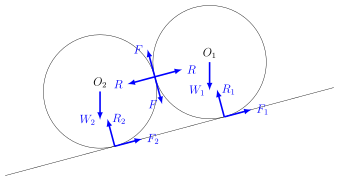
- \begin{align*} \overset{\curvearrowright}{O_2}: && 0 &= F_2 - F \\ \Rightarrow && F_2 &= F \\ \overset{\curvearrowright}{O_1}: && 0 &= F_1- F \\ \Rightarrow && F_1 &= F \\ \text{N2}(\swarrow, 2): && 0 &= R+W_2\sin\alpha -F \tag{1}\\ \text{N2}(\swarrow, 1): && 0 &= W_1\sin\alpha -F-R\tag{2}\\ \Rightarrow && W_1 \sin \alpha-R &= W_2 \sin \alpha+R \\ \Rightarrow && W_1 &\geq W_2 \end{align*}
- \begin{align*} (1)+(2)\Rightarrow && F &= \frac12 \sin \alpha (W_1 + W_2) \\ (1)-(2) \Rightarrow && R &= \frac12 \sin \alpha (W_1-W_2) \\ \Rightarrow && \frac{F}{R} &= \frac{W_1+W_2}{W_1-W_2} \\ \underbrace{\Rightarrow}_{F \leq \mu R} && \mu &\geq \frac{W_1+W_2}{W_1-W_2}\\ \end{align*}
- \begin{align*} \text{N2}(\nwarrow, 1): && 0 &= F+R_1-W_1\cos \alpha \\ \Rightarrow && R_1 &= W_1\cos \alpha - F \\ &&&= W_1 \cos \alpha - \frac12 \sin \alpha (W_1 + W_2) \\ \Rightarrow && \frac{R_1}{F_1} &= \frac{R_1}{F} \\ &&&= \frac{W_1 \cos \alpha - \frac12 \sin \alpha (W_1 + W_2)}{\frac12 \sin \alpha (W_1 + W_2) } \\ &&&= \frac{2W_1 \cot \alpha}{W_1+W_2} - 1 \\ \Rightarrow && \mu_1 & \geq \left ( \frac{2W_1 \cot \alpha}{W_1+W_2} - 1 \right)^{-1} \end{align*}
1996 Paper 3 Q11
A smooth circular wire of radius \(a\) is held fixed in a vertical plane with light elastic strings of natural length \(a\) and modulus \(\lambda\) attached to the upper and lower extremities, \(A\) and \(C\) respectively, of the vertical diameter. The other ends of the two strings are attached to a small ring \(B\) which is free to slide on the wire. Show that, while both strings remain taut, the equation for the motion of the ring is $$2ma \ddot\theta=\lambda(\cos\theta-\sin\theta)-mg\sin\theta,$$ where \(\theta\) is the angle \( \angle{CAB}\). Initially the system is at rest in equilibrium with \(\sin\theta=\frac{3}{5}\). Deduce that \(5\lambda=24mg\). The ring is now displaced slightly. Show that, in the ensuing motion, it will oscillate with period approximately $$10\pi\sqrt{a\over91g}\,.$$
1996 Paper 3 Q12
It has been observed that Professor Ecks proves three types of theorems: 1, those that are correct and new; 2, those that are correct, but already known; 3, those that are false. It has also been observed that, if a certain of her theorems is of type \(i\), then her next theorem is of type \(j\) with probability \(p\low_{ij},\) where \(p\low_{ij}\) is the entry in the \(i\)th row and \(j\)th column of the following array: \[ \begin{pmatrix}0.3 & 0.3 & 0.4\\ 0.2 & 0.4 & 0.4\\ 0.1 & 0.3 & 0.6 \end{pmatrix}\,. \] Let \(a_{i},\) \(i=1,2,3\), be the probability that a given theorem is of type \(i\), and let \(b_{j}\) be the consequent probability that the next theorem is of type \(j\).
- Explain why \(b_{j}=a\low_{1}p\low_{1j}+a\low_{2}p\low_{2j}+a\low_{3}p\low_{3j}\,.\)
- Find values of \(a\low_{1},a\low_{2}\) and \(a\low_{3}\) such that \(b_{i}=a_{i}\) for \(i=1,2,3.\)
- For these values of the \(a_{i}\) find the probabilities \(q\low_{ij}\) that, if a particular theorem is of type \(j\), then the \textit{preceding }theorem was of type \(i\).
1996 Paper 3 Q13
Let \(X\) be a random variable which takes only the finite number of different possible real values \(x_{1},x_{2},\ldots,x_{n}.\) Define the expectation \(\mathbb{E}(X)\) and the variance \(\var(X)\) of \(X\). Show that , if \(a\) and \(b\) are real numbers, then \(\E(aX+b)=a\E(X)+b\) and express \(\var(aX+b)\) similarly in terms of \(\var(X)\). Let \(\lambda\) be a positive real number. By considering the contribution to \(\var(X)\) of those \(x_{i}\) for which \(\left|x_{i}-\E(X)\right|\geqslant\lambda,\) or otherwise, show that \[ \mathrm{P}\left(\left|X-\E(X)\right|\geqslant\lambda\right)\leqslant\frac{\var(X)}{\lambda^{2}}\,. \] Let \(k\) be a real number satisfying \(k\geqslant\lambda.\) If \(\left|x_{i}-\E(X)\right|\leqslant k\) for all \(i\), show that \[ \mathrm{P}\left(\left|X-\E(X)\right|\geqslant\lambda\right)\geqslant\frac{\var(X)-\lambda^{2}}{k^{2}-\lambda^{2}}\,. \]
Solution: Definition: \(\displaystyle \mathbb{E}(X) = \sum_{i=1}^n x_i \mathbb{P}(X = x_i)\) Definition: \(\displaystyle \mathrm{Var}(X) = \sum_{i=1}^n (x_i-\mathbb{E}(X))^2 \mathbb{P}(X = x_i)\) Claim: \(\mathbb{E}(aX+b) = a\mathbb{E}(X)+b\) Proof: \begin{align*} \mathbb{E}(aX+b) &= \sum_{i=1}^n (ax_i+b) \mathbb{P}(X = x_i) \\ &= a\sum_{i=1}^n x_i \mathbb{P}(X = x_i) + b\sum_{i=1}^n \mathbb{P}(X = x_i)\\ &= a \mathbb{E}(X) + b \end{align*} Claim: \(\mathrm{Var}(aX+b) = a^2 \mathrm{Var}(X)\) Claim: \(\mathrm{P}\left(\left|X-\mathrm{E}(X)\right|\geqslant\lambda\right)\leqslant\frac{\mathrm{var}(X)}{\lambda^{2}}\) Proof: \begin{align*} \mathrm{Var}(X) &= \sum_{i=1}^n (x_i-\mathbb{E}(X))^2 \mathbb{P}(X = x_i) \\ &\geq \sum_{|x_i - \mathbb{E}(X)| \geq \lambda} (x_i-\mathbb{E}(X))^2 \mathbb{P}(X = x_i) \\ &\geq \sum_{|x_i - \mathbb{E}(X)| \geq \lambda} \lambda^2 \mathbb{P}(X = x_i) \\ &= \lambda^2 \sum_{|x_i - \mathbb{E}(X)| \geq \lambda} \mathbb{P}(X = x_i) \\ &= \lambda^2 \mathrm{P}\left(\left|X-\mathrm{E}(X)\right|\geqslant\lambda\right) \end{align*} Claim: \[ \mathrm{P}\left(\left|X-\mathrm{E}(X)\right|\geqslant\lambda\right)\geqslant\frac{\mathrm{var}(X)-\lambda^{2}}{k^{2}-\lambda^{2}}\,. \] Proof: \begin{align*} && \mathrm{Var}(X) &= \sum_{i=1}^n (x_i-\mathbb{E}(X))^2 \mathbb{P}(X = x_i) \\ &&&= \sum_{|x_i - \mathbb{E}(X)| \geq \lambda} (x_i-\mathbb{E}(X))^2 \mathbb{P}(X = x_i) + \sum_{|x_i - \mathbb{E}(X)| < \lambda} (x_i-\mathbb{E}(X))^2 \mathbb{P}(X = x_i) \\ &&& \leq \sum_{|x_i - \mathbb{E}(X)| \geq \lambda} k^2 \mathbb{P}(X = x_i) + \sum_{|x_i - \mathbb{E}(X)| < \lambda} \lambda^2 \mathbb{P}(X = x_i) \\ &&&= k^2 \mathbb{P}\left(\left|X-\mathrm{E}(X)\right|\geqslant\lambda\right) + \lambda^2 \mathbb{P}\left(\left|X-\mathrm{E}(X)\right| < \lambda\right) \\ &&&= k^2 \mathbb{P}\left(\left|X-\mathrm{E}(X)\right|\geqslant\lambda\right) + \lambda^2(1- \mathbb{P}\left(\left|X-\mathrm{E}(X)\right| \leq \lambda\right) \\ &&&= (k^2 - \lambda^2) \mathbb{P}\left(\left|X-\mathrm{E}(X)\right|\geqslant\lambda\right) + \lambda^2 \\ \Rightarrow&& \frac{\mathrm{Var}(X)-\lambda^2}{k^2 - \lambda^2} &\leq \mathbb{P}\left(\left|X-\mathrm{E}(X)\right|\geqslant\lambda\right) \end{align*} [Note: This result is known as Chebyshev's inequality, and is an important starting point to understanding the behaviour of tails of random variables]
1996 Paper 3 Q14
Whenever I go cycling I start with my bike in good working order. However if all is well at time \(t\), the probability that I get a puncture in the small interval \((t,t+\delta t)\) is \(\alpha\,\delta t.\) How many punctures can I expect to get on a journey during which my total cycling time is \(T\)? When I get a puncture I stop immediately to repair it and the probability that, if I am repairing it at time \(t\), the repair will be completed in time \((t,t+\delta t)\) is \(\beta\,\delta t.\) If \(p(t)\) is the probability that I am repairing a puncture at time \(t\), write down an equation relating \(p(t)\) to \(p(t+\delta t)\), and derive from this a differential equation relating \(p'(t)\) and \(p(t).\) Show that \[ p(t)=\frac{\alpha}{\alpha+\beta}(1-\mathrm{e}^{-(\alpha+\beta)t}) \] satisfies this differential equation with the appropriate initial condition. Find an expression, involving \(\alpha,\beta\) and \(T\), for the time expected to be spent mending punctures during a journey of total time \(T\). Hence, or otherwise, show that, the fraction of the journey expected to be spent mending punctures is given approximately by \[ \quad\frac{\alpha T}{2}\quad\ \mbox{ if }(\alpha+\beta)T\text{ is small, } \] and by \[ \frac{\alpha}{\alpha+\beta}\quad\mbox{ if }(\alpha+\beta)T\text{ is large.} \]