Problems
Filters
13 problems found
2014 Paper 2 Q1
In the triangle \(ABC\), the base \(AB\) is of length 1 unit and the angles at~\(A\) and~\(B\) are \(\alpha\) and~\(\beta\) respectively, where \(0<\alpha\le\beta\). The points \(P\) and~\(Q\) lie on the sides \(AC\) and \(BC\) respectively, with \(AP=PQ=QB=x\). The line \(PQ\) makes an angle of~\(\theta\) with the line through~\(P\) parallel to~\(AB\).
- Show that \(x\cos\theta = 1- x\cos\alpha - x\cos\beta\), and obtain an expression for \(x\sin\theta\) in terms of \(x\), \(\alpha\) and~\(\beta\). Hence show that \begin{equation} \label{eq:2*} \bigl(1+2\cos(\alpha+\beta)\bigr)x^2 - 2(\cos\alpha + \cos\beta)x + 1 = 0\,. \tag{\(*\)} \end{equation} Show that \((*)\) is also satisfied if \(P\) and \(Q\) lie on \(AC\) produced and \(BC\) produced, respectively. [By definition, \(P\) lies on \(AC\) produced if \(P\) lies on the line through \(A\) and~\(C\) and the points are in the order \(A\), \(C\), \(P\)\,.]
- State the condition on \(\alpha\) and \(\beta\) for \((*)\) to be linear in \(x\). If this condition does not hold (but the condition \(0<\alpha \le \beta\) still holds), show that \((*)\) has distinct real roots.
- Find the possible values of~\(x\) in the two cases (a) \(\alpha = \beta = 45^\circ\) and (b) \(\alpha = 30^\circ\), \(\beta = 90^\circ\), and illustrate each case with a sketch.
2014 Paper 2 Q2
This question concerns the inequality \begin{equation} \int_0^\pi \bigl( f(x) \bigr)^2 \d x \le \int_0^\pi \bigl( f'(x)\bigr)^2 \d x\,.\tag{\(*\)} \end{equation}
- Show that \((*)\) is satisfied in the case \(f(x)=\sin nx\), where \(n\) is a positive integer. Show by means of counterexamples that \((*)\) is not necessarily satisfied if either \(f(0) \ne 0\) or \(f(\pi)\ne0\).
- You may now assume that \((*)\) is satisfied for any (differentiable) function \(f\) for which \(f(0)=f(\pi)=0\). By setting \(f(x) = ax^2 + bx +c\), where \(a\), \(b\) and \(c\) are suitably chosen, show that \(\pi^2\le 10\). By setting \(f(x) = p \sin \frac12 x + q\cos \frac12 x +r\), where \(p\), \(q\) and \(r\) are suitably chosen, obtain another inequality for \(\pi\). Which of these inequalities leads to a better estimate for \(\pi^2\,\)?
Solution:
- If \(f(x) = \sin nx\) then \(f'(x) = n \cos n x\) and so \begin{align*} && LHS &= \int_0^\pi \sin^2 n x \d x \\ &&&= \left [ \frac{x+\frac1{2n}\sin 2n x}{2} \right ]_0^{\pi} \\ &&&= \frac{\pi}{2} \\ \\ && RHS &= \int_0^{\pi} n^2 \cos^2 n x \d x \\ &&&= n^2 \left [ \frac{\frac{1}{2n}\sin 2n x + x}{2} \right]_0^{\pi} \\ &&&= n^2\frac{\pi}{2} \geq LHS \end{align*} [\(f(0) = 0, f(\pi) \neq 0\)] Suppose \(f(x) = x\) then \(f'(x) = 1\) and \(LHS = \frac{\pi^3}{3} > \pi = RHS\). [\(f(0) \neq 0, f(\pi) = 0\)] Suppose \(f(x) = \pi - x\) then \(f'(x) = -1\) and \(LHS = \frac{\pi^3}{3} > \pi = RHS\)
- Suppose \(f(x) = x(\pi - x)\) then \(f'(x) = \pi - 2x\) and so \begin{align*} && \int_0^\pi x^2(\pi-x)^2 \d x &\leq \int_0^\pi (\pi-2x)^2 \d x \\ \Leftrightarrow && \left [\pi^2 \frac{x^3}{3} - 2\pi \frac{x^4}{4} + \frac{x^5}{5} \right]_0^{\pi} &\leq \left [ \pi^2x - 4\pi \frac{x^2}{2} + \frac{4x^3}{3} \right]_0^{\pi} \\ \Leftrightarrow && \pi^5 \left (\frac13 - \frac12+\frac15 \right) &\leq \pi^3 \left ( 1 - 2+\frac43 \right) \\ \Leftrightarrow && \pi^2 \frac{1}{30} &\leq \frac13 \\ \Leftrightarrow && \pi^2 &\leq 10 \end{align*} Suppose \(f(x) = p\sin \tfrac12 x + q \cos \tfrac12 x + r\), so \(f(0) = q + r\) and \(f(\pi) = p + r\), so say \(p = q = 1, r = -1\) \begin{align*} && LHS &= \int_0^{\pi} \left ( \sin \tfrac12 x + \cos \tfrac12 x-1\right)^2 \d x \\ &&&=\int_0^\pi \left ( \sin^2 \tfrac12 x + \cos^2 \tfrac12 x+1-2\sin \tfrac12 x - 2\cos \tfrac12 x+ \sin x \right)\\ &&&= \left [2x + 4\cos \tfrac12 x - 4\sin \tfrac12 x - \cos x \right]_0^{\pi} \\ &&&= \left ( 2\pi -4+1 \right) - \left ( 4-1 \right) \\ &&&= 2\pi -6\\ \\ && RHS&= \int_0^{\pi} \left ( \tfrac12 \cos \tfrac12 x -\tfrac12 \sin \tfrac12 x\right)^2 \d x \\ &&&= \int_0^{\pi} \left ( \tfrac14 \cos^2 \tfrac12 x +\tfrac14 \sin^2 \tfrac12 x-\tfrac14 \sin x\right) \d x \\ &&&= \frac{\pi}{4} - \frac12 \\ \Rightarrow && 2\pi -6 &\leq \frac{\pi}{4} - \frac12 \\ \Rightarrow && \frac{7\pi}{4} &\leq \frac{11}{2} \\ \Rightarrow && \pi &\leq \frac{22}{7} \end{align*} \(22^2/7^2 = 484/49 < 10\) therefore \(\pi \leq \frac{22}{7}\) is the better estimate.
2014 Paper 2 Q3
- Show, geometrically or otherwise, that the shortest distance between the origin and the line \(y= mx+c\), where \(c\ge0\), is \(c(m^2+1)^{-\frac12}\).
- The curve \(C\) lies in the \(x\)-\(y\) plane. Let the line \(L\) be tangent to \(C\) at a point \(P\) on \(C\), and let \(a\) be the shortest distance between the origin and \(L\). The curve \(C\) has the property that the distance \(a\) is the same for all points \(P\) on \(C\). Let \(P\) be the point on \(C\) with coordinates \((x,y(x))\). Given that the tangent to \(C\) at \(P\) is not vertical, show that \begin{equation} (y-xy')^2 = a^2\big (1+(y')^2 \big) \,. \tag{\(*\)} \end{equation} By first differentiating \((*)\) with respect to \(x\), show that either \(y= mx \pm a(1+m^2)^{\frac12}\) for some \(m\) or \(x^2+y^2 =a^2\).
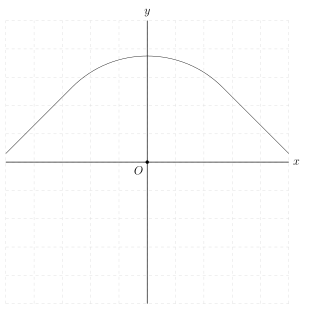
- Now suppose that \(C\) (as defined above) is a continuous curve for \(-\infty < x < \infty\), consisting of the arc of a circle and two straight lines. Sketch an example of such a curve which has a non-vertical tangent at each point.
Solution:
- \(\,\)
Note that we have a right angled triangle, with the sides in a ratio of \(m\). So if our target length is \(x\) we have \(x^2 + (mx)^2 = c^2\) and so \(x = c(m^2+1)^{-\frac12}\)
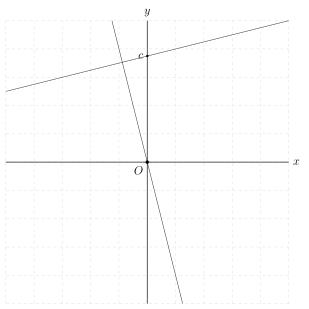
- The distance from the origin to \(L\) is \(a = c(m^2+1)^{-\frac12}\) so \begin{align*} && a^2(m^2+1) &= c^2 \\ && \frac{c-y(x)}{0-x} &= y' \\ \Rightarrow && c-y &= -xy' \\ \Rightarrow && a^2((y')^2+1) &= (y-xy')^2 \\ \\ && 2a^2y'y'' &= 2(y-xy')(y'-xy''-y') \\ &&&= 2(xy'-y)xy'' \\ \Rightarrow && y'' &= 0 \\ \text{ or } && 2a^2y' &= 2(xy'-y)x \end{align*} If \(y'' = 0\) then \(y = mx + c\) and the result follows immediately. \begin{align*} && 0 &= (a^2-x^2)y' + yx \\ \Rightarrow &&\frac1{y} y' &= -\frac{x}{a^2-x^2} \\ \Rightarrow && \ln y &= \frac12\ln (a^2-x^2) + K \\ \Rightarrow && y^2 &= M(a^2-x^2) \\ \Rightarrow && x^2 + y^2 &= a^2 \end{align*} Where in the last step we know the tangents from an ellipse are not all equidistant to the origin.
2014 Paper 2 Q4
- By using the substitution \(u=1/x\), show that for \(b>0\) \[ \int_{1/b}^b \frac{x \ln x}{(a^2+x^2)(a^2x^2+1)} \d x =0 \,. \]
- By using the substitution \(u=1/x\), show that for \(b>0\), \[ \int_{1/b}^b \frac{\arctan x}{x} \d x = \frac{\pi \ln b} 2\,. \]
- By using the result \( \displaystyle \int_0^\infty \frac 1 {a^2+x^2} \d x = \frac {\pi}{2 a} \) (where \(a > 0\)),and a substitution of the form \(u=k/x\), for suitable \(k\), show that \[ \int_0^\infty \frac 1 {(a^2+x^2)^2} \d x = \frac {\pi}{4a^3 } \, \ \ \ \ \ \ (a > 0). \]
Solution:
- \begin{align*} && I &= \int_{1/b}^b \frac{x \ln x}{(a^2+x^2)(a^2x^2+1} \d x \\ u = 1/x, \d u = -1/x^2 \d x: &&&= \int_{u=b}^{u=1/b} \frac{1/u \ln(1/u)}{(a^2+u^{-2})(a^2u^{-2}+1)} (- \frac{1}{u^2}) \d u \\ &&&= \int_{1/b}^b \frac{-u\ln u}{(a^2u^2+1)(a^2+u^2)} \d u \\ &&&= -I \\ \Rightarrow && I &= 0 \end{align*}
- \(\,\) \begin{align*} && I &= \int_{1/b}^b \frac{\arctan x}{x} \d x \\ u = 1/x, \d x = -1/u^2 \d u: &&&= \int_{u=b}^{u=1/b} \frac{\arctan \frac1u}{\frac1u} \frac{-1}{u^2} \d u \\ &&&= \int_{1/b}^b \frac{\arctan \frac1u}{u} \d u \\ \Rightarrow && 2I &= \int_{1/b}^b \frac{\arctan x + \arctan \frac1x}{x} \d x \\ &&&= \int_{1/b}^b \frac{\frac{\pi}2}{x} \d x \\ &&&= \pi \ln b \\ \Rightarrow && I &= \frac{\pi}{2} \ln b \end{align*}
- \(\,\) \begin{align*} && I_a &= \int_0^{\infty} \frac{1}{(a^2+x^2)^2} \d x \\ u = a/x, \d x = -a/u^2 \d u:&&&= \int_{u=0}^{u=\infty} \frac{1}{\left (a^2+\frac{a^2}{u^2} \right)^2} \frac{a}{u^2} \d u \\ &&&= \frac1{a^3}\int_0^{\infty} \frac{1}{(u+1/u)^2} \d u \\ &&&= \frac{1}{a^3} \int_0^{\infty} \frac{u^2}{(u^2+1)^2} \d u \\ &&&= \frac{1}{a^3} \int_0^{\infty} \frac{u^2+1-1}{(u^2+1)^2} \d u \\ &&&= \frac{1}{a^3} \int_0^{\infty} \frac{1}{(u^2+1)} - \frac{1}{(u^2+1)^2} \d u \\ &&&= \frac1{a^3} \frac{\pi}{2} - \frac{1}{a^3} I_1 \\ \Rightarrow && 2I_1 &= \frac{\pi}{2} \\ \Rightarrow && I_1 &= \frac{\pi}{4} \\ \Rightarrow && I_a &= \frac{\pi}{4a^3} \end{align*}
2014 Paper 2 Q5
Given that \(y=xu\), where \(u\) is a function of \(x\), write down an expression for \(\dfrac {\d y}{\d x}\).
- Use the substitution \(y=xu\) to solve \[ \frac {\d y}{\d x} = \frac {2y+x}{y-2x} \] given that the solution curve passes through the point \((1,1)\). Give your answer in the form of a quadratic in \(x\) and \(y\).
- Using the substitutions \(x=X+a\) and \(y=Y+b\) for appropriate values of \(a\) and \(b\), or otherwise, solve \[ \frac {\d y}{\d x} = \frac {x-2y-4} {2x+y-3}\,, \] given that the solution curve passes through the point \((1,1)\).
Solution: \begin{align*} \frac{\d y}{\d x} &= \frac{\d }{\d x} \l y \r \\ &= \frac{\d }{\d x} \l xu \r \\ &\underbrace{=}_{\text{product rule}} \frac{\d}{\d x} \l x \r u + x \frac{\d}{\d x} \l u \r \\ &= u + x \frac{\d u}{\d x} \end{align*} \begin{questionparts} \item \begin{align*} && \frac{\d y}{\d x} &= \frac{2y + x}{y - 2x} \\ && u + x \frac{\d u}{\d x} &= \frac{2u + 1}{u - 2} \\ && x \frac{\d u}{\d x} &= \frac{2u-1-u^2+2u}{u-2} \\ \Rightarrow && \int \frac{2-u}{u^2-4u+1} \d u &= \int \frac{1}{x} \d x \\ && \int \frac{2-u}{(u-2)^2-5} \d u &= \int \frac1x \d x \\ && -\frac12\ln| (u-2)^2 - 5| &= \ln x + C \\ (x,y) = (1,1): && - \ln 2 &= C \\ \Rightarrow && \ln x^2 &= \ln 4 - \ln |5 - (u-2)^2| \\ \Rightarrow && x^2 &= \frac{4}{5- (u-2)^2} \\ \Rightarrow && 4 & = x^2(5 - (\frac{y}{x} - 2)^2) \\ &&&= 5x^2 - (y-2x)^2 \\ &&&= x^2+4xy-y^2 \end{align*} \item It would be convienient if \(x-2y -4 = X-2Y\) and \(2x+y-3 = 2X+Y\), ie \(a-2b = 4\) and \(2a+b = 3\), ie \(a = 2, b = -1\). Now our differential equation is: \begin{align*} && \frac{\d Y}{\d X} &= \frac{X - 2Y}{2X+Y} \\ && \frac{\d X}{\d Y} &= \frac{2X + Y}{X-2Y} \end{align*} This is the same differential equation we have already solved, just with the roles of \(x\) and \(y\) interchanged with \(Y\) and \(X\) and with the point \((0,3)\) being on the curve, ie: \(Y^2 + 4XY-X^2 = c\) and \(c = 9\), therefore our equation is: \[ (y-1)^2 + 4(y-1)(x+2)-(x+2)^2 = 9\]
2014 Paper 2 Q6
By simplifying \(\sin(r+\frac12)x - \sin(r-\frac12)x\) or otherwise show that, for \(\sin\frac12 x \ne0\), \[ \cos x + \cos 2x +\cdots + \cos nx = \frac{\sin(n+\frac12)x - \sin\frac12 x}{2\sin\frac12x}\,. \] The functions \(S_n\), for \(n=1, 2, \dots\), are defined by \[ S_n(x) = \sum_{r=1}^n \frac 1 r \sin rx \qquad (0\le x \le \pi). \]
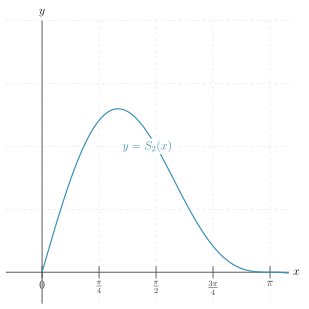
- Find the stationary points of \(S_2(x)\) for \(0\le x\le\pi\), and sketch this function.
- Show that if \(S_n(x)\) has a stationary point at \(x=x_0\), where \(0< x_0 < \pi\), then \[ \sin nx_0 = (1-\cos nx_0) \tan\tfrac12 x_0 \] and hence that \(S_n(x_0) \ge S_{n-1}(x_0)\). Deduce that if \(S_{n-1}(x) > 0\) for all \(x\) in the interval \(0 < x < \pi\), then \(S_{n}(x) > 0\) for all \(x\) in this interval.
- Prove that \(S_n(x)\ge0\) for \(n\ge1\) and \(0\le x\le\pi\).
Solution: \begin{align*} && \sin(r + \tfrac12)x - \sin(r - \tfrac12) x &= \sin rx \cos \tfrac12x + \cos r x\sin\tfrac12x - \sin r x \cos \tfrac12 x + \cos rx \sin \tfrac12 x \\ &&&= 2\cos r x \sin\tfrac12 x \\ \\ && S &= \cos x + \cos 2x + \cdots + \cos n x \\ && 2\sin \tfrac12 x S &= \sin(1 + \tfrac12)x - \sin \tfrac12 x + \\ &&&\quad+ \sin(2+\tfrac12)x - \sin(2- \tfrac12)x + \\ &&&\quad+ \sin(3+\tfrac12)x - \sin(3 - \tfrac12)x + \\ &&& \quad + \cdots + \\ &&&\quad + \sin(n+\tfrac12)x - \sin(n-\tfrac12)x \\ &&&=\sin(n+\tfrac12)x - \sin\tfrac12 x \\ \Rightarrow && S &= \frac{\sin(n+\tfrac12)x - \sin\tfrac12 x}{2 \sin \tfrac12 x} \end{align*}
- \(\,\) \begin{align*}
&& S_2(x) &= \sin x + \tfrac12 \sin 2 x \\
&& S'_2(x) &= \cos x + \cos 2x \\
&&&= \cos x + 2\cos^2 x - 1 \\
&&&= (2\cos x -1)(\cos x + 1) \\
\end{align*}
Therefore the turning points are \(\cos x= \frac12 \Rightarrow x = \frac{\pi}{3}\) and \(\cos x = -1 \Rightarrow x = \pi\)
- Suppose \(S_n(x)\) has a stationary point at \(x_0\), then $$ therefore \begin{align*} &&0 &= S_n'(x_0) \\ &&&= \cos x_0 + \cos 2x_0 + \cdots + \cos n x_0 \\ &&&= \frac{\sin(n+\tfrac12)x_0 - \sin \tfrac12x_0}{2 \sin \tfrac12 x_0} \\ \Rightarrow &&\sin\tfrac12 x_0&= \sin nx_0 \cos \tfrac12 x_0 + \cos nx_0 \sin \tfrac12x_0 \\ \Rightarrow && \sin nx_0 &= (1-\cos nx_0)\tan \tfrac12 x_0 \end{align*} Therefore \(S_n(x_0) -S_{n-1}(x_0) = \tfrac1n \sin n x_0 = \tfrac1n \underbrace{(1-\cos nx_0)}_{\geq 0}\underbrace{\tan\tfrac12 x_0}_{\geq 0} \geq 0\). Therefore if \(S_{n-1}(x) > 0\) for all \(x\) on \(0 < x < \pi\) then since \(S_n(x) > S_{n-1}(x)\) at the turning points and since they agree at the end points, it must be larger at all points inbetween.
- Notice that \(S_1(x) = \sin x \geq 0\) for all \(x \in [0,1]\) and by our previous argument we can show \(S_n > S_{n-1}\) inside the interval and equal on the boundary we must have \(S_n(x) \geq 0\) for \(x \in [0, \pi]\)
2014 Paper 2 Q7
- The function \(\f\) is defined by \(\f(x)= |x-a| + |x-b| \), where \(a < b\). Sketch the graph of \(\f(x)\), giving the gradient in each of the regions \(x < a\), \(a < x < b\) and \(x > b\). Sketch on the same diagram the graph of \(\g(x)\), where \(\g(x)= |2x-a-b|\). What shape is the quadrilateral with vertices \((a,0)\), \((b,0)\), \((b,\f(b))\) and \((a, \f(a))\)?
- Show graphically that the equation \[ |x-a| + |x-b| = |x-c|\,, \] where \(a < b\), has \(0\), \(1\) or \(2\) solutions, stating the relationship of \(c\) to \(a\) and \(b\) in each case.
- For the equation \[ |x-a| + |x-b| = |x-c|+|x-d|\,, \] where \(a < b\), \(c < d\) and \(d-c < b-a\), determine the number of solutions in the various cases that arise, stating the relationship between \(a\), \(b\), \(c\) and \(d\) in each case.
Solution:
- \(\,\)
\((a,0)\), \((b,0)\), \((b,\f(b))\) and \((a, \f(a))\) forms a rectangle.

- There are no solutions if \(a < c < b\):
There is one solution if \(a=c\) or \(a = b\)
 And there are two solution if \(c \not \in [a,b]\)
 There is exactly one solution unless....
 ... there are infinitely many solutions when the gradients line up perfectly, ie when \(a+b=c+d\)

2014 Paper 2 Q8
For positive integers \(n\), \(a\) and \(b\), the integer \(c_r\) (\(0\le r\le n\)) is defined to be the coefficient of \(x^r\) in the expansion in powers of \(x\) of \((a+bx)^n\). Write down an expression for \(c_r\) in terms of \(r\), \(n\), \(a\) and \(b\). For given \(n\), \(a\) and \(b\), let \(m\) denote a value of \(r\) for which \(c_r\) is greatest (that is, \(c_m \ge c_r\) for \(0\le r\le n\)). Show that \[ \frac{b(n+1)}{a+b} - 1 \le m \le \frac {b(n+1)}{a+b} \,. \] Deduce that \(m\) is either a unique integer or one of two consecutive integers. Let \(G(n,a,b)\) denote the unique value of \(m\) (if there is one) or the larger of the two possible values of \(m\).
- Evaluate \(G(9,1,3)\) and \(G(9,2,3)\).
- For any positive integer \(k\), find \(G(2k,a,a)\) and \(G(2k-1,a,a)\) in terms of \(k\).
- For fixed \(n\) and \(b\), determine a value of \(a\) for which \(G(n,a,b)\) is greatest.
- For fixed \(n\), find the greatest possible value of \(G(n,1,b)\). For which values of \(b\) is this greatest value achieved?
Solution: \(c_r = \binom{n}{r}a^{n-r}b^r\) \begin{align*} && c_m &\geq c_{m+1} \\ \Rightarrow && \binom{n}{m} a^{n-m}b^m &\geq \binom{n}{m+1} a^{n-m-1}b^{m+1} \\ \Rightarrow && \frac{1}{(n-m)}a &\geq \frac{1}{m+1}b \\ \Rightarrow && (m+1)a &\geq (n-m)b \\ \Rightarrow && m(a+b) &\geq nb -a \\ \Rightarrow && m &\geq \frac{n(b+1)-a-b}{a+b}=\frac{n(b+1)}{a+b} - 1 \\ \\ && c_m &\geq c_{m-1} \\ \Rightarrow && \binom{n}{m} a^{n-m}b^m &\geq \binom{n}{m-1} a^{n-m+1}b^{m-1} \\ \Rightarrow && \frac{1}m b &\geq \frac{a}{(n-m+1)} \\ \Rightarrow && (n-m+1)b &\geq ma \\ \Rightarrow && (n+1)b &\geq m(a+b) \\ \Rightarrow && m &\leq \frac{(n+1)b}{a+b} \end{align*} Since \(m\) lies between two values \(1\) apart is is either equal to one of those two values or is the unique integer between them. Let \(\displaystyle G(n,a,b) = \left \lfloor \frac{b(n+1)}{a+b} \right \rfloor\), so
- \(\,\) \begin{align*} && G(9,1,3) &= \left \lfloor \frac{3(9+1)}{1+3} \right \rfloor \\ &&&= \left \lfloor \frac{30}{4} \right \rfloor \\ &&&= 7 \\ \\ && G(9,2,3) &= \left \lfloor \frac{3(9+1)}{2+3} \right \rfloor \\ &&&= \left \lfloor \frac{30}{5} \right \rfloor \\ &&&= 6 \end{align*}
- \(\,\) \begin{align*} && G(2k, a, a) &= \left \lfloor \frac{a(2k+1)}{a+a} \right \rfloor \\ && &= \left \lfloor \frac{2k+1}{2} \right \rfloor \\ &&&= k \\ \\ && G(2k-1, a, a) &= \left \lfloor \frac{a(2k-1+1)}{a+a} \right \rfloor \\ && &= \left \lfloor k\right \rfloor \\ &&&= k \\ \end{align*}
- \(G(n,a,b)\) is decreasing in \(a\), therefore take \(a = 1\).
- For fixed \(n\), we are looking at \(\frac{a(n+1)}{a+b}\) and we want this to be as large as possible. By considering \((n+1) - \frac{b(n+1)}{a+b}\) we can see this is increasing in \(b\) and the largest value possible is \(n\). This is achieved when \begin{align*} && \frac{b(n+1)}{a+b} & \geq n \\ \Leftrightarrow && bn + b &\geq na + bn \\ \Leftrightarrow && b& \geq na \end{align*}
2014 Paper 2 Q9
A uniform rectangular lamina \(ABCD\) rests in equilibrium in a vertical plane with the \(A\) in contact with a rough vertical wall. The plane of the lamina is perpendicular to the wall. It is supported by a light inextensible string attached to the side \(AB\) at a distance \(d\) from \(A\). The other end of the string is attached to a point on the wall above \(A\) where it makes an acute angle \(\theta\) with the downwards vertical. The side \(AB\) makes an acute angle \(\phi\) with the upwards vertical at \(A\). The sides \(BC\) and \(AB\) have lengths \(2a\) and \(2b\) respectively. The coefficient of friction between the lamina and the wall is \(\mu\).
- Show that, when the lamina is in limiting equilibrium with the frictional force acting upwards, \begin{equation} d\sin(\theta +\phi) = (\cos\theta +\mu \sin\theta)(a\cos\phi +b\sin\phi)\,. \tag{\(*\)} \end{equation}
- How should \((*)\) be modified if the lamina is in limiting equilibrium with the frictional force acting downwards?
- Find a condition on \(d\), in terms of \(a\), \(b\), \(\tan\theta\) and \(\tan\phi\), which is necessary and sufficient for the frictional force to act upwards. Show that this condition cannot be satisfied if \(b(2\tan\theta+ \tan \phi) < a\).
Solution:
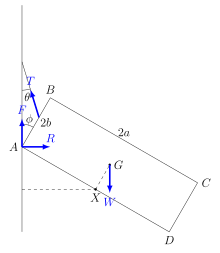
- \begin{align*} \text{N2}(\uparrow): && T \cos \theta + F -W &= 0 \\ && W &= T\cos \theta + \mu R \tag{1} \\ \text{N2}(\rightarrow): && R-T\sin \theta &= 0 \\ && R &= T \sin \theta \tag{2}\\ \\ (1)+(2): && W&=(\cos \theta + \mu \sin \theta)T \tag{3} \\ \overset{\curvearrowright}{A}: && 0 &= W(b\sin \phi + a \cos \phi) - Td\sin(\phi+\theta) \tag{4} \\ \\ (3)+(4): && 0 &= (\cos \theta + \mu \sin \theta)(b\sin \phi + a \cos \phi)-d\sin(\phi+\theta) \\ \Rightarrow && d\sin(\phi+\theta) &= (\cos \theta + \mu \sin \theta)(b\sin \phi + a \cos \phi) \end{align*} as required.
- If \(F\) is operating downwards, it's equivalent to \(-\mu\), ie: \[d\sin(\phi+\theta) = (\cos \theta - \mu \sin \theta)(b\sin \phi + a \cos \phi)\]
- For the frictional force to be acting upwards, we need \begin{align*} && d\sin(\phi+\theta) &\geq \cos \theta(b\sin \phi + a \cos \phi) \\ \Rightarrow && d &\geq \frac{\cos \theta(b\sin \phi + a \cos \phi)}{\sin(\phi + \theta)} \\ &&&= \frac{\cos \theta(b\sin \phi + a \cos \phi)}{\sin\phi \cos\theta+\cos\phi\sin \theta)}\\ &&&= \frac{(b\sin \phi + a \cos \phi)}{\sin\phi+\cos \phi \tan \theta)}\\ &&&= \frac{a+b\tan \phi}{\tan\theta+\tan\phi }\\ \end{align*} We know that \(d < 2b\), so \begin{align*} && 2b &>\frac{a+b\tan \phi}{\tan\theta+\tan\phi }\\ \Rightarrow && 2b \tan \theta + 2b \tan \phi &> a + b \tan \phi \\ \Rightarrow &&b(2 \tan \theta + \tan \phi) &> a\\ \end{align*} Therefore we will have problems if the inequality is reversed!
2014 Paper 2 Q10
A particle is projected from a point \(O\) on horizontal ground with initial speed \(u\) and at an angle of \(\theta\) above the ground. The motion takes place in the \(x\)-\(y\) plane, where the \(x\)-axis is horizontal, the \(y\)-axis is vertical and the origin is \(O\). Obtain the Cartesian equation of the particle's trajectory in terms of \(u\), \(g\) and~\(\lambda\), where \(\lambda=\tan\theta\). Now consider the trajectories for different values of \(\theta\) with \(u\)~fixed. Show that for a given value of~\(x\), the coordinate~\(y\) can take all values up to a maximum value,~\(Y\), which you should determine as a function of \(x\), \(u\) and~\(g\). Sketch a graph of \(Y\) against \(x\) and indicate on your graph the set of points that can be reached by a particle projected from \(O\) with speed \(u\). Hence find the furthest distance from \(O\) that can be achieved by such a projectile.
2014 Paper 2 Q11
A small smooth ring \(R\) of mass \(m\) is free to slide on a fixed smooth horizontal rail. A light inextensible string of length~\(L\) is attached to one end,~\(O\), of the rail. The string passes through the ring, and a particle~\(P\) of mass~\(km\) (where \(k>0\)) is attached to its other end; this part of the string hangs at an acute angle \(\alpha\) to the vertical and it is given that \(\alpha\) is constant in the motion. Let \(x\) be the distance between \(O\) and the ring. Taking the \(y\)-axis to be vertically upwards, write down the Cartesian coordinates of~\(P\) relative to~\(O\) in terms of \(x\), \(L\) and~\(\alpha\).
- By considering the vertical component of the equation of motion of \(P\), show that \[ km\ddot x \cos\alpha = T \cos\alpha - kmg\,, \] where \(T\) is the tension in the string. Obtain two similar equations relating to the horizontal components of the equations of motion of \(P\) and \(R\).
- Show that \(\dfrac {\sin\alpha}{(1-\sin\alpha)^2_{\vphantom|}} = k\), and deduce, by means of a sketch or otherwise, that motion with \(\alpha\) constant is possible for all values of~\(k\).
- Show that \(\ddot x = -g\tan\alpha\,\).
2014 Paper 2 Q12
The lifetime of a fly (measured in hours) is given by the continuous random variable \(T\) with probability density function \(f(t)\) and cumulative distribution function \(F(t)\). The hazard function, \(h(t)\), is defined, for \(F(t) < 1\), by \[ h(t) = \frac{f(t)}{1-F(t)}\,. \]
- Given that the fly lives to at least time \(t\), show that the probability of its dying within the following \(\delta t\) is approximately \(h (t) \, \delta t\) for small values of \(\delta t\).
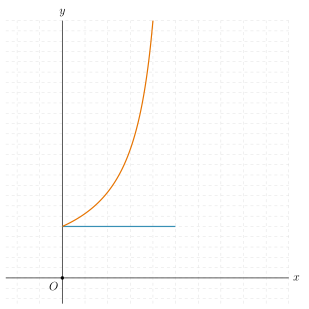
- Find the hazard function in the case \(F(t) = t/a\) for \(0< t < a\). Sketch \(f(t)\) and \(h(t)\) in this case.
- The random variable \(T\) is distributed on the interval \(t > a\), where \(a>0\), and its hazard function is \(t^{-1}\). Determine the probability density function for \(T\).
- Show that \(h(t)\) is constant for \(t > b\) and zero otherwise if and only if \(f(t) =ke^{-k(t-b)}\) for \(t > b\), where \(k\) is a positive constant.
- The random variable \(T\) is distributed on the interval \(t > 0\) and its hazard function is given by \[ h(t) = \left(\frac{\lambda}{\theta^\lambda}\right)t^{\lambda-1}\,, \] where \(\lambda\) and \(\theta\) are positive constants. Find the probability density function for \(T\).
Solution:
- \(\,\) \begin{align*} && \mathbb{P}(T > t + \delta t | T > t) &= \frac{\mathbb{P}(T < t + \delta t)}{\mathbb{P}(T > t )} \\ &&&= \frac{\int_t^{t+\delta t} f(s) \d s}{1-F(t)} \\ &&&\approx \frac{f(t)\delta t}{1-F(t)} \\ &&&= h(t) \delta t \end{align*}
- If \(F(t) = t/a\) then \(f(t) = 1/a\) and \(h(t) = \frac{1/a}{1-t/a} = \frac{1}{a-t}\)
- \(\,\) \begin{align*} && \frac{F'}{1-F} &= \frac{1}{t} \\ \Rightarrow && -\ln (1-F) &= \ln t + C\\ \Rightarrow && 1-F &= \frac{A}{t} \\ && F &= 1 - \frac{A}{t} \\ F(a) = 0: && F &= 1 - \frac{a}{t} \\ && f(t) &= \frac{a}{t^2} \end{align*}
- (\(\Rightarrow\)) \begin{align*} && \frac{F'}{1-F} &= k \\ \Rightarrow && -\ln(1-F) &= kt+C \\ \Rightarrow && 1-F &= Ae^{-kt} \\ F(b) = 0: && 1 &= Ae^{-kb} \\ \Rightarrow && 1-F &= e^{-k(t-b)}\\ \Rightarrow && f &= ke^{-k(t-b)} \\ \end{align*} (\(\Leftarrow\)) \(f(t) = ke^{-k(t-b)} \Rightarrow F(t) = 1-e^{-k(t-b)}\) and the result is clear.
- \(\,\) \begin{align*} && \frac{F'}{1-F} &= \left ( \frac{\lambda}{\theta^{\lambda}} \right) t^{\lambda-1} \\ \Rightarrow && -\ln(1-F) &= \left ( \frac{t}{\theta} \right)^{\lambda} +C\\ \Rightarrow && F &= 1-A\exp \left (- \left ( \frac{t}{\theta} \right)^{\lambda} \right) \\ F(0) = 0: && 0 &= 1-A \\ \Rightarrow && F &= 1 - \exp \left (- \left ( \frac{t}{\theta} \right)^{\lambda} \right) \\ \Rightarrow && f &= \lambda t^{\lambda -1} \theta^{-\lambda} \exp \left (- \left ( \frac{t}{\theta} \right)^{\lambda} \right) \end{align*}
2014 Paper 2 Q13
A random number generator prints out a sequence of integers \(I_1, I_2, I_3, \dots\). Each integer is independently equally likely to be any one of \(1, 2, \dots, n\), where \(n\) is fixed. The random variable \(X\) takes the value \(r\), where \(I_r\) is the first integer which is a repeat of some earlier integer. Write down an expression for \(\mathbb{P}(X=4)\).
- Find an expression for \(\mathbb{P}(X=r)\), where \(2\le r\le n+1\). Hence show that, for any positive integer \(n\), \[ \frac 1n + \left(1-\frac1n\right) \frac 2 n + \left(1-\frac1n\right)\left(1-\frac2n\right) \frac3 n + \cdots \ = \ 1 \,. \]
- Write down an expression for \(\mathbb{E}(X)\). (You do not need to simplify it.)
- Write down an expression for \(\mathbb{P}(X\ge k)\).
- Show that, for any discrete random variable \(Y\) taking the values \(1, 2, \dots, N\), \[ \mathbb{E}(Y) = \sum_{k=1}^N \mathbb{P}(Y\ge k)\,. \] Hence show that, for any positive integer \(n\), \[ \left(1-\frac{1^2}n\right) + \left(1-\frac1n\right)\left(1-\frac{2^2}n\right) + \left(1-\frac1n\right)\left(1-\frac{2}n\right)\left(1-\frac{3^2}n\right) + \cdots \ = \ 0. \]
Solution: \begin{align*} && \mathbb{P}(X > 4) &= 1 \cdot \frac{n-1}{n} \cdot \frac{n-2}{n} \cdot \frac{n-3}{n} \\ && \mathbb{P}(X > 3) &= 1 \cdot \frac{n-1}{n} \cdot \frac{n-2}{n} \\ \Rightarrow && \mathbb{P}(X =4) &= \mathbb{P}(X > 3) - \mathbb{P}(X > 4) \\ &&&= \frac{(n-1)(n-2)}{n^2} \left (1 - \frac{n-3}{n} \right) \\ &&&= \frac{3(n-1)(n-2)}{n^3} \end{align*}
- Notice that \begin{align*} && \mathbb{P}(X > r) &= \frac{n-1}{n} \cdots \frac{n-r+1}{n} \\ \Rightarrow && \mathbb{P}(X = r) &= \frac{n-1}{n} \cdots \frac{n-r+2}{n} \left (1 - \frac{n-r+1}{n} \right) \\ &&&= \frac{(n-1)\cdots(n-r+2)(r-1)}{n^{r-1}} \\ &&&= \left (1 - \frac{1}n \right)\left (1 - \frac{2}{n} \right) \cdots \left (1 - \frac{r-2}{n} \right) \frac{r-1}{n} \\ \Rightarrow && 1 &= \sum \mathbb{P}(X = r) \\ &&&= \sum_{r=2}^{n+1} \mathbb{P}(X = r) \\ &&&= \frac 1n + \left(1-\frac1n\right) \frac 2 n + \left(1-\frac1n\right)\left(1-\frac2n\right) \frac3 n + \cdots \end{align*}
- \(\,\) \begin{align*} \mathbb{E}(X) &= \sum_{r=2}^{n+1} r\cdot\mathbb{P}(X = r) \\ &= \frac 2n + \left(1-\frac1n\right) \frac {2\cdot3} n + \left(1-\frac1n\right)\left(1-\frac2n\right) \frac{3\cdot4} n + \cdots \end{align*}
- \(\displaystyle \mathbb{P}(X \geq k) = \frac{n-1}{n} \cdots \frac{n-r+2}{n}\)
- \(\,\) \begin{align*} && \mathbb{E}(Y) &= \sum_{r=1}^N r \cdot \mathbb{P}(Y = r) \\ &&&= \sum_{r=1}^N \sum_{j=1}^r \mathbb{P}(Y = r) \\ &&&= \sum_{j=1}^N \sum_{r=j}^N \mathbb{P}(Y=r) \\ &&&= \sum_{j=1}^N \mathbb{P}(Y \geq j) \end{align*} Let \(P_k = \left(1-\frac1n\right)\left(1-\frac2n\right) \cdots \left(1-\frac1n\right)\left(1-\frac{k}n\right) \) \begin{align*} && \mathbb{E}(X) &= P_1 \frac{1 \cdot 2 }{n} + P_2 \cdot \frac{2 \cdot 3}{n} + \cdots + P_k \cdot \frac{k(k+1)}{n} + \cdots \\ && &= \sum_{k=1}^{n} \frac{k^2}{n}P_k + \sum_{k=1}^{n} \frac{k}{n}P_k \\ && \text{Using the identity } & \frac{k}{n}P_k = \frac{k}{n} \prod_{i=1}^{k-1} \left(1-\frac{i}{n}\right) = P_k - P_{k+1}: \\ && \sum_{k=1}^{n} \frac{k}{n}P_k &= (P_1 - P_2) + (P_2 - P_3) + \cdots + (P_n - P_{n+1}) \\ && &= P_1 - P_{n+1} = 1 - 0 = 1 \\ \\ \Rightarrow && \mathbb{E}(X) &= \sum_{k=1}^{n} \frac{k^2}{n}P_k + 1 \\ && &= \mathbb{P}(X \geq 1) + \mathbb{P}(X \geq 2) + \mathbb{P}(X \geq 3) + \cdots \\ && &= 1 + P_1 + P_2 + P_3 + \cdots \\ && &= 1 + \sum_{k=1}^{n} P_k \\ \\ \Rightarrow && 1 + \sum_{k=1}^{n} P_k &= \sum_{k=1}^{n} \frac{k^2}{n}P_k + 1 \\ \Rightarrow && \sum_{k=1}^{n} P_k &= \sum_{k=1}^{n} \frac{k^2}{n}P_k \\ \Rightarrow && 0 &= \sum_{k=1}^{n} P_k \left( 1 - \frac{k^2}{n} \right) \end{align*}