Problems
Filters
14 problems found
2004 Paper 2 Q1
Find all real values of \(x\) that satisfy:
- \( \ds \sqrt{3x^2+1} + \sqrt{x} -2x-1=0 \;;\)
- \( \ds \sqrt{3x^2+1} - 2\sqrt{x} +x-1=0 \;;\)
- \( \ds \sqrt{3x^2+1} - 2\sqrt{x} -x+1=0 \;.\)
Solution:
- \(\,\) \begin{align*} && 0 &= \sqrt{3x^2+1} + \sqrt{x} -2x-1 \\ \Rightarrow && 2x+1 &= \sqrt{3x^2+1} + \sqrt{x} \\ \Rightarrow && 4x^2+4x+1 &= 3x^2+1+x+2\sqrt{x(3x^2+1)} \\ \Rightarrow && x^2+3x &= 2\sqrt{x(3x^2+1)} \\ \Rightarrow && x^2(x^2+6x+9) &= 4x(3x^2+1) \\ \Rightarrow && 0 &= x^4-6x^3+9x^2-4x \\ &&&= x(x-4)(x-1)^2 \end{align*} So clearly we have \(x = 0, x = 1, x = 4\). \(x = 0\) works, \(x = 1\) works, \(x = 4\) works.
- \(\,\) \begin{align*} && 0 &= \sqrt{3x^2+1} - 2\sqrt{x} +x-1 \\ \Rightarrow && 1-x &= \sqrt{3x^2+1}-2\sqrt{x} \\ \Rightarrow && x^2-2x+1 &= 3x^2+1+4x-4\sqrt{x(3x^2+1)} \\ \Rightarrow && x^2+3x &= 2\sqrt{x(3x^2+1)} \\ \Rightarrow && 0 &= x(x-4)(x-1)^2 \end{align*} Again we must check \(x = 0, x = 1, x = 4\). \(x = 0,1\) work, but \(x = 4\) is not a solution.
- \(\,\) \begin{align*} && 0 &= \sqrt{3x^2+1} - 2\sqrt{x} -x+1 \\ \Rightarrow && x-1 &= \sqrt{3x^2+1} - 2\sqrt{x} \\ \Rightarrow && x^2-2x+1 &= 3x^2+1+4x-4\sqrt{x(3x^2+1)} \\ \Rightarrow && x^2+3x &= 2\sqrt{x(3x^2+1)}\\ \Rightarrow && 0 &= x(x-4)(x-1)^2 \end{align*} So again, we need to check \(x = 0, 1, 4\). \(x = 0, 4\) work, but \(x = 1\) fails.
2004 Paper 2 Q2
Prove that, if \(\vert \alpha\vert < 2\sqrt{2},\) then there is no value of \(x\) for which \begin{equation} x^2 -{\alpha}\vert x \vert + 2 < 0\;. \tag{\(*\)} \end{equation} Find the solution set of \((*)\) for \({\alpha}=3\,\). For \({\alpha} > 2\sqrt{2}\,\), the sum of the lengths of the intervals in which \(x\) satisfies \((*)\) is denoted by \(S\,\). Find \(S\) in terms of \({\alpha}\) and deduce that \(S < 2{\alpha}\,\). Sketch the graph of \(S\,\) against \(\alpha \,\).
Solution: There are two cases to consider by they are equivalent to \(x^2 \pm \alpha x + 2 < 0\), which has no solution solutions if \(\Delta < 0\), ie if \(\alpha^2 - 4\cdot1\cdot2 < 0 \Leftrightarrow |\alpha| < 2\sqrt{2}\). If \(\alpha = 3\), we have \begin{align*} && 0 & > x^2-3x+2 \\ &&&= (x-2)(x-1) \\ \Rightarrow && x & \in (1,2) \\ \\ && 0 &> x^2+3x+2 \\ &&& = (x+2)(x+1) \\ \Rightarrow && x &\in (-2,-1) \end{align*} Both cases work here, so \(x \in (-2, -1) \cup (1,2)\). \begin{align*} && 0 &> x^2 \pm \alpha x + 2 \\ &&&= (x \pm \tfrac{\alpha}{2})^2 -\frac{\alpha^2-8}{4} \end{align*} The potential intervals therefore are \((\frac{\alpha -\sqrt{\alpha^2-8}}{2}, \frac{\alpha +\sqrt{\alpha^2-8}}{2})\) and \((\frac{-\alpha -\sqrt{\alpha^2-8}}{2}, \frac{-\alpha +\sqrt{\alpha^2-8}}{2})\). Neither of these intervals overlap with \(0\), since \(\alpha^2 > \alpha^2-8\), and their lengths are both \(\sqrt{\alpha^2-8}\), therefore \(S = 2\sqrt{\alpha^2-8} < 2\alpha\)

2004 Paper 2 Q3
The curve \(C\) has equation $$ y = x(x+1)(x-2)^4. $$ Determine the coordinates of all the stationary points of \(C\) and the nature of each. Sketch \(C\). In separate diagrams draw sketches of the curves whose equations are:
- \( y^2 = x(x+1)(x-2)^4\;\);
- \(y = x^2(x^2+1)(x^2-2)^4\,\).
Solution: \begin{align*} && y &= x(x+1)(x-2)^4 \\ \Rightarrow && y' &= (x+1)(x-2)^4+x(x-2)^4+4x(x+1)(x-2)^3 \\ &&&= (x-2)^3 \left ( (2x+1)(x-2)+4x(x+1) \right) \\ &&&= (x-2)^3 \left (2x^2-3x-2+4x^2+4x \right) \\ &&&=(x-2)^3(6x^2+x-2) \\ &&&=(x-2)^3(2x-1)(3x+2) \end{align*} Therefore there are stationary points at \((2,0), (\frac12, -\frac{625}{64}), (-\frac23, -\frac{4078}{81})\) \((0,2)\) is a minimum by considering the sign of \(y'\) either side. \( (-\frac23, \frac{2560}{729})\) is a minimum, since it's the first stationary point. \( (\frac12, \frac{243}{64})\) is a maximum since you can't have consecutive minima and the second derivative is clearly non-zero.

- \(\,\)

- \(\,\)

2004 Paper 2 Q4
\(\,\) \setlength{\unitlength}{1cm}
- An attempt is made to move a rod of length \(L\) from a corridor of width \(a\) into a corridor of width~\(b\), where \(a \ne b.\) The corridors meet at right angles, as shown in Figure 1 and the rod remains horizontal. Show that if the attempt is to be successful then $$ L \le a \cosec {\alpha} + b \sec {\alpha} \;, $$ where \({\alpha}\) satisfies $$ \tan^3\alpha =\frac a b \;. $$
- An attempt is made to move a rectangular table-top, of width \(w\) and length \(l\), from one corridor to the other, as shown in the Figure 2. The table-top remains horizontal. Show that if the attempt is to be successful then $$ l\le a \cosec {\beta} + b \sec {\beta} -2w \cosec 2{\beta}, $$ where \({\beta}\) satisfies $$ w= \left(\frac {a -b \tan^3 \beta} {1 - \tan^2 \beta} \right) \cos \beta \;. $$
2004 Paper 2 Q5
Evaluate \(\int_0^{{\pi}} x \sin x\,\d x\) and \(\int_0^{{\pi}} x \cos x\,\d x\;\). The function \(\f\) satisfies the equation \begin{equation} \f(t)=t + \int_0^{{\pi}} \f(x)\sin(x+t)\,\d x\;. \tag{\(*\)} \end{equation} Show that \[ \f(t)=t + A\sin t + B\cos t\;, \] where \(A= \int_0^{{\pi}}\,\f(x)\cos x\,\d x\;\) and \(B= \int_0^{{\pi}}\,\f(x)\sin x\,\d x\;\). Find \(A\) and \(B\) by substituting for \(\f(t)\) and \(\f(x)\) in \((*)\) and equating coefficients of \(\sin t\) and \(\cos t\,\).
Solution: \begin{align*} && I &= \int_0^\pi x \sin x \d x \\ &&&= \left [ -x \cos x \right]_0^\pi + \int_0^{\pi} \cos x \d x \\ &&&= \pi \\ \\ && J &= \int_0^\pi x \cos x \d x \\ &&&= \left [ x \sin x \right]_0^\pi - \int_0^\pi \sin x \d x \\ &&&= -2 \end{align*} \begin{align*} && f(t) &= t + \int_0^\pi f(x) \sin (x+t) \d x \\ &&&= t + \int_0^\pi f(x) \left ( \sin t \cos x + \cos t \sin x \right) \d x \\ &&&= t + \sin t \int_0^{\pi} f(x) \cos x \d x + \cos t \int_0^{\pi} f(x) \sin x \d x \\ \\ && A &= \int_0^\pi (x + A \sin x + B \cos x) \cos x \d x \\ &&&= -2+ \frac{\pi}{2} B \\ && B &= \int_0^{\pi} (x + A \sin x + B \cos x ) \sin x \d x \\ &&&= \pi + \frac{\pi}{2} A \\ \Rightarrow && (A,B) &= (-2,0) \end{align*}
2004 Paper 2 Q6
The vectors \({\bf a}\) and \({\bf b}\) lie in the plane \(\Pi\,\). Given that \(\vert {\bf a} \vert= 1\) and \({\bf a}.{\bf b} = 3,\) find, in terms of \({\bf a}\) and \({\bf b}\,\), a vector \({\bf p}\) parallel to \({\bf a}\) and a vector \({\bf q}\) perpendicular to \({\bf a}\,\), both lying in the plane \(\Pi\,\), such that $${\bf p}+{\bf q}={\bf a}+{\bf b}\;.$$ The vector \({\bf c}\) is not parallel to the plane \(\Pi\) and is such that \({\bf a}.{\bf c} = -2\) and \({\bf b}.{\bf c} = 2\,\). Given that \(\vert {\bf b} \vert = 5\,\), find, in terms of \({\bf a}, {\bf b}\) and \({\bf c},\) vectors \({\bf P}\), \({\bf Q}\) and \({\bf R}\) such that \({\bf P}\) and \({\bf Q}\) are parallel to \({\bf p}\) and \({\bf q},\) respectively, \({\bf R}\) is perpendicular to the plane \(\Pi\) and $${\bf P} + {\bf Q} + {\bf R} = {\bf a}+{\bf b}+{\bf c}\;.$$
Solution: Suppose \({\bf p} = \lambda {\bf a}\) and \({\bf p} + {\bf q} = {\bf a} + {\bf b}\) then \begin{align*} {\bf a} \cdot : && {\bf a} \cdot {\bf p} + {\bf a} \cdot {\bf p} &= {\bf a} \cdot {\bf a} + {\bf a} \cdot {\bf b} \\ && \lambda + 0 &= 1 + 3 = 4 \\ \Rightarrow && \mathbf{p} &= 4 \mathbf{a} \\ && \mathbf{q} &= \mathbf{b} - 3\mathbf{a} \\ \\ && \mathbf{P} &= 4p\mathbf{a} \\ && \mathbf{Q} &= q\mathbf{b} - 3q\mathbf{a} \\ \\ \mathbf{a} \cdot : && \mathbf{a} \cdot \mathbf{P} + \mathbf{a} \cdot \mathbf{Q} + \mathbf{a} \cdot \mathbf{R} &= \mathbf{a} \cdot \mathbf{a} + \mathbf{a} \cdot \mathbf{b} + \mathbf{a} \cdot \mathbf{c} \\ && 4p &= 1+3-2 \\ \Rightarrow && p &= \tfrac12 \\ \\ && {\bf P} + {\bf Q} + {\bf R} &= {\bf a}+{\bf b}+{\bf c} \\ \mathbf{b} \cdot : && \mathbf{b} \cdot \mathbf{P} + \mathbf{b} \cdot \mathbf{Q} + \mathbf{b} \cdot \mathbf{R} &= \mathbf{b} \cdot \mathbf{a} + \mathbf{b} \cdot \mathbf{b} + \mathbf{b} \cdot \mathbf{c} \\ && 12p + 25q - 9q &= 3+25+2 \\ && 6+16q &= 30 \\ \Rightarrow && q &= \tfrac{3}{2}\\ && \\ && \mathbf{P} &= 2\mathbf{a} \\ && \mathbf{Q} &= \tfrac32 \mathbf{b} - \tfrac92 \mathbf{a} \\ && \mathbf{R} &= \tfrac72\mathbf{a} -\tfrac12 \mathbf{b} + \mathbf{c} \end{align*}
2004 Paper 2 Q7
The function f is defined by $$\f(x) = 2\sin x - x\,.$$ Show graphically that the equation \(\f(x)=0\) has exactly one root in the interval \([\frac12\pi ,\,{\pi}]\,\). This interval is denoted \(I_0\). In order to determine the root, a sequence of intervals \(I_1\), \(I_2, \,\ldots\) is generated in the following way. If the interval \(I_n=[a_n,b_n]\,\), and \(c_n=(a_n+b_n)/2\,\), then \begin{equation*} I_{n+1}= \begin{cases} [a_n,c_n] & \text{if \(\; \f(a_n)\f(c_n)<0 \,\)}; \\[5pt] [c_n,b_n] & \text{if \(\; \f(c_n)\f(b_n)<0 \,\)}. \end{cases} \end{equation*} By using the approximations \(\displaystyle \frac 1{\sqrt{2}} \approx 0.7\) and \({\pi} \approx \sqrt{10} \,\), show that \(I_2=[\frac12{\pi},\,\frac58{\pi}]\) and find \(I_3\,\).
Solution: \begin{array}{c|c|c|c|c|c} n & a_n & b_n & c_n & f(a_n) & f(c_n) & f(b_n) \\ \hline 0 & \tfrac12 \pi & \pi & \tfrac34\pi & 2\sin(\tfrac12\pi)-\tfrac12\pi = 2-\tfrac12\pi & 2\sin(\tfrac34\pi)-\tfrac34\pi = \frac{2}{\sqrt{2}}-\tfrac34\pi & 2\sin(\pi)-\pi =-\pi \\ 0 & \tfrac12 \pi & \pi & \tfrac34\pi & >0 & 2-\frac{9}{16}10 < 0& <0 \\ \hline 1 & \frac12 \pi & \frac34\pi & \frac58\pi & >0 &2\sin \tfrac58\pi - \tfrac58\pi & < 0\\ 1 & \frac12 \pi & \frac34\pi & \frac58\pi & >0 & \approx 1.4 \cdot \sqrt{1.7} -\frac58\sqrt{10} < 0 & <0 \\ \hline 2 & \frac12 \pi & \frac58\pi & \frac9{16}\pi & >0 & 2\sin \frac{9}{16}\pi-\frac{9}{16}\pi & <0 \\ 2 & \frac12 \pi & \frac58\pi & \frac9{16}\pi & >0 & > 0 & <0 \\ \end{array} Threfore \(I_3 = [\frac9{16}\pi,\frac58\pi]\) \(\sin \frac{5\pi}{8} = \cos \frac{\pi}{8} = \sqrt{\frac12(\cos \frac{\pi}{4}+1)} = \frac{1}{\sqrt{2}}\sqrt{1 + \frac{1}{\sqrt{2}}} \approx 0.7 \cdot \sqrt{1.7}\) \(\sin \frac{9\pi}{16} = \cos \frac{\pi}{16} = \sqrt{\frac12\left ( \cos \frac{\pi}{8}+1 \right)} \) So we are comparing \(2\cos \frac{\pi}{16}\) with \(\frac{9}{16}\pi\) or \(4 \cos^2 \frac{\pi}{16} = 2\cos \frac{\pi}{8}+2\) with \(\frac{90}{16}\)
2004 Paper 2 Q8
Let \(x\) satisfy the differential equation $$ \frac {\d x}{\d t} = {\big( 1-x^n\big)\vphantom{\Big)}}^{\!1/n} $$ and the condition \(x=0\) when \(t=0 \,\).
- Solve the equation in the case \(n=1\) and sketch the graph of the solution for \(t > 0 \,\).
- Prove that \(1-x < (1-x^2)^{1/2} \) for \(0 < x < 1 \,\). Use this result to sketch the graph of the solution in the case \(n=2\) for \(0 < t < \frac12 \pi \,\), using the same axes as your previous sketch. By setting \(x=\sin y\,\), solve the equation in this case.
- Use the result (which you need not prove) \[ (1-x^2)^{1/2} < (1-x^3)^{1/3} \text{ \ \ for \ \ } 0 < x < 1 \;, \] to sketch, without solving the equation, the graph of the solution of the equation in the case \(n=3\) using the same axes as your previous sketches. Use your sketch to show that \(x=1\) at a value of \(t\) less than \(\frac12 \pi \,\).
Solution:
- \(\,\) \begin{align*}
&& \dot{x} &= (1-x) \\
\Rightarrow &&\int \frac{1}{1-x} \d x &= \int \d t \\
\Rightarrow && -\ln |1-x| &= t + C \\
t=0, x = 0: && -\ln 1 &= C \Rightarrow C = 0\\
\Rightarrow && -\ln|1-x| &= t \\
\Rightarrow && 1-x&= e^{-t} \\
\Rightarrow && x &= 1-e^{-t}
\end{align*}

- Notice that \((1-x^2)^{1/2} = (1-x)^{1/2}(1+x)^{1/2} > (1-x)^{1/2} > 1-x\)
\begin{align*} && \dot{x} &= \sqrt{1-x^2} \\ \Rightarrow && \int \frac{1}{\sqrt{1-x^2}} \d x &= t + C \\ x = \sin y, \d x = \cos y && \int \frac{\cos y}{\cos y} \d y &= t + C \\ \Rightarrow && y &= t + C \\ \Rightarrow && \sin^{-1} x &= t + C \\ t = 0, x = 0: && x &= \sin t \end{align*}

- \(\,\)
We know the gradient is steeper, so the solution must always be above \(\sin t\), which means it reaches \(1\) before \(\frac{\pi}{2}\)

2004 Paper 2 Q9
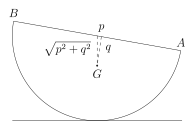
The base of a non-uniform solid hemisphere, of mass \(M,\) has radius \(r.\) The distance of the centre of gravity, \(G\), of the hemisphere from the base is \(p\) and from the centre of the base is \(\sqrt{p^2 + q^2} \,\). The hemisphere rests in equilibrium with its curved surface on a horizontal plane. A particle of mass \(m,\,\) where \(m\) is small, is attached to \(A\,\), the lowest point of the circumference of the base. In the new position of equilibrium, find the angle, \(\alpha\), that the base makes with the horizontal. The particle is removed and attached to the point \(B\) of the base which is at the other end of the diameter through \(A\,\). In the new position of equilibrium the base makes an angle \({\beta}\) with the horizontal. Show that $$\tan(\alpha-\beta)= \frac{2mMrp} {M^2\left(p^2+q^2\right)-m^2r^2}\;.$$
Solution:
2004 Paper 2 Q10
In this question take \(g = 10 ms^{-2}.\) The point \(A\) lies on a fixed rough plane inclined at \(30^{\circ}\) to the horizontal and \(\ell\) is the line of greatest slope through \(A\). A particle \(P\) is projected up \(\ell\) from \(A\) with initial speed \(6\)ms\(^{-1}\). A time \(T\) seconds later, a particle \(Q\) is projected from \(A\) up \(\ell\), also with speed \(6\)ms\(^{-1}\). The coefficient of friction between each particle and the plane is \(1/(5\sqrt{3})\,\) and the mass of each particle is \(4\)kg.
- Given that \(T<1+\sqrt{3/2}\), show that the particles collide at a time \((3-\sqrt6)T+1\) seconds after \(P\) is projected.
- In the case \(T=1+\sqrt{2/3}\,\), determine the energy lost due to friction from the instant at which \(P\) is projected to the time of the collision.
Solution: Since the particles are identical and are projected with the same speed, the only way they can reach the same point \(x\) at the same time, is if \(A\) has reached it's apex and started descending. Considering \(P\), we must have (setting the level of \(A\) to be the \(0\) G.P.E. level), suppose it travels a distance \(x\) before becoming stationary: \begin{align*} \text{N2}(\nwarrow): && R - 4g \cos(30^\circ) &= 0 \\ \Rightarrow && R &= 20\sqrt{3} \\ \Rightarrow && \mu R &= \frac1{5 \sqrt{3}} (20 \sqrt{3}) \\ &&&= 4 \\ \end{align*} Therefore in the two phases of the journey the particle is being accelerated down the slope by either \(6\) or \(4\). \(v^2 = u^2 + 2as \Rightarrow 0 = 36 - 12s \Rightarrow s = 3\). \(v = u + at \Rightarrow t = 1\). Therefore after \(1\) second \(P\) reaches its highest point having travelled \(3\) metres. It will pass back to the start in \(s = ut + \frac12 a t^2 \Rightarrow 3 = \frac12 4 t^2 \Rightarrow t = \sqrt{3/2}\) seconds, ie the constraint is that the particle hasn't already past \(Q\) before the collision. The collision will occur when \(s = 6t - \frac12 6 t^2\) and \(s =3 - \frac12 4 (t+T-1)^2\) coincide, ie: \begin{align*} && 6t - 3t^2 &= 3 - 2(t+T-1)^2 \\ && 0 &= 3 -2(T-1)^2 -(4(T-1)+6)t + t^2 \\ && 0 &= 3 -2(T-1)^2 -(4T+2)t + t^2 \\ \Rightarrow && t &= \frac{4T+2 \pm \sqrt{(4T+2)^2 - 4(3-2(T-1)^2)}}{2} \\ &&&= \frac{4T+2 \pm \sqrt{24T^2}}{2} \\ &&&= 2T + 1 \pm \sqrt{6} T \\ &&&= (2 \pm \sqrt{6})T + 1 \end{align*} we must take the smaller root, ie \((2-\sqrt{6})T + 1\). In the case the collision occurs exactly at the start, the particle \(P\) has traveled \(6\) meters, against a force of \(4\) newtons of friction, ie work done is \(24\) Joules.
2004 Paper 2 Q11
The maximum power that can be developed by the engine of train \(A\), of mass \(m\), when travelling at speed \(v\) is \(Pv^{3/2}\,\), where \(P\) is a constant. The maximum power that can be developed by the engine of train \(B\), of mass \(2m\), when travelling at speed \(v\) is \(2Pv^{3/2}.\) For both \(A\) and \(B\) resistance to motion is equal to \(kv\), where \(k\) is a constant. For \(t\le0\), the engines are crawling along at very low equal speeds. At \(t = 0\,\), both drivers switch on full power and at time \(t\) the speeds of \(A\) and \(B\) are \(v_{\vphantom{\dot A}\!A}\) and \(v_{\vphantom{\dot B}\hspace{-1pt}B},\) respectively.
- Show that \[ v_{\vphantom{\dot A}\!A} = \frac{P^2 \left(1-\e^{-kt/2m}\right)^2}{k^2} \] and write down the corresponding result for \(v_{\vphantom{\dot B}B}\).
- Find \(v_{\vphantom{\dot B}A}\) and \(v_{\vphantom{\dot B}B}\) when \(9 v_{\vphantom{\dot B}A} =4v_{\vphantom{\dot B}B}\;\). [Not on original paper] Show that \(1 < v_{\vphantom{\dot B}\hspace{-1pt}B} /v_{\vphantom{\dot A}\!A} < 4\) for \(t > 0\,\).
- Both engines are switched off when \(9 v_{\vphantom{\dot B}A} =4v_{\vphantom{\dot B}B}\,\). Show that thereafter \(k^2 v_{\vphantom{\dot B}B}^2 = 4 P^2 v_{\vphantom{\dot B}A}\,\).
Solution:
- \(\,\) \begin{align*} && P &= Fv \\ \text{N2}(\rightarrow): && Pv^{1/2} - kv &= ma \\ \Rightarrow && \dot{v} &= \frac{P}{m} \sqrt{v}-\frac{k}{m}v \\ \Rightarrow && \int \d t & = \int \frac{m}{\sqrt{v}\left (P-k\sqrt{v} \right)} \d v \\ &&t &= -\frac{2m}k\ln\left (P - k\sqrt{v_A}\right) + C \\ t = 0, v_A \approx 0: && 0 & =-\frac{2m}{k} \ln P+ C \\ \Rightarrow && C &= \frac{2m}{k} \ln P \\ \Rightarrow && e^{-kt/2m} &= \frac{P- k \sqrt{v_A}}{P} \\ \Rightarrow && v_A &= \frac{P^2(1-e^{-kt/2m})^2}{k^2} \end{align*} The equation of motion for \(B\) is \(\dot{v_B} = \frac{P}{m}\sqrt{v} - \frac{k}{2m} v\), ie \(k \to \frac{k}{2}\), so \[ v_B = \frac{4P^2(1-e^{-kt/4m})^2}{k^2} \]
- Suppose \(9v_A = 4v_B\), then and let \(e^{-kt/4m} = X\) \begin{align*} && 9 \frac{P^2(1-e^{-kt/2m})^2}{k^2} &= 4 \frac{4P^2(1-e^{-kt/4m})^2}{k^2} \\ \Rightarrow && \frac{3}{4} &= \frac{1-X}{1-X^2} \\ \Rightarrow && 0 &= 3X^2-4X+1 \\ &&&= (3X-1)(X-1) \\ \Rightarrow && X &= 1, \frac13 \\ X = 1: && t &= 0 \\ X = \frac13: && e^{-kt/4m} &= \frac13\\ \Rightarrow && t &= \frac{4m}{k}\ln 3 \\ && v_A &= \frac{P^2(1-\frac19)^2}{k^2} \\ &&&= \frac{64P^2}{81k^2} \\ && v_B &= \frac{P^2(1-\frac13)^2}{k^2} \\ &&&= \frac{4P^2}{9k^2} \end{align*} Notice also that \begin{align*} && \frac{v_B}{v_A} &= 4\left ( \frac{1-X}{1-X^2} \right)^2 \\ &&&= 4 \frac{1}{(1+X)^2} \end{align*} Since \(X \in (0,1)\) \(\frac{v_B}{v_A} \in (1, 4)\)
- Once the engines are switched off, the equation of motion for \(A\) is (where \(t\) is measured from that point) \begin{align*} && \dot{v} &= -\frac{k}{m}v \\ \Rightarrow && v &= Ae^{-kt/m} \\ \Rightarrow && v_A &= \frac{64P^2}{81k^2}e^{-kt/m} \end{align*} Similarly, \(v_B = \frac{4P^2}{9k^2}e^{-kt/2m}\) so \begin{align*} && \frac{v_A}{v_B^2} &= \frac{64P^2}{81k^2} \cdot \frac{81k^4}{16P^4} = \frac{4k^2}{P^2} \end{align*} as required.
2004 Paper 2 Q12
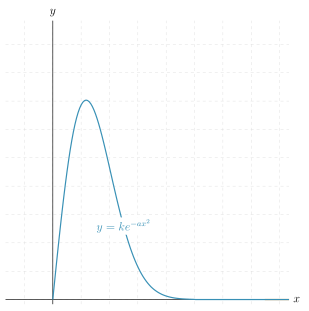
Sketch the graph, for \(x \ge 0\,\), of $$ y = kx\e^{-ax^2} \;, $$ where \(a\) and \(k\) are positive constants. The random variable \(X\) has probability density function \(\f(x)\) given by \begin{equation*} \f(x)= \begin{cases} kx\e^{-ax^2} & \text{for \(0 \le x \le 1\)}\\[3pt] 0 & \text{otherwise}. \end{cases} \end{equation*} Show that \(\displaystyle k=\frac{2a}{1-\e^{-a}}\) and find the mode \(m\) in terms of \(a\,\), distinguishing between the cases \(a < \frac12\) and \(a > \frac12\,\). Find the median \(h\) in terms of \(a\), and show that \(h > m\) if \(a > -\ln\left(2\e^{-1/2} - 1\right).\) Show that, \(-\ln\left(2\e^{-1/2}-1\right)> \frac12 \,\). Show also that, if \(a > -\ln\left(2\e^{-1/2} - 1\right) \,\), then $$ P(X > m \;\vert\; X < h) = {{2\e^{-1/2}-\e^{-a}-1} \over 1-\e^{-a}}\;. $$
Solution:
2004 Paper 2 Q13
A bag contains \(b\) balls, \(r\) of them red and the rest white. In a game the player must remove balls one at a time from the bag (without replacement). She may remove as many balls as she wishes, but if she removes any red ball, she loses and gets no reward at all. If she does not remove a red ball, she is rewarded with \pounds 1 for each white ball she has removed. If she removes \(n\) white balls on her first \(n\) draws, calculate her expected gain on the next draw and show that %her expected total reward would be the same as before it is zero if \(\ds n = {b-r \over r+1}\,\). Hence, or otherwise, show that she will maximise her expected total reward if she aims to remove \(n\) balls, where \[ n = \mbox{ the integer part of } \ds {b + 1 \over r + 1}\;. \] With this value of \(n\), show that in the case \(r=1\) and \(b\) even, her expected total reward is \(\pounds {1 \over 4}b\,\), and find her expected total reward in the case \(r=1\) and \(b\) odd.
2004 Paper 2 Q14
Explain why, if \(\mathrm{A, B}\) and \(\mathrm{C}\) are three events, \[ \mathrm{P(A \cup B \cup C) = P(A) + P(B) + P(C) - P(A \cap B) - P(B \cap C) - P(C \cap A) +P(A \cap B \cap C)}, \] where \(\mathrm{P(X)}\) denotes the probability of event \(\mathrm{X}\). A cook makes three plum puddings for Christmas. He stirs \(r\) silver sixpences thoroughly into the pudding mixture before dividing it into three equal portions. Find an expression for the probability that each pudding contains at least one sixpence. Show that the cook must stir 6 or more sixpences into the mixture if there is to be less than \({1 \over 3}\) chance that at least one of the puddings contains no sixpence. Given that the cook stirs 6 sixpences into the mixture and that each pudding contains at least one sixpence, find the probability that there are two sixpences in each pudding.
Solution:
