Problems
Filters
14 problems found
2003 Paper 2 Q1
Consider the equations \begin{alignat*}{2} ax-&y- \ z && =3 \;,\\ 2ax -&y -3z && = 7 \;,\\ 3ax-&y-5z && =b \;, \end{alignat*} where \(a\) and \(b\) are given constants.
- In the case \(a=0\,\), show that the equations have a solution if and only if \(b=11\,\).
- In the case \(a\ne0\) and \(b=11\,\) show that the equations have a solution with \(z=\lambda\) for any given number \(\lambda\,\).
- In the case \(a=2\) and \(b=11\,\) find the solution for which \(x^2+y^2+z^2\) is least.
- Find a value for \(a\) for which there is a solution such that \(x>10^6\) and \(y^2+z^2<1\,\).
Solution:
- If \(a = 0\), then then the LHS second equation is the average of the first and last equations, ie \(7 = \frac{b+3}{2}\) so \(b = 11\). This clearly has solutions, say \(x = 0, y = -1, z = -2\).
- If \(a \neq 0\) and \(b = 11\), it is still the case that the third equation a linear combination of the first two. Therefore we can consider the linear system: \begin{cases} ax - y &= 3 + \lambda \\ 2ax - y &= 7 + 3\lambda \end{cases} and since \(-a+2a = a \neq 0\) the solution has a unique solution for \(x\) and \(y\).
- \begin{align*} \begin{cases} 2x - y &= 3 + \lambda \\ 4x - y &= 7 + 3\lambda \end{cases} \Rightarrow x = 2 +\lambda, y = 1 + \lambda \\ x^2 + y^2 + z^2 &= (2 + \lambda)^2 + (1+\lambda)^2 + \lambda^2 \\ &= (4 + 1) + (4+2)\lambda + 3\lambda^2 \\ &= 5 + 3((\lambda+1)^2 - 1) \\ &= 3(\lambda + 1)^2 + 2 \end{align*} Therefore the solution is minimized when \(\lambda = -1, x = 1, y = 0, z = -1\)
- \begin{align*} \begin{cases} ax - y &= 3 + \lambda \\ 2ax - y &= 7 + 3\lambda \end{cases} \Rightarrow x = \frac{4 +2\lambda}{a}, y = 1 + \lambda \end{align*} We want say \(\lambda = -\frac12\) then we have \(y^2 + z^2 = \frac12\) and \(x = \frac{3}{a}\), so choose \(a < \frac{3}{10^6}\)
2003 Paper 2 Q2
Write down a value of \(\theta\,\) in the interval \(\frac{1}{4}\pi< \theta <\frac{1}{2}\pi\) that satisfies the equation \[ 4\cos\theta+ 2\sqrt3\, \sin\theta = 5 \;. \] Hence, or otherwise, show that \[ \pi=3\arccos(5/\sqrt{28}) + 3\arctan(\sqrt3/2)\;. \] Show that \[ \pi=4\arcsin(7\sqrt2/10) - 4\arctan(3/4)\;. \]
Solution: If \(\theta = \frac{\pi}{3}\) then \(\cos \theta = \frac12, \sin \theta = \frac{\sqrt{3}}{2}\) and clearly the equation is satisfied. We can also solve this equation using the harmonic formulae, namely: \begin{align*} && 5 &= 4 \cos \theta + 2\sqrt{3} \sin \theta \\ &&&= \sqrt{4^2+2^2 \cdot 3} \cos \left (\theta -\tan^{-1} \left (\frac{2\sqrt{3}}{4}\right) \right) \\ \Rightarrow && \frac{5}{\sqrt{28}} &= \cos \left ( \frac{\pi}{3} - \tan^{-1} \left (\frac{\sqrt{3}}{2}\right) \right) \\ \Rightarrow && \frac{\pi}{3} &= \arccos\left( \frac{5}{\sqrt{28}}\right) + \arctan \left (\frac{\sqrt{3}}{2}\right) \end{align*} From which the result follows. Similarly, notice that \(3 \cos \theta + 4 \sin \theta = \frac{7}{\sqrt{2}}\) is clearly solved by \(\frac{\pi}{4}\), but also writing it in harmonic form, we have \begin{align*} &&\frac{7}{\sqrt{2}} &= 5 \sin \left (\theta + \tan^{-1} \left ( \frac{3}{4} \right) \right) \\ \Rightarrow && \frac{7\sqrt{2}}{10} &= \sin \left ( \frac{\pi}{4} + \tan^{-1} \left ( \frac{3}{4} \right) \right) \\ \Rightarrow && \frac{\pi}{4} &= \arcsin \left ( \frac{7\sqrt{2}}{10} \right) - \arctan \left ( \frac{3}{4} \right) \end{align*} as required.
2003 Paper 2 Q3
Prove that the cube root of any irrational number is an irrational number. Let \(\displaystyle u_n = {5\vphantom{\dot A}}^{1/{(3^n)}}\,\). Given that \(\sqrt[3]5\) is an irrational number, prove by induction that \(u_n\) is an irrational number for every positive integer \(n\). Hence, or otherwise, give an example of an infinite sequence of irrational numbers which converges to a given integer \(m\,\). [An irrational number is a number that cannot be expressed as the ratio of two integers.]
Solution: Claim: \(x \in \mathbb{R}\setminus \mathbb{Q} \Rightarrow x^{1/3} \in \mathbb{R} \setminus\mathbb{Q}\) Proof: We will prove the contrapositive, since \(x^{1/3} = p/q\) but then \(x = p^3/q^3 \in \mathbb{Q}\), therefore we're done. Claim: \(u_n = 5^{1/(3^n)}\) is irrational for \(n \geq 1\) Proof: We are assuming the base case, but then \(u_{n+1} = \sqrt[3]{u_n}\) which is clearly irrational by our first lemma, so we're done. Note that \(u_n \to 1\) and so \((m-1)+u_n \to m\) for any integer \(m\).
2003 Paper 2 Q4
The line \(y=d\,\), where \(d>0\,\), intersects the circle \(x^2+y^2=R^2\) at \(G\) and \(H\). Show that the area of the minor segment \(GH\) is equal to \begin{equation} R^2\arccos \left({d \over R}\right) -d\sqrt{R^2 - d^2}\;. \tag {\(*\)} \end{equation} In the following cases, the given line intersects the given circle. Determine how, in each case, the expression \((*)\) should be modified to give the area of the minor segment.
- Line: \(y=c\,\); \ \ \ circle: \((x-a)^2+(y-b)^2=R^2\,\).
- Line: \(y=mx+c\, \); \ \ \ circle: \(x^2+y^2=R^2\,\).
- Line: \(y=mx+c\,\); \ \ \ circle: \((x-a)^2+(y-b)^2=R^2\,\).
2003 Paper 2 Q5
The position vectors of the points \(A\,\), \(B\,\) and \(P\) with respect to an origin \(O\) are \(a{\bf i}\,\), \(b{\bf j}\,\) and \(l{\bf i}+m{\bf j}+n{\bf k}\,\), respectively, where \(a\), \(b\), and \(n\) are all non-zero. The points \(E\), \(F\), \(G\) and \(H\) are the midpoints of \(OA\), \(BP\), \(OB\) and \(AP\), respectively. Show that the lines \(EF\) and \(GH\) intersect. Let \(D\) be the point with position vector \(d{\bf k}\), where \(d\) is non-zero, and let \(S\) be the point of intersection of \(EF\) and \(GH.\) The point \(T\) is such that the mid-point of \(DT\) is \(S\). Find the position vector of \(T\) and hence find \(d\) in terms of \(n\) if \(T\) lies in the plane \(OAB\).
Solution: \(E = \langle \frac{a}{2}, 0,0 \rangle, F = \langle \frac{l}{2}, \frac{m+b}{2}, \frac{n}{2} \rangle, G = \langle 0, \frac{b}{2}, 0 \rangle, H = \langle \frac{a+l}{2}, \frac{m}{2}, \frac{n}{2} \rangle\) Note that the midpoint of \(EF\) and \(GH\) are both $\langle \frac{a+l}{4}, \frac{m+b}{4}, \frac{n}{4} \rangle$, so clearly they must intersect at this point. The vector we just found is \(S\), and \(\mathbf{t} = \mathbf{d} + 2(\mathbf{s}-\mathbf{d}) = 2\mathbf{s} - \mathbf{d}\). Therefore \(T = \langle \frac{a+l}{2}, \frac{m+b}{2}, \frac{n-2d}{2} \rangle\). If \(T\) lies in the plane \(OAB\) then \(n - 2d = 0\) ie \(d = \frac{n}{2}\)
2003 Paper 2 Q6
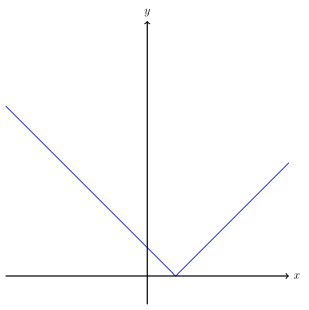
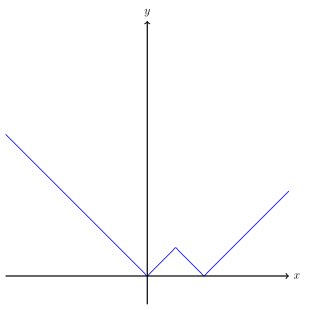
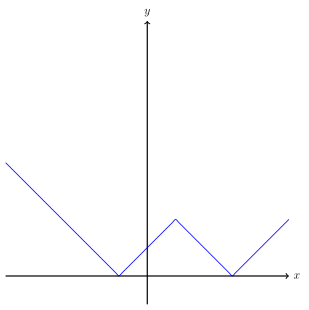
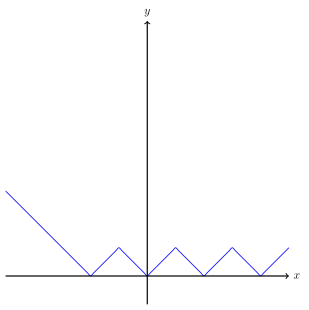
The function \(\f\) is defined by $$ \f(x)= \vert x-1 \vert\;, $$ where the domain is \({\bf R}\,\), the set of all real numbers. The function \(\g_n =\f^n\), with domain \({\bf R}\,\), so for example \(\g_3(x) = \f(\f(\f(x)))\,\). In separate diagrams, sketch graphs of \(\g_1\,\), \(\g_2\,\), \(\g_3\,\) and \(\g_4\,\). The function \(\h\) is defined by \[ \h(x) = |\sin {{{\pi}x} \over 2}|, \] where the domain is \({\bf R}\,\). Show that if \(n\) is even, \[ \int_0^n\,\big( \h(x)-\g_n(x)\big)\,\d x = \frac{2n}{\pi} -\frac{n}2\;. \]
Solution:
2003 Paper 2 Q7
Show that, if \(n>0\,\), then $$ \int_{e^{1/n}}^\infty\,{{\ln x} \over {x^{n+1}}}\,\d x = {2 \over {n^2\e}}\;. $$ You may assume that \(\ds \frac{\ln x} x \to 0\;\) as \(x\to\infty\,\). Explain why, if \(1 < a < b\,\), then $$ \int_b^\infty\,{{\ln x} \over {x^{n+1}}}\,\d x < \int_a^\infty\,{{\ln x} \over {x^{n+1}}}\,\d x\;. $$ Deduce that $$ \sum_{n=1}^{N}{1 \over n^2} < {\e \over 2}\int_{\e^{1/N}}^{\infty} \left({1-x^{-N}} \over {x^2-x}\right) \ln x\,\d x\;, $$ where \(N\,\) is any integer greater than \(1\).
2003 Paper 2 Q8
It is given that \(y\) satisfies $$ {{\d y} \over { \d t}} + k\left({{t^2-3t+2} \over {t+1}}\right)y = 0\;, $$ where \(k\) is a constant, and \(y=A \) when \(t=0\,\), where \(A\) is a positive constant. Find \(y\) in terms of \(t\,\), \(k\) and \(A\,\). Show that \(y\) has two stationary values whose ratio is \((3/2)^{6k}\e^{-5{k}/2}.\) Describe the behaviour of \(y\) as \(t \to +\infty\) for the case where \(k> 0\) and for the case where \(k<0\,.\) In separate diagrams, sketch the graph of \(y\) for \(t>0\) for each of these cases.
Solution: \begin{align*} && \frac{\d y}{\d t} &= - k \left (\frac{t^2-3t+2}{t+1} \right) y \\ \Rightarrow && \int \frac1y \d y &= -k\int \left (t-4 + \frac{6}{t+1}\right) \d t \\ \Rightarrow && \ln y &= -k \left ( \frac12 t^2 -4t + 6\ln (t+1) \right) + C \\ (t,y) = (0,A): && \ln A &=C \\ \Rightarrow && \ln y &= -k \left ( \frac12 t^2 -4t + 6\ln (t+1) \right) + \ln A \\ && \ln \left ( \frac{y}{A}(t+1)^{6k} \right) &= -k \l \frac12 t^2 - 4t \r \\ \Rightarrow && y &= A\frac{\exp \l -k(\frac12 t^2-4t)\r}{(t+1)^{6k}} \end{align*} \(y\) wil have stationary values when \(\frac{\d y}{\d t} = 0\), ie \begin{align*} k \left (\frac{t^2-3t+2}{t+1} \right) y &= 0 \\ k \left ( \frac{(t-2)(t-1)}{t+1} \right) y &= 0 \end{align*} ie when \(y = 0, t = 1, t =2\). Clearly \(y = 0\) is not a solution, so \(y\) has the values: \begin{align*} t = 1: && y &= A\frac{\exp \l -k(\frac12 -4)\r}{(2)^{6k}} \\ &&&= A \frac{e^{7/2 k}}{2^{6k}} \\ t = 2: && y &= A\frac{\exp \l -k(2 -8)\r}{(3)^{6k}} \\ &&&= A \frac{e^{6 k}}{3^{6k}} \\ \text{ratio}: && \frac{e^{7/2k}}{2^{6k}} \cdot \frac{3^{6k}}{e^{6k}} &= (3/2)^{6k} e^{-5k/2} \end{align*} If \(k > 0\) as \(t \to \infty\) \(y \to 0\) since the \(e^{-kt^2/2}\) term dominates everything. If \(k < 0\) as \(t \to \infty\) \(y \to \infty\) as since the \(e^{-kt^2}\) term also dominates but now it growing to infinity faster than everything else.

2003 Paper 2 Q9
\(AB\) is a uniform rod of weight \(W\,\). The point \(C\) on \(AB\) is such that \(AC>CB\,\). The rod is in contact with a rough horizontal floor at \(A\,\) and with a cylinder at \(C\,\). The cylinder is fixed to the floor with its axis horizontal. The rod makes an angle \({\alpha}\) with the horizontal and lies in a vertical plane perpendicular to the axis of the cylinder. The coefficient of friction between the rod and the floor is \(\tan \lambda_1\) and the coefficient of friction between the rod and the cylinder is \(\tan \lambda_2\,\). Show that if friction is limiting both at \(A\) and at \(C\), and \({\alpha} \ne {\lambda}_2 - {\lambda}_1\,\), then the frictional force acting on the rod at \(A\) has magnitude $$ \frac{ W\sin {\lambda}_1 \, \sin({\alpha}-{\lambda}_2)} {\sin ({\alpha}+{\lambda}_1-{\lambda}_2)} \;.$$ %and that %$$ %p=\frac{\cos{\alpha} \, \sin({\alpha}+{\lambda}_1-{\lambda}_2)} %{2\cos{\lambda}_1 \, \sin {\lambda}_2}\;. %$$
2003 Paper 2 Q10
A bead \(B\) of mass \(m\) can slide along a rough horizontal wire. A light inextensible string of length \(2\ell\) has one end attached to a fixed point \(A\) of the wire and the other to \(B\,\). A particle \(P\) of mass \(3m\) is attached to the mid-point of the string and \(B\) is held at a distance \(\ell\) from~\(A\,\). The bead is released from rest. Let \(a_1\) and \(a_2\) be the magnitudes of the horizontal and vertical components of the initial acceleration of \(P\,\). Show by considering the motion of \(P\) relative to \(A\,\), or otherwise, that \(a_1= \sqrt 3 a_2\,\). Show also that the magnitude of the initial acceleration of \(B\) is \(2a_1\,\). Given that the frictional force opposing the motion of \(B\) is equal to \(({\sqrt{3}}/6)R\), where \(R\) is the normal reaction between \(B\) and the wire, show that the magnitude of the initial acceleration of \(P\) is~\(g/18\,\).
2003 Paper 2 Q11
A particle \(P_1\) is projected with speed \(V\) at an angle of elevation \({\alpha}\,\,\,( > 45^{\circ})\,,\,\,\,\) from a point in a horizontal plane. Find \(T_1\), the flight time of \(P_1\), in terms of \({\alpha}, V \hbox{ and } g\,\). Show that the time after projection at which the direction of motion of \(P_1\) first makes an angle of \(45^{\circ}\) with the horizontal is \(\frac12 (1-\cot \alpha)T_1\,\). A particle \(P_2\) is projected under the same conditions. When the direction of the motion of \(P_2\) first makes an angle of \(45^{\circ}\) with the horizontal, the speed of \(P_2\) is instantaneously doubled. If \(T_2\) is the total flight time of \(P_2\), show that $$ \frac{2T_2}{T_1} = 1+\cot{\alpha} +\sqrt{1+3\cot^2{\alpha}} \;. $$
2003 Paper 2 Q12
The life of a certain species of elementary particles can be described as follows. Each particle has a life time of \(T\) seconds, after which it disintegrates into \(X\) particles of the same species, where \(X\) is a random variable with binomial distribution \(\mathrm{B}(2,p)\,\). A population of these particles starts with the creation of a single such particle at \(t=0\,\). Let \(X_n\) be the number of particles in existence in the time interval \(nT < t < (n+1)T\,\), where \(n=1\,\), \(2\,\), \(\ldots\). Show that \(\P(X_1=2 \mbox { and } X_2=2) = 6p^4q^2\;\), where \(q=1-p\,\). Find the possible values of \(p\) if it is known that \(\P(X_1=2 \vert X_2=2) =9/25\,\). Explain briefly why \(\E(X_n) =2p\E(X_{n-1})\) and hence determine \(\E(X_n)\) in terms of \(p\). Show that for one of the values of \(p\) found above \(\lim_{n \to \infty}\E(X_n) = 0\) and that for the other \(\lim_{n \to \infty}\E(X_n) = + \infty\,\).
Solution: Notice that we can see the total number generated as \(X_n \sim B(2X_{n-1},p)\), since a Binomial is a sum of independent Bernoullis, and there are two Bernoullis per particle. \begin{align*} && \mathbb{P}(X_1=2 \mbox { and } X_2=2) &= \underbrace{p^2}_{\text{two generated in first iteration}} \cdot \underbrace{\binom{4}{2}p^2q^2}_{\text{two generated from the first two}} \\ &&&= 6p^4q^2 \end{align*} \begin{align*} && \mathbb{P})(X_1 = 2 |X_2 = 2) &= \frac{ \mathbb{P}(X_1=2 \mbox { and } X_2=2) }{ \mathbb{P}( X_2=2) } \\ &&&= \frac{6p^4q^2}{6p^4q^2+2pq \cdot p^2} \\ &&&= \frac{3pq}{3pq+1} \\ \Rightarrow && \frac{9}{25} &= \frac{3pq}{3pq+1} \\ \Rightarrow && 27pq + 9 &= 75pq \\ \Rightarrow && 9 &= 48pq \\ \Rightarrow && pq &= \frac{3}{16} \\ \Rightarrow && 0 &= p^2 - p + \frac3{16} \\ \Rightarrow && p &= \frac14, \frac34 \end{align*} By the same reasoning about the Bernoullis, we must have \(\E[X_n] = \E[\E[X_n | X_{n-1}]] = \E[2pX_{n-1}] = 2p \E[X_{n-1}]\) therefore \(\E[X_n] = (2p)^n\). If \(p = \frac14\) then \(\E[X_n] = \frac1{2^n} \to 0\) If \(p = \frac34\) then \(\E[X_n] = \left(\frac32 \right)^n \to \infty\)
2003 Paper 2 Q13
The random variable \(X\) takes the values \(k=1\), \(2\), \(3\), \(\dotsc\), and has probability distribution $$ \P(X=k)= A{{{\lambda}^k\e^{-{\lambda}}} \over {k!}}\,, $$ where \(\lambda \) is a positive constant. Show that \(A = (1-\e^{-\lambda})^{-1}\,\). Find the mean \({\mu}\) in terms of \({\lambda}\) and show that $$ \var(X) = {\mu}(1-{\mu}+{\lambda})\;. $$ Deduce that \({\lambda} < {\mu} < 1+{\lambda}\,\). Use a normal approximation to find the value of \(P(X={\lambda})\) in the case where \({\lambda}=100\,\), giving your answer to 2 decimal places.
Solution: Let \(Y \sim Po(\lambda)\) \begin{align*} && 1 &= \sum_{k=1}^\infty \mathbb{P}(X = k ) \\ &&&= \sum_{k=1}^\infty A \frac{\lambda^k e^{-\lambda}}{k!}\\ &&&= Ae^{-\lambda} \sum_{k=1}^{\infty} \frac{\lambda^k e^{-\lambda}}{k!} \\ &&&= Ae^{-\lambda} \left (e^{\lambda}-1 \right) \\ \Rightarrow && A &= (1-e^{-\lambda})^{-1} \\ \\ && \E[X] &= \sum_{k=1}^{\infty} k \cdot \mathbb{P}(X=k) \\ &&&= A\sum_{k=1}^{\infty} k \frac{\lambda^k e^{-\lambda}}{k!} \\ &&&= A\E[Y] = A\lambda = \lambda(1-e^{-\lambda})^{-1} \\ \\ && \var[X] &= \E[X^2] - (\E[X])^2 \\ &&&= A\sum_{k=1}^{\infty} k^2 \frac{\lambda^k e^{-\lambda}}{k!} - \mu^2 \\ &&&= A\E[Y^2] - \mu^2 \\ &&&= A(\var[Y]+\lambda^2) - \mu^2 \\ &&&= A(\lambda + \lambda^2) - \mu^2 \\ &&&= A\lambda(1+\lambda) - \mu^2 \\ &&&= \mu(1+\lambda - \mu) \end{align*} Since \(A > 1\) we must have \(\mu > \lambda\) and since \(\var[X] > 0\) we must have \(1 + \lambda > \mu\) as required. If \(\lambda = 100\), then \(A \approx 1\) and \(P(X=\lambda) \approx P(Y = \lambda)\) and \(Y \approx N(\lambda, \lambda)\) so the value is approximately \(\displaystyle \int_{-\frac12}^{\frac12} \frac{1}{\sqrt{2\pi \lambda}} e^{-\frac{x^2}{2\lambda}} \d x \approx \frac{1}{\sqrt{200\pi}} = \frac{1}{\sqrt{630.\ldots}} \approx \frac{1}{25} = 0.04 \)
2003 Paper 2 Q14
The probability of throwing a 6 with a biased die is \(p\,\). It is known that \(p\) is equal to one or other of the numbers \(A\) and \(B\) where \(0 < A < B < 1 \,\). Accordingly the following statistical test of the hypothesis \(H_0: \,p=B\) against the alternative hypothesis \(H_1: \,p=A\) is performed. The die is thrown repeatedly until a 6 is obtained. Then if \(X\) is the total number of throws, \(H_0\) is accepted if \(X \le M\,\), where \(M\) is a given positive integer; otherwise \(H_1\) is accepted. Let \({\alpha}\) be the probability that \(H_1\) is accepted if \(H_0\) is true, and let \({\beta}\) be the probability that \(H_0\) is accepted if \(H_1\) is true. Show that \({\beta} = 1- {\alpha}^K,\) where \(K\) is independent of \(M\) and is to be determined in terms of \(A\) and \(B\,\). Sketch the graph of \({\beta}\) against \({\alpha}\,\).
Solution: \(X \sim Geo(p)\). \(\alpha = \mathbb{P}(X > M | p = B) = (1-B)^{M}\) \(\beta = \mathbb{P}(X \leq M | p = A) = 1 - \mathbb{P}(X > M | p = A) = 1 - (1-A)^{M}\) \begin{align*} \ln \alpha &= M \ln(1-B) \\ \ln (1-\beta) &= M \ln(1-A) \\ \frac{\ln \alpha}{\ln (1-\beta)} &= \frac{\ln(1-B)}{\ln(1-A)} \\ \ln(1-\beta) &= \ln \alpha \frac{\ln (1-A)}{\ln(1-B)} \\ \beta &= 1- \alpha^{ \frac{\ln (1-A)}{\ln(1-B)} } \end{align*} and \(K = \frac{\ln (1-A)}{\ln(1-B)} \) Since \(0 < A < B < 1\) we must have that \(0 < 1 - B < 1-A < 1\) and \(\ln(1-B) < \ln(1-A) < 0\) so \(0 < K < 1\)
